
✦ Quick Answer & Key Takeaways: How to Pray Eid Prayer Step by Step
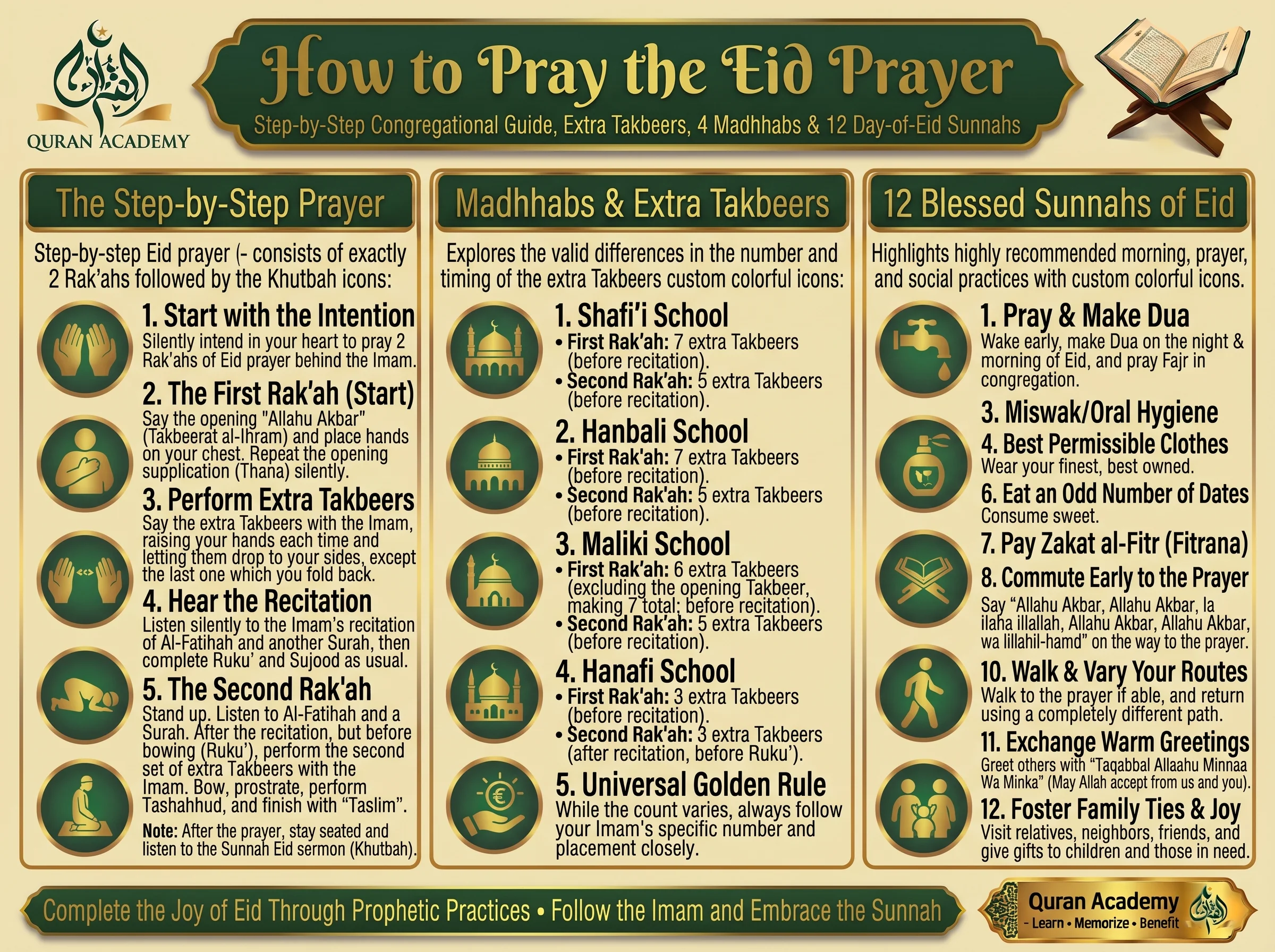
Knowing how to pray Eid prayer step by step (صَلَاةُ الْعِيدَيْنِ: عِيدُ الْفِطْرِ وَعِيدُ الْأَضْحَىٰ) ensures you and your family never feel confused when the Imam begins the extra Takbeerat on the two most joyful mornings of the Islamic year! Offered during the early forenoon (Duha time, starting 15–20 minutes after sunrise) with NO Adhan and NO Iqamah, Salat Al-Eid consists of 2 Rak'ahs out loud followed by the Eid Khutbah (unlike Friday Jumu'ah, where the Khutbah comes before the prayer!). What makes Salat Al-Eid unique are its extra Takbeers (التكبيرات الزوائد)—performed as 7 extra in Rak'ah 1 and 5 extra in Rak'ah 2 (Shafi'i), 6 extra in Rak'ah 1 and 5 extra in Rak'ah 2 (Maliki & Hanbali), or 3 extra before recitation in Rak'ah 1 and 3 extra after recitation in Rak'ah 2 (Hanafi). In our 1-on-1 Online Islamic Studies & Fiqh Course, students master the Eid prayer alongside the two Prophetic Surah pairs!
- Prayer First, Khutbah Second (Sahih al-Bukhari 956): On the Day of Eid, the Prophet (ﷺ), Abu Bakr, and 'Umar (RA) always prayed the 2 Rak'ahs of Eid before delivering the sermon!
- The Golden Congregation Rule: Whether your local Imam follows the 7 & 5, 6 & 5, or 3 & 3 Takbeer count, all three are authentically transmitted from the Companions—so always follow your Imam!
- The 2 Prophetic Surah Pairs (Sahih Muslim 878 & 891): Either Surah Al-A'la (87) + Surah Al-Ghashiyah (88) OR Surah Qaf (50) + Surah Al-Qamar (54)!
- Dates on Eid al-Fitr vs. Waiting on Eid al-Adha (Bukhari 953): Eat an odd number of dates before going to Eid al-Fitr prayer; delay eating until after Eid al-Adha prayer!
Every Muslim knows the familiar scene on the morning of Eid al-Fitr or Eid al-Adha: because we only pray Salat Al-Eid twice a year, just moments before the Imam steps up to the microphone, whispers ripple through the prayer rows—"Wait, how many extra Takbeers are in the first Rak'ah and the second Rak'ah? Do we raise our hands on every Takbeer? And what do we say silently between the Takbeers?"
Even more common in Western mosques—where worshippers from South Asia, the Arab world, Africa, and Southeast Asia stand shoulder to shoulder—is the surprise when an Imam prays with 7 and 5 extra Takbeers before the Surah, or when a Hanafi Imam prays with 3 extra Takbeers before the Surah in the 1st Rak'ah and 3 extra Takbeers after the Surah in the 2nd Rak'ah! Just as we harmonized the four Sunni schools in our guides to Salat Al-Witr, Dua Al-Qunoot, and Salat Al-Janazah (which has 4 Takbeers and zero Ruku'!), this complete guide gives you the 4 Madhhab Step-by-Step Comparison Chart, the 12 Prophetic Eid Morning Sunnahs, the Authentic Eid Takbeerat Wording, and what to do if you arrive late or miss the prayer.
- 1. What Is the Ruling & Exact Time Window for Salat Al-Eid? (Fard Kifayah, Wajib & Sunnah Mu'akkadah)
- 2. Master Chart: How to Pray Salat Al-Eid Step by Step Across the 4 Sunni Madhhabs
- 3. The 12 Prophetic Sunnahs of Eid Morning (Eid al-Fitr vs. Eid al-Adha Comparison)
- 4. The Authentic Eid Takbeerat (Arabic Text, Transliteration & Restricted vs. Unrestricted Takbeer)
- 5. What If You Join Late or Miss the Eid Prayer? + 4 Tajweed Rules in the Eid Takbeerat
- 6. Frequently Asked Questions (FAQs)
1. What Is the Ruling & Exact Time Window for Salat Al-Eid?
In Sahih al-Bukhari (324 & 971) and Sahih Muslim (890)—verifiable in our Online Hadith Explorer—Umm 'Atiyyah (may Allah be pleased with her) narrated that Prophet Muhammad (ﷺ) commanded everyone—men, women, youths, and even menstruating women—to come out to the open Eid prayer ground (Al-Musalla) to witness the goodness, the Takbeerat, and the supplications of the Muslims (while sisters on their monthly cycle sit slightly back from the prayer rows and join fully in the Takbeer and Dua, as we explained in our guide on Worship & Dhikr During Your Period!).
- Ruling Across the 4 Sunni Schools: Emphasized Confirmed Sunnah (Sunnah Mu'akkadah) in the Maliki and Shafi'i schools; Communal Obligation (Fard Kifayah) in the Hanbali school; and Practically Obligatory (Wajib upon everyone for whom Friday prayer is obligatory, and investigated as an individual obligation by many scholars) in the Hanafi school!
- Exact Time Window: Exactly matches the window of Salat Ad-Duha—beginning 15 to 20 minutes after sunrise and lasting until 10–15 minutes before Dhuhr. Notice a beautiful Sunnah subtlety: it is recommended to pray Eid al-Adha early right after the sunrise buffer (so people have ample time to offer their sacrifice/Qurbani), and to delay Eid al-Fitr slightly in the morning (so everyone has ample time to distribute Zakat al-Fitr before the prayer!).
2. Master Chart: How to Pray Salat Al-Eid Step by Step Across the 4 Sunni Madhhabs
Why do the four Sunni schools have slightly different counts for the extra Takbeers in Salat Al-Eid? Because different Companions of the Prophet (ﷺ) transmitted different valid counts—such as 7 and 5 from 'Amr ibn 'Awf and Ibn 'Umar (Sunan at-Tirmidhi 536 & Abu Dawud 1151), and 3 and 3 from 'Abdullah ibn Mas'ud and Abu Musa Al-Ash'ari (Musannaf Ibn Abi Shaybah 5703)! Compare the exact step-by-step flow across all four schools:
| Stage of Prayer | Shafi'i School (7 & 5 Extra) | Maliki & Hanbali Schools (6 & 5 Extra) | Hanafi School (3 & 3 Extra) |
|---|---|---|---|
| 1. First Rak'ah: Opening + Extra Takbeers |
Say Takbeeratul-Ihram + Opening Dua, then say 7 EXTRA Takbeers (making 8 Takbeers total in Rak'ah 1) before reciting Al-Fatihah! | Say Takbeeratul-Ihram (+ Opening Dua in Hanbali), then say 6 EXTRA Takbeers (making 7 Takbeers total including the opening Takbeer) before reciting Al-Fatihah! | Say Takbeeratul-Ihram + Sanaa' (Subhaanakal-laahumma), then say 3 EXTRA Takbeers (raising hands on each, letting them hang on 1 & 2, folding on #3) before reciting Al-Fatihah! |
| 2. First Rak'ah: Recitation, Ruku' & Sujood |
Imam recites Al-Fatihah + Surah Al-A'la (87) or Qaf (50) out loud, then completes Ruku' and 2 Sujoods as normal. | Imam recites Al-Fatihah + Surah Al-A'la (87) or Qaf (50) out loud, then completes Ruku' and 2 Sujoods as normal. | Imam recites Al-Fatihah + Surah Al-A'la (87) out loud, then completes Ruku' and 2 Sujoods as normal. |
| 3. Second Rak'ah: When Are Extra Takbeers Done? |
Rise from Sujood with 1 Takbeer, then immediately say 5 EXTRA Takbeers BEFORE reciting Al-Fatihah, then recite Al-Fatihah + Surah Al-Ghashiyah (88) or Al-Qamar (54)! | Rise from Sujood with 1 Takbeer, then immediately say 5 EXTRA Takbeers BEFORE reciting Al-Fatihah, then recite Al-Fatihah + Surah Al-Ghashiyah (88) or Al-Qamar (54)! | Rise from Sujood and recite Al-Fatihah + Surah Al-Ghashiyah FIRST! Then, AFTER finishing the Surah, raise hands for 3 EXTRA Takbeers, and say a 4th Takbeer to bow into Ruku'! |
| 4. Between the Extra Takbeers & If Forgotten 🏆 | Pause briefly between Takbeers to say silently: Subhaanallaah, wal-hamdu lillaah, wa laa ilaaha illallaah, wallaahu Akbar! | Say praise and Salawat between Takbeers (Hanbali); extra Takbeers are Sunnah (no Sujood As-Sahw needed if forgotten). | Pause for the length of 3 Tasbeehs between Takbeers; if forgotten in Hanafi school, perform Sujood As-Sahw. |
3. The 12 Prophetic Sunnahs of Eid Morning (Eid al-Fitr vs. Eid al-Adha)
To earn the full reward of the Prophetic Sunnah on both Eid mornings (and celebrate with your children using our Islamic Reward Charts for Kids!), follow this 12-Point Eid Morning Checklist:
- 1. Perform Ghusl (Ritual Bath) Before Going Out: Authentically practiced by Ibn 'Umar and the Companions on the morning of Eid (Muwatta' Malik).
- 2. Wear Your Finest Clothes & Perfume (For Men): The Prophet (ﷺ) had a special cloak (Hullah) that he wore on the two Eids and on Friday (Sahih al-Bukhari 948).
- 3. The Breakfast Contrast — Dates on Eid al-Fitr vs. Waiting on Eid al-Adha (Sahih al-Bukhari 953):
• On Eid al-Fitr: Eat an odd number of dates (3, 5, or 7) before leaving home for the prayer!
• On Eid al-Adha: Do not eat anything before the prayer until you return and eat from your sacrifice/morning meal (Sunan at-Tirmidhi 542)! - 4. Pay Zakat al-Fitr Before the Eid al-Fitr Prayer (Sahih al-Bukhari 1509): Must be distributed before people stand for the Eid al-Fitr prayer so the poor are enriched on that day!
- 5. Walk to the Open Prayer Ground (Al-Musalla) If Able: Walking to the prayer with serenity and humility (Sunan Ibn Majah 1295 — Hasan).
- 6. Chant the Eid Takbeerat Out Loud All the Way to the Prayer Ground: Until the Imam steps up to begin the Eid prayer!
- 7. Pray Zero Voluntary Rak'ahs Before or After Eid Prayer at the Musalla (Bukhari 989): Unless praying inside a regular mosque where you offer the 2 Rak'ahs of greeting the masjid (Tahiyyatul-Masjid).
- 8. Stay to Listen Attentively to the Eid Khutbah After the Prayer: Receiving the reminders and collective Duas of the Imam.
- 9. Congratulate Fellow Muslims With the Companions' Greeting: Say « تَقَبَّلَ ٱللَّهُ مِنَّا وَمِنْكُمْ » (Taqabbalallaahu minnaa wa minkum — "May Allah accept from us and from you!" — graded Hasan by Ibn Hajar in Fath al-Bari).
- 10. Return Home by a Different Route (Sahih al-Bukhari 986): Jabir ibn 'Abdillah (RA) reported: « كَانَ النَّبِيُّ ﷺ إِذَا كَانَ يَوْمُ عِيدٍ خَالَفَ الطَّرِيقَ » ("On the Day of Eid, the Prophet ﷺ used to take one route going and a different route returning!")—so both streets witness your worship and you greet twice as many Muslims!
- 11. Offer the Udhiyah (Qurbani) *After* the Eid al-Adha Prayer (Sahih al-Bukhari 5545): Any animal slaughtered before the Eid prayer is merely ordinary meat, whereas slaughtering after the prayer fulfills the Sunnah of Ibrahim and Muhammad (peace be upon them)!
- 12. Spread Permissible Joy, Gifts & Family Visits (Sahih al-Bukhari 952): Showing that there is wholesome joy and spaciousness in our religion!
4. The Authentic Eid Takbeerat (Arabic Text, Transliteration & Restricted vs. Unrestricted)
In Surah Al-Baqarah (2:185) (for Eid al-Fitr) and Surah Al-Baqarah (2:203) & Al-Hajj (22:28) (for Eid al-Adha), Allah Almighty commanded us to magnify Him (Wa li-tukabbirullaaha 'alaa maa hadaakum). Here are the authentic wordings transmitted from 'Abdullah ibn Mas'ud, Salman Al-Farisi, and Ibn 'Abbas (may Allah be pleased with them, recorded in Musannaf Ibn Abi Shaybah 5650 & Al-Bayhaqi 3/316 — Sahih):
ٱللَّهُ أَكْبَرُ، ٱللَّهُ أَكْبَرُ، لَا إِلَٰهَ إِلَّا ٱللَّهُ، وَٱللَّهُ أَكْبَرُ، ٱللَّهُ أَكْبَرُ، وَلِلَّهِ ٱلْحَمْدُ.
ٱللَّهُ أَكْبَرُ كَبِيرًا، وَٱلْحَمْدُ لِلَّهِ كَثِيرًا، وَسُبْحَانَ ٱللَّهِ بُكْرَةً وَأَصِيلًا.
Transliteration: Allaahu Akbar, Allaahu Akbar, laa ilaaha illallaah, wallaahu Akbar, Allaahu Akbar, wa lillaahil-hamd. Allaahu Akbaru kabeeraa, wal-hamdu lillaahi katheeraa, wa Subhaanallaahi bukratan wa aseelaa.
When Do the Takbeerat Begin & End?
• On Eid al-Fitr: Begins from sunset on the night before Eid (when the new moon of Shawwal is announced) and ends when the Imam begins the Eid prayer!
• On Eid al-Adha: Unrestricted Takbeer (التكبير المطلق) runs from the 1st of Dhul-Hijjah right through the sunset of the 13th of Dhul-Hijjah (the 3 Days of Tashreeq), while Restricted Post-Prayer Takbeer (التكبير المقيد بعد الصلوات) begins from Fajr on the Day of 'Arafah (9th of Dhul-Hijjah) until Asr on the 13th of Dhul-Hijjah!
Struggling to perfect your Recitation?
Join hundreds of students mastering the Quran with our Verified Al-Azhar Graduates. We offer flexible 1-on-1 sessions tailored to your schedule.
Book a Free Evaluation Class →Never Bounce the Kaaf in "Allaahu Akْbar" or the Dal in "Walillaahil-Hamْd"!
Look closely at the Eid Takbeerat: in ٱللَّهُ أَكْبَرُ (Allaahu Akْbar), the silent Kaaf (كْ) is NOT a Qalqalah letter—it has a whispered breath (Hams)—whereas in وَسُبْحَانَ ٱللَّهِ (Wa SubْhaanAllaah) and تَقَبَّلَ ٱللَّهُ and when stopping on the Dal at the end of وَلِلَّهِ ٱلْحَمْدْ (Walillaahil-Hamdْ), both بْ and دْ ARE among the 5 Qalqalah (Echoing) letters (ق ط ب ج د)! Watch Senior Instructor Ustadhah Yasmeen Gamal demonstrate true Qalqalah on our Quran Academy YouTube Channel:
- Crisp Final Dal in "Al-Hamdْ": Hold the silent Meem first, then release a gentle Qalqalah bounce on the final Dal!
- 1-on-1 Live Coaching: Perfect your Eid Surahs & Tajweed with Al-Azhar scholars!
5. What If You Join Late or Miss the Eid Prayer? + 4 Essential Tajweed Rules
What if parking at the Eid venue takes longer than expected and you join the Imam after he has already finished the extra Takbeers—or after the prayer has ended completely? Here are the clear Fiqh rulings and Tajweed rules from our 1-on-1 Online Tajweed & Fiqh Course:
- 1. If You Join the Imam *After* the Extra Takbeers in Rak'ah 1 (While He Is Reciting the Surah):
Say your opening Takbeeratul-Ihram and immediately listen silently to the Imam's recitation (or in the Hanafi school, quickly say the 3 extra Takbeers if you can before bowing into Ruku'; in the majority schools, because the extra Takbeers are Sunnah and their place has passed, you do not need to make them up!). - 2. If You Join in the 2nd Rak'ah & Need to Make Up 1 Missed Rak'ah:
When the Imam gives Salam at the end of the 2nd Rak'ah, stand up and complete your missed Rak'ah **including its extra Takbeers**! - 3. If You Miss the Entire Eid Prayer With the Congregation:
Following the authentic practice of Anas ibn Malik (RA) recorded by Imam Al-Bukhari in his Sahih (and upheld by the Maliki, Shafi'i, and Hanbali schools), gather your family or pray individually 2 Rak'ahs in the exact same manner as the Imam's Eid prayer (with the extra Takbeers, and without a Khutbah)! - 4. Four Tajweed Rules in the Eid Takbeerat (Never Stretch "Akbar" Into "Akbaar"!):
Applying our Rules of Madd, Ahkam Al-Raa, Makharij al-Huruf, Sifaat al-Huruf, Heavy & Light Letters, Noon Sakinah Rules, Meem Sakinah Rules, Rules of Waqf, Laam Shamsiyyah & Qamariyyah, Hamzatul Wasl vs. Qat', 4 Special Words of Hafs, and 7 Alifs in the Quran guides:
• Warning on "Allaahu Akbar": Never stretch the Fatha on the Baa into a long Alif ("Allaahu Akbaar" ❌)—in classical Arabic, Akbaar is the plural of Kabar (a drum), which corrupts the meaning! Keep the Baa a crisp 1-count Fatha (Ak-ba-ru / Ak-barْ) with a Heavy Raa!
• Madd 'Iwad (2 Beats) on Stop: When pausing on كَبِيرًا (Kabeeraa), كَثِيرًا (Katheeraa), and وَأَصِيلًا (Wa Aseelaa), replace the Fathatayn with a 2-count open Alif! Test your Tajweed accuracy right now on our Free 3-Minute Tajweed Quiz!
Pair your Eid prayer knowledge with our complete library of Salah, Adhkar, and Surah guides: How to Pray Tahajjud & Qiyam Al-Layl, Salat Al-Istikharah, Wudu & Tayammum, Authentic Duas After Fard Salah, Bedtime & Waking Up Duas, Prophetic Duas for Anxiety & Debt Relief, Authentic Ruqyah Shariah, Morning & Evening Adhkar, 40 Rabbana Duas, Surah Al-Fatihah Guide, Last 3 Verses of Surah Al-Hashr, 10 Shortest Surahs for Salah, Surah Al-Alaq Guide, Ayatul Kursi, Last 2 Verses of Surah Al-Baqarah, The 3 Quls, Surah Ad-Duha & Ash-Sharh, Surah Ya-Sin, Surah Ar-Rahman, Surah Al-Waqi'ah, Surah Maryam, Surah Yusuf, Surah Luqman, Surah Al-Hujurat, 5 Pillars of Islam, and 25 Prophets in the Quran in our Online Hifz Program (using our Smart Hifz Planner)! Whether you are studying with our Al-Azhar Certified Tutors or enrolling your child in our 1-on-1 Kids Quran Classes with our Printable Kids Star Chart, see how families across the US, UK, Canada, and Australia rate our teachers on our Verified Student & Parent Reviews Page.
6. Frequently Asked Questions (FAQs) About How to Pray Salat Al-Eid
1. How many extra Takbeers are in Salat Al-Eid across the 4 Sunni Madhhabs?
All four Sunni schools follow authentic transmissions from the Companions: (1) In the Shafi'i school, there are 7 extra Takbeers in the 1st Rak'ah (after the opening Takbeer) and 5 extra Takbeers in the 2nd Rak'ah (after rising from Sujood). (2) In the Maliki and Hanbali schools, there are 6 extra Takbeers in the 1st Rak'ah (making 7 total with the opening Takbeer) and 5 extra Takbeers in the 2nd Rak'ah. (3) In the Hanafi school, there are 3 extra Takbeers before recitation in the 1st Rak'ah, and 3 extra Takbeers AFTER the Surah recitation (right before Ruku') in the 2nd Rak'ah. When praying in congregation, simply follow your Imam!
2. Which Surahs did Prophet Muhammad (ﷺ) recite in Salat Al-Eid?
According to Sahih Muslim (878 & 891), Prophet Muhammad (ﷺ) alternated between two authentic pairs of Surahs after Surah Al-Fatihah in the Eid prayers: Pair 1 (Surah Al-A'la [Chapter 87] in the 1st Rak'ah and Surah Al-Ghashiyah [Chapter 88] in the 2nd Rak'ah) and Pair 2 (Surah Qaf [Chapter 50] in the 1st Rak'ah and Surah Al-Qamar [Chapter 54] in the 2nd Rak'ah).
3. What is the difference between eating before Eid al-Fitr prayer vs. Eid al-Adha prayer?
Recorded in Sahih al-Bukhari (953) and Sunan at-Tirmidhi (542), on the morning of Eid al-Fitr, it is Sunnah to eat an odd number of dates BEFORE leaving home for the Eid prayer (showing that the fasting of Ramadan has ended). On the morning of Eid al-Adha, it is Sunnah NOT to eat anything before the prayer until you return and eat from your sacrificial animal (Udhiyah/Qurbani) or morning meal!
4. Is there an Adhan, Iqamah, or Sunnah prayer before or after Salat Al-Eid at the prayer ground?
No! According to Sahih al-Bukhari (960 & 989) from Ibn 'Abbas (RA), Salat Al-Eid has NO Adhan and NO Iqamah, and the Prophet (ﷺ) prayed two Rak'ahs on the Day of Eid without praying any voluntary Sunnah prayer before it or after it at the open prayer ground (Musalla).
5. What should you do if you arrive late and miss the Eid prayer with the congregation?
According to the majority of scholars (following the practice of Anas ibn Malik RA recorded in Sahih al-Bukhari), if a person misses Salat Al-Eid with the Imam, they should pray 2 Rak'ahs (individually or with their family at home) in the exact same manner as the Imam's Eid prayer with the extra Takbeers (or 4 Rak'ahs according to the narration of 'Abdullah ibn Mas'ud RA).
Celebrate Every Season of Worship With Prophetic Knowledge!
Master the Eid Surahs (Al-A'la, Al-Ghashiyah, and Qaf), Tajweed rules, and everyday Islamic Fiqh in personalized 1-on-1 sessions with certified male and female Al-Azhar scholars. Book your free trial class today!
Book Your Free 1-on-1 Trial Class →