
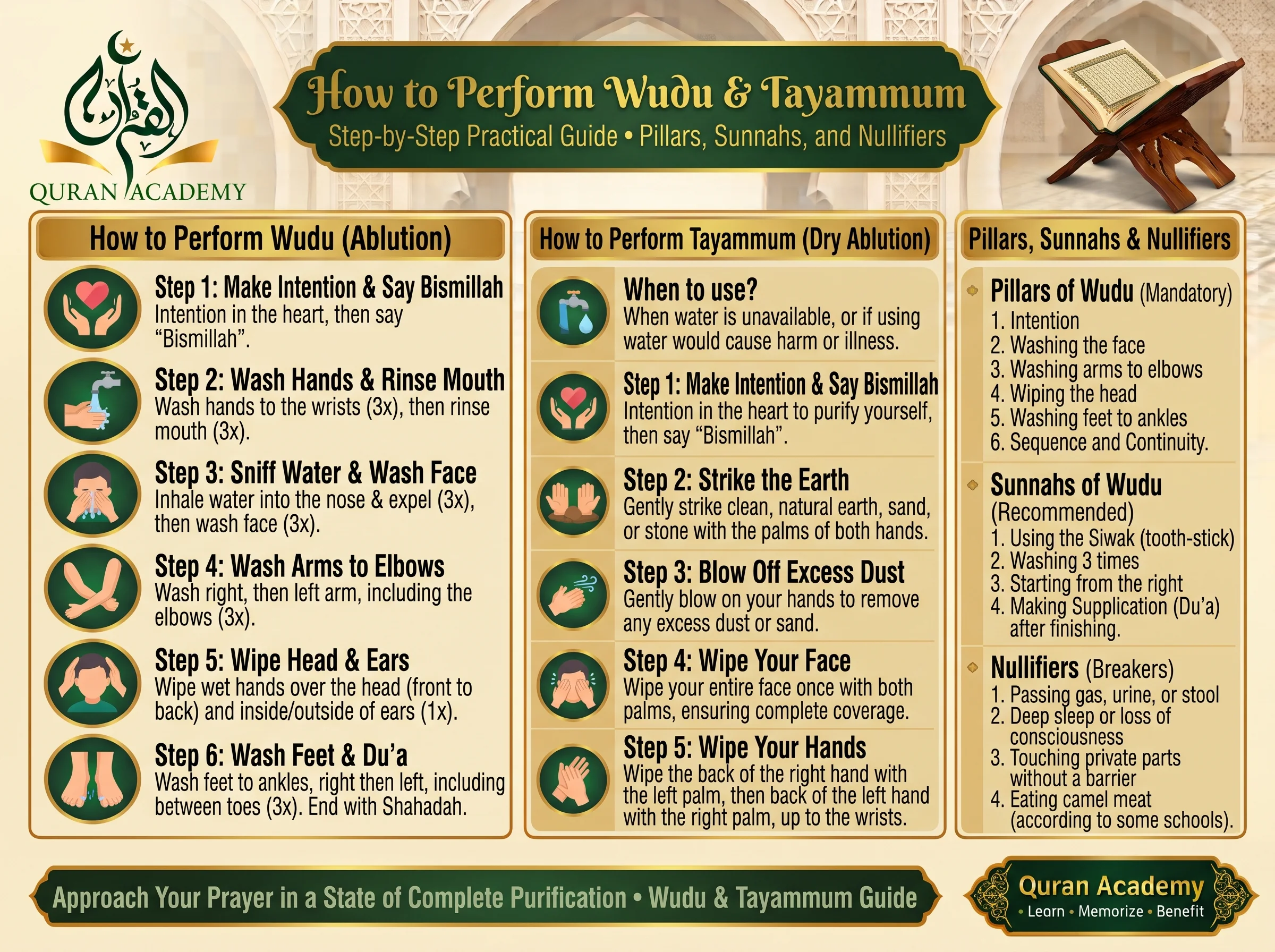
✦ Quick Answer & Key Takeaways: How to Perform Wudu & Tayammum Step-by-Step
Mastering how to perform Wudu and Tayammum (الْوُضُوءُ وَالتَّيَمُّمُ — Ritual Ablution and Dry Ablution) is the essential gateway to daily prayer (Salah), holding the physical Mushaf, and earning radiant light on the Day of Resurrection (Al-Ghurr Al-Muhajjaloon — Sahih al-Bukhari 136). Commanded directly by Allah Almighty in Surah Al-Ma'idah (Chapter 5, Verse 6), a complete Prophetic Wudu follows a 10-step sequence combining the obligatory Quranic limbs (washing the face, washing both arms including the elbows, wiping the head, and washing both feet including the ankles) with the Prophetic Sunnahs—while Tayammum replaces Wudu in just 2 simple steps (wiping the face and hands with clean natural earth) whenever water is unavailable or medically harmful. In our 1-on-1 Online Islamic Studies & Fiqh Course, adults and children master the exact rulings of purification across all four Sunni schools!
- The 4 Core Physical Pillars in Surah Al-Ma'idah (5:6): (1) Washing the entire face (with mouth & nose), (2) Washing both arms including the elbows, (3) Wiping the head (with ears), and (4) Washing both feet including the ankles.
- The Reward That Opens All 8 Gates of Jannah (Sahih Muslim 234): Reciting the Shahadah and repentance Dua immediately after Wudu opens all eight gates of Paradise so you may enter through whichever you wish!
- The 2-Step Tayammum Relief (Sahih al-Bukhari 338): Strike clean earth/dust once with your palms, blow off excess dust, wipe your face, and wipe both hands up to the wrists!
- Wiping Over Socks (Masah 'alal-Khuffayn): Valid for 24 hours for a resident and 72 hours for a traveler when worn in a state of complete Wudu.
Every single day, five times a day, a Muslim steps away from the noise of the world, turns on the tap, and prepares to stand before the King of Kings in prayer. In the Prophetic Sunnah, Wudu (الْوُضُوء — derived from Al-Wadaa'ah, meaning brightness, beauty, and purity) is not merely a physical washing of the skin; with every drop of water that leaves your hands, face, arms, and feet, your minor sins are washed away until you step onto your prayer mat spiritually renewed!
However, many beginners, new Muslims, and young children—and even lifelong Muslims when traveling, sick in the hospital, or wearing winter socks—encounter practical Fiqh questions: "Which actions in Wudu are obligatory pillars (Fard) that invalidate my Wudu if a single dry spot is missed, and which are recommended Sunnahs? Does accidentally touching my spouse, bleeding from a small cut, or laughing outside of prayer break my Wudu? And if I have a surgical cast, eczema, or no water on a flight, how exactly do I perform Tayammum?" Just as we answered your questions on Reading the Quran Without Wudu and How to Perform Sujood As-Sahw, this complete guide walks you through every detail of Wudu, Tayammum, and wiping over socks across all four Sunni Madhhabs.
- The Quranic Verse of Wudu & Tayammum (Surah Al-Ma'idah 5:6) & Prophetic Virtues
- How to Perform Wudu Step by Step (All 10 Steps: Fard Pillars vs. Sunnahs Explained)
- The Authentic Dua Before & After Wudu (Arabic, Transliteration & Meaning)
- Master Comparison Chart: What Breaks Wudu Across the 4 Sunni Schools (Hanafi, Maliki, Shafi'i & Hanbali)
- How to Perform Tayammum (Dry Ablution) in 2 Simple Steps & Wiping Over Socks (Masah)
- Frequently Asked Questions (FAQs)
1. The Quranic Verse of Wudu & Tayammum (Surah Al-Ma'idah 5:6) & Prophetic Virtues
When you open Page 108 of our Online Uthmani Quran Explorer (and apply the principles of our Complete Quran Tafseer Guide), you find that Allah Almighty combined the rulings of Wudu, Ghusl, and Tayammum in a single majestic verse—Surah Al-Ma'idah (5:6)—opening with the direct call to the believers to wash their faces, wash their arms to the elbows, wipe their heads, and wash their feet to the ankles when rising for prayer, and permitting clean earth (Sa'eedan Tayyiban) to wipe their faces and hands whenever they are ill, traveling, or find no water—concluding with the tender reassurance that Allah does not wish to place any hardship upon us, but wishes to purify us and complete His favor upon us so that we may be grateful!
• Sins Falling With the Last Drop of Water (Sahih Muslim 244): Abu Hurayrah (may Allah be pleased with him) reported that the Messenger of Allah (peace be upon him) said that when a Muslim servant performs Wudu and washes his face, every sin his eyes looked at departs with the water (or with the last drop of water); when he washes his hands, every sin his hands grasped departs with the water; and when he washes his feet, every sin his feet walked toward departs with the water—until he emerges cleansed of sins!
• Shining Limbs on the Day of Resurrection (Sahih al-Bukhari 136 & Muslim 246): The Prophet (ﷺ) declared that his Ummah will be called on the Day of Resurrection with radiant foreheads, hands, and feet from the traces of Wudu (غُرًّا مُحَجَّلِينَ مِنْ آثَارِ الْوُضُوءِ)!
2. How to Perform Wudu Step by Step (All 10 Steps: Fard Pillars vs. Sunnahs Explained)
Recorded in Sahih al-Bukhari (159) and Sahih Muslim (226) from Humran, the freed slave of 'Uthman ibn 'Affan (may Allah be pleased with him), Caliph 'Uthman (RA) called for a vessel of water and demonstrated the complete Prophetic Wudu in public step by step. Below is the exact 10-Step Sequence—clearly marking which steps are Recommended Sunnahs and which are Obligatory Pillars (Fard / Arkan) that must never be skipped:
- Step 1 — Intention in the Heart (Niyyah • PILLAR #1) & Saying "Bismillah":
Form the conscious intention in your heart to perform Wudu for prayer/purification (without pronouncing the intention out loud!), and say aloud: بِسْمِ اللَّهِ (Bismillaah — "In the Name of Allah"). *(Note: Use moderate water without wasting it—the Prophet ﷺ used to perform Wudu with just one Mudd [two cupped hands] of water!).* - Step 2 — Washing Both Hands Up to the Wrists (3 Times • SUNNAH):
Wash both hands up to the wrists three times, running wet fingers between the fingers (Takhleel) and making sure water reaches beneath any rings. *(Using the Siwak/toothbrush at this step is a beloved Sunnah!).* - Step 3 — Rinsing the Mouth (Madmadah) & Nose (Istinshaq • 3 Times):
With a scoop of water in your right hand, swirl water inside your mouth (Madmadah) and gently sniff water into your nostrils (Istinshaq), then blow the water out of your nose using your left hand (Istinthar)—repeating this 3 times. *(Note: In the Hanbali school, rinsing the mouth and nose is part of the obligatory pillar of washing the face; in the Hanafi, Maliki, and Shafi'i schools, it is a confirmed Sunnah inside Wudu).* - Step 4 — Washing the Entire Face (3 Times • PILLAR #2):
Wash your entire face three times (1 time is the obligatory minimum; 3 times is the complete Sunnah): vertically from the normal hairline of the forehead down to the bottom of the chin/beard, and horizontally from ear to ear, ensuring no dry spot remains around the corners of the eyes! - Step 5 — Washing Both Arms Up to and Including the Elbows (3 Times • PILLAR #3):
Wash your right arm first from the fingertips all the way up to and including the elbow three times, then wash your left arm from the fingertips up to and including the elbow three times! *(Common Mistake Alert: Many people start washing from the wrist to the elbow and forget to wash their hands again during this step—you must wash from the fingertips all the way past the elbow!).* - Step 6 — Wiping the Head (Masah ar-Ra's • 1 Time Only • PILLAR #4):
Wet your hands with fresh water, place them at the front hairline of your head, wipe all the way back to the nape of the neck, and bring them back to the front hairline—once only (the head is wiped once, not three times!). *(For sisters with long or braided hair: you only need to wipe from the front hairline to the nape of the neck without undoing your braids or wetting the hanging length of your hair!).* - Step 7 — Wiping Both Ears Inside and Out (1 Time):
Using the same moisture on your fingers from wiping your head, insert your index fingers into the folds of your ears and wipe the back of your ears with your thumbs—once. - Step 8 — Washing Both Feet Up to and Including the Ankles (3 Times • PILLAR #5):
Wash your right foot first three times up to and including the two protruding ankle bones (Al-Ka'bayn), using your little finger to wash between all the toes, and paying special attention to the back of the heels (for the Prophet ﷺ warned: "Woe to the dry heels from the Fire!" — Sahih al-Bukhari 165). Then wash your left foot three times in the exact same way! - Step 9 — Correct Order (Tartib) & Continuity (Muwalah • PILLAR #6):
Perform the 4 Quranic limbs in their exact Quranic order (Face → Arms → Head → Feet) without leaving a long gap that lets one limb dry before washing the next. - Step 10 — Reciting the Prophetic Dua After Wudu (SUNNAH):
Immediately after finishing, recite the testimony of faith and repentance Dua below!
3. The Authentic Dua Before & After Wudu (Arabic, Transliteration & Meaning)
Just as we memorized the daily remembrances in our Morning and Evening Adhkar Authentic List and the 40 Rabbana Duas From the Quran, look at the extraordinary reward promised by the Prophet (ﷺ) in Sahih Muslim (234) and Sunan at-Tirmidhi (55) for reciting this short 15-second Dua right after Wudu:
أَشْهَدُ أَنْ لَا إِلَٰهَ إِلَّا اللَّهُ وَحْدَهُ لَا شَرِيكَ لَهُ، وَأَشْهَدُ أَنَّ مُحَمَّدًا عَبْدُهُ وَرَسُولُهُ. اللَّهُمَّ اجْعَلْنِي مِنَ التَّوَّابِينَ وَاجْعَلْنِي مِنَ الْمُتَطَهِّرِينَ.
Transliteration: Ash-hadu an laa ilaaha illallaahu wahdahu laa shareeka lahu, wa ash-hadu anna Muhammadan 'abduhu wa rasooluh. Allaahummaj-'alnee minat-tawwaabeena waj-'alnee minal-mutatahhireen.
Meaning: "I bear witness that there is no deity worthy of worship except Allah alone, with no partner, and I bear witness that Muhammad is His servant and His Messenger. O Allah, make me among those who constantly repent (purifying the heart from sins) and make me among those who purify themselves (purifying the body with water)!" *(You may also add: **سُبْحَانَكَ اللَّهُمَّ وَبِحَمْدِكَ، أَشْهَدُ أَنْ لَا إِلَٰهَ إِلَّا أَنْتَ، أَسْتَغْفِرُكَ وَأَتُوبُ إِلَيْكَ** — An-Nasa'i in 'Amal al-Yawm wal-Laylah 81, graded Sahih).*
4. Master Comparison Chart: What Breaks Wudu Across the 4 Sunni Schools
When we teach Fiqh in our Interactive Tajweed & Islamic Encyclopedia, students discover that some nullifiers of Wudu (Nawaqid al-Wudu) are 100% agreed upon by all four Sunni schools (anything exiting the front or back private passages—urine, stool, wind/gas, or prostatic fluid—plus deep sleep and loss of consciousness), while four common everyday situations differ across the Hanafi, Maliki, Shafi'i, and Hanbali Madhhabs:
Struggling to perfect your Recitation?
Join hundreds of students mastering the Quran with our Verified Al-Azhar Graduates. We offer flexible 1-on-1 sessions tailored to your schedule.
Book a Free Evaluation Class →| Everyday Situation | Hanafi School | Shafi'i School | Maliki & Hanbali Schools |
|---|---|---|---|
| 1. Touching Spouse (Skin-to-Skin) |
Does NOT break Wudu (unless fluid exits). | Breaks Wudu upon direct skin-to-skin contact (even without desire). | Breaks Wudu ONLY if accompanied by physical desire (Shahwah); normal affectionate touch does not break it. |
| 2. Bleeding From a Cut or Nosebleed / Vomiting | Breaks Wudu if blood flows beyond the wound or if vomit is a mouthful. | Does NOT break Wudu (only wash the blood/vomit off). | • Maliki: Does NOT break Wudu. • Hanbali: Breaks Wudu only if excessive in amount. |
| 3. Touching One's Own Private Part | Does NOT break Wudu (washing hands is recommended). | Breaks Wudu if touched directly with the inner palm/fingers without a cloth barrier. | Breaks Wudu if touched directly without a barrier. *(Changing a baby's diaper does NOT break the parent's Wudu!).* |
| 4. Eating Camel Meat (Sahih Muslim 360) |
Does NOT break Wudu (washing hands/mouth is recommended). | Does NOT break Wudu (though Imam Ash-Shafi'i said if the Hadith is authentic, it is my view!). | • Hanbali: Breaks Wudu! • Maliki: Does not break Wudu. |
Mastering the Crisp Qalqalah in "'Abْduhu" & "Wajْ'alnee" After Wudu!
Did you notice that in the Dua after Wudu—عَبْدُهُ وَرَسُولُهُ، اللَّهُمَّ اجْعَلْنِي...—both the Baa Sakinah in عَبْدُهُ ('Abْduhu) and the Jeem Sakinah in اجْعَلْنِي (Ijْ'alnee) are Qalqalah (Echoing) letters (ق ط ب ج د)? Watch Senior Instructor Ustadhah Yasmeen Gamal demonstrate on our Quran Academy YouTube Channel:
- Clear Baa & Jeem Bounce: Keep 'Abْduhu and Ijْ'alnee crisp without muting the consonants.
- 1-on-1 Live Coaching: Perfect your daily Duas and Quran recitation with our Al-Azhar scholars!
5. How to Perform Tayammum (Dry Ablution) in 2 Simple Steps & Wiping Over Socks (Masah)
What if you are traveling in an area with no water, or a doctor tells you that wetting a wound, burn, or severe skin condition will delay healing? Allah's mercy provides two effortless concessions: Tayammum (Dry Ablution) and Wiping Over Socks/Casts (Al-Masah 'alal-Khuffayn wal-Jabeerah):
The 2-Step Prophetic Method of Dry Ablution
Based on the authentic Hadith of 'Ammar ibn Yasir (RA) in Sahih al-Bukhari (338) and Sahih Muslim (368), Tayammum replaces both Wudu and Ghusl when water cannot be used:
- Intention, "Bismillah" & Striking Clean Earth Once: Make the intention in your heart to perform Tayammum to permit prayer, say "Bismillah," strike both palms lightly once upon any pure natural earth surface (soil, sand, natural stone, unglazed brick, or a dusty surface), and blow gently across your palms (or tap them together) to remove excess dust.
- Wipe Your Face Once & Both Hands to the Wrists Once: Wipe your entire face once with both palms, then wipe the back of your right hand with your left palm and the back of your left hand with your right palm up to the wrists! *(Note: In the Hanafi and Shafi'i schools, a second strike is also done to wipe the forearms up to the elbows).*
The 4 Conditions of Masah 'alal-Khuffayn
Instead of removing your socks at work, school, or the airport during Wudu, you may wipe over them if 4 conditions are met:
- Worn in Complete Wudu: You must have put the socks on after completing a full Wudu where both feet were washed!
- Thick & Ankle-Covering: The socks (Jawrabayn) or leather footwear (Khuffayn) must be pure, non-see-through, and cover the entire foot including the ankle bones (not low-cut ankle socks!).
- How to Wipe: Wet your hands and wipe once over the TOP surface of the socks from the toes toward the shin (never the bottom sole!).
- Time Limit: Valid for 1 day and night (24 hours) for a resident and 3 days and nights (72 hours) for a traveler! *(And for a medical cast or bandage [Jabeerah], simply wash the healthy limbs and wipe lightly with wet hands over the cast until it is removed!).*
Once you have performed a complete, peaceful Wudu, step onto your prayer mat ready to recite the Book of Allah with accurate Tajweed—applying our Makharij al-Huruf Guide, Sifaat al-Huruf Guide, Heavy & Light Letters Guide, Rules of Madd, Noon Sakinah Rules, Meem Sakinah Rules, and Rules of Waqf in our 1-on-1 Online Tajweed Course, and test your knowledge on our Free 3-Minute Tajweed Quiz! Pair your daily prayers with our Salat Al-Istikharah Guide, Salat Al-Janazah Guide, Ayatul Kursi Guide, Last 2 Verses of Surah Al-Baqarah, 3 Quls Guide for Kids, Surah Ad-Duha & Ash-Sharh Guide, 15-Day Surah Ya-Sin Plan, 10-Day Surah Ar-Rahman Plan, 12-Day Surah Al-Waqi'ah Schedule, 14-Day Surah Maryam Plan, 30-Day Surah Yusuf Schedule, Surah Luqman Parenting Guide, Surah Al-Hujurat Manners Guide, and Friday Fajr Surahs Guide in our Online Hifz Program (using our Smart Hifz Planner)! Whether you are studying with our Al-Azhar Certified Tutors or enrolling your child in our 1-on-1 Kids Quran Classes, see how families across the US, UK, Canada, and Australia rate their progress on our Verified Student & Parent Reviews Page.
6. Frequently Asked Questions (FAQs) About How to Perform Wudu & Tayammum
1. What are the obligatory pillars (Fard / Arkan) of Wudu in the Quran?
Based on Surah Al-Ma'idah (5:6), the 4 core physical pillars agreed upon by all four Sunni schools are: (1) Washing the entire face (including rinsing the mouth and nose in the Hanbali school), (2) Washing both arms up to and including the elbows, (3) Wiping the head (including the ears in the Hanbali school), and (4) Washing both feet up to and including the ankles—plus (5) Intention (Niyyah) and (6) Correct sequence (Tartib) and continuity (Muwalah) in the majority of schools.
2. What is the authentic Dua before and after Wudu?
Before starting Wudu, say "Bismillah" (In the Name of Allah). After completing Wudu, recite the authentic testimony in Sahih Muslim (234): Ash-hadu an laa ilaaha illallaahu wahdahu laa shareeka lahu, wa ash-hadu anna Muhammadan 'abduhu wa rasooluh (and in Sunan at-Tirmidhi 55: Allaahummaj-'alnee minat-tawwaabeena waj-'alnee minal-mutatahhireen), which opens all eight gates of Paradise for the believer!
3. How do you perform Tayammum (dry ablution) step by step?
When water is unavailable or medically harmful to use, make the intention in your heart, say "Bismillah," strike your palms lightly once upon clean natural earth, dust, sand, or stone (blowing off excess dust), wipe your entire face once, and then wipe the back of your right hand with your left palm and the back of your left hand with your right palm up to the wrists (Sahih al-Bukhari 338).
4. What are the main things that break (nullify) Wudu in Islam?
The agreed-upon nullifiers of Wudu include: (1) Anything exiting from the front or back private passages (urine, stool, wind/gas, or prostatic fluid), (2) Deep sleep in which a person loses awareness, (3) Loss of consciousness or intoxication, and (4) Touching the private parts directly without a barrier (in the majority Shafi'i, Maliki, and Hanbali schools).
5. How long can you wipe over socks (Masah 'alal-Khuffayn) during Wudu?
According to Sahih Muslim (276), if you put on thick, ankle-covering socks or leather footwear (Khuffayn) while in a state of complete Wudu, a resident may wipe over the top of them instead of washing the feet for 1 day and night (24 hours), and a traveler may wipe over them for 3 days and nights (72 hours), starting from the first wipe after breaking Wudu.
Teach Your Family Authentic Wudu, Salah & Quran With Al-Azhar Scholars!
Give yourself or your children 1-on-1 mentorship in everyday Purification, Salah Fiqh, Tajweed, and Hifz with certified male and female Al-Azhar scholars. Book your free diagnostic trial session today!
Book Your Free 1-on-1 Trial Class →