
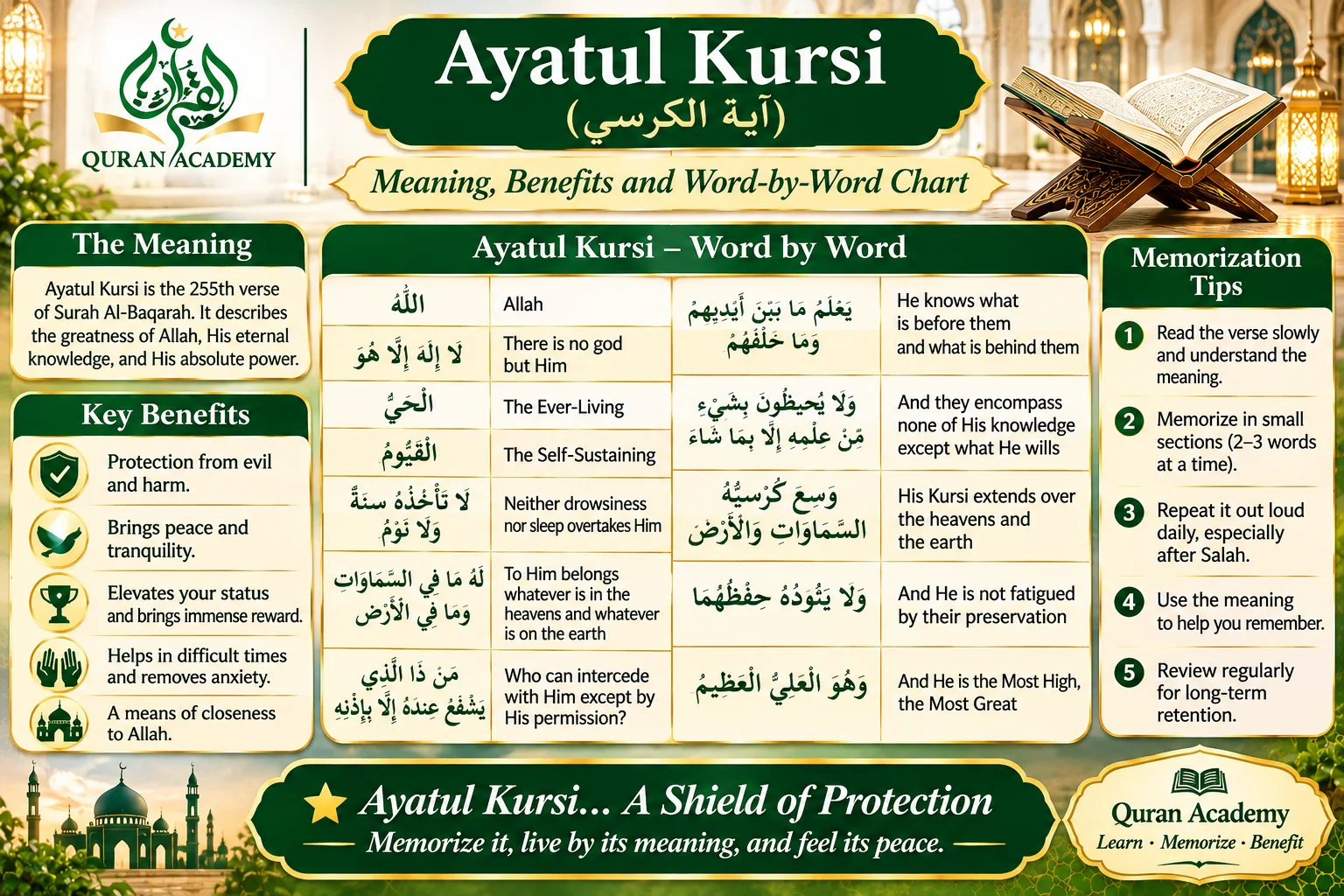
✦ Quick Answer & Key Takeaways: Ayatul Kursi Meaning, Benefits & 5-Minute Memorization
Mastering Ayatul Kursi meaning, benefits, and memorization connects your heart to the single greatest verse in the Holy Quran: Surah Al-Baqarah, Verse 255 (2:255), located on Page 42 in Juz 3. Consisting of exactly 50 Arabic words divided into 9 natural stopping clauses, Ayatul Kursi (The Verse of the Footstool) was declared by Prophet Muhammad (ﷺ) in Sahih Muslim (810) to be the loftiest verse in the Book of Allah because every single clause proclaims pure Tawheed and Allah's living, self-sustaining majesty (الْحَيُّ الْقَيُّومُ). In our 1-on-1 Online Quran Memorization (Hifz) Program, both children and adults memorize all 9 phrases in just 5 minutes using the "Mirror Ring Method" (Chiasmus)!
- Why It Is the Greatest Verse (Sayyidat Aayil-Quran): Contains 5 Divine Names (Allah, Al-Hayy, Al-Qayyum, Al-'Aliyy, Al-'Adheem) and 17 total references to Allah across 50 words.
- Two Unmatched Daily Promises: Reciting it after each of the 5 obligatory prayers leaves only death between you and Jannah; reciting it before sleep appoints an angelic guardian over you until Fajr!
- The "Mirror Ring" 5-Minute Memory Trick: Its 9 short clauses form a symmetrical ring where Clause 1 mirrors Clause 9, Clause 2 mirrors Clause 8, Clause 3 mirrors Clause 7, Clause 4 mirrors Clause 6, and Clause 5 is the centerpiece.
- Crucial Tajweed Rule: Never connect all 9 clauses breathlessly if it causes you to drop final vowels; use the 8 built-in Waqf (Stopping) signs to recite with calm precision.
After Surah Al-Fatihah and the Three Quls, Ayatul Kursi (آيَةُ الْكُرْسِيّ — Surah Al-Baqarah 2:255) is the most frequently recited passage in the daily life of every Muslim on earth. We whisper it on our prayer mats five times a day after finishing our obligatory Salah, we recite it over our children as we tuck them into bed at night, and we turn to it immediately whenever our hearts feel anxious, afraid, or overwhelmed.
Yet many Muslims—both children learning it for the first time and adults who have recited it from memory for years—face two quiet challenges. First, because they memorized it quickly by ear as children, they recite the Arabic sounds automatically without knowing the breathtaking word-by-word meaning or the miraculous 9-Ring Mirror Symmetry hidden inside its 50 words. Second, non-native speakers frequently make subtle pronunciation slips on words like الْقَيُّومُ, تَأْخُذُهُ, يَئُودُهُ, and حِفْظُهُمَا. In this complete guide, you will master the full Arabic text, transliteration, word-by-word meaning, authentic Hadiths, Tajweed rules, and our famous 5-Minute Mirror Ring Memorization Trick.
- Full Arabic Text, Transliteration & English Translation of Ayatul Kursi (Divided Into 9 Easy Clauses)
- Master Word-by-Word Breakdown Table of All 50 Words in Ayatul Kursi (With Roots)
- 4 Authentic Benefits of Ayatul Kursi in the Sunnah (After Salah, Bedtime & Ism Allah Al-A'dham)
- The 5-Minute Memorization Trick: How the "9-Phrase Mirror Ring" Makes Forgetting Impossible
- 6 Crucial Tajweed Rules & Common Pronunciation Mistakes in Ayatul Kursi
- Frequently Asked Questions (FAQs)
1. Full Arabic Text, Transliteration & Translation of Ayatul Kursi (In 9 Breath-Friendly Clauses)
When you open Page 42 of our Online Uthmani Quran Explorer (inside our broader Surah Al-Baqarah Memorization Plan), you will notice that Ayatul Kursi is punctuated by 8 natural Waqf (Stopping) marks, dividing the verse into 9 short, rhythmic sentences. Read them one by one below:
- Clause [1]: Allaahu laa ilaaha illaa Huwal-Hayyul-Qayyoom — "Allah—there is no deity worthy of worship except Him, the Ever-Living, the All-Sustaining."
- Clause [2]: Laa ta'khudhuhu sinatun wa laa nawm — "Neither drowsiness overtakes Him nor sleep."
- Clause [3]: Lahu maa fis-samaawaati wa maa fil-ard — "To Him belongs whatever is in the heavens and whatever is on the earth."
- Clause [4]: Man dhal-ladhee yashfa'u 'indahu illaa bi-idhnih — "Who is it that can intercede with Him except by His permission?"
- Clause [5]: Ya'lamu maa bayna aydeehim wa maa khalfahum — "He knows what is presently before them and what will be after them,"
- Clause [6]: Wa laa yuheetoona bi-shay'in min 'ilmihi illaa bimaa shaa' — "And they encompass not a thing of His knowledge except for what He wills."
- Clause [7]: Wasi'a Kursiyyuhus-samaawaati wal-ard — "His Kursi (Footstool) extends over the heavens and the earth,"
- Clause [8]: Wa laa ya'ooduhu hifdhuhumaa — "And their preservation tires Him not."
- Clause [9]: Wa Huwal-'Aliyyul-'Adheem — "And He is the Most High, the Most Great."
2. Master Word-by-Word Breakdown & Tafseer Table of Ayatul Kursi
Notice how many words in Ayatul Kursi come directly from our Top 50 High-Frequency Quranic Arabic Words (such as Allah, Laa, Illaa, Huwa, Maa, Fee, As-Samaawaat, Al-Ard, Man, Alladhee, Ya'lamu, Shay', 'Ilm, and Shaa'a)! As we explain in our Complete Quran Tafseer Guide and our Quranic Arabic Guide, understanding each phrase word-by-word transforms both your focus (Khushu') and your memorization speed:
| Clause # | Arabic Phrase | Key Vocabulary & 3-Letter Roots | Word-by-Word English Meaning | Core Tafseer Gem (Ibn Kathir / As-Sa'di) |
|---|---|---|---|---|
| Clause 1 | اللَّهُ لَا إِلَٰهَ إِلَّا هُوَ الْحَيُّ الْقَيُّومُ | ح-ي-ي (Life) ق-و-م (Sustain) |
Allah / no deity / except / He / the Ever-Living / the Sustainer of all | Al-Hayy: Perfect, eternal life in Himself. Al-Qayyum: Self-existing while sustaining every atom in existence! |
| Clause 2 | لَا تَأْخُذُهُ سِنَةٌ وَلَا نَوْمٌ | أ-خ-ذ (Overtake) سِنَة (Slumber/Doze) |
Not / overtakes Him / drowsiness (light dozing) / and not / deep sleep | Sinah (light drowsiness in the eyes) is negated before Nawm (deep sleep in the heart). If Allah slept for an instant, the heavens would collapse! |
| Clause 3 | لَّهُ مَا فِي السَّمَاوَاتِ وَمَا فِي الْأَرْضِ | س-م-و (Heavens) أ-ر-ض (Earth) |
To Him belongs / whatever / is in the heavens / and whatever / is in the earth | Absolute ownership (Mulk): every angel, human, star, and provision is His servant and creation. |
| Clause 4 | مَن ذَا الَّذِي يَشْفَعُ عِندَهُ إِلَّا بِإِذْنِهِ | ش-ف-ع (Intercede) أ-ذ-ن (Permission) |
Who / is it that / intercedes / with Him / except / by His permission? | Unlike worldly kings who can be pressured by mediators, not even the greatest Prophet or Angel can intercede on Judgment Day without Allah's explicit permission first! |
| Clause 5 | يَعْلَمُ مَا بَيْنَ أَيْدِيهِمْ وَمَا خَلْفَهُمْ | ع-ل-م (Knows) خ-ل-ف (Behind/After) |
He knows / what is / between their hands (in front of them) / and what is / behind them | Total omniscience: Allah knows their entire future and present (what is before them) and their entire past (what is behind them). |
| Clause 6 | وَلَا يُحِيطُونَ بِشَيْءٍ مِّنْ عِلْمِهِ إِلَّا بِمَا شَاءَ | ح-و-ط (Encompass) ش-ي-أ (Willed) |
And they encompass not / anything / of His knowledge / except / what He willed | All human science, revelation, and angelic knowledge is just a tiny drop that Allah chose to grant creation. |
| Clause 7 | وَسِعَ كُرْسِيُّهُ السَّمَاوَاتِ وَالْأَرْضَ | و-س-ع (Extended) كُرْسِيّ (Footstool) |
Extends / His Kursi (Footstool) / over the heavens / and the earth | Ibn 'Abbas stated that the seven heavens and seven earths compared to the Kursi are like a small ring thrown into a vast desert! |
| Clause 8 | وَلَا يَئُودُهُ حِفْظُهُمَا | أ-و-د (Burden/Tire) ح-ف-ظ (Preservation) |
And not / tires or burdens Him / the preservation of them both (heavens & earth) | Laa ya'ooduhu: It causes Him zero weight, fatigue, or difficulty to guard the entire cosmos—so how effortless is it for Him to guard you? |
| Clause 9 | وَهُوَ الْعَلِيُّ الْعَظِيمُ | ع-ل-و (Most High) ع-ظ-م (Most Great) |
And He is / the Most High / the Most Magnificent | Sealing the verse with absolute elevation above all creation (Al-'Aliyy) and infinite greatness (Al-'Adheem). |
3. Four Authentic Benefits of Ayatul Kursi in the Prophetic Sunnah
Unlike cultural myths, the virtues of Ayatul Kursi are established by the highest grades of authentic (Sahih) Hadiths—which we teach every student in our Comprehensive Islamic Studies Course (and which you can verify anytime in our Online Hadith Explorer):
Ubayy ibn Ka'b (may Allah be pleased with him) reported that the Messenger of Allah (peace be upon him) asked him: "O Abu al-Mundhir! Do you know which verse from the Book of Allah that you have with you is the greatest?" I said: "Allah and His Messenger know best." He asked again, so I said: "Allaahu laa ilaaha illaa Huwal-Hayyul-Qayyoom (Ayatul Kursi)." Thereupon the Prophet (ﷺ) struck me gently on the chest and said:
"By Allah! May knowledge bring you joy, O Abu al-Mundhir! (وَاللَّهِ لِيَهْنِكَ الْعِلْمُ أَبَا الْمُنْذِرِ)"
Abu Umamah (RA) reported that the Prophet (ﷺ) said: "Whoever recites Ayatul Kursi immediately after every obligatory prayer, nothing stands between him and entering Paradise except death!" (An-Nasa'i in As-Sunan Al-Kubra 9848 • Graded Sahih by Ibn Hibban & Ibn al-Qayyim).
In the famous Hadith of Abu Hurayrah (RA) guarding the Zakat dates, the Prophet (ﷺ) confirmed: "When you go to your bed, recite Ayatul Kursi from beginning to end; there will remain over you a guardian from Allah, and no devil will come near you until morning!" (Sahih al-Bukhari 2311).
Asma' bint Yazid (RA) narrated that the Prophet (ﷺ) said that Allah's Greatest Name (Ism Allah Al-A'dham)—by which when He is called upon, He answers—is in Ayatul Kursi and the opening of Surah Al-Imran (3:1–2): اللَّهُ لَا إِلَٰهَ إِلَّا هُوَ الْحَيُّ الْقَيُّومُ (Sunan Abu Dawud 1496 & Ibn Majah 3856).
4. The 5-Minute Memorization Trick: How the "9-Phrase Mirror Ring" Makes Forgetting Impossible
Why do some beginners or young children lose their place halfway through Ayatul Kursi? Because they try to memorize all 50 words as one flat paragraph! Classical and contemporary rhetorical scholars discovered that the 9 clauses of Ayatul Kursi form a flawless Concentric Mirror Ring (Chiasmus)—where the first half (Clauses 1 to 4) mirrors the second half (Clauses 9 down to 6) around the central axis of Clause 5!
When you pair this Mirror Ring visual map with our 3x3 Quran Memorization Method (mapped in our Smart Hifz Planner), you or your child can memorize all 9 phrases in 5 minutes flat:
🪞 The 5 Symmetrical Mirror Pairs of Ayatul Kursi (Learn 1 & Get Its Twin!)
• Clause [1] (Opening): Ends with two majestic Divine Names → الْحَيُّ الْقَيُّومُ (The Ever-Living, the All-Sustaining).
• Clause [9] (Closing): Ends with two majestic Divine Names → وَهُوَ الْعَلِيُّ الْعَظِيمُ (And He is the Most High, the Most Great).
Struggling to perfect your Recitation?
Join hundreds of students mastering the Quran with our Verified Al-Azhar Graduates. We offer flexible 1-on-1 sessions tailored to your schedule.
Book a Free Evaluation Class →• Clause [2]: Negates any drowsiness or sleep → لَا تَأْخُذُهُ سِنَةٌ وَلَا نَوْمٌ.
• Clause [8]: Negates any fatigue or tiredness in guarding creation → وَلَا يَئُودُهُ حِفْظُهُمَا.
• Clause [3]: He owns the heavens and the earth → لَّهُ مَا فِي السَّمَاوَاتِ وَمَا فِي الْأَرْضِ.
• Clause [7]: His Kursi encompasses the heavens and the earth → وَسِعَ كُرْسِيُّهُ السَّمَاوَاتِ وَالْأَرْضَ.
• Clause [4]: No one intercedes except by His permission → مَن ذَا الَّذِي يَشْفَعُ عِندَهُ إِلَّا بِإِذْنِهِ.
• Clause [6]: No one encompasses His knowledge except what He wills → وَلَا يُحِيطُونَ بِشَيْءٍ مِّنْ عِلْمِهِ إِلَّا بِمَا شَاءَ.
Right in the exact center of the verse sits Clause [5]: يَعْلَمُ مَا بَيْنَ أَيْدِيهِمْ وَمَا خَلْفَهُمْ ("He knows what is before them [Clauses 1–4] and what is behind/after them [Clauses 6–9]!"). Even the meaning of the central clause describes the structure of the verse itself!
Perfecting Letter Articulation in Your Daily Protection Recitations
When reciting your post-Salah and bedtime fortress verses—Ayatul Kursi and the Three Quls—keeping heavy letters distinct from light letters and applying crisp Qalqalah echoes preserves the majesty of every word. Watch Senior Instructor Ustadhah Yasmeen Gamal demonstrate on our Quran Academy YouTube Channel:
- Precision in Daily Adhkar: Why rushing through familiar verses causes reciters to drop key letters and vowels.
- 1-on-1 Live Correction: Let an Al-Azhar scholar audit your daily Salah and Adhkar recitation!
5. Six Crucial Tajweed Rules & Common Mistakes to Avoid in Ayatul Kursi
Even lifelong Muslims who know Ayatul Kursi by heart often make subtle pronunciation errors because they learned it by ear without studying Makharij al-Huruf (Articulation Points) in our 1-on-1 Online Tajweed Course. Check your recitation against these six golden checkpoints:
- 1. Pressing the Shaddah on the Yaa in "Al-Hayyul-Qayyoom" (الْحَيُّ الْقَيُّومُ): Both words contain a Yaa Mushaddadah (يّ). As explained in our Sifaat al-Huruf Guide, give the middle of your tongue a firm Nabr (stress) on the Yaa in Al-Hay-yu and Al-Qay-yoom so the double Yaa does not melt away—and make sure the ق (Qaaf) is heavy, not a light English "K"!
- 2. Pronouncing the Silent Hamzah in "Laa Ta'khudhuhu" (لَا تَأْخُذُهُ): Do not turn the glottal stop أْ (Hamzah Sakinah) into a long Alif ("Laa Taa-khudhuhu" ❌). Close the vocal cords crisply on Ta'ْ, then pronounce the heavy throat letter خُ (Khaa) and the interdental ذُ (Dhaal) cleanly.
- 3. Stopping vs. Continuing at the 8 Waqf Signs: According to our Rules of Waqf (Stopping Signs) Guide, whenever you stop at the end of a clause (such as وَلَا نَوْمٌ ۚ or إِلَّا بِإِذْنِهِ ۚ), you silence the final vowel (Nawmْ / Bi-idhnihْ). However, if you choose to connect two clauses without stopping, you must pronounce the full final vowel and Tanween rule—for example, joining Clause 2 into Clause 3 requires Idgham bila Ghunnah on وَلَا نَوْمٌ لَّهُ (Wa laa nawmul-lahu), and joining Clause 4 into Clause 5 requires a 2-count Madd Silah Sughra on إِلَّا بِإِذْنِهِۦ يَعْلَمُ (Illaa bi-idhnihee ya'lamu)!
- 4. Applying Noon Sakinah & Meem Sakinah Rules in Clauses 4, 5 & 6: Using our Noon Sakinah & Tanween Rules and Meem Sakinah Rules, hold a 2-count light nasal Ikhfa Haqiqi on مَن ذَا and عِندَهُ, a 2-count Idgham bi-Ghunnah on بِشَيْءٍ مِّنْ, a crisp throat Izhar Halqi on مِّنْ عِلْمِهِ, and a clear lip Izhar Shafawi on أَيْدِيهِمْ وَمَا خَلْفَهُمْ وَلَا.
- 5. Mastering "Wa laa Ya'ooduhu Hifdhuhumaa" (وَلَا يَئُودُهُ حِفْظُهُمَا): Watch two words here carefully: in يَئُودُهُ (Ya-'oo-du-hu), pronounce a clear Hamzah with Damma before the 2-count Waw; and in حِفْظُهُمَا (Hif-dhu-humaa), whispered air flows on the فْ (Faa Sakinah) followed immediately by the heavy, elevated interdental ظُ (Dhaa' with Damma)—never turn ظ into a buzzing English "Z" (Hifzuhumaa ❌)!
- 6. Differentiating "'Aliyy" vs. "'Adheem" in Clause 9 (وَهُوَ الْعَلِيُّ الْعَظِيمُ): Following our Heavy & Light Letters Guide and Rules of Madd, articulate the deep throat letter ع ('Ayn) twice, press the Shaddah on the Yaa in Al-'Aliyyu, and finish with a heavy, resonant ظ (Dhaa') and a calm 2, 4, or 6-count Madd 'Aarid lis-Sukoon on الْعَظِيمْ! Test your Tajweed knowledge right now on our Free 3-Minute Interactive Tajweed Quiz!
Once you and your children have mastered Ayatul Kursi, combine it in your nightly protection routine with our Surah Al-Mulk Memorization Guide, our 15-Day Surah Ya-Sin Plan, our 10-Day Surah Ar-Rahman Plan, and our 12-Day Surah Al-Waqi'ah Schedule! (And remember: as we explained in our Fiqh guide on Reading the Quran Without Wudu or During Your Period, sisters are permitted across the schools of Fiqh to recite Ayatul Kursi before sleeping every night with the intention of protection and remembrance!). Explore how families across the US, UK, Canada, and Australia rate our 1-on-1 Kids & Adults Quran Classes on our Verified Student & Parent Reviews Page.
6. Frequently Asked Questions (FAQs) About Ayatul Kursi Meaning, Benefits & Memorization
1. Where is Ayatul Kursi located in the Quran, and how many words does it have?
Ayatul Kursi is Verse 255 of Surah Al-Baqarah (2:255), located in Juz 3 on Page 42 of the standard 15-line Uthmani Mushaf. It consists of exactly 50 Arabic words divided into 9 natural, self-contained grammatical clauses.
2. Why is Ayatul Kursi called the greatest verse in the Quran?
In Sahih Muslim (810), the Prophet Muhammad (ﷺ) affirmed to Ubayy ibn Ka'b that Ayatul Kursi is the greatest verse in the Book of Allah because it is devoted entirely to pure Tawheed and the Majesty of Allah, containing 17 explicit and implicit references to Allah's Names and Pronouns across its 9 clauses.
3. What are the authentic benefits of reciting Ayatul Kursi after every prayer and before sleeping?
First, reciting Ayatul Kursi after every obligatory prayer (Fard Salah) guarantees that nothing stands between the believer and entering Paradise except death (As-Sunan Al-Kubra 9848). Second, reciting it when going to bed assigns an angel from Allah to guard you all night so that no devil can come near you until morning (Sahih al-Bukhari 2311).
4. How can I or my child memorize Ayatul Kursi in 5 minutes?
Use the "9-Phrase Mirror Ring Method" (Chiasmus): instead of memorizing one long paragraph, break Ayatul Kursi into its 9 short stops (Waqf signs). Notice how Phrase 1 mirrors Phrase 9, Phrase 2 mirrors Phrase 8, Phrase 3 mirrors Phrase 7, Phrase 4 mirrors Phrase 6, and Phrase 5 sits right in the center!
5. What does "Al-Kursi" mean in Ayatul Kursi?
According to the authentic explanation of 'Abdullah ibn 'Abbas (may Allah be pleased with him), Al-Kursi is the Footstool of Allah Almighty, which encompasses the seven heavens and the earth in its vastness, and is distinct from and beneath Allah's Mighty Throne (Al-'Arsh).
Recite Ayatul Kursi & Daily Surahs With Flawless Tajweed!
Give yourself or your child the gift of 1-on-1 mentorship with a certified male or female Al-Azhar scholar. Book your free diagnostic trial session today!
Book Your Free 1-on-1 Quran Trial Class →