
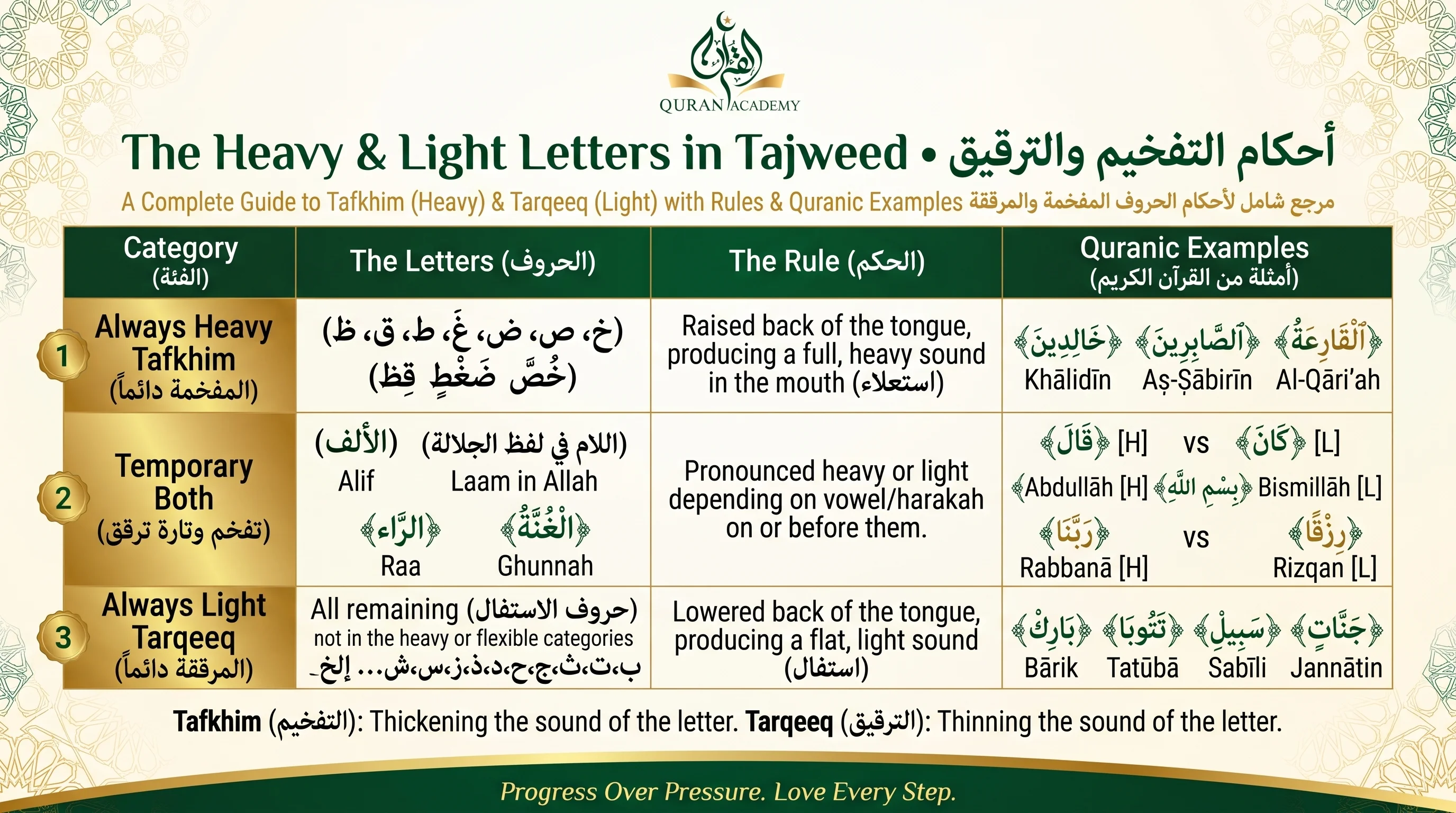
✦ Quick Answer & Key Takeaways: Heavy & Light Letters in Tajweed
In Quranic recitation, the 28 Arabic letters are divided into three acoustic groups based on Tafkhim (heaviness/full-mouth resonance) and Tarqeeq (lightness/thin-mouth resonance): 7 Permanently Heavy Letters collected in the phrase خُصَّ ضَغْطٍ قِظْ (خ ص ض غ ط ق ظ), 3 Conditionally Heavy or Light Letters (the Alif of Madd, the Lam in the Name of Allah, and the letter Raa ر), and 18 Permanently Light Letters (all remaining letters of the alphabet). Students in our 1-on-1 Online Tajweed Course master these exact tongue positions live with Al-Azhar scholars so they never confuse look-alike sound pairs like س (Seen) vs. ص (Saad) or ت (Taa) vs. ط (Taa).
- How Tafkhim Is Produced Anatomically: Heaviness comes from Isti'laa (الاسْتِعْلَاء)—elevating the back of the tongue toward the soft palate (roof of the mouth), which traps and echoes the sound inside the oral cavity. Never puff your cheeks or round your lips to fake a heavy sound!
- Why Confusing Heavy & Light Letters Changes Quranic Meaning: Pronouncing a heavy قَلْب (Qalb = Heart) as a light كَلْب (Kalb = Dog), or عَسَى (Perhaps) as عَصَى (He disobeyed) completely alters the meaning of the verse.
- The 5 Levels of Heaviness (Ibn Al-Jazari's Scale): Heavy letters are strongest when followed by an Alif (e.g., قَالَ), followed by Fatha, Damma, Sukoon, and weakest when carrying a Kasra (e.g., قِيلَ / صِرَاطَ).
- The 3 Chameleon Letters: The Alif (ا) follows the letter before it; the Lam in اللّٰه follows the vowel before it; and the Raa (ر) follows its own vowel or the vowel preceding it.
Why is it that when a non-native English speaker recites Surah Al-Fatihah, they can pronounce every vowel mark correctly, yet their recitation still sounds noticeably "flat" or Westernized compared to a native Arab Qari? And why do so many beginners accidentally turn a heavy letter next to a light letter into two heavy letters—pronouncing مَخْمَصَة (Makhmasah) as "Makhmaswah" or بَاطِل (Baatil) as "Baa-twil"?
The secret lies in mastering heavy and light letters in Tajweed (Tafkhim and Tarqeeq). In English, consonant weight stays almost identical across words; we only have one "S" sound, one "T" sound, and one "D" sound. In Quranic Arabic, however, every one of those light English-like consonants has a deep, resonant, full-mouth twin produced by raising the back of the tongue. Once you understand the simple mechanics of tongue elevation—and memorize the clear rules for the three conditional letters (Alif, Lam, and Raa)—your recitation will immediately gain the rich, authentic acoustic depth of traditional Tarteel.
- What Are Tafkhim (Heaviness) & Tarqeeq (Lightness) in Tajweed?
- Category 1: The 7 Permanently Heavy Letters (Khussa Daghtin Qidh) & Their 5 Levels
- Category 2: The 18 Permanently Light Letters (And 5 Dangerous Sound-Alike Pairs)
- Category 3: The 3 Conditional Letters (Alif Madd, Lam of Allah & Raa Rules)
- Master 5-Column Chart: Heavy, Light & Conditional Letters With Quranic Examples
- 4 Common Tafkhim & Tarqeeq Mistakes Non-Native Speakers Make
- Frequently Asked Questions (FAQs)
1. What Are Tafkhim (Heaviness) & Tarqeeq (Lightness) in Tajweed?
In classical Tajweed science—which you can explore term by term in our Interactive Tajweed & Quranic Encyclopedia—every Arabic letter possesses inherent qualities (Sifaat Lazimah) that never leave the letter, and resulting acoustic effects:
Linguistic Meaning: Thickening or fattening.
Technical Definition: A fullness and richness that enters the body of the letter because the back of the tongue rises toward the roof of the mouth (Isti'laa), filling the entire oral cavity with a deep, vertical echo.
Linguistic Meaning: Thinning or slenderizing.
Technical Definition: A slimness and brightness that enters the sound of the letter because the back of the tongue stays flat and low on the floor of the mouth (Istifal), allowing air to exit forward with a natural "smile" posture.
Crucial Anatomical Rule for Beginners: Many English speakers try to make a letter sound "heavy" by rounding their lips into an "O" or "W" shape (as if saying "Swad" or "Qwaaf"). In Tajweed, the lips have zero role in Tafkhim unless the letter carries a Damma (ـُ)! True heaviness happens invisibly at the back of your tongue while your lips remain completely neutral and relaxed.
Hear How Heavy vs. Light Letters Sound in Live Recitation
Some letters—like ق (Qaaf) and ط (Taa)—are always heavy, while others—like ب (Baa), ج (Jeem), and د (Daal)—are always light even when they bounce with Qalqalah! In this 60-second video from our official Quran Academy YouTube Channel, Senior Instructor Ustadhah Yasmeen Gamal demonstrates the exact acoustic contrast:
- Heavy Echo vs. Light Echo: Listen to how the heavy ق in Al-Falaq resonates deep in the soft palate, while the light د in Ahad bounces forward at the front teeth.
- Live Mouth-Posture Coaching: Why hearing a native Al-Azhar Qari model the sound cuts months off your learning curve.
2. Category 1: The 7 Permanently Heavy Letters (خُصَّ ضَغْطٍ قِظْ) & Their 5 Levels
Seven letters in the Arabic alphabet carry the permanent quality of Isti'laa (elevation of the back of the tongue). Because their articulation always lifts the back of the tongue, these 7 letters are always heavy in every single verse of the Quran, regardless of what vowel they carry.
Classical scholars grouped them into the famous three-word mnemonic phrase: خُصَّ ضَغْطٍ قِظْ (Khussa Daghtin Qidh):
- Four "Lidded" Super-Heavy Letters (Huroof al-Itbaq — ص ض ط ظ): In Saad (ص), Daad (ض), Taa (ط), and Dhaa (ظ), not only does the back of the tongue rise, but the middle blade of the tongue also curves upward like a lid against the roof of the mouth (Itbaq), producing the strongest, deepest resonance in the Arabic language.
- Three "Open" Heavy Letters (Huroof al-Infitah — ق غ خ): In Qaaf (ق), Ghayn (غ), and Khaa (خ), the back of the tongue rises (Isti'laa) while the front of the tongue remains open (Infitah), giving them a slightly lighter shade of heaviness than the four Itbaq letters—especially when they carry a Kasra.
The 5 Degrees of Heaviness (Maratib al-Tafkhim — Imam Ibn Al-Jazari's Scale)
Even though all 7 letters of Khussa Daghtin Qidh are permanently heavy, their degree of fullness shifts across 5 levels depending on their vowel (you can listen to each of these Quranic word examples inside our Online Quran Explorer & Audio Player):
- Level 1 (Highest Heaviness — Fatha Followed by Alif): Example: قَالَ (Qaala), طَائِفَة (Taa'ifah), الضَّالِّينَ (Ad-Daalleen).
- Level 2 (High Heaviness — Fatha Alone Without Alif): Example: خَلَقَ (Khalaqa), صَبَرَ (Sabara), ضَرَبَ (Daraba).
- Level 3 (Medium Heaviness — Carrying a Damma ـُ): Example: قُلْ (Qul), يَطْبَعُ (Yatba'u), غُلِبَتِ (Ghulibati).
- Level 4 (Moderate Heaviness — Carrying a Sukoon ـْ): Example: يَقْطَعُونَ (Yaqta'oon), اضْرِب (Idrib), يَخْرُجُ (Yakhruju).
- Level 5 (Relative Heaviness — Carrying a Kasra ـِ): Example: قِيلَ (Qeela), صِرَاطَ (Siraata), خِيَانَة (Khiyaanah). Here, the downward pull of the Kasra reduces the heaviness slightly (especially in ق، غ، خ, known as Tafkhim Nisbi), though ص، ض، ط، ظ remain unmistakably full!
3. Category 2: The 18 Permanently Light Letters (And 5 Dangerous Sound-Alike Pairs)
Once you subtract the 7 permanently heavy letters (خ ص ض غ ط ق ظ) and the 3 conditional letters (ا ل ر) from the 28 letters of the Arabic alphabet, the remaining 18 letters (ء ب ت ث ج ح د ذ ز س ش ع ف ك م ن هـ و ي) are 100% permanently light (Muraqqaqah) in every single context in the Quran.
As we highlight in our foundational Complete Tajweed Learning Guide and our breakdown of Common Quran Reading Mistakes Beginners Make, non-native speakers must pay special attention to the 5 Contrast Pairs where a light letter shares the exact same front-of-mouth exit (Makhraj) as a heavy letter:
⚠️ The 5 "Twin-Exit" Contrast Pairs Every Beginner Must Practice
- 1. Light ت (Taa) vs. Heavy ط (Taa): Compare تَابَ (Taaba — He repented) with طَابَ (Taaba — It became good/pure).
- 2. Light س (Seen) vs. Heavy ص (Saad): Compare سَارَ (Saara — He walked) with صَارَ (Saara — He became), or عَسَى (Perhaps) with عَصَى (He disobeyed).
- 3. Light د (Daal) vs. Heavy ض (Daad): Compare ضَلَّ (Dalla — He went astray) with دَلَّ (Dalla — He guided/pointed).
- 4. Light ذ (Dhaal) vs. Heavy ظ (Dhaa): Compare ظَلَّ (Dhalla — He remained/continued) with ذَلَّ (Dhalla — He became humbled/low).
- 5. Light ك (Kaaf) vs. Heavy ق (Qaaf): Compare قُلْ (Qul — Say!) with كُلْ (Kul — Eat!), or خَلَقَ (He created) with هَلَكَ (He perished).
4. Category 3: The 3 Conditional Letters (Alif Madd, Lam of Allah & Raa Rules)
Three letters in the Quran act like acoustic chameleons—switching between Tafkhim (heavy) and Tarqeeq (light) depending on the letters or vowels around them:
Struggling to perfect your Recitation?
Join hundreds of students mastering the Quran with our Verified Al-Azhar Graduates. We offer flexible 1-on-1 sessions tailored to your schedule.
Book a Free Evaluation Class →A. Rule 1: The Alif of Madd (الأَلِفُ الْمَدِّيَّة) — Follows the Letter Before It!
This is the easiest rule in Tajweed, yet beginners break it constantly because in English, the vowel "a" in "cat" or "hat" is always flat and nasal. In Quranic Tajweed, the Alif of Madd has no independent weight of its own; it is 100% a follower of the consonant immediately preceding it:
- Heavy Alif: If the Alif comes right after one of the 7 heavy letters (or a heavy Raa), the Alif is pronounced with a deep, vertical, resonant "Aaa" sound—as in قَالَ (Qaala), الصَّلَاة (As-Salaah), خَالِدِينَ (Khaalideen), and الطَّامَّة (At-Taammah).
- Light Alif: If the Alif comes right after any of the 18 light letters (or a light Lam/Raa), the Alif is pronounced with a bright, clear, forward "Aaa" sound—as in كَانَ (Kaana), النَّاس (An-Naas), بَابًا (Baaban), and مَالِكِ (Maaliki).
B. Rule 2: The Lam in the Majestic Name of Allah (لَامُ لَفْظِ الْجَلَالَةِ — اللّٰه / اللّٰهُمَّ)
Normally, the letter Lam (ل) is a permanently light letter in every Arabic word (such as Al-Hamdu, Layl, or Waliyy). The only exception in the entire Quran is the Lam inside the Majestic Name of اللّٰه (Allah) and اللّٰهُمَّ (Allahumma), which looks at the vowel immediately before it:
- Heavy Lam in اللّٰه (Tafkhim): Pronounced heavy ("Allaah") when preceded by a Fatha (ـَ) or a Damma (ـُ), or when starting directly with اللَّهُ at the beginning of a verse. Examples: هُوَ اللَّهُ (Huwallaahu), نَصْرُ اللَّهِ (Nasrullaahi), قَالَ اللَّهُ (Qaalallaahu).
- Light Lam in اللّٰه (Tarqeeq): Pronounced light ("Bi-llaahi") when preceded by a Kasra (ـِ) (whether original or temporary). Examples: بِسْمِ اللَّهِ (Bismillaahi), لِلَّهِ (Lillaahi), قُلِ اللَّهُمَّ (Qulillaahumma).
C. Rule 3: The Letter Raa (أَحْكَامُ الرَّاء — ر) Explained Simply
The letter Raa (ر) is the most versatile conditional letter in Tajweed. Instead of memorizing twenty complicated sub-rules, use this crystal-clear 3-part rulebook taught in our Noorani Qaida vs. Madani Qaida curriculum:
- When Raa Is HEAVY (Tafkhim — 5 Main Cases):
- When Raa carries a Fatha (رَ) or Damma (رُ): e.g., رَبَّنَا (Rabbanaa), رُزِقْنَا (Ruziqnaa).
- When Raa carries a Sukoon (رْ) and is preceded by a Fatha or Damma: e.g., مَرْيَم (Maryam), الْقُرْآن (Al-Qur'aan).
- When Raa carries a Sukoon preceded by a temporary Kasra (Hamzatul-Wasl): e.g., ارْجِعِي (Irji'ee), أَمِ ارْتَابُوا (Amir-taaboo).
- When Raa carries a Sukoon preceded by a Kasra, but is followed in the same word by a heavy letter carrying a Fatha: (5 words in the Quran: قِرْطَاس، فِرْقَة، إِرْصَادًا، مِرْصَادًا، لَبِالْمِرْصَاد).
- When stopping on Raa preceded by a long Alif or Waw (e.g., النَّارْ / الْغَفُورْ).
- When Raa Is LIGHT (Tarqeeq — 4 Main Cases):
- When Raa carries a Kasra (رِ): e.g., رِزْقًا (Rizqaa), كَرِيم (Kareem).
- When Raa carries a Sukoon (رْ) preceded by an original Kasra in the same word (and not followed by a heavy letter): e.g., فِرْعَوْن (Fir'awn), فَاصْبِرْ (Fasbir), مِرْيَة (Miryah).
- When stopping on Raa preceded by a silent Yaa (يْ): e.g., خَيْرْ (Khayr), قَدِيرْ (Qadeer), خَبِيرْ (Khabeer).
- In the single word مَجْر۪هَا (Majreehaa) in Surah Hud (11:41) due to Imalah.
- When Both Heavy & Light Are Permissible (Jawaz al-Wajhayn): In words like فِرْقٍ (Firq) (Surah Ash-Shu'ara 26:63), مِصْرَ (Misr) (when stopping), and الْقِطْرِ (Al-Qitr) (when stopping).
When Umm Salamah (may Allah be pleased with her) was asked to describe the recitation of the Prophet Muhammad (peace be upon him), she highlighted how clearly he articulated every single letter:
"She described his recitation as being clear and distinct, letter by letter (حَرْفًا حَرْفًا)."
5. Master Chart: Heavy, Light & Conditional Letters at a Glance
Bookmark or print this 5-column quick-reference chart to keep beside your Mushaf during daily recitation practice:
| Letter Group | Arabic Letters Included | Tongue Posture | Governing Rule | Quranic Examples |
|---|---|---|---|---|
| 1. Permanently Heavy (Itbaq) (4 Strongest Letters) |
ص ض ط ظ | Back of tongue raised + blade curved up to roof of mouth. | Always Heavy in all 5 vowel states (even with Kasra). | الصِّرَاطَ، الضَّالِّينَ، الطَّامَّة، الظَّالِمِينَ |
| 2. Permanently Heavy (Infitah) (3 Open Heavy Letters) |
خ غ ق | Back of tongue raised; front of tongue stays open. | Always Heavy (with relative lightness when carrying Kasra). | خَلَقَ، غَيْرِ، الْقَارِعَة، قِيلَ |
| 3. Conditional Chameleons (3 Context-Dependent Letters) |
ا ل ر | Shifts between raised (heavy) and flat (light) by rule. | Alif follows preceding letter; Lam (اللّٰه) & Raa follow vowels. | Heavy: قَالَ، هُوَ اللَّهُ، رَبَّنَا Light: كَانَ، بِسْمِ اللَّهِ، رِزْقًا |
| 4. Permanently Light (Istifal) (18 Remaining Letters) |
ء ب ت ث ج ح د ذ ز س ش ع ف ك م ن هـ و ي | Back of tongue stays flat and low on floor of mouth. | Always Light (never let adjacent heavy letters color them!). | الْحَمْدُ، نَسْتَعِينُ، كُفُوًا، مَسَدٍ |
6. Four Common Tafkhim & Tarqeeq Mistakes Our Tutors Fix in 1-on-1 Classes
When students join our Al-Azhar Certified Quran Tutors for live recitation checks—whether they are preparing for our Online Ijazah & Connected Sanad Program or building daily Hifz with the 3x3 Quran Memorization Method—we help them eliminate four subtle habits:
- Rounding the Lips on Heavy Letters ("The W-Sound Trap"): Rounding your lips when pronouncing ص، ض، ط، ظ، ق adds a hidden Waw sound (Ishmam). Practice reciting heavy letters in front of a mirror to ensure your lips stay completely still unless the letter has a Damma!
- "Heavy Spillover" onto Neighboring Light Letters: When a light letter sits next to a heavy letter—such as the م (Meem) in مَخْمَصَة, the س (Seen) in مُسْتَقِيم, or the ب (Baa) in بَاطِل—your tongue must drop down immediately for the light letter and rise only for the heavy letter.
- Making Waw (و) Heavy After a Heavy Letter: Unlike the Alif of Madd (which follows the letter before it), the Waw of Madd (ـُو) is ALWAYS light! In words like قُولُوا (Qooloo) or طُورِ (Toori), make the Qaaf and Taa heavy, then immediately relax your tongue for a clean, light Waw.
- Trilling (Repeating) the Letter Raa Excessively (Takreer): When pronouncing a heavy or shaddah Raa (like الرَّحْمَٰن), press the tip of your tongue firmly once against the gum ridge while leaving a tiny central gap so the Raa vibrates once rather than rolling like a Spanish "RRR."
Want to see how quickly children and adults master these distinctions in live 1-on-1 classes? Read verified parent and student feedback on our Student & Parent Reviews Page, or plan your upcoming memorization milestones in our Smart Hifz Planner.
7. Frequently Asked Questions (FAQs) About Heavy & Light Letters in Tajweed
1. What are the 7 heavy letters in Tajweed?
The 7 permanently heavy letters in Tajweed (Huroof al-Isti'laa) are Khaa (خ), Saad (ص), Daad (ض), Ghayn (غ), Taa (ط), Qaaf (ق), and Dhaa (ظ), memorized easily through the classical Arabic phrase خُصَّ ضَغْطٍ قِظْ (Khussa Daghtin Qidh).
2. Which 3 letters in the Quran can be both heavy and light?
The 3 conditional letters that alternate between Tafkhim (heaviness) and Tarqeeq (lightness) are: (1) The Alif of Madd (ا), which copies the heaviness or lightness of the letter before it; (2) The Lam in the Name of Allah (اللّٰه), which is heavy after Fatha/Damma and light after Kasra; and (3) The letter Raa (ر), which is governed by its own vowel or the vowel before it.
3. Is the Alif Madd always light or does it change?
The Alif of Madd changes! It follows the letter immediately before it: if preceded by a heavy letter (such as قَالَ or الصَّلَاة), the Alif is pronounced heavy; if preceded by a light letter (such as كَانَ or النَّاس), the Alif is pronounced light. By contrast, the Waw of Madd and Yaa of Madd are always light.
4. Why is the Raa in "Fir'awn" (فِرْعَوْن) light while the Raa in "Maryam" (مَرْيَم) is heavy?
When the letter Raa carries a Sukoon (رْ), we look at the vowel on the letter right before it: in مَرْيَم (Maryam), the Raa is preceded by a Fatha, making it heavy; in فِرْعَوْن (Fir'awn), the Raa is preceded by an original Kasra (and not followed by a heavy letter), making it light.
5. How can I stop rounding my lips when pronouncing heavy Arabic letters?
Remember that Tafkhim happens at the back of the tongue (raising it toward the soft palate), not at the lips! Practice pronouncing صَا، طَا، قَا while watching your mouth in a mirror or on webcam with a 1-on-1 Tajweed tutor to keep your lips neutral and relaxed.
Perfect Your Heavy & Light Letters With a Certified Al-Azhar Tutor
Reading a chart teaches you the rule, but a live teacher trains your ear and tongue! Book a complimentary 1-on-1 evaluation session today and receive personalized feedback on your recitation.
Book Your Free 1-on-1 Tajweed Trial Class →