
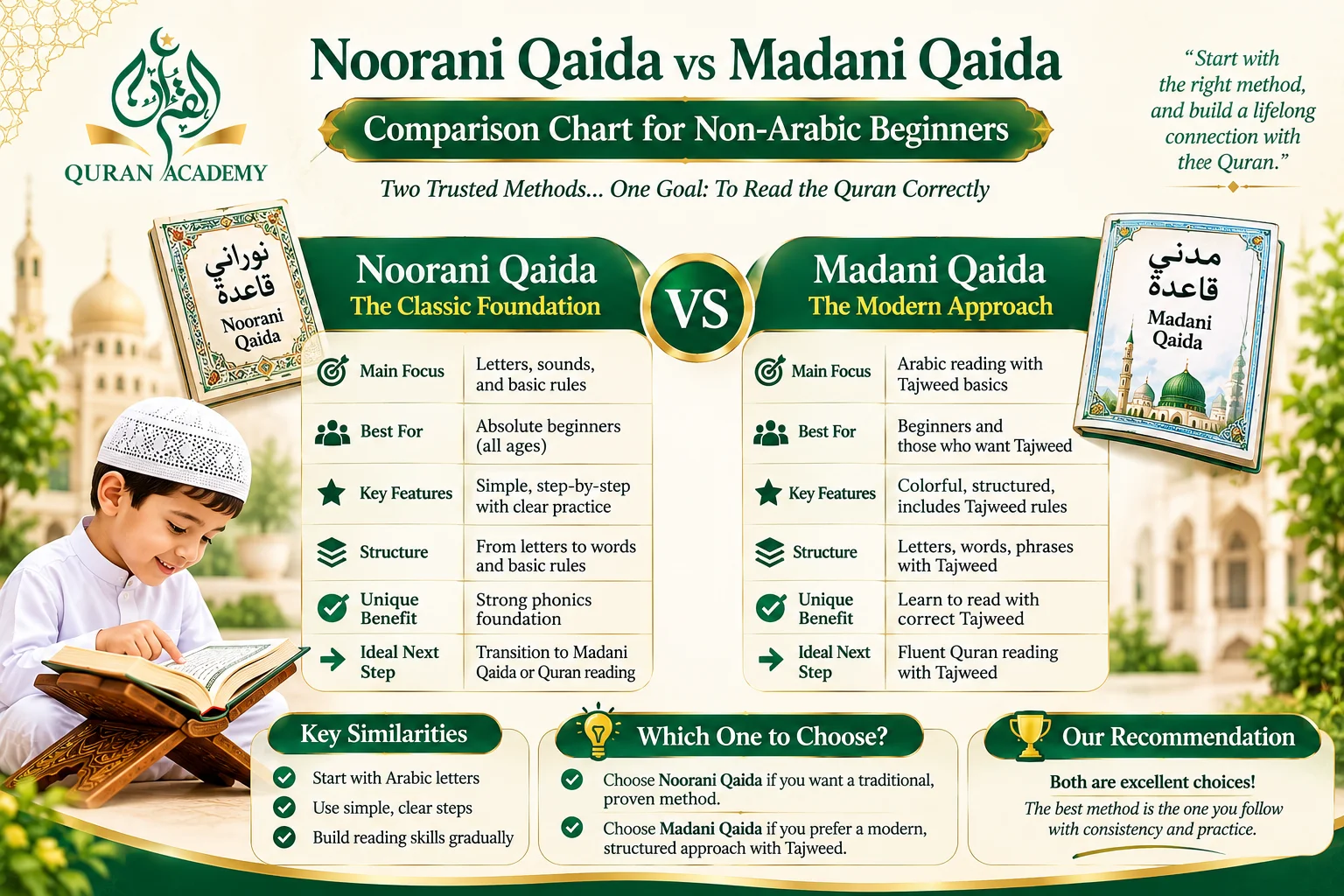
✦ Quick Answer & Key Takeaways: Noorani Qaida vs. Madani Qaida
When comparing Noorani Qaida vs. Madani Qaida, both are time-tested phonetic primers that take non-Arabic beginners from the alphabet (Alif-Baa-Taa) to reading full Quranic verses with Tajweed. Noorani Qaida (compiled by Sheikh Noor Muhammad Haqqani) is a streamlined 17-lesson classical curriculum that trains your eyes to decode rules directly from standard Uthmani script markings, whereas Madani Qaida is an expanded 22-lesson modern adaptation featuring built-in 4-color Tajweed coding, written Q&A rule boxes at the bottom of each page, and an appendix of daily Duas. In our 1-on-1 Online Tajweed & Qaida Course, we customize whichever booklet best matches your child's or your own visual learning style.
- Choose Noorani Qaida If: You want the fastest, most direct bridge (17 lessons in 3–5 months) into the standard black-and-white 15-line Uthmani Madinah Mushaf without becoming dependent on color-coded highlights.
- Choose Madani Qaida If: You are teaching a visual learner or young child who benefits from seeing heavy letters in dark green, Qalqalah in blue, and Ghunnah in red, or if your household prefers the Indo-Pak script style.
- 100% Quranic Vocabulary: Every single word example in both books is taken directly from the Holy Quran—meaning by the final lesson, you are already reading real Quranic words!
- The "Talaqqi" Secret: No Qaida book can correct your tongue placement on its own; live auditory feedback from a certified teacher is what brings the printed letters to life.
When an English-speaking parent or adult revert decides to start learning how to read the Holy Quran from scratch, the very first question that pops up is: "Which beginner booklet should we start with—Noorani Qaida or Madani Qaida?"
If you ask one local teacher, they will insist that Al-Qaida Al-Nooraniyyah is the undisputed gold standard of the Muslim world. If you ask another tutor, they will recommend Madani Qaida for its color-coded letters and self-study questions at the bottom of every page. To make matters even more confusing for Western families, both books exist in multiple print scripts (Uthmani vs. Indo-Pak) and use slightly different phonetic spelling styles (Hija'). In this comprehensive pillar guide, we will dissect Noorani Qaida vs. Madani Qaida lesson by lesson, compare their visual layouts side by side, and help you select the exact pathway that will get you or your child reading the Mushaf fluently in the shortest time possible.
- What Is Noorani Qaida? (History, 17-Lesson Structure & Core Strengths)
- What Is Madani Qaida? (Origins, 22-Lesson Structure & Color-Coding System)
- Master Comparison Chart: Noorani Qaida vs. Madani Qaida Across 8 Factors
- The Script Dilemma: Uthmani (Madinah) Script vs. Indo-Pak (Majeedi) Script
- Syllabus Breakdown: How Both Books Teach Vowels, Sukoon, Madd & Noon Sakinah
- Decision Guide: Which Book Is Best for Young Kids, Adult Beginners & Reverts?
- How to Transition From Your Qaida Book to Fluent Mushaf Reading Without Losing Tajweed
- Frequently Asked Questions (FAQs)
1. What Is Noorani Qaida? (History, 17-Lesson Structure & Core Strengths)
Al-Qaida Al-Nooraniyyah (الْقَاعِدَةُ النُّورَانِيَّة) is the world's most widely taught Quranic phonics primer. Compiled in the 19th century by the renowned scholar Sheikh Noor Muhammad Haqqani (1856–1925 CE) of Ludhiana, India, and later refined in its modern Uthmani script edition by his grandson Engineer Mohammad Farooq Al-Raee, this compact booklet revolutionized how non-Arab children and adults learn to read the Quran.
Before Sheikh Haqqani's work, beginners often spent years memorizing non-Quranic Arabic sentences before ever touching the Mushaf. As we explain in our dedicated beginner overview on How Noorani Qaida Helps Quran Beginners, the genius of Noorani Qaida lies in three pedagogical breakthroughs:
Every single page builds mathematically on the previous page—moving from isolated letters (Lesson 1) to joined forms (Lesson 2), short vowels (Lesson 4), Tanween (Lesson 5), Madd, Sukoon, and Shaddah (Lessons 7–17).
Instead of using everyday modern words like "apple" or "car," Noorani Qaida uses exclusively authentic words from the Holy Quran, training your tongue on real Quranic consonant clusters from Week 2.
Students spell out each syllable rhythmically (e.g., "Baa Fatha Baa, Dal Kasra Di, Badi..."), which naturally internalizes vowel timing counts (Harakat) so beginners never rush or clip long vowels.
How Applied Tajweed Rules Come Alive Inside Your Qaida Lessons
Whether you study Noorani Qaida (Lesson 11) or Madani Qaida (Lesson 10), your first major Tajweed milestone is mastering Sukoon and the 5 echoing letters of Qalqalah (ق ط ب ج د). In this short video from our official Quran Academy YouTube Channel, Senior Instructor Ustadhah Yasmeen Gamal demonstrates how live auditory modeling brings printed Qaida rules to life:
- Sound Before Theory: Hear the immediate difference between a muted consonant and a crisp, natural Qalqalah bounce on Al-Falaq and Lam Yalid.
- Why Live Coaching Matters: A book shows you the symbol, but a certified teacher trains your ear and tongue in real time!
2. What Is Madani Qaida? (Origins, 22-Lesson Structure & 4-Color Tajweed System)
Madani Qaida (الْقَاعِدَةُ الْمَدَنِيَّة) is a modern, visually enhanced adaptation of classical Qaida primers, published and popularized globally by Dawat-e-Islami (Maktaba-tul-Madina). While it follows the exact same foundational phonics sequence as Noorani Qaida, Madani Qaida expands the curriculum into 22 lessons and introduces three distinct features designed for visual learners and self-study review:
- 1. Built-In 4-Color Tajweed Highlighting: From the very first lesson, Madani Qaida prints letters in four distinct colors to trigger instant visual recognition of essential Tajweed terminology:
- Dark Green Letters: Indicate the 7 permanently heavy letters (Huroof al-Isti'laa / Musta'liyah — خ ص ض غ ط ق ظ) so the student remembers to pronounce them with a full mouth (Tafkhim).
- Red Letters: Indicate where Ghunnah (2-count nasalization) or Ikhfa / Idgham with Ghunnah must be held in the nose.
- Blue Letters: Indicate the 5 bouncing letters of Qalqalah (ق ط ب ج د) when they carry a Sukoon.
- Purple / Magenta Markings: Highlight vowels or letters requiring longer prolongation (Madd).
- 2. Written "Instruction & Q&A Boxes" at the Bottom of Every Page: Unlike classical Noorani Qaida (which contains only Arabic letter grids and relies 100% on the teacher's oral explanation), Madani Qaida includes English or Urdu instruction footnotes and 3 to 5 test questions at the bottom of each lesson so parents can quiz their children at home.
- 3. Basic Islamic Etiquette & Daily Duas (Lessons 21–22): The final pages of Madani Qaida include the Six Kalimas, the method of Wudu and Salah, and daily Prophetic supplications—making it a two-in-one primer for young children.
3. Master Comparison Chart: Noorani Qaida vs. Madani Qaida Across 8 Key Factors
To see how both books stack up side by side, review this 5-column technical comparison prepared by our curriculum supervisors (all of whom are Certified Al-Azhar Quran Tutors):
| Comparison Feature | Noorani Qaida (Classical) | Madani Qaida (Modern) | Pedagogical Impact | Which One Wins? |
|---|---|---|---|---|
| 1. Total Number of Lessons | 17 Lessons (Approx. 30–34 pages). | 22 Lessons (Approx. 44–52 pages). | Noorani Qaida reaches the Mushaf 3–4 weeks faster; Madani splits rules into smaller steps. | 🏆 Noorani (For Speed) 🏆 Madani (For Micro-Steps) |
| 2. Primary Arabic Script | Available in both Uthmani (Madinah) & Indo-Pak scripts. | Primarily printed in Indo-Pak (Majeedi) script. | Uthmani script matches the standard 15-line Madinah Mushaf used worldwide. | 🏆 Noorani Qaida (Uthmani) |
| 3. Color-Coded Tajweed | Rule-Based Recognition: Teaches you to spot rules without color crutches (or light vowel colors). | Full 4-Color System: Green (Heavy), Red (Ghunnah), Blue (Qalqalah). | Colors help kids initially, but Noorani prevents "freezing" on black-and-white Mushafs. | 🏆 Tie (Depends on Learner) |
| 4. Written Rule Explanations | Zero English text on the pages (100% teacher-guided oral Talaqqi). | Includes English/Urdu rule definitions & Q&A quizzes on every page. | Helpful for parents reviewing homework with kids between live classes. | 📘 Madani Qaida |
| 5. Syllabic Spelling (Hija') | Standard Arabic names (Fatha, Kasra, Damma, Tanween). | Uses either Zabar, Zer, Pesh (South Asian) or Fatha, Kasra, Damma. | Using standard Arabic terms (Fatha/Kasra/Damma) aligns with international Tajweed books. | 🏆 Noorani Qaida |
| 6. Average Completion Time | 3 to 5 Months (at 3 classes/week). | 4 to 6 Months (at 3 classes/week). | Both build complete readiness to read Juz Amma directly from the Mushaf. | 🏆 Noorani Qaida (Slightly Faster) |
4. The Script Dilemma: Why Uthmani vs. Indo-Pak Script Matters More Than the Book Title
Here is a critical insight that 90% of comparison articles miss: when choosing between Noorani Qaida vs. Madani Qaida, the most important factor is actually which Quranic script (Rasm) your family uses at home!
Across the Muslim world, printed Mushafs follow one of two major calligraphic conventions:
- The Uthmani Script (Madinah Mushaf Style): Used across the Arab world, Makkah and Madinah, Turkey, Africa, and the vast majority of mosques and Islamic schools in the US, UK, Canada, and Australia—as well as in our Online Uthmani Quran Explorer. In Uthmani script, the Sukoon looks like a tiny head of the letter Haa (ـْـ), Hamzatul-Wasl carries a tiny Saad (ٱ), and silent letters are left completely bare without vowel markings.
- The Indo-Pak (Majeedi / Persian) Script: Widely used across Pakistan, India, Bangladesh, and South African madrasas. It uses a rounder, bolder Nastaliq-inspired calligraphy where the Sukoon looks like a curved caret, long vowels use vertical standing Fathas more frequently, and stopping signs include extra regional markers.
Our Golden Rule for Beginners: If you plan to read and memorize from the standard 15-line Madinah Mushaf (Uthmani script), always study the Uthmani edition of Noorani Qaida (Al-Qaida Al-Nooraniyyah)! Starting in an Indo-Pak Madani Qaida and then switching to an Uthmani Mushaf six months later forces a beginner's eyes to re-learn how Sukoon, Tanween, and stopping signs look on the page.
3. The 15-Minute "Fajr & Salah Anchor" Daily Hifz Routine for Working Women & Moms
The biggest mistake mature learners make is waiting for a quiet two-hour block on the weekend to memorize a full page at once. By Monday morning, 80% of that weekend page has vanished. Instead, our most successful sisters and working professionals over 40 use the 15-Minute Fajr & Salah Anchor System—which breaks a 3-line daily target into four effortless micro-moments across the day:
Struggling to perfect your Recitation?
Join hundreds of students mastering the Quran with our Verified Al-Azhar Graduates. We offer flexible 1-on-1 sessions tailored to your schedule.
Book a Free Evaluation Class →🕰️ Your 4-Step Daily Micro-Hifz Schedule (3 to 5 Lines / Day)
Open our Online Quran Explorer & Audio Player, play your target 3 lines recited by Sheikh Mishary Alafasy 3 times while tracking the Arabic words with your eyes, and read the English translation once. During deep sleep, your hippocampus begins consolidating those visual and acoustic patterns before you even start memorizing!
While the house is quiet and your cortisol and focus levels are naturally balanced, sit on your prayer mat and apply the 3x3 method to your 3 target lines:
• Minutes 1–4 (Line 1): Read 3x looking at the Mushaf → Recite 3x from memory.
• Minutes 5–8 (Line 2 + Link): Read Line 2 (3x looking, 3x memory) → Recite Line 1 + Line 2 together 3x.
• Minutes 9–12 (Line 3 + Full Seal): Read Line 3 (3x looking, 3x memory) → Recite all 3 lines together 3x without peeking!
Instead of reciting only short Surahs from Juz Amma in every prayer, recite your new 3-line block in the first Rak'ah of your Sunnah and obligatory prayers throughout the day (glancing at your Mushaf for 20 seconds before Takbir if needed). By Isha prayer, you will have recited your new verses 10 to 15 times inside Salah! (You can also use our 5-Prayer Daily Quran Schedule Calculator to anchor your broader reading habit to your daily prayers).
Never memorize new lines 7 days a week! Memorize 3 lines per day from Sunday to Thursday (15 lines = 1 full Madani Mushaf page per week), and dedicate Friday and Saturday strictly to stitching those 15 lines into a single, seamless page.
4. Master Chart: Realistic Adult Hifz Pacing vs. Traditional Youth Pacing
When adults over 40 quit Hifz, 90% of the time it is not because their memory failed—it is because they tried to follow a schedule built for a 12-year-old full-time boarding student. Choose one of the three realistic adult tracks below based on your current life season:
| Hifz Track Name | Daily New Target (5 Days / Wk) | Daily Time Needed | Milestone: Time to Finish 1 Juz | Best Suited For |
|---|---|---|---|---|
| 1. The "3-Line Micro" Track (Most Popular Over 40) |
3 Lines / Day (1 Full Page / Week) |
12–15 Minutes | 5 Months per Juz (~2.5 Juz / Year) |
Working mothers, executives, and adults over 40 starting Hifz. |
| 2. The "5-Line Third-Page" Track (Balanced Adult Pace) |
5 Lines / Day (1.6 Pages / Week) |
20–25 Minutes | 3 Months per Juz (4 Juz / Year) |
Adults with smooth Arabic reading fluency & flexible mornings. |
| 3. The "Half-Page Steady" Track (Retirees & Dedicated Sisters) |
7–8 Lines / Day (2.5 Pages / Week) |
30–35 Minutes | 8 Weeks per Juz (6 Juz / Year) |
Empty-nesters, retirees over 50, and part-time homemakers. |
| 4. Traditional Seminary Track (High Burnout Risk for Adults) |
1–2 Full Pages / Day (15–30 Lines / Day) |
2–3 Hours Daily | 2–4 Weeks per Juz | Full-time youth students; rarely sustainable for busy adults with jobs/families. |
5. How to Use Sabaq, Sabqi & Manzil to Protect Your Adult Memory Against Forgetting
As we grow older, our brains become highly selective about what they keep in permanent storage: if the brain does not see a piece of information used repeatedly across multiple days, it prunes it away to save mental energy. To signal to your brain that every verse of the Quran is permanent, pair your daily 3-line lesson with the 3-Tier Consolidation Loop (explore all related Quranic sciences and recitation terms in our Interactive Tajweed & Quranic Encyclopedia):
- 1. Sabaq (Your New 3 Lines Today): Never start memorizing today's 3 lines until you can read them fluently without a single pronunciation slip.
- 2. Sabqi (Your 7-Day Rolling Buffer): Before learning today's 3 lines, spend 5 minutes reciting the previous 15 to 30 lines (1 to 2 pages) you memorized over the past week. Every new line must stay in your daily Sabqi buffer for 7 consecutive days before graduating to old revision.
- 3. Manzil (Your Lifetime Treasure): Once you have memorized 5 or more pages, read 2 to 3 pages of your older memorized Surahs every day (for example, right before Maghrib or Isha).
If you ever feel discouraged because a verse takes you longer to pronounce or memorize than it takes a child, remember the glad tidings of Prophet Muhammad (peace be upon him) narrated by Aisha (may Allah be pleased with her):
"The one who is proficient in the recitation of the Quran will be with the honorable and obedient scribes (angels), and he who recites the Quran and finds it difficult to recite, doing his best to recite it in the best way possible, will have a double reward."
6. Why 1-on-1 Female Tutors & Private Coaching Transform Adult Hifz Over 40
Self-studying Hifz alone at home works for the first week—until a busy workday, a family emergency, or a tricky verse in Surah An-Naba or Surah Al-Mulk breaks your streak. As we explain in our guide on How Busy Adults Learn Quran Online, having a dedicated 1-on-1 instructor solves the three biggest hurdles mature learners face:
- 100% Judgment-Free Privacy for Sisters & Brothers: Sisters over 40 study 1-on-1 with compassionate, certified Al-Azhar female teachers, while brothers study with certified male scholars—with zero group pressure or embarrassment.
- Catching "Hidden Vowel Mistakes" Before You Memorize Them: Even advanced readers occasionally misread a Damma as a Fatha or skip a subtle Quranic Tajweed rule. Your tutor listens to you read tomorrow's 3 lines live (Talaqqi) so you never engrave an error into your memory.
- Built-In Weekly Accountability: Knowing that your warm, encouraging teacher is waiting to hear your 3-line block on Tuesday and Thursday morning keeps you consistent even during busy work weeks.
7. Four Common Mistakes Mature Hifz Students Make (And How to Fix Them)
- Starting With Surah Al-Baqarah Instead of Building Momentum With Short Surahs: While memorizing Surah Al-Baqarah is a noble goal, jumping straight into 286 long verses as your very first Hifz project can feel overwhelming. Start with Juz Amma (Juz 30) or Juz Tabarak (Juz 29 — starting with Surah Al-Mulk) so your brain experiences the joy of completing entire Surahs every few weeks!
- Memorizing Without Understanding the Storyline (Tafsir): Adult memory thrives on logic and meaning. Spend 2 minutes reading our Complete Quran Tafseer Guide or scanning the verse translation before you begin repeating.
- Relying on Silent Visual Reading Instead of Audible Recitation: Never memorize silently in your head! Recite aloud in a moderate, melodious voice so your ears and vocal cords lock in the rhythm.
- Giving Up After Missing Two Days: Life happens—children get sick, work trips come up, and guests visit. If you miss two days of new memorization, simply treat those days as Manzil revision days and pick up your 3-line target the next morning without guilt!
Read inspiring stories from adult learners, reverts, and parents across the US, UK, Canada, and Australia who started their Quran journey with us on our Verified Student & Parent Reviews Page.
8. Frequently Asked Questions (FAQs) About Memorizing the Quran After 40
1. Is it really possible to memorize the Quran as an adult over 40, 50, or 60?
Yes, absolutely! While children memorize through raw auditory repetition, adults over 40, 50, and 60 possess superior analytical comprehension, contextual intelligence, and emotional discipline. By memorizing just 3 to 5 lines per day using structured micro-schedules, mature learners consistently complete Juz Amma, Juz Tabarak, and full Hifz tracks without burnout.
2. Does adult brain plasticity allow for long-term Quran memorization?
Modern neuroscience confirms that adult brains retain neuroplasticity throughout life. In fact, daily Quran memorization is one of the most powerful cognitive exercises for keeping memory sharp as we age. When adults pair verse meanings (Tafsir) with the 3x3 linking method and daily Salah recitation, their long-term retention becomes exceptionally strong.
3. How can busy working women and mothers fit Hifz into a tight daily routine?
Busy sisters and mothers succeed by using the "Fajr & Salah Anchor Method": listen to your target 3 lines for 3 minutes before bed, spend 12 uninterrupted minutes right after Fajr prayer memorizing those 3 lines with the 3x3 technique, and recite them inside your 5 daily prayers throughout the day.
4. Do I need full fluency in Arabic grammar to start memorizing the Quran after 40?
No, prior mastery of Arabic grammar is not required to begin Hifz. As long as you can read the Arabic Mushaf script accurately (or after a quick refresher in Noorani Qaida and Tajweed), you can read the English translation of your 3 daily lines in 45 seconds to grasp the storyline before memorizing.
5. Where can women over 40 find private, certified female Quran tutors online?
Quran Academy provides dedicated 1-on-1 online Hifz and Tajweed classes led by certified Al-Azhar female scholars, guaranteeing 100% privacy, flexible scheduling across US, UK, Canadian, and Australian timezones, and gentle, customized pacing for adult learners.
It Is Never Too Late to Carry the Quran in Your Heart
Take the first step today in a warm, judgment-free 1-on-1 classroom. Meet your certified male or female Al-Azhar tutor for a free evaluation session and get a realistic 15-minute daily Hifz plan tailored to your life!
Book Your Free 1-on-1 Adult Hifz Trial Class →