
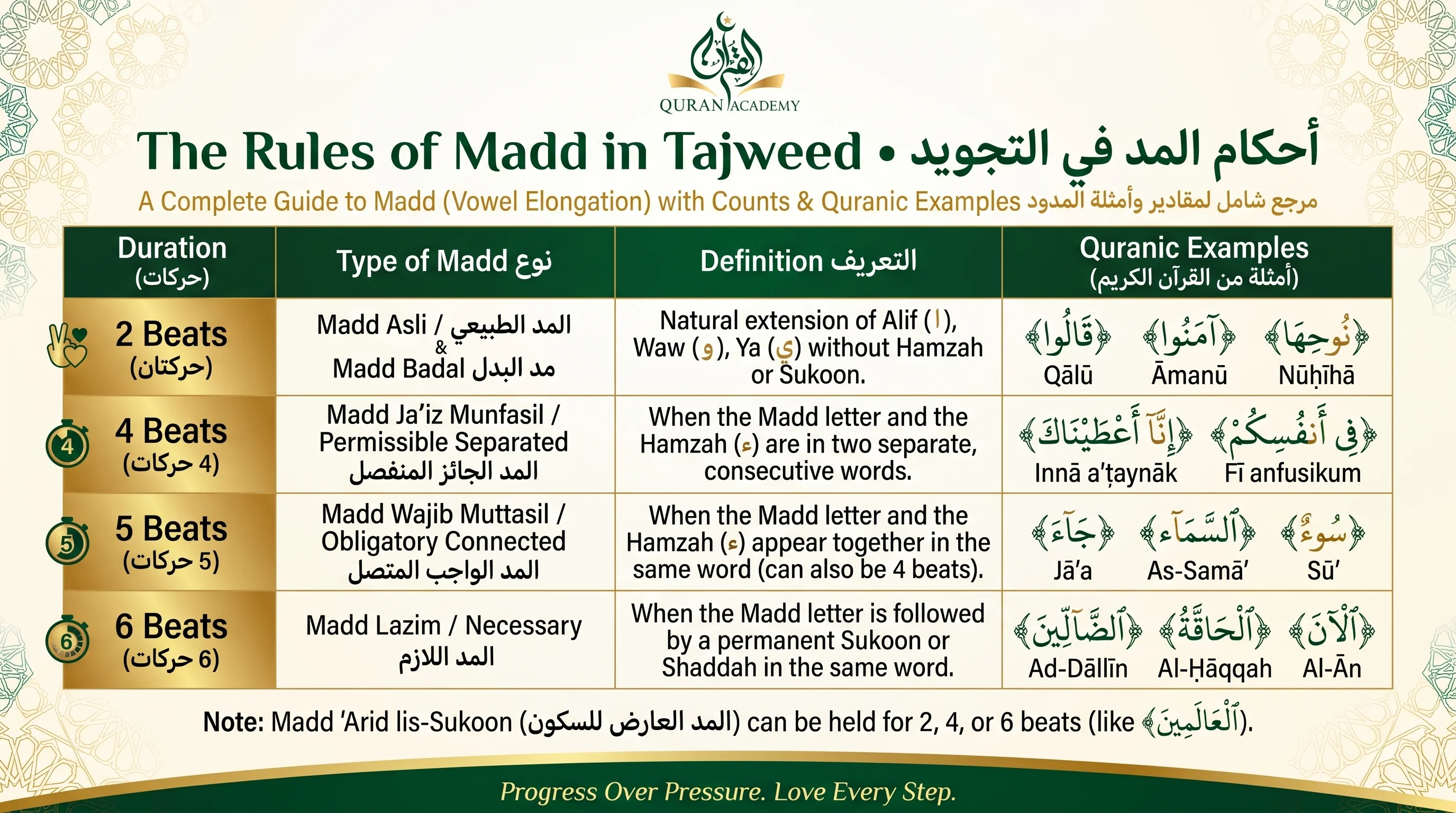
✦ Quick Answer & Key Takeaways: Rules of Madd in Tajweed
In Tajweed, Al-Madd (الْمَدّ — Prolongation) means stretching the sound of one of the three long vowel letters—Alif (ـَا), Waw (ـُو), or Yaa (ـِي)—for a precise number of beats (Harakat). Every Madd in the Quran falls into two master categories configured by a simple 2-4-6 Beat Rule: 1. Natural Madd (Madd Tabee'i) is stretched for exactly 2 beats when no Hamzah (ء) or Sukoon (ـْ) follows it; 2. Secondary Madd (Madd Far'i) is stretched for 4 or 5 beats when followed by a Hamzah, and up to 6 beats when followed by a permanent Sukoon or Shaddah. Students in our 1-on-1 Learn Tajweed Online Course master these exact vowel timings directly inside the Uthmani Mushaf.
- The 3 Letters of Madd (Grouped in نُوحِيهَا): 1. Vowelless ا (Alif) preceded by a Fatha, 2. Vowelless و (Waw) preceded by a Damma, and 3. Vowelless ي (Yaa) preceded by a Kasra.
- What Is 1 Harakah (Beat)? One Harakah equals the natural time it takes to smoothly unfold or close one finger (roughly 0.5 seconds at a moderate recitation pace).
- The Mushaf Tilde Secret (~): Whenever you see the wavy tilde sign (آ) above a Madd letter in the Madani Mushaf, it is your instant visual cue to stretch that vowel beyond 2 beats (for 4, 5, or 6 counts)!
- Why 2-Beat Accuracy Matters Most: Dropping a 2-beat Natural Madd down to 1 beat is a major error (Lahn Jali) that can change the grammar and meaning of Allah's words.
Have you ever listened to a master Qari recite Surah Al-Fatiha or Surah Maryam and wondered how they know exactly how long to hold each vowel? On some words, their voice glides briskly for two quick beats; on other words carrying the wavy (~) sign, they hold the vowel for four or পাঁচ counts; and on the final word of Surah Al-Fatiha (وَلَا الضَّآلِّينَ), they sustain a majestic six-beat stretch before coming to a gentle rest.
When solo learners try to copy that melody by ear without knowing the rules of Madd in Tajweed, they fall into guesswork—stretching short vowels randomly where they shouldn't and cutting mandatory 6-beat elongations short. The good news is that Quranic elongation is not a mystery; it is a crystal-clear, mathematical system governed by just two triggers: the Hamzah (ء) and the Sukoon (ـْ/ـّ). Once you learn the visual 3-step decision tree below, you will know the exact beat count of every single word in the Mushaf at a glance!
- What Is Madd in Tajweed? (The 3 Madd Letters & 2 Leen Letters)
- Category 1: Natural Madd (Al-Madd Al-Tabee'i) & Its 4 Sisters (Always 2 Beats)
- Category 2: Secondary Madd (Al-Madd Al-Far'i) — Hamzah vs. Sukoon Triggers
- Master Chart: All 9 Types of Madd in Tajweed (2, 4, 5 & 6-Beat Breakdown)
- Step-by-Step: How to Spot Every Madd Instantly Using Mushaf Symbols
- Practical Walkthrough: Auditing Every Madd Inside Surah Al-Fatiha
- 3 Common Madd Timing Mistakes Our Al-Azhar Tutors Fix in 1-on-1 Classes
- Frequently Asked Questions (FAQs) About Rules of Madd
1. What Is Madd in Tajweed? (The 3 Madd Letters & 2 Leen Letters)
Linguistically, the Arabic word Al-Madd (الْمَدّ) means "extra" or "lengthening." In the science of Tajweed, it means prolonging the vocal sound through the open cavity of the throat and mouth (Al-Jawf—the first of the 5 major Makharij al-Huruf articulation areas) when reciting one of the three Madd letters or two Leen letters.
Scholarly poetry gathers all three conditions of the Madd letters into a single Quranic word from Surah Hud (11:49): نُوحِيهَا (Nooheehaa):
An open ا (or miniature Dagger Alif ـٰ) preceded by a Fatha—as in قَالَ (Qaala) and هَـٰذَا (Haadhaa).
A bare, vowelless و (or tiny inverted Damma ـۥ) preceded by a Damma—as in يَقُولُ (Yaqoolu) and نُوحِيهَا.
A bare, vowelless ي (or tiny standing Kasra ـۦ) preceded by a Kasra—as in قِيلَ (Qeela) and فِي (Fee).
What about the 2 Leen (Soft) Letters? When a vowelless وْ (Waw Sakinah) or يْ (Yaa Sakinah) is preceded by a Fatha (ـَ) instead of a matching vowel—as in خَوْفٍ (Khawf) and قُرَيْشٍ (Quraysh)—they are called Huruf al-Leen. In the Mushaf, you can spot a Leen letter instantly because it carries a visible Sukoon head (ـْ) above the Waw or Yaa, whereas true Madd letters are completely bare!
Hear How Precise Vowel Timing & Stopping Rules Transform Recitation
How do you combine smooth Madd elongations with crisp end-of-verse stops? Watch Senior Al-Azhar Instructor Ustadhah Yasmeen Gamal on our official Quran Academy YouTube Channel demonstrate how live auditory modeling trains your ear to master Quranic rhythm:
- Clean End-of-Ayah Transitions: Learn how stopping at the end of a verse activates both Madd 'Arid lis-Sukoon and end-of-word Qalqalah.
- 1-on-1 Finger-Count Coaching: Our teachers count beats live on screen until your 2, 4, and 6-count stretches are 100% consistent!
2. Category 1: Natural Madd (Al-Madd Al-Tabee'i) & Its 4 Sisters (Always 2 Beats)
Al-Madd Al-Asli / Al-Tabee'i (الْمَدُّ الطَّبِيعِيّ — Natural Madd) is the foundational building block of Arabic rhythm. It occurs whenever an Alif, Waw, or Yaa Madd is NOT preceded by a Hamzah and is NOT followed by a Hamzah (ء) or a Sukoon (ـْ). As we highlight in our foundational What Is Tajweed in Islam Pillar Guide, it is called "Natural" because a person with a sound linguistic nature naturally holds it for exactly 2 beats (2 Harakat)—never more, never less!
Along with standard Madd Tabee'i, scholars group four "Sister Rules" (Mulhaqat al-Madd al-Tabee'i) that also take an exact 2-beat count in Riwayat Hafs 'an 'Asim:
- 1. Al-Madd Al-Badal (مَدُّ الْبَدَل — Substitute Madd | 2 Beats): Occurs when a Hamzah comes BEFORE the Madd letter in the same word (and no Hamzah or Sukoon follows it), such as آمَنُوا (Aamanoo), إِيمَانًا (Eemaanan), and أُوتُوا (Ootoo). It is stretched for exactly 2 beats in Hafs.
- 2. Al-Madd Al-'Iwad (مَدُّ الْعِوَض — Compensation Madd | 2 Beats on Stopping): Occurs when you stop (pause) on a word ending in a double Fatha (ـً / Fathatayn), such as stopping at the end of verses in Surah Al-'Adiyat or Surah An-Naba: مَاءً ثَجَّاجًا → pronounced "Thajjaajaa" (2 beats) instead of "Thajjaajan"! (Exception: if the double Fatha sits on a round Taa Marbootah ـةً like رَحْمَةً, you stop with a soft هْ sound: "Rahmah").
- 3. Al-Madd Al-Silah Al-Sughra (مَدُّ الصِّلَةِ الصُّغْرَى — Minor Connecting Madd | 2 Beats): Occurs when the singular masculine pronoun ـهُ / ـهِ (Haa al-Kinayah) falls between two vowel-bearing letters and is not followed by a Hamzah. In the Mushaf, a tiny miniature Waw (ـۥ) or miniature Yaa (ـۦ) is printed right after the ه—as in إِنَّهُۥ كَانَ (Innahoo kaana — 2 beats).
- 4. Madd Tabee'i Harfi (حَيٌّ طَهُرَ — 2-Beat Opening Letters): In the mysterious opening letters of certain Surahs (Al-Huruf Al-Muqatta'ah), any letter from the five-letter phrase حَيٌّ طَهُرَ (ح، ي، ط، هـ، ر) is spelled as two letters and stretched for 2 beats—such as طه (Taa-Haa: 2 beats + 2 beats) and the ط in طسم!
3. Category 2: Secondary Madd (Al-Madd Al-Far'i) — Hamzah vs. Sukoon Triggers
Whenever a 2-beat Natural Madd letter is immediately followed by either a Hamzah (ء) or a Sukoon (ـْ / ـّ), it upgrades into Al-Madd Al-Far'i (الْمَدُّ الْفَرْعِيّ — Secondary / Extended Madd) and is stretched for 4, 5, or 6 beats. Here is the golden rule to separate the two triggers:
⚡ The Two Triggers of Extended Madd (4–5 Beats vs. 6 Beats)
Whenever a Madd letter (~) is followed by a Hamzah (ء / أ / إ), your finger count is 4 or 5 beats:
Struggling to perfect your Recitation?
Join hundreds of students mastering the Quran with our Verified Al-Azhar Graduates. We offer flexible 1-on-1 sessions tailored to your schedule.
Book a Free Evaluation Class →2. Madd Ja'iz Munfasil (مَدٌّ جَائِزٌ مُنْفَصِل — Separated Permissible Madd | 4 or 5 Beats): The Madd letter is at the end of Word 1, and the أ / إ is at the start of Word 2 (e.g., إِنَّآ أَعْطَيْنَاكَ, قُوٓا۟ أَنفُسَكُمْ).
3. Madd Silah Kubra (مَدُّ الصِّلَةِ الْكُبْرَى — Major Connecting Madd | 4 or 5 Beats): The pronoun ـهُ / ـهِ is followed by a Hamzah at the start of the next word, marked by a tiny tilde over the miniature Waw/Yaa (e.g., مَالَهُۥٓ أَخْلَدَهُۥ in Surah Al-Humazah).
Whenever a Madd letter is followed by a vowelless letter (Sukoon or Shaddah):
2. Madd 'Arid lis-Sukoon (الْمَدُّ الْعَارِضُ لِلسُّكُون — Temporary Madd for Stopping | 2, 4, or 6 Beats): Occurs when you stop at the end of a verse where the second-to-last letter is a Madd letter (e.g., stopping on الْعَالَمِينَ, الرَّحِيمِ, نَسْتَعِينُ). Because stopping turns the final letter into a temporary Sukoon, you may stretch it for 2, 4, or 6 beats!
3. Madd Leen (مَدُّ اللِّين — Soft Madd on Stopping | 2, 4, or 6 Beats): Occurs only when you stop on a word with a Waw or Yaa Sakinah preceded by a Fatha before the final consonant (e.g., stopping on قُرَيْشٍ, خَوْفٍ, الصَّيْفِ).
4. Master Chart: All 9 Types of Madd in Tajweed (2, 4, 5 & 6-Beat Breakdown)
Save or print this comprehensive 5-column chart covering every major Madd rule in Riwayat Hafs 'an 'Asim (and test all examples live with audio in our Online Digital Quran Explorer):
| Name of Madd Rule | Beat Count (Harakat) | Exact Condition / Trigger | Visual Clue in Madani Mushaf | Quranic Example |
|---|---|---|---|---|
| 1. Madd Tabee'i (الْمَدُّ الطَّبِيعِيّ — Natural) |
2 Beats (Mandatory) |
Alif, Waw, or Yaa Madd with no Hamzah or Sukoon after it. | Bare ا / و / ي or miniature ـٰ with NO tilde (~). | قَالُوا۟ / مَـٰلِكِ (Surah Al-Fatiha 1:4) |
| 2. Madd Badal (مَدُّ الْبَدَل — Substitute) |
2 Beats | Hamzah comes before the Madd letter in the same word. | ءَا / إِي / أُو without a wavy tilde (~). | ءَامَنُوا۟ / إِيمَـٰنًا (Surah Al-Baqarah 2:9) |
| 3. Madd 'Iwad (مَدُّ الْعِوَض — Stopping) |
2 Beats (On Pause Only) |
Stopping at the end of a word with double Fatha (ـًا). | Final ـًا at the end of an Ayah. | أَفْوَاجًا → Afwaajaa (Surah An-Nasr 110:2) |
| 4. Madd Silah Sughra (مَدُّ الصِّلَةِ الصُّغْرَى) |
2 Beats (When Connecting) |
Pronoun ـهُ / ـهِ between two vowels (no Hamzah after). | Tiny ـۥ or ـۦ after ه with NO tilde. | إِنَّهُۥ كَانَ تَوَّابًۢا (Surah An-Nasr 110:3) |
| 5. Madd Wajib Muttasil (مَدٌّ وَاجِبٌ مُتَّصِل — Same Word) |
4 or 5 Beats (6 if stopping on ء) |
Madd letter + Hamzah (ء) in the SAME word. | Wavy tilde (~) directly before ء in one word. | إِذَا جَآءَ نَصْرُ اللَّهِ (Surah An-Nasr 110:1) |
| 6. Madd Ja'iz Munfasil (مَدٌّ جَائِزٌ مُنْفَصِل — Two Words) |
4 or 5 Beats (Standard Shatibiyyah) |
Madd at end of Word 1 + Hamzah (أ/إ) at start of Word 2. | Wavy tilde (~) at end of word before أ / إ. | إِنَّآ أَنزَلْنَـٰهُ / لَآ أَعْبُدُ (Surah Al-Qadr 97:1) |
| 7. Madd Silah Kubra (مَدُّ الصِّلَةِ الْكُبْرَى) |
4 or 5 Beats | Pronoun ـهُ / ـهِ followed by a Hamzah (أ/إ) in the next word. | Tiny ـۥٓ or ـۦٓ carrying a wavy tilde (~). | مَالَهُۥٓ أَخْلَدَهُۥ (Surah Al-Humazah 104:3) |
| 8. Madd 'Arid & Leen (عَارِضٌ لِلسُّكُونِ وَلِين) |
2, 4, or 6 Beats (On Pause Only) |
Stopping on a word where the second-to-last letter is Madd or Leen. | End-of-verse word like ـِينَ / ـُونَ / ـِيمِ / قُرَيْشٍ. | رَبِّ الْعَـٰلَمِينَ (٢) (Surah Al-Fatiha 1:2) |
| 9. Madd Lazim (Kalimi & Harfi) (الْمَدُّ اللَّازِم — Compulsory) |
STRICTLY 6 Beats! (Mandatory for All) |
Madd letter followed by a permanent Shaddah (ـّ) or Sukoon (ـْ). | Wavy tilde (~) immediately followed by ـّ or ـْ (or in الم / ق / ن). | وَلَا الضَّآلِّينَ / الْحَآقَّةُ (Surah Al-Fatiha 1:7) |
5. Step-by-Step: How to Spot Every Madd Instantly Using Mushaf Symbols
What if you are reading the Quran and don't have time to analyze grammar names in your head? In our Step-by-Step Tajweed Learning Guide (and inside our Interactive Tajweed Glossary), we teach a 2-Second Visual Shortcut whenever you see the wavy tilde sign (~) in the Mushaf:
- Visual Rule 1 — Look at the Very Next Letter After the Tilde (~):
• If the letter immediately after the ~ is a Hamzah (ء / أ / إ) → Count 4 Beats on your fingers!
• If the letter immediately after the ~ carries a Shaddah (ـّ) or Sukoon (ـْ) → Count a full 6 Beats on your fingers! - Visual Rule 2 — How to Decode Opening Surah Letters (Al-Huruf Al-Muqatta'ah):
When a Surah begins with disjointed letters like الم, الر, كهيعص, or حم:
• Alif (ا): Has 0 beats of Madd (just say "Alif").
• Any letter in حَيٌّ طَهُرَ (ح ي ط هـ ر) carries a tiny Dagger Alif (no tilde) → Stretch for 2 Beats (Haa, Yaa, Taa, Haa, Raa).
• Any letter in سَنَقُصُّ عِلْمَكُمْ (س ن ق ص ع ل م ك) carries a wavy tilde (~) → Stretch for a full 6 Beats (Laaaaaam, Meeeeeem, Qaaaaaaf, Noooooon)! - Visual Rule 3 — Beware of the "Circle-Topped Silent Alif/Waw/Yaa" (ا۟): If you see a small round circle (Sifr Mustadeer ـ۟) above an Alif, Waw, or Yaa—such as the final Alif in قَالُوا۟ or the Waw in أُو۟لَـٰٓئِكَ—that letter is 100% silent! Do not stretch it at all!
Qatadah (may Allah have mercy on him) said: I asked Anas ibn Malik (may Allah be pleased with him) about the recitation of the Prophet (peace be upon him), and he replied:
"He used to elongate his recitation with clear, measured stretches (Kana yamuddu maddan)—reciting 'Bismillahir-Rahmanir-Raheem' by stretching 'Bismillah,' stretching 'Ar-Rahman,' and stretching 'Ar-Raheem.'"
6. Practical Walkthrough: Auditing Every Madd Inside Surah Al-Fatiha
Because you recite Surah Al-Fatiha at least 17 times every single day in prayer, perfecting its Madd timings is the fastest way to upgrade your daily Salah:
- 1. Every Mid-Verse Dagger Alif & Long Vowel (2 Beats — Madd Tabee'i): In بِسْمِ اللَّهِ الرَّحْمَـٰنِ, الْعَـٰلَمِينَ (on the 'Aaa), مَـٰلِكِ (on the Maa), إِيَّاكَ (on the yaa), and الصِّرَٰطَ (on the raa), hold each vowel for a crisp 2 beats. Never cut Maaliki down to Maliki!
- 2. Stopping at the End of Verses 1 through 6 (2, 4, or 6 Beats — Madd 'Arid lis-Sukoon): When you pause at the end of each verse on الرَّحِيمِ, الْعَـٰلَمِينَ, الدِّينِ, نَسْتَعِينُ, and الْمُسْتَقِيمَ, choose one consistent beat count (we recommend 4 beats for a calm, melodious prayer pace) and apply that exact same 4-beat length to every verse ending in the Surah!
- 3. The Crown of Verse 7 — وَلَا الضَّآلِّينَ (STRICTLY 6 Beats — Madd Lazim Kalimi Muthaqqal): Notice the wavy tilde (~) over the Alif in الضَّآلِّينَ followed immediately by a Shaddah on the Lam (لِّ)! You must stretch الضَّآ... for a full 6 counts, then press smoothly onto the doubled لِّ before finishing with a 2, 4, or 6-beat pause on ـينَ! (Want to master the classical poetic rules of Imam Al-Jazari and Al-Jamzuri on Mudood? Explore our Advanced Tajweed Rules & Classical Texts Course).
7. Three Common Madd Timing Mistakes Our Al-Azhar Tutors Fix in 1-on-1 Classes
When students join our Al-Azhar Certified Tajweed Tutors (or enroll their children after checking our Tajweed Course Prerequisites Guide), we immediately polish three subtle timing habits:
- Mistake 1 — Dropping Natural 2-Beat Madds at the End of Words (Batr al-Madd): Many readers pronounce the 2-beat Alif at the end of مَا, لَا, or إِذَا as a 1-beat short Fatha when reading quickly. Remember: قَالَ (He said) has a 2-beat Alif, whereas قَلَ changes the word completely!
- Mistake 2 — Sending the Madd Sound Into the Nose (Khashnamat al-Madd): Unlike Noon Sakinah & Tanween rules or Meem Sakinah rules (which use the nasal cavity for Ghunnah), pure Madd vowels (ا / و / ي) must exit 100% cleanly through the open mouth (Al-Jawf) with zero nasal twang! Our tutors test this by having you lightly pinch your nose during a 4-beat Alif Madd—if your voice changes or buzzes, you are nasalizing the Madd!
- Mistake 3 — Uneven "Peer Lengths" ('Adam Taswiyat al-Mudood): Imam Ibn Al-Jazari taught the golden rule: "wal-lafzhu fee nazheerihi kamithlihi" (pronounce equal rules with equal length!). If you choose to stretch Madd 'Arid lis-Sukoon for 4 beats on Verse 1, do not stretch it for 2 beats on Verse 2 and 6 beats on Verse 3!
Read how adult students, sisters, and parents across the US, UK, Canada, and Australia perfected their Quranic recitation rhythm in 1-on-1 classes on our Verified Student & Parent Reviews Page.
8. Frequently Asked Questions (FAQs) About Rules of Madd in Tajweed
1. What is the difference between Madd Muttasil and Madd Munfasil?
Both are stretched for 4 or 5 beats in standard Hafs 'an 'Asim recitation because a Madd letter is followed by a Hamzah (ء). The difference is word boundaries: in Madd Wajib Muttasil (Connected), the Madd letter and the Hamzah are inside the same single word (like جَآءَ or السَّمَآءِ). In Madd Ja'iz Munfasil (Separated), the Madd letter is at the end of Word 1 and the Hamzah is at the start of Word 2 (like إِنَّآ أَعْطَيْنَاكَ).
2. How long is 1 Harakah (beat) in Tajweed, and how do I count it accurately?
One Harakah (count/beat) equals the time it takes to say a single short vowel (like "Ba") or to smoothly unfold one finger at a normal pace—roughly 0.5 seconds. Therefore, a 2-beat Natural Madd takes about 1 second, a 4-beat Madd takes about 2 seconds, and a 6-beat Madd Lazim takes about 3 seconds.
3. Which type of Madd is the strongest in the Quran?
In classical Tajweed scholarship, the hierarchy of strength from strongest to weakest is: 1. Madd Lazim (6 beats — strongest), 2. Madd Wajib Muttasil (4–5 beats), 3. Madd 'Arid lis-Sukoon (2, 4, or 6 beats), 4. Madd Ja'iz Munfasil (4–5 beats), and 5. Madd Badal (2 beats in Hafs).
4. Why is there a wavy sign (~) on وَلَا الضَّآلِّينَ in Surah Al-Fatiha, and how many counts do I hold it?
The word الضَّآلِّينَ contains Madd Lazim Kalimi Muthaqqal because the Alif Madd is immediately followed by a permanent doubled letter (the لّ with a Shaddah). It is mandatory for every Muslim in prayer to stretch the ضَآ... for a full 6 counts before pronouncing the doubled Lam!
5. Is an Alif Madd heavy (Tafkhim) or light (Tarqeeq)?
Unlike Waw and Yaa Madd (which are always light), the Alif Madd (ـَا) is a chameleon—it follows the letter directly before it! If the letter before the Alif is one of the 7 heavy letters (like قَالَ or طَالَ), the Alif Madd sounds deep and heavy. If the letter before it is light (like كَانَ or جَآءَ), the Alif Madd sounds crisp and light!
Master Your 2, 4 & 6-Beat Madd Timing Live With an Al-Azhar Tutor
Want a certified male Sheikh or female Ustadhah to listen to your recitation and calibrate your vowel elongations in real time? Book your free 1-on-1 Tajweed diagnostic session today!
Book Your Free 1-on-1 Tajweed Trial Class →