
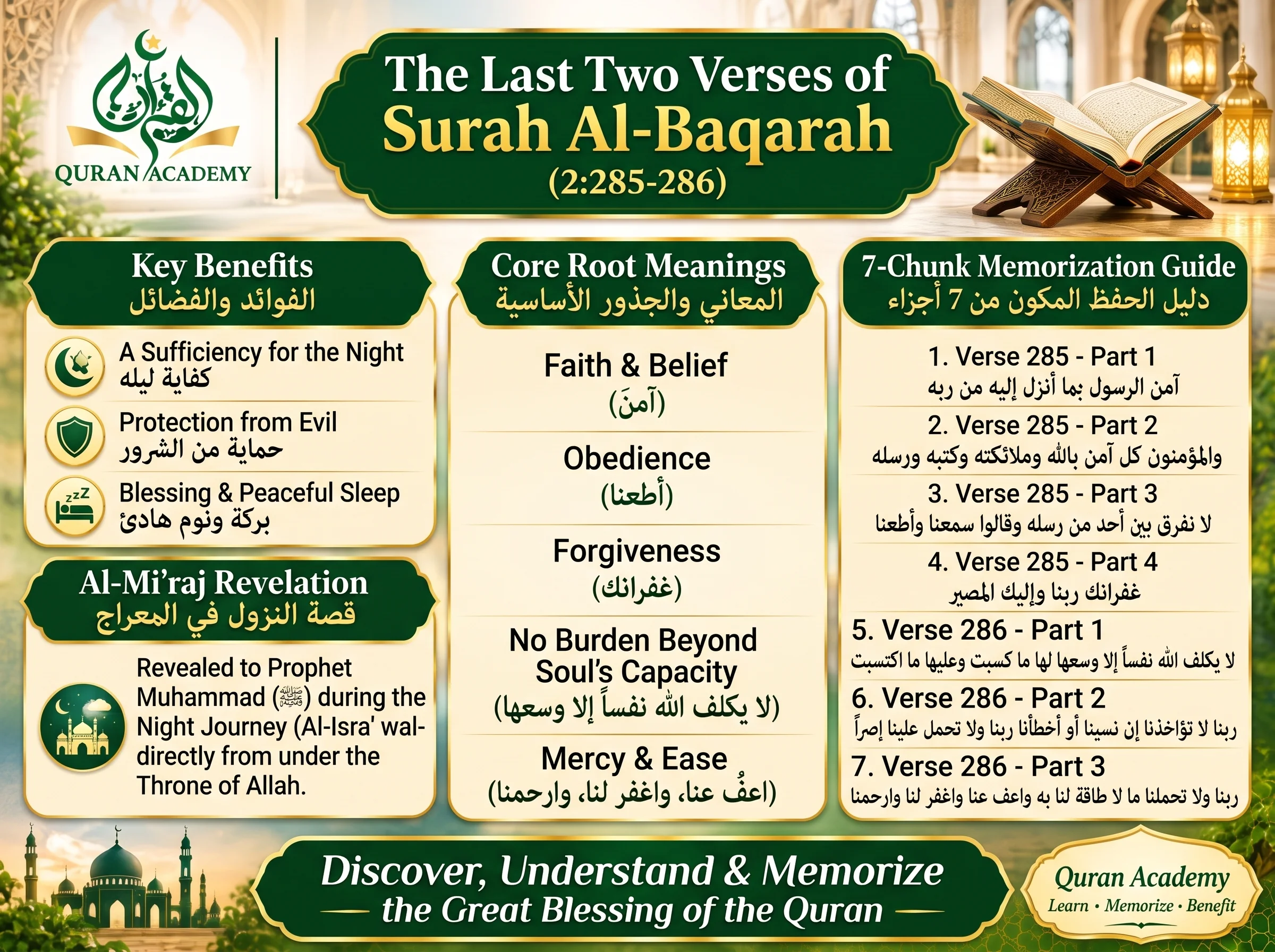
✦ Quick Answer & Key Takeaways: Last Two Verses of Surah Al-Baqarah Benefits & Hifz Guide
Understanding the last two verses of Surah Baqarah benefits, thematic meaning, and memorization structure connects every believer to one of the most honored passages in Islam: Surah Al-Baqarah, Verses 285 and 286 (Khawatim Surat Al-Baqarah), located at the bottom of Page 49 in Juz 3. Unlike chapters revealed gradually on earth, these two concluding verses were gifted directly to Prophet Muhammad (ﷺ) during the Night of Ascension (Al-Isra' wal-Mi'raj), and every collective prayer inside them was immediately accepted by Allah Almighty. In our 1-on-1 Online Quran Memorization (Hifz) Program, students master all 76 words of these two verses in just 10 minutes by breaking them into 7 natural thematic chunks!
- Complete Nightly Sufficiency (Sahih al-Bukhari 5009): Reciting Verses 285–286 before sleeping suffices the believer as a comprehensive spiritual shield and nocturnal worship anchor.
- Direct Gift From Above the Seven Heavens (Sahih Muslim 173): Bestowed at Sidrat al-Muntaha alongside the five daily prayers and sent through a heavenly gate opened specifically for this revelation (Sahih Muslim 806).
- The Ultimate Cure for Spiritual Anxiety (2:286): Establishes the foundational Islamic principle that Allah never burdens any human soul beyond its true capacity, pardoning unintentional forgetfulness and honest mistakes.
- The 7-Chunk Memorization Map: Verse 285 contains 3 Creed Chunks (26 words), while Verse 286 contains 1 Divine Assurance + 3 Escalating "Rabbana" Supplications (50 words).
When you prepare for sleep after a demanding day, which verses form the final spiritual fortress around your home and heart? Alongside Ayatul Kursi (2:255) and Surah Al-Mulk, the Prophetic Sunnah places special emphasis on reciting the last two verses of Surah Al-Baqarah (Verses 285–286) every single night.
Senior Companions such as 'Umar ibn Al-Khattab and 'Ali ibn Abi Talib (may Allah be pleased with them) emphasized that no discerning Muslim should go to sleep without reciting these concluding lines. Why? Because these 76 Arabic words combine a complete renewal of the six pillars of faith with a three-part communal supplication where Allah Almighty personally guaranteed acceptance for every phrase. Yet many beginners and young learners hesitate when memorizing Verse 286 because of its length, or mix up the sequence of the three Rabbana petitions at the end. In this comprehensive guide, we explore the authentic benefits of Verses 285–286, unpack their historical revelation story, analyze their core Arabic root vocabulary, and walk you through our 7-Chunk Memorization System.
- The 7-Chunk Structural Map of Verses 285–286 (How Page 49 Is Organized)
- 5 Authentic Benefits of the Last Two Verses of Surah Al-Baqarah in the Sunnah
- The Historical Context of Verses 284–286: How Humble Obedience Brought Divine Relief
- Master Arabic Root & Thematic Tafseer Table (All 7 Chunks Explained)
- How to Memorize Verses 285–286 in 10 Minutes (3 Cognitive Memory Keys)
- 5 Essential Tajweed Checkpoints in Khawatim Surat Al-Baqarah
- Frequently Asked Questions (FAQs)
1. The 7-Chunk Structural Map of Verses 285–286 (How Page 49 Is Organized)
When you open Page 49 of our Online Uthmani Quran Explorer (which concludes our Surah Al-Baqarah Memorization Plan), you will notice that the final 8 lines of the longest Surah in the Quran are divided by classical Waqf (stopping) signs into 7 balanced, breath-friendly units:
📜 Part A — Verse 285: The Covenant of Faith (3 Chunks • 26 Words)
- Chunk [1] — Shared Faith of the Prophet & Believers (آمَنَ الرَّسُولُ... وَالْمُؤْمِنُونَ): Begins by affirming that the Messenger (ﷺ) and the community of believers wholeheartedly accept everything sent down from their Lord.
- Chunk [2] — Universal Belief in All Prophets (كُلٌّ آمَنَ بِاللَّهِ... مِّن رُّسُلِهِ): Lists the four pillars of revelation—Allah, His angels, His scriptures, and His messengers—declaring that believers never discriminate between any of Allah's prophets.
- Chunk [3] — The Motto of Submission & Return (وَقَالُوا سَمِعْنَا وَأَطَعْنَا... الْمَصِيرُ): Seals the creed with active obedience (Sami'naa wa Ata'naa), seeking Divine pardon (Ghufraanaka), and acknowledging the final return to Allah.
🤲 Part B — Verse 286: Divine Mercy & The 3 "Rabbana" Petitions (4 Chunks • 50 Words)
- Chunk [4] — The Law of Compassionate Capacity (لَا يُكَلِّفُ اللَّهُ نَفْسًا إِلَّا وُسْعَهَا... مَا اكْتَسَبَتْ): Reassures humanity that Allah never assigns obligations beyond a soul's capability, crediting every soul with the good it achieves (Kasabat) and holding it responsible only for the wrong it deliberately earns (Iktasabat).
- Chunk [5] — First "Rabbana" Petition (رَبَّنَا لَا تُؤَاخِذْنَا إِن نَّسِينَا أَوْ أَخْطَأْنَا): A plea for pardon whenever we slip through human forgetfulness (Naseenaa) or unintended error (Akhta'naa).
- Chunk [6] — Second "Rabbana" Petition (رَبَّنَا وَلَا تَحْمِلْ عَلَيْنَا إِصْرًا... مِن قَبْلِنَا): A plea to be spared the rigorous legal covenants and heavy restrictions (Isran) that tested earlier nations.
- Chunk [7] — Third "Rabbana" Petition & Final Seal (رَبَّنَا وَلَا تُحَمِّلْنَا... الْكَافِرِينَ): A plea against trials exceeding our personal strength (Taaqah), followed by the five crowning requests: effacing sins (Wa'fu 'annaa), forgiveness (Waghfir lanaa), mercy (Warhamnaa), acknowledging Allah as our Protector (Anta Mawlaanaa), and asking for victory.
2. Five Authentic Benefits of the Last Two Verses of Surah Al-Baqarah in the Sunnah
When studying the virtues of the Quran—which you can verify across the six canonical collections in our Online Hadith Explorer—few passages possess as many authentic (Sahih) narrations as the conclusion of Surah Al-Baqarah:
An angel descended through a gate in heaven that had never opened before to give glad tidings of two lights granted exclusively to Prophet Muhammad (ﷺ): Surah Al-Fatihah and the concluding verses of Surah Al-Baqarah, promising that every letter recited from them brings an answered request.
Reported by Abu Mas'ud Al-Ansari (RA), the Prophet (ﷺ) affirmed that reciting these two verses at night suffices the believer (Kafataahu). Classical scholars like Imam An-Nawawi explain that this encompasses protection from nightly harm, evil whispers, and spiritual deficiency.
When the Messenger of Allah (ﷺ) reached Sidrat al-Muntaha during the Night Journey and Ascension, he was bestowed three direct gifts without intermediary: the five daily prayers, the final verses of Surah Al-Baqarah, and forgiveness of major sins for believers who uphold pure monotheism.
An-Nu'man ibn Bashir (RA) reported that Allah inscribed these two concluding verses two millennia before creating the heavens and earth, and whenever they are recited inside a home for three consecutive nights, no devil can approach that household.
3. The Historical Context of Verses 284–286: How Humble Obedience Brought Divine Relief
As we emphasize in our Complete Quran Tafseer Guide and our Beginner's Roadmap to Important Tafseer Surahs, knowing the reason for revelation (Asbab an-Nuzul)recorded in Sahih Muslim (125 & 126) brings tears of gratitude to your eyes every time you recite Page 49:
- The Companions' Anxiety Over Verse 284: When Verse 284 was revealed—stating that Allah accounts for whatever is disclosed or concealed within human hearts—the Companions felt deeply distressed, fearing they would be held liable for involuntary fleeting thoughts (Waswasah) that no human can prevent.
- Choosing Submission Over Argument: When they expressed their fear to the Prophet (ﷺ), he guided them away from the stubbornness of past nations and instructed them to declare wholeheartedly: سَمِعْنَا وَأَطَعْنَا غُفْرَانَكَ رَبَّنَا وَإِلَيْكَ الْمَصِيرُ ( affirming full listening, obedience, and reliance on Allah's pardon).
- The Divine Relief & Immediate Acceptance: Once their tongues and hearts submitted, Allah revealed Verses 285 and 286—clarifying that human beings are never held accountable for unacted involuntary whispers beyond their capacity (لَا يُكَلِّفُ اللَّهُ نَفْسًا إِلَّا وُسْعَهَا), and personally responding to each of the three Rabbana petitions in Verse 286 with the words: قَدْ فَعَلْتُ (affirming that He had already granted their plea!).
4. Master Arabic Root & Thematic Tafseer Table (All 7 Chunks Explained)
Over 60% of the words in Verses 285–286 come directly from our Top 50 High-Frequency Quranic Arabic Words and our Quranic Arabic Foundation Guide (taught alongside Aqeedah essentials in our Comprehensive Islamic Studies Course). Use this 5-column linguistic table to anchor every root word in your mind:
Struggling to perfect your Recitation?
Join hundreds of students mastering the Quran with our Verified Al-Azhar Graduates. We offer flexible 1-on-1 sessions tailored to your schedule.
Book a Free Evaluation Class →| Chunk # | Opening & Closing Arabic Cue | Core Trilateral Roots | Key Vocabulary Meaning | Linguistic & Tafseer Gem |
|---|---|---|---|---|
| Chunk 1 (2:285a) |
آمَنَ الرَّسُولُ ... وَالْمُؤْمِنُونَ | أ-م-ن (Faith) ن-ز-ل (Revelation) |
Aamana (believed), Unzila (sent down), Al-Mu'minoon (the believers). | Highlights the bond between the Prophet (ﷺ) and his Ummah—sharing the same root of security and faith (Iman). |
| Chunk 2 (2:285b) |
كُلٌّ آمَنَ بِاللَّهِ ... مِّن رُّسُلِهِ | ك-ت-ب (Books) ف-ر-ق (Separate) |
Malaa'ikatihi (His angels), Kutubihi (His scriptures), Laa nufarriqu (we do not divide). | Establishes the unity of Prophetic revelation across history—honoring all messengers as one brotherhood. |
| Chunk 3 (2:285c) |
وَقَالُوا سَمِعْنَا ... الْمَصِيرُ | س-م-ع (Hear) ط-و-ع (Obey) ص-ي-ر (Return) |
Sami'naa (we heard), Ata'naa (we obeyed), Ghufraanaka (Your pardon), Al-Maseer (final journey's end). | True believers pair active compliance (Ata'naa) with humility—asking for forgiveness immediately after obeying! |
| Chunk 4 (2:286a) |
لَا يُكَلِّفُ اللَّهُ ... مَا اكْتَسَبَتْ | ك-ل-ف (Task) و-س-ع (Capacity) ك-س-ب (Earn) |
Wus'ahaa (its scope/ease), Lahaa maa kasabat (in its favor is what it earned), Iktasabat (what it laboured to commit). | Morphological Gem: Good deeds use the simple Form I verb (Kasabat) because good is natural and multiplied, while evil uses the heavier Form VIII verb (Iktasabat)! |
| Chunk 5 (2:286b) |
رَبَّنَا لَا تُؤَاخِذْنَا ... أَخْطَأْنَا | أ-خ-ذ (Censure) ن-س-ي (Forget) خ-ط-أ (Err) |
Laa tu'aakhidhnaa (do not take us to task), In naseenaa (if we forgot), Aw akhta'naa (or made an unintended slip). | Forms the basis of the legal maxim that unintentional forgetfulness and honest mistakes carry zero sin in Islam. |
| Chunk 6 (2:286c) |
رَبَّنَا وَلَا تَحْمِلْ ... مِن قَبْلِنَا | ح-م-ل (Carry) أ-ص-ر (Covenant weight) |
Laa tahmil (do not place), Isran (a binding, heavy covenant restriction), Min qablinaa (before us). | Celebrates the ease of the Muhammadan Shari'ah—such as dry ablution (Tayammum) and the whole earth being a pure place of prayer. |
| Chunk 7 (2:286d) |
رَبَّنَا وَلَا تُحَمِّلْنَا ... الْكَافِرِينَ | ط-و-ق (Endurance) ع-ف-و (Efface) ن-ص-ر (Aid) |
Taaqata (ability to endure), Wa'fu 'annaa (efface our faults), Waghfir lanaa (cover our sins), Warhamnaa (grant us mercy). | Notice the ascending triad: 'Afw erases the record, Maghfirah shields from disgrace, and Rahmah bestows eternal grace! |
Articulating Crisp Qalqalah Bounces in "Min Qablinaa"
In Verse 286, the phrase مِن قَبْلِنَا (Min Qabْlinaa) features a mid-word Qalqalah Sughra on the Baa Sakinah (بْ). If you close your lips without a gentle acoustic release, the letter Baa vanishes! Watch Senior Instructor Ustadhah Yasmeen Gamal demonstrate on our Quran Academy YouTube Channel:
- Mid-Word Clarity: How a subtle bounce on the 5 letters of ق ط ب ج د preserves every consonant in your nightly Adhkar.
- 1-on-1 Coaching: Audit your nightly protection Surahs live with an Al-Azhar scholar!
5. How to Memorize Verses 285–286 in 10 Minutes (3 Cognitive Memory Keys!)
When you pair our 3x3 Quran Memorization Method and the Sabaq, Sabqi & Manzil System with the 7 chunks above, our Al-Azhar Certified Huffaz use three simple memory hooks so you never mix up a single phrase:
- Memory Key #1 — The "Top-Down Chain of Revelation" in Verse 285: To remember the exact order of بِاللَّهِ وَمَلَائِكَتِهِ وَكُتُبِهِ وَرُسُلِهِ, visualize how revelation descends: from (1) Allah → carried by (2) His Angels → containing (3) His Books → delivered to (4) His Messengers! And because Rusulihi (His Messengers) is the fourth item, the next clause immediately echoes it: لَا نُفَرِّقُ بَيْنَ أَحَدٍ مِّن رُّسُلِهِ.
- Memory Key #2 — "Lahaa" (Short Verb) vs. "'Alayhaa" (Long Verb) in Verse 286a:
• لَهَا (2 letters — in its favor) pairs with the shorter, lighter 4-letter verb مَا كَسَبَتْ (Maa Kasabat).
• وَعَلَيْهَا (longer preposition — against it) pairs with the longer, 6-letter verb containing an extra Taa: مَا اكْتَسَبَتْ (Maktasabat)! - Memory Key #3 — How to Never Mix Up "Laa Tahmil" (Dua #2) vs. "Laa Tuhammilnaa" (Dua #3): Students often ask: "Which comes first—Tahmil (without Shaddah) or Tuhammilnaa (with Shaddah)?" Remember the law of progression from light to heavy:
• Rabbana #1: Unintended slips → لَا تُؤَاخِذْنَا.
• Rabbana #2 (Lighter Verb FIRST): وَلَا تَحْمِلْ عَلَيْنَا إِصْرًا (Tahmil has a light Fatha on the Taa and Sukoon on the Haa).
• Rabbana #3 (Heavier Verb SECOND): وَلَا تُحَمِّلْنَا مَا لَا طَاقَةَ لَنَا بِهِ (Tuhammilnaa has a Damma on the Taa and a heavy Shaddah on the Meem—matching the heavier meaning of unbearable trials!).
6. Five Essential Tajweed Checkpoints in Verses 285–286
Before reciting these two blessed verses tonight, audit your pronunciation against these five rules from our 1-on-1 Online Tajweed Course and our Interactive Tajweed Encyclopedia:
- 1. Madd Badal vs. Madd Munfasil & Muttasil: Following our Rules of Madd in Tajweed, give آمَنَ (Aaa-mana) a steady 2-count Madd Badal, while stretching بِمَا أُنزِلَ and تُؤَاخِذْنَا إِن for 4 to 5 counts (Madd Ja'iz Munfasil) and وَمَلَائِكَتِهِ for 4 to 5 counts (Madd Wajib Muttasil).
- 2. Noon Sakinah & Tanween Contrasts: Applying our Noon Sakinah & Tanween Guide, merge مِن رَّبِّهِ and مِّن رُّسُلِهِ with zero nasal sound (Idgham bila Ghunnah), hold a 2-count nasal merge on أَحَدٍ مِّن and إِن نَّسِينَا (Idgham bi-Ghunnah), and apply a 2-count nasal Ikhfa on أُنزِلَ, إِصْرًا كَمَا, مِن قَبْلِنَا, and فَانصُرْنَا.
- 3. Whispering Hams on "Kasabat" & "Maktasabat": Using our Sifaat al-Huruf Guide, release a delicate breath (Hams) on the كْ (Kaaf Sakinah) and تْ (Taa Sakinah) in مَا اكْتَسَبَتْ without adding an extra vowel.
- 4. Heavy Letters in "Isran", "Akhta'naa" & "Taaqata": According to our Heavy & Light Letters Guide, keep the صْ (Saad) in إِصْرًا elevated so it never sounds like a light Seen ("Is-ran" ❌), and keep the خْ and ط heavy in أَخْطَأْنَا and طَاقَةَ.
- 5. Stopping Properly at the 7 Waqf Landmarks: Following our Rules of Waqf in the Quran, use the stopping signs after each chunk to take a calm breath—and notice how the Raa in وَاغْفِرْ لَنَا (Waghfirْ lanaa) is light (Tarqeeq) because of the preceding Kasrah, whereas the Raa in وَارْحَمْنَا and فَانصُرْنَا is heavy (Tafkhim)! Test your Tajweed skills now on our Free 3-Minute Tajweed Quiz!
With Verses 285–286 mastered, you can now weave them into your daily and weekly Hifz schedule alongside our 15-Day Surah Ya-Sin Plan, our 10-Day Surah Ar-Rahman Plan, and our 12-Day Surah Al-Waqi'ah Schedule! (And as explained in our Fiqh guide on Reading the Quran Without Wudu or During Your Period, sisters may continue reciting these concluding supplications every night for protection and remembrance!). Whether you are a busy mother following our 15-Minute Daily Quran Routine, an adult over 40 following our Adult Hifz Roadmap, or a parent motivating your child in our 1-on-1 Kids Quran Classes with our Printable Kids Star Chart, read how families across the West rate our teachers on our Verified Student & Parent Reviews Page!
7. Frequently Asked Questions (FAQs) About the Last Two Verses of Surah Al-Baqarah
1. What are the authentic benefits of reciting the last two verses of Surah Al-Baqarah at night?
Authentic Prophetic traditions recorded in Sahih al-Bukhari (5009) and Sahih Muslim (807) confirm that reciting the final two verses of Surah Al-Baqarah (2:285–286) at night provides complete sufficiency (Kafataahu) for the believer—serving as a spiritual shield against harm, devils, and anxiety while carrying immense nocturnal reward.
2. Where and when were Verses 285 and 286 of Surah Al-Baqarah revealed?
According to Sahih Muslim (173), the concluding verses of Surah Al-Baqarah were granted directly to Prophet Muhammad (ﷺ) during the Night of Ascension (Al-Isra' wal-Mi'raj) at Sidrat al-Muntaha alongside the five daily prayers.
3. How did Allah respond to the three supplications at the end of Surah Al-Baqarah?
As recorded in Sahih Muslim (125 & 126), after each of the three collective Rabbana petitions in Verse 286—seeking pardon for forgetfulness, relief from heavy covenant burdens, and mercy—Allah Almighty affirmed that He had already granted every request (Qad Fa'altu).
4. How can I memorize the last two verses of Surah Al-Baqarah without confusing the order of the Duas?
Divide the 76 Arabic words into 7 natural stopping chunks (3 creed statements in Verse 285 and 4 supplication segments in Verse 286). Notice how the verbs in the three Rabbana requests progress logically from unintended slips to heavy legal covenants (Tahmil, without Shaddah) and finally to overwhelming personal trials (Tuhammilnaa, with Shaddah).
5. Can sisters recite the concluding verses of Surah Al-Baqarah before sleep during menstruation?
Yes! Because Verse 285 affirms core faith and Verse 286 consists of direct supplication and remembrance, scholars across the schools of jurisprudence permit sisters to recite them from memory or a digital screen before sleeping with the intention of Dua and nightly protection.
Master Surah Al-Baqarah & Daily Surahs With an Al-Azhar Scholar!
Whether you want to perfect your nightly protection verses or memorize the entire Surah Al-Baqarah step by step, our certified male and female Al-Azhar tutors are ready to guide you. Book your free 1-on-1 evaluation session today!
Book Your Free 1-on-1 Quran Trial Class →