
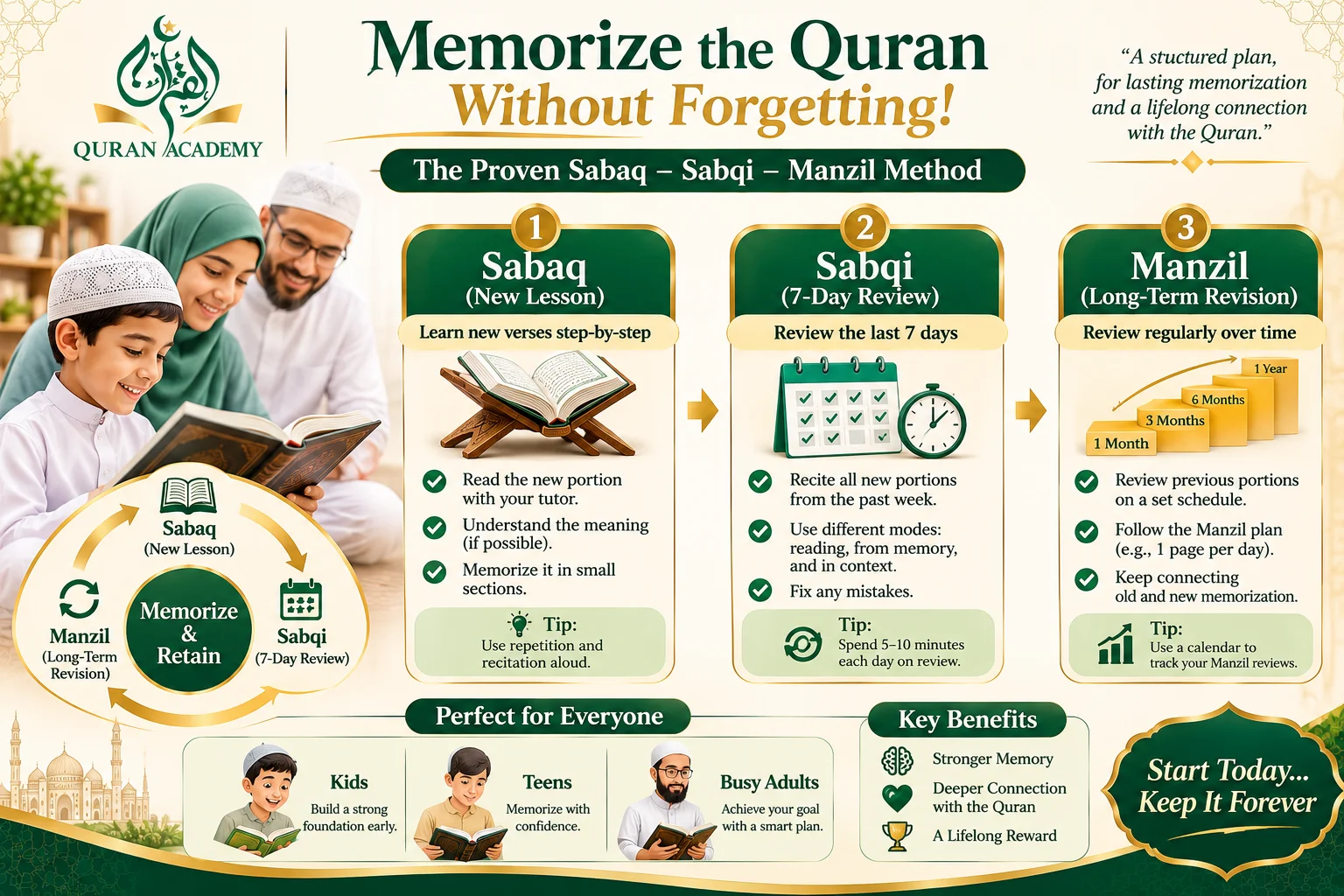
✦ Quick Answer & Key Takeaways: How to Memorize Quran Without Forgetting
To memorize the Quran without forgetting, you must never memorize new verses in isolation; instead, you must anchor every lesson inside the classical Three-Fortress Hifz System: 1. Sabaq (new daily lines), 2. Sabqi (daily review of the last 7 to 14 days of recent memorization), and 3. Manzil (rotational revision of all older completed Surahs and Juz). Students in our Complete Online Quran Memorization (Hifz) Program follow this exact 1:2:4 ratio to achieve 99% long-term recall.
- Why We Forget Memorized Surahs: Without structured revision during the first 7 days, the brain's natural Ebbinghaus Forgetting Curve erases up to 70% of newly memorized verses before they ever reach permanent cortex storage.
- The "Sabqi Bridge" Secret: The most dangerous zone in Hifz is not your brand-new page or your oldest Juz—it is the 5 to 10 pages you memorized last week. Reviewing them daily for 7 consecutive days locks them in permanently.
- The 70/30 Time Rule: Whenever your old revision starts feeling shaky, immediately shift 70% of your study time to Sabqi and Manzil and only 30% to new Sabaq (or take a 3-day "Zero-New-Lines Consolidation Break").
- Photographic & Meaning Anchors: Sticking to a single 15-line Madani Mushaf and learning the core meaning of similar verses (Mutashabihat) prevents mid-prayer confusion.
There is no heartbreak for a student of the Quran quite like working hard for two months to memorize Surah Al-Mulk, Surah Ya-Sin, or an entire Juz—only to go back three weeks later and realize you cannot recite four consecutive verses without opening the Mushaf. You feel as though your memory is a leaking bucket: every time you pour a new Surah in at the top, an older Surah drains out from the bottom.
In classical Hifz scholarship, this painful cycle is called "The Sabaq Addiction." Because memorizing brand-new verses feels exciting and measurable, solo learners spend 100% of their daily energy chasing the next page while leaving last week's pages unguarded. Once you replace random review with the time-tested Sabaq, Sabqi, and Manzil System, the leaking stops immediately—and every Surah you memorize stays as effortless on your tongue as Surah Al-Fatiha.
- What Is the Sabaq, Sabqi & Manzil System? (The 3 Fortresses of Memory)
- 3 Pre-Memorization Memory Anchors That Prevent Future Forgetting
- Step-by-Step: How to Structure a 30-Minute Zero-Forgetting Hifz Session
- Master Chart: 5 Manzil Revision Cycles Based on How Much Quran You Know
- How to Stop Mixing Up Similar Verses (Al-Mutashabihat) Across Surahs
- Custom Retention Routines for Busy Adults, Sisters & School Kids
- 3 Fatal Revision Mistakes (And How to Recover Forgotten Surahs Fast)
- Frequently Asked Questions (FAQs)
1. What Is the Sabaq, Sabqi & Manzil System? (The 3 Fortresses of Memory)
For centuries across Cairo, Madinah, Damascus, and the Indian Subcontinent, master Huffaz have divided every student's relationship with the Quran into three distinct memory zones. Each zone corresponds to how the human brain processes information—from initial working memory to synaptic consolidation and permanent neocortical storage:
Your brand-new daily portion (from 3 lines up to 1 full page) encoded fresh today with 100% accurate pronunciation and vowel timing.
The preceding 5 to 10 pages of the Juz you are currently memorizing. Reviewed every single day so wet cement hardens into stone.
All previously completed Surahs or Juz (also called Dhor or Muraja'ah al-Qadeem), rotated on a fixed 7- to 30-day loop.
Why do 90% of self-taught students forget what they memorize? Because they jump directly from Sabaq (Day 1) to Manzil (Month 2) while skipping Sabqi (Days 2 through 14)! Think of new memorization like wet concrete: if you walk away after pouring it today, the wind erases it tomorrow. Sabqi is the daily protective shield that guards your recent verses during their most fragile 14-day window until they are strong enough to enter your long-term Manzil rotation.
Why Pre-Correcting Tricky Words (Tashih al-Lauh) Stops You From Memorizing Mistakes
Did you know that the #1 reason students stumble during revision is that they accidentally memorized a wrong vowel on Day 1? Watch this short lesson from our official Quran Academy YouTube Channel showing how our instructors audit and correct commonly misread Quranic words before you commit them to memory:
- Pre-Lesson Correction (Tashih al-Lauh): Reading tomorrow's verses aloud to your teacher ensures 100% vowel accuracy before your brain locks them in.
- Motor-Memory Anchoring: When your tongue learns the exact right pronunciation first, your mouth remembers the flow effortlessly during prayer!
2. Three Pre-Memorization Memory Anchors That Prevent Future Forgetting
Long-term retention actually begins before you repeat a verse for the first time. If you encode a page weakly on Day 1, no amount of revision will stop it from feeling wobbly later. Lock in these three multi-sensory anchors before every Hifz session:
- Anchor 1 — Auditory & Visual Alignment (Same Qari + Same 15-Line Mushaf): Before memorizing your new lines, listen to them 3 times on our Interactive Digital Quran & Audio Mushaf while following along in your physical 15-line Madani Mushaf. In the standard 15-line print, every single page ends at the end of a complete verse—allowing your brain to take a mental snapshot of the right-hand versus left-hand page and the first word of every 5-line block.
- Anchor 2 — Thematic Storyline Mapping (Rabt al-Ma'na): Spend 60 seconds reading the English translation of your target lines. Highlight the "anchor keyword" in each verse (for example, how Surah An-Naba moves from the creation of the earth and mountains in verses 6–7, to sleep and day/night in verses 9–11, to the rain and gardens in verses 14–16). When your mind knows the sequence of scenes, you never skip a verse!
- Anchor 3 — Interlocking Repetition (Using the 3x3 Method): Instead of repeating isolated lines, encode your new Sabaq using our step-by-step 3x3 Quran Memorization Method so that every verse is welded to the verse before it and after it from Day 1.
3. Step-by-Step: How to Structure a 30-Minute "Zero-Forgetting" Hifz Session
Whether you are studying on your own at home or reciting live in a 30-minute class with your Sheikh or Ustadhah, here is how to divide a 30-minute daily window across all three fortresses so nothing is ever neglected:
⏱️ The 30-Minute Golden Hifz Session Blueprint
Goal: Memorize 3 to 7 new lines while your brain's focus is at 100% (ideally right after Fajr).
Goal: Recite the last 3 to 7 pages you memorized over the past week completely from memory.
Goal: Recite today's scheduled slice of older Surahs/Juz + pre-read tomorrow's Sabaq.
Struggling to perfect your Recitation?
Join hundreds of students mastering the Quran with our Verified Al-Azhar Graduates. We offer flexible 1-on-1 sessions tailored to your schedule.
Book a Free Evaluation Class →4. Master Chart: 5 Manzil Revision Cycles Based on How Much Quran You Know
How much old revision (Manzil) should you do every day so you never forget a single Surah? Use this 5-tier classical rotation chart matched to the exact number of Juz you have memorized so far:
| Total Quran Memorized | Recommended New Sabaq | Daily Sabqi (Recent Pages) | Daily Manzil (Old Revision) | Full Cycle Completion Frequency |
|---|---|---|---|---|
| Stage 1: 1 to 2 Juz (e.g., Juz Amma & Tabarak) |
3 to 5 Lines / Day | Last 3 to 5 Pages of current Juz | 4 Pages (Quarter Juz / 1 Rub') per day | Every 5 to 10 Days (3x per month) |
| Stage 2: 3 to 5 Juz (Intermediate Foundation) |
Half Page (7–8 Lines) / Day | Last 7 to 10 Pages of current Juz | Half Juz (1 Hizb / 10 Pages) per day | Every 6 to 10 Days |
| Stage 3: 6 to 10 Juz (One-Third of the Quran) |
Half to 1 Full Page / Day | Current Juz up to 15 Pages | 1 Full Juz (20 Pages) per day | Every 10 Days (3 cycles per month) |
| Stage 4: 11 to 20 Juz (Advanced Hifz Student) |
1 Full Page (15 Lines) / Day | Full Current Juz + Previous Juz | 1.5 to 2 Juz per day | Every 10 to 14 Days |
| Stage 5: 21 to 30 Juz (Complete Hafiz / Fami bi-Shawqin) |
1 to 2 Pages / Day (or Consolidation) | Last 2 Completed Juz | 3 to 5 Juz per day (or 2 Juz minimum) | Every 7 Days (Prophetic Fami bi-Shawqin) or 15 Days |
5. How to Stop Mixing Up Similar Verses (Al-Mutashabihat) Across Surahs
As your memorization grows beyond two or three Juz, a new challenge appears: Al-Mutashabihat al-Lafzhiyyah (look-alike verses). Two verses in different Surahs might share the exact same first ten words and differ in only a single preposition or Divine Name at the end—causing you to accidentally jump from Surah Al-Baqarah into Surah Aal-'Imran mid-recitation! Our instructors train students to master these transitions using three classical rules (you can look up all technical Hifz and Tajweed terminology in our Interactive Tajweed & Quranic Glossary):
- 1. Context Governs the Verse Ending (Al-Khatimah Tabi'ah lil-Siyaq): Never memorize a verse ending blindly. If a passage speaks about repentance and human weakness, the verse naturally concludes with Al-Ghafoor Al-Raheem; if it speaks about Allah's power over creation or judgment, it concludes with Al-'Azeez Al-Hakeem.
- 2. Keep a Dedicated "Mutashabihat Twin Margin" in Your Notebook: Whenever a new verse resembles an older verse you already know, write both verses side-by-side on a single index card and highlight the 1-word difference in red ink. Review both twins together 3 times!
- 3. The Alphabetical & Unique-Letter Rule: Classical scholars noticed that when two verses are nearly identical, the variant containing a unique letter often matches the unique letter in the Surah's name or comes earlier in alphabetical order.
Abdullah ibn 'Umar (may Allah be pleased with him) reported that the Messenger of Allah (peace be upon him) said:
"When the companion of the Quran stands to pray and recites it by night and by day, he remembers it; and if he does not stand to pray with it, he forgets it."
6. Custom Retention Routines for Busy Working Adults, Sisters & School Kids
You do not need four free hours a day to maintain your Hifz. The secret is matching your revision schedule to your real-life calendar in the US, UK, Canada, or Australia:
A. The "4+1+2 Weekly Rhythm" for Busy Professionals & Mothers
As we explain in our practical guide on how busy adults can learn the Quran online, trying to memorize new verses 7 days a week while working full-time or raising children inevitably causes a revision backlog by Week 3. Instead, use the 4+1+2 Weekly Rhythm:
- 4 Days of New Sabaq (Monday to Thursday): Memorize 3 to 5 new lines each morning after Fajr + review 3 pages of Sabqi.
- 1 Day of Weekly Consolidation (Friday): Zero new lines! Stitch together the 12 to 20 lines you learned from Monday to Thursday into one seamless block + read Surah Al-Kahf.
- 2 Days of Pure Manzil Review (Saturday & Sunday): Dedicate 25 minutes on Saturday and Sunday mornings exclusively to reviewing your older completed Surahs so you enter Monday morning with 100% confidence!
B. Keeping Kids from Forgetting Juz Amma (The "Car-Ride & Bedtime Loop")
Children memorize fast, but they also forget fast if they only open the Mushaf twice a week during class. As detailed in our parent guide on how often kids should practice Quran reading, short daily micro-reviews beat long weekend marathons every time:
- The Morning School Drive (8 Minutes): Play "Pass the Ayah" in the car—Mom or Dad recites Verse 1 of a previously memorized Surah from Juz Amma, and your child recites Verse 2!
- The Maghrib/Isha Imam Privilege: Let your child recite their newest Sabqi Surah aloud during family prayer (or right after Maghrib) to earn a daily sticker on our Printable Kids Star Reward Chart.
7. Three Fatal Revision Mistakes (And How to Recover Forgotten Surahs Fast)
When students join our Al-Azhar Certified Hifz Tutors to rescue rusty or forgotten Juz, we immediately replace three common self-study mistakes with proven classical habits:
- Mistake 1 — Reviewing With Your Eyes Open on the Page: Reading a previously memorized Surah while looking at the Mushaf is Tilawah (reading), not Muraja'ah (memory retrieval)! Your brain only strengthens synaptic pathways when forced to retrieve the next word from a closed Mushaf. Always keep the Mushaf closed and only glance when completely stuck.
- Mistake 2 — Restarting From Verse 1 Every Time You Make a Mistake on Verse 15: If you stumble in the middle of a page, do not go back to the top of the page (which is already strong!). Instead, isolate the exact 2-line weak spot, repeat the end of the previous verse into the forgotten word 7 times aloud, and then continue downward.
- Mistake 3 — Refusing to Pause New Sabaq When Sabqi Gets Weak: In traditional Al-Azhar Hifz circles, if a student makes more than 3 memory mistakes during their Sabqi or Manzil check, the Sheikh does not assign new Sabaq that day. Pausing new lines for 48 hours to repair weak pages saves you months of frustration later.
Discover how adult learners, sisters, and parents across North America, the UK, and Australia rebuilt their Quran retention in 1-on-1 classes on our Verified Student & Parent Reviews Page.
8. Frequently Asked Questions (FAQs) About Retaining Memorized Quran
1. What is the ideal ratio between new memorization (Sabaq) and old revision (Sabqi & Manzil)?
In classical Hifz pedagogy, the golden time allocation is 35% New Sabaq, 35% Near Sabqi (recent 5–10 pages), and 30% Old Manzil. Once you have memorized more than 10 Juz, your revision time should increase to 60%–70% of your daily session so older Juz remain crystal clear.
2. How do I recover Surahs or Juz that I memorized years ago and completely forgot?
Good news: verses you once memorized are never truly erased from your brain's deeper neural pathways—they just need re-activation! Pause all brand-new Surahs for 30 days, break your old Juz into half-page daily recovery blocks, apply the 3x3 method once, and recite them to a teacher. Most students recover old Surahs 3x to 4x faster than memorizing from scratch.
3. Why can I recite a Surah smoothly alone at home, but I freeze when reciting to my teacher or in prayer?
Freezing in prayer or during a test happens when your memorization is still relying on short-term sequential cues rather than deep auditory and meaning anchors. To cure this, practice reciting your new Sabqi pages while standing in Sunnah/Nafl prayers and ask your teacher to test you with random mid-page prompts ("Read from verse X...").
4. Is it better to revise 1 Juz every day or 3 Juz on weekends?
Daily spaced revision is neurobiologically superior to weekend cramming. Even 15 minutes of daily Sabqi and Manzil (for example, 4 pages after Fajr and 4 pages after Maghrib) builds stronger long-term retention than a single exhausting two-hour session once a week.
5. How many days should a new page stay in my "Sabqi" list before moving to "Manzil"?
Every newly memorized page should remain in your daily Sabqi (Near Review) queue for a minimum of 7 to 14 consecutive days. Once you can recite that page from memory for 7 days in a row without a single prompt, it is ready to graduate into your rotational Manzil vault!
Lock In Your Hifz With 1-on-1 Sabaq, Sabqi & Manzil Coaching
Stop struggling with solo revision guesswork! Join a certified male Sheikh or female Ustadhah from Al-Azhar University for a free 1-on-1 Hifz assessment and receive a customized retention schedule tailored to your routine.
Book Your Free 1-on-1 Hifz Trial Class →