
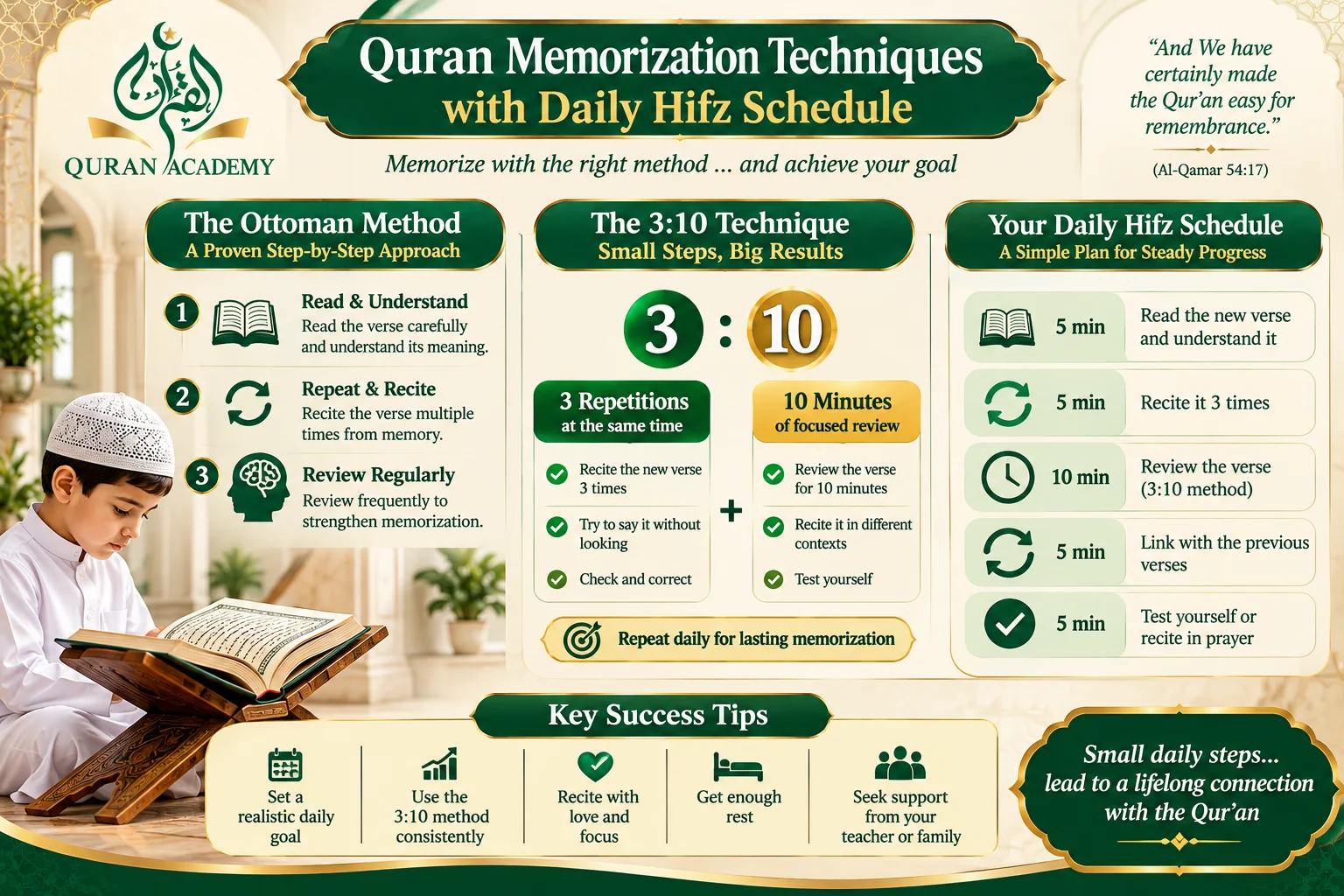
✦ Quick Answer & Key Takeaways: The Ottoman & 3:10 Hifz Techniques
The Ottoman Quran memorization technique is a classical macro-system where you memorize the 20th (final) page of each Juz first across the Mushaf, then cycle backward to Page 19, Page 18, and down to Page 1—so you always recite forward into your strongest, most-reviewed pages. Meanwhile, the 3:10 Quran memorization technique is a micro line-by-line drill where you read a line 10 times looking at the Mushaf and recite it 3 times from memory before linking it. Students in our Online Hifz & Ijazah Certification Program combine both methods to eliminate "end-of-Juz amnesia" permanently.
- Macro vs. Micro Hifz Synergy: The Ottoman Method tells you which page to memorize today (the 20-page Juz architecture), while the 3:10 Technique (or our 3x3 Quran Memorization Method) tells you how to memorize the lines on that page.
- Why the Ottoman Method Builds Unbreakable Juz Anchors: In standard linear Hifz, Page 1 of a Juz is reviewed 20 times while Page 20 is reviewed only once. The Ottoman reverse-stacking system flips that curve so every new page flows directly into an older, rock-solid page.
- Why Non-Native Speakers Love the 3:10 Drill: Reading a line 10 times looking trains your tongue on unfamiliar Arabic consonant clusters before asking your brain for 3 blind memory recalls.
- Single-Juz Adaptation for Beginners: You don't have to rotate across all 30 Juz at once! You can apply the Mini-Ottoman Method inside a single Juz (memorizing from Page 20 down to Page 1 of Juz Amma or Juz Tabarak).
Ask any Hifz student which part of a Surah or Juz they know best, and they will give you the exact same answer: "I know the first five pages by heart, but the last five pages of the Juz always feel shaky!"
Why does the end of every Surah or Juz feel so much weaker than the beginning? Because when you memorize linearly from Page 1 to Page 20, you naturally review Page 1 every single day as you build forward, whereas Page 19 and Page 20 are memorized right before you rush into the next Juz. Centuries ago, Ottoman scholars noticed this exact psychological blind spot and engineered the Ottoman Quran memorization technique—a brilliant reverse-stacking architecture that turns the weakest part of every Juz into your strongest anchor. And when you pair it with the 3:10 line-by-line repetition formula, even non-Arabic speakers and busy adults can memorize with crystal-clear fluency.
- What Is the Ottoman Quran Memorization Technique? (The 20-Page Juz Cycle)
- How Beginners Apply the "Mini-Ottoman Method" Inside a Single Juz
- What Is the 3:10 Quran Memorization Technique? (Step-by-Step Line Drill)
- Master Comparison Chart: Ottoman vs. 3:10 vs. 3x3 vs. Linear Hifz
- The Ultimate Hybrid Protocol: Combining Ottoman Page Order With 3:10 Drills
- 3 Ready-to-Use Daily Schedules (Busy Adults, Sisters & Kids)
- 3 Critical Mistakes Our Tutors Fix When Students Use Ottoman & 3:10
- Frequently Asked Questions (FAQs)
1. What Is the Ottoman Quran Memorization Technique? (The 20-Page Juz Cycle)
In a standard 15-line Madani Mushaf (or the traditional 15-line Turkish Mushaf with Berkenar verse-ending pages), the Holy Quran consists of 30 Juz, and each Juz is divided into exactly 20 pages (10 double-sided leaves). In the classical Ottoman Quran memorization technique, you do not memorize Juz 1 from Page 1 to 20 and then move to Juz 2.
Instead, the Ottoman system uses 20 horizontal rounds (Devir) across the Juz, always starting from the final page (Page 20) of each Juz and stacking backward toward Page 1:
Day 1: Memorize Page 20 of Juz 1. Day 2: Memorize Page 20 of Juz 2... until Day 30 (Page 20 of Juz 30).
Memorize Page 19 of Juz 1, then immediately recite Page 19 + Page 20 together in natural forward order!
Each round adds one page above your existing stack (18 → 19 → 20) until Page 1 crowns every Juz.
Look closely at the psychological genius of this system: When you are in Round 5 (memorizing Page 16 of a Juz), as soon as you finish your new page, you keep reciting forward into Pages 17, 18, 19, and 20—which you have already memorized and reviewed in Rounds 1 through 4! Instead of your confidence dropping as you reach the bottom of a Juz, your recitation gets stronger and faster the further you read.
2. How Beginners Apply the "Mini-Ottoman Method" Inside a Single Juz
If you are a busy working adult, a parent helping a child, or a beginner who only wants to memorize 1 Juz at a time (such as Juz 29 Tabarak or Juz 28 Qad Sami' Allah), rotating across all 30 Juz can feel intimidating. Fortunately, our instructors adapt the Ottoman principle into the 5-Page Mini-Ottoman Stack inside a single Juz:
- Day 1: Memorize Page 20 (the final page of your target Juz) in our Online Quran Explorer & Audio Mushaf.
- Day 2: Memorize Page 19, then recite Page 19 → Page 20 together seamlessly.
- Day 3: Memorize Page 18, then recite Page 18 → Page 19 → Page 20 in one continuous flow.
- Day 4: Memorize Page 17, then recite Pages 17 through 20.
- Day 5: Memorize Page 16, then recite the entire 5-page quarter-Juz (Hizb half) from Page 16 to Page 20!
This reverse page-stacking works for a single long Surah (like Surah Al-Kahf or Surah Yasin) too: memorize the last page of the Surah on Day 1, the second-to-last page on Day 2, and work your way up to Page 1. Whenever you recite the Surah from the beginning, you are walking downhill toward your most deeply ingrained verses!
Why Tajweed Sound Patterns Make Your 10 Visual Reads Unforgettable
When applying the 3:10 technique, your 10 visual repetitions must be recited with crisp Tajweed so your ears and vocal cords encode the exact acoustic signature of every word. In this short lesson from our official Quran Academy YouTube Channel, Senior Instructor Ustadhah Yasmeen Gamal demonstrates how proper letter bounce (Qalqalah) anchors verse endings in memory:
- Preventing Fossilized Errors: Repeating a verse 10 times with muted or incorrect letter exits locks that mistake into muscle memory.
- Rhythmic Verse Endings: Hear how clear consonant release creates a natural musical cadence at the end of every Ayah.
3. What Is the 3:10 Quran Memorization Technique? (Step-by-Step Line Drill)
While the Ottoman method organizes which page you memorize, the 3:10 Quran memorization technique (pronounced "Three-to-Ten") is a high-fluency micro-method designed to help you memorize the individual lines on that page—especially if Arabic is not your first language.
Why do many non-native speakers struggle when they try to recite a verse from memory after only 3 visual reads? Because their tongue is still working hard to connect unfamiliar Arabic letters, heavy throat consonants, and elongation counts (Madd). The 3:10 formula solves this by front-loading 10 visual repetitions before testing your memory:
🎯 The 4-Step 3:10 Execution Loop (Applied Line by Line)
Place your finger under Line 1. Read the line aloud 10 times at a measured pace (Tarteel) while looking directly at the script. Count on your right-hand fingers twice. By repetition #7, your tongue will glide over the words effortlessly and your eyes will have photographed the exact word positions.
Lift your eyes from the Mushaf and recite Line 1 aloud 3 times from memory. Because you already conditioned your tongue with 10 visual reads, these 3 memory recalls will feel smooth and automatic.
Struggling to perfect your Recitation?
Join hundreds of students mastering the Quran with our Verified Al-Azhar Graduates. We offer flexible 1-on-1 sessions tailored to your schedule.
Book a Free Evaluation Class →Move your finger to Line 2. Read it aloud 10 times looking at the Mushaf, then recite it 3 times from memory.
Recite Line 1 and Line 2 together 3 times from memory without stopping at the line break. Continue adding one line at a time (linking every 3 lines into a solid mini-block) until your daily target is complete!
4. Master Comparison Chart: Ottoman vs. 3:10 vs. 3x3 vs. Standard Linear Hifz
Which technique fits your current reading speed and daily schedule? Compare the four major approaches side by side:
| Memorization System | Scope (Macro vs. Micro) | Core Repetition Rule | Ideal Student Profile | Primary Retention Benefit |
|---|---|---|---|---|
| 1. Ottoman Method (Reverse Juz Stacking) |
Macro-System (Page order across Juz) |
Memorize Page 20 of each Juz first, then Page 19, down to Page 1. | Students who forget the end of a Juz or want 30-Juz mastery. | Every new page flows forward into older, deeply reviewed pages. |
| 2. The 3:10 Technique (10 Look : 3 Recall) |
Micro-System (Line-by-line encoding) |
10x Look → 3x Memory → 3x Link for each line or verse. | Non-native speakers & beginners with moderate reading speed. | 10 visual reads eliminate tongue stumbles before memory testing. |
| 3. The 3x3 Method (3 Look : 3 Recall : 3 Link) |
Micro-System (Triad verse chunking) |
3x Look → 3x Memory → 3x Link across 3-verse blocks. | Fluent readers, busy professionals, and active kids. | Fastest encoding (15–20 mins) with high active-recall engagement. |
| 4. Standard Linear Hifz (Page 1 to Page 20) |
Macro-System (Sequential page order) |
Memorize Page 1, then Page 2, sequentially to the end of the Surah. | Students memorizing short Surahs in Juz Amma (1–2 pages long). | Follows natural narrative order, though final pages need extra review. |
5. How to Combine the Ottoman Macro-Plan With the 3:10 Micro-Drill
The biggest misconception among Hifz students is thinking they have to choose either the Ottoman method or the 3:10 method. In reality, they operate at two completely different levels of your study session:
- Level 1 — The Ottoman Macro-Compass (Which Page Today?): Before opening your Mushaf, your Ottoman tracker tells you which page is due today (for example, Page 18 of Juz 29).
- Level 2 — The 3:10 Micro-Engine (How to Memorize That Page): Once you open to Page 18, you divide its 15 lines into three 5-line blocks and apply the 10x Look → 3x Memory → 3x Link formula to master each line with flawless Tajweed & Makharij terminology.
- Level 3 — The Forward Stack Seal (Hasila): As soon as you finish memorizing Page 18 using the 3:10 drill, you recite Page 18 → Page 19 → Page 20 straight through from memory in forward order!
The Prophet Muhammad (peace be upon him) taught us the golden rule of lifelong spiritual habits:
"The most beloved of deeds to Allah are those that are most consistent, even if they are small."
6. Three Practical Weekly Schedules (Full-Time, Working Adult & Kids Tracks)
Whether you have 60 minutes a day or just 15 minutes before work, here is how to structure your week using the combined Ottoman + 3:10 system:
Track A: The Working Adult & Busy Sister Track (5 Lines / Day — 20 Minutes)
If you are balancing a career, university studies, or motherhood—as we detail in our guide on How Busy Adults Learn Quran Online—memorizing a full 15-line page every single day can lead to burnout by Week 3. Instead, use the 3-Day Page Split inside the Single-Juz Ottoman cycle:
- Monday (Bottom 5 Lines of Page 20): Apply the 3:10 method to Lines 11–15 of Page 20 (15 mins).
- Tuesday (Middle 5 Lines of Page 20): Apply the 3:10 method to Lines 6–10, then recite Lines 6–15 forward (18 mins).
- Wednesday (Top 5 Lines of Page 20): Apply the 3:10 method to Lines 1–5, then recite the entire Page 20 from top to bottom 3 times (20 mins)!
- Thursday & Friday: Begin the bottom and middle sections of Page 19.
- Saturday & Sunday (Anchor Revision Days): Zero new lines! Recite your completed pages in Salah and to your tutor.
Track B: The Classical 1-Page Daily Track (For Intensive Hifz Students — 45 Minutes)
- Pre-Fajr or Post-Fajr (30 Mins): Memorize today's target Ottoman page (e.g., Page 17 of your current Juz) using the 3:10 drill (5 lines every 10 minutes).
- After Maghrib (15 Mins — Forward Stack Review): Recite Page 17 → Page 18 → Page 19 → Page 20 straight through without looking at the Mushaf.
- Night Preparation (5 Mins Before Sleep): Listen to tomorrow's target page (Page 16) 3 times with your eyes on the Mushaf so your subconscious brain begins encoding the verses overnight!
Track C: The Young Memorizer Track (Kids Ages 6–13 — 15 Minutes)
For children memorizing Juz Amma or Juz Tabarak in our Dedicated Online Quran Classes for Kids, sitting through 10 silent reads can feel repetitive. Our teachers break the 10 reads into "3 Melodic Echoes + 4 Finger-Tracking Reads + 3 Loud Recitations", followed by 3 memory recalls—and reward every completed verse with a star on our Interactive Kids Quran Reward Chart!
7. Four Common Mistakes to Avoid When Using the Ottoman & 3:10 Methods
In our 1-on-1 sessions with Certified Al-Azhar Hifz Instructors, we help students avoid four frequent traps that can derail backward stacking and 3:10 drills:
- Using a Non-Standard Mushaf Where Verses Split Across Pages: The Ottoman method only works if every page ends at the completion of a verse (Ayat-Berkenar) and every Juz is exactly 20 pages. Never switch Mushaf prints mid-Juz!
- Reciting Verses Backward Instead of Stacking Pages Backward: Remember: you never recite Ayah 10 before Ayah 9! Inside any single page, you read and recite from top to bottom in normal order. And when you review your stacked pages (e.g., Pages 18, 19, and 20), you recite them in normal forward order (18 → 19 → 20).
- Doing the "10x Visual Reads" Silently With Your Eyes Only: Silent reading only activates visual recognition, which vanishes as soon as you close the Mushaf. All 10 reads in the 3:10 method must be audible so your tongue, lips, and ears build physical muscle memory. (If you want to make sure your basic pronunciation is solid first, read our Complete Tajweed Learning Guide and avoid the errors listed in Common Quran Reading Mistakes Beginners Make).
- Neglecting Pre-Sleep Night Listening (Tahdir): In classical Ottoman schools, a student never attempts to memorize a new page in the morning without having read and listened to it 3 to 5 times the night before. That 5-minute evening preview cuts your morning 3:10 memorization time by 40%!
Curious how adult learners and parents across North America, the UK, and Australia experience these methods in live classes? Browse hundreds of verified testimonials on our Student & Parent Reviews Page.
8. Frequently Asked Questions (FAQs) About the Ottoman & 3:10 Techniques
1. What is the Ottoman Quran memorization technique?
The Ottoman (Turkish) Quran memorization technique is a classical Hifz system where a student memorizes the 20th (last) page of each of the 30 Juz first during Round 1, then returns in Round 2 to memorize the 19th page of each Juz (stacking it onto Page 20), and continues backward through 20 rounds until Page 1 of every Juz is completed.
2. What is the 3:10 Quran memorization method and how does it work?
The 3:10 Quran memorization method is a line-by-line micro-technique: you read a single Mushaf line 10 times aloud while looking at the page, recite that line 3 times from memory without looking, and then link it with the next line 3 times together.
3. Why does the Ottoman Hifz method start from the last page (Page 20) of each Juz?
In traditional linear Hifz, the final pages of a Juz are memorized last and receive the fewest cumulative revisions, making them the weakest pages. By memorizing Page 20 first and stacking Pages 19, 18, and 17 onto it over 20 rounds, the end of every Juz becomes the strongest, most-reviewed anchor in your memory.
4. Can I combine the Ottoman macro-system with the 3:10 or 3x3 micro-techniques?
Yes! They complement each other seamlessly: the Ottoman method tells you which page of the Mushaf to memorize today (your macro-schedule), while the 3:10 or 3x3 method tells you how to memorize the 15 lines on that specific page (your daily micro-drill).
5. Do I need a specific Mushaf to use the Ottoman memorization technique?
Yes, you should use a standard 15-line verse-ending (Ayat-Berkenar) Mushaf—such as the standard Madani Mushaf or Ottoman Hifz Mushaf—where every Juz consists of exactly 20 pages and every page ends cleanly at the end of a verse.
Master the Ottoman & 3:10 Hifz Methods With a Certified Tutor
Want an Ijazah-certified Al-Azhar scholar to customize a backward-stacking or 3:10 Hifz schedule around your work or school routine? Book your free 1-on-1 evaluation session today!
Book Your Free 1-on-1 Hifz Trial Class →