
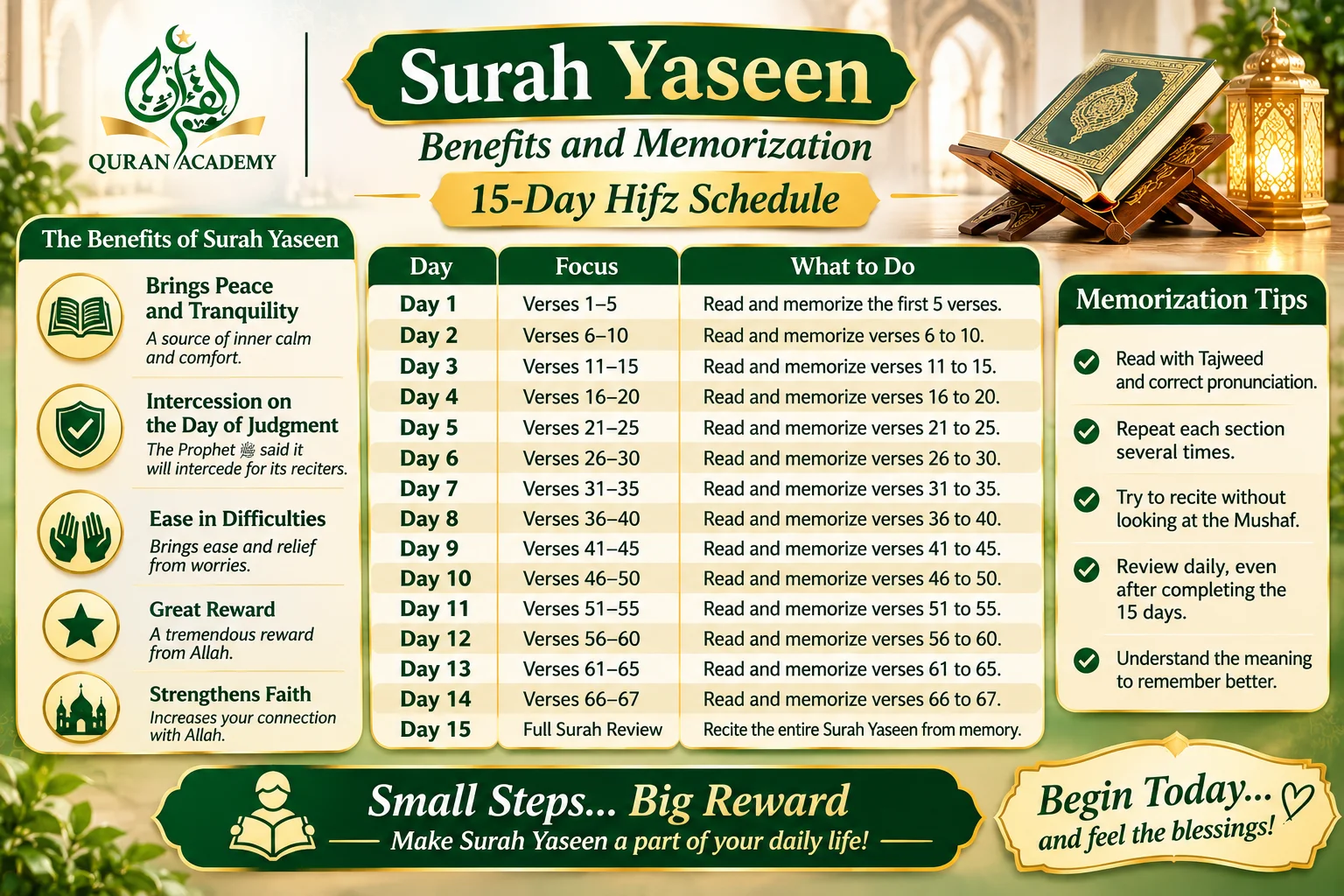
✦ Quick Answer & Key Takeaways: Surah Ya-Sin Benefits & 15-Day Memorization Plan
Exploring Surah Yaseen benefits and memorization unlocks one of the most beloved Makkan chapters in the Holy Quran (Surah 36, spanning 83 short, rhythmic verses across just 5.5 pages—Pages 440 to 445—spanning the end of Juz 22 and the start of Juz 23). Known in classical Islamic tradition as the "Heart of the Quran" (Qalbul-Quran) because it encapsulates the three core pillars of faith—Tawheed (Oneness of Allah), Risalah (Prophethood), and Al-Ba'th (Resurrection)—Surah Ya-Sin can be memorized effortlessly in 15 days by learning just 5 to 6 lines (5–6 short verses) per day. Students in our 1-on-1 Online Quran Memorization (Hifz) Program master all 83 verses with live Al-Azhar feedback and zero forgetting.
- Why It Is So Easy to Memorize: Unlike long legal verses in Madinan Surahs, Surah Ya-Sin's 83 verses are concise, rhyming, and divided into 5 vivid visual stories and cosmic signs.
- The 15-Day "Half-Page" Blueprint: Memorizing just 7 to 8 lines a day for 11 days—plus 4 cumulative review days—seals all 5.5 pages permanently.
- Crucial Tajweed Landmarks in Surah Ya-Sin: Features Madd Lazim Harfi on يسٓ, Idgham Lawh/Clarified Izhar on يسٓ وَالْقُرْآنِ, and the famous Obligatory Breathless Pause (Sakt) on مَرْقَدِنَا ۜ (36:52).
- Spiritual Anchor for Life & Hereafter: Reciting and pondering Surah Ya-Sin renews certainty in Allah's power to revive dead hearts and dead earth alike: "Be, and it is!" (كُن فَيَكُونُ — 36:82).
Almost every Muslim growing up in the East or the West has heard the rhythmic, soul-stirring cadence of "Yaa-Seeen, Wal-Quraanil-Hakeem..." recited in their family home on mornings, Fridays, or during moments of illness and hardship. Alongside Surah Al-Mulk and Surah Al-Kahf, Surah Ya-Sin (Chapter 36) sits at the very top of the list of Surahs every believer dreams of reciting by heart during night prayer (Tahajjud) or daily Salah.
Yet when many students open Page 440 of the Mushaf to start memorizing it on their own, they hit two common roadblocks: first, they try to memorize the Arabic lines mechanically without knowing how the 5 thematic story blocks connect to one another; second, they stumble over unique Tajweed exceptions in Surah Ya-Sin—like how to join Verse 1 and Verse 2, or why there is a tiny letter س (Sakt) above the word Marqadinaa in Verse 52. In this complete guide, we cover the authentic virtues and scholarly commentary of Surah Ya-Sin, break down its 5 thematic sections for effortless memory retention, and give you a ready-to-use 15-Day Surah Ya-Sin Memorization Plan.
- Why Is Surah Ya-Sin Called the "Heart of the Quran"? (Virtues & Scholarly Grading)
- Tafseer Breakdown: The 5 Core Themes & Stories of Surah Ya-Sin (Memory Anchors)
- Master Chart: The 15-Day Surah Ya-Sin Memorization Plan (Page-by-Page & Verse-by-Verse)
- 5 Special Tajweed Rules in Surah Ya-Sin Every Reciter Must Master
- How to Never Confuse Similar Verse Endings (Mutashabihat) in Surah Ya-Sin
- Frequently Asked Questions (FAQs)
1. Why Is Surah Ya-Sin Called the "Heart of the Quran"? (Virtues & Scholarly Insight)
Revealed in Makkah during a period of intense ideological opposition to the message of Islam, Surah Ya-Sin (سُورَةُ يسٓ) is the 36th chapter of the Mushaf, containing 83 verses and 730 words. Classical commentators—whose methodologies you can explore in our Complete Quran Tafseer Guide and our Interactive Tajweed & Quranic Encyclopedia—explain why this Surah holds such a central station in Muslim hearts:
Just as the physical heart pumps life-giving blood to every limb, Surah Ya-Sin pumps certainty in Resurrection (Al-Hashr) and Divine Power into every believer's heart.
Imam Ibn Kathir notes in his Tafseer that scholars experienced that reciting Surah Ya-Sin during difficult matters brings immense relief, tranquility, and facilitation from Allah.
Ending with the majestic declaration that when Allah wills a thing, He merely says to it "Be!" and it is—reminding you that no obstacle is impossible for your Creator.
In classical Hadith collections, Ma'qil ibn Yasar (may Allah be pleased with him) reported the narration: "Recite Ya-Sin over your dying ones" (recorded in Sunan Abu Dawud 3121 & Sunan Ibn Majah 1448), and Anas (may Allah be pleased with him) reported: "Indeed, for everything there is a heart, and the heart of the Quran is Ya-Sin" (Sunan at-Tirmidhi 2887).
Scholarly Grading Note: Hadith masters (including Imam At-Tirmidhi, Ad-Daraqutni, and Ibn Kathir) noted that the specific chains (Isnad) specific to Surah Ya-Sin range from weak (Da'eef) to debated, while the overarching reward of reciting, memorizing, and pondering every letter of Surah Ya-Sin is 100% established by authentic (Sahih) consensus!
2. Tafseer Breakdown: The 5 Core Themes & Stories of Surah Ya-Sin (Memory Anchors)
Just as we showed in our guide on The Most Important Surahs to Start Learning Tafseer With (and our breakdown of the 4 trials in Surah Al-Kahf), the secret to memorizing a multi-page Surah without losing your place is Story-Arc Chunking. When you open Surah Ya-Sin in our Online Uthmani Quran Explorer, divide its 83 verses in your mind into these 5 unforgettable scenes:
- Scene 1 (Verses 1–12 • Page 440): The Divine Oath Confirming Prophethood: Allah swears by the Wise Quran (وَالْقُرْآنِ الْحَكِيمِ) that Prophet Muhammad (ﷺ) is unequivocally upon a straight path, warning a heedless people, while promising forgiveness and a noble reward to those who fear the Most Merciful in the unseen (bil-Ghayb)—and reminding us that Allah records both our deeds and the footprints we leave behind (وَنَكْتُبُ مَا قَدَّمُوا وَآثَارَهُمْ).
- Scene 2 (Verses 13–32 • Pages 441–442): The Parable of the People of the Town & the Believing Man (Habib An-Najjar): Allah tells the moving story of a town to which two Messengers were sent, reinforced by a third (فَعَزَّزْنَا بِثَالِثٍ). When the townspeople threatened the Messengers, a courageous man came running from the farthest end of the city (وَجَاءَ مِنْ أَقْصَى الْمَدِينَةِ رَجُلٌ يَسْعَىٰ — 36:20, where Juz 23 begins on Page 442!), urging his people to follow those who ask no payment. Even when martyred and told "Enter Paradise!" (قِيلَ ادْخُلِ الْجَنَّةَ), his heart held zero bitterness—wishing only that his people knew how generously his Lord had forgiven and honored him!
- Scene 3 (Verses 33–50 • Pages 442–443): The 4 Cosmic Signs (Aayat) of Allah's Power in Nature: Notice the four consecutive verses starting with وَآيَةٌ لَّهُمُ (And a sign for them is...):
• Sign 1 — The Dead Earth Revived (36:33–36): Bringing forth grain, date-palm gardens, grapevines, and gushing springs.
• Sign 2 — Night & Day, Sun & Moon (36:37–40): The sun running to its fixed term and the moon measured in phases like an old curved date-stalk (كَالْعُرْجُونِ الْقَدِيمِ), each floating in its orbit (وَكُلٌّ فِي فَلَكٍ يَسْبَحُونَ).
• Sign 3 — The Ark & Ships (36:41–44): Carrying their offspring in the laden ship (فِي الْفُلْكِ الْمَشْحُونِ).
• Sign 4 — Turning Away From Charity & Warnings (36:45–50): Until the first blast of the Trumpet catches them while they are disputing! - Scene 4 (Verses 51–68 • Pages 443–444): The Trumpet Blast, the Bliss of Jannah & Speaking Limbs: From the second blast of the Trumpet when humanity rushes from their graves to their Lord (36:51–54), to the People of Paradise rejoicing in shade on raised couches greeted with سَلَامٌ قَوْلًا مِّن رَّبٍّ رَّحِيمٍ (36:55–58), to the Day when mouths are sealed and hands speak and feet testify to what they used to earn (36:65).
- Scene 5 (Verses 69–83 • Page 445): Refuting the Skeptic With Decayed Bones & "Kun Fayakoon": Closing with the powerful rebuttal to the man who crumbled a decayed bone and asked, "Who can give life to bones when they have rotted away?" (مَن يُحْيِي الْعِظَامَ وَهِيَ رَمِيمٌ). Allah answers: قُلْ يُحْيِيهَا الَّذِي أَنشَأَهَا أَوَّلَ مَرَّةٍ ("Say: He will give them life Who created them the first time!").
3. Master Chart: The 15-Day Surah Ya-Sin Memorization Plan (7–8 Lines Per Day)
In the standard 15-line Uthmani Mushaf, Surah Ya-Sin spans exactly 5.5 pages (82 lines total, from Page 440 to Page 445). By applying our 3x3 Quran Memorization Method and the Sabaq, Sabqi & Manzil Revision System for just 15 to 20 minutes after Fajr, you can memorize half a page a day for 11 days and use 4 checkpoint days to lock the entire Surah into permanent memory:
Struggling to perfect your Recitation?
Join hundreds of students mastering the Quran with our Verified Al-Azhar Graduates. We offer flexible 1-on-1 sessions tailored to your schedule.
Book a Free Evaluation Class →| Day # | Mushaf Page & Half | Exact Verses (Ayahs) | Thematic Anchor / Story Cue | Daily Revision (Sabqi) |
|---|---|---|---|---|
| Day 1 | Page 440 (Full Half-Page) | Verses 1 – 12 (12 Ayahs) | Oath by the Wise Quran & recording footprints (Wa-aathaarahum). | Recite Verses 1–12 in Maghrib & Isha Salah. |
| Day 2 | Page 441 (Top Half) | Verses 13 – 19 (7 Ayahs) | Companions of the Town & the 3 Messengers' dialogue. | Link Verses 1 – 19 continuously. |
| Day 3 | Page 441 (Bottom Half) | Verses 20 – 27 (8 Ayahs) | Start of Juz 23: The believing man runs from the far end of the city & enters Jannah. | Recite Full Pages 440 – 441 (Verses 1–27). |
| Day 4 ⭐ | Checkpoint 1 (No New Lines) | Audit Verses 1 – 27 | Consolidate Scenes 1 & 2 (Pages 440–441) 5x from memory. | Zero-peek test with your tutor or family member. |
| Day 5 | Page 442 (Top Half) | Verses 28 – 34 (7 Ayahs) | A single Cry (Sayhah) & Sign #1: The dead earth revived with gardens. | Review Verses 20 – 34. |
| Day 6 | Page 442 (Bottom Half) | Verses 35 – 40 (6 Ayahs) | Sign #2: Night & Day, the Sun's orbit & the Moon's phases. | Recite Full Page 442 (Verses 28–40). |
| Day 7 | Page 443 (Top Half) | Verses 41 – 47 (7 Ayahs) | Sign #3: The Laden Ark (Al-Fulk Al-Mashhoon) & heedlessness of signs. | Review Verses 28 – 47. |
| Day 8 | Page 443 (Bottom Half) | Verses 48 – 54 (7 Ayahs) | "When is this promise?" • 1st & 2nd Trumpet Blasts + Sakt on Marqadinaa (36:52). | Recite Full Pages 442 – 443 (Verses 28–54). |
| Day 9 ⭐ | Checkpoint 2 (No New Lines) | Audit Verses 1 – 54 | Recite the first 3.5 pages (Pages 440–443) continuously from memory. | Two-thirds of Surah Ya-Sin is now locked in! |
| Day 10 | Page 444 (Top Half) | Verses 55 – 63 (9 Ayahs) | Companions of Jannah (Salaamun Qawlan) & warning against Shaytan. | Review Verses 48 – 63. |
| Day 11 | Page 444 (Bottom Half) | Verses 64 – 70 (7 Ayahs) | Sealing mouths on Judgment Day & the Quran as a clear reminder for the living. | Recite Full Page 444 (Verses 55–70). |
| Day 12 | Page 445 (Top Half) | Verses 71 – 77 (7 Ayahs) | Sign of cattle/livestock, false idols, & creation from a drop (Nutfah). | Review Verses 55 – 77. |
| Day 13 | Page 445 (Bottom Half) | Verses 78 – 83 (6 Ayahs) | Reviving decayed bones, green tree fire, & Kun Fayakoon seal! | Recite Full Page 445 (Verses 71–83). |
| Day 14 & 15 🏆 | Full Surah Consolidation | All 83 Verses (Pages 440–445) | Recite the entire Surah Ya-Sin 3x looking and 3x from memory across your 5 prayers! | Pass your live 1-on-1 Surah Ya-Sin audit with your tutor! |
Mastering the Qalqalah Echoes Inside Surah Ya-Sin
Surah Ya-Sin is packed with powerful Qalqalah (Echoing) letters (ق ط ب ج د)—such as لَقَدْ حَقَّ الْقَوْلُ (36:7), نَطْمِسَ (36:66), and مِن مَّرْقَدِنَا (36:52). In this 60-second lesson from our official Quran Academy YouTube Channel, Senior Instructor Ustadhah Yasmeen Gamal demonstrates how to bounce these letters cleanly without adding an extra vowel sound:
- Mid-Word vs. End-of-Verse Echo: Hear how Qalqalah Sughra on Laqadْ differs from stopping at the end of a verse.
- Beautify Your Recitation: Accurate Tajweed gives Surah Ya-Sin its signature heart-melting rhythm!
4. Five Special Tajweed Rules in Surah Ya-Sin Every Reciter Must Master
In fact, Surah Ya-Sin is one of the favorite test passages during an Online Quran Ijazah Exam because it contains five crucial Tajweed rules and exceptions in the narration of Hafs 'an 'Asim. Before you start Day 1 of your memorization plan, review these five points with our 1-on-1 Online Tajweed Course guidelines:
- 1. Elongating "Yaa-Seeen" (يسٓ — Verse 1): According to our Rules of Madd in Tajweed, the letter ي (Yaa) is a 2-count natural elongation (Madd Tabee'i Harfi: "Yaa"), whereas the letter سٓ (Seen) is a 6-count compulsory elongation (Madd Lazim Harfi Mukhaffaf: "Seeeeen") ending with a clear whispered Seen sound.
- 2. Joining Verse 1 to Verse 2 (يسٓ ﴿١﴾ وَالْقُرْآنِ الْحَكِيمِ ﴿٢﴾ — Izhar Riwayah Exception!): Normally, under the Rules of Noon Sakinah and Tanween, a Noon Sakinah followed by the letter و (Waw) merges with nasalization (Idgham bi-Ghunnah). However, if you read يسٓ (which ends with a spoken Noon: Yaa-Seenْ) continuously into وَالْقُرْآنِ without stopping, Hafs 'an 'Asim (via Ash-Shatibiyyah) requires Izhar Mutlaq (Clear Pronunciation of the Noon without merging into the Waw)! *(Of course, stopping at the end of Verse 1 on يسٓ is the Sunnah and easiest option).*
- 3. The Obligatory Breathless Pause (Sakt) in Verse 52 (مِن مَّرْقَدِنَا ۜ ۗ هَٰذَا): As explained in our Rules of Waqf & Sakt Guide, if you continue reading past مِن مَّرْقَدِنَا ۜ (Min Marqadinaa), you must pause your voice for 2 counts without taking a breath before saying هَٰذَا مَا وَعَدَ الرَّحْمَٰنُ. Why? So the listener knows that the disbelievers' complaint ends at "Who raised us from our sleeping place?" and the angels/believers answer: "This is what the Most Merciful promised!" (Note: Doing a full breathing Waqf on Marqadinaa is also completely permissible because of the ۗ قلى sign above it!).
- 4. Compulsory Stop (Waqf Lazim — مـ) in Verse 76 (فَلَا يَحْزُنكَ قَوْلُهُمْ ۘ إِنَّا نَعْلَمُ): In Verse 76, you will see the horizontal-tail مـ (Waqf Lazim) above قَوْلُهُمْ ۘ. You must stop on Qawluhum and take a fresh breath before starting Innaa Na'lamu so it does not sound as if "Innaa Na'lamu..." is what the disbelievers said!
- 5. Stopping vs. Continuing on "Salaasila" & "Qawaareera" vs. "Malakootu" (36:83): Pay careful attention to every final vowel mark in the closing verses—especially pronouncing the clear Damma on مَلَكُوتُ كُلِّ شَيْءٍ (36:83) and testing your rules on our Free 3-Minute Tajweed Quiz!
5. How to Never Confuse Similar Verse Endings (Mutashabihat) in Surah Ya-Sin
Because Surah Ya-Sin features rhythmic rhymes ending in ـون (oon) and ـيم (eem), students memorizing alone sometimes mix up two or three look-alike phrases. Here are three instant memory keys taught by our Al-Azhar Certified Huffaz:
- 1. "Fa-hum Laa..." Endings (Verses 7, 8, 9 & 26): Notice the logical progression in Scene 1: first, because the word has come into effect against them, فَهُمْ لَا يُؤْمِنُونَ (they do not believe — 36:7); second, because their heads are raised up in shackles, فَهُم مُّقْمَحُونَ (36:8); third, because barriers cover them from front and back, فَهُمْ لَا يُبْصِرُونَ (they do not see — 36:9)!
- 2. The Two Trumpet Blasts (Verse 49 vs. Verse 53): Both verses contain the exact phrase إِن كَانَتْ إِلَّا صَيْحَةً وَاحِدَةً فَإِذَا هُمْ...! How do you distinguish the ending?
• In Verse 49 (First Blast of Destruction), they are still on earth being extinguished like a fire: فَإِذَا هُمْ خَامِدُونَ (extinguished/lifeless — same as in Verse 29!).
• In Verse 53 (Second Blast of Resurrection), they are brought forth before Allah for judgment: فَإِذَا هُمْ جَمِيعٌ لَّدَيْنَا مُحْضَرُونَ (all brought present before Us)! - 3. "Afalaa Yashkuroon" Across the Surah (Verses 35 & 73): Both after the sign of fruits/gardens (36:35) and after the sign of livestock/milk (36:73), Allah concludes with gratitude: أَفَلَا يَشْكُرُونَ (Will they not then be grateful?).
Whether you are a busy mother or working sister building a daily habit with our 15-Minute Daily Quran Routine for Busy Women, an adult learner following our Realistic Hifz Plan for Adults Over 40, or a parent pairing Surah Ya-Sin with Surah Al-Mulk Memorization for your children using our Printable Kids Quran Star Chart, mastering Surah Ya-Sin in 15 days will give you an extraordinary boost of confidence! See how hundreds of students across the US, UK, Canada, and Australia rate our 1-on-1 Hifz mentorship on our Verified Student & Parent Reviews Page.
6. Frequently Asked Questions (FAQs) About Surah Ya-Sin Benefits & Memorization
1. How many verses and pages are in Surah Ya-Sin, and which Juz is it in?
Surah Ya-Sin (Chapter 36) contains 83 verses (Ayahs) and spans 5.5 pages (Pages 440 to 445) in the standard 15-line Uthmani Mushaf. It begins in the final pages of Juz 22 (Verses 1–27), and Juz 23 officially begins on Page 442 at Verse 28 (وَمَا أَنزَلْنَا عَلَىٰ قَوْمِهِ).
2. How long does it take to memorize Surah Ya-Sin easily?
Because Surah Ya-Sin is only 5.5 pages long with short, rhythmic verses, you can memorize the entire Surah in 15 days by memorizing half a page (7 to 8 lines, or 6 to 8 verses) per day for 11 days, with 4 built-in review days to cement your retention.
3. Why is there a small letter Seen (س) above the word "Marqadinaa" in Surah Ya-Sin verse 52?
The small س (Seen) above مِن مَّرْقَدِنَا ۜ (36:52) indicates an obligatory Sakt (2-count breathless pause) if you are reading continuously into Haadhaa maa wa'adar-Rahmaan. Pausing separates the speech of the disbelievers waking from their graves from the speech of the angels/believers answering them.
4. What is the best time of day to read and memorize Surah Ya-Sin?
The best time to memorize and review Surah Ya-Sin is immediately after Fajr prayer when the mind is rested and free of distractions, followed by reciting your newly memorized verses inside your daily Sunnah and night (Qiyam / Tahajjud) prayers.
5. Why is there a Compulsory Stop (مـ) on "Qawluhum" in Surah Ya-Sin verse 76?
In Verse 76 (فَلَا يَحْزُنكَ قَوْلُهُمْ ۘ إِنَّا نَعْلَمُ مَا يُسِرُّونَ وَمَا يُعْلِنُونَ), stopping at the horizontal-tail مـ (Waqf Lazim) on Qawluhum is compulsory so that Allah's statement ("Indeed, We know what they conceal and what they declare") is not mistakenly connected as the speech of the disbelievers.
Memorize Surah Ya-Sin in 15 Days With a Certified Al-Azhar Tutor!
Want to master all 83 verses of Surah Ya-Sin with flawless Tajweed, clear Sakt application, and permanent retention? Book your free 1-on-1 trial session with our male or female Al-Azhar scholars today!
Book Your Free 1-on-1 Hifz Trial Class →