
✦ Quick Answer & Key Takeaways: What Happens During an Online Quran Ijazah Exam?
An online Quran Ijazah exam is a formal, live 1-on-1 oral certification assessment conducted by an Ijazah-certified Sheikh or Ustadhah holding an unbroken chain of transmission (Sanad) back to Prophet Muhammad (ﷺ). Contrary to common anxiety, the Ijazah is not decided by a single high-pressure test day; instead, it combines 1. A Complete Oral Recitation (Khatmah) of the entire Quran from cover to cover with zero uncorrected Major Mistakes (Lahn Jali), and 2. A Final Oral & Theoretical Examination testing random verse spot-checks (for Hifz), applied articulation points (Makharij & Sifaat), stopping rules (Waqf & Ibtida'), and special words in your chosen narration (such as Hafs 'an 'Asim). Candidates in our Online Ijazah & Connected Sanad Program receive step-by-step mock exams so they enter their final assessment with 100% serenity and confidence.
- Two Distinct Ijazah Tracks: In an Ijazah in Recitation (Tilawah / Nazar), you recite looking at the Mushaf with flawless Tajweed; in an Ijazah in Memorization (Hifz / Ghayb), you recite 100% from memory on camera without looking at any text.
- The 4 Pillars of the Final Exam: (1) Live Recitation & Spot-Checks, (2) Applied Makharij & Sifaat Verification, (3) Theoretical Tajweed Q&A (often based on Al-Jazariyyah), and (4) Special Words of Hafs 'an 'Asim (like Imalah, Ishmam, and Tashil).
- Zero-Defect Standard on Major Errors: Changing a letter, altering a vowel (Harakah), or dropping a Shaddah is a Major Error (Lahn Jali) that must be self-corrected immediately or upon a gentle prompt.
- Official Verifiable Sanad Certificate: Upon passing, you receive a signed, documented Ijazah scroll listing every scholar in your chain up to the Prophet (ﷺ), plus a unique digital ID verifiable on our portal.
For every dedicated student of the Book of Allah, earning an Ijazah with a connected Sanad is the ultimate spiritual milestone. Imagine holding a documented certificate proving that the exact way you pronounce every letter of Surah Al-Fatihah and Surah Al-Baqarah has been verified link-by-link through a living chain of master reciters stretching back over 1,400 years to the Companions, to the Prophet Muhammad (ﷺ), to Angel Jibreel, and to Allah Almighty Himself.
Yet many capable students in the US, UK, Canada, and Australia delay applying for an Ijazah track for years because of one nagging fear: "What actually happens during an online Quran Ijazah exam? Will the Sheikh or Ustadhah ask me obscure grammar riddles, or fail me if my voice trembles from nervousness on Zoom?" In this complete student readiness guide, we pull back the curtain on the entire Ijazah examination process—from your initial diagnostic evaluation to the 4 exact testing phases, the special words of Hafs 'an 'Asim examiners always ask about, and how your official Sanad certificate is issued.
- What Is a Quran Ijazah & Connected Sanad? (And Why the Exam Is a Journey, Not 1 Hour)
- Master Comparison: Recitation (Tilawah) Ijazah Exam vs. Memorization (Hifz) Ijazah Exam
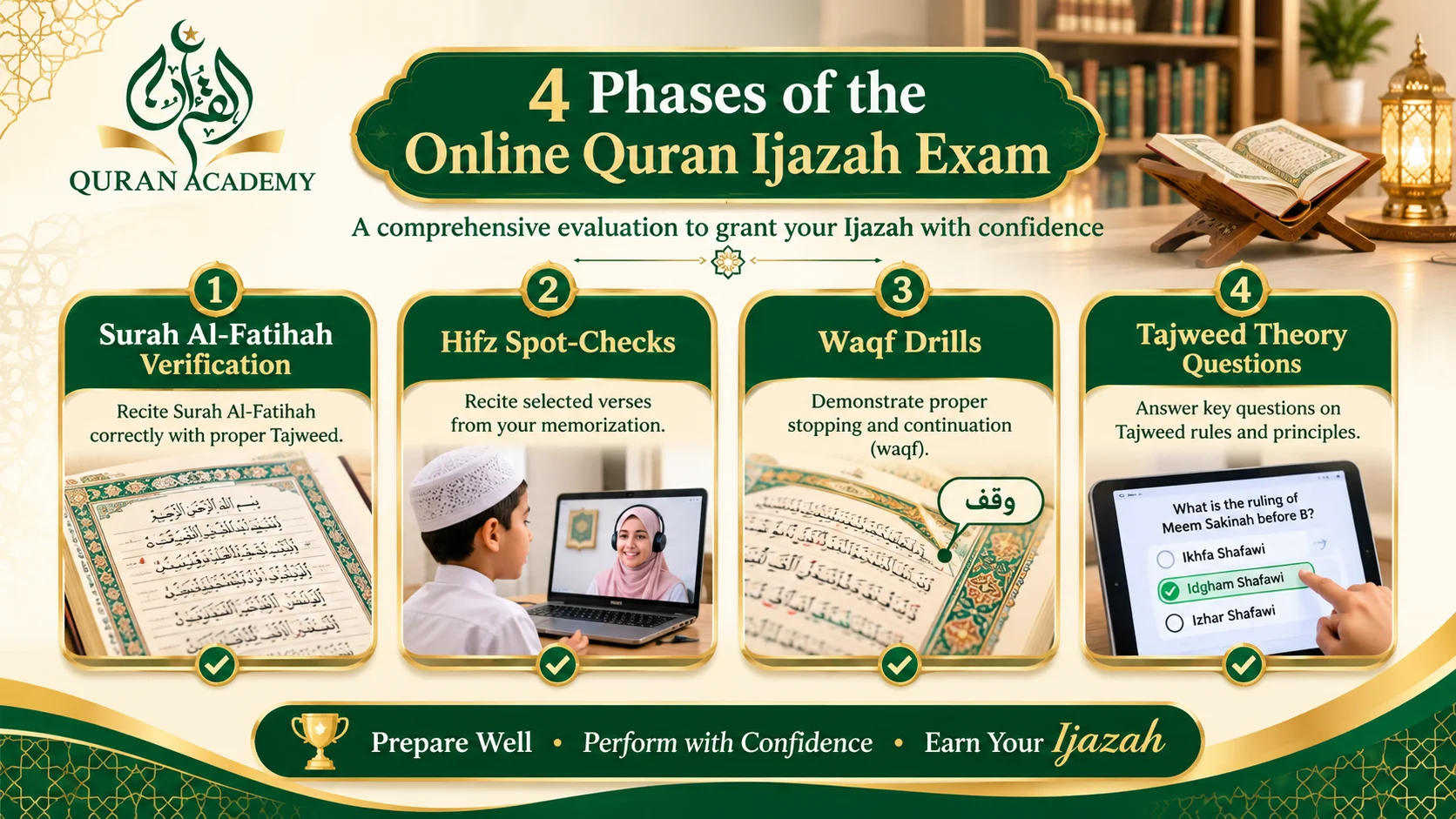
- Step-by-Step: The 4 Phases of an Online Quran Ijazah Examination
- How Examiners Grade Your Recitation: Lahn Jali (Major) vs. Lahn Khafi (Subtle) Errors
- The 7 "Special Words of Hafs 'an 'Asim" Every Ijazah Examiner Tests You On
- 6-Step Pre-Exam Readiness Checklist (Audio, Camera & Revision Prep)
- Frequently Asked Questions (FAQs)
1. What Is a Quran Ijazah & Connected Sanad? (Why It Is a Complete Khatmah, Not Just a 1-Hour Test)
Linguistically, the Arabic word Ijazah (إِجَازَة) means "permission" or "authorization." In the sciences of the Quran—whose core terms are indexed in our Interactive Tajweed & Quranic Encyclopedia—an Ijazah is an official scholarly license granted by an already-certified authority (Mujeez) testifying that the student (Mujaz) has recited the entire Holy Quran to them word-for-word with complete mastery and is now qualified to transmit and teach it to others.
Unlike a university final exam where you sit for two hours and answer 20% of the textbook, an authentic Quran Ijazah requires a 100% complete oral Khatmah:
Your Sheikh or Ustadhah listens to selected passages from long and short Surahs to verify that your foundational Tajweed and fluency are ready for the Sanad track.
You recite the entire Quran from Surah Al-Fatihah (1:1) to Surah An-Nas (114:6) across weekly 1-on-1 sessions. Every single session is part of your ongoing examination!
Upon completing Juz 30, you sit for a comprehensive final assessment covering random spot-checks, Tajweed theory, and the special rulings of your Riwayah.
The tradition of reciting the entire Quran before a teacher for verification goes directly back to the annual review (Al-'Ardah) between Angel Jibreel and the Prophet Muhammad (peace be upon him). Fatimah (may Allah be pleased with her) narrated that the Prophet (ﷺ) told her:
"Jibreel used to review the Quran with me once every year, and this year he reviewed it with me twice (مَرَّتَيْنِ)."
2. Master Comparison: Recitation (Tilawah) Ijazah vs. Memorization (Hifz) Ijazah Exam
Before booking your assessment, it is essential to know that our Authentic Online Ijazah Program offers two distinct certification tracks. Compare how the exam works in each track below:
| Exam Dimension | 1. Ijazah in Recitation (Tilawah / Nazar) | 2. Ijazah in Memorization (Hifz / Ghayb) | Single-Juz / Sub-Track Option | Key Passing Requirement |
|---|---|---|---|---|
| 1. Use of the Mushaf | Open-Mushaf Recitation: You read directly from the Uthmani Mushaf on screen or in print. | 100% Blind Recitation: You recite from memory on camera with eyes directed at the lens. | Available for Juz Amma, Juz Tabarak, or Surah Al-Baqarah milestones. | Zero unauthorized peeking during Hifz sessions. |
| 2. Tajweed Theory & Application | 100% Identical Standard: Flawless Makharij, Sifaat, Madd, Noon/Meem Sakinah, and Waqf. | 100% Identical Standard: Must maintain full Tajweed precision while recalling from memory. | Tested on all Tajweed rules appearing in the selected Juz. | 95%+ theoretical & practical Tajweed accuracy. |
| 3. Final Spot-Check Format | Examiner opens to 5–7 challenging passages across the Quran to test live sight-reading & rules. | Examiner reads a verse prompt (Su'al fil-Hifz) from 8–12 random locations; you continue reciting for 1 page each. | 3–5 spot-check prompts within the specific Juz or Surah. | Smooth continuation across page transitions & Mutashabihat. |
| 4. Certificate Wording | States: "Ijazah in Recitation (Tilawatan / Nazaran) with Connected Sanad." | States: "Ijazah in Memorization & Recitation (Hifzan wa Tilawatan) with Connected Sanad." | States: "Mastery Certificate / Partial Ijazah in [Juz Name]." | Includes official Verification ID for Online Certificate Verification. |
The Acoustic Precision an Ijazah Examiner Listens For
During an Ijazah evaluation, your examiner doesn't just check if you know the words—they listen to the exact release of every consonant, especially when stopping on Sukoon. In this 60-second clip from our official Quran Academy YouTube Channel, Senior Instructor Ustadhah Yasmeen Gamal demonstrates the level of clarity required for Sanad certification:
- Zero Vowel Intrusion on Qalqalah: Hear how a true Qalqalah echo bounces cleanly without accidentally adding a Fatha or Kasra sound.
- Why Examiner Feedback Is a Gift: Every micro-correction polishes your recitation to match the Prophetic transmission!
3. Step-by-Step: The 4 Phases of an Online Quran Ijazah Examination
What actually happens on the day of your final online Ijazah assessment with our Al-Azhar Certified Scholars? Here is the exact 60-to-90-minute walkthrough so nothing surprises you:
📋 Inside the 4-Phase Live Online Assessment
Every Ijazah exam begins with Al-Isti'adhah, Al-Basmalah, Surah Al-Fatihah, and the first 5 verses of Surah Al-Baqarah. Why? Because Surah Al-Fatihah is the pillar of daily prayer—containing 14 Shaddahs, heavy/light contrasts (Ihdinas-Siraatal-Mustaqeem), and compulsory 6-count elongation (Walad-Daalleen). Your examiner listens closely to your transition ways (Awjuh al-Basmalah) between the end of one Surah and the start of the next.
Struggling to perfect your Recitation?
Join hundreds of students mastering the Quran with our Verified Al-Azhar Graduates. We offer flexible 1-on-1 sessions tailored to your schedule.
Book a Free Evaluation Class →For Hifz Candidates: The examiner recites the beginning of a verse from 8 to 10 different Juz (for example, one from Al-Imran, one from Al-A'raf, one from Yusuf, one from An-Noor, and one from Qaf) and asks you to continue reciting for 10 to 15 lines. They specifically test Mutashabihat (look-alike verses) and page transitions to verify that your 3x3 verse linking and 20-page Juz anchors are rock-solid.
For Tilawah Candidates: You are asked to sight-read selected verses containing complex consonant clusters and diverse elongations.
Your examiner will ask you to stop on specific words mid-verse (Waqf Ikhtibari — Testing Stop) to see if you know how to handle word endings (such as stopping on words with Hamzah, Yaa Mahdhoofah, or joined/separated words Al-Maqtoo' wal-Mawsool) and how you backtrack 1–2 words to resume without breaking the meaning, following the Rules of Waqf in the Quran.
Because an Ijazah authorizes you to teach others, your examiner will point to 5 or 6 words you just recited and ask you to explain the rule in English or Arabic: "Why did you make the Raa heavy here?" (Tafkhim & Tarqeeq rules), "What is the exact Makhraj and Sifaat of the letter Daad (ض)?", or "How many counts is this Madd Lazim?"
4. How Examiners Grade Your Recitation: Lahn Jali vs. Lahn Khafi
As we detail in our Complete Tajweed Learning Guide, Ijazah committees evaluate errors across two distinct categories:
- 1. Al-Lahn Al-Jali (اللَّحْنُ الْجَلِيّ — Clear / Major Grammatical & Letter Errors): Changing one letter into another (e.g., reading ط as ت or ص as س), changing a vowel mark (e.g., reading An'amta with a Damma or Kasra on the Taa), adding/dropping a letter, or dropping a Shaddah. Ijazah Standard: Zero uncorrected Lahn Jali is permitted. If a student slips due to nerves and immediately self-corrects (or corrects upon a single prompt), it is excused; repeated uncorrected Lahn Jali requires additional remedial sessions before certification.
- 2. Al-Lahn Al-Khafi (اللَّحْنُ الْخَفِيّ — Subtle / Hidden Beautification Errors): Shortening a 2-beat Ghunnah to 1 beat, making a 4-count Madd Muttasil slightly uneven, or trilling the letter Raa excessively. Ijazah Standard: Candidates must maintain at least 90% to 95% consistency in all subtle beautification rules.
5. The 7 "Special Words of Hafs 'an 'Asim" Every Ijazah Examiner Tests You On
Here is an insider tip from our examination board: almost every Hafs 'an 'Asim Ijazah exam includes questions on the 7 unique exceptions (Kalimat Khassah li-Hafs) where Hafs departs from regular phonetic rules. Make sure you can recite and explain all seven before your exam:
- 1. Al-Imalah (الإِمَالَة — Vowel Tilting) in Surah Hud (11:41): The word مَجْر۪هَا (Majreehaa) is the only word in Hafs recited with Imalah Kubra—tilting the Fatha of the Raa and the Alif halfway toward a Kasra and Yaa (sounding like "ey" in the English word "they"), with a light Raa!
- 2. At-Tashil (التَّسْهِيل — Easing the 2nd Hamzah) in Surah Fussilat (41:44): In the word ءَأَعْجَمِيٌّ (A-a'jamiyyun), the first Hamzah is pronounced sharply, while the second Hamzah is softened halfway between a Hamzah and an Alif.
- 3. Al-Ishmam & Ar-Rawm (الإِشْمَام وَالرَّوْم) in Surah Yusuf (12:11): On the word لَا تَأْمَنَّا (Laa Ta'mannaa) (originally Ta'manunaa), you must demonstrate either Ishmam (rounding the lips silently during the Noon's Ghunnah to signal the dropped Damma) or Rawm / Ikhtilas (pronouncing two-thirds of the Damma quickly).
- 4. The 4 Obligatory Saktahs (السَّكَتَات الْأَرْبَع): Pausing for 2 counts without breathing on عِوَجَا ۜ (Al-Kahf 18:1), مَرْقَدِنَا ۜ (Yaseen 36:52), مَنْ ۜ رَاقٍ (Al-Qiyamah 75:27), and بَلْ ۜ رَانَ (Al-Mutaffifin 83:14), plus the optional Sakt between the end of Surah Al-Anfal and the start of Surah At-Tawbah, and on مَالِيَهْ ۜ هَلَكَ (Al-Haqqah 69:28–29).
- 5. Words With Saad Written Over Seen (ص / س): Knowing which reading is obligatory or preferred in the 4 words: وَيَبْسُطُ (2:245 — Seen only), بَصْطَةً (7:69 — Seen only), أَمْ هُمُ الْمُصَيْطِرُونَ (52:37 — Saad or Seen both permissible), and بِمُصَيْطِرٍ (88:22 — Saad only).
- 6. Daad (ض) in Surah Ar-Rum (30:54): Knowing that the three occurrences of ضَعْفٍ / ضَعْفًا in Surah Ar-Rum (30:54) can be read with either a Fatha (Da'f) or a Damma (Du'f) in Hafs.
- 7. The 7 Alifs (الأَلِفَاتُ السَّبْع) Marked With a Tall Oval Zero (٠): Words like أَنَا۠، لَٰكِنَّا۠، الظُّنُونَا۠، الرَّسُولَا۠، السَّبِيلَا۠، قَوَارِيرَا۠ (1st one in 76:15)، سَلَاسِلَا۠ where the final Alif is pronounced for 2 counts only when stopping and dropped completely when continuing!
6. Six-Step Pre-Exam Readiness Checklist for Online Candidates
Before your final online assessment, complete these 6 practical steps (and use our Smart Hifz Planner to organize your final 30-day revision cycle):
- 1. Use a Clear Headset or Condenser Microphone: Built-in laptop microphones often clip soft whisper letters (Huroof al-Hams like ف ح ث هـ ش خ ص س ك ت). A simple wired headset ensures your examiner hears every subtle consonant release.
- 2. Camera Framing for Hifz Exams: Position your webcam at eye level showing your face and hands clearly (or wear a Niqab/Hijab with a female examiner for sisters—we provide 100% private female committees for sisters, as highlighted on our Verified Student & Parent Reviews Page!).
- 3. Recite at a Calm "Tarteel / Tahqeeq" Pace: Never rush during an Ijazah exam! Reciting at a measured medium speed gives your tongue time to fulfill every 2-count Ghunnah and 4-count Madd without breathlessness.
- 4. Keep Warm Water (No Dairy or Cold Drinks) Nearby: Cold water and milk coat the vocal cords and constrict throat letters (ع، ح). Sip room-temperature or warm water with honey 15 minutes before starting.
- 5. Review the Endings of Juz 15 to 27: In Hifz exams, most spot-check prompts come from the middle-to-late Juz (Surahs like Al-Isra, Taha, Al-Mu'minun, Ash-Shu'ara, and Az-Zumar).
- 6. Renew Your Intention (Ikhlas): Remind your heart that you are reciting for the pleasure of Allah Almighty first, and that your examiner is your brother or sister in Islam who wants to see you succeed!
7. Frequently Asked Questions (FAQs) About the Online Quran Ijazah Exam
1. Can I earn an authentic Quran Ijazah online without memorizing all 30 Juz by heart?
Yes! Classical Islamic scholarship recognizes two distinct types of Ijazah: (1) Ijazah in Recitation (Tilawah / Nazar), where you recite all 30 Juz looking directly at the Mushaf with 100% flawless Tajweed and receive a connected Sanad in recitation; and (2) Ijazah in Memorization (Hifz / Ghayb), where you recite all 30 Juz entirely from memory.
2. How long does it take to complete an online Ijazah Khatmah and pass the exam?
If you have already memorized the Quran (or already read fluently with strong Tajweed), completing the 30-Juz verification Khatmah (reading 1 Juz per session, 2 to 3 sessions per week) typically takes 3 to 6 months. If you are still building advanced Tajweed or memorizing new Juz, our customized pathway takes 1 to 2.5 years.
3. How many mistakes are allowed during a Hifz Ijazah spot-check exam?
In a standard Hifz Ijazah exam (8 to 10 random verse prompts), zero uncorrected Major Tajweed Mistakes (Lahn Jali) are permitted. For memory recall, a student is typically allowed no more than 1 to 2 minor memory prompts across the entire exam—and must self-correct immediately upon hearing the prompt.
4. Do sisters take their online Ijazah exam with a female scholar (Sheikha / Ustadhah)?
Yes, 100%! At Quran Academy, all female candidates complete their entire Khatmah and final oral examination in a completely private 1-on-1 virtual classroom with an Ijazah-certified female Al-Azhar scholar (Mujeezah).
5. Is an online Quran Ijazah certificate recognized internationally for teaching?
Yes! Because the validity of an Ijazah in Islam depends on direct oral hearing (Mushafahah / Talaqqi) and the authenticity of the teacher's documented chain of transmission (Sanad), an online Ijazah earned through live audio-visual recitation to a certified scholar is recognized globally—and every certificate we issue carries a unique ID verifiable online.
Book Your Free Ijazah Readiness Evaluation With an Al-Azhar Qari
Ready to find out how close you are to earning your official Ijazah in Recitation or Hifz? Meet a certified male or female scholar live for a complimentary diagnostic session and receive your personalized Sanad roadmap!
Book Your Free 1-on-1 Ijazah Evaluation Class →