
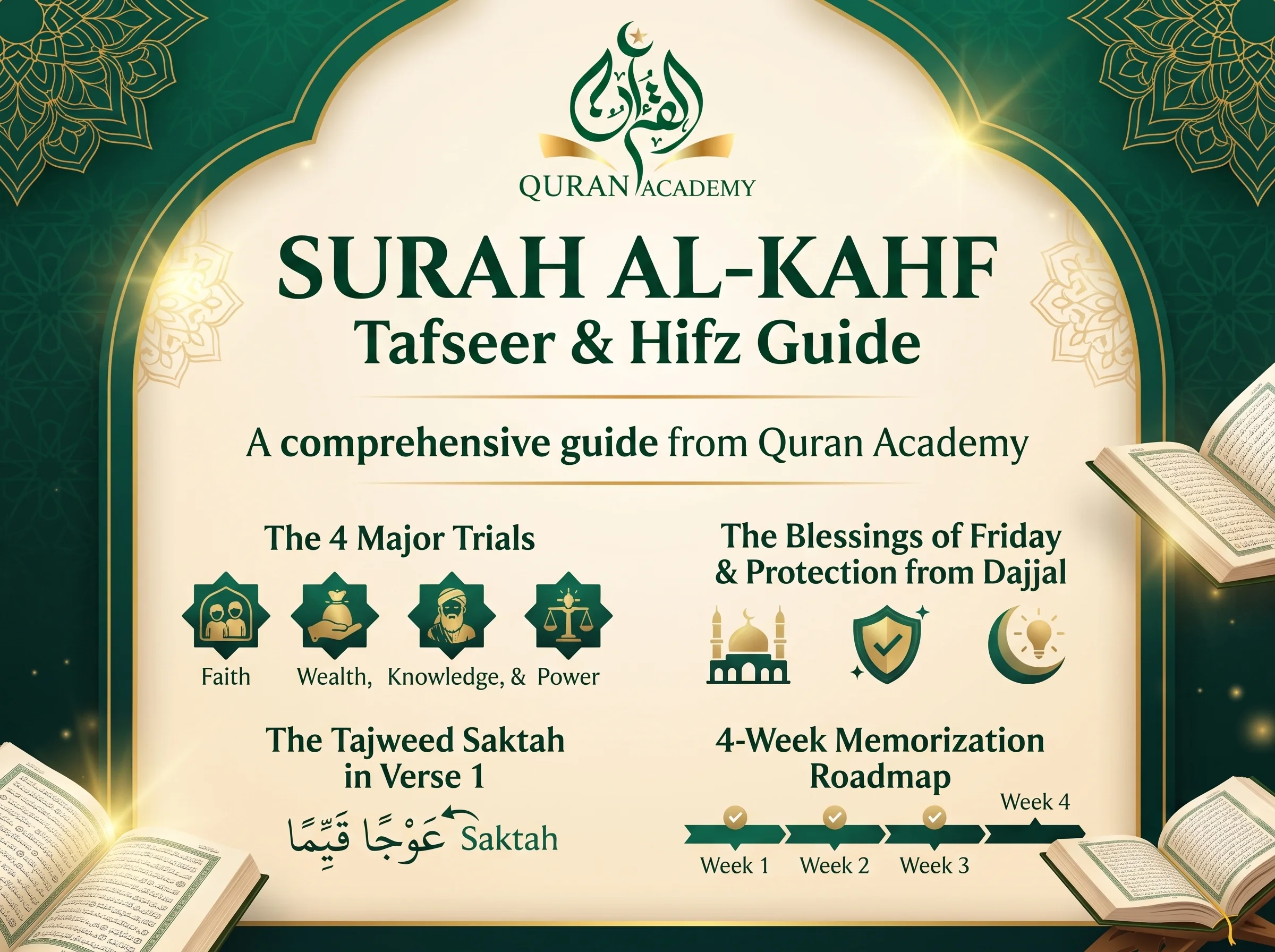
✦ Quick Answer & Key Takeaways: Surah Al-Kahf's 4 Trials & Friday Virtues
Surah Al-Kahf (سُورَةُ الْكَهْف — Chapter 18, "The Cave") is a 110-verse Makkan Surah spanning 11 pages (from the middle of Juz 15 into Juz 16) that we recite every Friday to receive a spiritual light (Noor) between two Fridays and divine immunity from the tribulation of the False Messiah (Al-Masih Ad-Dajjal). Its 110 verses are built around 4 master stories that decode humanity's 4 greatest trials (Fitan): 1. The Trial of Faith (The Youths of the Cave), 2. The Trial of Wealth (The Owner of the Two Gardens), 3. The Trial of Knowledge (Prophet Musa & Al-Khidr), and 4. The Trial of Power (Dhul-Qarnayn). Students in our 1-on-1 Online Quran Tafseer & Exegesis Course study these four narratives in depth to anchor their weekly faith and worldview.
- Why It Protects Against Dajjal: The False Messiah tests humanity with the exact 4 illusions exposed in Surah Al-Kahf (persecuting faith, controlling wealth/rain, dazzling with hidden knowledge, and wielding global power).
- The Friday Time Window: You can recite Surah Al-Kahf anytime from sunset (Maghrib) on Thursday evening until sunset (Maghrib) on Friday—all at once (20–25 mins) or split across 4 prayers!
- The First 10 & Last 10 Verses Shield: Memorizing the opening 10 verses (18:1–10) and closing 10 verses (18:101–110) is an emphasized Prophetic fortress for every Muslim adult and child.
- The 4 "Safe Boats" (Antidotes): Each story pairs its trial with a practical antidote: righteous companionship, remembering the Hereafter, intellectual humility, and sincere service.
Every Friday across the world, millions of Muslims open the middle of their Mushaf to Page 293 to recite Surah Al-Kahf. Yet for many busy professionals, parents, and students in the West, Friday arrives in the middle of a packed work or school day. Eleven pages feels too long to finish in one sitting before Jumu'ah prayer, and even when we do read through the Arabic verses, we often wonder: "What do a group of sleeping youths in a cave, a boastful farmer with two vineyards, a prophet traveling on a boat that gets its plank broken, and a righteous king building an iron wall have to do with my life in 2026?"
When classical scholars of Tafseer unlocked the thematic architecture of Surah Al-Kahf, they discovered one of the most breathtaking structural miracles in the entire Quran: those four seemingly unrelated stories are actually four shields against the four temptations that destroy human hearts in every era! Once you understand the hidden thread connecting all four stories—and learn how to divide the 11 pages into four effortless 5-minute blocks between Thursday Maghrib and Friday Asr—you will never miss your Friday Surah Al-Kahf habit again.
- Why Do We Read Surah Al-Kahf Every Friday? (Authentic Hadiths & Dajjal Link)
- The Backstory (Asbab al-Nuzul): The 3 Riddles That Triggered Surah Al-Kahf
- Deep Dive: The 4 Trials of Surah Al-Kahf & Their 4 Spiritual Antidotes
- Master Chart: The 4 Stories, Their Verses, Core Trials & "Safe Boats"
- How to Finish Surah Al-Kahf Every Friday Effortlessly (The 4-Prayer Split)
- How to Memorize the First 10 Verses (& Full Surah) Using the 3x3 Method
- 3 Special Tajweed Rules in Surah Al-Kahf (The Saktah in Verse 1 & More!)
- Frequently Asked Questions (FAQs) About Surah Al-Kahf
1. Why Do We Read Surah Al-Kahf Every Friday? (Authentic Hadiths & Dajjal Link)
Positioned at the exact physical center of the Holy Quran (Chapter 18—where Verse 19 contains the famous central word of the Mushaf, وَلْيَتَلَطَّفْ), Surah Al-Kahf is our weekly spiritual recalibration. Authentic Prophetic traditions establish three extraordinary promises for the believer who connects with this Surah:
Illuminates your heart, decisions, and path with divine guidance (Noor) for the entire 7-day stretch until the next Jumu'ah.
Memorizing the opening 10 verses (and closing 10 verses in another narration) grants immunity against the deceptions of Ad-Dajjal.
When a Companion recited Surah Al-Kahf at night, a glowing cloud of angels and divine peace (Sakinah) descended over his home!
Abu Darda' (may Allah be pleased with him) reported that the Messenger of Allah (peace be upon him) said:
"Whoever memorizes ten verses from the beginning of Surah Al-Kahf will be protected from the False Messiah (Ad-Dajjal)."
And Abu Sa'id al-Khudri (may Allah be pleased with him) reported that the Prophet ﷺ said: "Whoever recites Surah Al-Kahf on the day of Jumu'ah (Friday), a light (Noor) will shine for him between the two Fridays."
2. The Backstory (Asbab al-Nuzul): The 3 Riddles That Triggered Surah Al-Kahf
As we explain in our Complete Guide to Quran Tafseer, knowing the historical event that triggered a Surah's revelation (Sabab al-Nuzul) makes the entire chapter come alive like a movie! Why did Allah reveal Surah Al-Kahf in Makkah?
When the Quraysh leaders grew desperate to discredit the Prophet Muhammad ﷺ in Makkah, they sent two emissaries (An-Nadr ibn al-Harith and 'Uqbah ibn Abi Mu'ayt) to the Jewish rabbis in Madinah to ask for a test that only a true Prophet of God could pass. The scholars of Madinah gave them three ancient riddles to ask him:
- Riddle #1: Ask him about a group of young men who vanished in ancient times whose story is wondrous (The Youths of the Cave).
- Riddle #2: Ask him about a great traveler who reached the eastern and western horizons of the earth (Dhul-Qarnayn).
- Riddle #3: Ask him about the nature of the Soul (Ar-Ruh).
The Prophet ﷺ confidently told Quraysh: "I will give you the answer tomorrow!"—but he forgot to add the phrase "In sha' Allah" (If Allah wills). For 15 agonizing days in Makkah, revelation paused completely while the Quraysh mocked him—until Angel Jibreel (AS) descended with Surah Al-Kahf, answering the riddles in breathtaking detail, adding two additional stories (the Two Gardens and Musa & Al-Khidr), and teaching every believer the eternal lesson in Verses 23–24: "And never say of anything, 'Indeed, I will do that tomorrow,' except by adding: 'If Allah wills (In sha' Allah)!'"
Stop Mispronouncing These Tricky Quranic Words on Friday!
Surah Al-Kahf contains some of the most unique words in the entire Mushaf—including عِوَجَا (18:1), وَرِقِكُمْ (18:19), لَّكِنَّا۠ (18:38), and مُهْلِكِهِم (18:59)! Watch this quick 32-second lesson from our official Quran Academy YouTube Channel on how our Al-Azhar instructors audit and fix commonly misread words:
- Eliminate Hidden Vowel Errors: Make sure your Friday recitation is 100% free of accidental vowel swaps (Lahn Jali).
- 1-on-1 Friday Surah Check: Recite Surah Al-Kahf live to a certified teacher and perfect every page!
3. Deep Dive: The 4 Trials of Surah Al-Kahf & Their 4 Spiritual Antidotes
Why is Surah Al-Kahf ranked among the 9 Most Important Surahs to Start Learning Quran Tafseer With? Because scholars such as Sheikh Abul-Hasan Ali Nadwi and classical exegetes pointed out that the Surah doesn't just describe 4 trials (Fitan)—immediately after each story, Allah places a commentary passage that gives you the exact spiritual "Safe Boat" (Antidote) to survive that trial! Follow along in our Online Digital Quran & Audio Mushaf:
🛡️ The 4 Trials (Fitan) & Their 4 Divine Shields
The Story: The Young Men of the Cave (Ashab al-Kahf)
The Antidote (Verse 28): How do you protect your faith in a secular or hostile environment? Look at Verse 28 right after their story: Righteous Companionship (As-Suhbah As-Salihah)! Allah commands: "And keep yourself patiently with those who call upon their Lord morning and evening, seeking His countenance..." Never walk the path of faith alone!
The Story: The Owner of the Two Lush Gardens (Sahib al-Jannatayn)
The Antidote (Verses 39, 45–46): Two shields protect your heart from materialism: 1. Saying "Maa shaa'a Allahu laa quwwata illaa billaah" whenever you see a blessing, and 2. Remembering the Parable of Dunya as temporary rain while investing in eternal good deeds (Al-Baqiyat As-Salihat)!
The Story: Prophet Musa (AS) & Al-Khidr at the Junction of the Two Seas
Struggling to perfect your Recitation?
Join hundreds of students mastering the Quran with our Verified Al-Azhar Graduates. We offer flexible 1-on-1 sessions tailored to your schedule.
Book a Free Evaluation Class →The Antidote (Verses 66 & 82): Intellectual Humility, Patience (Sabr), and Trusting Allah's Hidden Wisdom (Qadar)! Even when a painful event in your life looks like "a damaged boat," Allah is often protecting your ship from a tyrant king ahead!
The Story: Dhul-Qarnayn & The Iron Barrier Against Ya'juj and Ma'juj
The Antidote (Verse 98): The moment he finished building the mighty iron-and-copper dam, he didn't boast about his genius; he gave 100% credit to Allah: "هَـٰذَا رَحْمَةٌ مِّن رَّبِّى" ("This is a mercy from my Lord!"). The antidote to power is Sincerity (Ikhlas) and Selfless Service to Humanity.
4. Master Chart: The 4 Stories, Their Verses, Core Trials & "Safe Boats"
Bookmark this 5-column summary chart to review the architecture of Surah Al-Kahf with your family every Friday:
| Story & Verses | Mushaf Pages | The Core Trial (Fitnah) | How Dajjal Uses This Trial | The Quranic "Safe Boat" (Antidote) |
|---|---|---|---|---|
| 1. Youths of the Cave (Verses 9–26) |
Pages 294–296 | Trial of Faith (Persecution & Peer Pressure) |
Demands people abandon Tawheed and worship him. | Righteous Friends (18:28) & Dua for Mercy (18:10). |
| 2. Owner of Two Gardens (Verses 32–44) |
Pages 297–299 | Trial of Wealth (Materialism & Arrogance) |
Commands the sky to rain and the earth to bring forth treasure. | Gratitude (Maa shaa'a Allah) & Hereafter focus (18:46). |
| 3. Musa & Al-Khidr (Verses 60–82) |
Pages 300–302 | Trial of Knowledge (Ego & Judging by Appearances) |
Uses dazzling feats and partial knowledge to deceive minds. | Humility ("Above every knower is The All-Knowing"). |
| 4. Dhul-Qarnayn (Verses 83–98) |
Pages 302–304 | Trial of Power (Tyranny & Self-Glorification) |
Sweeps across the earth with immense worldly dominion. | Sincerity (Ikhlas) & using strength to protect the weak. |
5. How to Finish Surah Al-Kahf Every Friday Effortlessly (The 4-Prayer Split)
In the Islamic Hijri calendar, a new day begins at Maghrib (sunset) the evening before! That means the blessed time window for reciting Surah Al-Kahf opens at Maghrib on Thursday evening and remains open until Maghrib on Friday evening (a full 24-hour window!).
If sitting for 25 uninterrupted minutes on a busy Friday morning feels difficult (especially for working professionals and parents following our Busy Adult Quran Learning Guide), divide the 11 pages of Surah Al-Kahf into 4 micro-sessions of just 5 minutes each (1 Story per Prayer!):
- Block 1 — Thursday Night After Maghrib (5 Mins | Verses 1–31): Read the Opening Praise + Story #1 (The Youths of the Cave). (Only 3 pages: 293 to 297!).
- Block 2 — Thursday Night After Isha (5 Mins | Verses 32–59): Read Story #2 (The Owner of the Two Gardens) + the warning about Iblis. (Only 2.5 pages: 297 to 300!). Notice that before you even go to sleep on Thursday night, you have already finished half of Surah Al-Kahf!
- Block 3 — Friday Morning After Fajr (5 Mins | Verses 60–82): Read Story #3 (Prophet Musa & Al-Khidr)—spanning from the bottom of Page 300 (where Juz 16 begins at Verse 75: Qala alam aqul laka...) to Page 302.
- Block 4 — Friday Before Jumu'ah or After Asr (5 Mins | Verses 83–110): Finish with Story #4 (Dhul-Qarnayn) and the majestic closing 10 verses (Pages 302 to 304)! (Want to build this same prayer-anchored habit for the entire Quran? Use our Interactive 30-Day Khatmah Planner!).
6. How to Memorize the First 10 Verses (& Full Surah) Using the 3x3 Method
Before attempting all 110 verses, every Muslim man, woman, and child should lock in the First 10 Verses (Verses 1–10 on Pages 293–294) and the Last 10 Verses (Verses 101–110 on Page 304):
A. The 3-Day Weekend Sprint for the First 10 Verses (Only 15 Lines Total!)
Did you know that the first 10 verses of Surah Al-Kahf are only 15 lines long in total (the exact length of a single Mushaf page)? Using our 3x3 Quran Memorization Method inside our Complete Online Hifz Program, you can memorize them in a single weekend:
- Day 1 (Verses 1–4): Praise of Allah Who revealed the Book with no crookedness ('Iwaja) to give glad tidings to the believers and warn those who claim Allah has taken a son.
- Day 2 (Verses 5–8): Consoling the Prophet ﷺ not to grieve over their rejection, and reminding us that everything on earth is merely an adornment test.
- Day 3 (Verses 9–10): The opening of the Cave story and the famous golden Dua of the Youths: "رَبَّنَآ ءَاتِنَا مِن لَّدُنكَ رَحْمَةً وَهَيِّئْ لَنَا مِنْ أَمْرِنَا رَشَدًا" ("Our Lord, grant us from Yourself mercy and prepare for us from our affair right guidance!").
B. Making Friday Surah Al-Kahf Exciting for Kids & Teens
Children and teenagers love the adventure stories of Surah Al-Kahf! Enroll them in our Bring the Quran to Life: Tafseer for Kids & Teens Course (or pair their Friday recitation of the first 10 verses with our Printable Kids Star Reward Chart) so Friday evening becomes their favorite storytelling night of the week!
7. Three Special Tajweed Rules in Surah Al-Kahf (The Saktah in Verse 1 & More!)
In Riwayat Hafs 'an 'Asim, Surah Al-Kahf contains three famous recitation gems that our Al-Azhar Certified Tajweed Tutors train every student to master (you can check all technical symbols in our Interactive Tajweed Glossary or join our 1-on-1 Learn Tajweed Online Course):
- 1. The Mandatory Breathless Pause (Al-Saktah — س) Between Verses 1 & 2:
Look closely at the end of Verse 1: وَلَمْ يَجْعَل لَّهُۥ عِوَجَا ۜ (١) قَيِّمًا. Above the Alif of عِوَجَا ۜ, you will see a tiny letter س (Seen)! If you simply stop at the end of Verse 1 and take a breath (which is completely permissible!), you stop with a 2-beat Madd 'Iwad ('Iwajaa). However, if you choose to connect Verse 1 into Verse 2, you must NOT apply Ikhfa on the Tanween! Instead, pronounce 'Iwajaa, hold a gentle 2-beat pause WITHOUT taking a breath (Saktah), and then say Qayyiman! Why? So the listener never thinks the word "Straight" (Qayyiman) is describing "Crookedness" ('Iwaja)! - 2. The Tall Zero Symbol (Al-Sifr Al-Mustateel — ۠) in לَّكِنَّا۠ هُوَ اللَّهُ رَبِّى (Verse 38):
In Verse 38, the word لَّـٰكِنَّا۠ (originally Lakin Ana — "But as for me") carries a tall oval zero (۠) over its final Alif! The rule of the tall oval zero in the Mushaf is: drop the Alif completely when connecting (1 beat: LakinnahuwAllahu), and pronounce the Alif for 2 beats ONLY if you stop on the word (Lakinnaa)! - 3. The Two Valid Pronunciations of الضعف / ضُعْف in Verse 54 and ردماً / السدّين in Verses 93–96:
Watch your vowels carefully in the story of Musa and Dhul-Qarnayn: in Verse 19, the silver coin is read with a quick Kasra under the Raa (بِوَرِقِكُمْ — Bi-wariqikum), and in Verse 59, it is read with a Damma on the Meem and Kasra on the Lam (مُهْلِكِهِم — Muhlikihim)!
Read how students across the US, UK, Canada, and Australia perfected their Friday recitation of Surah Al-Kahf on our Verified Student & Parent Reviews Page.
8. Frequently Asked Questions (FAQs) About Surah Al-Kahf
1. When does the time for reading Surah Al-Kahf on Friday start and end?
Because the Islamic day begins at sunset, the time window for reading Surah Al-Kahf starts at Maghrib on Thursday evening and ends at Maghrib on Friday evening. You can read it on Thursday night, Friday morning after Fajr, before Jumu'ah prayer, or Friday afternoon after Asr—and you may read it all in one sitting or split it into parts across the day.
2. Should I memorize the first 10 verses or the last 10 verses of Surah Al-Kahf for protection from Dajjal?
Both are authentic! In Sahih Muslim (809a), the Prophet ﷺ mentioned the first ten verses of Surah Al-Kahf, and in another authentic narration right after it in Sahih Muslim (809b), he mentioned the last ten verses of Surah Al-Kahf. Therefore, scholars strongly recommend memorizing both the first 10 verses (18:1–10) and the last 10 verses (18:101–110) to combine both Prophetic promises!
3. Does listening to Surah Al-Kahf on Friday give the same reward if I cannot read Arabic fluently yet?
If you are still learning to read Quranic Arabic smoothly, following along with your eyes on the Mushaf and translation while listening attentively to a Qari brings immense reward. However, even reading the first 10 verses slowly with your own tongue (earning a double reward for your effort!) alongside listening to the rest is the best way to build your fluency week by week.
4. Why did the Youths of the Cave sleep for 300 years, and why does the verse add "and nine"?
In Verse 25, Allah says: "And they remained in their cave for three hundred years and exceeded by nine." Scholars of Tafseer and astronomy point out a miraculous precision: 300 solar years equals exactly 309 lunar years (since every 100 solar years equals 103 lunar years)! Thus, the verse united both calendar systems in a single sentence.
5. How long does it take to memorize all 110 verses of Surah Al-Kahf?
Surah Al-Kahf is 11 pages long (Pages 293 to 304 in the 15-line Madani Mushaf). By memorizing half a page (7.5 lines) per day from Monday to Friday and reviewing on weekends, you can memorize the entire Surah in just 4.5 weeks (1 month)—and because you recite it every Friday for the rest of your life, you will never forget it!
Master Surah Al-Kahf's Tajweed, Tafseer & Hifz 1-on-1
Ready to recite Surah Al-Kahf smoothly every Friday—and lock its 4 life-changing stories into your heart? Book your free 1-on-1 trial session with a certified male Sheikh or female Ustadhah from Al-Azhar University today!
Book Your Free 1-on-1 Trial Class →