
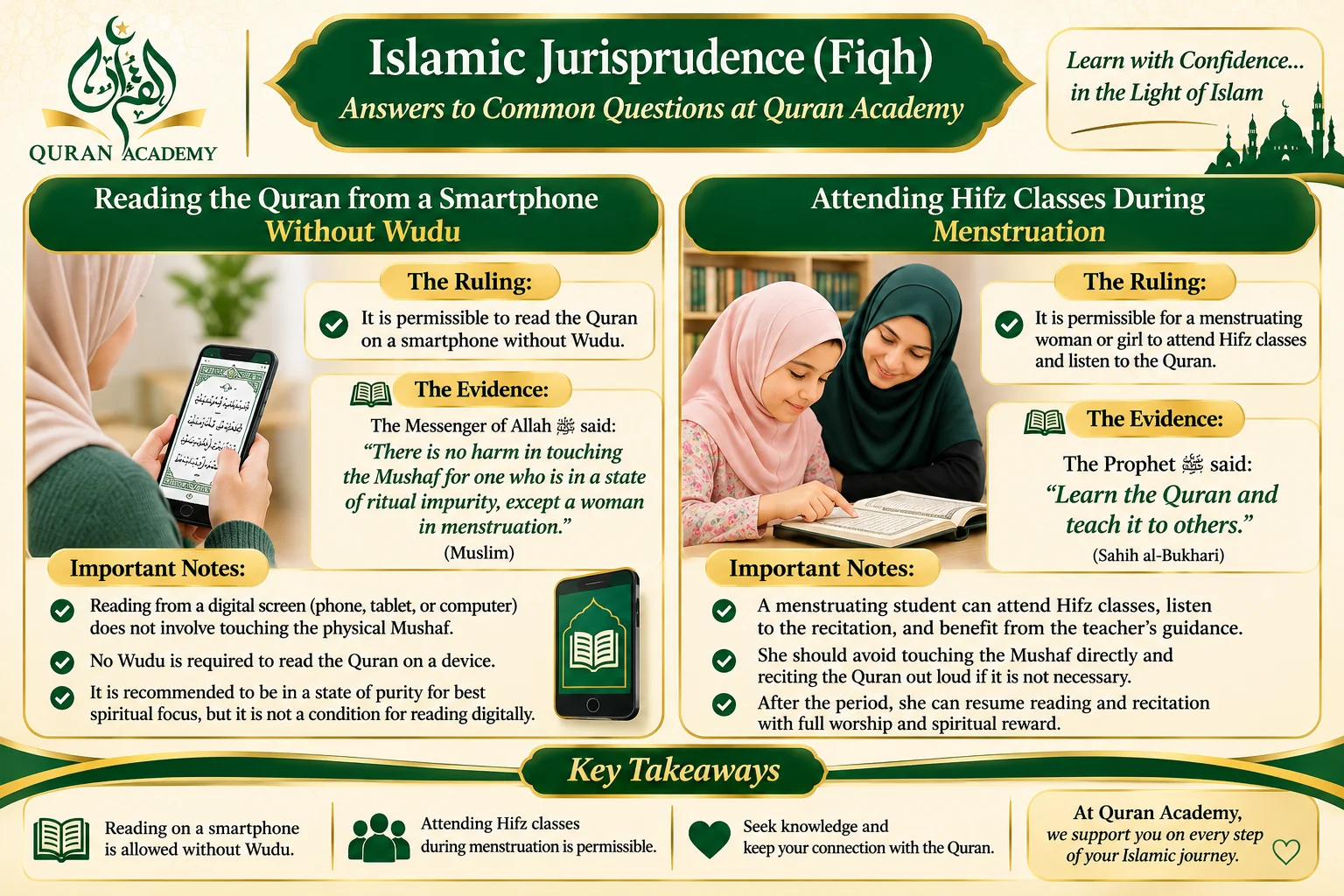
✦ Quick Answer & Key Takeaways: Reading Quran on a Phone Without Wudu or During Menses
If you are asking, "can I read the Quran on my phone without Wudu?" the overwhelming consensus of contemporary Islamic scholars is yes, it is completely permissible. A smartphone or tablet screen does not carry the legal ruling of a physical paper Mushaf because the verses appear as temporary electronic light pixels behind a glass barrier—meaning you can touch the screen and recite aloud or silently without Wudu. Regarding reading the Quran during your period (menstruation): reading silently with your eyes, listening to audio, and reading Tafseer or translations on a phone is unanimously permissible across all four Sunni schools. Furthermore, for verbal recitation aloud during menses, the Maliki school (along with a strong narration in the Hanbali school and Al-Azhar fatwas) explicitly permits female students, teachers, and Hifz learners to recite aloud from a digital screen so they do not forget their memorization or miss their 1-on-1 Online Tajweed & Quran Classes.
- Minor Impurity (No Wudu) vs. Major Impurity (Hayd/Janabah): If you simply lack Wudu (Hadath Asghar), all four Madhhabs agree you may recite the Quran aloud from memory or from a digital screen; the classical restriction only applies to touching a printed Arabic paper Mushaf directly.
- Why Smartphones Are Not Paper Mushafs: Contemporary jurists explain that digital text consists of encoded data and light vibrations behind a glass screen (acting as a permanent barrier, or Ha'il), not permanent physical ink on parchment.
- The Hifz Student Dispensation for Sisters: Because a menstruating woman cannot end her period at will (unlike Janabah, which ends with a 5-minute shower), the Maliki school permits her to recite aloud so her memorized Surahs do not slip away.
- Staying Connected During Ramadan & Year-Round: Sisters never need to feel spiritually disconnected for 7 days every month—whether reciting from a screen, doing Dhikr, or listening and reflecting!
Picture two everyday situations faced by millions of Muslims across the US, UK, Canada, and Australia. First: you are commuting on a train or sitting in a waiting room with fifteen quiet minutes to spare, and you want to open our Online Uthmani Quran Explorer on your smartphone to review your daily Hifz lines—but you do not currently have Wudu, and there is no washroom nearby to perform ablution.
Second: you are a dedicated Muslim sister, working professional, or mother who has worked hard for months to build a daily Quran habit—or you are in the middle of the last ten nights of Ramadan—when your monthly period (Hayd) begins. Immediately, you are hit with conflicting advice on social media: one person tells you that uttering a single word of the Quran during menstruation is strictly forbidden, while another tells you that reading from a smartphone app is completely allowed. To give you total peace of mind, our Al-Azhar curriculum scholars have compiled this comprehensive, respectful Fiqh guide breaking down the exact evidence and rulings of the Four Sunni Schools of Jurisprudence (Hanafi, Maliki, Shafi'i, and Hanbali).
- 3 Foundational Distinctions: Touching vs. Reciting & Minor vs. Major Impurity
- Part 1: Can I Read the Quran on My Phone Without Wudu? (The Digital Screen Ruling)
- Part 2: Can Women Read or Recite the Quran During Their Period? (The 4 Madhhabs)
- Master 5-Column Fiqh Chart: Rulings Across All 8 Everyday Scenarios
- Rulings on English Translations, Tafseer Books & Quranic Duas
- What Should Sisters Do During Their Online Quran & Hifz Classes Each Month?
- 7 Rewarding Acts of Worship for Sisters During Menstruation in Ramadan
- Frequently Asked Questions (FAQs)
1. Three Foundational Fiqh Distinctions Every Muslim Must Know First
90% of confusion around the question "can I read the Quran on my phone without Wudu or during my period?" happens because people mix up three completely different legal categories in Islamic jurisprudence (you can explore all foundational Islamic and recitation terms in our Interactive Tajweed & Quranic Encyclopedia):
Mass al-Mushaf (مَسُّ الْمُصْحَف) means physically touching the printed Arabic book with bare skin. Qira'at al-Quran (قِرَاءَةُ الْقُرْآن) means moving the tongue to recite verses aloud or from memory without touching the book.
Hadath Asghar (Minor): Simply not having Wudu (due to sleep, using the restroom, or passing wind).
Hadath Akbar (Major): Requires a full ritual bath (Ghusl), which includes marital intimacy (Janabah), menstruation (Hayd), and postnatal bleeding (Nifas).
Looking at Quranic verses with your eyes and pondering them in your heart without moving your tongue or lips (Qira'ah bil-Qalb) is not legally classified as verbal recitation and is permissible in all states across all four Madhhabs!
2. Part 1: Can I Read the Quran on My Phone Without Wudu? (The Digital Screen Ruling)
First, let us establish the baseline rule for someone who simply does not have Wudu (Minor Impurity / Hadath Asghar):
- Reciting From Memory Without Wudu: By 100% unanimous consensus (Ijma') of all four Sunni schools (Hanafi, Maliki, Shafi'i, and Hanbali), a Muslim who does not have Wudu is completely permitted to recite the Quran aloud from memory (or while looking at an open Mushaf without touching it).
- Touching a Physical Paper Mushaf Without Wudu: The majority of classical jurists across the four schools hold that physically touching a printed Arabic paper Mushaf with bare skin requires Wudu, citing Surah Al-Waqi'ah (56:79): "None touch it except the purified" (لَّا يَمَسُّهُ إِلَّا الْمُطَهَّرُونَ) and the famous letter of the Prophet (ﷺ) to 'Amr ibn Hazm: "None should touch the Quran except one who is pure (لاَ يَمَسُّ الْقُرْآنَ إِلاَّ طَاهِرٌ)." *(Note: Even for a physical paper Mushaf, the Maliki school grants a special exemption allowing teachers and students—both children and adults—to touch the paper Mushaf without Wudu during study and Hifz lessons so that learning is not made difficult!).*
Why Reading & Touching a Smartphone or Tablet Screen Without Wudu Is Permissible
What about holding your iPhone, Android phone, iPad, or laptop and scrolling through a Quran app without Wudu? Contemporary fatwa councils worldwide—including Al-Azhar Al-Sharif's Dar al-Ifta (Egypt), the Islamic Fiqh Academy, and senior scholars across all four Madhhabs—have ruled that touching and reading the Quran on a digital screen does NOT require Wudu for three clear technical reasons:
- Pixels Are Light Waves, Not Permanent Script: The letters on a smartphone screen are not fixed ink on paper; they are temporary electronic impulses and light vibrations that appear when the app is open and vanish the instant you lock the screen.
- The Protective Glass Screen Acts as a Permanent Barrier (Ha'il): Even when the verses are displayed on the LCD/OLED layer, your finger touches the outer protective glass digitizer—which jurists compare to touching a Mushaf from behind a glass display case or wrapper.
- Removing Hardship for Daily Reciters: Because people carry their phones everywhere (and cannot put a phone down in the restroom the way one leaves a paper Mushaf outside, provided the Quran app screen is turned off), treating a phone as a literal Mushaf would create severe hardship (Haraj). That said, performing Wudu when possible still earns extra spiritual reward out of reverence (Adab) for Allah's words!
How Digital Screen-Sharing & Listening Keep Your Tajweed Sharp
Whether you are reviewing verses on your phone during a commute or attending your live 1-on-1 class on weeks when you prefer to focus on auditory Tajweed and theory, listening to a certified Qari builds deep phonetic memory. Watch Senior Instructor Ustadhah Yasmeen Gamal on our official Quran Academy YouTube Channel:
- Auditory Discrimination Training: Even before moving your tongue, training your ear to recognize crisp Qalqalah and heavy/light letters is 50% of Tajweed mastery.
- 100% Sisters-Friendly Classes: Our female Al-Azhar scholars adapt every session to your comfort and Fiqh preference!
3. Part 2: Can Women Read or Recite the Quran During Their Period? (The 4 Madhhabs Explained)
Now let us address the second—and most important—half of the question: What are the scholarly rulings for a woman during her monthly period (Hayd) or postnatal bleeding (Nifas)?
First, remember that menstruation is a natural biological decree created by Allah Almighty—not a spiritual flaw or punishment. As the Prophet Muhammad (ﷺ) comforted Mother of the Believers Aisha (may Allah be pleased with her) when her period began during the Hajj pilgrimage:
When the Prophet (peace be upon him) found Aisha (may Allah be pleased with her) weeping because her menses began during Hajj, he gently reassured her:
"Indeed, this is a matter that Allah has decreed for the daughters of Adam; so do everything that the pilgrim does, except that you do not perform Tawaf around the House until you bathe (become pure)."
When it comes to verbal recitation of the Quran by a menstruating woman, classical Sunni scholarship offers two well-established, orthodox positions—and understanding both gives sisters immense flexibility and ease:
⚖️ Comparing the Two Classical Scholarly Positions on Reciting During Menses
The Ruling: In the Hanafi, Shafi'i, and standard Hanbali schools, a menstruating woman pauses verbal recitation of the Quran aloud until her period ends, drawing an analogy (Qiyas) between menstruation and major ritual impurity (Janabah).
What IS Permitted in This View:
• Silent Visual Reading (Bil-Qalb / Bin-Nazar): Looking at the Quran on a phone screen or open Mushaf and reading the words in her heart without moving her tongue.
• Listening to Audio Recitation: Listening to a Qari or teacher recite.
• Reading Quranic Verses With the Intention of Dua & Dhikr: Reciting Al-Fatihah, Ayatul-Kursi, the last 2 verses of Al-Baqarah, and the 3 Quls with the intention of protection/supplication (Dhikr/Tahassun), not pureTilawah!
• Spelling Out Words Syllable-by-Syllable (For Teachers): The Hanafi school permits a female Quran teacher to read one word or half-verse at a time with pauses in between to teach her students.
Struggling to perfect your Recitation?
Join hundreds of students mastering the Quran with our Verified Al-Azhar Graduates. We offer flexible 1-on-1 sessions tailored to your schedule.
Book a Free Evaluation Class →The Ruling: The Maliki school of jurisprudence (along with a second narration from Imam Ahmad ibn Hanbal, Imam Al-Bukhari, Ibn Hazm, Sheikh al-Islam Ibn Taymiyyah, Ibn al-Qayyim, and contemporary fatwa councils for students) holds that a menstruating woman IS permitted to recite the Quran aloud—especially when she is a student, teacher, Hifz learner fearing she will forget her memorized Surahs, or reciting her daily Wird—so long as she reads from memory, from a digital phone/computer screen, or turns pages of a Mushaf with a barrier (like a stylus or clean cloth).
Why? Because unlike a person in Janabah (who can take a shower in 5 minutes and resume reading immediately), a menstruating woman cannot end her 5-to-10-day cycle at will! Stopping a female Hifz student or teacher for up to 10 days every single month would cause her to forget the Quran and lose nearly a third of her study year, and there is no authentic (Sahih) Hadith prohibiting a menstruating woman from reciting.
4. Master Fiqh Chart: Rulings Across All 8 Everyday Scenarios
Bookmark this clear 5-column reference table summarizing the rulings across every scenario you or your family will encounter:
| Action / Scenario | Without Wudu (Minor Impurity) | During Period (Majority: Hanafi/Shafi'i) | During Period (Maliki / Student View) | Practical Best Practice |
|---|---|---|---|---|
| 1. Touching & Reading a Phone / Tablet Quran App | ✅ Permissible (Consensus) | ✅ Touching & silent eye-reading allowed. | ✅ Touching & reciting aloud allowed. | Ideal way to read on commutes or during menses without touching a paper Mushaf. |
| 2. Reciting Aloud From Memory (Hifz Revision) | ✅ Permissible (Unanimous Ijma') | ⏸️ Paused (Review silently in heart/eyes). | ✅ Permissible (To prevent forgetting Hifz). | Sisters in Hifz programs may adopt the Maliki dispensation so their Hifz stays strong. |
| 3. Touching a Printed Arabic Paper Mushaf | ❌ Requires Wudu (Except Maliki student rule). | ❌ Not permitted with bare skin. | ⚠️ Permitted for students/teachers or with a barrier. | Use a digital screen on your phone/laptop instead of a paper Mushaf when without Wudu. |
| 4. Reading Silently With Eyes Only (No Tongue Movement) | ✅ Permissible (All 4 Schools) | ✅ Permissible (All 4 Schools) | ✅ Permissible (All 4 Schools) | Zero disagreement: looking at the verses and pondering them in the heart is always allowed! |
| 5. Touching & Reading an English Translation or Tafseer Book | ✅ Permissible (All 4 Schools) | ✅ Permissible (All 4 Schools) | ✅ Permissible (All 4 Schools) | Books where commentary/translation words outnumber Arabic verses are not pure Mushafs. |
| 6. Reciting Ayatul-Kursi, 3 Quls & Quranic Duas for Protection | ✅ Permissible (All 4 Schools) | ✅ Permissible (With intention of Dhikr/Dua) | ✅ Permissible | Never skip your morning, evening, or bedtime protection Adhkar during your period! |
5. Rulings on Touching English Translations, Tafseer Books & Reciting Quranic Duas
What if you want to hold a printed book of English Quran translation, read a volume of Tafseer Ibn Kathir, or recite verses of healing and protection (Ruqyah & Adhkar) before going to sleep while you do not have Wudu or while you are on your period? Classical jurists across all four Sunni schools provide three crystal-clear rulings that make daily connection with the Quran effortless:
📚 The "50%+ Commentary Rule" & Intention of Supplication (Niyyat al-Dua)
In Islamic jurisprudence, a printed book is only governed by the strict touching rules of a Mushaf if it consists exclusively (or predominantly) of the Arabic text of the Quran. If a book contains an English translation alongside the Arabic text, or if it is a book of commentary—as we explain in our Complete Quran Tafseer Guide—where the explanatory words outnumber the Arabic Quranic words, it is legally classified as a book of knowledge (Tafseer), not a pure Mushaf. Therefore, you may hold, touch, and read it without Wudu and during menstruation across all four Madhhabs (providing you avoid placing your finger directly on the Arabic verses if following the stricter Hanafi/Shafi'i precaution).
Even in the majority view (Hanafi, Shafi'i, and Hanbali), any verse of the Quran that is phrased as a supplication, remembrance, or praise—and isuttered with the intention of Dua or Dhikr rather than formal Tilawah—is 100% permissible during menstruation! This includes:
• Saying بِسْمِ اللَّهِ الرَّحْمَٰنِ الرَّحِيمِ (Bismillahir-Rahmanir-Raheem) before eating or starting a task, and saying الْحَمْدُ لِلَّهِ رَبِّ الْعَالَمِينَ after finishing.
• Saying إِنَّا لِلَّهِ وَإِنَّا إِلَيْهِ رَاجِعُونَ (2:156) during times of difficulty, or the travel supplication سُبْحَانَ الَّذِي سَخَّرَ لَنَا هَٰذَا (43:13).
• Reciting all 40 "Rabbana" Duas from the Quran (such as Rabbana aatina fid-dunya hasanatan... in 2:201 or Rabbana laa tuzigh quloobanaa... in 3:8).
Can a sister recite Ayatul-Kursi (2:255), the last two verses of Surah Al-Baqarah (2:285–286), and Surah Al-Ikhlas, Al-Falaq, and An-Nas before sleeping while on her period? Yes! Scholars across the schools permit reciting these specific verses with the intention of seeking protection and fortressing oneself (Tahassun / Ruqyah) as part of the nightly Sunnah Adhkar.
6. What Should Sisters Do During Their Online Quran & Hifz Classes Each Month?
One of the most frequent questions our female academic directors receive from adult sisters, university students, and mothers enrolled in our Online Hifz & Ijazah Certification Program—as well as mature learners following our Realistic Hifz Plan for Women Over 40—is: "Should I cancel my online Quran classes for a whole week every month when my period starts?"
The answer is a resounding NO! Canceling your classes for 7 days every month breaks your learning momentum and costs you 12 weeks (nearly 3 full months) of progress every year. Instead, our Certified Female Al-Azhar Tutors offer two seamless, 100% Fiqh-compliant options for your monthly cycle week:
- Option A — Continue Normal Recitation & Hifz From the Digital Screen (Following the Maliki / Student Dispensation): If you follow the Maliki school, Imam Ahmad's narration, or the contemporary fatwa of Al-Azhar for female Quran students and teachers, you simply read directly from our shared digital classroom screen (or your tablet/phone) without touching a paper Mushaf! This allows you to keep practicing your 3x3 Quran Memorization Method and your Ottoman 20-Page Juz Cycle without losing a single day of retention.
- Option B — Switch to Our "Auditory Tajweed, Qaida & Tafseer Mode" (For Strict Hanafi/Shafi'i Followers): If your personal conscience prefers not to recite connected verses aloud during those 5 to 7 days, simply tell your female Ustadhah at the start of class! She will immediately pivot that week's sessions to:
- Theoretical Tajweed Mastery: Studying the rules of Heavy & Light Letters (Tafkhim & Tarqeeq), Rules of Waqf (Stopping Signs), and practicing isolated letter articulation exercises from our Noorani Qaida & Madani Qaida syllabus (which is permitted in the Hanafi school when read word-by-word with pauses!).
- Auditory Shadowing & Visual Hifz Inspection: Your Ustadhah recites your Hifz pages aloud while you track the Uthmani script silently with your eyes, spotting similar-verse transitions (Mutashabihat) and discussing the Surah's Tafseer and vocabulary!
7. Seven High-Reward Acts of Quranic Worship for Sisters During Menstruation (Especially in Ramadan!)
Whether it is the blessed month of Ramadan (where you can use the 24-Day Sisters' Buffer Plan in our guide on How to Finish Reading the Quran in 30 Days) or any week of the year, never let shaytan convince you that you are "spiritually on pause" during your period. Here are 7 deeply rewarding ways to stay immersed in the Quran:
- 1. Active Tadabbur Listening (The Listener Shares the Reciter's Reward): Listen to 1 Juz a day while tracking the Arabic words and English translation with your eyes on your phone.
- 2. Memorizing Quranic Vocabulary & Root Words: Test your knowledge of high-frequency Quranic words using our Free Interactive Arabic Placement Quiz.
- 3. Mastering Tajweed Rules & Diagrams: Use your week to master tongue-placement charts and test yourself on our 3-Minute Interactive Tajweed Quiz and our Complete Tajweed Learning Guide.
- 4. Helping Your Children With Their Daily Quran Routine: Listen to your children recite their homework lines and award their daily stars on our Printable Kids Quran Reward Chart—earning the full reward of teaching the Quran!
- 5. Abundant Dhikr, Istighfar & Salawat: There is zero restriction on praising Allah (SubhanAllah, Alhamdulillah, Allahu Akbar), seeking forgiveness, and sending blessings upon the Prophet (ﷺ) at Fajr and Maghrib times.
- 6. Nightly Protection Recitations: Recite your morning, evening, and bedtime Quranic Duas and 3 Quls with the intention of remembrance and protection.
- 7. Mapping Your Next Hifz Milestone: Organize your upcoming monthly memorization targets in our Smart Hifz Planner, and read how hundreds of sisters across the US, UK, Canada, and Australia thrive in our private 1-on-1 classes on our Verified Student & Parent Reviews Page!
8. Frequently Asked Questions (FAQs) About Reading the Quran Without Wudu or During Your Period
1. Can I read the Quran on my phone without Wudu?
Yes! According to the overwhelming consensus of contemporary Islamic scholars and fatwa councils (including Al-Azhar and major Fiqh academies), it is completely permissible to read the Quran on your phone, tablet, or computer screen without Wudu, and to touch the glass screen. Digital screens display temporary light pixels rather than permanent ink on paper, though performing Wudu remains recommended for extra reward.
2. Can I recite the Quran aloud from memory without Wudu?
Yes, by 100% unanimous consensus (Ijma') of all four Sunni schools of jurisprudence (Hanafi, Maliki, Shafi'i, and Hanbali), a Muslim who simply lacks Wudu (minor ritual impurity) is permitted to recite the Quran aloud or silently from memory—provided they do not touch a physical printed Arabic Mushaf with bare skin.
3. Can a woman read or recite the Quran on her phone during her period (menstruation)?
Looking silently at the Quran on a phone screen with the eyes, listening to audio recitation, and reading English translations or Tafseer is permissible across all four schools. For verbal recitation aloud during menstruation, the Maliki school (along with a narration from Imam Ahmad, Ibn Taymiyyah, and Al-Azhar fatwas for students) explicitly permits women to recite aloud from a digital screen or from memory for learning, teaching, and Hifz revision so she does not forget.
4. Should sisters cancel their online Quran or Hifz classes during their monthly period?
No! Sisters never need to cancel their online Quran classes during menstruation. You can either continue reciting from our digital screen-share Mushaf (following the Maliki/student scholarly dispensation) or ask your female Ustadhah to dedicate that week's sessions to auditory Tajweed training, word-by-word phonics, and Tafseer study.
5. Can I touch an English translation of the Quran or a Tafseer book without Wudu or on my period?
Yes! Classical jurists across all four Madhhabs state that any book containing more commentary or translation words than Arabic Quranic words is legally classified as a book of Tafseer/knowledge rather than a pure Mushaf, and may be touched and read without Wudu or during menstruation.
Stay Connected to the Quran Every Week of the Year!
Study in a warm, flexible 1-on-1 virtual classroom with certified Al-Azhar female and male teachers who adapt every lesson to your schedule and Fiqh comfort. Book your free evaluation session today!
Book Your Free 1-on-1 Quran Trial Class →