
✦ Quick Answer & Key Takeaways: Sifaat al-Huruf in Tajweed
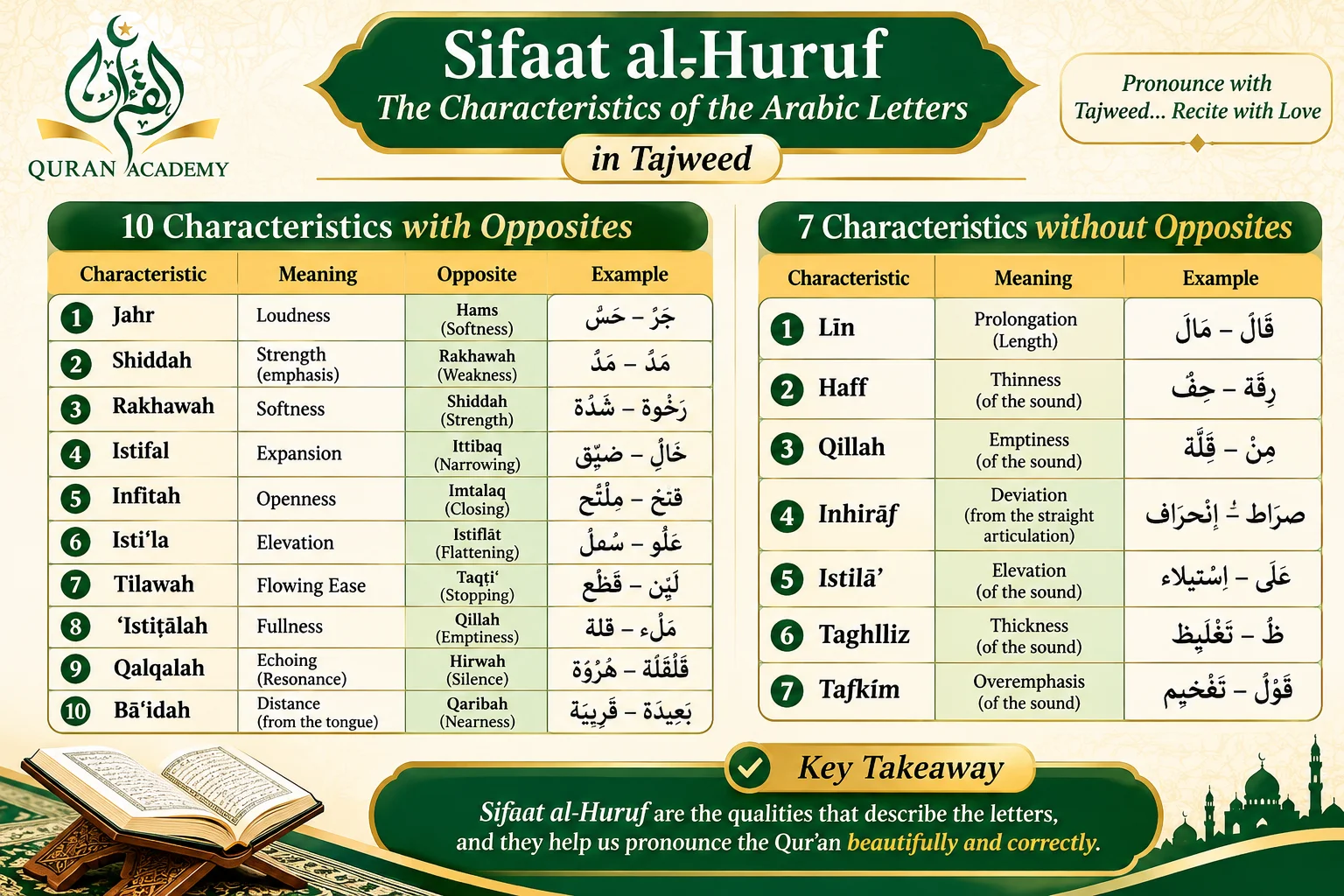
In Tajweed, Sifaat al-Huruf (صِفَاتُ الْحُرُوف — Characteristics of the Letters) are the acoustic qualities—such as breathiness, vocal vibration, sound duration, and tongue elevation—that give each Arabic letter its unique personality as it exits its articulation point (Makhraj). According to Imam Ibn Al-Jazari, there are 17 permanent characteristics (Sifaat Lazimah) divided into two master groups: 1. Ten Characteristics With Opposites (5 pairs covering Breath, Sound Flow, Tongue Weight, Tongue Lidding, and Ease), and 2. Seven Unique Characteristics Without Opposites (such as Safeer, Qalqalah, Leen, and Istitalah). Students in our 1-on-1 Advanced Tajweed Rules & Classical Texts Course master these exact vocal traits to achieve scholarly recitation precision.
- Makhraj Is the Address; Sifaat Is the Furniture: If two or three letters live at the exact same address in your mouth (like ظ، ذ، ث on the tip of the tongue), only their Sifaat prevent them from sounding identical!
- Every Letter Has at Least 5 Sifaat: Every single Arabic letter must take 1 quality from each of the 5 opposite pairs (giving it 5 baseline traits), plus 1 or 2 additional traits if it belongs to the 7 unique qualities.
- When Do Sifaat Appear Most Clearly? While a letter keeps its Sifaat with any vowel, its acoustic characteristics shine at 100% power when the letter carries a Sukoon (ـْ) or Shaddah (ـّ)!
- 4 Key Mnemonic Phrases to Memorize: فَحَثَّهُ شَخْصٌ سَكَتْ (Whisper/Hams), أَجِدْ قَطٍ بَكَتْ (Stop/Shiddah), لِنْ عُمَرْ (Moderation/Tawassut), and خُصَّ ضَغْطٍ قِظْ (Heaviness/Isti'laa).
Imagine placing the tip of your tongue against the roots of your upper front teeth. From that single tiny spot—no wider than a grain of rice—three completely different Arabic letters are born: ط (Taa), د (Daal), and ت (Taa)! If all three letters share the exact same physical exit point (Makhraj), why does ط sound like a deep, thunderous drum, د sound like a crisp, voiced bounce, and ت end with a delicate, airy whisper?
The answer is Sifaat al-Huruf (The Characteristics of the Letters). Many students spend months studying where letters exit the mouth, yet their recitation still feels flat or mechanical because they treat Sifaat like an intimidating list of 17 Greek-sounding terms to memorize for a written exam. Once you see how these characteristics work as simple physical switches in your breath, vocal cords, and tongue, the entire science of Tajweed clicks together—and you can diagnose and beautify any letter in the Mushaf in seconds!
- What Are Sifaat al-Huruf? (And the 3 Benefits of Mastering Them)
- Part 1: The 5 Pairs of Characteristics WITH Opposites (10 + 1 Traits)
- Master Chart 1: The 5 Opposite Pairs, Their Mnemonics & Physical Actions
- Part 2: The 7 Unique Characteristics WITHOUT Opposites (Special Traits)
- Master Chart 2: The 7 Unique Sifaat (Safeer, Qalqalah, Istitalah & More)
- How Sifaat Control the Exact Time Duration of Every Vowelless (Sukoon) Letter
- 3 Common Sifaat Mistakes Our Al-Azhar Tutors Fix in 1-on-1 Classes
- Frequently Asked Questions (FAQs) About Sifaat al-Huruf
1. What Are Sifaat al-Huruf? (And the 3 Benefits of Mastering Them)
While Makharij al-Huruf (Articulation Points) tell you WHERE a letter is born inside your throat, tongue, or lips, Sifaat al-Huruf tell you HOW that letter behaves the moment it is born! Scholars divide characteristics into two types: 1. Permanent Characteristics (Sifaat Lazimah), which are attached to the letter's DNA and never leave it (the 17 traits covered in this guide), and 2. Temporary Characteristics (Sifaat 'Aridah), which visit a letter occasionally—such as merging (Idgham), hiding (Ikhfa), or vowel elongation (Madd).
Mastering the permanent Sifaat gives every Quran reciter three immediate superpowers:
Separates roommates that share the exact same exit point—like ص / س / ز, ط / د / ت, ظ / ذ / ث, and ع / ح.
Shows why strong letters (like ط) can never be swallowed entirely inside weak letters (like ت) during incomplete merging (Idgham Naqis).
Gives vowelless letters their exact acoustic duration—whether a quick stop, a moderate hum, or a flowing stream of sound.
Why Do the 5 Letters of Qalqalah Bounce? Because of Jahr + Shiddah!
Have you ever wondered why the five letters of ق ط ب ج د (Qutb Jad) need an acoustic bounce when they carry a Sukoon? Because they combine two powerful Sifaat: Al-Jahr (trapped breath) and Al-Shiddah (trapped sound)! Watch Senior Al-Azhar Instructor Ustadhah Yasmeen Gamal on our official Quran Academy YouTube Channel demonstrate this exact characteristic live:
- Releasing Acoustic Pressure: Because both air and sound lock shut on ق ط ب ج د, bouncing the organ open (Qalqalah) is the only way the ear can hear the letter!
- Practical Over Theoretical: See how we teach Sifaat through live recitation rather than dry memorization.
2. Part 1: The 5 Pairs of Characteristics WITH Opposites (Al-Sifaat Dhat al-Didd)
Think of the first 10 characteristics (plus 1 middle bridge) as 5 physical switches inside your vocal tract. Every single letter of the Arabic alphabet must flip each of these 5 switches one way or the other (you can check any Arabic term in our Interactive Tajweed Glossary):
🎛️ The 5 Vocal Switches Every Arabic Letter Must Choose From
• Al-Hams (الْهَمْس — 10 Letters): A gentle stream of unvoiced air continues flowing out of your mouth when pronouncing the 10 letters of فَحَثَّهُ شَخْصٌ سَكَتْ (ف ح ث هـ ش خ ص س ك ت). Place your palm in front of your mouth on أَفْ، أَحْ، أَسْ، أَكْ، أَتْ—you will feel warm air hit your hand!
• Al-Jahr (الْجَهْر — Remaining 19 Letters): Your vocal cords vibrate strongly and hold back excess breath so the sound comes out pure, loud, and resonant (e.g., ب، ج، د، ذ، ز، ض، ط، ظ، ع، غ، ق).
• Al-Shiddah (الشِّدَّة — 8 Stopped Letters): The vocal exit locks 100% shut so the sound stops dead in the 8 letters of أَجِدْ قَطٍ بَكَتْ (ء ج د ق ط ب ك ت). (To release that locked sound on a Sukoon: ق ط ب ج د bounce via Qalqalah, while ك / ت release a tiny puff of Hams breath!).
• Al-Tawassut / Al-Bayniyyah (التَّوَسُّط — 5 Moderate Letters): The sound flows partially (half-open) in the 5 letters of لِنْ عُمَرْ (ل ن ع م ر).
• Al-Rakhawah (الرَّخَاوَة — Remaining 16 Flowing Letters): The sound flows smoothly and continuously without blockage (e.g., س، ش، ص، ض، ذ، ز، ظ، ف، ث، ح، خ، غ، هـ).
As detailed in our complete guide to Heavy and Light Letters in Tajweed, the 7 letters of خُصَّ ضَغْطٍ قِظْ (خ ص ض غ ط ق ظ) elevate the back of the tongue (Isti'laa), while the remaining 22 letters keep the back of the tongue down (Istifal).
• Al-Itbaq (الْإِطْبَاق — 4 Letters): In ص، ض، ط، ظ, the middle of the tongue cups upward against the roof of the mouth, trapping the echo.
• Al-Infitah (الِانْفِتَاح — Remaining 25 Letters): A wide open space remains between the middle of the tongue and the roof of the mouth.
• Al-Idhlaq (الْإِذْلَاق — 6 Letters): The 6 letters of فَرَّ مِنْ لُبٍّ (ف ر م ن ل ب) roll effortlessly off the tip of the tongue and lips.
• Al-Ismat (الْإِصْمَات — Remaining 23 Letters): Anchored deeper in the vocal tract. (Note: Scholars explain that Switch 5 relates to Arabic root-word morphology rather than altering how you pronounce the letter in recitation!).
Struggling to perfect your Recitation?
Join hundreds of students mastering the Quran with our Verified Al-Azhar Graduates. We offer flexible 1-on-1 sessions tailored to your schedule.
Book a Free Evaluation Class →3. Master Chart 1: The 5 Opposite Pairs, Their Mnemonics & Physical Actions
Use this 5-column chart to see how the 10 characteristics with opposites (plus intermediate Tawassut) compare side by side:
| Vocal Parameter | Characteristic A (& Mnemonic) | Middle Bridge | Opposite Characteristic B | How to Feel It on a Sukoon (ـْ) |
|---|---|---|---|---|
| 1. Breath (Airflow) | Al-Hams (Whisper — 10): فَحَثَّهُ شَخْصٌ سَكَتْ |
— | Al-Jahr (Voiced — 19): All remaining letters |
Touch your throat on أَسْ (no cord vibration = Hams) vs. أَزْ (strong buzz = Jahr!). |
| 2. Sound Duration | Al-Shiddah (Stop — 8): أَجِدْ قَطٍ بَكَتْ |
Al-Tawassut (5): لِنْ عُمَرْ |
Al-Rakhawah (Flow — 16): All remaining letters |
Compare أَكْ (stops instantly) vs. أَلْ (brief hum) vs. أَشْ (flows smoothly). |
| 3. Tongue Root | Al-Isti'laa (Elevated — 7): خُصَّ ضَغْطٍ قِظْ |
— | Al-Istifal (Lowered — 22): All remaining letters |
Back of tongue lifts to soft palate on ق / ص / ط; stays flat on ك / س / ت. |
| 4. Tongue Blade | Al-Itbaq (Cupped — 4): ص ض ط ظ |
— | Al-Infitah (Open — 25): All remaining letters |
Notice how ط / ص feel "covered/lidded" inside the mouth compared to open ق / خ. |
| 5. Lexical Ease | Al-Idhlaq (Fluent — 6): فَرَّ مِنْ لُبٍّ |
— | Al-Ismat (Anchored — 23): All remaining letters |
Theoretical linguistic trait (does not change practical recitation sound). |
4. Part 2: The 7 Unique Characteristics WITHOUT Opposites (Al-Sifaat Ghayr Dhat al-Didd)
In addition to the 5 baseline traits every letter receives from Part 1, certain special letters possess a 6th (or even 7th!) unique signature characteristic that no other group shares:
- 1. Al-Safeer (الصَّفِير — The Whistle / Sibilance | 3 Letters: ص، ز، س): A sharp, bird-like whistle or buzz that exits through the narrow gap between the tip of the tongue and the front teeth (strongest in lidded ص, buzzing like a bee in voiced ز, and crisp in whispered س).
- 2. Al-Qalqalah (الْقَلْقَلَة — The Acoustic Bounce | 5 Letters: ق ط ب ج د): As we detail in our dedicated guide to Qalqalah Letters in Tajweed, when any letter of قُطْبُ جَدٍّ carries a Sukoon, the locked vocal organs bounce apart immediately without adding a vowel.
- 3. Al-Leen (اللِّين — The Soft Glide | 2 Letters: وْ and يْ after Fatha): Pronouncing vowelless ـَوْ (as in خَوْفٍ) and ـَيْ (as in الْبَيْتِ) gently and effortlessly without tension—allowing 2, 4, or 6 beats of Madd Leen when stopping at the end of a verse.
- 4. Al-Inhiraf (الِانْحِرَاف — Sound Deflection | 2 Letters: ل and ر): When the tongue tip blocks the center of the gums on ل (Lam), the sound deflects out around the two sides of the tongue tip; on ر (Raa), the sound deflects inward from the sides into a tiny central channel so the Raa never gets completely blocked!
- 5. Al-Takreer (التَّكْرِير — The Single Trill | 1 Letter: ر): The natural tendency of the tongue tip to vibrate when pronouncing ر (Raa). You study this trait not to exaggerate it, but to control it to a single clean tap rather than rolling five R's!
- 6. Al-Tafasshi (التَّفَشِّي — The Spreading Wind | 1 Letter: ش): The wide, rushing spread of air and sound filling the entire middle of the mouth when pronouncing ش (Sheen)—as in وَالشَّمْسِ.
- 7. Al-Istitalah (الِاسْتِطَالَة — Forward Elongation of the Tongue | 1 Letter: ض): The exclusive crown of the Arabic language! When pronouncing vowelless ضْ (Daad)—as in الْمَغْضُوبِ or يَضْرِبُ—the side edges of your tongue press against the upper molars and glide slightly forward for ~1.5 beats until the front edge touches the gum line of Lam, without ever bouncing into a Qalqalah!
5. Master Chart 2: The 7 Unique Sifaat Without Opposites (+ Al-Ghunnah)
Here is your quick-reference summary of the 7 unique characteristics (plus Al-Ghunnah, which scholars count as the intrinsic nasal characteristic of ن and م):
| Unique Characteristic | Target Letter(s) | Acoustic Meaning | Live Mushaf Example (Audio) | Common Recitation Mistake Fixed |
|---|---|---|---|---|
| 1. Al-Safeer (الصَّفِير) | ص، ز، س | Crisp whistle / buzz through front teeth | وَسْوَسَ / الصِّرَٰطَ / رِجْزًا | Putting the tongue between the teeth (turning س/ص into a lisp like ث/ظ!). |
| 2. Al-Qalqalah (الْقَلْقَلَة) | ق ط ب ج د | Vowel-free acoustic bounce on Sukoon | لَمْ يَلِدْ وَلَمْ يُولَدْ (112:3) | Swallowing the letter silently or adding an accidental Fatha vowel. |
| 3. Al-Leen (اللِّين) | ـَوْ / ـَيْ | Soft, effortless diphthong glide | مِنْ خَوْفٍ / الْبَيْتِ (106:3–4) | Pressing too hard on the Waw or Yaa so it sounds stiff or choppy. |
| 4. Al-Inhiraf (الِانْحِرَاف) | ل، ر | Deflection of sound around tongue tip | الْحَمْدُ / فَٱنْحَرْ | Swallowing the لْ before Noon (saying "A'amdu" instead of "Al-hamdu"). |
| 5. Al-Takreer (التَّكْرِير) | ر (Raa) | Controlled single tap of tongue tip | الرَّحْمَـٰنِ الرَّحِيمِ | Over-rolling the رّ into multiple Spanish-style trills. |
| 6. Al-Tafasshi (التَّفَشِّي) | ش (Sheen) | Spreading rush of air filling the mouth | ٱشْتَرَوُا۟ / الشَّيْطَـٰنِ | Pronouncing a weak, narrow Sheen at the front teeth instead of the middle palate. |
| 7. Al-Istitalah (الِاسْتِطَالَة) | ض (Daad) | Forward creeping glide along upper molars | غَيْرِ الْمَغْضُوبِ (1:7) | Bouncing ضْ like a Qalqalah ("Al-Magh-doob") or turning it into a ظ! |
6. How Sifaat Control the Exact Time Duration of Every Vowelless (Sukoon) Letter
Here is the most practical secret in advanced Tajweed—known as Azminat al-Huruf al-Sakinah (The Time Durations of Vowelless Letters). While all short vowels (Fatha, Kasra, Damma) take the exact same 1-beat duration regardless of the letter, vowelless Sukoon letters (ـْ) do NOT all take the same amount of time!
Depending on Switch 2 (Sound Flow), every Sukoon letter in the Mushaf falls into a 3-Tier Time Clock:
- 1. Longest Sukoon Duration — The 16 Rakhawah (Flowing) Letters: When you recite a vowelless flowing letter like سْ، شْ، صْ، ضْ، فْ، حْ، خْ، ذْ، ظْ (as in بِسْمِ, الْمَغْضُوبِ, or أَفْوَاجًا), let the sound flow for a generous ~1.25 to 1.5 beats so the listener hears the full beauty of its whistle, breath, or Istitalah!
- 2. Medium Sukoon Duration — The 5 Tawassut (لِنْ عُمَرْ) Letters: When you recite a vowelless لْ، نْ، عْ، مْ، رْ—as in الْحَمْدُ لِلَّهِ رَبِّ الْعَـٰلَمِينَ (نَعْبُدُ / أَنْعَمْتَ)—hold the sound for a balanced ~1 beat (shorter than Rakhawah, longer than Shiddah) so you never clip the letter off abruptly.
- 3. Shortest Sukoon Duration — The 8 Shiddah (أَجِدْ قَطٍ بَكَتْ) Letters: Because the sound stops immediately on contact, these take the shortest time (~0.5 beats), followed instantly by the crisp bounce of Qalqalah (on ق ط ب ج د) or the subtle breath release of Hams (on كْ and تْ).
Umm Salamah (may Allah be pleased with her) described the recitation of the Messenger of Allah (peace be upon him):
"Behold, it was a distinct recitation, explained letter by letter (Qira'atan mufassaratan harfan harfan)."
7. Three Common Sifaat Mistakes Our Al-Azhar Tutors Fix in 1-on-1 Classes
When students join our Al-Azhar Certified Tajweed Tutors—whether starting in our Foundational Learn Tajweed Online Course, following our Complete Tajweed Learning Guide, or preparing for an Ijazah audit—we immediately fix three classic Sifaat errors:
- Mistake 1 — Turning the Hams of تْ and كْ Into a "Ch" or "S" Sound: When stopping on a vowelless تْ (like كُوِّرَتْ / انْفَطَرَتْ) or pronouncing a mid-word كْ (like يَكْتُبُونَ), both letters are Shiddah FIRST, then Hams SECOND! Many students skip the initial stop and blow excessive air through a wet tongue—making تْ sound like "T-ss" or "T-ch"! Instead, touch the Makhraj firmly to stop the sound first, then release a tiny, dry whisper of air as the tongue separates.
- Mistake 2 — Adding an Accidental Hams Whisper to Voiced Taa (ط) or Qaaf (ق): Because English "T" and "K" are heavily aspirated (whispered), English speakers often blow air when saying vowel-bearing تَ (Ta) or كَ (Ka)—and accidentally carry that breath into heavy ط (Taa) and ق (Qaaf)! Remember: ط and ق are 100% Jahr (Zero Whisper)!
- Mistake 3 — Bouncing Non-Qalqalah Sukoon Letters (Especially ضْ, غْ, نْ, مْ, لْ): In Surah Al-Fatiha alone, beginners frequently add an accidental bounce on أَنْعَمْتَ (saying "Ana-'ama-ta") and الْمَغْضُوبِ (saying "Al-Magha-doobi"). By holding the moderate Tawassut time on نْ / مْ (along with proper Noon Sakinah and Meem Sakinah rules) and the flowing Rakhawah + Istitalah time on غْ / ضْ, those unwanted bounces disappear forever!
See how students across North America, the UK, and Australia mastered the subtleties of Sifaat al-Huruf in 1-on-1 sessions on our Verified Student & Parent Reviews Page.
8. Frequently Asked Questions (FAQs) About Sifaat al-Huruf in Tajweed
1. How many Sifaat al-Huruf (Characteristics of Letters) are there in Tajweed?
According to the famous view of Imam Ibn Al-Jazari (followed globally in standard Tajweed curricula), there are 17 permanent characteristics (Sifaat Lazimah): 10 characteristics with opposites (arranged in 5 pairs, plus intermediate Tawassut) and 7 unique characteristics without opposites (Safeer, Qalqalah, Leen, Inhiraf, Takreer, Tafasshi, and Istitalah). Some scholars also list Al-Ghunnah and Al-Khafa' to bring the count to 19 or 20.
2. How do I find all the Sifaat of any single Arabic letter?
Run the letter through the 5 Opposite Switches first: check if it is in فحثه شخص سكت (if not, it is Jahr); check if it is in أجد قط بكت or لن عمر (if neither, it is Rakhawah); check if it is in خص ضغط قظ (if not, it is Istifal); check if it is in ص ض ط ظ (if not, it is Infitah); and check فر من لب. That gives you 5 guaranteed traits! Then check if the letter has 1 or 2 bonus traits from the 7 unique characteristics without opposites.
3. Which letter in the Arabic alphabet is the strongest, and which is the weakest?
The strongest letter in the Arabic alphabet is ط (Taa) because all 6 of its characteristics are pure strength (Jahr, Shiddah, Isti'laa, Itbaq, Ismat, and Qalqalah—zero weak traits!). The weakest letter (aside from Madd letters) is هـ (Haa)—along with ف، ح، ث—because all of its characteristics are weak (Hams, Rakhawah, Istifal, Infitah).
4. Why do ONLY კ (Kaaf) and ت (Taa) combine Shiddah (stopped sound) with Hams (whispered air)?
Wait—how can a letter stop the sound completely (Shiddah) AND let air flow (Hams) at the same time? It doesn't happen at the exact same millisecond—it happens in two sequential micro-stages! When pronouncing أَكْ or أَتْ, your tongue first presses the Makhraj to stop the sound completely (Shiddah), and then immediately releases a tiny whisper of air (Hams) so the listener can hear the letter!
5. What is the difference between Istitalah on ض (Daad) and Qalqalah on د (Daal)?
In Qalqalah (دْ), the sound stops completely (Shiddah) and the tongue tip bounces downward away from the gums immediately. In Istitalah (ضْ), the sound flows (Rakhawah) for ~1.5 beats while the sides of the tongue stay pressed against the upper molars and creep slightly forward—with zero bounce at the end!
Perfect Your Sifaat al-Huruf Live With an Ijazah-Certified Scholar
Want a certified Al-Azhar male Sheikh or female Ustadhah to listen to your Hams, Tawassut, and Istitalah on ض and give you instant 1-on-1 feedback? Book your free diagnostic trial session today!
Book Your Free 1-on-1 Tajweed Trial Class →