
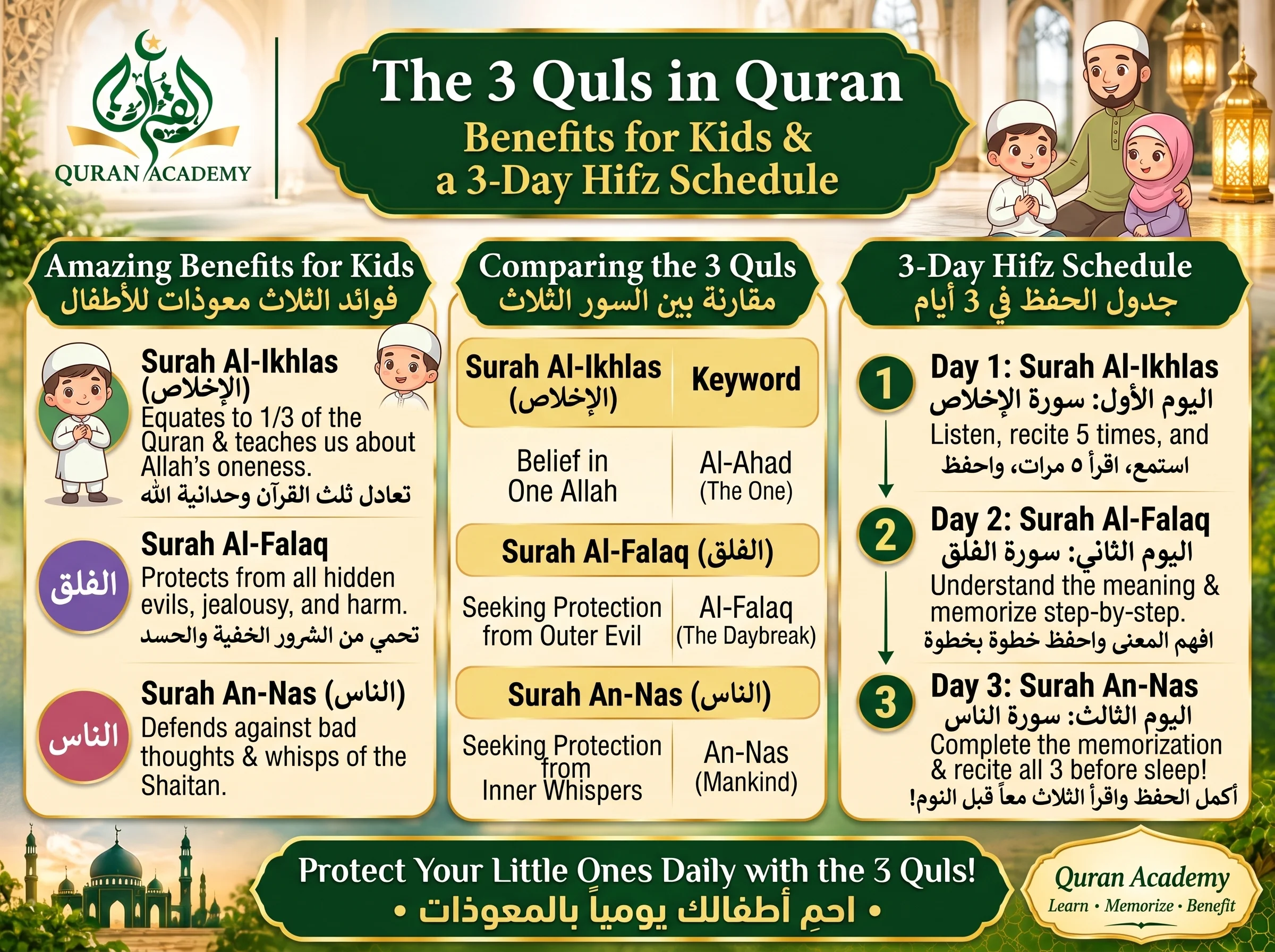
✦ Quick Answer & Key Takeaways: The 3 Quls Benefits & Kids Memorization Guide
Teaching the 3 Quls in Quran benefits for kids—comprising the final three chapters of the Holy Quran on Page 604 of Juz 30: Surah Al-Ikhlas (Chapter 112), Surah Al-Falaq (Chapter 113), and Surah An-Nas (Chapter 114)—gives every Muslim child an unshakeable daily shield of faith and protection. Called the 3 Quls because each chapter opens with the Divine command قُلْ (Qul — "Say!"), these 15 short verses (47 words total) combine pure monotheism (Tawheed) with comprehensive refuge against external harm and internal whispers (Al-Mu'awwidhat). In our 1-on-1 Online Kids Quran Classes, children as young as 4 to 7 master all three Surahs in just 3 days (one Surah per day!) using playful story-anchoring and live Tajweed feedback.
- Surah Al-Ikhlas (112 • 4 Verses): Declares the absolute Oneness of Allah and equals one-third of the entire Quran in reward (Sahih al-Bukhari 5015).
- Surah Al-Falaq (113 • 5 Verses): Seeks refuge with the Lord of Daybreak from external physical and unseen harms (night darkness, sorcery, and envy/Hasad).
- Surah An-Nas (114 • 6 Verses): Seeks refuge with the Lord, King, and God of Mankind from internal spiritual whispers (Al-Waswas Al-Khannas).
- The Prophetic 3x Daily Shield: Reciting them 3 times in the morning and evening suffices against everything (Sunan at-Tirmidhi 3575), and cupping the hands to blow over the body at bedtime is the nightly Sunnah (Sahih al-Bukhari 5017).
Every Muslim parent remembers the heartwarming milestone when their young son or daughter stands beside them on the prayer mat or snuggles under the blanket at bedtime and recites "Qul Huwal-laahu Ahad..." in a sweet, earnest voice. After Surah Al-Fatihah, the Three Quls (Al-Ikhlas, Al-Falaq, and An-Nas) are the very first chapters of the Quran we pass down to our children—forming the foundation of our 30-Day Juz Amma Memorization Schedule.
However, when children learn the 3 Quls purely by mimicking fast audio recordings without a structured parent-and-teacher method, two common issues arise. First, kids recite the words mechanically without realizing why Surah Al-Falaq protects them from outside dangers when the sun goes down, or why Surah An-Nas mentions three different Names of Allah to chase away bad thoughts! Second, non-Arab children frequently make cute but critical pronunciation slips—like turning the heavy echoing ق (Qaaf) in Qul and Al-Falaq into an English "K", or forgetting to hold the 2-beat nasal Ghunnah on the four نّ (Noon Mushaddadah) words in Surah An-Nas. In this complete guide for parents and beginners, we break down the child-friendly meaning of each Surah, share their authentic Prophetic protection habits, and give you a fun 3-Day Kids Memorization Plan.
- Master Comparison Chart: How Surah Al-Ikhlas, Al-Falaq & An-Nas Work Together
- 4 Authentic Benefits of the 3 Quls in the Prophetic Sunnah (Bedtime, Salah & Ruqyah)
- Kid-Friendly Tafseer & Root Meaning Breakdown of All 3 Surahs (Page 604)
- The 3-Day Kids Memorization Plan (With Playful Sensory & Hand-Action Games!)
- 5 Essential Tajweed Rules Kids Must Master in the 3 Quls (Qalqalah & Ghunnah)
- Frequently Asked Questions (FAQs)
1. Master Comparison Chart: How Surah Al-Ikhlas, Al-Falaq & An-Nas Work Together
When you open the very last page of the Mushaf (Page 604 in our Online Uthmani Quran Explorer), you see all three chapters framed together on a single page. Notice how the 3 Quls (also distinguished in our Interactive Tajweed & Quranic Encyclopedia between Al-Mu'awwidhatayn—the two refuge chapters 113 & 114—and all three together as Al-Mu'awwidhat) form a complete spiritual armor:
| Surah Name & Number | Verses & Words | Core Spiritual Theme | What It Protects Your Child From | Signature Tajweed Rule |
|---|---|---|---|---|
| 1. Surah Al-Ikhlas (Chapter 112 • Sincerity) |
4 Verses (15 Words) |
Pure Tawheed (Who Allah Is): The One (Ahad), Self-Sufficient Master (As-Samad). | Protects the heart from confusion about Allah; equals 1/3 of the Quran! | Qalqalah Kubra on final د (Daal) in all 4 verses! |
| 2. Surah Al-Falaq (Chapter 113 • The Daybreak) |
5 Verses (23 Words) |
External Protection: Seeking refuge in the Lord of the splitting dawn (Rabbul-Falaq). | 4 Outside Harms: Created evils, dark night fears, magic knots, & jealousy (Hasad). | Qalqalah Kubra on final ق / ب / د + Ikhfa on Min Sharri. |
| 3. Surah An-Nas (Chapter 114 • Mankind) |
6 Verses (20 Words) |
Internal Heart Protection: Calling on the Lord (Rabb), King (Malik), & God (Ilah) of mankind. | 1 Inside Harm: The retreating whisperer (Al-Waswas Al-Khannas) from Jinn & mankind. | 2-Beat Nasal Ghunnah on النَّاسِ / الْخَنَّاسِ / الْجِنَّةِ! |
2. Four Authentic Benefits of the 3 Quls in the Prophetic Sunnah (Why Kids Love Practicing Them!)
When we teach children in our Comprehensive Islamic Studies Course for Kids & Beginners why we recite the 3 Quls every day, we show them these four authentic Prophetic practices (all verifiable in our Online Hadith Explorer):
Mother of the Believers 'Aishah (may Allah be pleased with her) narrated that whenever the Messenger of Allah (peace be upon him) went to his bed every night, he would bring his cupped palms together, blow gently into them with a trace of moisture (Nafatha), recite into them Qul Huwal-laahu Ahad (Al-Ikhlas), Qul A'oodhu bi-Rabbil-Falaq, and Qul A'oodhu bi-Rabbin-Nas, and then wipe his hands over whatever he could reach of his body—starting with his head, his face, and the front of his body—doing that three times!
The Prophet (ﷺ) told his Companions that reciting Surah Al-Ikhlas equals one-third of the Quran in reward! Scholars explain this is because the Quran's message consists of three parts: Laws, Stories, and Pure Tawheed—and Al-Ikhlas summarizes Pure Tawheed completely.
'Abdullah ibn Khubayb (RA) reported that the Prophet (ﷺ) told him: "Recite Qul Huwal-laahu Ahad and Al-Mu'awwidhatayn (Al-Falaq & An-Nas) three times in the evening and in the morning; it will suffice you against everything!"
The Prophet (ﷺ) said to 'Uqbah ibn 'Amir (RA) regarding Surah Al-Falaq and Surah An-Nas: "No seeker of refuge has ever sought refuge with anything like these two!" We also recite all three once after Dhuhr, Asr, and Isha prayers, and 3x after Fajr and Maghrib!
3. Kid-Friendly Tafseer & Root Meaning Breakdown of the 3 Quls (Page 604)
As we explain in our Complete Quran Tafseer Guide and our Most Important Surahs to Start Learning Tafseer With, children remember Arabic verses 3x faster when you explain the story and meaning in simple, vivid words. Notice how many words here come straight from our Top 50 High-Frequency Quranic Arabic Words (Qul, Huwa, Allah, Lam, Min, Fee, Rabb, Naas, Ilah):
🧒 How to Explain Each of the 3 Quls to a 5- to 10-Year-Old Child
Why It Was Revealed: When people in Makkah asked the Prophet (ﷺ), "Describe your Lord to us!" Allah revealed these 4 short verses:
• Verse 1 (قُلْ هُوَ اللَّهُ أَحَدٌ): Tell them: He is Allah, the Unique One (Ahad)—not just "one in number" (like Waahid in our Arabic Numbers for Kids Guide), but completely Unique with no partner!
• Verse 2 (اللَّهُ الصَّمَدُ): Allah is As-Samad—meaning everyone in the universe needs Him for every breath, meal, and wish, while He needs nobody at all!
• Verse 3 (لَمْ يَلِدْ وَلَمْ يُولَدْ): He has no children (Lam yalid) and no parents (Wa lam yoolad), because He has always existed.
• Verse 4 (وَلَمْ يَكُن لَّهُ كُفُوًا أَحَدٌ): And nothing in all of creation is ever equal or comparable (Kufuwan) to Him!
What "Al-Falaq" Means: Al-Falaq comes from the root ف-ل-ق (to split open)—meaning the morning daybreak when Allah splits the dark night open with warm sunlight! Just as Allah's light chases away the dark night, we ask Rabbul-Falaq (113:1) to protect us (أَعُوذُ = I seek refuge/shelter) from 4 outside harms, each starting with مِن شَرِّ (Min Sharri = From the harm/evil of):
• 1. مِن شَرِّ مَا خَلَقَ (v. 2): Any harmful thing in creation (insects, sickness, or bad people).
• 2. وَمِن شَرِّ غَاسِقٍ إِذَا وَقَبَ (v. 3): The dark night (Ghaasiq) when it settles in (Idhaa Waqab)—perfect for calming children who are afraid of the dark!
• 3. وَمِن شَرِّ النَّفَّاثَاتِ فِي الْعُقَدِ (v. 4): Those who blow on knots (practitioners of magic/sorcery who try to break friendships and families).
• 4. وَمِن شَرِّ حَاسِدٍ إِذَا حَسَدَ (v. 5): An envious person (Haasid) when they act on jealousy (Hasad / the evil eye).
Struggling to perfect your Recitation?
Join hundreds of students mastering the Quran with our Verified Al-Azhar Graduates. We offer flexible 1-on-1 sessions tailored to your schedule.
Book a Free Evaluation Class →A Beautiful Contrast for Kids: In Surah Al-Falaq, we mentioned 1 attribute of Allah (Rabbul-Falaq) to protect against 4 outside harms. In Surah An-Nas, we mention 3 attributes of Allah—رَبِّ النَّاسِ (Caring Lord of mankind, v. 1), مَلِكِ النَّاسِ (Supreme King of mankind, v. 2), and إِلَٰهِ النَّاسِ (True God of mankind, v. 3)—to protect against 1 single inside danger! Why? Because protecting our hearts from bad whispers (مِن شَرِّ الْوَسْوَاسِ الْخَنَّاسِ — v. 4) is even more important than protecting our bodies! And what does الْخَنَّاس (Al-Khannas) mean? It means "the sneaker who runs away and hides" the very second a child remembers Allah and says Bismillah or A'oodhu billah!
How to Teach Your Child the "Bouncing Letters" in Surah Al-Ikhlas & Al-Falaq!
Did you notice that every single verse in Surah Al-Ikhlas ends with the letter د (Daal)—Ahadْ, As-Samadْ, Yooladْ, Ahadْ—and 4 out of 5 verses in Surah Al-Falaq end with ق، ب، د (Al-Falaqْ, Khalaqْ, Waqabْ, Hasadْ)? That means the 3 Quls are the #1 place in the Quran to teach kids the 5 echoing Qalqalah letters (ق ط ب ج د)! Watch Senior Instructor Ustadhah Yasmeen Gamal demonstrate on our Quran Academy YouTube Channel:
- No Muted Endings: If a child stops on Ahad or Al-Falaq without a bounce, the final letter disappears in English ears!
- Fun Echo Game: Kids love copying the crisp Qalqalah Kubra bounce at the end of every verse!
4. The 3-Day Kids Memorization Plan (With Fun Hand-Action & Sensory Games!)
As we share in our parenting guides on What to Do When Your Child Says Quran Class Is Boring and Islamic Reward Charts That Motivate Kids, young children learn best when you combine our 3x3 Quran Memorization Method with physical hand gestures (Total Physical Response). Use this 3-Day "10-Minutes-a-Day" Plan (and map out the rest of Juz 30 in our Smart Hifz Planner):
- Day 1 — Surah Al-Ikhlas (4 Verses in 8 Minutes): The "One Finger & Bouncing Ball" Game:
• Hold up one index finger for Verse 1 (Qul Huwal-laahu Ahad) and Verse 2 (Allaahus-Samad).
• Shake your finger gently side-to-side for the two "Lam" negations in Verse 3 (Lam yalid wa lam yoolad) and Verse 4 (Wa lam yakul-lahu kufuwan ahad).
• Sensory Trick: Gently bounce a soft foam ball on the floor on the final letter د (Daal) of each of the 4 verses so your child hears and feels the Qalqalah echo! - Day 2 — Surah Al-Falaq (5 Verses in 10 Minutes): The "4 Fingers of Min Sharri" Trick:
• Why do young children sometimes skip Verse 3 or Verse 4 of Surah Al-Falaq? Because Verses 2, 3, 4, and 5 all start with مِن شَرِّ / وَمِن شَرِّ!
• Teach your child to count on 4 fingers accompanied by a visual gesture:
1️⃣ Finger 1 (Min sharri maa khalaq): Open both hands wide like the whole world.
2️⃣ Finger 2 (Wa min sharri ghaasiqin idhaa waqab): Cover eyes gently like nighttime darkness.
3️⃣ Finger 3 (Wa min sharrin-naffaathaati fil-'uqad): Pretend to tie a tiny string knot with fingers.
4️⃣ Finger 4 (Wa min sharri haasidin idhaa hasad): Place hand over the heart for protection from jealousy! - Day 3 — Surah An-Nas (6 Verses in 10 Minutes): The "Crown, Heart & 5-Second Hum" Trick:
• How do you help a child never mix up the order of رَبِّ النَّاسِ (1) → مَلِكِ النَّاسِ (2) → إِلَٰهِ النَّاسِ (3)?
• Step 1 (Rabbin-Naas — Caring Lord): Hold hands out like a cradle (Allah created and cares for us first!).
• Step 2 (Malikin-Naas — King): Touch the top of the head like a royal crown.
• Step 3 (Ilaahin-Naas — Worshipped God): Place both hands over the chest as in prayer!
• Then point to the chest on فِي صُدُورِ النَّاسِ (v. 5), and finish by cupping both hands together at bedtime to blow and wipe over their head and face just like the Prophet (ﷺ)!
5. Five Essential Tajweed Rules Kids & Beginners Must Master in the 3 Quls
As we highlight in our guide on Why Some Kids Can Recite From Memory But Can't Read the Mushaf (and our 5 Common Noorani Qaida Mistakes Kids Make), always let your child look directly at the large Arabic letters on Page 604 while learning the 3 Quls so their eyes connect with these five rules from our 1-on-1 Online Tajweed Course:
- 1. Heavy "Qul" (قُلْ) vs. Light "Kul" (كُلْ): This is the #1 mistake non-Arab beginners make! If you pronounce قُلْ with a light English "K" (كُلْ = Kul), the meaning in Arabic changes from "Say!" to "Eat!" Use our Heavy & Light Letters Guide to pronounce the ق (Qaaf) from the very back of the tongue with a deep, round sound.
- 2. Mid-Word Qalqalah Sughra on "Lam Yalidْ" (لَمْ يَلِدْ): In Verse 3 of Surah Al-Ikhlas, there are two Daals: the first one in لَمْ يَلِدْ وَلَمْ is in the middle of the sentence (Qalqalah Sughra—a light, quick bounce), while the second one at the stop on يُولَدْ is at the end of the verse (Qalqalah Kubra—a stronger bounce)!
- 3. Full Idgham without Ghunnah on "Yakul-lahu" (وَلَمْ يَكُن لَّهُ): Under our Noon Sakinah & Tanween Rules, the Noon in Yakun merges 100% into the Laam of Lahu—so you read it smoothly as Wa lam yakul-lahu (not yakun lahu!).
- 4. 2-Beat Nasal Ikhfa on "Min Sharri" (مِن شَرِّ — 5 Times!): Across Surah Al-Falaq (4 times) and Surah An-Nas (1 time), the Noon Sakinah in مِنْ is followed by the letter ش (Sheen). Hide the Noon with a soft 2-beat nasal hum (Ikhfa Haqiqi) while getting your tongue ready for the "Sh" sound!
- 5. Holding the 2-Beat Nasal Ghunnah on All 8 "Noon Mushaddadah" (نّ) Words: In Surah Al-Falaq (النَّفَّاثَاتِ) and in every single verse of Surah An-Nas (النَّاسِ [5x]، الْخَنَّاسِ، الْجِنَّةِ), there is a Noon with a Shaddah (نّ). Teach your child to hold a musical 2-second nasal hum on every An-Naaaas! Test your child's Tajweed ear right now on our Free 3-Minute Interactive Tajweed Quiz!
Once your child or family has mastered the 3 Quls in 3 days, combine them in your bedtime routine with our 5-Minute Ayatul Kursi Memorization Guide, our Last 2 Verses of Surah Al-Baqarah Guide, and our Surah Al-Mulk Hifz Plan (and older students can progress into our 15-Day Surah Ya-Sin Plan, 10-Day Surah Ar-Rahman Plan, and 12-Day Surah Al-Waqi'ah Schedule in our Online Hifz Program!). Read how parents across the US, UK, Canada, and Australia rate our gentle Al-Azhar Certified Male & Female Tutors on our Verified Student & Parent Reviews Page.
6. Frequently Asked Questions (FAQs) About the 3 Quls in the Quran
1. Which Surahs are known as the "3 Quls" in the Quran, and why are they called that?
The 3 Quls are the final three chapters of the Holy Quran located on Page 604 in Juz 30: Surah Al-Ikhlas (Chapter 112), Surah Al-Falaq (Chapter 113), and Surah An-Nas (Chapter 114). They are called the 3 Quls because each of the three chapters begins with the Arabic command قُلْ (Qul — meaning "Say!").
2. Are there 3 Quls or 4 Quls in the Quran?
In the Prophetic Sunnah of daily protection (Al-Mu'awwidhat), the 3 Quls refer to Surahs 112, 113, and 114. When people speak of the "4 Quls," they are adding Surah Al-Kafirun (Chapter 109 — قُلْ يَا أَيُّهَا الْكَافِرُونَ). (In fact, 5 chapters in the Quran begin with the word Qul: Al-Jinn [72], Al-Kafirun [109], Al-Ikhlas [112], Al-Falaq [113], and An-Nas [114]).
3. When and how many times should my child and I recite the 3 Quls every day?
According to authentic Hadiths, there are three main daily times: (1) 3 times every morning (after Fajr) and 3 times every evening (after Maghrib) for complete protection (Sunan at-Tirmidhi 3575); (2) Once after Dhuhr, Asr, and Isha prayers; and (3) 3 times at bedtime while cupping the palms, blowing gently into them, and wiping over the head, face, and body (Sahih al-Bukhari 5017).
4. What is the difference between Surah Al-Falaq and Surah An-Nas?
Surah Al-Falaq (113) seeks Allah's protection from external physical and unseen harms (created dangers, night darkness, sorcery, and envy/evil eye), whereas Surah An-Nas (114) seeks Allah's protection from internal spiritual harm—specifically the sneaky whispers (Waswasah) placed in the chest by devils from among Jinn and mankind.
5. What is the best age to teach a child the 3 Quls?
Children can begin listening to and echoing the 3 Quls between ages 3 and 5 during their nightly bedtime routine, and begin structured 1-on-1 phonics and Tajweed recitation of Page 604 between ages 5 and 7 alongside Noorani Qaida.
Give Your Child a Joyful Start With Juz Amma & Tajweed!
Watch your child light up as they memorize the 3 Quls and Juz Amma with a patient, certified male or female Al-Azhar tutor who makes every lesson fun and interactive. Book your free 1-on-1 trial class today!
Book Your Child's Free 1-on-1 Trial Class →