
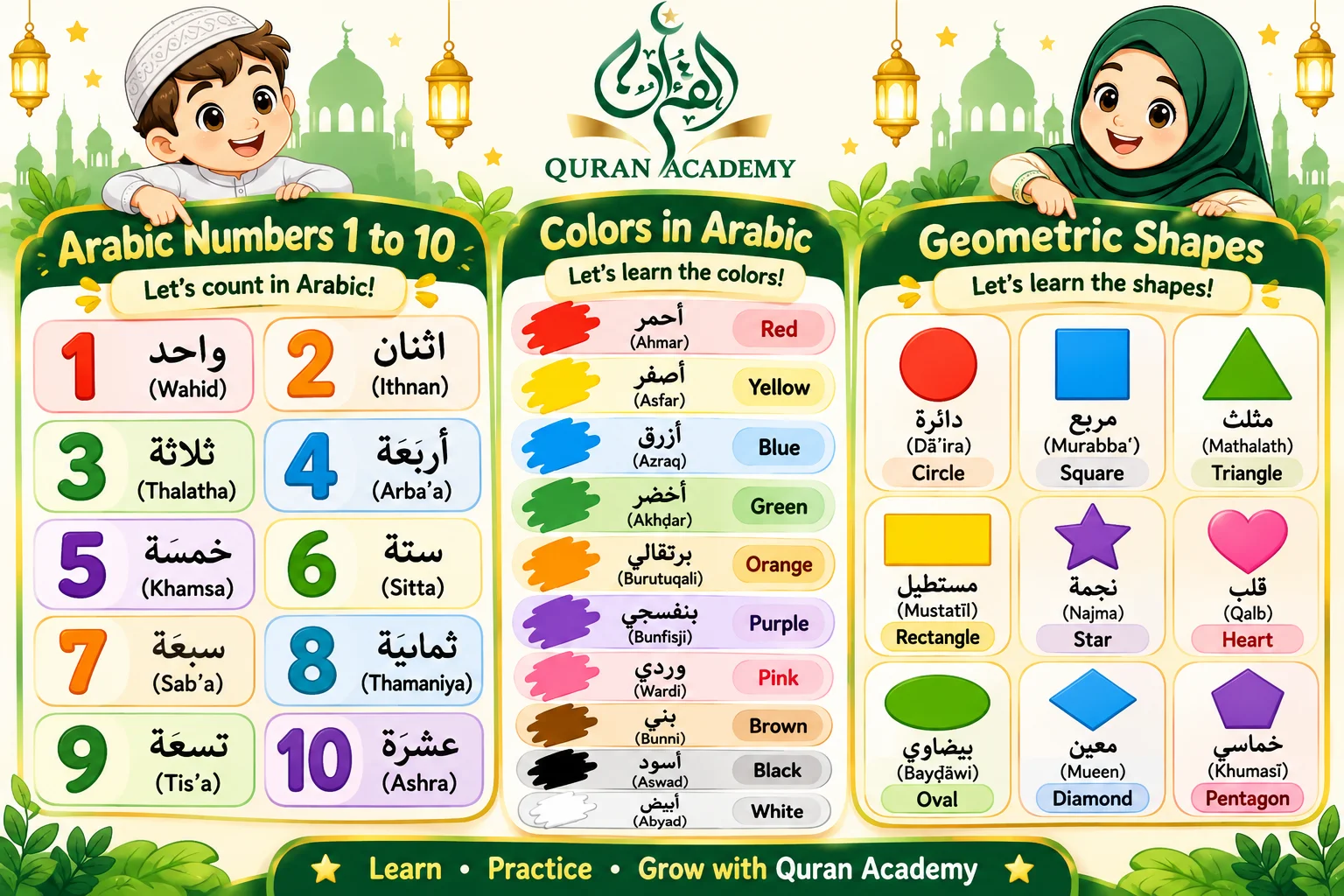
✦ Quick Answer & Key Takeaways: Arabic Numbers, Colors & Shapes for Kids
Teaching Arabic numbers (Al-Arqam), colors (Al-Alwan), and shapes (Al-Ashkal) for kids is the fastest way to build your child's first 30 everyday Arabic words while unlocking the page and verse numbers inside their Mushaf. Children learn best when you group Arabic numbers 1 to 10 (١ to ١٠) into two 5-finger rhymes, teach the "Af'al" pattern that links the 6 primary Quranic colors (Ahmar, Akhdar, Azraq, Asfar, Abyad, Aswad), and combine them with 8 geometric shapes during 2-minute household scavenger hunts. Students in our 1-on-1 Quranic Arabic for Beginners Course master these visual building blocks through live screen games with native Al-Azhar teachers.
- Arabic Words Write Right-to-Left, But Numbers Write Left-to-Right! Teach your child this golden rule early: while Arabic sentences flow from right to left, multi-digit Arabic numbers (like ١٠ for 10 or ١١٤ for 114 Surahs) are read and written from left to right, just like English!
- The "5 vs. 0" Mushaf Secret: In Eastern Arabic numerals, a round circle (٥) is the number 5 (Khamsah), while a tiny dot (٠) is 0 (Sifr)!
- The "A-" Color Pattern: Six of the most famous colors in Arabic start with the exact same sound—"A-" (أَ): Ahmar (Red), Akhdar (Green), Azraq (Blue), Asfar (Yellow), Abyad (White), and Aswad (Black).
- Number + Root Connection: Knowing the number 3 (Thalathah) and 4 (Arba'ah) automatically teaches your child the Arabic words for Triangle (Muthallath) and Square (Murabba')!
Have you ever asked your seven-year-old to open their Mushaf to Verse 5 or Page 20, only to watch them stare in confusion at the ornate little symbols inside the verse markers—wondering why the number ٥ (5) looks like an English zero and why ٧ (7) and ٨ (8) look like upside-down triangles?
For Muslim children growing up in the US, UK, Canada, and Australia, learning Arabic numbers, colors, and shapes is much more than a fun preschool or elementary language activity—it is the bridge that makes the Arabic script feel friendly, familiar, and alive! Best of all, Arabic is a mathematical root language: once your child learns the numbers 1 through 10, they instantly unlock the names of geometric shapes, the days of the week, and dozens of verses in the Holy Quran. Below is our complete, step-by-step illustrated lesson with pronunciation tables, visual memory tricks, and 5-minute family games you can play at the dinner table tonight.
- Why Numbers, Colors & Shapes Are the Best First Arabic Words for Kids
- Part 1: Arabic Numbers 0 to 10 (Al-Arqam) — Chart & Visual Symbol Tricks
- Part 2: The 10 Essential Colors in Arabic (Al-Alwan) & Their Quranic Verses
- Part 3: The 8 Basic Shapes in Arabic (Al-Ashkal) & The Number-Root Secret
- Bonus Grammar Magic: How Kids Combine a Shape + a Color in Arabic!
- Spot It in the Mushaf: A Fun Quranic Scavenger Hunt for Numbers & Colors
- 3 Playful 5-Minute Home Games That Lock In 30 Arabic Words This Week
- Frequently Asked Questions (FAQs) From Parents
1. Why Numbers, Colors & Shapes Are the Best First Arabic Words for Kids
When children start learning a second language, abstract grammar rules bore them within minutes. By contrast, numbers, colors, and shapes are 100% tangible—your child can point to a red apple, count five fingers, or draw a yellow star on the screen! In our curriculum, starting with these three word families gives your child three instant wins:
Every verse end-marker in the Uthmani Mushaf uses Eastern Arabic numerals (١، ٢، ٣...). Knowing them lets your child find any Ayah independently!
In Arabic, numbers 1–5 unlock the days of the week AND geometric shapes like Triangle (3), Square (4), and Pentagon (5)!
Words like Wahid (ح), Sab'ah (ع), Akhdar (خ/ض), and Asfar (ص) train your child's throat and heavy letters naturally through play.
See How Joyful 1-on-1 Interaction Sparks Kids' Love for Arabic & Islam!
Why do children absorb Arabic vocabulary so quickly in our live 1-on-1 sessions? Because our teachers connect every word to the colorful blessings Allah created around us! Watch little Mohamed on our official Quran Academy YouTube Channel light up with excitement during his lesson:
- Visual Whiteboard Games: Drawing colored stars, counting verses, and spotting letters together in real time.
- Warm Native Mentors: Certified Al-Azhar teachers who speak clear, encouraging English tailored for Western kids.
2. Part 1: Arabic Numbers 0 to 10 (Al-Arqam) — Chart & Visual Symbol Tricks
In the Arab world and inside the Uthmani Mushaf, numbers are written using Eastern Arabic Numerals (٠ ١ ٢ ٣ ٤ ٥ ٦ ٧ ٨ ٩ ١٠). Before looking at the chart, show your child these 3 visual tricks so they never mix up the symbols:
- Trick #1 — ٢ (2) and ٣ (3) Are Sideways 2 and 3: Tell your child to tilt their head to the right! If you lay an English 2 on its back, it looks just like ٢ (2 ridges); if you lay an English 3 on its back, it looks just like ٣ (3 ridges)!
- Trick #2 — ٧ (7) Looks Up to Heaven, ٨ (8) Looks Down: Kids always mix up ٧ (7) and ٨ (8)! Teach them the rhyme: "Sab'ah (٧) opens its arms UP to the 7 Heavens, while Thamaniyah (٨) points DOWN like a tent!"
- Trick #3 — ٥ (5) Is a Donut, ٠ (0) Is a Crumb: The round circle ٥ is 5 (Khamsah), and the tiny dot ٠ is Zero (Sifr—where the English word "cipher/zero" comes from!).
| English # | Arabic Numeral | Arabic Word | Easy Pronunciation | Visual Memory Hook & Islamic Fact |
|---|---|---|---|---|
| 0 | ٠ | صِفْر | Sifr | A tiny dot! Starts with heavy whistle ص (Saad). |
| 1 | ١ | وَاحِد | Waahid | 1 straight line like an Alif! Allah is Al-Wahid (The One). |
| 2 | ٢ | اِثْنَان | Ithnaan | Has 2 top points; Fajr prayer has 2 Rak'ahs! |
| 3 | ٣ | ثَلَاثَة | Thalaathah | Has 3 top points like a crown; Maghrib has 3 Rak'ahs! |
| 4 | ٤ | أَرْبَعَة | Arba'ah | Looks like a backwards 3; Dhuhr, Asr & Isha have 4 Rak'ahs! |
| 5 | ٥ | خَمْسَة | Khamsah | A full circle like a fist of 5 fingers; 5 Pillars of Islam & 5 Daily Prayers! |
| 6 | ٦ | سِتَّة | Sittah | Looks like an English 7; 6 Pillars of Iman (Faith)! |
| 7 | ٧ | سَبْعَة | Sab'ah | Points UP (V) to the 7 Heavens & 7 verses of Surah Al-Fatiha! |
| 8 | ٨ | ثَمَانِيَة | Thamaaniyah | Points DOWN (^) like a roof; 8 Gates of Jannah (Paradise)! |
| 9 | ٩ | تِسْعَة | Tis'ah | Looks just like an English 9! (9 miracles of Prophet Musa in 17:101). |
| 10 | ١٠ | عَشَرَة | 'Asharah | Line ١ + Dot ٠ = ١٠! Every good deed is multiplied by 10! |
3. Part 2: The 10 Essential Colors in Arabic (Al-Alwan) & Their Quranic Verses
In Arabic, the word for "Color" is لَوْن (Lawn), and "Colors" is أَلْوَان (Alwan). Here is a wonderful secret that makes learning Arabic colors twice as easy for children: the 6 classic primary colors all follow the exact same rhythmic rhyme pattern—Af'al (أَفْعَل)—starting with the letter Alif-Hamzah (أَ)!
Even more exciting for Muslim kids, all 6 of those primary colors appear directly inside the verses of the Holy Quran! Explore all 10 essential colors below (and listen to the Quranic verses in our Online Digital Quran Explorer):
| Color Swatch & Name | Arabic (Masculine) | Arabic (Feminine) | Easy Pronunciation | Where This Color Appears in the Quran! |
|---|---|---|---|---|
| 🔴 1. Red | أَحْمَر | حَمْرَاء | Ahmar (f: Hamraa') | Red & white mountain streaks in Surah Fatir (35:27 — وَمِنَ الْجِبَالِ جُدَدٌ بِيضٌ وَحُمْرٌ)! |
| 🟢 2. Green | أَخْضَر | خَضْرَاء | Akhdar (f: Khadraa') | The favorite color of Jannah's silk garments & cushions in Surah Ar-Rahman (55:76 — رَفْرَفٍ خُضْرٍ)! |
| 🔵 3. Blue | أَزْرَق | زَرْقَاء | Azraq (f: Zarqaa') | Mentioned in Surah Taha (20:102 — زُرْقًا); ends with a crisp Qalqalah on ق! |
| 🟡 4. Yellow | أَصْفَر | صَفْرَاء | Asfar (f: Safraa') | The bright golden-yellow cow in Surah Al-Baqarah (2:69 — بَقَرَةٌ صَفْرَاءُ فَاقِعٌ لَّوْنُهَا)! |
| ⚪ 5. White | أَبْيَض | بَيْضَاء | Abyad (f: Baydaa') | The white thread of dawn in Ramadan (2:187) & Prophet Musa's glowing white hand! |
| ⚫ 6. Black | أَسْوَد | سَوْدَاء | Aswad (f: Sawdaa') | The Black Stone of the Ka'bah (Al-Hajar Al-Aswad) & towering dark mountains (35:27 — غَرَابِيبُ سُودٌ)! |
| 🟠 7. Orange | بُرْتُقَالِيّ | بُرْتُقَالِيَّة | Burtuqaaliyy | Named after the delicious fruit بُرْتُقَال (Orange)—just like in English! |
| 🌸 8. Pink | وَرْدِيّ | وَرْدِيَّة | Wardiyy | From وَرْدَة (Wardah — A Rose), mentioned in Surah Ar-Rahman (55:37 — كَالْوَرْدَةِ)! |
| 🟣 9. Purple | بَنَفْسَجِيّ | بَنَفْسَجِيَّة | Banafsajiyy | Named after the sweet-smelling Violet flower (بَنَفْسَج). |
| 🟤 10. Brown | بُنِّيّ | بُنِّيَّة | Bunniyy | Named after roasted Coffee Beans (بُنّ — Bunn); practice the 2-beat nasal نّ! |
4. Part 3: The 8 Basic Shapes in Arabic (Al-Ashkal) & The Number-Root Secret
Now watch how Arabic connects Part 1 (Numbers) directly into Part 3 (الأَشْكَالُ الْهَنْدَسِيَّة — Geometric Shapes)! Since your child just learned that 3 is Thalathah (ثَلَاثَة), 4 is Arba'ah (أَرْبَعَة), and 5 is Khamsah (خَمْسَة), look at how easy the shapes become:
📐 The 8 Essential Shapes Every Child Should Know in Arabic
1. 🔺 Triangle — مُثَلَّث (Muthallath): Built from ثَلَاثَة (3) = "The 3-Sided Shape!"
2. 🟦 Square — مُرَبَّع (Murabba'): Built from أَرْبَعَة (4) = "The 4-Equal-Sided Shape!"
3. ⬠ Pentagon — خُمَاسِيّ (Khumaasiyy): Built from خَمْسَة (5) = "The 5-Sided Shape!" (And Hexagon is سُدَاسِيّ — Sudaasiyy from سِتَّة — 6!).
Struggling to perfect your Recitation?
Join hundreds of students mastering the Quran with our Verified Al-Azhar Graduates. We offer flexible 1-on-1 sessions tailored to your schedule.
Book a Free Evaluation Class →4. ⭕ Circle — دَائِرَة (Daa'irah): From Daara ("to spin around in a circle")—contains a 4-beat Madd Muttasil!
5. ▭ Rectangle — مُسْتَطِيل (Mustateel): Means "The Stretched-Out Long Shape" (from the same root as the Tajweed characteristic Istitalah!).
6. 🥚 Oval — بَيْضَاوِيّ (Baydaawiyy): From بَيْضَة (Baydah — An Egg) = "Egg-Shaped!"
7. ⭐ Star — نَجْمَة (Najmah): Matches Surah An-Najm (Chapter 53 — The Star) in the Quran!
8. 🌙 Crescent — هِلَال (Hilaal) & 💚 Heart — قَلْب (Qalb): The silver crescent moon of Ramadan and the believing heart!
5. Bonus Grammar Magic: How Kids Combine a Shape + a Color in Arabic!
Want your child to start speaking real 2-word Arabic phrases today? Teach them the "Noun First, Color Second" Flip Rule (you can check foundational Arabic and Quranic grammar terms in our Interactive Arabic & Tajweed Glossary):
- In English: We say the color first and the shape second: "A Green Heart" or "A Yellow Star."
- In Arabic: We say the Shape FIRST and the Color SECOND!
• If the shape does NOT end with a round Taa Marbootah (ـة) (like قَلْب — Qalb, مُرَبَّع — Murabba', or مُثَلَّث — Muthallath), use the masculine "A-" color:
💚 قَلْبٌ أَخْضَرُ (Qalbun Akhdar) = A Green Heart!
🟦 مُرَبَّعٌ أَزْرَقُ (Murabba'un Azraq) = A Blue Square!
🔺 مُثَلَّثٌ أَحْمَرُ (Muthallathun Ahmar) = A Red Triangle! - • If the shape DOES end with a feminine Taa Marbootah (ـة) (like نَجْمَة — Najmah or دَائِرَة — Daa'irah), match it with the feminine color from Column 3 of our chart:
⭐ نَجْمَةٌ صَفْرَاءُ (Najmatun Safraa') = A Yellow Star!
🌸 دَائِرَةٌ وَرْدِيَّةٌ (Daa'iratun Wardiyyah) = A Pink Circle!
Abdullah ibn Mas'ud (may Allah be pleased with him) reported:
"The Prophet (peace be upon him) drew a square (Khatta murabba'an) in the sand, and then drew a line in the middle of it extending outside it, and drew smaller lines along that middle line, using the visual diagram to explain the human being, his hopes, and his lifespan."
And Anas (may Allah be pleased with him) described the Prophet's ﷺ radiant complexion as: "Azhar al-lawn (bright, luminous white-rosy)."
6. Spot It in the Mushaf: A Fun Quranic Scavenger Hunt for Numbers & Colors
One of the best ways to cure what we discussed in our guide on what to do when your child says Quran class is boring is turning their Mushaf into an interactive treasure hunt! Open these three Surahs with your child (especially inside our Bring the Quran to Life: Tafseer for Kids & Teens Course) and ask them to spot these numbers and colors in Arabic:
- Scavenger Hunt #1 — Counting the Youths in Surah Al-Kahf (18:22): Open Surah Al-Kahf to Verse 22 and watch your child's eyes light up as they spot the numbers ثَلَاثَةٌ رَّابِعُهُمْ كَلْبُهُمْ (3, the 4th is their dog), خَمْسَةٌ سَادِسُهُمْ كَلْبُهُمْ (5, the 6th is their dog), and سَبْعَةٌ وَثَامِنُهُمْ كَلْبُهُمْ (7, and the 8th is their dog) all inside a single verse!
- Scavenger Hunt #2 — The 7 Heavens in Surah Al-Mulk (67:3) & Surah Nuh (71:15): While your child is working through their Juz Amma Memorization Schedule or Surah Al-Mulk, ask them to find the phrase سَبْعَ سَمَـٰوَٰتٍ طِبَاقًا (Seven layered heavens)!
- Scavenger Hunt #3 — Three Colors in One Verse in Surah Fatir (35:27): Show your child how Allah describes the colorful mountains He created in a single verse using three of the exact colors they just learned: بِيضٌ (White), وَحُمْرٌ (Red), and سُودٌ (Black)!
7. Three Playful 5-Minute Home Games That Lock In 30 Arabic Words This Week
When parents team up with our Al-Azhar Certified Kids Tutors—including our specialized Online Preschool Track for 4-Year-Olds and our Fun & Engaging Kids Classes—we recommend three zero-prep games at home:
- Game 1 — "I Spy With My Little Eye in Arabic" (Ana Araa Shay'an Lawnuhu...): In the living room or car, say: "I spy something that is Akhdar (Green)!" or "Touch Thalathah (3) things that are Abyad (White) in 10 seconds!" Kids burn physical energy while shouting out the Arabic colors!
- Game 2 — The "Mushaf Page-Number Race": Write a 2-digit Eastern Arabic number on a sticky note—like ٢٥ (25) or ٧٨ (78)—and see how fast your child can flip their Mushaf to that exact page number! Every time they find 3 pages in under a minute, award them a star on our Printable Kids Star Reward Chart!
- Game 3 — "Pancake & Play-Doh Shapes": On Saturday morning, pour pancake batter (or roll Play-Doh) into a Daa'irah (Circle), a Muthallath (Triangle), a Najmah (Star), and a Qalb (Heart)—your child gets to eat whichever shape they can name in Arabic!
Read how parents across the US, UK, Canada, and Australia watched their children fall in love with Arabic and the Quran on our Verified Student & Parent Reviews Page.
8. Frequently Asked Questions (FAQs) About Arabic Numbers, Colors & Shapes
1. How do you count from 1 to 10 in Arabic with English pronunciation?
The numbers 1 to 10 in Arabic are: 1. Waahid (وَاحِد), 2. Ithnaan (اِثْنَان), 3. Thalaathah (ثَلَاثَة), 4. Arba'ah (أَرْبَعَة), 5. Khamsah (خَمْسَة), 6. Sittah (سِتَّة), 7. Sab'ah (سَبْعَة), 8. Thamaaniyah (ثَمَانِيَة), 9. Tis'ah (تِسْعَة), and 10. 'Asharah (عَشَرَة), while Zero is Sifr (صِفْر).
2. Are Arabic numbers read from right to left or left to right?
While Arabic words and letters are written and read from right to left, multi-digit Arabic numbers are written and read from left to right (with the largest place value on the left, just like in English)! For example, the number ٢٥ (25) has the ٢ (20) on the left and the ٥ (5) on the right.
3. What are the 6 primary colors mentioned in the Holy Quran?
The Holy Quran mentions six core colors: 1. Abyad / Beed (White), 2. Aswad / Sood (Black), 3. Akhdar / Khudr (Green—the color of Paradise garments), 4. Asfar / Safraa' (Yellow), 5. Ahmar / Humr (Red), and 6. Azraq / Zurq (Blue), as well as rose-pink (Kal-Wardah in Surah Ar-Rahman 55:37).
4. Why do Arabic colors have two forms (like Ahmar and Hamraa')?
In Arabic grammar, adjectives match the gender of the noun they describe! When describing a masculine word (like قَلَمٌ أَحْمَرُ — A red pen), you use the Af'al form (أَحْمَر، أَخْضَر، أَزْرَق). When describing a feminine word ending in Taa Marbootah (like سَيَّارَةٌ حَمْرَاءُ — A red car or بَقَرَةٌ صَفْرَاءُ — A yellow cow), you use the Fa'laa' form (حَمْرَاء، خَضْرَاء، زَرْقَاء، صَفْرَاء).
5. How can my child learn both Quranic reading and everyday Arabic vocabulary together?
In our 1-on-1 kids' sessions, we combine 20 minutes of structured phonics and Mushaf reading with 10 minutes of interactive Arabic vocabulary (numbers, colors, shapes, family members, and Quranic root words) so your child builds reading fluency and comprehension at the exact same time!
Start Your Child's 1-on-1 Arabic & Quran Journey Free Today
Watch your child count, read, and speak Arabic with confidence in just weeks! Book a free 1-on-1 trial class with our friendly, English-fluent Al-Azhar male or female kids' specialists.
Book Your Child's Free Arabic & Quran Trial →