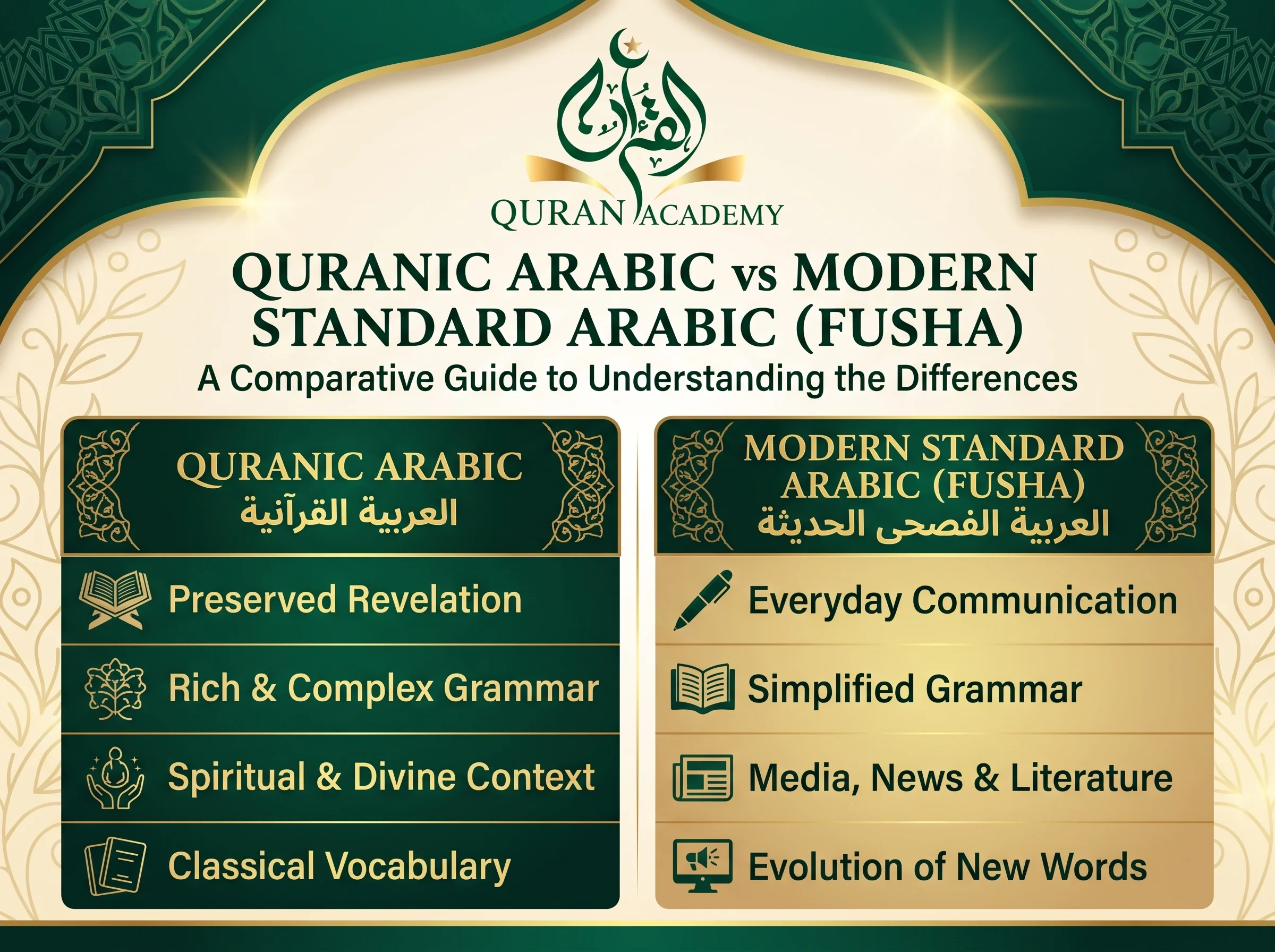
✦ Quick Answer & Key Takeaways: Quranic Arabic vs. Modern Standard Arabic
When comparing Quranic Arabic vs. Modern Standard Arabic (MSA), both are branches of formal Al-Fusha (الْفُصْحَى) that share the exact same foundational grammar (Nahw) and trilateral root system (Sarf). However, if your primary goal is to understand the Holy Quran, your 5 daily prayers (Salah), and Prophetic Hadith, you should learn Quranic Arabic first. Why? Because standard university MSA courses spend two years teaching modern newspaper vocabulary (airports, elections, and economics) that never appears in the Mushaf—whereas our targeted 1-on-1 Al-Azhar Arabic & Quran Mentorship teaches the 300 high-frequency Quranic words that unlock 70% of the entire Quran in just 3 to 6 months!
- Shared Grammatical Engine (95% Overlap): Verb conjugations, pronouns, prepositions, and sentence structures (Jumlah Ismiyyah & Fi'liyyah) are virtually identical in Quranic Arabic and MSA.
- The "80/20 Vocabulary" Miracle: Out of 77,430 total words in the Quran, learning just 100 words unlocks 50% of the text, and 300 words unlock 70% of every page!
- Why Quranic Arabic Is Easier for Beginners to Read: Every word in the Quran is printed with 100% complete vowel markings (Tashkeel), whereas MSA books and news articles print bare consonants without vowels.
- When to Add MSA (And Avoid Dialects Initially): Start with Quranic Fusha to master the roots and grammar; once you have that foundation, adding modern conversational MSA takes just a few extra months.
Imagine enrolling in a two-year Modern Standard Arabic (MSA) course at a local university or downloading a popular language-learning app on your phone because your deepest dream is to stand in Taraweeh or daily Salah and understand the words of Allah directly without reading an English translation.
Six months into the course, you have memorized how to say "The United Nations ambassador arrived at the embassy in a taxi"—yet when you open Surah Al-Mulk or Surah Yaseen in the Mushaf, you still cannot understand a single complete verse! Why does this happen to thousands of sincere Western Muslims every year? Because nobody explained the critical distinction between Quranic Arabic vs. Modern Standard Arabic (Fusha)—and how choosing the right starting point cuts your journey to Quranic comprehension from five years down to a few inspiring months.
- The 3 Forms of Arabic Explained: Quranic (Classical), MSA & Regional Dialects
- Master Comparison Chart: Quranic Arabic vs. Modern Standard Arabic Across 7 Factors
- The "80/20 Pareto Secret": Why 300 Quranic Words Unlock 70% of the Mushaf
- How the Root System (Sarf) & Grammar (Nahw) Connect Both Forms of Fusha
- Decision Guide: Which Should You (or Your Child) Learn First Based on Your Goal?
- The 4-Stage Roadmap to Understanding the Quran Directly in Arabic
- Frequently Asked Questions (FAQs)
1. The 3 Forms of Arabic Explained: Quranic (Classical), MSA & Regional Dialects
Before comparing Quranic Arabic vs. Modern Standard Arabic, it is helpful to understand the three-tier landscape of the Arabic language today (you can explore key linguistic and Quranic sciences terminology in our Interactive Tajweed & Quranic Encyclopedia):
The timeless,eloquent Arabic in which the Holy Quran was revealed over 1,400 years ago, and in which the Prophetic Hadith and classical books of Tafseer and Fiqh are preserved. It features full vowel markings (I'rab) and unmatched rhetorical precision (Balaghah).
The modernized descendant of Classical Arabic used across all 22 Arab nations in books, news broadcasts (like Al-Jazeera), official documents, and children's cartoons. It uses the exact same grammar as Quranic Arabic but swaps ancient vocabulary for modern terms.
Informal street spoken varieties (Egyptian, Levantine, Gulf, Moroccan) that drop classical case endings and mix local slang. Warning for Beginners: Learning a street dialect will not help you understand the Quran or read Islamic books!
The Key Takeaway: Notice that both Quranic Arabic and Modern Standard Arabic are called Al-Fusha (الْفُصْحَى) by native speakers! An Arab does not view them as two separate languages (like Latin vs. Italian); rather, they are two registers of the same living language—where the Quran itself is the reason Arabic grammar has remained 100% preserved and unchanged for fourteen centuries.
2. Master Comparison Chart: Quranic Arabic vs. Modern Standard Arabic (MSA)
How do Quranic Arabic and Modern Standard Arabic differ in day-to-day study? Compare them across 7 crucial dimensions in our master table below:
| Comparison Dimension | Quranic / Classical Arabic | Modern Standard Arabic (MSA) | Overlap / Difference Level | Better Starting Point For Muslims |
|---|---|---|---|---|
| 1. Core Vocabulary Focus | Spiritual, ethical & cosmic lexicon (Rabb, Jannah, Taqwa, Sabr, 'Ilm, Qalb). | Media, travel, politics & modern life (Airport, Parliament, Computer, Hotel). | Biggest Difference: MSA teaches 3,000+ modern words absent from the Quran. | 🏆 Quranic Arabic (3x Faster ROI) |
| 2. Size of Target Lexicon | Closed & Finite Corpus: 77,430 total words built from ~1,750 roots; 300 words = 70%! | Open & Expanding Corpus: Requires 4,000–6,000 words to read modern news fluently. | Quranic Arabic has a clear finish line; MSA vocabulary expands every year. | 🏆 Quranic Arabic |
| 3. Vowel Markings (Tashkeel) | 100% Fully Voweled: Every Fatha, Kasra, Damma & Sukoon is printed on the page. | Unvoweled Text: Books & websites omit short vowels; reader must guess from grammar. | Full vowels make Quranic script much easier for beginners to read accurately! | 🏆 Quranic Arabic |
| 4. Grammar & Root System (Nahw & Sarf) | Full classical case endings (Marfoo', Mansoob, Majroor) & 10 verb forms. | Exact same 10 verb forms & case rules (though spoken MSA often drops final vowels). | 95% Identical: Learning Quranic grammar automatically teaches you MSA grammar! | 🏆 Tie (Same Engine) |
| 5. Pronunciation & Acoustics | Governed by precise Tajweed & Makharij rules (Ghunnah, Madd, Qalqalah). | Standard conversational articulation without elongated Madd or nasal Tajweed counts. | Mastering letter exits in Tajweed gives you a crystal-clear, native Fusha accent. | 🏆 Quranic Arabic |
| 6. Everyday Conversational Speaking | Focused on reading, listening & spiritual comprehension (not ordering food at a café). | Designed for speaking, writing emails, media, and modern dialogue across Arab countries. | Add MSA speaking modules once your core Quranic grammar & roots are solid. | 🗣️ MSA (For Modern Conversation) |
Why Mastering Arabic Letter Sounds Is Step 1 for Both Quran & Fusha
In Arabic, changing a single letter's pronunciation changes the entire root word—for example, confusing the heavy ق (Qaaf) in Qalb (Heart) with the light ك (Kaaf) in Kalb (Dog)! In this 60-second lesson from our official Quran Academy YouTube Channel, Senior Instructor Ustadhah Yasmeen Gamal demonstrates how clear phonetic articulation anchors your Arabic comprehension:
- Hearing Root Consonants Clearly: Why recognizing the 5 echoing letters of Qalqalah (ق ط ب ج د) helps your ear catch root letters instantly during prayer.
- Native Al-Azhar Modeling: Learn authentic Fusha pronunciation directly from native Egyptian scholars!
3. The "80/20 Pareto Secret": Why 300 Quranic Words Unlock 70% of the Mushaf
Here is the most motivating statistical fact in Islamic education: the entire Holy Quran—from the opening verse of Surah Al-Fatihah to the final verse of Surah An-Nas—contains 77,430 total words. At first glance, 77,430 words sounds like a massive dictionary. However, when computational linguists analyzed how often words repeat across the 114 Surahs, they discovered an astonishing Pareto (80/20) distribution:
- Milestone 1 — The Top 100 Words = 50% of the Quran (~38,700 word occurrences!): By learning just the 100 most frequent particles, pronouns, prepositions, and core nouns/verbs (such as Min, Fee, 'Ala, Allah, Rabb, Alladheena, Qaala, Kaana, Aamana, 'Alima), you already know every second word on every single page of the Mushaf!
- Milestone 2 — The Top 300 Words = 70% of the Quran (~54,200 word occurrences!): Adding the next 200 high-frequency words brings your comprehension to 7 out of every 10 words across all 30 Juz. If you learn just 5 words a day, you can master all 300 words in 60 days (2 months)!
- Milestone 3 — The Top 500 to 600 Words = 82% of the Quran (~63,500 word occurrences!): At 600 words, you can read through entire pages of narrative Surahs (like Surah Yusuf, Al-Kahf, Maryam, Taha, and Al-Qasas) and understand the storyline directly in Arabic as you recite!
The Prophet Muhammad (peace be upon him) was granted Jawami' al-Kalim—the ability to express vast oceans of wisdom in a few concise, crystal-clear Arabic words. Abu Hurayrah (may Allah be pleased with him) narrated that the Messenger of Allah (ﷺ) said:
"I have been sent with concise, comprehensive speech (بُعِثْتُ بِجَوَامِعِ الْكَلِمِ)."
Struggling to perfect your Recitation?
Join hundreds of students mastering the Quran with our Verified Al-Azhar Graduates. We offer flexible 1-on-1 sessions tailored to your schedule.
Book a Free Evaluation Class →4. How the Root System (Sarf) & Grammar (Nahw) Connect Both Forms of Fusha
The biggest reason you never have to worry about "missing out" on Modern Standard Arabic when you start with Quranic Arabic is that both registers run on the exact same twin linguistic engines: Ilm al-Sarf (Morphology / The 3-Letter Root System) and Ilm al-Nahw (Syntax / Case Endings).
🔬 Inside the Arabic Root & Case Engine (1 Root = 12+ Words!)
In English, words like "know," "science," "scholar," "information," and "teach" look completely unrelated; you have to memorize each word separately. In Arabic, 99% of words grow mathematically out of a single 3-letter root (Jazr Thulathi)! Take the Quranic root ع - ل - م ('Ayn - Lam - Meem), which appears over 850 times in the Quran:
• عَلِمَ ('Alima): He knew | عَلَّمَ ('Allama): He taught (as in Surah Ar-Rahman 55:2 — عَلَّمَ الْقُرْآنَ)
• عِلْم ('Ilm): Knowledge/Science | عَالِم ('Aalim): Scholar / Knower (Plural: عُلَمَاء 'Ulama)
• عَلِيم ('Aleem): All-Knowing (Divine Name) | عَالَمِين ('Aalameen): The Worlds/Creation
• تَعَلَّمَ (Ta'allama): He learned | مُعَلِّم (Mu'allim): Teacher | مَعْلُومَات (Ma'loomaat): Information (MSA).
Notice the magic: By mastering one 3-letter Quranic root, you unlock 10 to 15 words in both the Mushaf and modern Arabic simultaneously!
In Arabic grammar (Nahw), the vowel on the very last letter of a noun tells you who is doing the action (Subject = Damma ـُ, Marfoo') and who is receiving the action (Object = Fatha ـَ, Mansoob), regardless of word order! Look at Surah Fatir (35:28):
• إِنَّمَا يَخْشَى اللَّهَ مِنْ عِبَادِهِ الْعُلَمَاءُ (Innamaa yakhshaa Allaaha min 'ibaadihil-'ulamaa'u).
Even though the word اللَّهَ (Allaaha) comes first right after the verb Yakhsha (fears/stands in awe), it carries a Fatha (ـَ)—meaning Allah is the One being revered! And the word الْعُلَمَاءُ (Al-'Ulamaa'u) at the end carries a Damma (ـُ)—meaning the scholars are the ones doing the fearing: "Indeed, among His servants, only those who have knowledge stand in true awe of Allah." This is why our Complete Tajweed Learning Guide and Quran Tafseer Guide emphasize never changing a final vowel mark during recitation!
5. Decision Guide: Which Should You (or Your Child) Learn First Based on Your Goal?
Still deciding how to structure your weekly lessons? Use this practical persona breakdown used by our academic advisors:
- Persona A — Adult Muslims, Reverts & Busy Professionals Who Want Khushu' in Salah: Start 100% with Quranic Arabic + Applied Tajweed! As we show in our guides on How Busy Adults Learn Quran Online and Memorizing the Quran After 40, adults don't have time to waste on textbook dialogues about booking hotel rooms. Learning the top 300 Quranic words alongside your daily 3x3 Hifz lines transforms your daily prayers within 60 days.
- Persona B — Muslim Children & Teens (Ages 5 to 16) Growing Up in the West: Use our "Quranic Phonics First → Integrated Fusha Second" sequence! In our 1-on-1 Online Kids Classes, children first master decoding the script through Noorani Qaida or Madani Qaida while learning the meaning of Juz Amma vocabulary and daily Duas in our Comprehensive Islamic Studies Course. Once their reading is fluent, we layer in conversational Fusha stories so they can both understand the Mushaf and speak polite, clear Arabic! (Track their daily Arabic word goals with our free Printable Kids Star Chart).
- Persona C — Students Planning to Study Abroad, Work in the Middle East, or Earn Ijazah: Combine our Quranic Nahw/Sarf track with active MSA conversation and preparation for our Online Ijazah & Connected Sanad Program. Because all of our tutors are native Egyptian Al-Azhar graduates, you can practice speaking pure Fusha live in every session!
6. The 4-Stage Roadmap to Understanding the Quran Directly in Arabic (In 6 to 12 Months)
Whether you are starting from zero or already read the script fluently, here is the exact 4-stage curriculum we use to take students from relying on English translations to understanding the Arabic Mushaf directly:
- Stage 1: Script Decoding & Acoustic Precision (Weeks 1–8): Never learn Arabic through English transliteration (like "Bismillahi")! Master the 28 letters, short/long vowels, Heavy & Light Letters (Tafkhim & Tarqeeq), and the Rules of Waqf (Stopping Signs) so you can read any voweled Arabic word accurately—and test your rules in our 3-Minute Interactive Tajweed Quiz.
- Stage 2: The Top 125 Particles, Pronouns & Prepositions (Months 2–3): Before memorizing complex verbs, master the "glue words" of the Quran—attached pronouns (Hu, Hum, Ka, Kum, Naa), prepositions (Min, Fee, 'Ala, Ila, Bi, Li), and demonstrative/relative words (Dhalika, Haadha, Alladhee, Alladheena). These 125 words alone make up over 40% of the entire Quran!
- Stage 3: The Top 200 Trilateral Verb & Noun Roots + Core Nahw (Months 4–6): Learn how past, present, and command verbs work, how nominal and verbal sentences fit together, and master the 200 most frequent roots in Surah Al-Fatihah, Juz Amma, and Surah Al-Baqarah.
- Stage 4: Applied Mushaf Tadabbur & Daily Khatmah Reading (Months 6–12): Apply your vocabulary directly inside your daily reading schedule using our 30-Day Salah Anchor Reading Plan (and our Smart Khatmah Calculator) alongside your memorization schedule in our Smart Hifz Planner! Read how students describe the moment they first understood a verse in prayer without translation on our Verified Student & Parent Reviews Page.
7. Frequently Asked Questions (FAQs) About Quranic Arabic vs. Modern Standard Arabic
1. What is the main difference between Quranic Arabic and Modern Standard Arabic (MSA)?
Both Quranic (Classical) Arabic and Modern Standard Arabic (MSA) are registers of formal Al-Fusha that share 95% of the same grammar (Nahw) and root system (Sarf). The primary difference is vocabulary and vowel markings: Quranic Arabic uses a focused lexicon of ~1,750 roots centered on faith, ethics, and Prophetic history printed with 100% full vowel markings (Tashkeel), whereas MSA uses modern vocabulary for news, politics, and business printed without short vowel marks.
2. Which should I learn first: Quranic Arabic or Modern Standard Arabic?
If your goal is to understand your 5 daily prayers (Salah), comprehend the Quran while reciting, and read Hadith and Tafseer, always start with Quranic Arabic first. Mastering the top 300 high-frequency Quranic words unlocks 70% of the entire Quran in 3 to 6 months—whereas standard MSA courses spend years on modern vocabulary that never appears in the Mushaf.
3. Will Arabs understand me if I speak Modern Standard Arabic (Fusha) or Quranic Arabic?
Yes! Because Al-Fusha is the official language taught in every school, used in all books and media, and heard in every mosque across all 22 Arab countries, native speakers from Makkah and Cairo to Amman and Rabat will understand you clearly when you speak Fusha.
4. Can I learn Quranic Arabic using English transliteration before learning the Arabic alphabet?
No—relying on English transliteration hides the 3-letter Arabic roots and corrupts letter pronunciation (such as confusing ح with هـ or ق with ك). Spend your first 4 to 8 weeks mastering the Arabic script through Noorani Qaida alongside your first 50 Quranic words so your eyes recognize roots directly on the page.
5. How many words do I need to learn to understand 80% of the Holy Quran?
Out of the 77,430 total words in the Quran, learning the top 100 most frequent words covers 50% of all word occurrences; learning the top 300 words covers 70%; and mastering the top 500 to 600 words covers approximately 80% to 82% of every page in the Mushaf!
Unlock the Meaning of Every Verse You Recite in Salah!
Study 1-on-1 with a native Egyptian Al-Azhar scholar who makes Quranic vocabulary, root patterns, and Fusha grammar effortless and inspiring. Book your free diagnostic trial class today!
Book Your Free 1-on-1 Arabic Trial Class →