
✦ Quick Answer & Key Takeaways: Surah Yusuf Lessons & 30-Day Memorization Schedule
Exploring our complete Surah Yusuf lessons and memorization schedule unlocks the only chapter in the Holy Quran that narrates a complete Prophetic biography from beginning to end in one uninterrupted sequence: Surah Yusuf (Chapter 12), spanning 111 verses across 13.5 pages (Pages 235 to 248, bridging the end of Juz 12 and the first half of Juz 13). Described in Verse 3 as Ahsanal-Qasas (the finest of narratives) and revealed during the Prophet Muhammad's (ﷺ) "Year of Sorrow" ('Aam al-Huzn) to comfort grieving hearts, all 111 verses can be memorized effortlessly in 30 days by learning just half a page (7 to 8 lines) per day in our 1-on-1 Online Quran Memorization (Hifz) Program.
- Why It Is the Easiest Long Surah to Memorize: Follows a chronological Symmetrical Ring Structure—beginning with the childhood dream in Verse 4 and culminating in its fulfillment on the royal throne in Verse 100!
- The Ultimate Cure for Grief & Family Trials: Teaches Sabrun Jameel (gracious patience without complaining to creation — 12:18, 83) and unshakeable optimism in Allah's relief (12:87).
- Unique Tajweed Exception in Verse 11: Contains the famous obligatory Ishmam / Rawm word (Laa Ta'mannaa) marked with a diamond sign (◊) in the Uthmani Mushaf for Hafs 'an 'Asim.
- The 30-Day "Half-Page" Blueprint: Memorize half a page daily for 26 days—plus 4 built-in review checkpoints—to lock all 13.5 pages into permanent memory.
Classical scholars of Tafseer observed that no sad or distressed believer listens attentively to Surah Yusuf (Chapter 12) without feeling their sorrow relieved and their chest expanded with hope. Why? Because almost every major human test—sibling rivalry, separation from a beloved child, false accusation, years of forgotten waiting, and economic hardship—is woven into this single chapter, and every one of those dark valleys leads directly to elevation, reconciliation, and mercy from Allah.
Yet when students open Page 235 of the Mushaf hoping to memorize all 111 verses (13.5 pages) of Surah Yusuf, they often face two practical challenges. First, because the dialogues between Ya'qub (AS), Yusuf (AS), his brothers, and the royal court feature recurring expressions (Mutashabihat)—such as two mentions of Fasabrun Jameel (v. 18 & 83), three shirts, and three dreams—students sometimes mix up which wording belongs to which page. Second, many reciters are unsure how to perform the lip-rounding gesture of Ishmam in Verse 11. Below, we give you the thematic story arc, 6 life and parenting lessons, the Mutashabihat keys, and a day-by-day 30-Day Surah Yusuf Memorization Schedule.
- Why Is Surah Yusuf Called "Ahsanal-Qasas" (The Best of Stories)? (Revelation Context)
- Thematic Story Breakdown: The Two-Part Symmetrical Ring of Surah Yusuf
- 6 Timeless Life, Character & Parenting Lessons From Surah Yusuf
- Master Chart: The 30-Day Surah Yusuf Memorization Schedule (Half a Page Per Day)
- 5 Essential Tajweed Landmarks (Ishmam in 12:11!) & Mutashabihat Keys
- Frequently Asked Questions (FAQs)
1. Why Is Surah Yusuf Called "Ahsanal-Qasas" (The Best of Stories)?
Revealed in Makkah during the most difficult year of the Prophetic mission—after the passing of Khadijah (RA) and Abu Talib, right when the Quraysh were plotting against the Messenger of Allah (ﷺ)—Surah Yusuf (Chapter 12) descended both as a clear proof of Prophethood and as a direct consolation to the Prophet's heart. As we explain in our Complete Quran Tafseer Guide and our Beginner's Roadmap to Important Tafseer Surahs, this chapter carried a remarkable glad tiding: just as Yusuf's brothers plotted against him and drove him from his homeland, only to stand humbled before him years later receiving his complete pardon in Verse 92, Prophet Muhammad (ﷺ) would return victoriously to Makkah and grant amnesty to Quraysh with those exact words! You can verify the authentic narrations praising Prophet Yusuf's four-generation prophetic lineage (Sahih al-Bukhari 3390) in our Online Hadith Explorer.
2. Thematic Story Breakdown: The Two-Part Symmetrical Ring of Surah Yusuf
When you open Surah Yusuf on Page 235 of our Online Uthmani Quran Explorer, you immediately see why Hifz students love memorizing it: just as Ayatul Kursi features a mirror ring structure, Surah Yusuf is built on a Two-Part Symmetrical Ring—where the trials of Part 1 in Juz 12 (Verses 1–52) are reversed point-for-point by the triumphs of Part 2 in Juz 13 (Verses 53–111):
- Act 1 — Childhood Vision & Sibling Plot (Verses 1–18 • Pages 235–237): Opens with Yusuf's childhood vision of eleven stars, the sun, and the moon, followed by Ya'qub's wise counsel against sibling envy. When the brothers cast Yusuf into the well and return with his first shirt stained with false blood, Ya'qub anchors his heart in gracious patience (Sabrun Jameel).
- Act 2 — The Palace Test & Choosing Moral Purity (Verses 19–35 • Pages 237–239): Rescued by a passing caravan and sold into the household of Egypt's Chief Minister, Yusuf grows into maturity and steadfastly resists seduction—vindicated by his second shirt torn from behind—ultimately choosing imprisonment over disobedience to Allah.
- Act 3 — Prison Da'wah, Royal Dream & Exoneration (Verses 36–52 • Pages 239–242): Inside prison, Yusuf calls his fellow inmates to pure Tawheed and interprets their dreams. Years later, when he interprets the King's dream of seven fat and lean years, Yusuf insists on full public exoneration of his honor before stepping out of prison (concluding Juz 12).
- Act 4 — Stewardship of Egypt & Testing His Brothers (Verses 53–87 • Pages 242–246): Appointed over Egypt's storehouses (Hafeedhun 'Aleem), Yusuf receives his brothers during the famine, arranges for his full brother Binyamin to stay safely with him via the royal cup, and witnesses his father Ya'qub renew his vow of Sabrun Jameel and unbroken hope in Allah's relief.
- Act 5 — Forgiveness, Healing Shirt & Dream Fulfillment (Verses 88–111 • Pages 246–248): Yusuf reveals his identity, grants unconditional forgiveness to his brothers, and sends his third shirt to restore his father's eyesight. The family enters Egypt in safety, the childhood vision is fulfilled on the royal throne, and the Surah closes with timeless lessons on prophetic resilience.
3. Six Timeless Life, Character & Parenting Lessons From Surah Yusuf
Just as we explored emotional resilience in our Surah Ad-Duha & Ash-Sharh Guide for Anxiety, look at the character and parenting principles we teach families in our Comprehensive Islamic Studies Course from the story of Yusuf (AS):
Ya'qub (AS) proves that feeling deep sorrow does not contradict patience. Gracious patience means directing your tears and complaints to Allah alone while never losing hope in His mercy.
By advising young Yusuf not to share his dream with his brothers, Ya'qub (AS) teaches parents to be mindful of sibling sensitivity, avoiding comparisons that allow Shaytan to sow jealousy.
Yusuf (AS) summarizes his journey from the well to the throne in two pillars: whoever guards their Taqwa in private temptation and remains patient in adversity, Allah never wastes their reward!
4. Master Chart: The 30-Day Surah Yusuf Memorization Schedule (Half a Page Per Day)
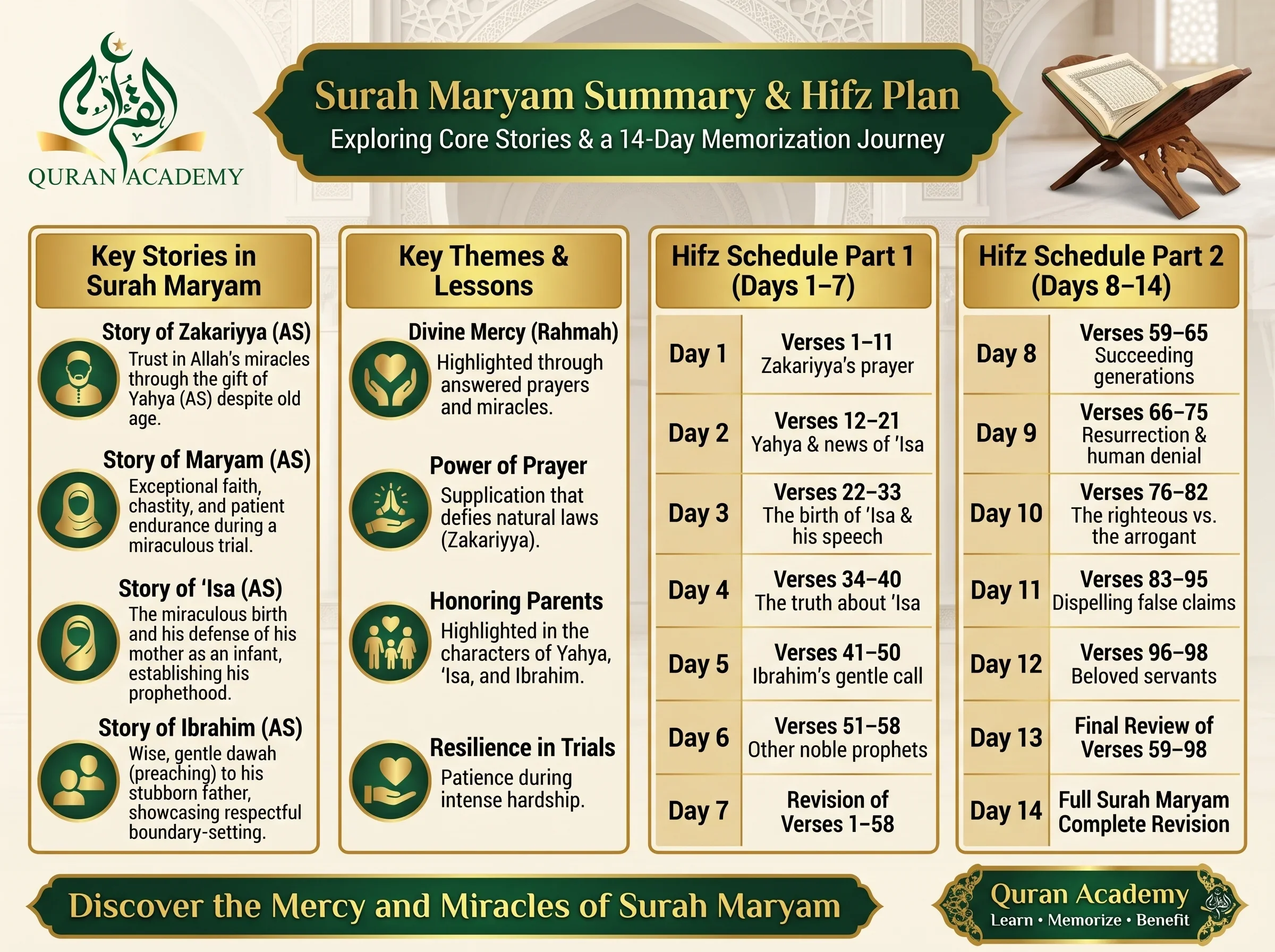
In the standard 15-line Uthmani Mushaf, Surah Yusuf spans 13.5 pages (Pages 235 to 248). Just as we structured our Surah Al-Baqarah Memorization Plan and our 14-Day Surah Maryam Plan using the 3x3 Quran Memorization Method and the Sabaq, Sabqi & Manzil Revision System, memorizing just 7 to 8 lines (4 to 5 verses) per day allows you to finish all 111 verses in 30 days:
Struggling to perfect your Recitation?
Join hundreds of students mastering the Quran with our Verified Al-Azhar Graduates. We offer flexible 1-on-1 sessions tailored to your schedule.
Book a Free Evaluation Class →| Days | Mushaf Pages | Exact Verses (Ayahs) | Story Scenes & Key Landmarks | Cumulative Checkpoint Goal |
|---|---|---|---|---|
| Days 1 – 5 (+ Day 6 Audit) |
Pages 235 – 237 (2.5 Pages) |
Verses 1 – 22 (4–5 Ayahs/day) |
Act 1: Dream of 11 stars (v. 4), Ishmam on Laa Ta'mannaa (v. 11), the well, Shirt #1, 1st Sabrun Jameel (v. 18), & arrival in Egypt. | Day 6 Audit ⭐: Recite Pages 235–237 (Verses 1–22) 5x from memory without peeking. |
| Days 7 – 11 (+ Day 12 Audit) |
Pages 238 – 240 (3 Pages) |
Verses 23 – 43 (4 Ayahs/day) |
Acts 2 & 3a: Palace trial, Shirt #2 torn from behind, women's banquet, prison Dua (v. 33), & prison Tawheed Da'wah (v. 36–42). | Day 12 Audit ⭐: Recite Pages 235–240 (Verses 1–43) continuously across your prayers. |
| Days 13 – 17 (+ Day 18 Audit) |
Pages 241 – 243 (3 Pages) |
Verses 44 – 69 (5 Ayahs/day) |
Acts 3b & 4a: King's dream, exoneration (v. 51 • End of Juz 12 at v. 52!), Treasurer of Egypt (v. 55), & brothers' visits. | Day 18 Audit ⭐: Recite Pages 241–243 (Verses 44–69) + link Juz 12 to Juz 13 smoothly! |
| Days 19 – 23 (+ Day 24 Audit) |
Pages 244 – 246 (3 Pages) |
Verses 70 – 95 (5 Ayahs/day) |
Acts 4b & 5a: The King's cup in Binyamin's bag, 2nd Sabrun Jameel (v. 83), Yusuf's reveal (v. 90), & Shirt #3 of healing! | Day 24 Audit ⭐: Contrast v. 18 vs. v. 83 and recite Verses 53–95 from memory. |
| Days 25 – 30 🏆 (Final Pages + Seal) |
Pages 247 – 248 (2 Pages) |
Verses 96 – 111 (4 Ayahs/day + 2 Seal Days) |
Act 5b: Sight restored, entering Egypt (v. 99), Dream fulfilled on the throne (v. 100), Yusuf's Dua (v. 101), & closing lessons! | Days 29 & 30 🏆: Full 13.5-page audit of all 111 verses with your Al-Azhar tutor! |
Mastering the Qalqalah Echoes in "Sabrun Jameel" & "Al-Jubb"
Surah Yusuf is rich with mid-word and end-of-word Qalqalah (Echoing) letters (ق ط ب ج د)—such as the Baa Sakinah in فَصَبْرٌ جَمِيلٌ (Fasabْrun Jameel — 12:18, 83), the Jeem in اجْعَلْنِي (Ijْ'alnee — 12:55), and the double Baa when stopping on الْجُبِّ (Al-Jubbْ — 12:10, 15)! Watch Senior Instructor Ustadhah Yasmeen Gamal demonstrate on our Quran Academy YouTube Channel:
- Mid-Word Clarity: How a light bounce on the Baa in Sabْrun keeps it from sounding like a muted "P".
- 1-on-1 Live Feedback: Perfect your Tajweed and Hifz of Surah Yusuf with our Al-Azhar scholars!
5. Five Essential Tajweed Landmarks (Including "Ishmam" in 12:11!) & Mutashabihat Keys
In fact, Verse 11 of Surah Yusuf is one of the most famous test questions in any Online Quran Ijazah Exam! Review these five Tajweed and Mutashabihat keys from our 1-on-1 Online Tajweed Course and our Interactive Tajweed Encyclopedia:
- 1. The Special Diamond Sign (◊) — Obligatory Ishmam or Rawm on "Laa Ta'mannaa" (12:11): Originally composed of two Noons (Laa Ta'manunaa, with a Damma on the first Noon), this word is read in Hafs 'an 'Asim either with Al-Ishmam (silently rounding your lips into a Damma shape while holding the 2-count nasal Ghunnah on the merged Noon Mushaddadah) or with Ar-Rawm / Al-Ikhtilas (pronouncing the first Noon quickly with two-thirds of its Damma vowel).
- 2. How to Pronounce "Alif-Laam-Raa" (الر — 12:1): Following our Rules of Madd in Tajweed and Heavy & Light Letters Guide, Alif has zero Madd, Laaaaaam is stretched for 6 counts, and Raa is a heavy 2-count natural elongation.
- 3. Mutashabihat Key #1 — The Two "Fasabrun Jameel" Verses (Verse 18 vs. Verse 83): In Verse 18 (when only Yusuf was missing), Ya'qub (AS) concludes by seeking Allah's help against what they describe (Wallaahul-Musta'aanu...); in Verse 83 (when three sons—Yusuf, Binyamin, and their eldest brother—are all separated from him!), he concludes with hope that Allah will bring all of them back together ('Asallaahu an ya'tiyanee bihim jamee'aa)!
- 4. Mutashabihat Key #2 — Reaching Maturity in Surah Yusuf (12:22) vs. Surah Al-Qasas (28:14): In Surah Yusuf (12:22), it says directly Wa lammaa balagha ashuddahu aataynaahu hukman wa 'ilmaa, whereas for Musa (AS) in Surah Al-Qasas (28:14), it adds the word Wastawaa.
- 5. Mastering Noon Sakinah, Meem Sakinah & Long Narrative Stops: Keep your Noon Sakinah & Tanween, Meem Sakinah, and Sifaat al-Huruf rules crisp across the dialogue verses (and use our Rules of Waqf Guide when pausing on long narrative verses!). Test your Tajweed knowledge right now on our Free 3-Minute Interactive Tajweed Quiz!
Once you embark on your 30-day Surah Yusuf journey (notice how many words in Surah Yusuf you already know from our Top 50 High-Frequency Quranic Arabic Words!), you can pair it with our other Hifz & Tafseer milestones: our Surah Al-Kahf Four Trials Guide, our 15-Day Surah Ya-Sin Plan, our 10-Day Surah Ar-Rahman Plan, our 12-Day Surah Al-Waqi'ah Schedule, our Last 2 Verses of Surah Al-Baqarah Guide, and our 3-Day Kids Guide to the 3 Quls! Whether you are a busy mother following our 15-Minute Daily Quran Routine, an adult over 40 following our Adult Hifz Roadmap with our Al-Azhar Certified Male & Female Tutors, or a parent inspiring your child in our 1-on-1 Kids Quran Classes with our Printable Kids Quran Star Chart, see how students across the US, UK, Canada, and Australia rate their progress on our Verified Student & Parent Reviews Page!
6. Frequently Asked Questions (FAQs) About Surah Yusuf Story, Lessons & Memorization
1. How many verses and pages are in Surah Yusuf, and which Juz is it in?
Surah Yusuf (Chapter 12) contains 111 verses (Ayahs) and spans 13.5 pages (from Page 235 to Page 248) in the standard 15-line Uthmani Mushaf. Verses 1 to 52 are in the final pages of Juz 12, and Juz 13 begins on Page 242 at Verse 53.
2. How long does it take to memorize Surah Yusuf easily?
Because Surah Yusuf narrates one continuous, chronological story across 13.5 pages, you can memorize the entire Surah in 30 days by learning half a page (7 to 8 lines, or 4 to 5 verses) per day for 26 days, with 4 weekly review days to cement your retention.
3. Why is Surah Yusuf called "Ahsanal-Qasas" (The Best of Stories)?
Scholars explain that Surah Yusuf is called Ahsanal-Qasas (The Best of Stories) because it is the only prophetic biography told in one complete, unbroken arc in the Quran, combining literary ring symmetry with practical lessons on patience (Sabrun Jameel), moral purity, forgiveness, and how every trial is turned into elevation by Allah.
4. What is the diamond sign (◊) above "Laa Ta'mannaa" in Surah Yusuf verse 11?
The diamond lozenge mark (◊) above Laa Ta'mannaa (12:11) indicates an obligatory Ishmam (or Rawm) in the recitation of Hafs 'an 'Asim. To perform Ishmam, round your lips forward into a Damma shape while holding the 2-count nasal Ghunnah on the Noon Mushaddadah to visually indicate the original Damma vowel.
5. What are the 3 shirts (Qamees) mentioned in Surah Yusuf?
The narrative of Surah Yusuf is anchored around three shirts: (1) The Shirt of Sorrow (12:18) stained with false blood; (2) The Shirt of Innocence (12:25–28) torn from the back in the palace; and (3) The Shirt of Healing & Joy (12:93, 96) sent to restore his father Ya'qub's eyesight!
Memorize "The Best of Stories" in 30 Days With an Al-Azhar Scholar!
Want to master all 111 verses of Surah Yusuf with accurate Ishmam application, clear Mutashabihat anchors, and life-changing Tadabbur? Book your free 1-on-1 trial session with our male or female Al-Azhar scholars today!
Book Your Free 1-on-1 Hifz Trial Class →