
✦ Quick Answer & Key Takeaways: Surah Ad-Duha & Ash-Sharh for Anxiety
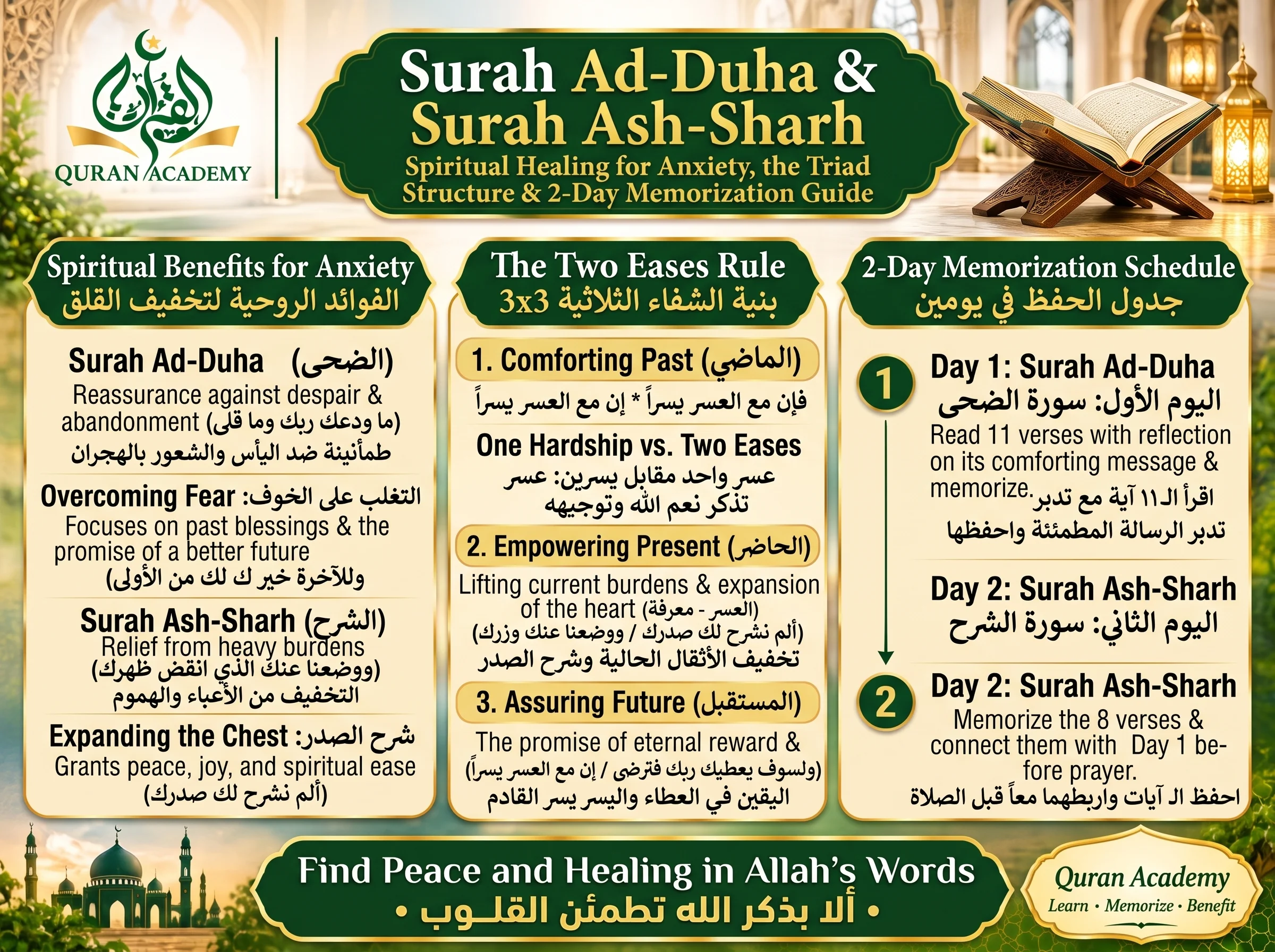
Exploring Surah Ad Duha benefits for anxiety alongside its twin chapter, Surah Ash-Sharh (Al-Inshirah), reveals the ultimate Quranic remedy for grief, burnout, and emotional heaviness. Located side by side on Page 596 of Juz 30—comprising 11 verses in Surah Ad-Duha (Chapter 93) and 8 verses in Surah Ash-Sharh (Chapter 94)—these 19 short, consoling verses were revealed directly to heal the heart of Prophet Muhammad (ﷺ) during a painful pause in revelation when he felt distressed and mocked by his opponents (Sahih al-Bukhari 4950). In our 1-on-1 Online Quran Memorization (Hifz) Program, both adults and children memorize these two twin Surahs in just 2 days (10 minutes per day!) using our "3-Triad Symmetry Method."
- Direct Divine Reassurance (93:3): Directly addresses the fear of abandonment with the tender oath: مَا وَدَّعَكَ رَبُّكَ وَمَا قَلَىٰ (Your Lord has never forsaken you, nor has He grown displeased with you).
- The "3x3 Triad Architecture" of Surah Ad-Duha: Divides cleanly into 3 Oaths & Promises (v. 1–5), 3 Past Mercies Remembered (v. 6–8), and 3 Active Gratitude Commands (v. 9–11).
- The "One Hardship, Two Eases" Law in Surah Ash-Sharh (94:5–6): Because the word Al-'Usr (the hardship) is definite and repeated once while Yusran (ease) is indefinite and mentioned twice, one single hardship can never overcome two distinct eases!
- 2-Day Hifz Blueprint: Master all 11 verses of Ad-Duha on Day 1 and all 8 verses of Ash-Sharh on Day 2 to recite them in your daily Salatud-Duha and Fajr prayers!
Have you ever gone through a season of life where the night feels endlessly long, your prayers feel quiet, and a heavy whisper in your chest asks: "Is Allah upset with me? Have I been forgotten?" In modern psychology, that combination of emotional exhaustion, loneliness, and fear of the future is the very core of anxiety and sadness.
What many Muslims do not realize is that fourteen centuries ago, in the valleys of Makkah, the most beloved creation of Allah—Prophet Muhammad (peace be upon him)—experienced a moment of intense sorrow when revelation paused temporarily (Fatrat al-Wahy) and his enemies taunted him saying, "His Lord has abandoned him!" In response, Allah Almighty did not send down a chapter of stern commands; He sent down the two most comforting, heart-healing chapters on Page 596 of the Mushaf: Surah Ad-Duha (Chapter 93) and its inseparable twin, Surah Ash-Sharh (Chapter 94). Below, we explore the authentic revelation story, break down the 6 psychological healing steps embedded in these two Surahs, and give you a simple 2-Day Memorization Plan.
- The Authentic Revelation Story (Asbab an-Nuzul) of Surah Ad-Duha in Sahih al-Bukhari
- Surah Ad-Duha Tafseer (93:1–11): The "3x3 Triad Cure" for Sadness & Anxiety
- Surah Ash-Sharh Tafseer (94:1–8): Why "One Hardship Can Never Defeat Two Eases"
- Master Comparison Table: How the Twin Surahs (93 & 94) Mirror Each Other on Page 596
- The 2-Day Memorization Plan (How to Memorize All 19 Verses in 20 Minutes)
- 5 Essential Tajweed Landmarks in Surah Ad-Duha & Ash-Sharh
- Frequently Asked Questions (FAQs)
1. The Authentic Revelation Story (Asbab an-Nuzul) of Surah Ad-Duha in Sahih al-Bukhari
As we teach in our Complete Quran Tafseer Guide and our Beginner's Roadmap to Important Tafseer Surahs, knowing the exact historical moment a Surah descended transforms how you feel when reciting it in prayer:
Jundub ibn Sufyan Al-Bajali (may Allah be pleased with him) narrated that the Prophet Muhammad (peace be upon him) became unwell and could not stand for night prayer for two or three nights. A woman (Umm Jamil, the wife of Abu Lahab) came to him and said: "O Muhammad! I think that your companion (meaning the angel of revelation) has forsaken you, for I have not seen him come near you for two or three nights!" Thereupon Allah Almighty revealed:
وَالضُّحَىٰ ﴿١﴾ وَاللَّيْلِ إِذَا سَجَىٰ ﴿٢﴾ مَا وَدَّعَكَ رَبُّكَ وَمَا قَلَىٰ ﴿٣﴾
(By the morning brightness, and by the night when it grows still and calm—your Lord has not forsaken you, nor has He become displeased!)
Notice the gentle divine wisdom in the two oaths at the opening of Surah Ad-Duha: Allah swears by the bright morning sunlight (وَالضُّحَىٰ — representing the warmth of revelation and ease) and by the night when it settles peacefully (وَاللَّيْلِ إِذَا سَجَىٰ — representing quiet rest). Just as the quiet night is not a sign that the sun has abandoned the earth—rather, the cool night is a mercy so eyes can rest from the intense light of day—a quiet season of testing in a believer's life is never a sign that Allah has abandoned you!
2. Surah Ad-Duha Tafseer (93:1–11): The "3x3 Triad Cure" for Sadness & Anxiety
When you open Page 596 of our Online Uthmani Quran Explorer, you will see that the 11 verses of Surah Ad-Duha (40 words total) are built on a remarkable 3-Part Cognitive Healing Framework that modern therapists and classical scholars alike marvel at:
🌅 The 3 Triads of Surah Ad-Duha (Future Hope → Past Proof → Present Action)
When anxiety strikes, it whispers three lies: (1) "You are alone," (2) "Things will only get worse," and (3) "You will never be happy again." Verses 3, 4, and 5 shatter all three lies in exact sequence:
• Promise 1 (v. 3 — مَا وَدَّعَكَ رَبُّكَ وَمَا قَلَىٰ): Your Lord has neither left you (Wadda'aka) nor hated you (Qalaa—notice that Allah says wa maa qalaa without even attaching "you" [Qalaaka] out of pure tenderness toward His Prophet!).
• Promise 2 (v. 4 — وَلَلْآخِرَةُ خَيْرٌ لَّكَ مِنَ الْأُولَىٰ): Every coming chapter of your life—and the Hereafter above all—is better for you than what has passed!
• Promise 3 (v. 5 — وَلَسَوْفَ يُعْطِيكَ رَبُّكَ فَتَرْضَىٰ): And your Lord is going to give you until your heart is completely content and satisfied (Fatardaa)!
How do you convince an anxious mind that Allah will take care of tomorrow? By looking at how He already took care of your yesterday! Notice the 3 Past Blessings starting with أَلَمْ يَجِدْكَ (Did He not find you...?):
• Proof 1 — Shelter (v. 6 — أَلَمْ يَجِدْكَ يَتِيمًا فَآوَىٰ): Did He not find you an orphan (Yateeman) and give you loving shelter (Fa-aawaa)?
• Proof 2 — Guidance (v. 7 — وَوَجَدَكَ ضَالًّا فَهَدَىٰ): And He found you searching for the way (Daallan) and guided you (Fa-hadaa)?
• Proof 3 — Sufficiency (v. 8 — وَوَجَدَكَ عَائِلًا فَأَغْنَىٰ): And He found you in financial need ('Aa'ilan) and made you self-sufficient and rich in contentment (Fa-aghnaa)?
Finally, the fastest way to break out of inward rumination is outward kindness and gratitude—matching the 3 past rescues in Verses 6–8 with 3 Present Duties in Verses 9–11:
• Duty 1 (Matching v. 6 Orphanhood → v. 9): فَأَمَّا الْيَتِيمَ فَلَا تَقْهَرْ (Because you were sheltered as an orphan, never oppress or belittle the orphan!).
• Duty 2 (Matching v. 7–8 Need & Searching → v. 10): وَأَمَّا السَّائِلَ فَلَا تَنْهَرْ (And as for the petitioner/seeker who asks for help or knowledge, never scold or repulse him!).
• Duty 3 (The Gratitude Seal → v. 11): وَأَمَّا بِنِعْمَةِ رَبِّكَ فَحَدِّثْ (And as for the favor and blessing of your Lord, proclaim and speak of it with gratitude!).
3. Surah Ash-Sharh Tafseer (94:1–8): Why "One Hardship Can Never Defeat Two Eases"
Immediately below Surah Ad-Duha on Page 596 sits Surah Ash-Sharh (سُورَةُ الشَّرْح / الْإِنشِرَاح — The Relief / Expansion of the Chest, Chapter 94), containing 8 short verses (27 words). While Surah Ad-Duha heals external circumstances (orphanhood, guidance, and provision), Surah Ash-Sharh heals the internal chest, back, and reputation:
Struggling to perfect your Recitation?
Join hundreds of students mastering the Quran with our Verified Al-Azhar Graduates. We offer flexible 1-on-1 sessions tailored to your schedule.
Book a Free Evaluation Class →- 1. Three Inner Gifts (Verses 1–4):
• Expanding the Chest (أَلَمْ نَشْرَحْ لَكَ صَدْرَكَ — 94:1): Filling the heart with light, spaciousness, peace, and wisdom so tightness disappears.
• Lifting the Crushing Weight (وَوَضَعْنَا عَنكَ وِزْرَكَ ﴿٢﴾ الَّذِي أَنقَضَ ظَهْرَكَ ﴿٣﴾): Removing the heavy burden (Wizr) that felt as though it was making the back creak under its weight (Anqada Dhahraka).
• Elevating Your Mention Forever (وَرَفَعْنَا لَكَ ذِكْرَكَ — 94:4): Whenever Allah's Name is proclaimed in the Adhan, Iqamah, Tashahhud, and sermons around the globe every second, the name of Prophet Muhammad (ﷺ) is honored alongside His! - 2. The Grammatical Miracle of "Al-'Usr" vs. "Yusran" (Verses 5–6):
Look closely at the Arabic letters of Verses 5 and 6 (using the principles of our Quranic Arabic Grammar Guide and Top 50 High-Frequency Quranic Words):
• فَإِنَّ مَعَ الْعُسْرِ يُسْرًا ﴿٥﴾ إِنَّ مَعَ الْعُسْرِ يُسْرًا ﴿٦﴾
• First Secret (مَعَ = "With," not "After"!): Allah did not say "After hardship comes ease"; He said مَعَ (Ma'a = WITH hardship is ease)—meaning that in the very same moment a trial descends, Allah sends down the patience, wisdom, and relief to carry you through it!
• Second Secret (1 Definite Hardship vs. 2 Indefinite Eases): In Arabic grammar, when a noun with ال (Al- / "The") is repeated (الْعُسْرِ ... الْعُسْرِ), both words refer to the exact same single hardship. But when an indefinite noun with Tanween (يُسْرًا ... يُسْرًا) is repeated, the second one is a brand-new, second ease! That is why the Prophet (ﷺ) and Companions like Ibn 'Abbas and 'Umar ibn Al-Khattab rejoiced and said: "One hardship will never overcome two eases! (لَنْ يَغْلِبَ عُسْرٌ يُسْرَيْنِ)" - 3. The Productive Believer's Formula (Verses 7–8):
فَإِذَا فَرَغْتَ فَانصَبْ ﴿٧﴾ وَإِلَىٰ رَبِّكَ فَارْغَب ﴿٨﴾ — Whenever you finish your worldly work or obligatory duty (Faraghta), immediately stand up and strive sincerely in worship and prayer (Fansab), turning all your longing and hope solely toward your Lord (Wa ilaa Rabbika farghab)!
4. Master Comparison Table: How the Twin Surahs (93 & 94) Mirror Each Other on Page 596
Why do students in our Juz Amma Memorization Schedule always learn Surah Ad-Duha and Surah Ash-Sharh together as a single pair? Look at how their structures mirror each other point for point:
| Structural Feature | Surah Ad-Duha (Chapter 93) | Surah Ash-Sharh (Chapter 94) | Memory & Tadabbur Connection |
|---|---|---|---|
| Verses & Location | 11 Verses (40 Words • Top of Page 596) | 8 Verses (27 Words • Middle of Page 596) | Both fit together on the upper two-thirds of Page 596! |
| The "Alam..." Question | أَلَمْ يَجِدْكَ يَتِيمًا فَآوَىٰ (93:6) Did He not find you...? |
أَلَمْ نَشْرَحْ لَكَ صَدْرَكَ (94:1) Did We not expand for you your chest? |
Both use gentle rhetorical questions (Alam...) to remind the heart of Allah's care. |
| 3 Past Blessings | 3 External Gifts (v. 6–8): 1. Sheltered you as an orphan 2. Guided your path 3. Made you self-sufficient |
3 Internal Gifts (v. 1–4): 1. Expanded your chest 2. Removed your heavy burden 3. Raised high your reputation |
Surah 93 heals your outer life; Surah 94 heals your inner chest and soul! |
| The Core Promise | وَلَسَوْفَ يُعْطِيكَ رَبُّكَ فَتَرْضَىٰ (93:5) Your Lord will give you until you are content! |
فَإِنَّ مَعَ الْعُسْرِ يُسْرًا • إِنَّ مَعَ الْعُسْرِ يُسْرًا (94:5–6) With every hardship come two eases! |
Unshakeable optimism in Allah's relief during every trial. |
| Closing Action Commands | 3 Social & Gratitude Commands (v. 9–11): Honor the orphan, help the seeker, & proclaim Allah's favors! |
2 Worship & Devotion Commands (v. 7–8): Strive in worship (Fansab) & turn all hope to your Lord (Farghab)! |
Surah 93 ends with serving creation; Surah 94 ends with devotion to the Creator! |
Mastering the Qalqalah Bounce in "Fansab" & "Farghab" (94:7–8)
Surah Ash-Sharh contains three famous Qalqalah (Echoing) letters (ق ط ب ج د): the mid-word Dal Sakinah in صَدْرَكَ (Sadْraka — 94:1), and the two final Baa Sakinah stops in فَانصَبْ (Fansabْ — 94:7) and فَارْغَب (Farghabْ — 94:8)! Watch Senior Instructor Ustadhah Yasmeen Gamal demonstrate on our Quran Academy YouTube Channel:
- Mid-Word vs. End Stop: Hear how the light bounce on Sadْraka differs from the strong Qalqalah Kubra bounce when stopping on Fansabْ and Farghabْ.
- 1-on-1 Coaching: Perfect your Juz Amma recitation with certified Al-Azhar scholars!
5. The 2-Day Memorization Plan (How to Memorize All 19 Verses in 20 Minutes)
By applying our 3x3 Quran Memorization Method and the Sabaq, Sabqi & Manzil Revision System, you or your child can master both Surahs over a single weekend:
- Day 1 — Surah Ad-Duha (11 Verses in 12 Minutes): Memorize in 3 Blocks of 3!
• Minutes 1–4 (Block 1 — Verses 1–5): Memorize the 2 oaths (Wad-Duhaa, Wal-layli idhaa sajaa) + the 3 promises ending in the soft "-aa" rhyme (Qalaa → Al-Oolaa → Fatardaa).
• Minutes 5–8 (Block 2 — Verses 6–8): Memorize the 3 past rescues—notice the alphabetical/logical sequence: يَتِيمًا فَآوَىٰ (Orphan → Sheltered), ضَالًّا فَهَدَىٰ (Searching → Guided), عَائِلًا فَأَغْنَىٰ (In need → Enriched)!
• Minutes 9–12 (Block 3 — Verses 9–11): Notice that the rhyme changes from "-aa" to two "-ar" endings (فَلَا تَقْهَرْ • فَلَا تَنْهَرْ) before sealing with فَحَدِّثْ! Recite all 11 verses in the first Rak'ah of your 2-Rak'ah morning Salatud-Duha prayer! - Day 2 — Surah Ash-Sharh (8 Verses in 8 Minutes): Memorize in 2 Blocks of 4!
• Minutes 1–4 (Block 1 — Verses 1–4): Notice that all 4 opening verses end with the attached pronoun ـكَ (Ka = Your) referring to parts of the Prophet's body and honor: صَدْرَكَ (your chest) → وِزْرَكَ (your burden) → ظَهْرَكَ (your back) → ذِكْرَكَ (your mention)!
• Minutes 5–8 (Block 2 — Verses 5–8): Memorize the twin ease verses (فَإِنَّ مَعَ الْعُسْرِ يُسْرًا ﴿٥﴾ إِنَّ مَعَ الْعُسْرِ يُسْرًا ﴿٦﴾—remembering that the first one starts with فَإِنَّ [Fa-inna] and the second one starts with إِنَّ [Inna] without Faa!), followed by the twin "-ab" endings (فَانصَبْ • فَارْغَب)! Recite Surah Ash-Sharh in the second Rak'ah of your Salatud-Duha prayer right after Surah Ad-Duha!
6. Five Essential Tajweed Landmarks in Surah Ad-Duha & Ash-Sharh
Before reciting these two chapters in prayer today, check your pronunciation against these five rules from our 1-on-1 Online Tajweed Course and our Interactive Tajweed Glossary:
- 1. Preserving the 2-Beat Natural Alif (Madd Tabee'i) at the End of Verses 1–8 of Ad-Duha: Following our Rules of Madd in Tajweed, give every verse ending from Verse 1 to Verse 8 (Wad-Duhaa, Sajaa, Qalaa, Al-Oolaa, Fatardaa, Fa-aawaa, Fa-hadaa, Fa-aghnaa) an exact, calm 2-beat elongation—neither clipping it short like a Fatha nor over-stretching it to 4 beats!
- 2. The 6-Count Madd Lazim Kalimi Muthaqqal in "Daallan" (ضَالًّا — 93:7): Look at the wavy Madd sign (~) followed by a Shaddah on the Laam in وَوَجَدَكَ ضَالًّا فَهَدَىٰ! You must stretch the heavy ضَا (Daaaaaal-lan) for a full 6 counts, press the Shaddah on the Laam, and then apply a 2-count nasal Ikhfa on the Tanween before the Faa of Fa-hadaa!
- 3. Heavy Raa When Stopping on "Taqharْ" & "Tanharْ" (93:9–10): According to our Heavy & Light Letters Guide, when you stop at the end of Verse 9 (فَلَا تَقْهَرْ—with a crisp Qalqalah on the Qaaf!) and Verse 10 (فَلَا تَنْهَرْ—with clear throat Izhar on the Noon before Haa!), the final رْ (Raa Sakinah) is preceded by a Fatha, so it must be pronounced heavy (Tafkhim)!
- 4. Whispered Hams on "Fa-haddithْ", "Nashrahْ", "Kaf" & "Faraghta": Applying our Sifaat al-Huruf Guide, release a soft, gentle flow of air (Hams) when stopping on the interdental ثْ (Thaa) in فَحَدِّثْ (93:11), on the throat حْ (Haa) in أَلَمْ نَشْرَحْ (94:1), and on the final كَْ (Kaaf Sakinah) when stopping at the end of Verses 1–4 of Surah Ash-Sharh!
- 5. Heavy vs. Light Noon Ikhfa in Surah Ash-Sharh (أَنقَضَ vs. فَانصَبْ): Under our Noon Sakinah & Tanween Rules, both أَنقَضَ (94:3 — Noon before heavy Qaaf) and فَانصَبْ (94:7 — Noon before heavy Saad) have a Heavy Nasal Ghunnah (Tafkhim al-Ghunnah)! Test your Tajweed accuracy right now on our Free 3-Minute Interactive Tajweed Quiz!
Once you and your family have memorized Surah Ad-Duha and Surah Ash-Sharh in 2 days, pair them in your daily routine with our 3-Day Kids Guide to the 3 Quls, our 5-Minute Ayatul Kursi Guide, our Last 2 Verses of Surah Al-Baqarah Guide, and our 15-Day Surah Ya-Sin Plan, 10-Day Surah Ar-Rahman Plan, and 12-Day Surah Al-Waqi'ah Schedule! Whether you are a busy mother following our 15-Minute Daily Quran Routine, an adult over 40 following our Adult Hifz Roadmap with our compassionate Al-Azhar Certified Male & Female Tutors, or a parent teaching your child in our 1-on-1 Kids Quran Classes with our Printable Kids Quran Star Chart, see how students across the US, UK, Canada, and Australia rate their transformation on our Verified Student & Parent Reviews Page!
7. Frequently Asked Questions (FAQs) About Surah Ad-Duha & Surah Ash-Sharh
1. Why was Surah Ad-Duha revealed, and why is it recommended for anxiety and sadness?
According to Sahih al-Bukhari (4950) and Sahih Muslim (1797), Surah Ad-Duha (Chapter 93) was revealed when revelation paused briefly and opponents claimed Allah had forsaken Prophet Muhammad (ﷺ). It heals anxiety and sadness through a 3-step framework: reassuring the believer of Allah's love and a brighter future (v. 1–5), recalling past times Allah rescued and provided for them (v. 6–8), and channeling energy into kindness and gratitude (v. 9–11).
2. How are Surah Ad-Duha (Chapter 93) and Surah Ash-Sharh (Chapter 94) connected?
Located consecutively on Page 596 of Juz 30, both Surahs address the Prophet's heart with gentle rhetorical questions (Alam yajidka... in 93:6 and Alam nashrah... in 94:1), recount three past divine favors, promise relief and contentment, and conclude with active commands of gratitude and devotion.
3. Why did the Companions say "One hardship will never overcome two eases" in Surah Ash-Sharh (94:5–6)?
In Arabic grammar, when a definite noun with ال (Al-'Usr / The Hardship) is repeated in Verses 5 and 6, both occurrences refer to the same single hardship. However, when an indefinite noun with Tanween (Yusran / An Ease) is repeated, the second occurrence refers to a second, additional ease—meaning every single hardship is accompanied by two distinct eases!
4. How long does it take to memorize Surah Ad-Duha and Surah Ash-Sharh?
Because Surah Ad-Duha has only 11 short verses (40 words) and Surah Ash-Sharh has only 8 short verses (27 words), a beginner or child can easily memorize both chapters in just 2 days (10 minutes per day) using the 3x3 Triad Method.
5. What is the best prayer in which to recite Surah Ad-Duha and Surah Ash-Sharh?
You can recite them in any obligatory or voluntary prayer, and it is especially rewarding to recite Surah Ad-Duha in the first Rak'ah and Surah Ash-Sharh in the second Rak'ah of the mid-morning Duha Prayer (Salatud-Duha) or the Sunnah of Fajr prayer.
Experience the Peace of Memorizing & Understanding Juz Amma!
Study 1-on-1 with a compassionate, certified male or female Al-Azhar scholar who brings the meaning, Tajweed, and comfort of every Surah to life. Book your free diagnostic trial session today!
Book Your Free 1-on-1 Quran Trial Class →