
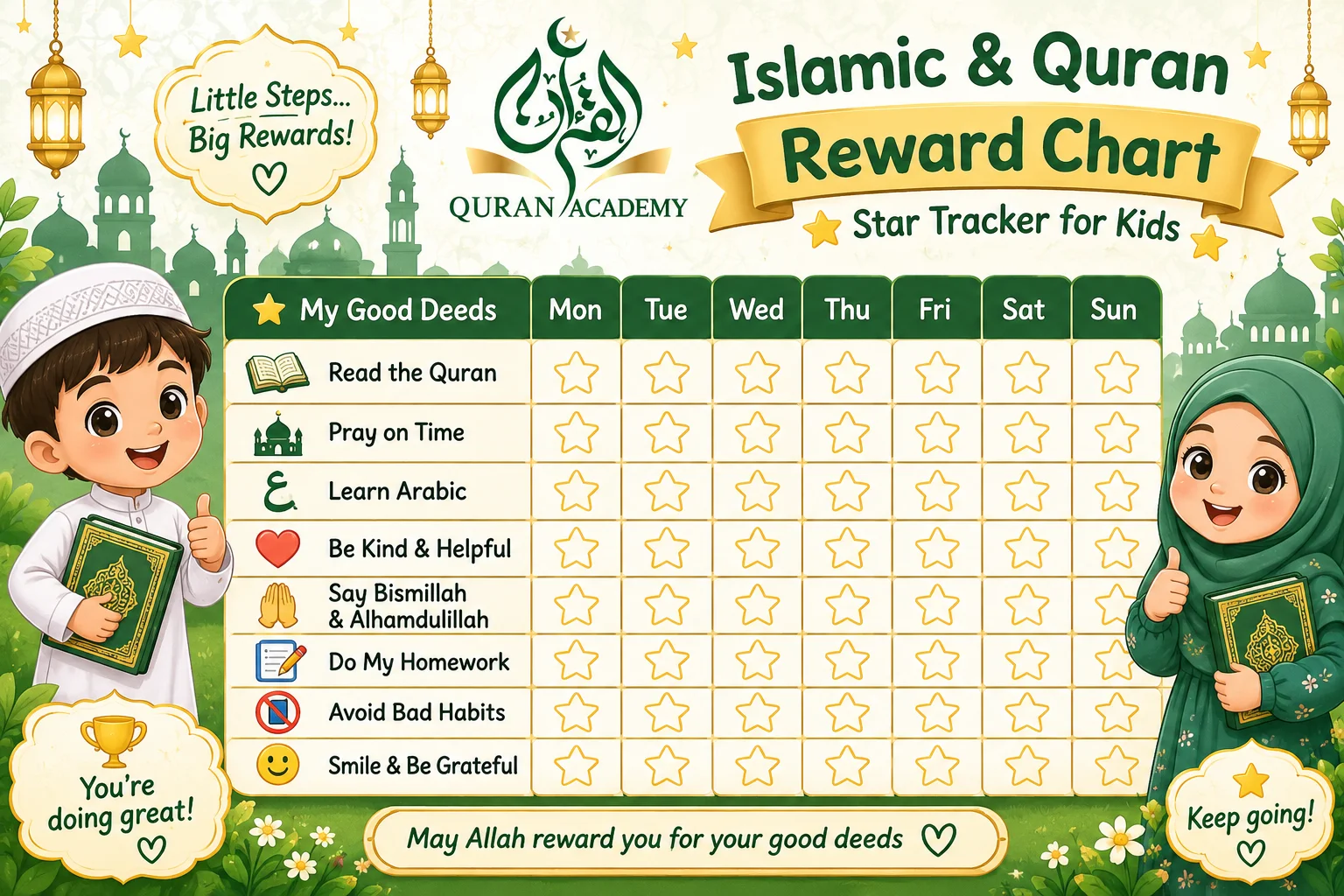
✦ Quick Answer & Key Takeaways: Islamic & Quran Reward Charts
Islamic and Quran reward charts are visual habit-building trackers that use immediate positive reinforcement (stars, stickers, and milestone badges) to help children ages 4 to 12 build consistent daily routines in Quran recitation, Noorani Qaida, the 5 daily prayers (Salah), and Prophetic manners (Akhlaq) without parental nagging. Parents in our Fun 1-on-1 Online Quran Classes for Kids pair live tutor praise with a customized weekly star chart to turn 10 minutes of daily Quran practice into their child's favorite part of the day.
- Why Most Sticker Charts Fail After Week 1: Generic charts fail when they track too many tasks (8+ items), demand perfection (100% completion to win), or rely on sugary bribes instead of connection-based family rewards.
- The "3-Habit Rule" for Muslim Kids: Always limit a child's weekly chart to 1 Quran habit (e.g., 10 minutes of Qaida or 3 Hifz lines), 1 Salah/Adhkar habit, and 1 Akhlaq habit (e.g., helping parents or speaking kindly).
- Age-Calibrated Milestones: Young beginners (ages 4–6) need 3-day instant wins, elementary learners (ages 7–9) thrive on weekly 20-star goals, and pre-teens (ages 10–12) respond best to point-banking toward privileges.
- The Ultimate Motivation Secret: A paper chart works 3x better when an encouraging teacher asks to see the child's star progress on camera at the start of every live class!
Does this evening scene sound familiar in your home? You come home exhausted after work, look at the clock before Maghrib, and remind your seven-year-old for the fourth time: "Please open your Noorani Qaida or review Surah Al-Fajr before your online class tomorrow!" Immediately, the negotiating, sighing, and sudden "stomachaches" begin—leaving you torn between forcing them to read (and risking them resenting Quran time) or letting them skip practice again.
Here is the comforting truth every Muslim parent in the US, UK, Canada, and Australia needs to hear: your child does not dislike the Quran—their developing brain simply struggles with delayed gratification. When you tell a child that reading the Mushaf today brings immense reward in the Hereafter and fluency next year, their prefrontal cortex cannot visualize a reward twelve months away. Well-designed Islamic and Quran reward charts bridge that developmental gap by making spiritual progress visible, tangible, and celebratory right now.
- The Prophetic Psychology of Positive Reinforcement (Why Encouragement Beats Nagging)
- Why 80% of Generic Sticker Charts Stop Working After 5 Days (And How to Fix It)
- Master Chart: Age-by-Age Islamic & Quran Reward System (Ages 4 to 12)
- How to Structure Your Child's Weekly Chart Using the "3-Pillar Balance"
- 15 Meaningful Islamic & Family Rewards That Don't Spoil Kids With Toys
- How Our 1-on-1 Tutors Use Digital Star Charts & Whiteboards to Keep Kids Excited
- Frequently Asked Questions (FAQs)
1. The Prophetic Psychology of Positive Reinforcement (Why Encouragement Beats Nagging)
Some parents wonder whether using Islamic and Quran reward charts teaches children to worship Allah only for worldly prizes. In reality, classical Islamic pedagogy (Tarbiyah) has always recognized that young children require warm encouragement, affectionate praise, and joyful milestones while their internal faith (Iman) matures.
When the Prophet Muhammad (peace be upon him) taught children, he never used harshness, shaming, or exhausting lectures. Instead, he used affectionate titles, physical warmth, joyful competitions, and small gifts to anchor love for worship in their hearts:
Anas ibn Malik (may Allah be pleased with him), who served the Prophet (peace be upon him) as a young boy for ten years, testified:
"I served the Prophet (peace be upon him) at Medina for ten years. I was a boy, and not everything that I did was as my master wished that I should do. Yet he never said to me 'Uff' (a word of displeasure), nor did he ever say to me: 'Why did you do this?' or 'Why did you not do that?'"
From a neurological perspective, every time your child places a gold star on their chart right after reciting three lines from our Online Quran Explorer, their brain releases a micro-burst of dopamine—the neurotransmitter responsible for habit formation. Within 21 to 30 days, the brain begins associating the sound of the Quran itself with warmth, pride, and accomplishment, allowing you to gradually fade out external prizes while the internal habit remains for life!
Making Tajweed & Recitation Fun and Clear for Young Learners
Children stay 10x more motivated when they understand how Arabic letters sound rather than being told they are "wrong." In this 60-second lesson from our official Quran Academy YouTube Channel, Senior Instructor Ustadhah Yasmeen Gamal demonstrates how we turn letter articulation into an engaging audio game:
- The "Bouncing Letters" Trick: Kids love hearing the crisp echo on the 5 Qalqalah letters (ق ط ب ج د) in Surah Al-Falaq and Surah Al-Ikhlas.
- Confidence Through Clarity: When a child masters one clear rule per week, earning their daily Quran star feels easy and exciting!
2. Why 80% of Generic Sticker Charts Stop Working After 5 Days (And How to Fix It)
If you have ever printed a cute chart from Pinterest, taped it to the fridge on Monday, and watched your child completely ignore it by Friday, the problem wasn't your child—it was the chart mechanics. Here are the three design flaws that kill motivation and how our academy's behavioral framework fixes them:
Requiring 7 out of 7 days to win the weekly prize. If a child misses Tuesday, they realize they've already lost the week and quit on Wednesday!
✓ The Fix: Set the winning threshold at 80% (e.g., 5 out of 7 days) so one tough day never ruins their streak.
Writing "Practice Quran" or "Be a good Muslim" on the chart without a clear finish line.
✓ The Fix: Use micro-specific actions like "Read 1 page of Noorani Qaida" or "Repeat 3 lines using the 3x3 Hifz Method."
Struggling to perfect your Recitation?
Join hundreds of students mastering the Quran with our Verified Al-Azhar Graduates. We offer flexible 1-on-1 sessions tailored to your schedule.
Book a Free Evaluation Class →Erasing a child's Quran star later in the evening because they argued with their sibling.
✓ The Fix: Never revoke a spiritual star once earned! Keep Quran progress sacred and separate from discipline.
3. Master Chart: Age-by-Age Islamic & Quran Reward System (Ages 4 to 12)
A five-year-old learning the Arabic alphabet needs a completely different reward horizon than an eleven-year-old memorizing Juz Tabarak. As we explain in our foundational guides on When a Child Should Start Learning the Quran and How Often Kids Should Practice Quran Reading, matching the chart to your child's developmental stage is the key to effortless consistency:
| Child's Age Group | Ideal Daily Quran Task | Max Tasks on Chart | Reward Horizon (When They Win) | Best Reward Type |
|---|---|---|---|---|
| 1. Little Explorers (Ages 4–6 Years) |
5–10 mins of Noorani Qaida phonics + repeating 1 short verse after Mom/Dad. | 2 to 3 Tasks Max | Every 3 Days (Short memory span; needs quick wins!) |
Choosing bedtime story, 15 mins of park time, or special 3D shiny stickers. |
| 2. Junior Reciters (Ages 7–9 Years) |
15 mins of Mushaf reading or memorizing 2–3 lines of Juz Amma + praying 3–5 daily Salah. | 4 to 5 Tasks Max | Weekly (Every Friday) (Target: 18 out of 25 weekly stars) |
Friday Jummah ice cream date, picking family dinner, or 30 mins of Lego/craft time. |
| 3. Pre-Teen Huffaz (Ages 10–12 Years) |
20 mins of Hifz & Tajweed rules + all 5 daily prayers on time + morning/evening Adhkar. | 5 to 6 Tasks Max | Weekly + Monthly Bank (Convert stars into points) |
One-on-one outing with Dad/Mom, weekend sports/gaming pass, or Surah completion gift. |
4. How to Structure Your Child's Weekly Chart Using the "3-Pillar Balance"
When you open our free interactive Islamic Kids Reward Chart Generator (linked at the top of this guide), you will notice pre-built checkboxes covering worship, Quran, and character. For maximum success, select one or two habits from each of these three pillars so your child connects Quran learning with everyday kindness:
- Pillar 1 — The Quranic Anchor (10–15 Minutes Daily): Choose "Read/Listen to Quran," "Memorize 1 Short Surah," or "Practice Arabic Alphabet." Pair this with a fixed daily trigger—such as right after afternoon snack or immediately after Maghrib prayer.
- Pillar 2 — The Worship & Dhikr Anchor: Choose "Pray 5 Daily Prayers" (or 2–3 prayers for younger beginners) and "Say Morning/Evening Adhkar."
- Pillar 3 — The Akhlaq (Character) Anchor: Choose "Help Mom/Dad" or "Speak Politely (No Yelling)." Showing your child that smiling, helping set the table, and speaking gently earns the exact same gold star as reciting Surah Al-Mulk teaches them that living the Quran is just as important as reading it!
5. Fifteen Meaningful Islamic & Family Rewards That Don't Spoil Kids With Toys
You do not need to buy expensive plastic toys every Friday to keep your child excited about their chart! In fact, behavioral research shows that connection-based privileges and family experiences create much stronger long-term motivation than material gifts. Pick one of these parent-tested rewards when your child hits their weekly star goal:
- 5 Connection & Privilege Rewards (Zero Cost): (1) Staying up 30 minutes past bedtime on Friday night with Mom and Dad, (2) Choosing the family Friday dinner menu, (3) Being the "Imam" who leads the family in Maghrib or Isha prayer (for boys learning prayer leadership) or calling the Adhan at home, (4) A 20-minute flashlight fort story session, or (5) A "Pass Card" from one household chore on Saturday.
- 5 Experience Rewards (Low Cost): (6) A Friday after-Jummah hot chocolate or ice cream date with Dad or Mom, (7) A trip to their favorite park or bike trail, (8) Baking cookies together and delivering a plate to a neighbor (combining reward with Sunnah charity!), (9) Hosting a cousin or Muslim friend for a playdate, or (10) Choosing the family movie/documentary night.
- 5 Milestone "Surah Completion" Gifts (For Finishing a Full Surah or Juz): (11) Their own personalized velvet-cover Mushaf or color-coded Tajweed Quran, (12) A special prayer mat in their favorite color, (13) A small "Sadaqah Jar" where they get $5 to donate to an orphan or masjid of their choice (teaching them the joy of giving!), (14) A mini family "Khatmah Party" with balloons when they finish a Juz (planned using our Smart Hifz Planner), or (15) A fun 3-minute quiz challenge with their siblings on our Interactive Tajweed Quiz!
6. Why Pairing a Home Chart With a Live 1-on-1 Tutor Triples Your Child's Excitement
Here is a secret discovered by hundreds of parents across North America, the UK, and Australia: children work twice as hard for a warm, outside mentor whom they admire! When your child studies with one of our patient, English-fluent Al-Azhar Certified Quran Tutors, your home reward chart becomes part of an exciting team effort:
- The "Show-and-Tell" Opening Ritual: At the start of every 30-minute class, your child holds up their printed reward chart to the webcam so their Ustadh or Ustadhah can celebrate the stars they earned at home!
- Live Interactive Whiteboard Stickers & Confetti: Inside our custom virtual classroom, teachers award digital trophies, star stamps, and live screen confetti whenever a child pronounces a tricky letter or completes a verse.
- Official Printable Certificates: Every time your child completes a level in Noorani Qaida or memorizes a new Surah, they receive an official, verifiable Quran Academy Certificate in their student dashboard. Read how parents describe their children's transformation on our Verified Student & Parent Reviews Page!
7. Frequently Asked Questions (FAQs) About Islamic & Quran Reward Charts
1. Is it permissible in Islam to give kids worldly rewards for reading the Quran and praying?
Yes! Islamic scholars and classical educators agree that giving young children small gifts, stars, and encouraging rewards to build habits of Salah and Quran recitation is completely permissible and recommended—just as the Companions used to give toys to young children to help them practice fasting. As the child matures, parents gently pair the chart with reminders of Allah's love and Jannah so their internal intention (Niyyah) blossoms naturally.
2. How many tasks should I put on my child's Islamic reward chart?
Keep it simple! For ages 4 to 6, include no more than 2 to 3 daily tasks. For ages 7 to 12, include 4 to 5 tasks maximum (1 Quran task, 1–2 Salah/Adhkar tasks, and 1–2 character tasks). Overloading a chart with 10 chores overwhelms children and causes them to abandon it.
3. What should I do if my child misses a day or refuses to practice their Quran lines?
Never turn the reward chart into a punishment tool or take away stars they already earned! If your child is tired on a particular evening, offer a "Mini-Win Option"—such as listening to their Surah recited on audio for 2 minutes or reading just 1 line together—and set the weekly prize threshold at 80% (5 out of 7 days) so one missed day never ruins their week.
4. How do I transition my child from needing stickers to loving the Quran for Allah's sake?
Use the "Praise + Meaning Bridge": every time you place a sticker on the chart, pair it with spiritual affirmation—such as saying, "Look how proud you are of this star, and imagine how much Allah loves hearing your voice recite His words! Every single letter you just read earned you 10 Hasanat in Jannah!" Over time, shift from weekly toy prizes to monthly family experiences.
5. Where can I download a free personalized Islamic and Quran reward chart?
You can create and print a custom weekly chart with your child's name, their favorite weekly reward goal, and your chosen daily Islamic tasks in under 30 seconds using our free Islamic Kids Reward Chart Generator at the top of this page.
Give Your Child a Quran Teacher Who Makes Every Lesson a Joy!
Pair your home reward chart with a warm, certified male or female Al-Azhar tutor who uses interactive games, digital whiteboards, and positive encouragement. Book your child's free 1-on-1 trial session today!
Book My Child's Free 1-on-1 Trial Class →