
✦ Quick Answer & Key Takeaways: How to Perform Sujood As-Sahw
Knowing how to perform Sujood As Sahw (سُجُودُ السَّهْوِ — The Prostration of Forgetfulness) rescues your daily prayers whenever you accidentally add an action, omit an obligatory duty, or doubt how many Rak'ahs you have prayed. Established directly by the Sunnah of Prophet Muhammad (ﷺ)—who himself forgot in prayer so that his Ummah could learn the exact legal remedy (Sahih al-Bukhari 401 & Sahih Muslim 572)—Sujood As-Sahw consists of two consecutive prostrations (with a brief sitting between them) accompanied by Takbeer ("Allahu Akbar"), performed either immediately before saying the final Tasleem (As-salamu 'alaykum wa rahmatullah) or immediately after it. In our 1-on-1 Online Islamic Studies & Fiqh Course, both adults and children master the exact rulings of Salah and Sujood As-Sahw across all four Sunni schools of jurisprudence!
- The 3 Universal Triggers of Sujood As-Sahw: (1) Ziyadah (Addition) of an action, (2) Naqs (Omission) of an obligatory duty (Wajib), or (3) Shakk (Doubt) regarding the number of Rak'ahs (3 vs. 4, or 2 vs. 3).
- Golden Rule for Before vs. After Salam (Sunnah Evidence Method): Prostrate BEFORE Salam for omissions (such as skipping the First Tashahhud) or unresolved 50/50 doubt; prostrate AFTER Salam for additions or resolved doubt based on prevailing certainty.
- What to Recite Inside Sujood As-Sahw: Recite the exact same glorified dhikr as normal prayer prostration: سُبْحَانَ رَبِّيَ الْأَعْلَىٰ (Subhaana Rabbiyal-A'laa — 3 times)! (The popular phrase "Subhaana man laa yanaamu wa laa yashoo" has no authentic Prophetic basis).
- Pillars (Arkan) vs. Obligations (Wajibat): If you forget a Pillar (Rukn) like Ruku' or Sujood, Sujood As-Sahw alone cannot replace it—you must go back and perform the missing pillar (or add a full replacement Rak'ah) and then do Sujood As-Sahw!
Every single Muslim—from a seven-year-old child praying their first complete Dhuhr to a seasoned adult praying late at night—has experienced that sudden mid-prayer freeze: you are standing in the middle of Asr or Isha prayer, reciting a Surah, and suddenly a thought whispers in your mind: "Wait—am I in my 3rd Rak'ah or my 4th Rak'ah right now? And did I sit for the middle Tashahhud in Rak'ah 2, or did I stand straight up?"
Without clear Fiqh knowledge, that split second of doubt triggers panic. Some worshippers break their prayer completely and start over from scratch three or four times (opening the door to Waswasah and anxiety), while others finish the prayer with a heavy, uncertain heart wondering if their Salah was even accepted. In reality, Islam is a religion of mercy and ease—and just as we learned in the concluding supplication of Surah Al-Baqarah (2:286: "Our Lord, do not hold us accountable if we forget or err"), Allah Almighty legislated Sujood As-Sahw (The Prostration of Forgetfulness) to repair any unintentional slip in prayer and humiliate Shaytan at the very same time! Below, we break down the step-by-step performance of Sujood As-Sahw, the 3 categories of prayer actions, the 6 most common real-life Salah scenarios, and the comparison across all 4 Sunni Madhhabs (Hanafi, Maliki, Shafi'i, and Hanbali).
- Authentic Prophetic Hadiths on Sujood As-Sahw (Why the Prophet ﷺ Forgot in Prayer!)
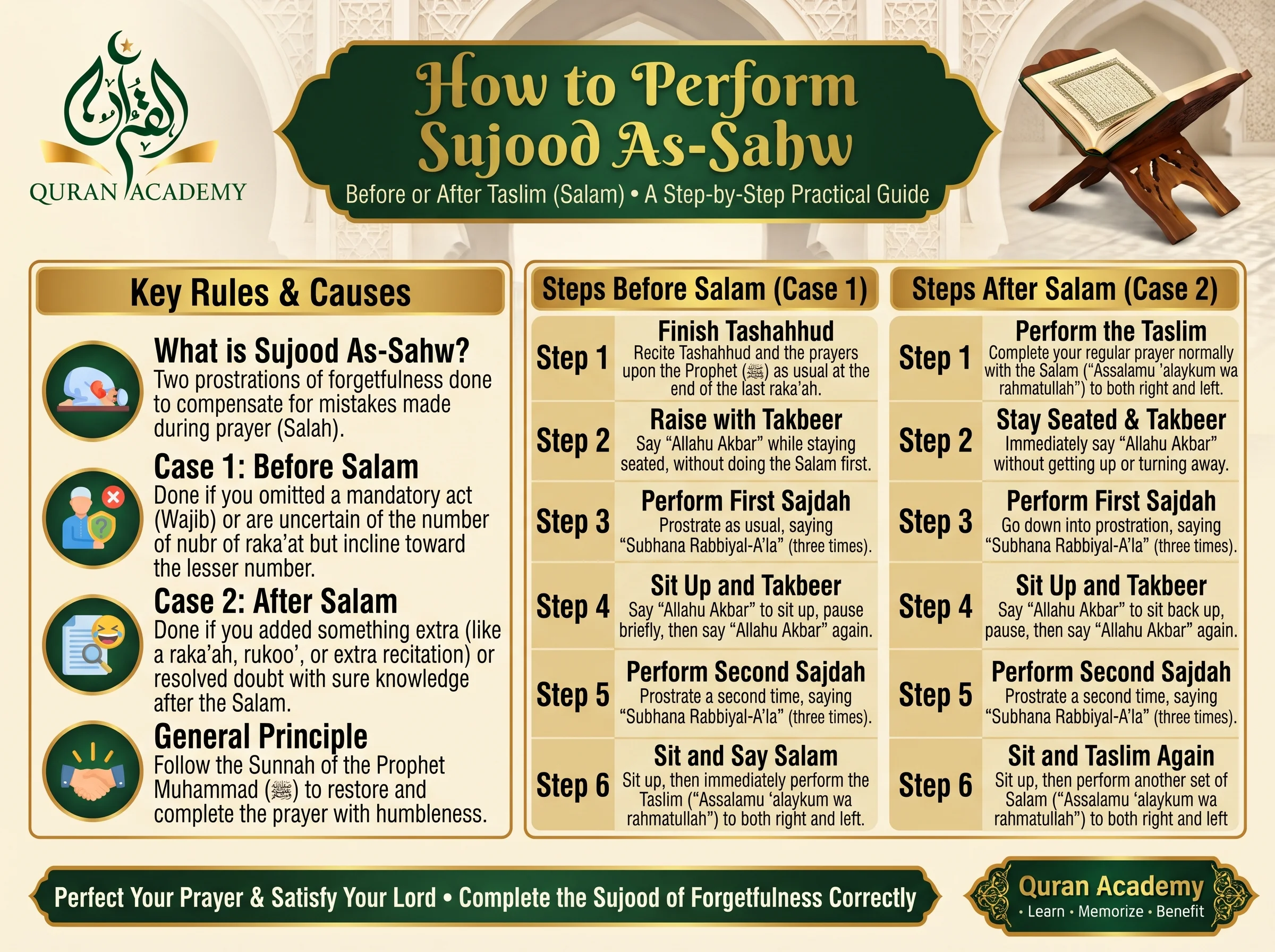
- How to Perform Sujood As-Sahw Step by Step (Method A: Before Salam vs. Method B: After Salam)
- The Foundation Key: Distinguishing Pillars (Arkan), Obligations (Wajibat) & Sunnahs in Salah
- Master Chart: 6 Real-Life Salah Mistakes & Exactly How to Fix Each One
- How the 4 Sunni Schools (Hanafi, Maliki, Shafi'i & Hanbali) Perform Sujood As-Sahw
- Frequently Asked Questions (FAQs)
1. Authentic Prophetic Hadiths on Sujood As-Sahw (Why the Prophet ﷺ Forgot in Prayer!)
Just as we distinguished Sajdah Tilawah (Prostration of Recitation) in our Quranic studies guides (and defined key Fiqh terms in our Interactive Tajweed & Islamic Encyclopedia), Sujood As-Sahw is rooted in some of the most famous authentic (Sahih) Hadiths in Islam. Why did Allah allow His Messenger (ﷺ) to experience forgetfulness in prayer on a handful of occasions? So that he could demonstrate with his own actions every possible scenario of repairing a prayer! Look at the two foundational Hadiths below (verifiable in our Online Hadith Explorer):
📜 The Two Core Prophetic Hadiths Every Muslim Should Know
- 1. "I am only a human being like you; I forget just as you forget!" (Sahih al-Bukhari 401 & Sahih Muslim 572):
'Abdullah ibn Mas'ud (may Allah be pleased with him) reported that the Prophet (ﷺ) prayed and either added or omitted something. When he was asked about it after finishing, he turned to the Companions, performed two prostrations of forgetfulness, and declared that he is a human being who forgets just as they forget—so whenever anyone forgets in prayer, let him remind him, and if someone doubts in his prayer, let him strive to determine what is correct, complete his prayer upon that, give Salam, and prostrate twice! - 2. How Sujood As-Sahw Humiliates Shaytan & Completes the Prayer (Sahih Muslim 571):
Abu Sa'id Al-Khudri (may Allah be pleased with him) narrated that the Messenger of Allah (ﷺ) said that if one of you is in doubt during his prayer and does not know whether he prayed three or four Rak'ahs, let him cast aside the doubt, build upon what he is 100% certain of (the lesser number, i.e., three), and then perform two prostrations before giving Salam. The Prophet (ﷺ) added the heartwarming promise: "If he had actually prayed five Rak'ahs, those two prostrations will make his prayer even; and if he had prayed a complete four Rak'ahs, those two prostrations will be a humiliation and spite against Shaytan (تَرْغِيمًا لِلشَّيْطَانِ)!" Why? Because Shaytan distracted you hoping to stop you from prostrating to Allah—and instead, your mistake caused you to prostrate to Allah two extra times!
2. How to Perform Sujood As-Sahw Step by Step (Before Salam vs. After Salam)
Before we look at which mistakes require prostrating before Salam and which require prostrating after Salam, let us walk through the exact physical and verbal steps of how to perform Sujood As Sahw in both positions:
When Prostrating BEFORE the Final Tasleem
- Finish Your Final Sitting: In the final Rak'ah of your prayer, sit and recite the complete Tashahhud (At-Tahiyyat) and Salawat 'alan-Nabi (Allahumma salli 'alaa Muhammad...)—stopping right before you would normally turn your head for Salam.
- 1st Prostration: Say "Allahu Akbar" and go down into your first prostration. Recite سُبْحَانَ رَبِّيَ الْأَعْلَىٰ (Subhaana Rabbiyal-A'laa) 3 times.
- Sit Between the Two Prostrations: Say "Allahu Akbar", sit up briefly between the two prostrations, and say رَبِّ اغْفِرْ لِي (Rabbigh-fir lee — "My Lord, forgive me").
- 2nd Prostration: Say "Allahu Akbar", go down into your second prostration, and recite سُبْحَانَ رَبِّيَ الْأَعْلَىٰ 3 times.
- Sit Up & Give Final Salam: Say "Allahu Akbar", sit back up, and immediately turn your head right and left to give the final Tasleem (As-salamu 'alaykum wa rahmatullah) without repeating the Tashahhud!
When Prostrating AFTER the Final Tasleem
- Complete the Prayer & Give Salam: Finish your final Tashahhud and Salawat, and give the final Tasleem (As-salamu 'alaykum wa rahmatullah) as normal. *(Note: In the Hanafi school, you give Salam to the right side only before prostrating; in the Shafi'i, Maliki, and Hanbali schools, you give Salam to both sides).*
- 1st Prostration: While still seated facing the Qiblah, say "Allahu Akbar", go down into your first prostration, and recite سُبْحَانَ رَبِّيَ الْأَعْلَىٰ 3 times.
- Sit Between the Two Prostrations: Say "Allahu Akbar", sit up briefly, and say رَبِّ اغْفِرْ لِي.
- 2nd Prostration: Say "Allahu Akbar", go down into your second prostration, and recite سُبْحَانَ رَبِّيَ الْأَعْلَىٰ 3 times.
- Sit Up & Give a Second Salam: Say "Allahu Akbar", sit back up, and give a final Tasleem to your right and left to exit Sujood As-Sahw!
3. The Foundation Key: Distinguishing Pillars (Arkan), Obligations (Wajibat) & Sunnahs in Salah
Here is the single most important Fiqh rule that prevents 99% of confusion about prayer mistakes: not every action in Salah has the same rank! Every action in prayer belongs to one of three categories, and how you react when you forget an action depends entirely on which category it belongs to:
| Category of Action | Key Examples in Salah | Can Sujood As-Sahw Replace It If Skipped? | What You Must Do If You Forget It |
|---|---|---|---|
| 1. Pillars of Salah (الأركان — Arkan) |
Opening Takbeer, standing, reciting Surah Al-Fatihah, Ruku' (bowing), rising from Ruku', both Sujoods, sitting between them, & Final Tashahhud. | ❌ NO! A pillar can NEVER be dropped or replaced by Sujood As-Sahw alone! |
You must go back and perform the missed pillar (if you haven't reached the same spot in the next Rak'ah) OR cancel that incomplete Rak'ah, add a new Rak'ah at the end, and then do Sujood As-Sahw! |
| 2. Obligations of Salah (الواجبات — Wajibat / Sunan Mu'akkadah) |
Sitting & reciting the First (Middle) Tashahhud in Rak'ah 2, saying Sami'a-llaahu liman hamidah, & saying the transitional Takbeers. | ✅ YES! This is the exact job of Sujood As-Sahw! |
Once you have completely stood up for the 3rd Rak'ah after forgetting the First Tashahhud, do NOT sit back down—keep going and repair the missed obligation with Sujood As-Sahw before Salam! |
| 3. Recommended Sunnahs (السنن المستحبة — Sunan) |
Opening Dua (Subhaanak-Allahumma...), reciting a second Surah after Al-Fatihah, raising hands (Raf' al-Yadayn), & placing right hand over left. | Not Required (Prayer is 100% valid without it). | If you forget to read a second Surah after Al-Fatihah and bow into Ruku', your prayer is completely valid and you do not even need Sujood As-Sahw (though doing it is permissible). |
4. Six Real-Life Salah Mistakes & Exactly How to Fix Each One
Let us apply these principles to the six most common real-life prayer mistakes students ask our Al-Azhar Certified Tutors about:
- Scenario 1 — Forgetting the First (Middle) Tashahhud in Rak'ah 2 (Sahih al-Bukhari 829):
You finish the second prostration of Rak'ah 2 in Dhuhr, Asr, Maghrib, or Isha, and instead of sitting for the middle Tashahhud, you stand up for Rak'ah 3. What should you do?
• If you remember while your knees and hands are still near the ground before standing upright: Sit back down immediately, recite the Tashahhud, and complete your prayer (no Sujood As-Sahw needed).
• If you remember only AFTER you have stood completely upright: Do NOT sit back down! (Because standing for Rak'ah 3 is a Pillar, and you cannot leave a Pillar to go back for an Obligation!). Continue your prayer normally and perform Sujood As-Sahw BEFORE Salam. - Scenario 2 — Doubting Whether You Prayed 3 or 4 Rak'ahs:
• Case A (50/50 Doubt — Neither side outweighs the other): Build on what you are 100% certain of (the lesser number = 3 Rak'ahs), pray one more Rak'ah to make it 4, and perform Sujood As-Sahw BEFORE Salam (Sahih Muslim 571).
• Case B (Prevailing Certainty / Ghalabat adh-Dhann — You are 80% sure it is your 4th Rak'ah): Act on your prevailing certainty (treat it as your 4th Rak'ah), finish the prayer, and perform Sujood As-Sahw AFTER Salam (Sahih al-Bukhari 401). - Scenario 3 — Accidentally Standing Up for an Extra 5th Rak'ah (Addition):
As soon as you remember (or someone alerts you by saying "SubhanAllah!" for men or clapping once for women) that you are in a 5th Rak'ah, sit back down immediately—even if you are already in Ruku'—recite the Final Tashahhud, give Salam, and perform Sujood As-Sahw AFTER Salam. - Scenario 4 — Giving Salam Early After Only 2 or 3 Rak'ahs (The Hadith of Dhul-Yadayn — Bukhari 482):
If you accidentally give Salam after 2 or 3 Rak'ahs of a 4-Rak'ah prayer and remember shortly afterward, stand back up with Takbeer, pray the remaining 1 or 2 Rak'ahs to complete your prayer, give Salam, and perform Sujood As-Sahw AFTER Salam! - Scenario 5 — Forgetting One of the Two Prostrations (A Pillar!):
Suppose in Rak'ah 1 you accidentally did only one prostration instead of two, and stood up for Rak'ah 2.
• If you remember while standing in Rak'ah 2 (before bowing into Ruku' of Rak'ah 2), sit right back down on the floor, perform the sitting and the missed 2nd prostration, stand back up to repeat Rak'ah 2 properly, and do Sujood As-Sahw after Salam.
• If you only remember after reaching Ruku' or Sujood of Rak'ah 2, then Rak'ah 1 is canceled, Rak'ah 2 takes its place as your new Rak'ah 1, you add a replacement Rak'ah at the end of the prayer, and do Sujood As-Sahw! - Scenario 6 — Praying Behind an Imam in Congregation (Jama'ah):
• If you make a minor forgetfulness mistake while praying behind an Imam (and didn't miss a Pillar), the Imam carries your forgetfulness—you do not do Sujood As-Sahw on your own!
• If the Imam makes a mistake and performs Sujood As-Sahw, you must follow the Imam into Sujood As-Sahw even if you didn't hear what mistake he made!
Pronouncing the Qalqalah Bounce in "Subْhaana Rabbiyal-A'laa" & "Allahu Akْbar"
Did you notice that the very first word you say inside every prostration—سُبْحَانَ رَبِّيَ الْأَعْلَىٰ (Subْhaana Rabbiyal-A'laa)—contains a mid-word Qalqalah Sughra on the Baa Sakinah (بْ)? If you press your lips together without a gentle bounce, it turns into an English "P" (Sup-haana ❌)! Watch Senior Instructor Ustadhah Yasmeen Gamal demonstrate on our Quran Academy YouTube Channel:
- Crisp Baa in "Subْhaana": Keep the Baa voiced and lightly bounced in every Ruku' and Sujood.
- 1-on-1 Live Coaching: Perfect your Salah recitation and Tajweed with our Al-Azhar scholars!
5. How the 4 Sunni Schools (Hanafi, Maliki, Shafi'i & Hanbali) Perform Sujood As-Sahw
Just as we compared all four Sunni schools in our Fiqh guide on Reading & Touching the Quran Without Wudu, why do you sometimes see one Muslim perform Sujood As-Sahw before Salam while another performs it after Salam? Because the Prophet (ﷺ) authentically performed Sujood As-Sahw both before Salam and after Salam in different Hadiths—so all four Sunni Madhhabs are following authentic Prophetic Sunnah! Here is a clear summary of each school's method:
Struggling to perfect your Recitation?
Join hundreds of students mastering the Quran with our Verified Al-Azhar Graduates. We offer flexible 1-on-1 sessions tailored to your schedule.
Book a Free Evaluation Class →| Sunni Madhhab | When to Prostrate (Before vs. After Salam) | Exact Procedure in That School |
|---|---|---|
| 1. Hanbali School (& Hadith-Based Method) |
Follows Each Hadith Directly: • Before Salam: Omissions & 50/50 doubt. • After Salam: Additions & resolved doubt. |
Applies each Prophetic Hadith to the exact case in which the Prophet (ﷺ) performed it (Before Salam in the Hadith of Ibn Buhaynah; After Salam in the Hadiths of Ibn Mas'ud & Dhul-Yadayn). |
| 2. Shafi'i School | Always BEFORE Salam (for all causes: addition, omission, or doubt). |
After completing both the Final Tashahhud and Salawat 'alan-Nabi, perform the two prostrations of Sahw and then give the final Salam once. |
| 3. Maliki School | • Before Salam (Sujood Qabli): For Omission (or Omission + Addition together). • After Salam (Sujood Ba'di): For pure Addition only. |
Distinguishes cleanly between repairing a deficiency inside the prayer (before Salam) and apologizing for an extra addition outside the prayer (after Salam). |
| 4. Hanafi School | Always AFTER One Salam to the Right (for any missed Wajib or delayed Pillar). |
In the final sitting, recite At-Tahiyyat only, give one Salam to the right side, perform two prostrations, sit back up to recite At-Tahiyyat, Salawat, and Dua, and give the final Salam to both sides! |
Wait—what happens if you are reciting a Surah in Salah and suddenly forget the next verse? As we teach in our 3x3 Quran Memorization Method and our Sabaq, Sabqi & Manzil Revision System (mapped in our Smart Hifz Planner), as long as you recited Surah Al-Fatihah properly, getting stuck on a verse in the second Surah does not invalidate your prayer or even require Sujood As-Sahw—simply stop at a clean Waqf stopping point and bow into Ruku' (or switch to a familiar Surah like our 3 Quls Guide or Surah Ad-Duha & Ash-Sharh)! And to make sure your recitation of Surah Al-Fatihah is free of major pronunciation errors (Lahn Jali), review our Makharij al-Huruf Guide, Sifaat al-Huruf Guide, Heavy & Light Letters Guide, Rules of Madd, Noon Sakinah Rules, and Meem Sakinah Rules in our 1-on-1 Online Tajweed Course, and test yourself on our Free 3-Minute Tajweed Quiz!
Once your daily prayers feel calm and confident, expand your Hifz repertoire for Salah with our 15-Day Surah Ya-Sin Plan, our 10-Day Surah Ar-Rahman Plan, our 12-Day Surah Al-Waqi'ah Schedule, our 5-Minute Ayatul Kursi Guide, our 14-Day Surah Maryam Plan, our 30-Day Surah Yusuf Schedule, our Surah Luqman Parenting Guide, our Surah Al-Hujurat Manners Guide, and our Friday Fajr Surahs Guide (As-Sajdah & Al-Insan) in our Online Hifz Program! Whether you are teaching your children in our 1-on-1 Kids Quran & Salah Classes with our Printable Kids Star Chart or studying as an adult, read how families across the US, UK, Canada, and Australia rate our teachers on our Verified Student & Parent Reviews Page.
6. Frequently Asked Questions (FAQs) About How to Perform Sujood As-Sahw
1. What do you say during Sujood As-Sahw (Prostration of Forgetfulness)?
During both prostrations of Sujood As-Sahw, you recite the exact same Prophetic dhikr as in normal prayer prostration: سُبْحَانَ رَبِّيَ الْأَعْلَىٰ (Subhaana Rabbiyal-A'laa — "Glory be to my Lord, the Most High") three times, and between the two prostrations you say رَبِّ اغْفِرْ لِي (Rabbigh-fir lee — "My Lord, forgive me"). There is no special separate Dua required for Sujood As-Sahw.
2. When do you perform Sujood As-Sahw before Salam vs. after Salam?
Following the direct Prophetic Hadith classification: perform Sujood As-Sahw BEFORE Salam when you omit an obligatory duty (like the First Tashahhud) or when you have an unresolved 50/50 doubt and build on the lesser number. Perform Sujood As-Sahw AFTER Salam when you accidentally add an extra action to the prayer, give Salam early and then complete the prayer, or act upon your prevailing certainty (Ghalabat adh-Dhann) during doubt.
3. Do you have to repeat At-Tahiyyat (Tashahhud) after performing Sujood As-Sahw?
In the Shafi'i, Maliki, and Hanbali schools (and the majority of Hadith scholars), if you have already recited At-Tahiyyat before performing Sujood As-Sahw, you do not repeat At-Tahiyyat after rising from the second prostration—you simply sit up and give the final Salam. (In the Hanafi school, because you only recite At-Tahiyyat and give one Salam to the right before prostrating, you recite At-Tahiyyat and Salawat after rising from Sujood As-Sahw and then give the final Salam).
4. What if I make two or three mistakes in the same prayer—how many times do I do Sujood As-Sahw?
By scholarly consensus across all four Sunni schools, even if you make multiple unintentional mistakes in a single prayer, a single Sujood As-Sahw (two prostrations total) at the end of the prayer suffices to cover all of them!
5. What should you do if you have constant chronic doubts (Waswasah) in every prayer?
Scholars across all four Madhhabs agree that if a person suffers from chronic, obsessive whispers (Kathrat ash-Shukook / Waswasah) in almost every prayer, they must completely ignore the doubt, assume their prayer is correct, and NOT perform Sujood As-Sahw—because paying attention to chronic whispers only feeds Shaytan's distraction!
Pray Every Salah With Complete Confidence, Khushu' & Tajweed!
Give yourself or your child 1-on-1 mentorship in Salah Fiqh, Tajweed, and Hifz with a certified male or female Al-Azhar scholar. Book your free evaluation session today!
Book Your Free 1-on-1 Trial Class →