
✦ Quick Answer & Key Takeaways: Surah Al-Hujurat Lessons, Manners & 5-Day Hifz Plan
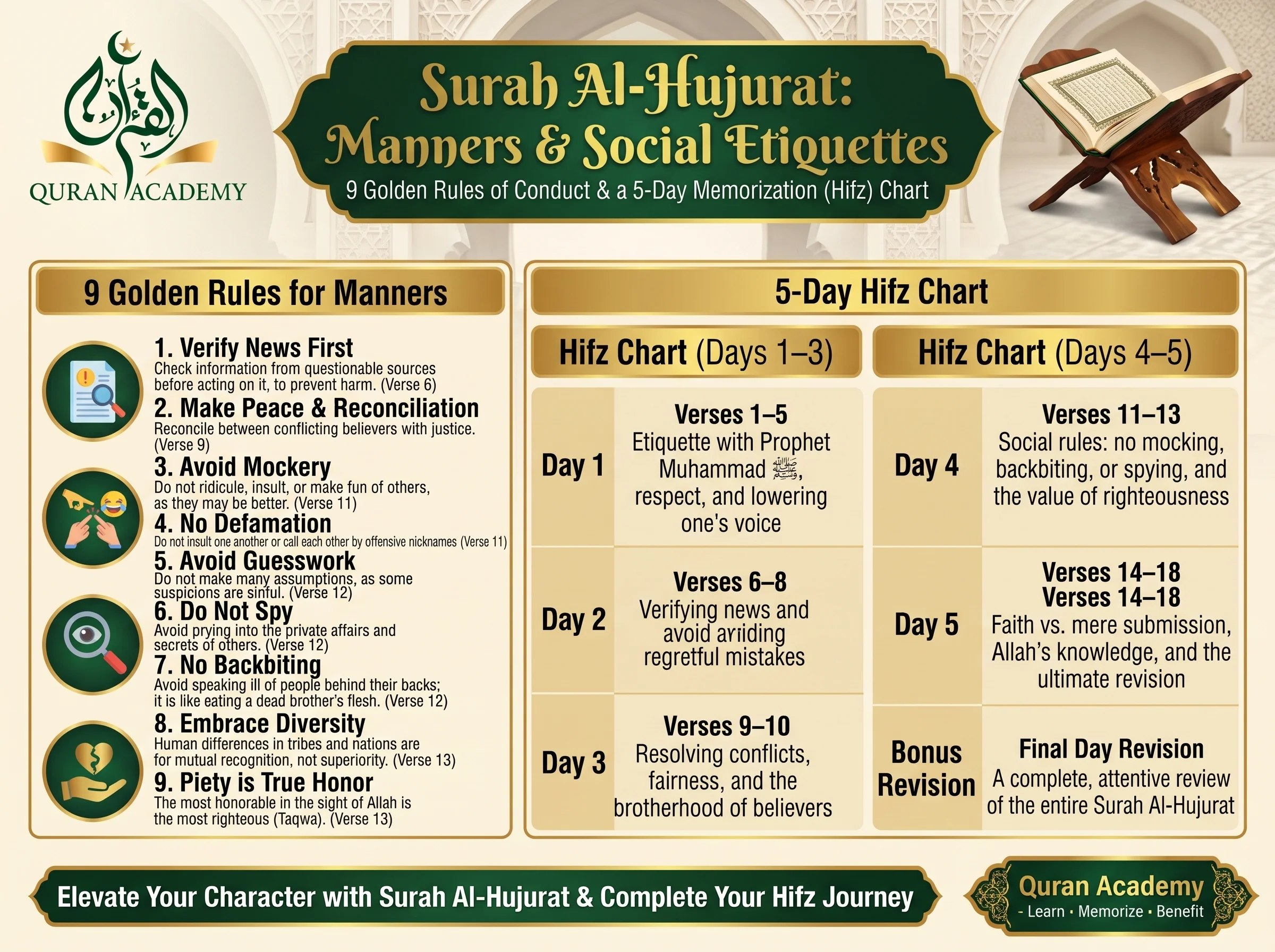
Mastering Surah Al Hujurat lessons and manners gives every Muslim family a complete Divine charter for speech, brotherhood, digital media ethics, and inner sincerity. Located in Juz 26 across just 2.5 pages (Pages 515 to 517, containing 18 Madinan verses), Surah Al-Hujurat (Chapter 49 — The Private Chambers) is famously titled by classical scholars "Suratul-Akhlaq wal-Adab" (The Chapter of Manners and Etiquette) because it structures 9 golden social rules around 5 direct calls of يَا أَيُّهَا الَّذِينَ آمَنُوا (O you who have believed!) and 1 universal call to all humanity (يَا أَيُّهَا النَّاسُ — 49:13). In our 1-on-1 Online Quran Memorization (Hifz) Program, children and adults memorize all 18 verses in just 5 days by learning half a page per day!
- The "5 + 1 Calls" Memory Architecture: Memorizing Surah Al-Hujurat is effortless when you anchor its 18 verses to the 5 calls to Believers (v. 1, 2, 6, 11, 12) and the 1 call to Mankind (v. 13).
- The Antidote to Social Media Rumors & Bullying: Establishes the law of verifying news (Fatabayyanoo — 49:6) and forbids mockery, offensive nicknames, bad assumptions, spying, and backbiting (49:11–12).
- Famous Tajweed Exception in Verse 11 (بِئْسَ الِاسْمُ): Features the unique vowel-transfer rule in Hafs 'an 'Asim where Bi'sa + Al-Ismu is read smoothly as Bi'sa-lismu!
- Opening of Hizb Al-Mufassal: According to the majority of scholars, Surah Al-Hujurat (or Surah Qaf right after it) marks the start of the final, oft-recited Mufassal section of the Mushaf.
Imagine what our homes, schools, WhatsApp groups, and communities would look like if every adult and teenager lived by just two and a half pages of the Quran: no forwarding unverified rumors, no mocking or calling classmates hurtful nicknames, no toxic suspicion inside marriages, and no judging people by their skin color, tribe, or accent!
That exact vision is why Allah Almighty revealed Surah Al-Hujurat (سُورَةُ الْحُجُرَات — Chapter 49) in Madinah in the 9th year after the Hijrah (the "Year of Delegations" — 'Aam al-Wufood). Just as we explored the 10 personal character commandments in our Surah Luqman Parenting Advice Guide (31:12–19), Surah Al-Hujurat is listed at the very top of our Most Important Surahs to Start Learning Tafseer With because it builds the social ethics of a Muslim household. Yet when students memorize Pages 515 to 517, they often face two challenges: first, keeping the 5 occurrences of يَا أَيُّهَا الَّذِينَ آمَنُوا in exact sequence; second, pronouncing the unique Tajweed rule on بِئْسَ الِاسْمُ الْفُسُوقُ in Verse 11. Below, we solve both and give you a 5-Day Memorization Plan.
- The "5 + 1 Calls" Architecture: Why Surah Al-Hujurat Is So Easy to Memorize
- Master Breakdown: The 9 Golden Manners of a Muslim Home in Surah Al-Hujurat
- Verses 14–18 Tafseer: The Difference Between Outward "Islam" and Deep "Iman"
- The 5-Day Surah Al-Hujurat Memorization Plan (Page-by-Page & Verse-by-Verse)
- 5 Essential Tajweed Landmarks in Surah Al-Hujurat (How to Read "Bi'sa-lismu" in 49:11!)
- Frequently Asked Questions (FAQs)
1. The "5 + 1 Calls" Architecture: Why Surah Al-Hujurat Is So Easy to Memorize
When you open Surah Al-Hujurat on Page 515 of our Online Uthmani Quran Explorer, you immediately notice a visual pattern that serves as a built-in memory roadmap. In Sahih Muslim and classical Tafseer (which we cover in our Complete Quran Tafseer Guide), Abdullah ibn Mas'ud (may Allah be pleased with him) advised: "Whenever you hear Allah say يَا أَيُّهَا الَّذِينَ آمَنُوا (O you who have believed), lend it your full ear—for it is either a good that He is commanding you to do, or an evil that He is forbidding you from!"
In Surah Al-Hujurat, Allah addresses the believers with يَا أَيُّهَا الَّذِينَ آمَنُوا five times—moving step by step from our etiquette with Allah and His Messenger (ﷺ) to our etiquette with one another—before addressing all of humanity with يَا أَيُّهَا النَّاسُ once in Verse 13:
Anas ibn Malik (may Allah be pleased with him) reported that when Verse 2 of Surah Al-Hujurat was revealed—forbidding believers from raising their voices above the voice of the Prophet (ﷺ) lest their deeds be rendered vain while they do not perceive it—Thabit ibn Qays (RA), who naturally had a loud voice, sat in his house weeping and said: "I am from the people of the Fire!" When the Prophet (ﷺ) heard of this, he sent word to him with the glad tidings:
"Indeed, you are not from the people of the Fire; rather, you will live in praise, be martyred, and enter Paradise! (إِنَّكَ لَسْتَ مِنْ أَهْلِ النَّارِ، وَلَكِنَّكَ مِنْ أَهْلِ الْجَنَّةِ)"
2. Master Breakdown: The 9 Golden Manners of a Muslim Home in Surah Al-Hujurat
When we teach character education to children and teens in our Comprehensive Islamic Studies Course (and reward their weekly progress using our Printable Kids Quran Star Chart), we use this 9-Rule Charter from Verses 1 to 13:
| Call # & Verse | Golden Manner | Arabic Anchor Phrase | How to Practice It in Your Home Today |
|---|---|---|---|
| Call #1 (49:1) |
1. Putting Quran & Sunnah First | لَا تُقَدِّمُوا بَيْنَ يَدَيِ اللَّهِ وَرَسُولِهِ | Never put personal opinions, cultural habits, or desires ahead of the clear guidance of Allah and His Messenger (ﷺ). |
| Call #2 (49:2–5) |
2. Respectful Voice & Privacy | لَا تَرْفَعُوا أَصْوَاتَكُمْ ... يَغُضُّونَ أَصْوَاتَهُمْ | Revere the Prophet's Sunnah with a calm voice, respect family privacy, and knock gently rather than shouting from outside rooms (Al-Hujurat). |
| Call #3a (49:6–8) |
3. Verifying News (Tabayyun) | إِن جَاءَكُمْ فَاسِقٌ بِنَبَإٍ فَتَبَيَّنُوا | Never forward unverified rumors on social media or react to hearsay before verifying the truth—lest you harm an innocent person and regret it! |
| Call #3b (49:9–10) |
4. Peacemaking in Brotherhood | إِنَّمَا الْمُؤْمِنُونَ إِخْوَةٌ فَأَصْلِحُوا | The believers are nothing less than brothers and sisters; reconcile immediately between siblings, spouses, or neighbors with complete fairness (Al-Muqsiteen). |
| Call #4a (49:11a) |
5. Zero Mockery or Belittling | لَا يَسْخَرْ قَوْمٌ مِّن قَوْمٍ | Forbids mocking or laughing at anyone (addressed to both men and women explicitly), for the person mocked may be far better in the sight of Allah! |
| Call #4b (49:11b) |
6. No Insults or Bad Nicknames | وَلَا تَلْمِزُوا أَنفُسَكُمْ وَلَا تَنَابَزُوا بِالْأَلْقَابِ | Notice the phrase "Do not insult YOURSELVES"—because insulting a fellow believer is like cutting your own body! And never use offensive nicknames (Al-Alqaab). |
| Call #5a (49:12a) |
7. Avoiding Bad Suspicion & Spying | اجْتَنِبُوا كَثِيرًا مِّنَ الظَّنِّ ... وَلَا تَجَسَّسُوا | Guard your heart from assuming the worst about others (Su' adh-Dhann), and never snoop into people's private phones, homes, or hidden faults (Tajassus). |
| Call #5b (49:12b) |
8. Zero Backbiting (Gheebah) | وَلَا يَغْتَب بَّعْضُكُم بَعْضًا | Paints the most vivid deterrent in the Quran: speaking behind a believer's back is like eating the flesh of your own dead brother! |
| Call #6 (49:13) |
9. Universal Equality Through Taqwa | إِنَّ أَكْرَمَكُمْ عِندَ اللَّهِ أَتْقَاكُمْ | All humans come from one father and mother; nations and tribes exist to get to know one another (Li-ta'aarafoo), and the noblest in Allah's sight is the most God-conscious! |
3. Verses 14–18 Tafseer: The Difference Between Outward "Islam" and Deep "Iman"
After laying down the 9 social manners in Verses 1 to 13, how does Surah Al-Hujurat conclude on Page 517? Verses 14 to 18 address the inner sincerity of the heart when some newly converted desert Arabs (Al-A'raab) came to the Prophet (ﷺ) boasting that they had done him a favor by embracing Islam without fighting:
- 1. Outward Submission (Aslamnaa) vs. Deep Faith (Aamannaa — 49:14–15): Allah instructs them not to claim "We have achieved full Iman" yet, but rather to say أَسْلَمْنَا (We have submitted outwardly) until faith settles deeply into their hearts—defining true believers as those who believe in Allah and His Messenger without doubt and strive with their wealth and lives in Allah's cause.
- 2. Faith Is Allah's Gift to You, Never Your Favor Upon Allah (49:17–18): Whenever we pray, memorize Quran, or do a good deed, Verse 17 reminds us never to feel entitled; rather, بَلِ اللَّهُ يَمُنُّ عَلَيْكُمْ أَنْ هَدَاكُمْ لِلْإِيمَانِ—it is Allah Almighty who has conferred the ultimate favor upon us by guiding our hearts to faith!
Mastering the Qalqalah Echoes in "Bil-Alqaab" & "Ajr"
Surah Al-Hujurat features prominent Qalqalah (Echoing) letters (ق ط ب ج د)—such as the Jeem in أَجْرٌ (Ajْrun — 49:3) and اجْتَنِبُوا (Ijْtaniboo — 49:12), and the strong Qalqalah Kubra when stopping on the Baa of بِالْأَلْقَابِ (Bil-Alqaabْ — 49:11)! Watch Senior Instructor Ustadhah Yasmeen Gamal demonstrate on our Quran Academy YouTube Channel:
Struggling to perfect your Recitation?
Join hundreds of students mastering the Quran with our Verified Al-Azhar Graduates. We offer flexible 1-on-1 sessions tailored to your schedule.
Book a Free Evaluation Class →- Mid-Word vs. Stop Bounce: Hear how the subtle bounce on Ijْtaniboo differs from stopping on Bil-Alqaabْ.
- 1-on-1 Live Coaching: Audit your recitation of Surah Al-Hujurat with our Al-Azhar scholars!
4. Master Chart: The 5-Day Surah Al-Hujurat Memorization Plan (Half a Page Per Day)
In the standard 15-line Uthmani Mushaf, Surah Al-Hujurat spans just 37 lines across Pages 515, 516, and 517. By combining our 3x3 Quran Memorization Method and the Sabaq, Sabqi & Manzil Revision System for 15 minutes after Fajr, you can memorize all 18 verses in 5 days:
| Day # | Mushaf Page | Exact Verses | Calls & Thematic Anchors | Daily Revision Goal |
|---|---|---|---|---|
| Day 1 | Page 515 (Bottom Half) | Verses 1 – 4 (4 Ayahs) | Call #1 & Call #2: Not advancing ahead of Allah & His Messenger, lowering voices, & calling from behind Al-Hujurat. | Recite Verses 1–4 in Maghrib & Isha Salah. |
| Day 2 | Page 516 (Top & Mid) | Verses 5 – 8 (4 Ayahs) | Call #3a: Patience outside chambers, verifying news (Fatabayyanoo), & Allah endearing Iman to your hearts! | Link Verses 1 – 8 continuously. |
| Day 3 | Page 516 (Bottom) | Verses 9 – 11 (3 Ayahs) | Call #3b & Call #4: Reconciling brothers (Innamal-mu'minoona ikhwah), no mockery, & Bi'sa-lismu (v. 11)! | Recite Full Page 515 & 516 (Verses 1–11). |
| Day 4 | Page 517 (Top Half) | Verses 12 – 14 (3 Ayahs) | Call #5 & Call #6: Avoiding suspicion, spying, backbiting, universal equality (Atqaakum), & Qaalatil-A'raabu. | Review all 6 Calls (Verses 1–14) in sequence. |
| Day 5 🏆 | Page 517 (Bottom Half) | Verses 15 – 18 (4 Ayahs) | True believers' sincerity, faith as Allah's favor upon you, & Innallaaha ya'lamu ghaybas-samaawaati wal-ard! | Full 2.5-page audit of all 18 verses from memory! |
5. Five Essential Tajweed Landmarks in Surah Al-Hujurat (Including "Bi'sa-lismu" in 49:11!)
Just like Ishmam in Surah Yusuf (12:11), Verse 11 of Surah Al-Hujurat is one of the most famous test questions in any Online Quran Ijazah Exam! Review these five Tajweed rules from our 1-on-1 Online Tajweed Course and our Interactive Tajweed Encyclopedia:
- 1. How to Read "Bi'sal-Ismu Al-Fusuqu" (بِئْسَ الِاسْمُ الْفُسُوقُ — 49:11):
Why is there a Kasrah under the Laam in الِاسْمُ on Page 516? Because the word Ism begins with a silent السين (S-m) preceded by a Hamzatul-Wasl, and when preceded by the definite article Al-, two silent letters meet (the Laam Sakinah and the Seen Sakinah). Therefore, the Laam is given a Kasrah (لِ)!
• When reading continuously (Wasl — Normal Case): You connect بِئْسَ directly into the Laam with Kasrah and read it smoothly as: بِئْسَ لِسْمُ الْفُسُوقُ (Bi'sa-lismul-fusooq)!
• If starting directly on the word "الِاسْمُ" (Ibtida' — Testing Question in Ijazah Exams): You may start either with the Hamzatul-Wasl carrying a Fatha followed by the Laam with Kasrah (أَلِسْمُ = A-lismu), OR drop the Al- and start directly with the Laam carrying a Kasrah (لِسْمُ = Lismu)! - 2. Idgham Mutajanisayn (Homogeneous Merge) in "Wa laa Yaghtab Ba'dukum" (وَلَا يَغْتَب بَّعْضُكُم — 49:12): Look at the end of the verb يَغْتَب (Yaghtab)—there is no Sukoon on the Baa! Instead, the Baa Sakinah of Yaghtab merges 100% into the Baa of بَّعْضُكُم (Idgham Mutamathilayn Sagheer without Qalqalah!).
- 3. 4-to-5 Beat Madd Ja'iz Munfasil on All 6 "Yaa Ayyuhaa..." Calls: Following our Rules of Madd in Tajweed, stretch the Alif in يَا أَيُّهَا (Yaaaa-ayyuhaa) for a steady 4 or 5 counts across all six calls in the Surah.
- 4. Heavy vs. Light Letters & Noon/Meem Rules: Using our Heavy & Light Letters Guide, Noon Sakinah & Tanween Guide, and Meem Sakinah Rules, keep the ظّ (Dhaa') heavy and interdental in الظَّنِّ (49:12), hold the 2-beat nasal Ghunnah on الظَّنِّ إِنَّ بَعْضَ الظَّنِّ إِثْمٌ, and apply crisp Iqlab on بَعْضُكُم بَعْضًا!
- 5. Observing the Waqf Lazim (مـ) & Waqf Signs: Using our Rules of Waqf in the Quran and Sifaat al-Huruf Guide, pause cleanly at the clause markers in the long ethical verses (v. 6, 9, 11, 12) so every commandment stands out with clarity. Test your Tajweed skills right now on our Free 3-Minute Interactive Tajweed Quiz!
Once you finish memorizing Surah Al-Hujurat in 5 days (notice how many words in this Surah come directly from our Top 50 High-Frequency Quranic Arabic Words!), pair it in your family curriculum with our 15-Day Surah Ya-Sin Plan, our 10-Day Surah Ar-Rahman Plan, our 12-Day Surah Al-Waqi'ah Schedule, our 5-Minute Ayatul Kursi Guide, our Last 2 Verses of Surah Al-Baqarah Guide, our 3-Day Kids Guide to the 3 Quls, and our Surah Ad-Duha & Ash-Sharh Guide! Whether you are a busy mother following our 15-Minute Daily Quran Routine, an adult over 40 following our Adult Hifz Roadmap with our Al-Azhar Certified Tutors, or a parent enrolling your child in our 1-on-1 Kids Quran Classes, see how families across the US, UK, Canada, and Australia rate our teachers on our Verified Student & Parent Reviews Page!
6. Frequently Asked Questions (FAQs) About Surah Al-Hujurat Lessons & Manners
1. How many verses and pages are in Surah Al-Hujurat, and which Juz is it in?
Surah Al-Hujurat (Chapter 49) is a Madinan Surah located in Juz 26 (marking the opening of the Hizb Al-Mufassal section of the Quran). It contains 18 verses (Ayahs) spanning just 2.5 pages (from the middle of Page 515 to the bottom of Page 517) in the standard 15-line Uthmani Mushaf.
2. Why is Surah Al-Hujurat called the Surah of Manners (Suratul-Akhlaq wal-Adab)?
Classical scholars called Surah Al-Hujurat the Surah of Manners because it contains 5 direct calls to the believers (يَا أَيُّهَا الَّذِينَ آمَنُوا) that establish 9 comprehensive ethical rules—governing respect for the Prophet (ﷺ), verifying news, peacemaking, avoiding mockery, offensive nicknames, bad suspicion, spying, backbiting, and racial pride.
3. What is the special Tajweed rule in "Bi'sal-Ismu" in Surah Al-Hujurat verse 11?
In Surah Al-Hujurat (49:11), the phrase بِئْسَ الِاسْمُ الْفُسُوقُ بَعْدَ الْإِيمَانِ features a unique rule in Hafs 'an 'Asim: when connecting Bi'sa to Al-Ismu, the Hamzatul-Wasl drops and the Laam of Al-Ismu takes a Kasrah to prevent two silent letters from meeting, so it is pronounced smoothly as "Bi'sa-lismu"!
4. How long does it take to memorize Surah Al-Hujurat easily?
Because Surah Al-Hujurat is only 2.5 pages long (18 verses) and is organized around 5 clear calls of Yaa ayyuhal-ladheena aamanoo plus 1 universal call of Yaa ayyuhan-naas, you or your child can memorize the entire Surah in just 5 days by learning half a page (7 to 8 lines) per day.
5. What does "Al-Hujurat" mean, and why was Verse 4 revealed?
Al-Hujurat means "The Private Chambers / Inner Apartments" (plural of Hujrah), referring to the modest rooms of the Mothers of the Believers (wives of the Prophet, ﷺ). Verses 4 and 5 were revealed when a delegation from Banu Tamim called out loudly to the Prophet (ﷺ) from behind his private chambers at midday, teaching believers the etiquette of patience and lowered voices.
Memorize & Live Surah Al-Hujurat With a Certified Al-Azhar Scholar!
Want to master all 18 verses of Surah Al-Hujurat—including the special rule of Bi'sa-lismu—and build a home rooted in Quranic character? Book your free 1-on-1 trial session with our male or female Al-Azhar scholars today!
Book Your Free 1-on-1 Quran Trial Class →