
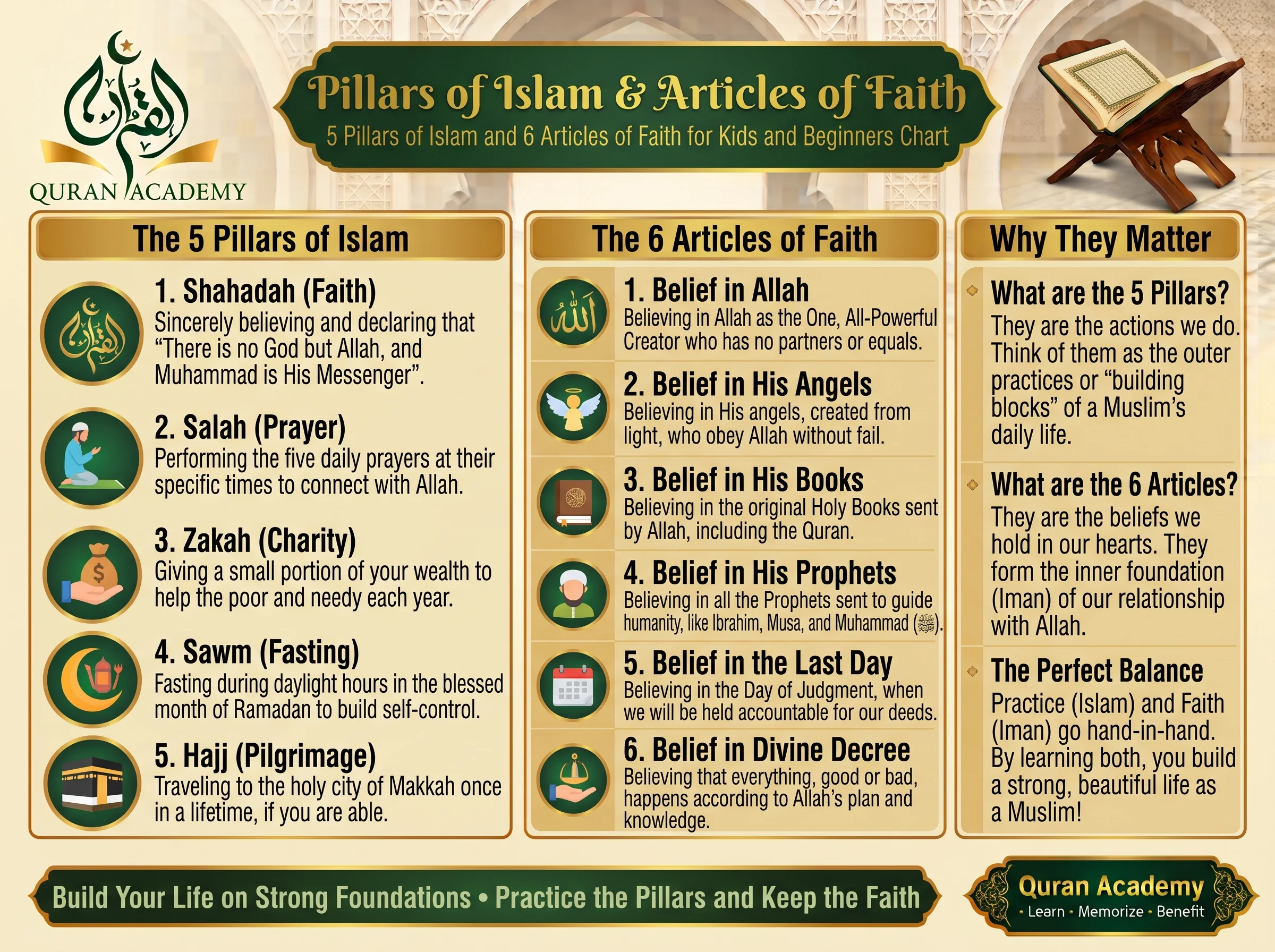
✦ Quick Answer & Key Takeaways: 5 Pillars of Islam & 6 Articles of Faith
Understanding the 5 Pillars of Islam and 6 Articles of Faith gives every Muslim child, parent, and new revert the complete architectural blueprint of the Islamic way of life. Taught directly by Angel Jibreel (AS) and Prophet Muhammad (ﷺ) in the famous Hadith of Jibreel (Sahih Muslim 8), the 5 Pillars of Islam (أَرْكَانُ الْإِسْلَامِ) are the outward physical acts of worship (Testimony of Faith, Daily Prayer, Obligatory Charity, Fasting Ramadan, and Pilgrimage to Makkah), whereas the 6 Articles of Faith (أَرْكَانُ الْإِيمَانِ) are the inward spiritual convictions of the heart (Belief in Allah, His Angels, His Books, His Messengers, the Last Day, and Divine Decree/Qadar)—crowned by the third and highest station: Al-Ihsan (Spiritual Excellence). In our 1-on-1 Online Islamic Studies Course for Kids & Beginners, students master all 11 pillars with their Quranic proofs and practical daily habits!
- The "Tree of Faith" Visual Rule for Kids: Iman (6 Articles) is the hidden root system in the heart; Islam (5 Pillars) is the visible trunk and branches; and Ihsan is the life-giving sunlight and fruit!
- The 5 Pillars of Islam (Sahih al-Bukhari 8): (1) Shahadah, (2) Salah [5x daily], (3) Zakat [2.5% annual charity], (4) Sawm [Ramadan fasting], and (5) Hajj [once in a lifetime if able].
- The 6 Articles of Faith (Sahih Muslim 8 & Quran 2:285): Belief in (1) Allah, (2) Mala'ikah [Angels], (3) Kutub [Scriptures], (4) Rusul [Messengers], (5) Yawm al-Akhir [Last Day], and (6) Al-Qadar [Divine Decree].
- Why Hadith Jibreel Is Called "Umm As-Sunnah": Just as Surah Al-Fatihah summarizes the entire Quran, Hadith Jibreel summarizes the entire Sunnah in a single conversation!
Ask a seven-year-old Muslim child—or even many adults who grew up in Muslim households—"What are the Five Pillars of Islam?" and most will gladly count them on their five fingers. But follow up with a second question: "Now what are the Six Articles of Faith (Arkan al-Iman), and how are they different from the Five Pillars of Islam?" and many people pause in hesitation or mix the two lists together!
Just as we clarified the difference between outward submission (Aslamnaa) and deep heart conviction (Aamannaa) in our Surah Al-Hujurat Manners & Faith Guide (49:14–15), understanding how Islam (Action), Iman (Belief), and Ihsan (Mindfulness of Allah) fit together transforms how a believer prays, gives charity, faces life trials, and raises their children. Without strong roots of Iman in the heart, outward acts of worship become mechanical routines; and without the trunk and branches of the 5 Pillars of Islam, faith in the heart remains unprotected. Below, we unpack the famous Hadith of Jibreel (AS), provide complete master tables for both the 5 Pillars of Islam and the 6 Articles of Faith with their Quranic verses, and share fun memory games for kids and beginners.
- The Story of Hadith Jibreel (Sahih Muslim 8): How Angel Jibreel Taught the 3 Levels of Religion
- Part 1: The 5 Pillars of Islam (Arkan al-Islam) — Complete Breakdown & Quranic Verses
- Part 2: The 6 Articles of Faith (Arkan al-Iman) — Complete Breakdown & Quranic Proofs
- Part 3: What Is "Al-Ihsan"? (The Tree of Faith Analogy Comparing Islam, Iman & Ihsan)
- How to Teach the 5 Pillars & 6 Articles of Faith to Kids (Finger-Counting & Memory Games!)
- Frequently Asked Questions (FAQs)
1. The Story of Hadith Jibreel (Sahih Muslim 8): How Angel Jibreel Taught the 3 Levels of Religion
Towards the end of the Prophet Muhammad's (ﷺ) life in Madinah, while he was sitting with his Companions, a remarkable visitor appeared: a man dressed in exceedingly white garments with jet-black hair, showing zero traces of travel dust, whom none of the Companions recognized. Sitting knee-to-knee in front of the Prophet (ﷺ), this visitor asked four foundational questions: (1) "Tell me about Islam," (2) "Tell me about Iman," (3) "Tell me about Ihsan," and (4) "Tell me about the Hour and its signs."
'Umar ibn Al-Khattab (may Allah be pleased with him) narrated that after the mysterious questioner departed, the Messenger of Allah (peace be upon him) asked him: "O 'Umar, do you know who the questioner was?" 'Umar replied: "Allah and His Messenger know best." The Prophet (ﷺ) said:
"فَإِنَّهُ جِبْرِيلُ أَتَاكُمْ يُعَلِّمُكُمْ دِينَكُمْ"
("Indeed, that was Angel Jibreel—he came to you in order to teach you your religion [Deenakum]!")
And in Sahih al-Bukhari (8) and Sahih Muslim (16), 'Abdullah ibn 'Umar (RA) reported that the Prophet (ﷺ) said: "Islam is built upon five pillars (بُنِيَ الْإِسْلَامُ عَلَىٰ خَمْسٍ)..."
2. Part 1: The 5 Pillars of Islam (Arkan al-Islam) — Complete Breakdown & Quranic Verses
Just as a grand house stands firm upon a central pillar and four corner columns, a Muslim's outward life of submission to Allah stands upon the Five Pillars of Islam (أَرْكَانُ الْإِسْلَامِ الْخَمْسَة). You can look up every Quranic verse below in our Online Uthmani Quran Explorer (and check their Fiqh terms in our Interactive Tajweed & Islamic Encyclopedia):
| Pillar # & Arabic Name | Type of Worship | Core Requirement & Frequency | Key Quranic Verse & Spiritual Purpose |
|---|---|---|---|
| 1. Ash-Shahadatan (الشَّهَادَتَان • Testimony of Faith) |
Heart + Tongue | Bearing witness that none is worthy of worship except Allah (Laa ilaaha illallaah) and that Muhammad (ﷺ) is the Messenger of Allah. | Surah Muhammad 47:19 & Al-Fath 48:29: Frees the human heart from servitude to creation and anchors all actions on following the Prophetic Sunnah. |
| 2. Iqamus-Salah (إِقَامُ الصَّلَاةِ • Daily Prayer) |
Physical Body + Soul | 5 Obligatory Prayers Every Day: Fajr (2), Dhuhr (4), Asr (4), Maghrib (3), and Isha (4)—performed with Wudu facing the Qiblah. | Surah Al-'Ankabut 29:45 & An-Nisa 4:103: The direct daily meeting between the servant and Allah; restrains from immorality and wrongdoing. |
| 3. Ita'uz-Zakat (إِيتَاءُ الزَّكَاةِ • Almsgiving) |
Financial Worship | Once per lunar year (2.5%) on savings, gold/silver, and trade goods that exceed the minimum threshold (Nisab) for a full lunar year (Hawl). | Surah At-Tawbah 9:103 & 9:60: Purifies the giver's heart from greed, blesses remaining wealth, and supports the poor and needy. |
| 4. Sawmu Ramadan (صَوْمُ رَمَضَانَ • Fasting) |
Physical Restraint | 1 Month Every Year (9th Lunar Month): Abstaining from food, drink, and marital relations from true dawn (Fajr) until sunset (Maghrib). | Surah Al-Baqarah 2:183–185: Celebrates the month in which the Quran was revealed and builds deep God-consciousness (La'allakum Tattaqoon)! |
| 5. Hajjul-Bayt (حَجُّ الْبَيْتِ • Pilgrimage) |
Body + Wealth Combined | Once in a Lifetime (in Dhul-Hijjah): Obligatory only upon adult Muslims who are physically and financially able (Man istataa'a ilayhi sabeelaa). | Surah Al 'Imran 3:97 & Al-Hajj 22:27: Unites millions of believers in simple white garments around the Ka'bah—returning as pure as a newborn! |
3. Part 2: The 6 Articles of Faith (Arkan al-Iman) — Complete Breakdown & Quranic Proofs
While the 5 Pillars of Islam govern our visible actions, the 6 Articles of Faith (أَرْكَانُ الْإِيمَانِ السِّتَّة) are the unseen truths that fill the believer's heart with certainty, purpose, and peace. As we saw in our Last 2 Verses of Surah Al-Baqarah Guide (2:285) and our Complete Quran Tafseer Guide, Allah Almighty summarizes these pillars in Surah Al-Baqarah (2:177 & 2:285), Surah An-Nisa (4:136), and Surah Al-Qamar (54:49):
| Article # & Arabic Name | What a Believer Affirms in the Heart | Key Examples & Details to Teach Kids | How It Transforms Daily Life |
|---|---|---|---|
| 1. Belief in Allah (الْإِيمَانُ بِاللَّهِ) |
Affirming Allah's existence, absolute Lordship (Ruboobiyyah), exclusive right to worship (Uloohiyyah), and perfection in His Names and Attributes (Al-Asma' was-Sifat). | Summarized in Ayatul Kursi (2:255) and Surah Al-Ikhlas (112). | Fills the heart with love, reliance (Tawakkul), and security—knowing the Creator of the universe hears every prayer. |
| 2. Belief in His Angels (وَمَلَائِكَتِهِ) |
Honored creations made of light who never disobey Allah and carry out His commands across the cosmos. | Jibreel (Revelation), Mika'il (Rain/Provision), Israfil (Trumpet), Malakul-Mawt, & the Noble Scribes (Kiraman Katibeen). | Inspires modesty and good speech, knowing noble angels record every word and gather at circles of Quran! |
| 3. Belief in His Books (وَكُتُبِهِ) |
Believing in all original revelations sent down by Allah to guide humanity, culminating in the final, preserved Book. | Suhuf (Ibrahim), Tawrah (Musa), Zabur (Dawud), Injeel ('Isa), and the final seal: Al-Quran Al-Kareem (Muhammad ﷺ). | Motivates us to read, understand, and memorize the Quran as Allah's direct, unaltered speech to us today. |
| 4. Belief in His Messengers (وَرُسُلِهِ) |
Loving and honoring all Prophets sent by Allah without discriminating against any of them (2:285), while following the final Messenger (ﷺ). | 25 Prophets named in the Quran—led by the 5 Ulul-'Azm (Arch-Prophets of Resolve): Nuh, Ibrahim, Musa, 'Isa, and Muhammad (ﷺ). | Gives us real-life role models of patience—as seen in our Surah Yusuf and Surah Maryam guides! |
| 5. Belief in the Last Day (وَالْيَوْمِ الْآخِرِ) |
Certitude in life after death, the trial of the grave, Resurrection, the Scales (Al-Mizan), the Bridge (As-Sirat), Paradise, and Hellfire. | Vividly depicted in Surah Al-Waqi'ah, Surah Ar-Rahman, and Juz Amma. | Gives ultimate meaning and justice to life—knowing not even a mustard seed of good goes unrewarded (Surah Luqman 31:16)! |
| 6. Belief in Divine Decree (وَبِالْقَدَرِ خَيْرِهِ وَشَرِّهِ) |
Believing that everything happens by Allah's infinite Knowledge, Writing in Al-Lawh Al-Mahfudh, Will, and Creation—while humans have real choice and responsibility. | Guided by Salat Al-Istikharah (taking action while trusting Allah's decree!). | Cures regret over the past and anxiety over the future—bringing gratitude in ease and patience in trials! |
4. Part 3: What Is "Al-Ihsan"? (The 3 Concentric Circles & Tree of Faith Analogy)
In the Hadith of Jibreel (Sahih Muslim 8), after defining the 5 Pillars of Islam and the 6 Articles of Iman, Angel Jibreel asked: "Tell me about Al-Ihsan (الْإِحْسَان — Spiritual Excellence / Perfection)!" The Prophet (ﷺ) answered in one of the most profound sentences in human language:
أَنْ تَعْبُدَ اللَّهَ كَأَنَّكَ تَرَاهُ، فَإِنْ لَمْ تَكُنْ تَرَاهُ فَإِنَّهُ يَرَاكَ
("It is to worship Allah as though you see Him; and even though you cannot see Him, indeed He sees you!")
How do you explain the relationship between Islam, Iman, and Ihsan to a child or beginner? Use the "Tree of Faith" Analogy:
Struggling to perfect your Recitation?
Join hundreds of students mastering the Quran with our Verified Al-Azhar Graduates. We offer flexible 1-on-1 sessions tailored to your schedule.
Book a Free Evaluation Class →- 🌱 1. The Roots Under the Soil = The 6 Articles of Iman (Belief in the Heart): Just as a tree cannot stand without deep, unseen roots beneath the ground, no outward act of worship is accepted without the 6 Articles of Faith anchored in the heart.
- 🌳 2. The Trunk & Branches Above Ground = The 5 Pillars of Islam (Outward Actions): When the roots of Iman are alive in your chest, they naturally grow upward into the visible trunk and branches of the Shahadah, the 5 daily prayers, Zakat, fasting Ramadan, and Hajj!
- 🍎 3. The Sweet Fruit & Sunlight = Al-Ihsan (Presence of Heart & Khushu'): What makes one person's prayer and Quran recitation radiant and life-changing while another's feels dry? Ihsan! Worshipping Allah with longing and love (as though you see His beauty and majesty) and with reverent mindfulness (knowing He sees you in private and public)!
Pronouncing the Qalqalah Bounce in "'Abْduhu" & "Al-Qadْr"
In the very first Pillar of Islam—وَأَشْهَدُ أَنَّ مُحَمَّدًا عَبْدُهُ وَرَسُولُهُ—the word عَبْدُهُ ('Abْduhu — His servant) features a mid-word Qalqalah Sughra on the Baa Sakinah (بْ)! Watch Senior Instructor Ustadhah Yasmeen Gamal demonstrate on our Quran Academy YouTube Channel:
- Crisp Shahadah Pronunciation: Keep the Baa in 'Abْduhu voiced and gently bounced.
- 1-on-1 Kids & Beginners Classes: Learn Aqeedah, Fiqh, and Tajweed live with Al-Azhar scholars!
5. How to Teach the 5 Pillars & 6 Articles of Faith to Kids (Finger-Counting & Memory Games!)
As we share in our parenting guides on What to Do When Your Child Says Quran Class Is Boring, Islamic Reward Charts That Motivate Kids, and Arabic Numbers, Colors & Shapes for Kids, children aged 4 to 10 memorize the 11 pillars in minutes when you use these three interactive games:
- 1. The "Right Hand = 5 Pillars of Islam" Finger Game:
Let your child hold up their right hand and assign each of the 5 fingers to one Pillar of Islam:
• ☝️ Index Finger (Pointer Finger): Ash-Shahadah—because we raise our index finger during the Tashahhud!
• 👍 Thumb (Strongest Daily Anchor): As-Salah—our 5 daily prayers!
• 🖐️ Middle Finger (Sharing With Others): Az-Zakat—giving charity to the poor!
• 💍 Ring Finger (Precious Month): Sawmu Ramadan—fasting the blessed month of the Quran!
• 🤙 Little Finger (Once-in-a-Lifetime Journey): Al-Hajj—visiting the Ka'bah in Makkah! - 2. The "Verse 285 of Surah Al-Baqarah" Song for the 6 Articles of Faith:
Because your child already recites the concluding verses of Surah Al-Baqarah at bedtime (where Verse 285 says: كُلٌّ آمَنَ بِاللَّهِ وَمَلَائِكَتِهِ وَكُتُبِهِ وَرُسُلِهِ—listing Articles 1, 2, 3, and 4 in exact order!), teach them that they already know the first 4 Articles of Faith in Arabic from Page 49 of the Mushaf—and only need to add #5 (Wal-Yawmil-Aakhir) and #6 (Wa bil-Qadari khayrihi wa sharrihi)! - 3. Pronouncing the Shahadah & Daily Prayers With Proper Tajweed:
In our 1-on-1 Online Kids Quran & Islamic Studies Classes and our 1-on-1 Online Tajweed Course, we teach students how to apply our Makharij al-Huruf Guide, Sifaat al-Huruf Guide, Heavy & Light Letters Guide (keeping the Laam of illa-llaah heavy after Fatha and light in Billaahi after Kasrah!), Rules of Madd, Noon Sakinah Rules (merging An-laa without Ghunnah!), and Meem Sakinah Rules (test your Tajweed ear on our Free 3-Minute Tajweed Quiz!).
Once you and your children have mastered the 5 Pillars of Islam and the 6 Articles of Faith (recognizing core vocabulary from our Top 50 High-Frequency Quranic Arabic Words!), continue building your family's daily practice with our Morning & Evening Adhkar Authentic List, our 40 Rabbana Duas Guide, our Sujood As-Sahw Guide, our Salat Al-Janazah Guide, our 15-Day Surah Ya-Sin Plan, our Surah Ad-Duha & Ash-Sharh Guide, and our Friday Fajr Surahs Guide in our Online Hifz Program (using our Smart Hifz Planner) with our Al-Azhar Certified Male & Female Tutors! Read how parents and adult beginners across the US, UK, Canada, and Australia rate our teachers on our Verified Student & Parent Reviews Page.
6. Frequently Asked Questions (FAQs) About the 5 Pillars of Islam & 6 Articles of Faith
1. What is the main difference between the 5 Pillars of Islam and the 6 Articles of Faith?
The 5 Pillars of Islam (Arkan al-Islam) are the outward physical acts of worship performed with the tongue, body, and wealth (Shahadah, Salah, Zakat, Sawm, and Hajj). The 6 Articles of Faith (Arkan al-Iman) are the inward spiritual convictions held firmly in the heart (belief in Allah, His Angels, His Books, His Messengers, the Last Day, and Divine Decree/Qadar).
2. What are the 5 Pillars of Islam in order?
According to Sahih al-Bukhari (8) and Sahih Muslim (16), the 5 Pillars of Islam in order are: (1) Ash-Shahadatan (Testimony of Faith that there is no deity worthy of worship except Allah and Muhammad is the Messenger of Allah), (2) Iqamus-Salah (Establishing the 5 daily prayers), (3) Ita'uz-Zakat (Giving obligatory charity), (4) Sawmu Ramadan (Fasting the month of Ramadan), and (5) Hajjul-Bayt (Pilgrimage to the Sacred House in Makkah for those who are able).
3. What are the 6 Articles of Faith (Arkan al-Iman) in Islam?
As defined in the Hadith of Jibreel (Sahih Muslim 8) and Surah An-Nisa (4:136), the 6 Articles of Faith are: (1) Belief in Allah, (2) Belief in His Angels (Mala'ikah), (3) Belief in His Revealed Scriptures (Kutub), (4) Belief in His Messengers (Rusul), (5) Belief in the Last Day (Yawm al-Akhir), and (6) Belief in Divine Decree (Al-Qadar), both its good and its testing aspects.
4. What is the Hadith of Jibreel and why is it called "Umm as-Sunnah"?
Recorded in Sahih Muslim (8) from 'Umar ibn Al-Khattab (RA), the Hadith of Jibreel narrates how Angel Jibreel (AS) came to Prophet Muhammad (ﷺ) in the form of a traveler in white garments to ask him about Islam, Iman, Ihsan, and the signs of the Hour. Scholars call it "Umm as-Sunnah" (The Mother of the Sunnah) because the entire religion of Islam is summarized within its three levels.
5. How can I explain the difference between Islam, Iman, and Ihsan to a young child?
Use the "Tree of Faith" analogy: the 6 Articles of Iman are the deep roots hidden under the soil in your heart; the 5 Pillars of Islam are the strong trunk and branches that everyone can see; and Ihsan (worshipping Allah as though you see Him, knowing He sees you) is the sweet fruit and sunlight that keeps the whole tree alive!
Build Unshakeable Faith & Quranic Love in Your Home!
Give your child or yourself structured 1-on-1 classes in Aqeedah, Fiqh, Seerah, Hadith, and Quranic Tajweed with certified male and female Al-Azhar scholars. Book your free trial session today!
Book Your Free 1-on-1 Trial Class →