
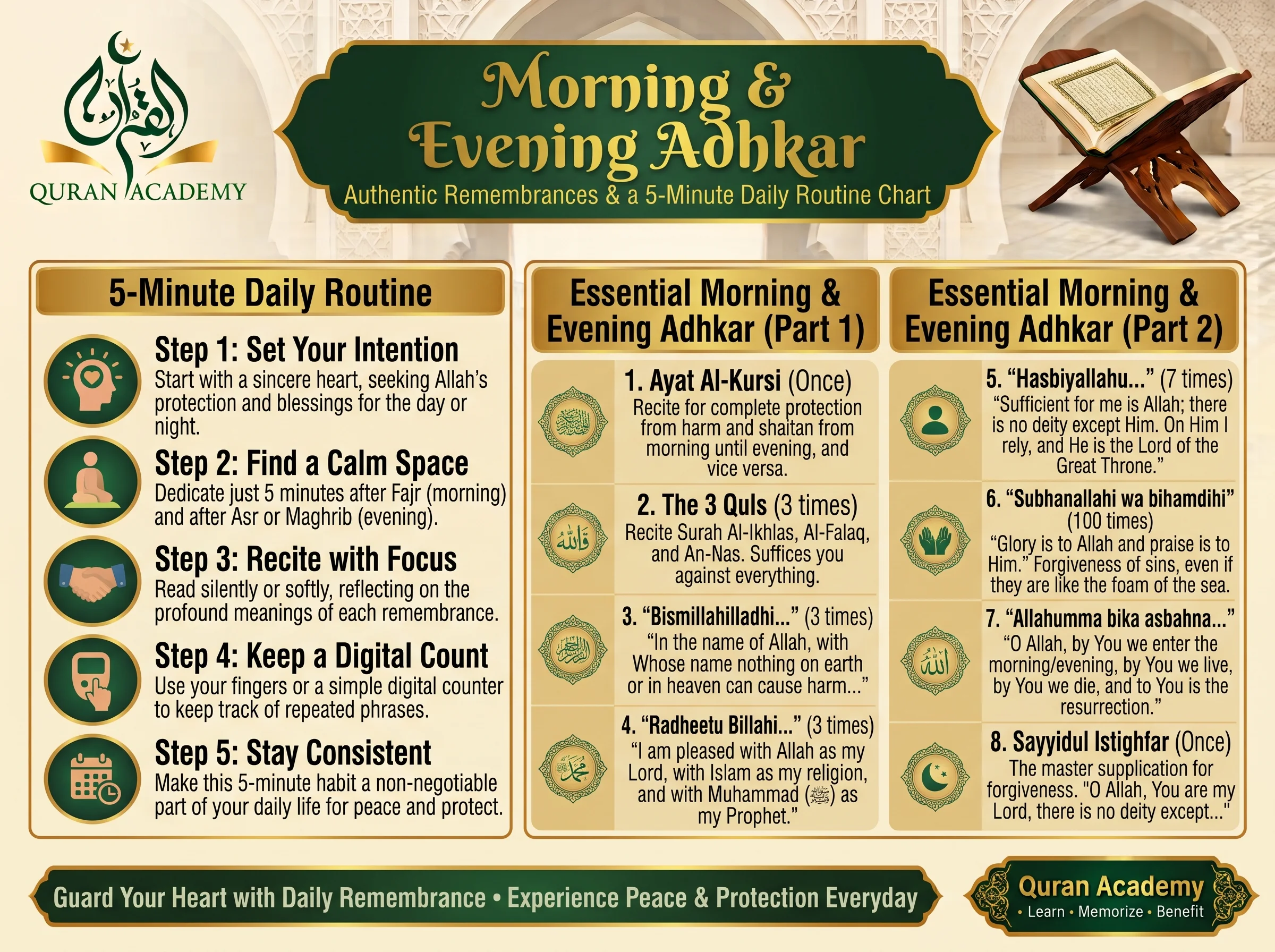
✦ Quick Answer & Key Takeaways: Morning and Evening Adhkar Authentic List
Practicing the morning and evening Adhkar authentic list (Adhkar As-Sabah wal-Masa') surrounds every believer and their home with a daily fortress of Divine protection, calm, and forgiveness. Rooted directly in the Quranic command to remember and glorify Allah at dawn and in the late afternoon (Surah Al-Ahzab 33:41–42 & Surah Qaf 50:39), the core Prophetic routine takes just 5 minutes twice a day: once in the morning window (from Fajr prayer until sunrise, or up to mid-morning) and once in the evening window (from Asr prayer until Maghrib sunset, or into the evening). In our 1-on-1 Online Islamic Studies & Daily Sunnah Course, both adults and children master the exact Arabic pronunciation, meanings, and Hadith virtues of the 10 essential daily Adhkar!
- The "5-Minute Core Shield" (When Short on Time): Recite (1) Ayatul Kursi [1x], (2) The 3 Quls [3x each], (3) Sayyidul-Istighfar [1x], (4) Bismillahil-ladhee laa yadurru... [3x], and (5) Hasbiyallaahu laa ilaaha illaa Huwa... [7x].
- Exact Golden Windows: Morning Adhkar are best recited immediately after Fajr Salah until sunrise; Evening Adhkar are best recited immediately after Asr Salah until sunset.
- The Morning vs. Evening Word Swap: In four daily supplications, you say Asbahnaa ("We have entered the morning") at dawn, and swap it to Amsaynaa ("We have entered the evening") in the afternoon!
- Guaranteed Jannah & Protection Promises: Reciting Sayyidul-Istighfar with conviction guarantees Paradise if you pass away that day or night (Sahih al-Bukhari 6306), while Bismillahil-ladhee laa yadurru... shields against sudden affliction (Sunan Abu Dawud 5088).
Think about how most modern mornings begin: before our feet even touch the floor, our hands reach for our phones to check messages, news alerts, and emails—flooding our chests with stress before we have spoken a single word to our Creator. By the time evening arrives, our mental battery is exhausted and inner peace feels out of reach.
Classical scholars like Imam Ibn al-Qayyim (in Al-Wabil As-Sayyib) famously compared the Morning and Evening Adhkar to a warrior's shield: the stronger your daily remembrance, the more protected your heart, family, and health remain throughout the day and night. Yet many Muslims struggle to stay consistent because pocket booklets often list 35 to 40 different supplications without clarifying which ones are the 100% authentic (Sahih) core essentials, how to swap the morning and evening words, or how to fit them into a 5-minute school-run or commute. Below, we give you the verified Top 10 Authentic Morning & Evening Adhkar Chart, the Morning-vs.-Evening word swap table, and a realistic family habit guide.
- Why Morning & Evening Adhkar Are Essential (Quranic Basis & Exact Best Times)
- Master Chart: The Top 10 Authentic Morning & Evening Adhkar (Count, Meaning & Reward)
- Deep Dive: Sayyidul-Istighfar & The 3 Protection Shields Every Believer Needs
- Comparison Table: The 4 "Morning vs. Evening" Word Swaps (Asbahnaa vs. Amsaynaa)
- How Busy Parents & Kids Can Build a 5-Minute Daily Adhkar Habit
- Frequently Asked Questions (FAQs)
1. Why Morning & Evening Adhkar Are Essential (Quranic Basis & Exact Best Times)
Across the Holy Quran—as we explore in our Complete Quran Tafseer Guide and our Interactive Tajweed & Islamic Encyclopedia—Allah Almighty repeatedly links emotional resilience to remembering Him at the two ends of the day: before sunrise (Qabla Tuloo'ish-Shams / Bukrah) and before sunset (Qabla Ghuroobihaa / 'Ashiyy). Here are the three daily windows established by scholars:
The prime golden window begins right after Fajr prayer and extends until sunrise. If you oversleep or get busy, the extended window remains open until mid-morning (Duha / before Dhuhr).
Because the Quran specifies "before the setting of the sun" (50:39), the prime golden window for Evening Adhkar is after Asr prayer until Maghrib! If missed before sunset, recite them after Maghrib into the evening.
Seal your night on the bed with The Last 2 Verses of Surah Al-Baqarah, Surah Al-Mulk, Ayatul Kursi, and cupping your palms for the 3 Quls!
2. Master Chart: The Top 10 Authentic Morning & Evening Adhkar (Count, Meaning & Reward)
You can look up the Quranic Surahs in our Online Uthmani Quran Explorer and verify every Hadith source below in our Online Hadith Explorer. Here is the complete 10-Item Authentic Checklist:
| # & Dhikr Name | Count | Opening Arabic / Transliteration Cue | Core Meaning & Authentic Hadith Promise |
|---|---|---|---|
| 1. Ayatul Kursi (Al-Baqarah 2:255) |
1x | اللَّهُ لَا إِلَٰهَ إِلَّا هُوَ الْحَيُّ الْقَيُّومُ... Allaahu laa ilaaha illaa Huwal-Hayyul-Qayyoom... |
The greatest verse in the Quran; protects the reciter from devils from morning until evening, and from evening until morning. |
| 2. The Three Quls (Surahs 112, 113, 114) |
3x Each | قُلْ هُوَ اللَّهُ أَحَدٌ • قُلْ أَعُوذُ بِرَبِّ الْفَلَقِ • قُلْ أَعُوذُ بِرَبِّ النَّاسِ | Sunan at-Tirmidhi 3575: Reciting all three 3x in the morning and evening suffices you against every harm (Takfeeka min kulli shay'). |
| 3. Sayyidul-Istighfar (Master Forgiveness) |
1x | اللَّهُمَّ أَنْتَ رَبِّي لَا إِلَٰهَ إِلَّا أَنْتَ، خَلَقْتَنِي وَأَنَا عَبْدُكَ... Allaahumma Anta Rabbee laa ilaaha illaa Ant... |
Sahih al-Bukhari 6306: Whoever says it with certainty in the morning or evening and passes away enters Jannah! |
| 4. Sudden Harm Shield (Bismillaahil-ladhee...) |
3x | بِسْمِ اللَّهِ الَّذِي لَا يَضُرُّ مَعَ اسْمِهِ شَيْءٌ فِي الْأَرْضِ وَلَا فِي السَّمَاءِ... | Abu Dawud 5088 & Tirmidhi 3388: Nothing on earth or in heaven can harm the one who recites it 3x in the morning and evening. |
| 5. Dominion Declaration (Asbahnaa / Amsaynaa) |
1x | أَصْبَحْنَا وَأَصْبَحَ الْمُلْكُ لِلَّهِ وَالْحَمْدُ لِلَّهِ... Asbahnaa wa asbahal-mulku lillaah... |
Sahih Muslim 2723: Asks Allah for the good of this day/night and seeks refuge from laziness, old-age misery, and the grave. |
| 6. Complete Wellbeing (Al-'Afwa wal-'Aafiyah) |
1x | اللَّهُمَّ إِنِّي أَسْأَلُكَ الْعَفْوَ وَالْعَافِيَةَ فِي الدُّنْيَا وَالْآخِرَةِ... | Abu Dawud 5074: Asks for pardon, wellbeing in religion/family/wealth, covering of faults, and protection from all 6 directions! |
| 7. Relief & Steadfastness (Yaa Hayyu Yaa Qayyoom) |
1x or 3x | يَا حَيُّ يَا قَيُّومُ بِرَحْمَتِكَ أَسْتَغِيثُ، أَصْلِحْ لِي شَأْنِي كُلَّهُ... | An-Nasa'i 10405: Entrusts all your affairs to the Ever-Living Sustainer without leaving you to yourself for the blink of an eye. |
| 8. Pleasing Allah (Radeetu billaahi Rabban) |
3x | رَضِيتُ بِاللَّهِ رَبًّا، وَبِالْإِسْلَامِ دِينًا، وَبِمُحَمَّدٍ ﷺ نَبِيًّا | Tirmidhi 3389: Declaring contentment with Allah as Lord, Islam as religion, and Muhammad (ﷺ) as Prophet guarantees Allah's pleasure! |
| 9. Sufficiency Against Worry (Hasbiyallaahu...) |
7x | حَسْبِيَ اللَّهُ لَا إِلَٰهَ إِلَّا هُوَ عَلَيْهِ تَوَكَّلْتُ وَهُوَ رَبُّ الْعَرْشِ الْعَظِيمِ | Abu Dawud 5081 (Surah At-Tawbah 9:129): Suffices the believer against whatever worries them of this world and the Hereafter. |
| 10. Daily Tasbeeh & Tahlil (Sahih Muslim 2691) |
100x | سُبْحَانَ اللَّهِ وَبِحَمْدِهِ (100x) + لَا إِلَٰهَ إِلَّا اللَّهُ وَحْدَهُ لَا شَرِيكَ لَهُ... (10x or 100x) |
Erases minor sins even if as abundant as the foam of the sea, and records 100 good deeds while guarding against Shaytan all day! |
3. Deep Dive: How to Memorize Sayyidul-Istighfar in 4 Chunks
Just as we broke down the 4 chunks of Dua al-Istikharah in our guide on How to Pray Salat Al-Istikharah using our 3x3 Memorization Method (tracked in our Smart Hifz Planner), look at how easy it is to memorize Sayyidul-Istighfar (Sahih al-Bukhari 6306) in 5 minutes when you divide it into 4 logical chunks (recognizing words from our Top 50 High-Frequency Quranic Words!):
- Chunk 1 (Tawheed & Creation): اللَّهُمَّ أَنْتَ رَبِّي لَا إِلَٰهَ إِلَّا أَنْتَ، خَلَقْتَنِي وَأَنَا عَبْدُكَ — Allaahumma Anta Rabbee laa ilaaha illaa Anta, khalaqtanee wa anaa 'abduka ("O Allah, You are my Lord; there is no deity except You. You created me and I am Your servant").
- Chunk 2 (Keeping the Covenant): وَأَنَا عَلَىٰ عَهْدِكَ وَوَعْدِكَ مَا اسْتَطَعْتُ — Wa anaa 'alaa 'ahdika wa wa'dika mastata'tu ("And I uphold Your covenant and promise to the best of my ability").
- Chunk 3 (Refuge & Double Acknowledgment): أَعُوذُ بِكَ مِنْ شَرِّ مَا صَنَعْتُ، أَبُوءُ لَكَ بِنِعْمَتِكَ عَلَيَّ، وَأَبُوءُ لَكَ بِذَنْبِي — A'oodhu bika min sharri maa sana'tu, aboo'u laka bi-ni'matika 'alayya, wa aboo'u laka bi-dhanbee ("I seek refuge in You from the evil of what I have done; I acknowledge Your blessing upon me, and I acknowledge my sin before You").
- Chunk 4 (The Plea for Pardon): فَاغْفِرْ لِي؛ فَإِنَّهُ لَا يَغْفِرُ الذُّنُوبَ إِلَّا أَنْتَ — Faghfir lee; fa-innahu laa yaghfirudh-dhunooba illaa Ant ("So forgive me, for indeed none forgives sins except You!").
4. Comparison Table: The 4 "Morning vs. Evening" Word Swaps
As we teach in our Quranic Arabic Grammar Guide, four of the daily remembrances swap their opening and closing nouns depending on whether it is morning or evening:
Struggling to perfect your Recitation?
Join hundreds of students mastering the Quran with our Verified Al-Azhar Graduates. We offer flexible 1-on-1 sessions tailored to your schedule.
Book a Free Evaluation Class →| Supplication | 🌅 In the MORNING (Sabah) | 🌇 In the EVENING (Masa') |
|---|---|---|
| 1. Entering the Time (Sahih Muslim 2723) |
أَصْبَحْنَا وَأَصْبَحَ الْمُلْكُ لِلَّهِ... فِي هَٰذَا الْيَوْمِ (Asbahnaa... fee haadhal-yawm) |
أَمْسَيْنَا وَأَمْسَى الْمُلْكُ لِلَّهِ... فِي هَٰذِهِ اللَّيْلَةِ (Amsaynaa... fee haadhihil-laylah) |
| 2. By You We Live & Die (At-Tirmidhi 3391) |
اللَّهُمَّ بِكَ أَصْبَحْنَا وَبِكَ أَمْسَيْنَا... وَإِلَيْكَ النُّشُورُ (Ends with Wa ilaykan-Nushoor) |
اللَّهُمَّ بِكَ أَمْسَيْنَا وَبِكَ أَصْبَحْنَا... وَإِلَيْكَ الْمَصِيرُ (Ends with Wa ilaykal-Maseer) |
| 3. Natural Fitrah of Islam (Musnad Ahmad 15360) |
أَصْبَحْنَا عَلَىٰ فِطْرَةِ الْإِسْلَامِ... (Asbahnaa 'alaa fitratil-Islaam...) |
أَمْسَيْنَا عَلَىٰ فِطْرَةِ الْإِسْلَامِ... (Amsaynaa 'alaa fitratil-Islaam...) |
| 4. Evening Scorpion/Pest Shield (Sahih Muslim 2709) |
*(Covered by 3x Bismillahil-ladhee laa yadurru...)* | أَعُوذُ بِكَلِمَاتِ اللَّهِ التَّامَّاتِ مِنْ شَرِّ مَا خَلَقَ (3x) (A'oodhu bi-kalimaatillaahit-taammaati...) |
Mastering the Crisp Qalqalah in "SubْhaanAllah", "Khalaqْtanee" & "Abْduka"
Look at the words you repeat dozens of times in your Morning and Evening Adhkar: سُبْحَانَ اللَّهِ (SubْhaanAllaah), خَلَقْتَنِي وَأَنَا عَبْدُكَ (Khalaqْtanee wa anaa 'abْduka), and قَدِيرٌ (Qadeer)! Every one of them relies on the 5 echoing Qalqalah letters (ق ط ب ج د)! Watch Senior Instructor Ustadhah Yasmeen Gamal demonstrate on our Quran Academy YouTube Channel:
- No Rushed Consonants: Keep the bounce on Khalaqْtanee and 'Abْduka distinct so no letter is swallowed.
- 1-on-1 Live Coaching: Perfect your daily Adhkar and Quran recitation with our Al-Azhar scholars!
5. How Busy Parents & Kids Can Build a 5-Minute Daily Adhkar Habit
Just as we designed a practical habit-stacking system in our 15-Minute Daily Quran Routine for Busy Moms and our parenting guide on Islamic Reward Charts That Motivate Kids, here are four effortless ways to make Morning and Evening Adhkar an unbreakable family habit:
- 1. The "Stay on the Prayer Mat for 4 Minutes" Rule: Recite Morning Adhkar while still sitting on your prayer mat for 4 minutes immediately after Fajr prayer—before touching your phone—and recite Evening Adhkar for 4 minutes immediately after Asr (or Maghrib) prayer.
- 2. The "School-Run Car Circle" for Kids: Turn the first 5 minutes of your morning and afternoon school drive into your family's "Adhkar Shield Time"—letting each child lead one Dhikr aloud!
- 3. Sisters on Their Period Never Miss Out: As explained in our Fiqh guide on Reading the Quran & Making Dhikr During Your Period, sisters on their monthly cycle are 100% permitted to recite all Morning and Evening Adhkar—including Ayatul Kursi and the 3 Quls—with the intention of protection and remembrance!
- 4. Pronounce Every Letter With Calm Tajweed Precision: Using our Makharij al-Huruf Guide, Sifaat al-Huruf Guide, Heavy & Light Letters Guide, Rules of Madd, Noon Sakinah Rules, and Meem Sakinah Rules in our 1-on-1 Online Tajweed Course, recite each Dhikr unhurriedly (and test yourself on our Free 3-Minute Tajweed Quiz!).
Once your 5-minute Morning and Evening Adhkar habit is locked in, pair it with our 15-Day Surah Ya-Sin Plan, our 12-Day Surah Al-Waqi'ah Schedule, our 10-Day Surah Ar-Rahman Plan, our Surah Ad-Duha & Ash-Sharh Guide, our 14-Day Surah Maryam Plan, our 30-Day Surah Yusuf Schedule, our Surah Luqman Parenting Guide, our Surah Al-Hujurat Manners Guide, our Friday Fajr Surahs Guide, and our Fiqh guides on Sujood As-Sahw and Salat Al-Janazah in our Online Hifz Program! Whether you are learning with our Al-Azhar Certified Tutors or enrolling your child in our 1-on-1 Kids Quran Classes, read how families rate their experience on our Verified Student & Parent Reviews Page.
6. Frequently Asked Questions (FAQs) About Morning and Evening Adhkar
1. What is the exact best time for Morning Adhkar and Evening Adhkar?
The prime window for Morning Adhkar (Adhkar As-Sabah) begins immediately after Fajr prayer and extends until sunrise (and remains open until mid-morning if missed). The prime window for Evening Adhkar (Adhkar Al-Masa') begins immediately after Asr prayer and extends until Maghrib sunset (and remains open into the first third of the night if missed before sunset).
2. What are the top 5 essential Morning and Evening Adhkar if I only have 3 minutes?
If you only have 3 to 5 minutes, prioritize these 5 authentic essentials: (1) Ayatul Kursi [1x], (2) The 3 Quls (Al-Ikhlas, Al-Falaq, An-Nas) [3x each], (3) Sayyidul-Istighfar [1x], (4) Bismillaahil-ladhee laa yadurru ma'as-mihi shay'un... [3x], and (5) Allaahumma innee as'alukal-'afwa wal-'aafiyah... [1x].
3. Do I need Wudu (ablution) to recite Morning and Evening Adhkar?
No! While having Wudu is meritorious, you do not need Wudu to recite Morning and Evening Adhkar, and women on their monthly period are completely permitted to recite all of them daily for remembrance and protection.
4. Why is "Sayyidul-Istighfar" called the Master of Seeking Forgiveness?
In Sahih al-Bukhari (6306), Prophet Muhammad (ﷺ) named Allaahumma Anta Rabbee laa ilaaha illaa Anta... Sayyidul-Istighfar because it combines pure monotheism, gratitude for blessings, and humble admission of sin—promising Paradise to whoever recites it with certainty in the morning or evening and passes away.
5. Can I recite Morning and Evening Adhkar while driving or commuting?
Yes! Although sitting calmly on your prayer mat after Fajr and Asr is ideal for concentration, it is completely permissible and rewarding to recite your daily Adhkar while driving, commuting, or walking.
Build a Protected, Quran-Centered Home With Our Al-Azhar Scholars!
Want yourself or your children to memorize the daily Adhkar, master Tajweed, and build a lifelong relationship with the Book of Allah? Book your free 1-on-1 evaluation session with our male or female Al-Azhar scholars today!
Book Your Free 1-on-1 Trial Class →