
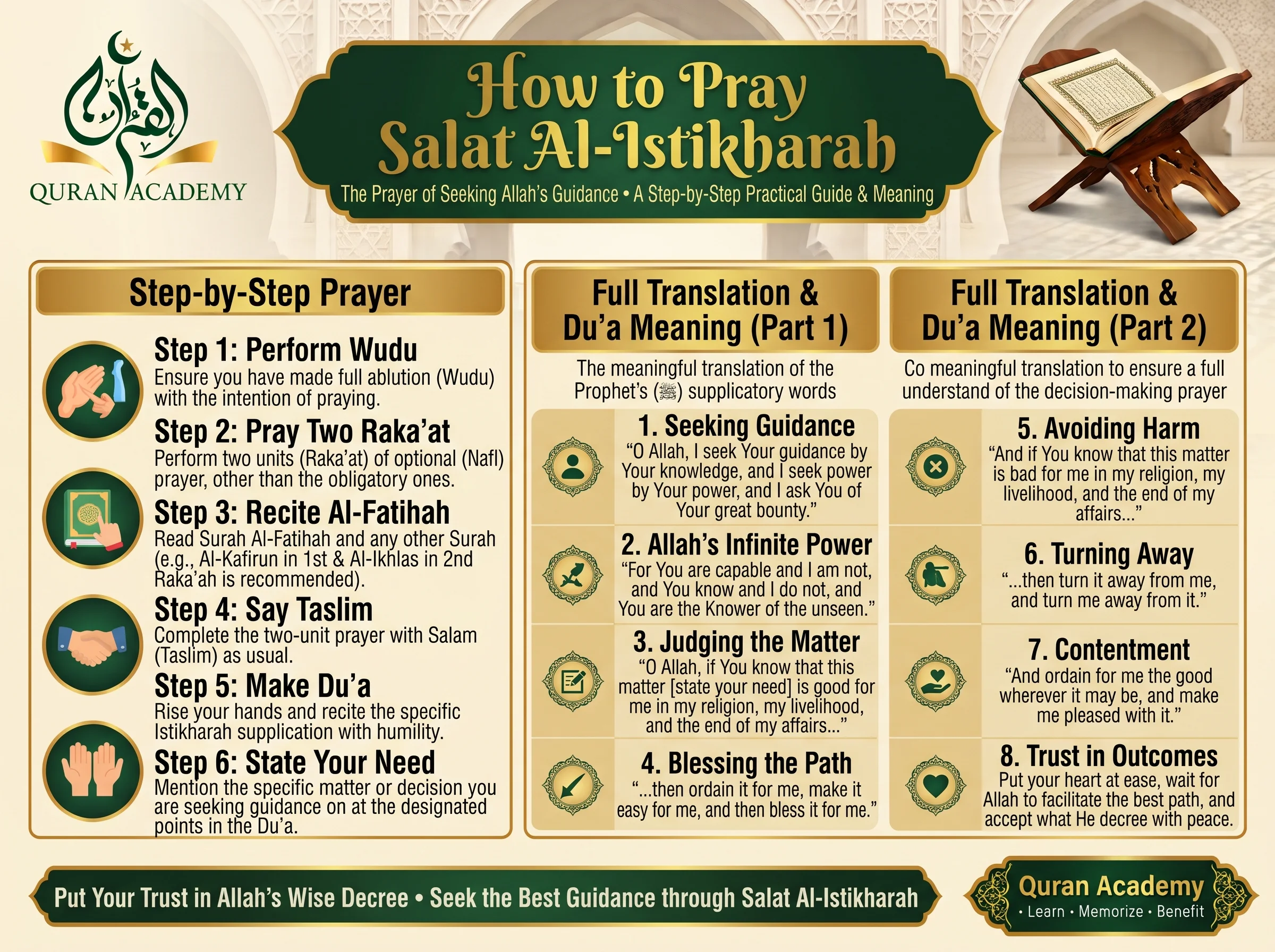
✦ Quick Answer & Key Takeaways: How to Pray Salat Al-Istikharah
Knowing how to pray Salat Al Istikharah (صَلَاةُ الِاسْتِخَارَةِ — The Prayer of Seeking Goodness and Guidance) empowers every Muslim to hand their life decisions—whether marriage, career, university, relocation, or business—directly over to the All-Knowing, All-Powerful Creator. Recorded in Sahih al-Bukhari (1166) from Jabir ibn 'Abdullah (may Allah be pleased with him), the Prophet Muhammad (ﷺ) taught his Companions the Istikharah prayer for all their affairs with the same care and precision as he taught them a Surah from the Quran! To perform it, pray two voluntary Rak'ahs (outside of obligatory prayer), and either immediately before giving the final Salam or immediately after giving Salam, recite the authentic Prophetic Dua al-Istikharah—naming your specific matter at the phrase هَٰذَا الْأَمْرَ (Haadhal-Amr). In our 1-on-1 Online Islamic Studies & Fiqh Course, students master the exact pronunciation, meaning, and jurisprudence of Istikharah across all four Sunni schools!
- The #1 Myth Busted (You Do NOT Need a Dream!): Classical scholars agree that waiting for a dream, a color (green/white vs. red/black), or a mystical sign has zero basis in the Sunnah; the answer to Istikharah appears as facilitation of the path (Tayseer) or turning the matter away (Sarf)!
- Recommended Surahs in the 2 Rak'ahs: Recite Surah Al-Fatihah + Surah Al-Kafirun (109) in Rak'ah 1, and Surah Al-Fatihah + Surah Al-Ikhlas (112) in Rak'ah 2.
- Can You Read the Dua From a Paper or Phone? Yes! Until you memorize the Arabic Dua, you may hold a paper or phone in your hand and read it after Salam (or before Salam).
- What If a Woman Is on Her Period? When facing an urgent decision during menstruation, a sister may make the Dua of Istikharah directly with her hands raised without performing the two Rak'ahs of prayer!
Every major crossroads in adult life brings a familiar wave of overthinking: "Should I accept this marriage proposal or walk away? Should I take this job offer in a new city or stay where I am? What if I make the wrong choice and regret it five years from now?" Because human beings cannot see one second into the unseen future (Al-Ghayb), making high-stakes decisions alone often leads to sleepless nights and decision paralysis.
In Islam, a believer never carries the weight of the future alone. Just as we learned how to repair unintentional mistakes inside prayer in our guide on How to Perform Sujood As-Sahw, and how to heal emotional heaviness in our Surah Ad-Duha & Ash-Sharh Guide for Anxiety, Prophet Muhammad (ﷺ) gave his Ummah the ultimate spiritual compass for every lawful life choice: Salat Al-Istikharah. Yet millions of Muslims hesitate to pray Istikharah—or misunderstand its results—because of cultural myths about waiting for dreams, confusion over whether the Dua is said before or after Salam, or difficulty memorizing the Arabic text. Below, we give you the complete 5-Step Performance Guide, the 4-Chunk Arabic Dua Breakdown, the truth about how Allah answers Istikharah, and how to combine Istikharah with Istisharah (consultation).
- What Is Salat Al-Istikharah? (The Authentic Hadith of Jabir RA in Sahih al-Bukhari)
- How to Pray Salat Al-Istikharah in 5 Simple Steps (Before vs. After Salam Explained)
- The Complete Istikharah Dua: Arabic Text, Transliteration, Meaning & 4-Chunk Memory Trick
- How Do You Know the Answer to Istikharah? (Busting the "Dream & Colors" Myth!)
- When Can You Pray Istikharah? (Permissible vs. Disliked Times & Repeating It 7 Times)
- Frequently Asked Questions (FAQs)
1. What Is Salat Al-Istikharah? (The Authentic Hadith of Jabir RA in Sahih al-Bukhari)
Linguistically—as we explain in our Quranic Arabic Grammar Guide and our Interactive Tajweed & Islamic Encyclopedia—the word الِاسْتِخَارَة (Al-Istikharah) is a Form X Arabic verbal noun on the pattern of Istif'aal (seeking/asking for something) derived from the 3-letter root خ-ي-ر (Khayr = Goodness). Therefore, praying Istikharah literally means: "Asking Allah Almighty to choose and decree what has the most Khayr (goodness) for you in both your religion and your worldly life!"
Jabir ibn 'Abdullah (may Allah be pleased with them both) narrated:
"The Messenger of Allah (peace be upon him) used to teach us Al-Istikharah (seeking Allah's guidance for what is best) in all of our affairs, just as he used to teach us a Surah from the Quran! He (ﷺ) said: 'When one of you intends to undertake a matter (إِذَا هَمَّ أَحَدُكُمْ بِالْأَمْرِ), let him pray two Rak'ahs other than the obligatory prayer, and then let him say: Allahumma innee astakheeruka bi-'ilmika...'"
What Types of Decisions Require Istikharah? Classical scholars (such as Imam An-Nawawi and Ibn Hajar Al-'Asqalani) clarify that Istikharah is performed for permissible (Mubah) personal choices where the best outcome is unknown to you—such as choosing whether to marry a specific person, choosing between two careers or universities, buying a house, or traveling—or when deciding the timing/priority between two good deeds. You never pray Istikharah over whether to perform an obligatory duty (Fard) like praying Fajr or fasting Ramadan, nor over avoiding a prohibited act (Haram)!
2. How to Pray Salat Al-Istikharah in 5 Simple Steps (Before vs. After Salam Explained)
Follow these five clear steps to perform Salat Al-Istikharah with complete confidence:
- Step 1 — Perform Wudu & Make the Intention in Your Heart:
Perform a complete ablution (Wudu), face the Qiblah in a quiet place, and form the intention (Niyyah) in your heart—without speaking it aloud—to pray two Rak'ahs of Sunnah for Istikharah regarding your specific decision. *(Tip: You can either pray two dedicated voluntary Rak'ahs, or combine the intention of Istikharah with any regular two-Rak'ah Sunnah prayer such as the Sunnah after Maghrib, Isha, Dhuhr, or Tahiyyatul-Masjid!)* - Step 2 — Pray Rak'ah 1 (Recommended: Al-Fatihah + Surah Al-Kafirun):
Begin with Takbeeratul-Ihram ("Allahu Akbar"), recite Surah Al-Fatihah, and then recite any Surah you know by heart. Imam An-Nawawi (in Al-Adhkar) notes that it is recommended to recite Surah Al-Kafirun (Chapter 109) in the first Rak'ah—or verses about Allah's supreme choice and knowledge, such as وَرَبُّكَ يَخْلُقُ مَا يَشَاءُ وَيَخْتَارُ (Surah Al-Qasas 28:68)—and then complete Ruku' and both Sujoods calmly. - Step 3 — Pray Rak'ah 2 (Recommended: Al-Fatihah + Surah Al-Ikhlas):
Stand up for the second Rak'ah, recite Surah Al-Fatihah followed by Surah Al-Ikhlas (Chapter 112—from our 3 Quls Guide, or Verse 36 of Surah Al-Ahzab), complete Ruku' and both Sujoods, and sit for the Final Tashahhud (At-Tahiyyat and Salawat 'alan-Nabi). - Step 4 — Recite the Istikharah Dua (After Salam vs. Before Salam):
Because the Hadith of Jabir (RA) states "ثُمَّ لْيَقُلْ" (Then let him say...) after mentioning the two Rak'ahs, scholars permitted two valid timings for reciting the Dua:
• Option A — Immediately AFTER Giving Salam (Majority View: Hanafi, Maliki, Shafi'i & Hanbali): Give the final Tasleem (As-salamu 'alaykum wa rahmatullah) to exit the two Rak'ahs, raise your hands humbly toward Allah, praise Allah and send blessings upon the Prophet (ﷺ), and recite the complete Dua al-Istikharah (this is also the easiest method if you need to read the Dua from a book or phone screen!).
• Option B — Immediately BEFORE Giving Salam (Chosen by Ibn Taymiyyah): If you have memorized the Dua by heart, you may also recite it at the very end of the Final Tashahhud right after Salawat 'alan-Nabi before turning your head for Salam! - Step 5 — Name Your Specific Need at "Haadhal-Amr" (هَٰذَا الْأَمْرَ):
As you recite the Dua, when you reach the words إِنْ كُنْتَ تَعْلَمُ أَنَّ هَٰذَا الْأَمْرَ (In kunta ta'lamu anna haadhal-amra...) twice in the middle of the supplication, either mention your specific matter directly after the words Haadhal-Amr (e.g., "haadhal-amra—my marriage to so-and-so / accepting this job at company X") OR hold the specific intention vividly in your heart as you say Haadhal-Amr!
3. The Complete Istikharah Dua: Arabic Text, Transliteration, Meaning & 4-Chunk Memory Trick
Just as we broke down the 9 clauses in our 5-Minute Ayatul Kursi Memorization Guide and the 7 chunks in our Last 2 Verses of Surah Al-Baqarah Guide using our 3x3 Memorization Method (tracked in our Smart Hifz Planner), look at how easy it is to memorize Dua al-Istikharah in 10 minutes when you divide it into 4 symmetrical chunks (notice how many words come directly from our Top 50 High-Frequency Quranic Arabic Words!):
🤲 Full Arabic Text & 4-Chunk Breakdown of Dua Al-Istikharah (Sahih al-Bukhari 1166)
اللَّهُمَّ إِنِّي أَسْتَخِيرُكَ بِعِلْمِكَ، وَأَسْتَقْدِرُكَ بِقُدْرَتِكَ، وَأَسْأَلُكَ مِنْ فَضْلِكَ الْعَظِيمِ؛ فَإِنَّكَ تَقْدِرُ وَلَا أَقْدِرُ، وَتَعْلَمُ وَلَا أَعْلَمُ، وَأَنْتَ عَلَّامُ الْغُيُوبِ.
Transliteration: Allaahumma innee astakheeruka bi-'ilmika, wa astaqdiruka bi-qudratika, wa as'aluka min fadlikal-'adheem; fa-innaka taqdiru wa laa aqdiru, wa ta'lamu wa laa a'lamu, wa Anta 'Allaamul-Ghuyoob.
Meaning: "O Allah, I seek Your guidance [in choosing what is best] by virtue of Your knowledge, and I seek ability by virtue of Your power, and I ask You of Your tremendous bounty. For indeed, You have power while I have no power, and You know while I do not know, and You are the Knower of the Unseen."
اللَّهُمَّ إِنْ كُنْتَ تَعْلَمُ أَنَّ هَٰذَا الْأَمْرَ [وَيُسَمِّي حَاجَتَهُ] خَيْرٌ لِي فِي دِينِي وَمَعَاشِي وَعَاقِبَةِ أَمْرِي — أَوْ قَالَ: عَاجِلِ أَمْرِي وَآجِلِهِ — فَاقْدُرْهُ لِي وَيَسِّرْهُ لِي ثُمَّ بَارِكْ لِي فِيهِ.
Transliteration: Allaahumma in kunta ta'lamu anna haadhal-amra [name your matter here] khayrun lee fee deenee wa ma'aashee wa 'aaqibati amree (or: 'aajili amree wa aajilihi) faqdurhu lee wa yassirhu lee thumma baarik lee feeh.
Meaning: "O Allah, if You know that this matter [mention your need] is good for me in my religion, my livelihood, and the final outcome of my affair (or: in my immediate and future affair), then (1) decree it for me, (2) make it easy for me, and then (3) bless it for me."
وَإِنْ كُنْتَ تَعْلَمُ أَنَّ هَٰذَا الْأَمْرَ شَرٌّ لِي فِي دِينِي وَمَعَاشِي وَعَاقِبَةِ أَمْرِي — أَوْ قَالَ: عَاجِلِ أَمْرِي وَآجِلِهِ — فَاصْرِفْهُ عَنِّي وَاصْرِفْنِي عَنْهُ،
Transliteration: Wa in kunta ta'lamu anna haadhal-amra sharrun lee fee deenee wa ma'aashee wa 'aaqibati amree (or: 'aajili amree wa aajilihi) fasrifhu 'annee wasrifnee 'anhu,
Meaning: "And if You know that this matter is bad/harmful for me in my religion, my livelihood, and the final outcome of my affair, then turn it away from me and turn me away from it—"
Struggling to perfect your Recitation?
Join hundreds of students mastering the Quran with our Verified Al-Azhar Graduates. We offer flexible 1-on-1 sessions tailored to your schedule.
Book a Free Evaluation Class →وَاقْدُرْ لِيَ الْخَيْرَ حَيْثُ كَانَ، ثُمَّ أَرْضِنِي بِهِ.
Transliteration: Waqdur liyal-khayra haythu kaana, thumma ardinee bih.
Meaning: "And decree for me goodness wherever it may be, and then make my heart pleased and content with it!"
4. How Do You Know the Answer to Istikharah? (Busting the "Dream & Colors" Myth!)
One of the most widespread cultural misconceptions in the Muslim world is the belief that after praying Salat Al-Istikharah, you must go straight to sleep and wait to see a dream—and that seeing the colors green or white means "Yes," while seeing red or black means "No"! Let us clarify the authentic scholarly position taught in our Quran Tafseer & Sunnah Guides:
Neither the Hadith of Jabir (RA) nor any Companion ever mentioned sleeping after Istikharah or waiting for a dream or colors. Dreams are often influenced by your own subconscious fears and wishes (Hadeeth an-Nafs) and are not a legal source for decisions!
Look at the words of the Dua itself: "Faqdurhu lee wa yassirhu lee" (Decree it for me and make it easy for me). If the matter is good for you, Allah opens the practical doors, aligns the means, and brings calm contentment (Inshirah as-Sadr) as you take steps forward!
And if the matter holds hidden harm for your religion or future, Allah answers "Fasrifhu 'annee wasrifnee 'anhu" by placing natural obstacles in the way, revealing red flags during consultation (Istisharah), and turning your heart away from it in peace!
Crucial Sunnah Principle — Combining "Istikharah" (Asking Allah) With "Istisharah" (Consulting Wise People): Scholars like Shaykh al-Islam Ibn Taymiyyah and Imam An-Nawawi state: "Never did anyone regret who sought the Creator's guidance (Maa khaaba man istakhaara) and consulted trustworthy people of experience (Wa laa nadima man istashaara)!" Just as we saw the value of wise counsel in our Surah Luqman Parenting Guide and our Surah Al-Hujurat Guide on Verifying Information (49:6), after praying Istikharah you do not sit passively waiting—you research, consult wise experts, and take practical steps forward while trusting Allah to open the right door and close the wrong one!
Mastering the Crisp Qalqalah on "Qaaf" in "Astaqْdiruka", "Taqْdiru" & "Faqْdurhu"
Did you notice that the most repeated root in Dua al-Istikharah is ق-د-ر (Power / Decree)—appearing six times in أَسْتَقْدِرُكَ (Astaqْdiruka), بِقُدْرَتِكَ (Bi-qudْratika), تَقْدِرُ (Taqْdiru), أَقْدِرُ (Aqْdiru), فَاقْدُرْهُ (Faqْdurhu), and وَاقْدُرْ (Waqْdur)? Every single one of those words contains a mid-word Qalqalah Sughra on Qaaf (قْ) or Dal (دْ)! Watch Senior Instructor Ustadhah Yasmeen Gamal demonstrate on our Quran Academy YouTube Channel:
- Heavy Qaaf Bounce: Never let Taqْdiru sound like an English "K" (Takdiru ❌).
- 1-on-1 Live Coaching: Perfect your Salah and Dua pronunciation with our Al-Azhar scholars!
5. When Can You Pray Istikharah? (Permissible vs. Disliked Times & Special Fiqh Cases)
Before you pray Salat Al-Istikharah tonight, review these four essential Fiqh rulings:
- 1. Best Times vs. The 3 Disliked Times for Voluntary Prayer:
You may pray Salat Al-Istikharah at any time of the day or night (and the last third of the night before Fajr is especially blessed because Allah descends to the lowest heaven answering every supplicant!). However, avoid starting a voluntary two-Rak'ah prayer during the three disliked times (Awqat an-Nahy) unless your decision is urgent and cannot wait: (a) from after Fajr prayer until 15 minutes after sunrise, (b) 10 minutes before Dhuhr when the sun is at its zenith, and (c) after Asr prayer until Maghrib sunset. *(If an urgent decision arises after Asr or Fajr, you can always make the **Dua of Istikharah immediately** without waiting!)* - 2. Can You Repeat Salat Al-Istikharah More Than Once?
Yes! If you pray Istikharah once and your heart still feels undecided or the path is not yet clear, scholars across the four schools agree that it is completely permissible and recommended to repeat Salat Al-Istikharah two, three, or more times until the matter becomes clear. *(Note: The famous narration telling Anas RA to "repeat Istikharah 7 times" has a very weak chain of transmission, so repeating it 7 times is not a fixed religious requirement—you may pray it once, three times, or as many times as needed!).* - 3. Can Someone Pray Istikharah on Behalf of Someone Else?
In the Hadith of Jabir (RA), the Prophet (ﷺ) said: "When one of you intends a matter, let HIM pray two Rak'ahs..."—meaning the person facing the decision should perform their own Istikharah directly to Allah! (However, a mother, father, or friend can always pray for Allah to guide and bless you in their general Duas). - 4. How Sisters on Their Period Can Perform Istikharah:
As we detailed in our Fiqh guide on Reading the Quran & Making Dhikr During Your Period, if a sister is facing a time-sensitive decision during menstruation or post-natal bleeding (Nifas), she does not miss out on Istikharah—she simply faces the Qiblah, raises her hands, praises Allah, sends Salawat on the Prophet (ﷺ), and recites the full Dua of Istikharah directly from her heart or phone!
To pronounce every letter of the Surahs and Duas in your prayers with crystal clarity, explore our Makharij al-Huruf Guide, Sifaat al-Huruf Guide, Heavy & Light Letters Guide, Rules of Madd, Noon Sakinah Rules, Meem Sakinah Rules, and Rules of Waqf in our 1-on-1 Online Tajweed Course, and test yourself on our Free 3-Minute Tajweed Quiz! You can also enrich your voluntary night and Istikharah prayers by memorizing our 15-Day Surah Ya-Sin Plan, 10-Day Surah Ar-Rahman Plan, 12-Day Surah Al-Waqi'ah Schedule, 14-Day Surah Maryam Plan, 30-Day Surah Yusuf Schedule, and Friday Fajr Surahs Guide in our Online Hifz Program with our Al-Azhar Certified Male & Female Tutors (or enroll your children in our 1-on-1 Kids Quran Classes with our Printable Kids Star Chart). See how families across the West rate their learning experience on our Verified Student & Parent Reviews Page!
6. Frequently Asked Questions (FAQs) About How to Pray Salat Al-Istikharah
1. Is the Dua of Istikharah recited before or after giving Salam?
Both are permissible according to Sunni scholars! The majority of jurists across the four schools (Hanafi, Maliki, Shafi'i, and Hanbali) recommend reciting Dua al-Istikharah immediately AFTER giving the final Salam of the two Rak'ahs (which also allows you to hold and read from a book or phone if you haven't memorized it yet). Other scholars (like Ibn Taymiyyah) also permitted reciting it at the end of the Final Tashahhud before giving Salam.
2. Do I have to see a dream after praying Salat Al-Istikharah?
No! Waiting for a dream or looking for specific colors (green/white vs. red/black) has no basis in the Prophetic Sunnah. Instead, the answer to Istikharah manifests in real life: if the matter is good for you, Allah facilitates its means (Wa yassirhu lee) and expands your chest toward it; if it is bad for you, Allah creates natural obstacles and turns it away from you (Fasrifhu 'annee).
3. What Surahs should I recite in the two Rak'ahs of Salat Al-Istikharah?
You may recite Surah Al-Fatihah followed by any Surah or verses you know. Classical scholars like Imam An-Nawawi recommend reciting Surah Al-Kafirun (Chapter 109) after Al-Fatihah in the first Rak'ah, and Surah Al-Ikhlas (Chapter 112) after Al-Fatihah in the second Rak'ah.
4. Can I read the Istikharah Dua in English if I don't know Arabic?
If you recite the Dua after giving Salam, you can read the Arabic text directly from a paper or phone screen (using transliteration if needed) and then read the English meaning so your heart connects fully with every word.
5. How can a woman perform Istikharah during her monthly period?
When a woman is on her period and needs to make a decision that cannot wait until her cycle ends, she performs Istikharah through Dua alone—facing the Qiblah, raising her hands, praising Allah, sending Salawat upon the Prophet (ﷺ), and reciting the complete Istikharah supplication without praying the two Rak'ahs.
Master Essential Duas, Salah Fiqh & Tajweed With an Al-Azhar Scholar!
Want to memorize Prophetic Duas, understand everyday Fiqh, and recite the Quran with confidence? Book your free 1-on-1 trial session with our male or female Al-Azhar scholars today!
Book Your Free 1-on-1 Trial Class →