
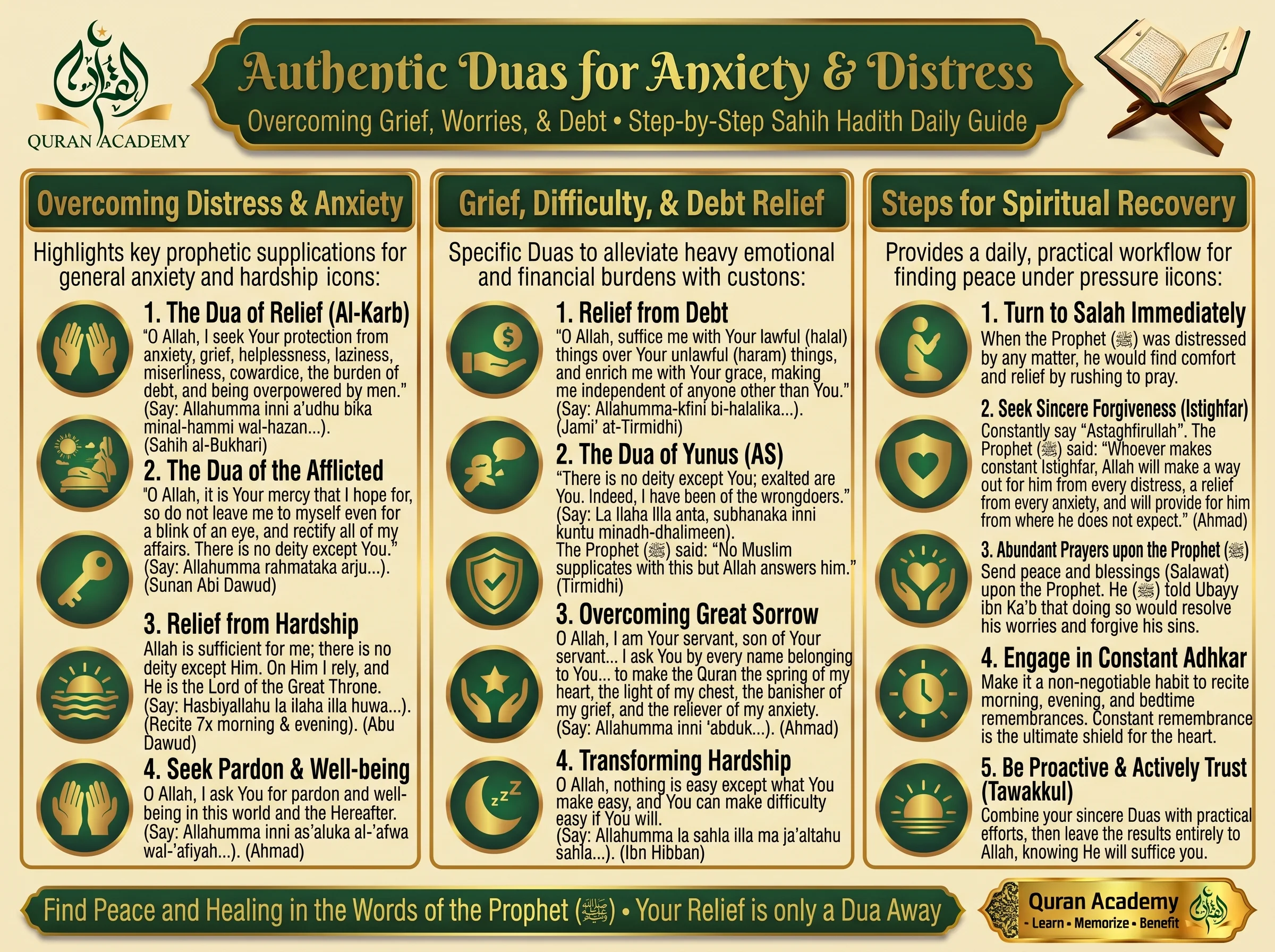
✦ Quick Answer & Key Takeaways: Authentic Duas for Anxiety, Distress & Debt Relief
Turning to authentic Duas for anxiety and distress (أَدْعِيَةُ الْهَمِّ وَالْحُزْنِ وَالْكَرْبِ وَقَضَاءِ الدَّيْنِ) connects an overwhelmed heart directly to the Lord of the Mighty Throne—Who alone replaces constriction with relief (Faraj) and opens doors of provision from where a servant could never imagine! Across Sahih al-Bukhari, Sahih Muslim, Sunan at-Tirmidhi, and Musnad Ahmad, Prophet Muhammad (ﷺ) taught 7 core supplications for emotional heaviness and financial burdens: (1) The 8-Item Refuge Dua (seeking protection from worry, grief, incapacity, laziness, cowardice, miserliness, crushing debt, and human oppression), (2) The "Quran as the Spring of My Heart" Dua, (3) Du'a al-Karb (for sudden, severe anguish), (4) The Prayer of Prophet Yunus (AS), and (5) The Halal-Sufficiency Dua taught to 'Ali ibn Abi Talib (RA). In our 1-on-1 Online Islamic Studies & Prophetic Duas Course, students master the exact Arabic pronunciation, meanings, and spiritual psychology behind each supplication!
- The 4 Pairs of "Al-Hamm wal-Hazan" (Sahih al-Bukhari 6369): Protects you from future anxiety (Hamm) & past grief (Hazan), inability ('Ajz) & laziness (Kasal), cowardice (Jubn) & stinginess (Bukhl), and crushing debt (Ghalabatid-Dayn) & human tyranny (Qahrir-Rijal)!
- The Guaranteed Joy Replacement (Musnad Ahmad 3712): Asking Allah to make the Quran the spring-rain of your heart (Rabee'a Qalbee) guarantees that Allah replaces your sorrow with relief and joy!
- The Mountain-of-Debt Dua (Sunan at-Tirmidhi 3563): Allaahummak-finee bi-halaalika 'an haraamika, wa aghninee bi-fadlika 'amman siwaak.
- The Action + Dua Formula (Sahih Muslim 2664): Whenever the Prophet (ﷺ) faced a stressful matter, he immediately stood for prayer (Surah Al-Baqarah 2:45) and paired Dua with diligent effort!
Every believer passes through seasons when the chest feels tight: perhaps a sudden financial obligation or debt weighs on your shoulders day and night, a family or health trial keeps you awake on your pillow, or waves of worry about the future (Al-Hamm) and regret over the past (Al-Hazan) drain your energy.
In one of the most touching moments in Madinah (recorded in Sunan Abu Dawud 1555), Prophet Muhammad (ﷺ) entered the mosque outside of the obligatory prayer time and noticed an Ansari Companion named Abu Umamah (may Allah be pleased with him) sitting alone, weighed down with distress. When the Prophet (ﷺ) asked why he was sitting in the masjid outside of prayer hours, Abu Umamah replied honestly: "Worries and debts that have surrounded me, O Messenger of Allah! (هُمُومٌ لَزِمَتْنِي وَدُيُونٌ يَا رَسُولَ اللَّهِ)." The Prophet (ﷺ) did not merely offer sympathy—he taught him specific words to say every morning and evening that removed his anxiety and settled his debts! Building upon our guides to Surah Ad-Duha & Ash-Sharh (The Quranic Cure for Anxiety), Morning & Evening Adhkar, and Authentic Self-Ruqyah, this complete guide unpacks the 4 Arabic Degrees of Emotional Distress, the 7 Verified Prophetic Duas with voweled Arabic and transliteration, and how to pronounce them with accurate Tajweed.
- 1. The 4 Pairs of "Al-Hamm wal-Hazan" (Sahih al-Bukhari 6369): Why These 8 Things Are Paired!
- 2. Master Directory: The 7 Authentic Prophetic Duas for Anxiety, Distress & Debt Relief
- 3. Deep Dive: How to Memorize "Make the Quran the Spring of My Heart" in 4 Easy Chunks
- 4. The 2 Authentic Debt-Relief Duas ('Ali RA & Abu Umamah RA) + Practical Sunnah Steps
- 5. Four Essential Tajweed Rules When Reciting Distress & Debt Relief Duas
- 6. Frequently Asked Questions (FAQs)
1. The 4 Pairs of "Al-Hamm wal-Hazan" (Sahih al-Bukhari 6369): Why These 8 Things Are Paired!
In Sahih al-Bukhari (6369), Anas ibn Malik (may Allah be pleased with him), who served the Prophet (ﷺ) for ten years in Madinah, reported that the supplication he heard the Messenger of Allah (ﷺ) repeat more than almost any other was the famous 8-Item Refuge Dua:
« ٱللَّهُمَّ إِنِّي أَعُوذُ بِكَ مِنَ ٱلْهَمِّ وَٱلْحَزَنِ، وَٱلْعَجْزِ وَٱلْكَسَلِ، وَٱلْجُبْنِ وَٱلْبُخْلِ، وَضَلَعِ ٱلدَّيْنِ (غَلَبَةِ ٱلدَّيْنِ) وَغَلَبَةِ ٱلرِّجَالِ (قَهْرِ ٱلرِّجَالِ) »
As Imam Ibn al-Qayyim explained in Zad al-Ma'ad and Miftah Dar as-Sa'adah (and as we study in our Quranic Arabic Guide and Interactive Tajweed & Islamic Encyclopedia), look at the astonishing psychological precision of why the Prophet (ﷺ) grouped these 8 trials into 4 exact pairs:
Al-Hamm is mental pain over what you fear in the future; Al-Hazan is emotional pain over what you lost in the past—freeing your mind to live productively in the present!
Why do people fail to achieve good? Either because they lack the power/ability (Al-'Ajz — Incapacity) OR they have the ability but lack the motivation/willpower (Al-Kasal — Laziness)!
Al-Jubn (Cowardice) holds a person back from helping others with their physical courage; Al-Bukhl (Miserliness) holds them back from helping others with their wealth!
Ghalabatid-Dayn is being crushed by a rightful financial obligation you owe; Qahrir-Rijal is being overpowered or bullied unjustly by people!
2. Master Directory: The 7 Authentic Prophetic Duas for Anxiety, Distress & Debt Relief
You can look up the Quranic verses in our Online Uthmani Quran Explorer and verify every Hadith source in our Online Hadith Explorer. Here is your complete 7-Item Authentic Checklist:
| # & Specific Need | Authentic Arabic Text & Transliteration | Source & Guaranteed Prophetic Promise |
|---|---|---|
| 1. The 8-Things Refuge (Worry, Laziness & Debt) |
ٱللَّهُمَّ إِنِّي أَعُوذُ بِكَ مِنَ ٱلْهَمِّ وَٱلْحَزَنِ، وَٱلْعَجْزِ وَٱلْكَسَلِ، وَٱلْجُبْنِ وَٱلْبُخْلِ، وَضَلَعِ ٱلدَّيْنِ وَغَلَبَةِ ٱلرِّجَالِ Allaahumma innee a'oodhu bika minal-hammi wal-hazan, wal-'ajzi wal-kasal, wal-jubni wal-bukhl, wa dala'id-dayni wa ghalabatir-rijaal. |
Sahih al-Bukhari 6369 & Abu Dawud 1555: Recited morning and evening; removed Abu Umamah's (RA) anxiety and paid off his debts! |
| 2. Du'a Al-Karb (Sudden Severe Anguish) |
لَا إِلَٰهَ إِلَّا ٱللَّهُ ٱلْعَظِيمُ ٱلْحَلِيمُ، لَا إِلَٰهَ إِلَّا ٱللَّهُ رَبُّ ٱلْعَرْشِ ٱلْعَظِيمِ، لَا إِلَٰهَ إِلَّا ٱللَّهُ رَبُّ ٱلسَّمَاوَاتِ وَرَبُّ ٱلْأَرْضِ وَرَبُّ ٱلْعَرْشِ ٱلْكَرِيمِ Laa ilaaha illallaahul-'Adheemul-Haleem, laa ilaaha illallaahu Rabbul-'Arshil-'Adheem, laa ilaaha illallaahu Rabbus-samaawaati wa Rabbul-ardi wa Rabbul-'Arshil-Kareem. |
Sahih al-Bukhari 6346 & Muslim 2730: Pure praise and Tawheed recited by the Prophet (ﷺ) at moments of intense crisis—turning the heart's focus to the Lord of the Mighty, Noble Throne! |
| 3. Prayer of Yunus (AS) (Surah Al-Anbiya 21:87) |
لَا إِلَٰهَ إِلَّا أَنْتَ سُبْحَانَكَ إِنِّي كُنْتُ مِنَ ٱلظَّالِمِينَ Laa ilaaha illaa Anta, Subhaanaka, innee kuntu minadh-dhaalimeen. |
Sunan at-Tirmidhi 3505 (Sahih): "No Muslim ever supplicates with it concerning any matter except that Allah answers him!" |
| 4. Not Leaving Me to Myself (Supplication of the Distressed) |
ٱللَّهُمَّ رَحْمَتَكَ أَرْجُو، فَلَا تَكِلْنِي إِلَىٰ نَفْسِي طَرْفَةَ عَيْنٍ، وَأَصْلِحْ لِي شَأْنِي كُلَّهُ، لَا إِلَٰهَ إِلَّا أَنْتَ Allaahumma rahmataka arjoo, falaa takilnee ilaa nafsee tarfata 'aynin, wa aslih lee sha'nee kullahu, laa ilaaha illaa Ant. |
Sunan Abu Dawud 5090 (Hasan): Named by the Prophet (ﷺ) "Da'awaatul-Makroob" (The Supplications of the Distressed)—entrusting every affair to Allah's Mercy! |
| 5. Taught to Asma' bint 'Umays (For Hardship & Grief) |
ٱللَّهُ ٱللَّهُ رَبِّي لَا أُشْرِكُ بِهِ شَيْئًا Allaahu, Allaahu Rabbee laa ushriku bihi shay'aa. |
Sunan Abu Dawud 1525 & Ibn Majah 3882 (Sahih): Taught by the Prophet (ﷺ) specifically to say during times of sudden distress and anxiety! |
| 6. 'Ali's (RA) Mountain-of-Debt Dua (Halal Sufficiency) |
ٱللَّهُمَّ ٱكْفِنِي بِحَلَالِكَ عَنْ حَرَامِكَ، وَأَغْنِنِي بِفَضْلِكَ عَمَّنْ سِوَاكَ Allaahummak-finee bi-halaalika 'an haraamika, wa aghninee bi-fadlika 'amman siwaak. |
Sunan at-Tirmidhi 3563 (Hasan): "Even if you owed a debt the size of Mount Sabir, Allah would pay it off for you!" |
| 7. "Make the Quran the Spring of My Heart" 🏆 (Musnad Ahmad 3712) |
ٱللَّهُمَّ إِنِّي عَبْدُكَ، وَٱبْنُ عَبْدِكَ، وَٱبْنُ أَمَتِكَ، نَاصِيَتِي بِيَدِكَ... أَنْ تَجْعَلَ ٱلْقُرْآنَ رَبِيعَ قَلْبِي، وَنُورَ صَدْرِي، وَجَلَاءَ حُزْنِي، وَذَهَابَ هَمِّي | Musnad Ahmad 3712 & Ibn Hibban 972 (Sahih): The Prophet (ﷺ) said when companions asked if they should learn these words: "Yes! Whoever hears them ought to learn them!" |
3. Deep Dive: How to Memorize "Make the Quran the Spring of My Heart" in 4 Easy Chunks
Just as we broke down Sayyidul-Istighfar in our Morning & Evening Adhkar Guide using our 3x3 Memorization Method (tracked in our Smart Hifz Planner), look at how easy it is to memorize the complete text of Musnad Ahmad (3712) in 5 minutes when you divide it into 4 logical chunks:
Struggling to perfect your Recitation?
Join hundreds of students mastering the Quran with our Verified Al-Azhar Graduates. We offer flexible 1-on-1 sessions tailored to your schedule.
Book a Free Evaluation Class →- Chunk 1 (Complete Servitude & Surrender of the Forelock):
ٱللَّهُمَّ إِنِّي عَبْدُكَ، وَٱبْنُ عَبْدِكَ، وَٱبْنُ أَمَتِكَ، نَاصِيَتِي بِيَدِكَ، مَاضٍ فِيَّ حُكْمُكَ، عَدْلٌ فِيَّ قَضَاؤُكَ
Allaahumma innee 'abduka, wabnu 'abdika, wabnu amatik, naasiyatee bi-yadik, maadin fiyya hukmuk, 'adlun fiyya qadaa'uk ("O Allah, I am Your servant, the son of Your male servant, and the son of Your female servant; my forelock is in Your Hand, Your command over me is forever executed, and Your decree over me is completely just!"). *(Note: Sisters may say **أَمَتُكَ وَبِنْتُ عَبْدِكَ وَبِنْتُ أَمَتِكَ** or recite the original wording intending "person/soul").* - Chunk 2 (Calling Upon All of Allah's Beautiful Names):
أَسْأَلُكَ بِكُلِّ ٱسْمٍ هُوَ لَكَ، سَمَّيْتَ بِهِ نَفْسَكَ، أَوْ أَنْزَلْتَهُ فِي كِتَابِكَ، أَوْ عَلَّمْتَهُ أَحَدًا مِنْ خَلْقِكَ، أَوِ ٱسْتَأْثَرْتَ بِهِ فِي عِلْمِ ٱلْغَيْبِ عِنْدَكَ
As'aluka bi-kulli ismin huwa lak, sammayta bihi nafsak, aw anzaltahu fee kitaabik, aw 'allamtahu ahadan min khalqik, awis-ta'tharta bihi fee 'ilmil-ghaybi 'indak ("I ask You by every Name belonging to You with which You have named Yourself, or revealed in Your Book, or taught to any of Your creation, or preserved in the knowledge of the Unseen with You..."). - Chunk 3 (The 4 Metaphors of Heart Healing):
أَنْ تَجْعَلَ ٱلْقُرْآنَ رَبِيعَ قَلْبِي، وَنُورَ صَدْرِي، وَجَلَاءَ حُزْنِي، وَذَهَابَ هَمِّي
An taj'alal-Qur'aana rabee'a qalbee, wa noora sadree, wa jalaa'a huznee, wa dhahaaba hammee ("...that You make the Quran the spring-rain [Rabee'] of my heart, the light of my chest, the polisher/remover of my past sorrow [Huznee], and the banisher of my future worry [Hammee]!"). - Why "Rabee'" (Spring Rain) & "Noor" (Light)? Because just as spring rain revives barren earth (as we saw in Surah Qaf 50:9–11) and sunlight banishes darkness, the Quran revives a withered heart and illuminates a constricted chest!
4. The 2 Authentic Debt-Relief Duas & The 3 Practical Sunnah Steps
When a Muslim is burdened by financial debt or seeking halal provision, the Prophetic Sunnah combines sincere Dua with three practical spiritual actions:
- 1. Make the Firm Intention to Repay Every Penny (Sahih al-Bukhari 2387):
The Prophet (ﷺ) promised: « مَنْ أَخَذَ أَمْوَالَ النَّاسِ يُرِيدُ أَدَاءَهَا أَدَّى اللَّهُ عَنْهُ » ("Whoever takes people's wealth with the sincere intention of paying it back, Allah will pay it back on his behalf [by opening doors of provision for him]!"). - 2. Combine Morning/Evening Istighfar With Surah Al-Waqi'ah & The Two Debt Duas:
As Prophet Nuh (AS) taught in Surah Nuh (71:10–12)—and as we explored in our Surah Al-Waqi'ah Sustenance & Contentment Guide—consistent seeking of forgiveness (Istighfar) paired with reciting Allaahummak-finee bi-halaalika 'an haraamika... after prayers and Allaahumma innee a'oodhu bika minal-hammi wal-hazan... morning and evening brings barakah into your income. - 3. Stand Immediately for 2 Rak'ahs of Prayer When Worried (Surah Al-Baqarah 2:45):
Hudhayfah (RA) reported in Sunan Abu Dawud (1319 — Hasan): « كَانَ النَّبِيُّ ﷺ إِذَا حَزَبَهُ أَمْرٌ صَلَّى » ("Whenever a matter distressed or worried the Prophet ﷺ, he immediately stood to pray!")—fulfilling Allah's command: "Seek help through patience and prayer!"
Mastering the Crisp Qalqalah in "Al-'Ajْzi", "Al-Jubْni", "Subْhaanaka" & "'Abْduka"!
Look closely at the words in these 7 Prophetic Duas: وَٱلْعَجْزِ (Wal-'Ajْzi), وَٱلْجُبْنِ (Wal-Jubْni), سُبْحَانَكَ (Subْhaanaka), and إِنِّي عَبْدُكَ وَٱبْنُ عَبْدِكَ ('Abْduka wabْnu 'abْdika)! Every single one features a mid-word Qalqalah Sughra on Jeem (جْ) or Baa (بْ)! Watch Senior Instructor Ustadhah Yasmeen Gamal demonstrate Qalqalah on our Quran Academy YouTube Channel:
- No Swallowed Consonants: Bounce the جْ in Al-'Ajْzi and the بْ in Al-Jubْni cleanly before the next letter!
- 1-on-1 Live Coaching: Make the Quran the spring of your heart with our Al-Azhar scholars!
5. Four Essential Tajweed Rules When Reciting Distress & Debt Relief Duas
Before reciting these 7 supplications in your Sujood or after prayer today, apply these four Tajweed rules from our 1-on-1 Online Tajweed Course:
- 1. Six Moon Laams vs. Two Sun Laams in the 8-Things Refuge Dua:
Applying our Laam Shamsiyyah & Laam Qamariyyah Guide and Hamzatul Wasl Guide, notice that the first 6 items—ٱلْهَمِّ، وَٱلْحَزَنِ، وَٱلْعَجْزِ، وَٱلْكَسَلِ، وَٱلْجُبْنِ (Moon Letter ج!), وَٱلْبُخْلِ—all begin with a clearly pronounced Moon Laam (لْ), whereas the final 2 items—ٱلدَّيْنِ (Ad-Dayni) and ٱلرِّجَالِ (Ar-Rijaal)—have a merged Sun Laam! - 2. Heavy vs. Light Raa in "Qahrir-Rijaal", "Al-'Arsh" & "Sadree" (Ahkam Al-Raa):
Using our Ahkam Al-Raa Guide, notice that in وَقَهْرِ ٱلرِّجَالِ (Wa Qah-rir-ri-jaal) and وَنُورَ صَدْرِي (Wa Noora Sad-ree), the Raa is Light (Tarqeeq) because of its Kasrah, whereas in رَبُّ ٱلْعَرْشِ (Rabbul-'Arْshi), رَحْمَتَكَ أَرْجُو (Rahmataka Arْjoo), and طَرْفَةَ (Tarْfata), the Raa is Heavy (Tafkhim)! - 3. Whispered Hams on the Kaaf Sakinah in "Allaahummak-finee" (ٱللَّهُمَّ ٱكْفِنِي):
According to our Makharij al-Huruf and Sifaat al-Huruf guides, when connecting Allaahumma to ٱكْفِنِي, drop the Hamzatul Wasl and release a gentle, whispered breath (Hams) on the silent Kaaf (كْ) before the Faa: Allaahummakْ-finee! - 4. Light Ikhfaa' on "Kuntu" vs. Heavy Dhaa' in "Minadh-Dhaalimeen" (21:87):
Following our Noon Sakinah Rules, Meem Sakinah Rules, Heavy & Light Letters, Rules of Madd, Rules of Waqf, 4 Special Words of Hafs, and 7 Alifs in the Quran, in Yunus's (AS) prayer إِنِّي كُنْتُ مِنَ ٱلظَّالِمِينَ, hold a 2-beat Ghunnah on Innee, a 2-beat light Ikhfaa' on Kuntu, and keep the interdental heavy ظَّ (Dhaa') deep and elevated without turning it into a Zay! Test your Tajweed skills right now on our Free 3-Minute Tajweed Quiz!
Pair these 7 authentic Duas for anxiety and debt relief with our complete library of daily remembrances and Surah guides: Authentic Duas After Fard Salah, Bedtime & Waking Up Duas, 40 Rabbana Duas From the Quran, Surah Al-Fatihah Guide, Last 3 Verses of Surah Al-Hashr, 10 Shortest Surahs for Salah, Surah Al-Alaq Guide, Ayatul Kursi, Last 2 Verses of Surah Al-Baqarah, The 3 Quls, Surah Ya-Sin, Surah Ar-Rahman, Surah Maryam, Surah Yusuf (the ultimate Surah for relief from grief!), Surah Luqman, Surah Al-Hujurat, Salat Al-Istikharah, Sujood As-Sahw, Salat Al-Janazah, Wudu & Tayammum, 5 Pillars of Islam, and 25 Prophets in the Quran in our Online Hifz Program! Whether you are learning with our Al-Azhar Certified Tutors or enrolling your child in our 1-on-1 Kids Quran Classes with our Printable Kids Star Chart, read how families across the US, UK, Canada, and Australia rate our teachers on our Verified Student & Parent Reviews Page.
6. Frequently Asked Questions (FAQs) About Prophetic Duas for Anxiety & Debt
1. What is the difference between "Al-Hamm" (anxiety) and "Al-Hazan" (grief) in the Prophetic Dua?
Classical scholars (such as Imam Ibn al-Qayyim and Imam Ibn Hajar) explain that Al-Hamm (الهم) is anxiety and worry over what may happen in the future, whereas Al-Hazan (الحزن) is grief and sadness over what has already happened or been lost in the past. Seeking refuge from both in "Allaahumma innee a'oodhu bika minal-hammi wal-hazan" protects the heart across both past and future!
2. What is the most authentic Prophetic Dua for severe distress (Du'a al-Karb)?
Recorded in Sahih al-Bukhari (6346) and Sahih Muslim (2730) from Ibn 'Abbas (RA), the Prophet's (ﷺ) supplication during moments of severe distress (Du'a al-Karb) was pure Tawheed: "Laa ilaaha illallaahul-'Adheemul-Haleem, laa ilaaha illallaahu Rabbul-'Arshil-'Adheem, laa ilaaha illallaahu Rabbus-samaawaati wa Rabbul-ardi wa Rabbul-'Arshil-Kareem."
3. What are the two most famous authentic Duas for paying off debt in the Sunnah?
The two primary authentic Duas for debt relief are: (1) The Dua taught to 'Ali ibn Abi Talib (RA) in Sunan at-Tirmidhi (3563 — Hasan): "Allaahummak-finee bi-halaalika 'an haraamika, wa aghninee bi-fadlika 'amman siwaak" (which suffices even if one owes a mountain of debt), and (2) The 8-item refuge Dua in Sahih al-Bukhari (6369) and Sunan Abu Dawud (1555): "Allaahumma innee a'oodhu bika minal-hammi wal-hazan... wa a'oodhu bika min ghalabatid-dayni wa qahrir-rijaal."
4. What did Prophet Muhammad (ﷺ) say about the Dua to make the Quran the spring of the heart?
In Musnad Ahmad (3712 — graded Sahih), the Prophet (ﷺ) promised that no servant is struck by anxiety or grief and says: "Allaahumma innee 'abduka, wabnu 'abdika, wabnu amatik, naasiyatee bi-yadik... an taj'alal-Qur'aana rabee'a qalbee, wa noora sadree, wa jalaa'a huznee, wa dhahaaba hammee" except that Allah removes their anxiety and grief and replaces it with joy and relief (Faraj)!
5. Why is the prayer of Prophet Yunus (AS) so powerful for removing distress?
In Sunan at-Tirmidhi (3505 — Sahih) and Surah Al-Anbiya (21:87–88), the Prophet (ﷺ) stated regarding the supplication of Dhun-Noon (Yunus AS) inside the belly of the whale—"Laa ilaaha illaa Anta, Subhaanaka, innee kuntu minadh-dhaalimeen"—that no Muslim supplicates with it concerning any matter except that Allah answers them!
Make the Holy Quran the True Spring of Your Heart!
Experience the peace, light, and tranquility of reciting, understanding, and memorizing the Book of Allah in private 1-on-1 classes with certified male and female Al-Azhar scholars. Book your free trial session today!
Book Your Free 1-on-1 Trial Class →