
✦ Quick Answer & Key Takeaways: Laam Shamsiyyah & Laam Qamariyyah Rules
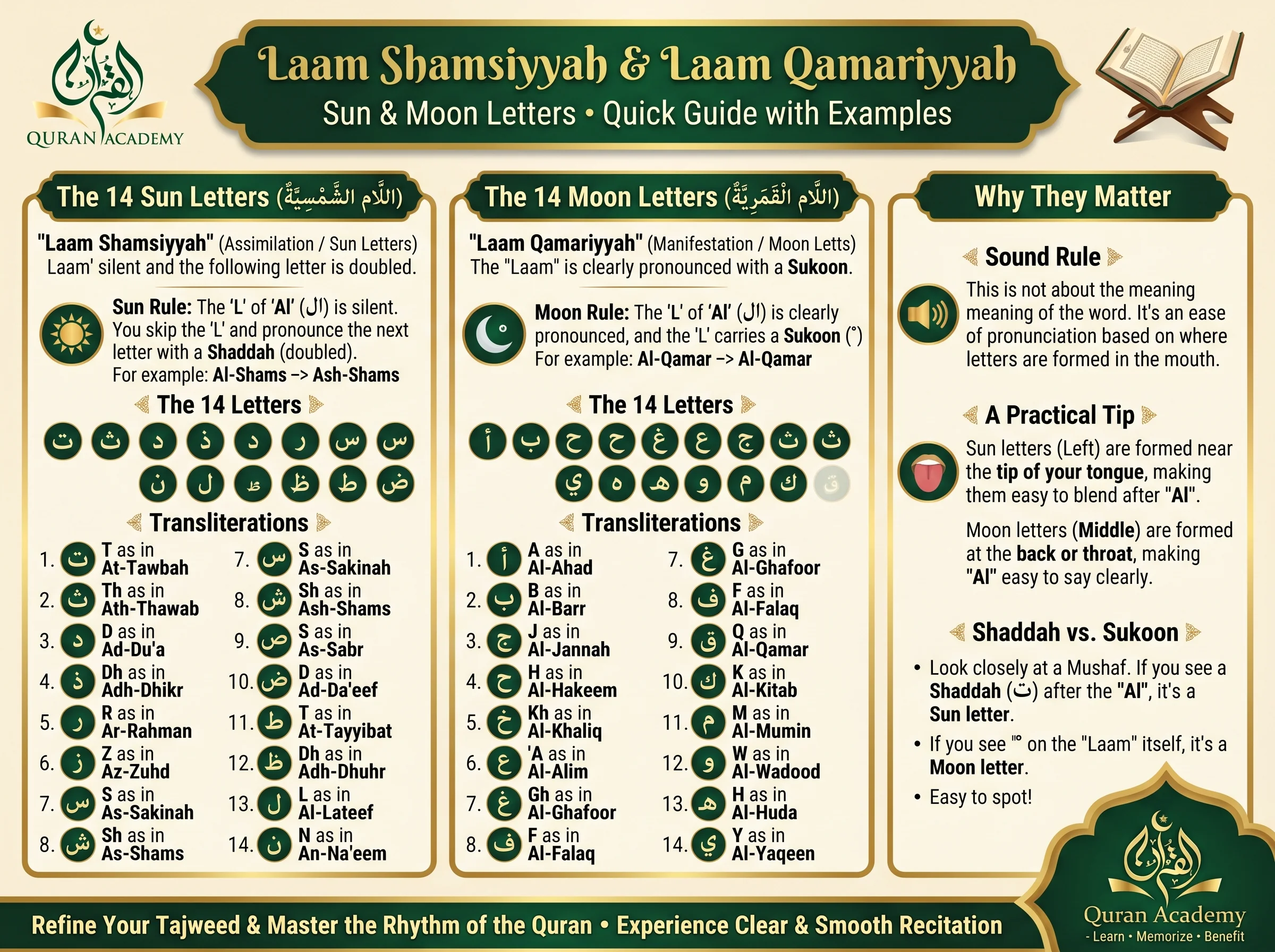
Mastering Laam Shamsiyyah and Laam Qamariyyah rules (اللَّامُ الشَّمْسِيَّةُ وَاللَّامُ الْقَمَرِيَّةُ — The Sun and Moon Letters of the Arabic Definite Article "Al-") is the bridge that takes a beginner from spelling individual letters to reading connected Quranic verses fluently. The 28 letters of the Arabic alphabet are split evenly into two groups of 14 letters: when الـ (Al-) comes before any of the 14 Moon Letters (الحروف القمرية), the Laam is pronounced clearly with a Sukoon (إِظْهَارٌ قَمَرِيٌّ — Izhar Qamari, as in الْقَمَرُ = Al-Qamar); when الـ comes before any of the 14 Sun Letters (الحروف الشمسية), the Laam is written but completely silent, merging 100% into the following letter with a Shaddah (إِدْغَامٌ شَمْسِيٌّ — Idgham Shamsi, as in الشَّمْسُ = Ash-Shams). In our 1-on-1 Online Noorani Qaida & Beginner Reading Course, kids and adults master this rule in a single class!
- The 2-Second Mushaf Visual Trick: Look at the Laam—if it has a Sukoon sign (لْ) on top, pronounce the Laam (Moon Letter); if the Laam is bare and the next letter has a Shaddah (ل + ـّ), skip the Laam completely (Sun Letter)!
- The 14 Moon Letters Mnemonic (Tuhfat al-Atfal): Memorize the 4-word phrase ابْغِ حَجَّكَ وَخَفْ عَقِيمَهُ (Ibrigh Hajjaka wa Khaf 'Aqeemah — أ ب غ ح ج ك و خ ف ع ق ي م هـ).
- The 14 Sun Letters (All Tongue-Tip/Edge Letters!): ت ث د ذ ر ز س ش ص ض ط ظ ل ن—every single one is articulated near the Laam on the tongue!
- Why "Ash-Shams" & "Al-Qamar"? In the word Ash-Shams (The Sun), the bright sun "outshines/hides" the sound of the Laam; in Al-Qamar (The Moon), the gentle moonlight lets the Laam shine clearly alongside it!
Look at the very first page of the Holy Quran—Surah Al-Fatihah—and count how many times the Arabic definite article الـ ("The") appears across just seven verses: اللَّهِ، الرَّحْمَٰنِ، الرَّحِيمِ، الْحَمْدُ، الْعَالَمِينَ، الدِّينِ، الصِّرَاطَ، الْمُسْتَقِيمَ، الَّذِينَ، الْمَغْضُوبِ، الضَّالِّينَ! On Page 1 alone, your tongue encounters Laam at-Ta'reef more than a dozen times.
Yet when children and adult beginners first transition from learning individual letters in our Noorani Qaida vs. Noor Al-Bayan Reading Curriculum to reciting connected Quranic words, two classic mistakes happen. Either the student pronounces the silent Laam in Ar-Rahmaan and reads it clumsily as "Al-Rahmaan" ❌ and "Al-Shams" ❌; or they accidentally merge the Moon Laam in Al-Jannah and read it as "Aj-Jannah" ❌! Just as we simplified the 8 cases of heavy and light Raa in our Complete Ahkam Al-Raa Tajweed Guide, this guide gives you and your child the complete 14 Sun & 14 Moon Letters Master Charts, the phonetic secret behind why they behave differently, and the 2-second visual shortcut in the Uthmani Mushaf.
- What Is "Laam At-Ta'reef" (الـ), and Why Does It Split Into Sun & Moon Letters?
- Part 1: The 14 Moon Letters (Laam Qamariyyah / Izhar Qamari) & The 4-Word Mnemonic
- Part 2: The 14 Sun Letters (Laam Shamsiyyah / Idgham Shamsi) & Quranic Examples
- The 2-Second Uthmani Mushaf Visual Trick (How Kids Spot the Rule Without Memorizing 28 Letters!)
- 5 Common Tajweed Mistakes With Laam Qamariyyah & Laam Shamsiyyah (And How to Fix Them)
- Frequently Asked Questions (FAQs)
1. What Is "Laam At-Ta'reef" (الـ), and Why Does It Split Into Sun & Moon Letters?
In Arabic grammar—as we explain in our Quranic Arabic Grammar Guide and our Interactive Tajweed Encyclopedia—an indefinite noun like كِتَابٌ (Kitaabun — "a book") becomes definite when we attach the prefix الـ (Al- — "the book" = الْكِتَابُ). In Tajweed scholarship, this silent Laam Sakinah is called لَامُ آلِ التَّعْرِيفِ (Laam Al-Ta'reef).
Why Did the Arabs Pronounce "Al-" in Some Words and Merge It in Others? The answer lies directly in our Makharij al-Huruf (Articulation Points of Arabic Letters) Guide:
- 🌙 1. Distance Causes Clear Pronunciation (Izhar Qamari — إِظْهَارٌ قَمَرِيٌّ): The letter Laam (ل) exits from the front edge and tip of the tongue touching the upper gums. Whenever the first letter of the noun exits far away from the tongue tip—such as from the throat (أ هـ ع ح غ خ), the lips (ب م و ف), the deep/middle tongue (ق ك ج ي)—your tongue has plenty of space to tap the Laam clearly before articulating the next letter!
- ☀️ 2. Closeness Causes Complete Assimilation (Idgham Shamsi — إِدْغَامٌ شَمْسِيٌّ): Whenever the first letter of the noun is Laam itself (ل) or one of the 13 other letters that exit right next to the Laam on the tip/edges of the tongue (ت ث د ذ ر ز س ش ص ض ط ظ ن), lifting the tongue twice in the exact same spot feels heavy and awkward—so the silent Laam merges 100% into its neighbor, which then takes a Shaddah (ـّ)!
2. Part 1: The 14 Moon Letters (Laam Qamariyyah / Izhar Qamari) & The 4-Word Mnemonic
In Verse 24 of his famous Tajweed poem Tuhfat al-Atfal, Imam Sulayman Al-Jamzuri gathered all 14 Moon Letters into a single, meaningful 4-word Arabic sentence that every Tajweed student memorizes in 10 seconds:
« ابْغِ حَجَّكَ وَخَفْ عَقِيمَهُ » (Ibrigh Hajjaka wa Khaf 'Aqeemah — "Seek your Hajj, and fear that which invalidates it/makes it fruitless!")
Open our Online Uthmani Quran Explorer and trace all 14 Moon Letters in the master chart below:
| # & Moon Letter | Articulation Zone | Quranic Example (With لْ) | Correct Pronunciation & Surah Reference |
|---|---|---|---|
| 1. Hamzah (أ / ء) | Deepest Throat | الْأَرْضِ • الْأَوَّلُ • الْأَبْرَارِ | Al-Ardi (2:11) • Pronounce both the Laam and the crisp Hamzah! |
| 2. Baa' (ب) | The Two Lips | الْبَيْتِ • الْبَقَرَةِ • الْبَارِئُ | Al-Bayti (106:3) • Tap the Laam on the gums, then close the lips for Baa. |
| 3. Ghayn (غ) | Upper Throat | الْغَيْبِ • الْغَفُورُ • الْغَاشِيَةِ | Al-Ghaybi (2:3) • Keep the Laam light before the heavy throat Ghayn! |
| 4. Haa' (ح) | Middle Throat | الْحَمْدُ • الْحَيُّ • الْحَكِيمُ | Al-Hamdu (1:2) • The very first Moon Laam in Surah Al-Fatihah! |
| 5. Jeem (ج) ⭐ | Middle Tongue | الْجَنَّةِ • الْجِبَالُ • الْجُمُعَةِ | Al-Jannati (2:35) • Caution: Never swallow the Laam into "Aj-Jannah" ❌! |
| 6. Kaaf (ك) | Back of Tongue | الْكِتَابُ • الْكَوْثَرَ • الْكَبِيرُ | Al-Kitaabu (2:2) • Clear Moon Laam followed by light Kaaf. |
| 7. Waw (و) | The Two Lips | الْوَدُودُ • الْوَاقِعَةُ • الْوَكِيلُ | Al-Wadoodu (85:14) • Tap the Laam before rounding the lips for Waw. |
| 8. Khaa' (خ) | Upper Throat | الْخَبِيرُ • الْخَالِقُ • الْخَنَّاسِ | Al-Khannaasi (114:4) • Keep the Laam light before the heavy Khaa'. |
| 9. Faa' (ف) | Lower Lip + Teeth | الْفَلَقِ • الْفَجْرِ • الْفَوْزُ | Al-Falaqi (113:1) • Clear Moon Laam in Surah Al-Falaq! |
| 10. 'Ayn (ع) | Middle Throat | الْعَالَمِينَ • الْعَصْرِ • الْعَظِيمُ | Al-'Aalameen (1:2) • Smooth transition from tongue tip to middle throat. |
| 11. Qaaf (ق) 🌙 | Deepest Tongue | الْقَمَرُ • الْقُرْآنُ • الْقَيُّومُ | Al-Qamaru (54:1) • The namesake of Laam Qamariyyah! |
| 12. Yaa' (ي) | Middle Tongue | الْيَوْمِ • الْيَتِيمَ • الْيَقِينُ | Al-Yateema (93:9) • Clear Laam before the middle-tongue Yaa'. |
| 13. Meem (م) | The Two Lips | الْمُلْكُ • الْمُؤْمِنُونَ • الْمُسْتَقِيمَ | Al-Mulku (67:1) • Tap the Laam cleanly before closing lips for Meem. |
| 14. Haa' (هـ) | Deepest Throat | الْهُدَىٰ • الْهَادِي • الْهُمَزَةِ | Al-Hudaa (2:16) • Clear Moon Laam before the soft throat Haa'. |
3. Part 2: The 14 Sun Letters (Laam Shamsiyyah / Idgham Shamsi) & Quranic Examples
The remaining 14 letters of the Arabic alphabet are the Sun Letters (الْحُرُوفُ الشَّمْسِيَّةُ)—gathered by Imam Al-Jamzuri as the first letter of each word in his poetic couplet: طِبْ ثُمَّ صِلْ رَحِمًا تَفُزْ ضِفْ ذَا نِعَمْ • دَعْ سُوءَ ظَنٍّ زُرْ شَرِيفًا لِلْكَرَمْ. Even easier for kids and beginners: notice that the 14 Sun Letters consist of 6 sibling pairs + 2 neighbor letters (ل and ن)! Trace all 14 below:
| Sun Pair / Group | The Sun Letters | Quranic Examples (Laam Is Bare + Shaddah!) | How It Sounds (Laam Is 100% Silent!) |
|---|---|---|---|
| Pair 1 (1 & 2) | ت • ث | التَّوَّابُ • التِّينِ • الثَّاقِبُ • الثَّمَرَاتِ | At-Tawwaab • Ath-Thaaqib (86:3) |
| Pair 2 (3 & 4) | د • ذ | الدِّينِ • الدُّنْيَا • الذِّكْرَ • الذَّارِيَاتِ | Ad-Deen (1:4) • Adh-Dhikr (15:9) |
| Pair 3 (5 & 6) | ر • ز | الرَّحْمَٰنِ • الرَّحِيمِ • الزَّكَاةَ • الزَّيْتُونِ | Ar-Rahmaan (1:3) • Az-Zaytoon (95:1) |
| Pair 4 (7 & 8) ☀️ | س • ش | السَّمَاءِ • السَّلَامُ • الشَّمْسِ • الشَّاكِرِينَ | As-Samaa' • Ash-Shams (91:1 — Namesake!) |
| Pair 5 (9 & 10) | ص • ض | الصِّرَاطَ • الصَّمَدُ • الضَّالِّينَ • الضُّحَىٰ | As-Siraat (1:6) • Ad-Duhaa (93:1) |
| Pair 6 (11 & 12) | ط • ظ | الطَّارِقِ • الطَّامَّةُ • الظَّالِمِينَ • الظُّلُمَاتِ | At-Taariq (86:1) • Adh-Dhaalimeen |
| Pair 7 (13 & 14) 🏆 | ل • ن | اللَّيْلِ • اللَّطِيفُ • النَّاسِ • النُّورُ | Al-Layl (92:1 — Double Laam!) • An-Naas (114:1 — 2-Beat Ghunnah!) |
4. The 2-Second Uthmani Mushaf Visual Trick (How Kids Spot the Rule Instantly!)
Here is the best news for parents and teachers using our 1-on-1 Online Kids Quran Classes and our Islamic Reward Charts for Kids: when reading from the standard Madinah / Uthmani Mushaf, your child does not even need to pause and count the 28 letters in their head! The scholars of Mushaf calligraphy (Dabt al-Mushaf) placed a built-in visual traffic light on every single الـ in the Quran:
Look for the Sukoon Hat Above the Laam (لْ)!
In every Moon Word (like الْقَمَرُ, الْحَمْدُ, الْمُلْكُ), you will see the small Mushaf Sukoon sign (shaped like the head of a small حـ) sitting right on top of the Laam (لْ), and NO Shaddah on the next letter! Rule for kids: "When the Laam wears its Sukoon hat, pronounce the Laam clearly!"
Bare Laam + Shaddah on the Next Letter (ل + ـّ)!
In every Sun Word (like الشَّمْسُ, الرَّحْمَٰنِ, النَّاسِ), the Laam is completely naked/bare (zero vowel and zero Sukoon), and the letter immediately after it wears a Shaddah (ـّ)! Rule for kids: "When the Laam is bare, jump straight from the previous vowel to the Shaddah!"
Struggling to perfect your Recitation?
Join hundreds of students mastering the Quran with our Verified Al-Azhar Graduates. We offer flexible 1-on-1 sessions tailored to your schedule.
Book a Free Evaluation Class →Never Bounce a Moon Laam! (How Qalqalah Differs From Laam Sakinah)
One of the most common mistakes beginners make on Laam Qamariyyah—in words like الْحَمْدُ (Al-Hamdu), الْمُلْكُ (Al-Mulku), and الْقَمَرُ (Al-Qamaru)—is bouncing the tongue off the gums and adding an extra vowel sound ("Al-a-Hamdu" ❌) as if the Laam were one of the 5 Qalqalah (Echoing) letters (ق ط ب ج د)! Watch Senior Instructor Ustadhah Yasmeen Gamal demonstrate true Qalqalah vs. steady non-Qalqalah consonants on our Quran Academy YouTube Channel:
- Hold the Laam With Tawassut: Keep the tongue tip pressed gently on the gums for Alْ-Hamdu without bouncing it!
- 1-on-1 Live Coaching: Master Noorani Qaida and Tajweed with our Al-Azhar scholars!
5. Five Common Tajweed Mistakes With Laam Qamariyyah & Laam Shamsiyyah
Before you practice reading today in our 1-on-1 Online Tajweed Course, watch out for these five classic pronunciation traps explained in our Sifaat al-Huruf Guide and Heavy & Light Letters Guide:
- 1. Accidentally Merging the Moon Laam Into "Jeem" (الْجَنَّةِ • الْجِبَالُ • الْجَحِيمِ):
Because the middle-tongue letter Jeem (ج) is articulated fairly close to the front palate in some dialects, many reciters accidentally turn الْجَنَّةِ (Al-Jannah) into a Sun Laam ("Aj-Jannah" ❌)! Remember the mnemonic Ibrigh Hajjaka: ج is a Moon Letter, so always pronounce the Laam clearly first! - 2. Forgetting the 2-Beat Nasal Ghunnah When the Sun Letter Is "Noon" (النَّاسِ • النُّورُ • النَّارِ):
As we learned in our Noon Sakinah & Tanween Guide and Meem Sakinah Guide, when the Laam Shamsiyyah merges into the letter Noon (ن), it produces a Noon Mushaddadah (نّ)! Therefore, in words like بِرَبِّ النَّاسِ (Bi-Rabbin-nnnaas) and النَّجْمُ, you must hold a rich 2-beat nasal Ghunnah on the Noon! - 3. Making the Moon Laam Heavy Before a Heavy Letter (الْقَمَرُ • الْخَبِيرُ • الْغَفُورُ):
In Arabic Tajweed, the only Laam that ever becomes heavy is the Laam in the Majestic Name اللَّهُ (Allaah) after a Fatha or Damma. Every other Laam—including the Moon Laam in الْقَمَرُ (Al-Qamar) and الْبَاطِلُ (Al-Baatil)—must remain 100% Light (Tarqeeq)! - 4. Pronouncing the Hamzatul-Wasl (ا) in the Middle of Connected Speech:
Whether a word has a Sun Laam or a Moon Laam, the initial Alif of الـ is a Hamzatul-Wasl: you only pronounce it as "A-" when starting on that word (Al-Hamdu), and you drop it completely when connecting from a previous word (e.g., بِسْمِ اللَّهِ الرَّحْمَٰنِ الرَّحِيمِ = Bismil-laahir-Rahmaanir-Raheem, and رَبِّ الْعَالَمِينَ = Rabbil-'Aalameen)! - 5. Shortening the 6-Beat Madd Lazim Before a Sun Laam (آلْآنَ • آلذَّكَرَيْنِ • آللَّهُ):
As we explained in our Rules of Madd in Tajweed, when a question Hamzah (أَ) enters upon a Sun or Moon word in the 3 famous Quranic words آلذَّكَرَيْنِ (6:143–144), آلْآنَ (10:51, 91), and آللَّهُ (10:59, 27:59), you stretch it for 6 full beats (Madd Lazim) (or apply Tashil) so the question is never confused with a statement!
Practice spotting Sun and Moon Letters today across our most popular Surah guides—starting with Surah Ad-Duha (Sun Laam!) & Ash-Sharh (Sun Laam!), The 3 Quls (Al-Ikhlas & Al-Falaq = Moon Laams; An-Nas = Sun Laam with Ghunnah!), Ayatul Kursi (Al-Hayyu Al-Qayyoom = Moon Laams!), Last 2 Verses of Surah Al-Baqarah (Ar-Rasoolu = Sun Laam; Al-Mu'minoon = Moon Laam!), Surah Ar-Rahman (Sun Laam!), Surah Al-Waqi'ah (Moon Laam!), Surah Ya-Sin, Surah Maryam, Surah Yusuf, Surah Luqman, Surah Al-Hujurat (Moon Laam!), and Surah As-Sajdah (Sun Laam!) & Al-Insan (Moon Laam!)! You will also encounter dozens of Sun and Moon words in our Top 50 High-Frequency Quranic Words, Morning & Evening Adhkar, 40 Rabbana Duas, Wudu & Tayammum Guide, Sujood As-Sahw Guide, Salat Al-Istikharah Guide, Salat Al-Janazah Guide, 5 Pillars of Islam, and 25 Prophets in the Quran! Whether you are learning with our Al-Azhar Certified Tutors in our Online Hifz Program (using our Smart Hifz Planner) or printing our Free Kids Star Chart, see how families across the West rate our teachers on our Verified Student & Parent Reviews Page.
6. Frequently Asked Questions (FAQs) About Laam Shamsiyyah & Laam Qamariyyah
1. What is the main difference between Laam Shamsiyyah and Laam Qamariyyah?
Both are forms of the Arabic definite article الـ (Al- / Laam at-Ta'reef). In Laam Qamariyyah (Moon Laam, e.g., الْقَمَرُ = Al-Qamar), the Laam is pronounced clearly (Izhar Qamari) before the 14 Moon Letters. In Laam Shamsiyyah (Sun Laam, e.g., الشَّمْسُ = Ash-Shams), the Laam is written but completely silent, merging directly into the following letter with a Shaddah (Idgham Shamsi) before the 14 Sun Letters.
2. What are the 14 Moon Letters (Al-Huruf Al-Qamariyyah) and their mnemonic phrase?
The 14 Moon Letters are: أ، ب، غ، ح، ج، ك، و، خ، ف، ع، ق، ي، م، هـ. In Tuhfat al-Atfal, Imam Al-Jamzuri gathered all 14 letters into the famous 4-word mnemonic phrase: « ابْغِ حَجَّكَ وَخَفْ عَقِيمَهُ » (Ibrigh Hajjaka wa Khaf 'Aqeemah).
3. What are the 14 Sun Letters (Al-Huruf Ash-Shamsiyyah)?
The 14 Sun Letters are: ت، ث، د، ذ، ر، ز، س، ش، ص، ض، ط، ظ، ل، ن (easy to remember as 6 sibling pairs—ت/ث، د/ذ، ر/ز، س/ش، ص/ض، ط/ظ—plus the 2 tongue-tip neighbors ل and ن!).
4. How can you spot Laam Shamsiyyah vs. Laam Qamariyyah instantly in the Uthmani Mushaf?
In the Uthmani Mushaf, a Laam Qamariyyah always has a small Sukoon sign (لْ) written directly above the Laam, telling you to pronounce it clearly. A Laam Shamsiyyah is completely bare (no Sukoon on the Laam) and the letter immediately after it always carries a Shaddah (ـّ), telling you to skip the Laam and double the next letter!
5. Why do the 14 Sun Letters merge with the Laam while the 14 Moon Letters do not?
The phonetic reason is articulation distance (Makharij al-Huruf): the 14 Sun Letters are all articulated from the tip or edges of the tongue—either identical to the Laam (like ل) or very close to the Laam's articulation point—making assimilation (Idgham) smooth and natural. The 14 Moon Letters are articulated far from the tongue tip (from the throat, lips, or deep/middle tongue), making clear pronunciation (Izhar) natural.
Help Your Child Read the Quran Fluently With an Al-Azhar Scholar!
From mastering Sun and Moon letters in Noorani Qaida to reciting the entire Mushaf with flawless Tajweed, our certified male and female Al-Azhar teachers make every lesson engaging. Book your free trial class today!
Book Your Free 1-on-1 Trial Class →