
✦ Quick Answer & Key Takeaways: The 7 Alifs in the Quran (Al-Alifat As-Sab')
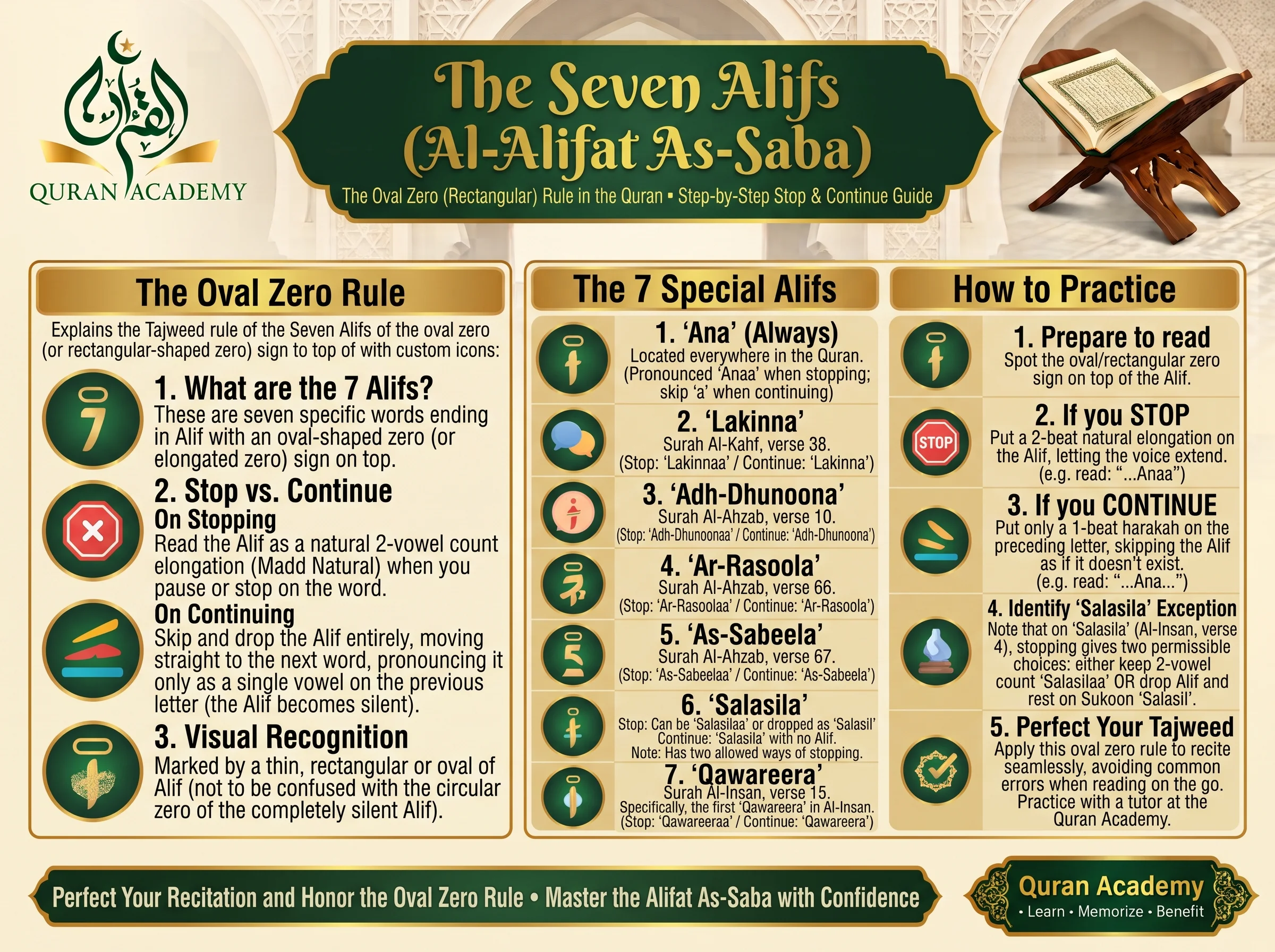
Mastering the seven Alifs in the Quran Tajweed rule (الْأَلِفَاتُ السَّبْعُ فِي الْقُرْآنِ) prevents one of the most common hidden pronunciation mistakes in Hafs 'an 'Asim: stretching an Alif when continuing across words where it must be dropped! In the Uthmani Mushaf, these 7 specific words end with an Alif crowned by a tall, upright oval zero (الصِّفْرُ الْمُسْتَطِيلُ الْقَائِمُ: ۠). Their golden rule is four Arabic words: « تَثْبُتُ وَقْفًا وَتَسْقُطُ وَصْلًا »—meaning the Alif is pronounced as a 2-beat Madd Tabee'i ONLY when you stop on the word (Waqf), and is 100% dropped (leaving only a short Fatha) when you continue into the next word (Wasl)! In our 1-on-1 Online Tajweed Course, students master all 7 words alongside the contrast between the oval zero and the round circle in a single interactive session!
- The Complete List of the 7 Alifs: (1) أَنَا۠ (Ana — wherever it occurs), (2) لَّٰكِنَّا۠ (Al-Kahf 18:38), (3) ٱلظُّنُونَا۠ (Al-Ahzab 33:10), (4) ٱلرَّسُولَا۠ (Al-Ahzab 33:66), (5) ٱلسَّبِيلَا۠ (Al-Ahzab 33:67), (6) قَوَارِيرَا۠ (1st one in Al-Insan 76:15), and (7) سَلَٰسِلَا۠ (Al-Insan 76:4).
- Oval Zero (۠) vs. Round Circle (ْ): Oval Zero (Sifr Mustateel) = Pronounce on Stop, Drop on Continuation; Round Circle (Sifr Mustadeer) = Drop on BOTH Stop and Continuation!
- The #1 Daily Trap ("Ana"): Never stretch the Alif of أَنَا۠ (I) when continuing (say "Wa laa ana 'aabidun" with a short Fatha on the Noon, NOT "Wa laa anaa 'aabidun" ❌!).
- The Dual-State Exception on Stop ("Salaasilaa" — 76:4): When stopping on سَلَٰسِلَا۠, you may either stop on a silent Laam (Salaasilْ) or with a 2-count Alif (Salaasilaa)!
Open Surah Al-Kafirun (Chapter 109, Verse 4)—a Surah that almost every Muslim child and adult knows by heart—and listen to how most people recite Verse 4: وَلَا أَنَا۠ عَابِدٌ مَّا عَبَدتُّمْ. Because the pronoun أَنَا (Ana — "I") is written with a tall Alif at the end, 9 out of 10 untrained reciters stretch that Alif for two beats in the middle of the verse and say: "Wa laa anaa 'aabidum-maa 'abadtum" ❌!
Yet if you look closely at the top of the Alif in أَنَا۠ inside the Uthmani Mushaf, you will spot a tiny upright oval zero (۠)—warning you that stretching that Alif while continuing is a pronunciation error! Just as we unlocked the secrets of The 4 Special Words of Hafs 'an 'Asim (Sakta, Imalah, Ishmam & Tashil), Ahkam Al-Raa, Laam Shamsiyyah & Qamariyyah, and Hamzatul Wasl vs. Hamzatul Qat', this complete guide breaks down all 7 Alifs in the Quran (Al-Alifat As-Sab'), contrasts the oval zero with the round circle, and shows you the 4 look-alike words where you must never drop the Alif.
- The Visual Key: Oval Zero (Sifr Mustateel ۠) vs. Round Circle (Sifr Mustadeer ْ) in the Mushaf
- Master Chart: All 7 Alifs in the Quran (Surah, Verse, Wasl Rule & Waqf Rule)
- Deep Dive Part 1: "Ana" (أَنَا۠) & "Laakinna" (لَّٰكِنَّا۠ in Surah Al-Kahf 18:38) + 4 Look-Alike Traps!
- Deep Dive Part 2: The 3 Rhyming Words of Surah Al-Ahzab & The 2 Gems of Surah Al-Insan
- How Ijazah Examiners Test the 7 Alifs (And Why "Thumoodaa" Is #8 in Round-Zero Form!)
- Frequently Asked Questions (FAQs)
1. The Visual Key: Oval Zero (Sifr Mustateel ۠) vs. Round Circle (Sifr Mustadeer ْ)
Before we examine the 7 words individually, every Quran reader—as we explain in our Interactive Tajweed Encyclopedia—must distinguish between three small symbols that appear above letters in the Uthmani Mushaf:
Shaped like a tall English zero (0), it appears ONLY over an Alif in the 7 Alifs of the Quran! Rule: Pronounce the Alif for 2 beats when STOPPING (Waqf), and drop it completely when CONTINUING (Wasl)!
Shaped like a perfectly round circle (over Alif, Waw, or Yaa, as in قَالُواْ, أُوْلَٰئِكَ, or the 2nd قَوَارِيرَاْ). Rule: 100% SILENT and dropped BOTH when continuing AND when stopping!
Shaped like the open head of a tiny حـ (not a closed circle!), it indicates a normal pronounced consonant with Sukoon (Izhar), such as مَنْ آمَنَ or الْحَمْدُ!
2. Master Chart: All 7 Alifs in the Quran (Surah, Verse, Wasl Rule & Waqf Rule)
Open our Online Uthmani Quran Explorer and trace all 7 Alifs in the Quran—occurring in 4 chapters (All across the Quran for "Ana", plus Surah Al-Kahf, Surah Al-Ahzab, and Surah Al-Insan):
| # & Word | Surah & Verse Location | ▶️ When Continuing (Wasl) | ⏹️ When Stopping (Waqf) |
|---|---|---|---|
| 1. أَنَا۠ (Ana — "I") |
Everywhere in the Quran (68x, e.g., 2:258, 18:34, 109:4) | Drop the Alif! (Read with short Fatha: أَنَ = Ana) |
Keep 2-Beat Alif! (Read as: أَنَا = Anaa) |
| 2. لَّٰكِنَّا۠ (Laakinna) |
Surah Al-Kahf (18:38) لَّٰكِنَّا۠ هُوَ اللَّهُ رَبِّي |
Drop the Alif! (Read: Laakinna Huwallaahu) |
Keep 2-Beat Alif! (Read: Laakinnaa) |
| 3. ٱلظُّنُونَا۠ (Adh-Dhunoona) |
Surah Al-Ahzab (33:10) وَتَظُنُّونَ بِاللَّهِ ٱلظُّنُونَا۠ ﴿١٠﴾ |
Drop the Alif! (Read: Adh-Dhunoona hunaalika) |
Keep 2-Beat Alif! (End of Ayah: Adh-Dhunoonaa) |
| 4. ٱلرَّسُولَا۠ (Ar-Rasoola) |
Surah Al-Ahzab (33:66) أَطَعْنَا اللَّهَ وَأَطَعْنَا ٱلرَّسُولَا۠ ﴿٦٦﴾ |
Drop the Alif! (Read: Ar-Rasoola wa qaaloo) |
Keep 2-Beat Alif! (End of Ayah: Ar-Rasoolaa) |
| 5. ٱلسَّبِيلَا۠ (As-Sabeela) |
Surah Al-Ahzab (33:67) فَأَضَلُّونَا ٱلسَّبِيلَا۠ ﴿٦٧﴾ |
Drop the Alif! (Read: As-Sabeela Rabbanaa) |
Keep 2-Beat Alif! (End of Ayah: As-Sabeelaa) |
| 6. قَوَارِيرَا۠ (1st) (Qawareera) |
Surah Al-Insan (76:15) كَانَتْ قَوَارِيرَا۠ ﴿١٥﴾ |
Drop the Alif! (Read: Qawareera qawareera) |
Keep 2-Beat Alif! (End of Ayah: Qawareeraa) |
| 7. سَلَٰسِلَا۠ 🏆 (Salaasila) |
Surah Al-Insan (76:4) إِنَّا أَعْتَدْنَا لِلْكَافِرِينَ سَلَٰسِلَا۠ وَأَغْلَالًا |
Drop the Alif! (Read: Salaasila wa aghlaalan) |
2 Valid Options (Jawaz al-Wajhayn): 1. Salaasilْ (Silent Laam — Preferred) 2. Salaasilaa (2-Beat Alif) |
3. Deep Dive Part 1: "Ana" (أَنَا۠) & "Laakinna" (لَّٰكِنَّا۠) + The 4 Look-Alike Traps!
Let us look closely at the first two words on the list—because both revolve around the first-person pronoun أَنَا۠ ("I"):
- 1. Why "Laakinnaa" (لَّٰكِنَّا۠) in Surah Al-Kahf (18:38) Has the Exact Same Rule as "Ana":
As we explained in our Quranic Arabic Grammar Guide, the word لَّٰكِنَّا۠ هُوَ اللَّهُ رَبِّي in the Story of the Two Gardens (Surah Al-Kahf 18:38) is actually a contraction of two words: لَٰكِنْ + أَنَا۠ (Laakin + Ana = "But as for me, He is Allah, my Lord!")! The Hamzah of Ana was dropped and the two Noons merged into a single Noon with a 2-beat Ghunnah (لَّٰكِنَّا۠)—so its final Alif is literally the Alif of Ana! - 2. ⚠️ Warning: The 4 Look-Alike Words Where You Must NEVER Drop the Alif!
Beginners who learn to drop the Alif of أَنَا۠ (Ana) sometimes accidentally drop the Alif in four other Quranic words that contain the letters أ-ن-ا—even though they are not the pronoun "I" and have NO oval zero on top! Always keep the full 2-beat Alif in:
• آنَاءَ (Aanaa'a — "Hours of the night", e.g., Aanaa'al-layli in 3:113 & 20:130).
• إِنَاهُ (Inaahu — "Its cooking perfection" in Surah Al-Ahzab 33:53: Ghayra naadhireena inaahu).
• أَنَابَ / وَأَنَابَ (Anaaba — Past-tense verb "He turned in repentance", e.g., in Surah Luqman 31:15 & Surah Sad 38:24).
• أَنَاسِيَّ (Anaasiyya — "People/Human beings" in Surah Al-Furqan 25:49: Wa anaasiyya katheeraa)!
4. Deep Dive Part 2: The 3 Rhyming Words of Surah Al-Ahzab & The 2 Gems of Surah Al-Insan
As we teach in our Complete Quran Tafseer Guide, why did the remaining 5 words of Al-Alifat As-Sab' receive this special Alif? Look at the rhetorical beauty in both Surahs:
Struggling to perfect your Recitation?
Join hundreds of students mastering the Quran with our Verified Al-Azhar Graduates. We offer flexible 1-on-1 sessions tailored to your schedule.
Book a Free Evaluation Class →- 1. The 3 Verse-Endings of Surah Al-Ahzab (ٱلظُّنُونَا۠ 33:10 • ٱلرَّسُولَا۠ 33:66 • ٱلسَّبِيلَا۠ 33:67):
Notice that every single verse in Surah Al-Ahzab ends with a 2-count open Alif rhyme (Madd 'Iwad, like Wakeelaa, Sabeelaa, Kabeeraa). Because these three nouns (Adh-Dhunoona, Ar-Rasoola, As-Sabeela) are definite with الـ (so they cannot take Tanween!), the Arabic language adds an Alif of Musical Rhyme & Lamentation (ألف الإطلاق) at the end of the verse—picturing the long cry of regret on the Day of Judgment when the disbelievers wail: "Yaa laytanaa ata'nallaaha wa ata'nar-Rasoolaa... fa-adalloonas-Sabeelaa!" Because all three sit at the end of an Ayah, you naturally stop on them and pronounce their 2-beat Alif! - 2. The Contrast Between the Two "Qawareera" Words in Surah Al-Insan (76:15–16):
In our Friday Fajr guide to Surah As-Sajdah & Surah Al-Insan, we highlighted how Verse 15 ends with قَوَارِيرَا۠ (1st Qawareera — Oval Zero ۠), while Verse 16 begins immediately with قَوَارِيرَاْ مِن فِضَّةٍ (2nd Qawareera — Round Circle ْ)!
• On the 1st Qawareera (76:15): Pronounce the 2-count Alif when stopping at the end of the verse (Qawareeraa), and drop it if continuing (Qawareera).
• On the 2nd Qawareera (76:16): Because it has a Round Circle (ْ), drop the Alif both when continuing (Qawareera min fiddah) AND when stopping for a test (stopping on a silent, light Raa: Qawareerْ)!
Stopping on Round-Zero Words Like "Thumoodْ" (11:68): Qalqalah Kubra!
Did you know that the word ثَمُودَاْ (Thamood) in Surah Hud (11:68), Al-Furqan (25:38), Al-'Ankabut (29:38), and An-Najm (53:51) ends with an Alif carrying a Round Circle (ْ — Sifr Mustadeer)? Because that Alif is dropped even when stopping, stopping on ثَمُودَاْ lands directly on the silent Dal (دْ)—triggering a crisp Qalqalah Kubra bounce (Thamoodْ)! Watch Senior Instructor Ustadhah Yasmeen Gamal demonstrate Qalqalah on our Quran Academy YouTube Channel:
- Oval vs. Round Zero on Stop: Hear why As-Sabeelaa ends in an Alif while Thamoodْ ends in a Qalqalah Dal!
- 1-on-1 Live Coaching: Audit your Tajweed and Ijazah rules with our Al-Azhar scholars!
5. How Ijazah Examiners Test the 7 Alifs (Waqf Ikhtibari)
As we detailed in our guide on What Happens During an Online Quran Ijazah Exam and our Rules of Waqf in the Quran, how do examiners test whether you truly know the 7 Alifs? Through Al-Waqf Al-Ikhtibari (الْوَقْفُ الِاخْتِبَارِيُّ — The Testing Stop):
- 1. Asking You to Connect the Verse-Endings of Al-Ahzab (33:10, 66, 67) & Al-Insan (76:15):
Because Adh-Dhunoonaa, Ar-Rasoolaa, As-Sabeelaa, and Qawareeraa (76:15) sit at the ends of verses, everyone naturally stops on them with an Alif. So the examiner will say: "Now connect Verse 66 to Verse 67 without stopping!"—testing whether you remember to drop the Alif in Wasl (Wa ata'nar-Rasoola wa qaaloo)! - 2. Asking You to Stop Mid-Verse on "Ana" (أَنَا۠), "Laakinnaa" (18:38), or "Salaasilaa" (76:4):
Conversely, because Ana, Laakinnaa, and Salaasilaa occur in the middle of verses where everyone normally continues and drops the Alif, the examiner will say: "Stop for a test on لَّٰكِنَّا۠ or سَلَٰسِلَا۠!"—testing whether you pronounce the 2-count Alif on Laakinnaa and state both valid stopping options on Salaasilْ / Salaasilaa! - 3. What If "Ana" (أَنَا۠) Is Followed by a Hamzatul Qat' in the Next Word (e.g., أَنَا۠ أُحْيِي وَأُمِيتُ — 2:258)?
Students often ask: "Does أَنَا۠ أُحْيِي or أَنَا۠ أَوَّلُ الْمُسْلِمِينَ have a 4-beat Madd Ja'iz Munfasil?" NO! Why? Because in Hafs 'an 'Asim, the Alif of أَنَا۠ is 100% dropped when continuing—even before a Hamzah! So you read it with a crisp short Fatha on the Noon: Ana uhyee wa umeet (NOT Anaaaa uhyee ❌!).
With this guide, you have completed all 5 Advanced Tajweed Guides of Day 1 (Articles 76 to 80)—connecting the 7 Alifs with our Makharij al-Huruf Guide, Sifaat al-Huruf Guide, Heavy & Light Letters Guide, Rules of Madd, Noon Sakinah Rules, and Meem Sakinah Rules! Apply these rules today across our most popular Surah and Fiqh guides: Surah Ya-Sin, Surah Ar-Rahman, Surah Al-Waqi'ah, Surah Maryam, Surah Yusuf, Surah Al-Hujurat, Ayatul Kursi, Last 2 Verses of Surah Al-Baqarah, The 3 Quls, Surah Ad-Duha & Ash-Sharh, Morning & Evening Adhkar (where Wa anaa 'abduka in Sayyidul-Istighfar has a short Fatha on Ana!), 40 Rabbana Duas, Sujood As-Sahw, Salat Al-Istikharah, Salat Al-Janazah, Wudu & Tayammum, 5 Pillars of Islam, and 25 Prophets in the Quran! Whether you are studying with our Al-Azhar Certified Tutors in our Online Hifz Program (using our Smart Hifz Planner) or enrolling your child in our 1-on-1 Kids Quran Classes with our Printable Kids Star Chart, see how families across the US, UK, Canada, and Australia rate our teachers on our Verified Student & Parent Reviews Page.
6. Frequently Asked Questions (FAQs) About the 7 Alifs in the Quran
1. What are the 7 Alifs in the Quran (Al-Alifat As-Sab') in Hafs 'an 'Asim?
The 7 Alifs (الألفات السبع) are 7 specific Quranic words ending with an Alif marked by a tall oval zero (Sifr Mustateel) that is pronounced for 2 beats ONLY when stopping (Waqf) and dropped completely when continuing (Wasl): (1) Anaa (أَنَا۠ — wherever it occurs), (2) Laakinnaa (لَّٰكِنَّا۠ — Al-Kahf 18:38), (3) Adh-Dhunoonaa (ٱلظُّنُونَا۠ — Al-Ahzab 33:10), (4) Ar-Rasoolaa (ٱلرَّسُولَا۠ — Al-Ahzab 33:66), (5) As-Sabeelaa (ٱلسَّبِيلَا۠ — Al-Ahzab 33:67), (6) Qawareeraa (قَوَارِيرَا۠ — the 1st one in Al-Insan 76:15), and (7) Salaasilaa (سَلَٰسِلَا۠ — Al-Insan 76:4).
2. What is the difference between the oval zero (Sifr Mustateel) and the round circle (Sifr Mustadeer) in the Mushaf?
The tall oval zero (الصفر المستطيل القائم: ۠) means the Alif is dropped when continuing (Wasl) but PRONOUNCED for 2 counts when stopping (Waqf). The small round circle (الصفر المستدير: ْ) means the letter is 100% silent and dropped BOTH when continuing and when stopping!
3. Why is the Alif in the pronoun "Ana" (أَنَا۠) dropped when continuing in Quranic recitation?
In Hafs 'an 'Asim, the final Alif of the pronoun أَنَا۠ ("I") is an orthographic marker. When continuing into the next word, you drop the Alif and pronounce only a short Fatha on the Noon (e.g., "Ana nadheerun", NOT "Anaa nadheerun"), whereas if you stop on Ana, you pronounce a 2-count natural Alif ("Anaa").
4. What is the special rule when stopping on "Salaasilaa" in Surah Al-Insan (76:4)?
When continuing on سَلَٰسِلَا۠, the Alif is dropped (Salaasila wa aghlaalan). When stopping on it for a test, Hafs 'an 'Asim allows two valid options (Jawaz al-Wajhayn): (1) Stopping with a silent Laam without the Alif (Salaasilْ — preferred), or (2) Stopping with a 2-count Alif (Salaasilaa).
5. Are there other words that look like "Ana" (أَنَا) where the Alif is NOT dropped when continuing?
Yes! Never drop the Alif in the 4 verb/noun words that resemble Ana in spelling but have no oval zero over their Alif: (1) Aanaa'a (آنَاءَ — "hours of the night"), (2) Inaahu (إِنَاهُ — "its cooking perfection" in 33:53), (3) Anaaba (أَنَابَ — "he turned in repentance"), and (4) Anaasiyya (أَنَاسِيَّ — "people" in 25:49).
Master Every Symbol in the Mushaf With an Al-Azhar Scholar!
From the 7 Alifs to complete Ijazah mastery, our certified male and female Al-Azhar scholars guide your recitation verse by verse. Book your free 1-on-1 evaluation session today!
Book Your Free 1-on-1 Tajweed Trial Class →