
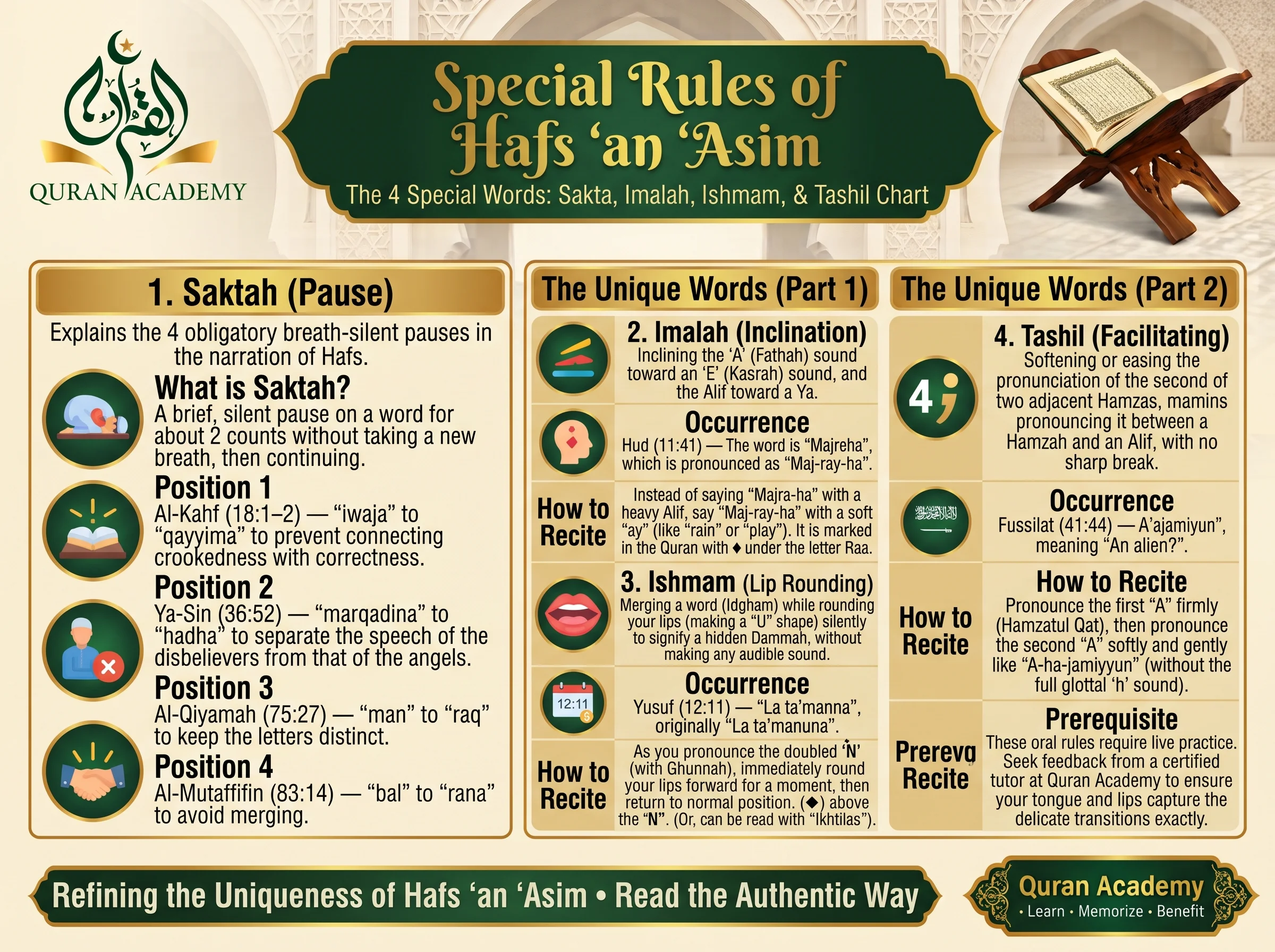
✦ Quick Answer & Key Takeaways: The 4 Special Words of Hafs 'an 'Asim
Mastering the 4 special words and rules of Hafs 'an 'Asim (أَحْكَامُ حَفْصٍ الْخَاصَّةُ) is the ultimate litmus test for any advanced Tajweed student preparing for an Online Quran Ijazah Exam. While 99.9% of the Quran follows standard Tajweed rules (like Nun Sakinah, Madd, and Raa), the transmission of Hafs via the Shatibiyyah route preserves four unique, exceptional phonetic phenomena that require precise physical delivery: (1) The 4 Obligatory Saktah (Silent Pauses) in Surah Al-Kahf, Yasin, Al-Qiyamah, and Al-Mutaffifin; (2) The single Imalah (Tilting) in Surah Hud (11:41); (3) The silent lip-rounding Ishmam in Surah Yusuf (12:11); and (4) The softened Tashil in Surah Fussilat (41:44). In our 1-on-1 Online Tajweed Course, certified Al-Azhar scholars train your tongue to master all four with flawless precision!
- Rule 1: The 4 Saktah (سَكْتَة): A brief, silent pause for roughly 2 beats without taking a fresh breath to protect the exact meaning of the verse.
- Rule 2: The Imalah in Surah Hud (11:41): Pronouncing مَجْرَاهَا as مَجْرِيهَا (Majreehaa) by tilting the Fatha toward Kasrah.
- Rule 3: The Ishmam in Surah Yusuf (12:11): Silently rounding your lips while pronouncing the nasal Noon of لَا تَأْمَنَّا (La ta'amunnaa).
- Rule 4: The Tashil in Surah Fussilat (41:44): Softening the second Hamzah in أَعَجَمِيٌّ (A-ajamiyyun) so it sounds halfway between a Hamzah and a soft Alif.
Imagine reciting the Holy Quran in front of an Ijazah-certified Grand Sheikh: you are reciting smoothly through Surah Al-Kahf or Surah Yasin, and suddenly you come across a tiny letter س (Seen) or سَكْتَة printed above a word. If you take a fresh breath where a pause is forbidden, or if you run two words together where a silent pause (Saktah) is mandatory, you alter the entire meaning of the Quranic verse in the sight of Allah!
Because the transmission of Hafs 'an 'Asim via the Shatibiyyah route is an exact, chain-linked oral tradition passed down generation by generation from the Prophet (ﷺ) to Ali ibn Abi Talib (RA) and Asim ibn Abi al-Najud, these four exceptional rules cannot be guessed—they must be learned and practiced precisely. Just as we mastered Ahkam Al-Raa and Hamzatul Wasl vs. Hamzatul Qat', this complete guide breaks down all 4 special rules with their Quranic ayah numbers, Tajweed rationale, and step-by-step physical execution.
- Rule 1: The 4 Obligatory Saktah (Silent Pauses Without Breathing) in the Quran
- Rule 2: The Single Imalah (Tilting Fatha Toward Kasrah) in Surah Hud (11:41)
- Rule 3: The Silent Lip-Rounding Ishmam in Surah Yusuf (12:11)
- Rule 4: The Softened Tashil (Between Hamzah & Alif) in Surah Fussilat (41:44)
- Why These 4 Rules Matter for Your Recitation & Ijazah Certification
- Frequently Asked Questions (FAQs)
1. Rule 1: The 4 Obligatory Saktah (Silent Pauses Without Breathing) in the Quran
Linguistically, As-Saktah (السَّكْتَةُ) means stopping the voice completely for roughly **2 beats (count of 1-2)** without taking any fresh breath (Bilaa tanaffus), and then immediately continuing. In the narration of Hafs 'an 'Asim via the Shatibiyyah route, there are exactly 4 obligatory Saktat marked in the Uthmani Mushaf with a small letter س (Seen) above the word:
| # & Surah Ref | Quranic Phrase (With سكتة) | Literal Meaning | Why the Saktah Is Mandatory (Tajweed Rationale) |
|---|---|---|---|
| 1. Surah Al-Kahf (18:1 – 2) |
عِوَجَا ۜ قَيِّمًا ٱًّلُّيُنذِرَ | "Crooked... upright—to warn..." | If you connect 'Iwajan to Qayyimaa without pausing, someone might mistakenly think "Qayyimaa" is an adjective describing "Crooked"! The pause clarifies that Qayyimaa is a new, independent description of the Book itself. |
| 2. Surah Yasin (36:52) |
مِن مَّرْقَدِنَا ۜ هَٰذَا مَا وَعَدَ | "From our sleeping place—this is what..." | This is the statement of the disbelievers rising from their graves in shock saying, *"Woe to us! Who raised us from our sleeping place?"*—after which the angels or Allah reply: *"This is what the Most Merciful promised!"* Pausing separates the disbelievers' speech from the divine reply. |
| 3. Surah Al-Qiyamah (75:27) |
وَقِيلَ مَنْ ۜ رَاقٍ | "And it is said: Who [can] cure / be a healer?" | Prevents the Nun Sakinah in Man from merging into the Raa of Raaqin via Idgham, preserving the crisp interrogative separation of "Who is the healer?" |
| 4. Surah Al-Mutaffifin (83:14) |
كَلَّا ۖ بَلْ ۜ رَانَ عَلَىٰ قُلُوبِهِمْ | "No! Rather, that which they committed has rusted upon their hearts." | Prevents the Laam in Bal from merging into the Raa of Raana, ensuring listeners understand: "No! It is NOT as they claim; rather, their sins have rusted upon their hearts." |
2. Rule 2: The Single Imalah (Tilting Fatha Toward Kasrah) in Surah Hud (11:41)
As we briefly noted in our Ahkam Al-Raa in Tajweed Guide, Al-Imalah (الْإِمَالَةُ — Tilting/Inclining) is the unique phonetic rule where you tilt the sound of a Fatha upward toward a Kasrah, and an Alif toward a Yaa. In the entire narration of Hafs 'an 'Asim, Imalah occurs in only one single word: the word مَجْرَاهَا (Majraahaa) in Surah Hud (11:41):
🌊 How to Pronounce "Majreehaa" in Surah Hud (11:41):
When Prophet Nuh (AS) commanded his followers to embark upon the Ark, he said: بِسْمِ اللَّهِ مَجْرَاهَا وَمُرْسَاهَا.
• The Standard Pronunciation (Tafkhim / Fatha): Normally, the Ra in Majraahaa would have a heavy Fatha and an open Alif (Maj-raa-haa).
• The Imalah Rule in Hafs: You pronounce the Ra with a tilted sound halfway between a Fatha and a Kasrah (مَجْرِيْهَا = Majreehaa), and you pronounce the Alif tilting toward a Yaa! In the Uthmani Mushaf, this is marked by a small hollow diamond sign (♦) written directly below the Ra letter.
3. Rule 3: The Silent Lip-Rounding Ishmam in Surah Yusuf (12:11)
Just as we explored Ishmam in our Surah Yusuf Story & 30-Day Hifz Guide, Al-Ishmam (الْإِشْمَامُ — Pouting/Lip-Rounding Indication) is one of the most fascinating physical movements in Tajweed. It appears in only one place in Hafs 'an 'Asim: the word لَا تَأْمَنَّا (La Ta'amunnaa) in Surah Yusuf (12:11) when the brothers say to their father Ya'qub (AS): "Why do you not trust us with Yusuf?":
👁️ Step-by-Step Execution of Ishmam in 12:11:
The word is originally written as **لَا تَأْمَنُنَا (La Ta'amununaa)** with two Noons (the first voweled with a Damma, and the second voweled with a Fatha). In Hafs, they are merged into a single Noon with a Shaddah (لَا تَأْمَنَّا). Because the first merged Noon originally carried a Damma, you must signal that hidden Damma visually without making any sound:
1. Pronounce the nasal Ghunnah of the merged Noon for 2 beats.
2. Simultaneously **round your lips into a small circle (like forming the English letter 'U' or Arabic Waw)** immediately after pronouncing the Noon.
3. *Crucial Rule:* This lip-rounding is **100% silent and invisible to a listener's ear**—it is purely a visual and tactile indicator for an Ijazah examiner watching your mouth!
Mastering Ishmam in Yusuf 12:11 & Tashil in Fussilat 41:44 Live!
Watch Senior Instructor Ustadhah Yasmeen Gamal demonstrate the exact mouth posture for the silent lip-rounding in La ta'amunnaa (Yusuf 12:11) and the softened middle-value Hamzah in A-ajamiyyun (Fussilat 41:44) on our Quran Academy YouTube Channel:
- Zero Sound on Ishmam: See why adding a vocal Damma sound on Ishmam fails the Ijazah test.
- 1-on-1 Live Coaching: Prepare for your Quran Ijazah exam with Al-Azhar scholars!
4. Rule 4: The Softened Tashil (Between Hamzah & Alif) in Surah Fussilat (41:44)
Al-Tashil (التَّسْهِيلُ — Easing/Softening) is the final special rule in Hafs 'an 'Asim. It appears in only one place in the entire Quran: the word أَعَجَمِيٌّ (A-ajamiyyun) in Surah Fussilat (41:44) when the disbelievers mockingly ask: "Why is this Quran recited in Arabic when the Prophet is an Arab speaking to a foreign people?":
Struggling to perfect your Recitation?
Join hundreds of students mastering the Quran with our Verified Al-Azhar Graduates. We offer flexible 1-on-1 sessions tailored to your schedule.
Book a Free Evaluation Class →🗣️ How to Pronounce "A-ajamiyyun" With Tashil:
Normally, saying two voweled Hamzahs back-to-back (A-a-jamiyyun) is very heavy on the tongue. In Hafs, the second Hamzah is softened (Tashil) so that it is pronounced "between a voweled Hamzah and a soft Alif" (sounding like a gentle, breathed sigh: A-aa-jamiyyun). In the Uthmani Mushaf, this is marked by a small dot or circle inside the second Alif.
5. Why These 4 Rules Matter for Your Recitation & Ijazah Certification
As we emphasize in our Online Quran Ijazah Guide, these four exceptional rules—the 4 Saktat, the Imalah in Hud, the Ishmam in Yusuf, and the Tashil in Fussilat—are the ultimate benchmark of authentic Sanad transmission. When an Ijazah examiner listens to your recitation, they will specifically wait for you to reach these four verses to verify whether you were trained by a qualified scholar who mastered the fine details of *Hafs 'an 'Asim*!
Combine your mastery of these advanced rules with daily recitation of our other specialized Tajweed guides: Ahkam Al-Raa, Laam Shamsiyyah & Qamariyyah, Hamzatul Wasl vs. Qat', Makharij al-Huruf, Sifaat al-Huruf, Heavy & Light Letters, Rules of Madd, Noon Sakinah Rules, Meem Sakinah Rules, and Rules of Waqf in our 1-on-1 Online Tajweed Course (and test your ear on our Free 3-Minute Tajweed Quiz!). Whether you are preparing for Ijazah or joining our Online Hifz Program (using our Smart Hifz Planner) with our Al-Azhar Certified Tutors, see how students worldwide rate our programs on our Verified Student Reviews Page!
6. Frequently Asked Questions (FAQs) About Hafs Special Rules
1. What are the 4 obligatory Saktah (silent pauses without breathing) in Hafs 'an 'Asim?
In the narration of Hafs 'an 'Asim via the Shatibiyyah route, there are 4 obligatory Saktah (pausing for roughly 2 beats without taking a fresh breath): (1) Surah Al-Kahf 18:1–2 ('Iwajan [saktah] qayyimaa), (2) Surah Yasin 36:52 (Marqadnaa [saktah] haadha), (3) Surah Al-Qiyamah 75:27 (Wa qiila [saktah] man raaq), and (4) Surah Al-Mutaffifin 83:14 (Kallaa [saktah] bal raana).
2. What is Imalah, and where does it occur in Hafs 'an 'Asim?
Imalah (إِمَالَة — tilting) is the unique phonetic tilting of a Fatha sound toward a Kasrah, and an Alif toward a Yaa. In Hafs 'an 'Asim, Imalah occurs in only one word in the entire Quran: Surah Hud 11:41 (بِسْمِ اللَّهِ مَجْرَاهَا — pronounced "Majreehaa" instead of Majraahaa).
3. How do you perform Ishmam in Surah Yusuf (12:11)?
In Surah Yusuf (12:11), the word لَا تَأْمَنَّا (La ta'amunnaa) contains a merged Noon where Ishmam is applied: you pronounce the Noon with a nasal Ghunnah while silently rounding your lips (like forming a 'U' sound) within 1 second without making any vocal sound or movement visible in the breath, indicating the original Damma of the hidden first Noon.
4. What is Tashil, and where does it appear in Hafs 'an 'Asim?
Tashil (تَسْهِيل — easing) is pronouncing a Hamzah "between two values" (halfway between a voweled Hamzah and a soft Alif). In Hafs 'an 'Asim, Tashil appears in only one place in the entire Quran: Surah Fussilat 41:44 (أَعَجَمِيٌّ وَعَرَبِيٌّ — pronounced with a softened second Hamzah: A-a-jamiyyun).
5. Why are these 4 special rules considered essential for an Online Quran Ijazah Exam?
Because they are rare, exceptional phonetic rules that test whether a reciter has memorized the exact chain of transmission (Sanad) of Hafs 'an 'Asim via Ash-Shatibiyyah, rather than reciting casually without formal Ijaza training.
Master Advanced Tajweed & Earn Your Quran Ijazah!
Want to master the 4 Saktat, Imalah, Ishmam, and Tashil with an expert Ijazah-certified Al-Azhar scholar? Book your free diagnostic trial session today!
Book Your Free 1-on-1 Ijazah Trial Class →