
✦ Quick Answer & Key Takeaways: Hamzatul Wasl & Hamzatul Qat' Rules
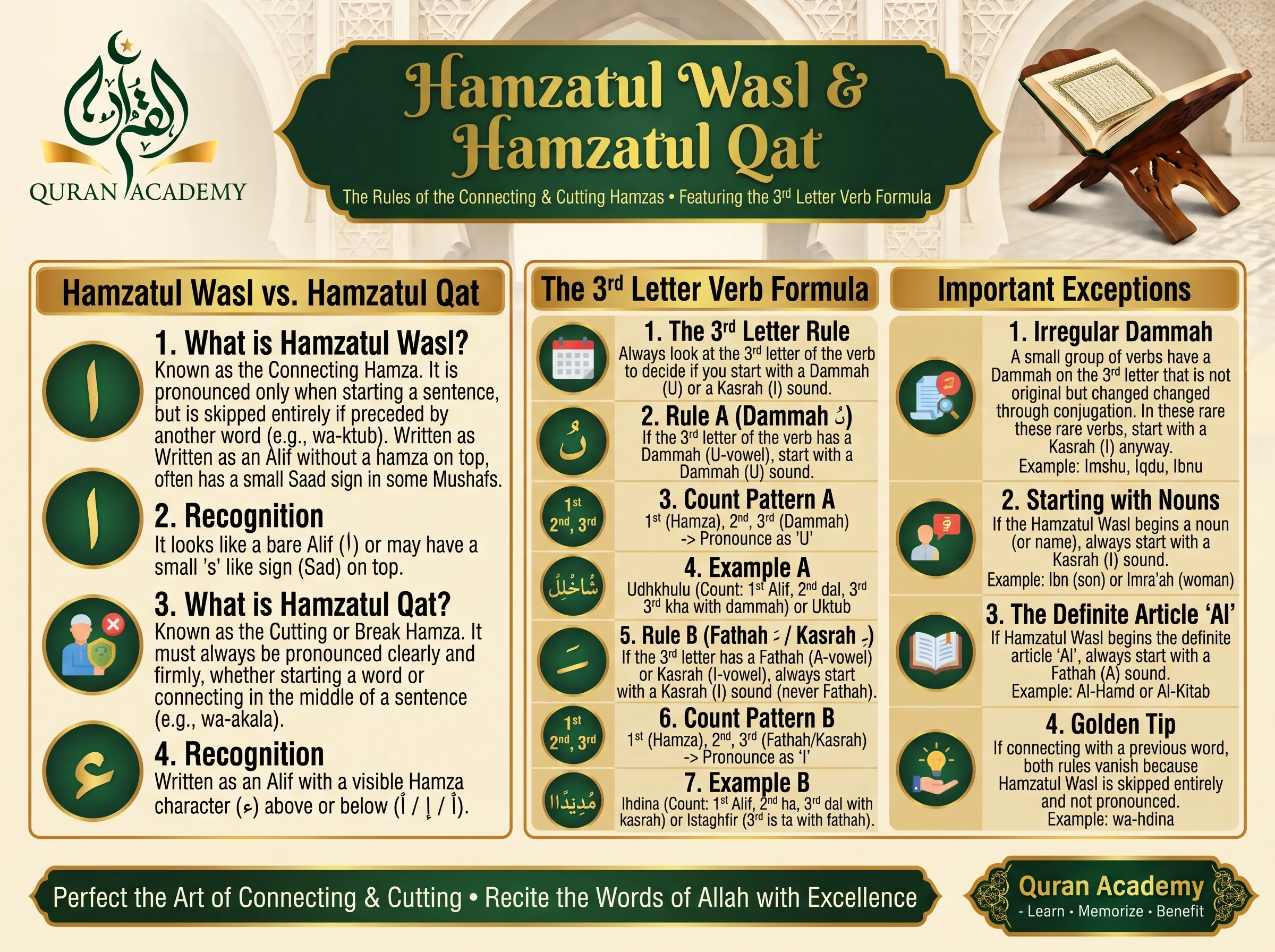
Mastering Hamzatul Wasl and Hamzatul Qat rules (هَمْزَةُ الْوَصْلِ وَهَمْزَةُ الْقَطْعِ) solves one of the most frequent reading puzzles in the Holy Quran: knowing when to pronounce or drop an initial Hamzah in connected recitation, and knowing whether to give a bare Hamzatul Wasl (ٱ) a Fatha (A-), a Damma (U-), or a Kasrah (I-) when starting a verse! In Arabic phonetics, no word can ever begin with a silent consonant (Sukoon). Therefore, Hamzatul Qat' (أَ / إِ / أُ) is an original root letter that is 100% pronounced both when starting and when connecting, whereas Hamzatul Wasl (ٱ) is a temporary "stepping-stone bridge" pronounced ONLY when starting a word (Ibtida') and dropped completely when connecting from a previous word (Wasl). In our 1-on-1 Online Tajweed Course, students learn to determine the exact starting vowel of any Hamzatul Wasl in less than 2 seconds!
- Visual Sign in the Uthmani Mushaf: Hamzatul Qat' wears a small 'Ayn head (ء) above or below the Alif; Hamzatul Wasl wears a small Saad head (صـ → ٱ) on top of the Alif with zero vowel mark!
- When to Start Hamzatul Wasl With FATHA (أَ): ONLY in the definite article الـ (Al-)—such as Al-Hamdu, Ar-Rahmaan, and Allaah!
- When to Start Hamzatul Wasl in VERBS (The 3rd-Letter Rule): Look at the 3rd letter of the verb—if it has an original Damma (ـُ), start with Damma (U-, e.g., Ud'u, Udkhuloo); if the 3rd letter has a Fatha (ـَ) or Kasrah (ـِ), start with Kasrah (I-, e.g., Ihdinaa, Idh-hab, Iqra')!
- When to Start Hamzatul Wasl in NOUNS: Every noun (other than Al-) starts with a Kasrah (I-)—including all verbal nouns (Istighfar, Intisar) and the 7 Famous Quranic Nouns (Ibn, Ibnat, Imru', Imra'at, Ithnayn, Ithnatayn, Ism)!
Every Quran student has experienced this moment of hesitation when opening the Uthmani Mushaf: you come to the beginning of a verse or restart after taking a breath, and the very first word starts with an Alif carrying a tiny loop on top (ٱ) with no Fatha, no Kasrah, and no Damma written on it—such as ٱهْدِنَا (Ihdinaa — 1:6), ٱدْعُ (Ud'u — 16:125), ٱقْرَأْ (Iqra' — 96:1), or ٱمْشُوا (Imshoo — 38:6)!
Why didn't the scholars of the Mushaf simply write a Fatha, Kasrah, or Damma on top of ٱ? Because in connected recitation (Wasl), Hamzatul Wasl is completely silent and unpronounced—and writing a vowel on it would trick reciters into pronouncing it in the middle of a sentence! Just as we unlocked the visual secrets of Laam Shamsiyyah and Laam Qamariyyah Rules and the 8 cases of Ahkam Al-Raa in Tajweed, this complete guide gives you the exact rules to distinguish Hamzatul Wasl from Hamzatul Qat', determine the starting vowel of any word in 2 seconds, and master the 6 famous exception verbs tested in Ijazah exams.
- Master Comparison: Hamzatul Wasl (ٱ) vs. Hamzatul Qat' (أ / إ) in the Uthmani Mushaf
- Rule 1 & Rule 2: Starting Hamzatul Wasl in "Al-" (With Fatha) & in Nouns (With Kasrah + The 7 Nouns!)
- Rule 3: The "3rd-Letter Formula" for Starting Hamzatul Wasl in Verbs (Damma vs. Kasrah)
- The 6 Famous Exception Verbs in the Quran (Why "Imshoo" & "Iqdoo" Start With Kasrah!)
- 3 Special Tajweed Cases: Starting on "Itooni" (46:4), Two Sukoons Meeting & Question Hamzah
- Frequently Asked Questions (FAQs)
1. Master Comparison: Hamzatul Wasl (ٱ) vs. Hamzatul Qat' (أ / إ) in the Uthmani Mushaf
As we explain in our Makharij al-Huruf Guide and our Interactive Tajweed Encyclopedia, both Hamzahs are articulated from the deepest part of the throat (Aqsal-Halq) when pronounced—but their function and Mushaf symbols are completely different. Compare them side by side:
| Feature | Hamzatul Qat' (هَمْزَةُ الْقَطْعِ • Cutting Hamzah) | Hamzatul Wasl (هَمْزَةُ الْوَصْلِ • Connecting Hamzah) |
|---|---|---|
| 1. Uthmani Mushaf Symbol | Written with the head of a small 'Ayn (ء) + explicit vowel mark: أَ / إِ / أُ / أْ. | Written with the head of a small Saad (صـ → ٱ) on top of the Alif (taken from the word Silah = connection) with NO vowel mark! |
| 2. Position in a Word | Can appear at the beginning, middle, or end of a word (أَكَلَ، سَأَلَ، قَرَأَ). | Appears ONLY at the very beginning of a word! |
| 3. Rule When Starting (Ibtida') | Always pronounced with its written vowel (e.g., أَنْعَمْتَ = An'amta). | Pronounced with an assigned Fatha, Damma, or Kasrah so you don't start on a silent letter (e.g., ٱهْدِنَا = Ihdinaa). |
| 4. Rule When Connecting (Wasl) 🏆 | Still 100% pronounced! It "cuts" between the previous letter and the next letter (e.g., قُلْ أَعُوذُ = Qul A'oodhu). | 100% DROPPED & SILENT! You jump straight from the previous vowel to the silent letter after the Alif (e.g., وَٱسْتَغْفِرْهُ = Was-taghfirhu, NOT Wa-istaghfirhu ❌!). |
2. Rule 1 & Rule 2: Starting Hamzatul Wasl in "Al-" (With Fatha) & in Nouns (With Kasrah)
When you start reciting a word that begins with ٱ (Hamzatul Wasl), how do you know whether to start with Fatha (A-) or Kasrah (I-) in particles and nouns? Open our Online Uthmani Quran Explorer and apply these two 100% fixed rules:
📌 Rule 1: Start With FATHA (أَ) ONLY in "Al-" (Laam At-Ta'reef)!
Whenever Hamzatul Wasl is part of the definite article الـ ("The"—whether followed by a Sun Letter or a Moon Letter), you always start it with a Fatha (A-):
• ٱلْحَمْدُ لِلَّهِ → أَلْحَمْدُ لِلَّهِ (Al-Hamdu lillaah)
• ٱلرَّحْمَٰنِ ٱلرَّحِيمِ → أَلرَّحْمَٰنِ الرَّحِيمِ (Ar-Rahmaanir-Raheem)
• ٱللَّهُ لَا إِلَٰهَ إِلَّا هُوَ → أَللَّهُ (Allaahu laa ilaaha illaa Huwa)
📌 Rule 2: Start With KASRAH (إِ) in ALL Other Nouns (Verbal Nouns + The 7 Quranic Nouns)!
Every noun in the Quran that begins with Hamzatul Wasl (outside of Al-) is always started with a Kasrah (I-)! This includes all 5-letter and 6-letter verbal nouns (Masadir, such as ٱسْتِغْفَارُ → Istighfaaru, ٱخْتِلَافِ → Ikhtilaafi, ٱبْتِغَاءَ → Ibtighaa'a) AND the 7 Famous Standard Nouns (الْأَسْمَاءُ السَّمَاعِيَّةُ السَّبْعَةُ) in the Quran:
- ٱبْن (Ibn — Son): e.g., عِيسَى ٱبْنَ مَرْيَمَ (when starting on Ibn: إِبْنَ = Ibna).
- ٱبْنَت (Ibnat — Daughter): e.g., وَمَرْيَمَ ٱبْنَتَ عِمْرَانَ (66:12 — when starting: إِبْنَتَ = Ibnata).
- ٱمْرُؤٌ / ٱمْرَأً / ٱمْرِئٍ (Imru'un / Imra'an / Imri'in — Man/Person): e.g., إِنِ ٱمْرُؤٌ هَلَكَ (4:176 — when starting: إِمْرُؤٌ = Imru'un).
- ٱمْرَأَت (Imra'at — Woman/Wife): e.g., ٱمْرَأَتُ عِمْرَانَ (3:35) and ٱمْرَأَتَ نُوحٍ وَٱمْرَأَتَ لُوطٍ (66:10 — starts as إِمْرَأَتُ = Imra'atu).
- ٱثْنَانِ / ٱثْنَيْنِ (Ithnaani / Ithnayni — Two [Masc.]): e.g., ٱثْنَانِ ذَوَا عَدْلٍ (5:106 — starts as إِثْنَانِ = Ithnaani).
- ٱثْنَتَانِ / ٱثْنَتَيْنِ (Ithnataani / Ithnatayni — Two [Fem.]): e.g., فَإِن كَانَتَا ٱثْنَتَيْنِ (4:176 — starts as إِثْنَتَيْنِ = Ithnatayni).
- ٱسْم (Ism — Name): e.g., ٱسْمُهُ الْمَسِيحُ (3:45) and سَبِّحِ ٱسْمَ رَبِّكَ الْأَعْلَى (87:1 — starts as إِسْمُ = Ismu!).
3. Rule 3: The "3rd-Letter Formula" for Starting Hamzatul Wasl in Verbs
As Imam Ibn Al-Jazari versified in Al-Muqaddimah Al-Jazariyyah: وَابْدَأْ بِهَمْزِ الْوَصْلِ مِنْ فِعْلٍ بِضَمّ • إِنْ كَانَ ثَالِثٌ مِنَ الْفِعْلِ يُضَمّ • وَاكْسِرْهُ حَالَ الْكَسْرِ وَالْفَتْحِ...
Whenever a verb begins with Hamzatul Wasl (ٱ), count to the 3rd letter of the verb (counting the Hamzatul Wasl itself as Letter #1, the silent consonant after it as Letter #2, and the voweled letter after that as Letter #3!):
| Vowel on 3rd Letter | Starting Vowel on ٱ | Step-by-Step Counting Examples | How to Read It When Starting |
|---|---|---|---|
| Case A: 3rd Letter Has an Original DAMMA (ـُ) | Start With DAMMA (أُ = U-)! | • ٱدْعُ (1=ٱ, 2=دْ, 3=عُ) • ٱدْخُلُوا (1=ٱ, 2=دْ, 3=خُ) • ٱنصُرْنَا (1=ٱ, 2=نْ, 3=صُ) • ٱجْتُثَّتْ (1=ٱ, 2=جْ, 3=تُ) |
• أُدْعُ (Ud'u — 16:125) • أُدْخُلُوا (Udkhuloo — 15:46) • أُنصُرْنَا (Unsurnaa — 2:286) • أُجْتُثَّتْ (Ujtuth-that — 14:26) |
| Case B: 3rd Letter Has a FATHA (ـَ) | Start With KASRAH (إِ = I-)! (Never start a verb with Fatha!) |
• ٱذْهَبْ (1=ٱ, 2=ذْ, 3=هَ) • ٱقْرَأْ (1=ٱ, 2=قْ, 3=رَ) • ٱسْتَغْفِرْ (1=ٱ, 2=سْ, 3=تَ) • ٱعْلَمُوا (1=ٱ, 2=عْ, 3=لَ) |
• إِذْهَبْ (Idh-hab — 20:24) • إِقْرَأْ (Iqra' — 96:1) • إِسْتَغْفِرْ (Istaghfir) • إِعْلَمُوا (I'lamoo — 57:20) |
| Case C: 3rd Letter Has a KASRAH (ـِ) | Start With KASRAH (إِ = I-)! | • ٱهْدِنَا (1=ٱ, 2=هْ, 3=دِ) • ٱضْرِب (1=ٱ, 2=ضْ, 3=رِ) • ٱصْبِرْ (1=ٱ, 2=صْ, 3=بِ) • ٱرْجِعِي (1=ٱ, 2=رْ, 3=جِ) |
• إِهْدِنَا (Ihdinaa — 1:6) • إِضْرِب (Idrib — 2:60) • إِصْبِرْ (Isbir) • إِرْجِعِي (Irji'ee — 89:28) |
4. The 6 Famous Exception Verbs in the Quran (Why "Imshoo" & "Iqdoo" Start With Kasrah!)
Just as we highlighted the top exam questions in our guide on What Happens During an Online Quran Ijazah Exam, look closely at Case A above: we said you start a verb with a Damma ONLY if the 3rd letter has an original Damma (ضَمٌّ أَصْلِيٌّ)! What if the Damma on the 3rd letter is temporary/accidental (ضَمٌّ عَارِضٌ)? In the entire Holy Quran, there are only 5 plural command verbs (plus 1 singular form: ائْتُونِي) where the 3rd letter carries a Damma solely because of the plural Waw—while in the singular form, the 3rd letter actually has a Kasrah! Therefore, all 6 of these verbs MUST start with a KASRAH (إِ = I-), NEVER a Damma:
Struggling to perfect your Recitation?
Join hundreds of students mastering the Quran with our Verified Al-Azhar Graduates. We offer flexible 1-on-1 sessions tailored to your schedule.
Book a Free Evaluation Class →🏆 The Only 5/6 Verbs in the Quran With a Temporary Damma on the 3rd Letter:
- 1. ٱمْشُوا (Surah Sad 38:6) → Start as: إِمْشُوا (Imshoo, NOT Umshoo ❌! Because singular is Imshi and original plural was Imshiyoo).
- 2. ٱقْضُوا (Surah Yunus 10:71) → Start as: إِقْضُوا (Iqdoo, NOT Uqdoo ❌! Because singular is Iqdi and original plural was Iqdiyoo).
- 3. ٱبْنُوا (Surah As-Saffat 37:97) → Start as: إِبْنُوا (Ibnoo, NOT Ubnoo ❌! Because singular is Ibni and original plural was Ibniyoo).
- 4. ٱمْضُوا (Surah Al-Hijr 15:65) → Start as: إِمْضُوا (Imdoo, NOT Umdoo ❌! Because singular is Imdi and original plural was Imdiyoo).
- 5 & 6. ٱئْتُوا (20:64) & ٱئْتُونِي (10:79, 12:54, 46:4) → Start as: إِيتُوا / إِيتُونِي (Eetoo / Eetoonee, NOT Ootoo ❌! Because singular is I'ti and original plural was I'tiyoo!).
Mastering the Qalqalah Bounce Right After Hamzatul Wasl: "Iqْra'", "Udْ'u" & "Ibْnoo"
Notice how many command verbs that start with Hamzatul Wasl have one of the 5 Qalqalah (Echoing) letters (ق ط ب ج د) as their silent 2nd letter—such as ٱقْرَأْ (Iqْra'), ٱقْضُوا (Iqْdoo), ٱدْعُ (Udْ'u), ٱدْخُلُوا (Udْkhuloo), ٱبْنُوا (Ibْnoo), and ٱجْتَنِبُوا (Ijْtaniboo)! Watch Senior Instructor Ustadhah Yasmeen Gamal demonstrate how to articulate that mid-word Qalqalah Sughra on our Quran Academy YouTube Channel:
- Vowel + Immediate Bounce: Pronounce the starting Kasrah or Damma, then bounce the قْ / دْ / بْ / جْ cleanly!
- 1-on-1 Live Coaching: Audit your Tajweed and Ibtida' rules with our Al-Azhar scholars!
5. Three Special Tajweed Cases Every Advanced Reciter Should Master
Before you finish this guide, bookmark these three advanced rules where Hamzatul Wasl and Hamzatul Qat' meet in the same word (combining our Rules of Madd, Sifaat al-Huruf, and Rules of Waqf & Ibtida'):
- 1. When Hamzatul Wasl Is Followed Immediately by a Silent Hamzatul Qat' (ٱئْتُونِي • ٱؤْتُمِنَ • ٱئْذَن لِّي):
Look at فِي السَّمَاوَاتِ ۖ ائْتُونِي بِكِتَابٍ in Surah Al-Ahqaf (46:4):
• When Connecting (Wasl): The Hamzatul Wasl drops completely, and you pronounce the silent Hamzatul Qat' right after the Taa of As-Samaawaati: Fis-samaawaati'-toonee!
• When Stopping on "As-Samaawaatْ" and Starting on "ائْتُونِي" (Ibtida'): Because the Arabs never pronounce two consecutive Hamzahs at the start of a word (I'toonee ❌), the first Hamzatul Wasl takes a Kasrah (إِ), and the second silent Hamzatul Qat' transforms into a 2-count Madd Badal letter matching that vowel (Yaa Sakinah → إِيتُونِي = Eetoonee)! Similarly, starting on ٱؤْتُمِنَ (2:283) begins with a Damma (3rd letter has Damma) and transforms the second Hamzah into a 2-count Waw: أُوتُمِنَ (Ootumina)! - 2. When a Question Hamzatul Qat' (أَ) Enters Upon a Verb's Hamzatul Wasl (أَتَّخَذْتُمْ • أَسْتَكْبَرْتَ • أَصْطَفَى):
In 7 Quranic verbs—such as أَتَّخَذْتُمْ (2:80), أَسْتَكْبَرْتَ (38:75), and أَصْطَفَى الْبَنَاتِ (37:153)—when the interrogative Hamzatul Qat' (أَ = "Did...?") enters upon a verb starting with a Kasrah-voweled Hamzatul Wasl, the Hamzatul Wasl is deleted completely in both script and pronunciation because the question Hamzah already has a Fatha and there is no longer a need for a helper bridge! - 3. Preventing Two Silent Letters From Meeting Across Words (إلتقاء الساكنين):
Using our Noon Sakinah & Tanween Guide and Meem Sakinah Guide, what happens when a Tanween (which ends in a silent Noon Sakinah!) or a silent letter meets a Hamzatul Wasl in the next word—such as خَيْرًا ٱلْوَصِيَّةُ (2:180) or قُلِ ٱدْعُوا اللَّهَ (17:110)? Because Hamzatul Wasl drops in connection, the first silent letter is given a temporary Kasrah (Noon Al-Wiqayah: Khayra-nil-wasiyyah / Quli-d'ullaah)—except plural Meem ('Alaykumul-qitaal takes Damma) and Min (Minal-jinnati takes Fatha)!
Practice spotting Hamzatul Wasl and Hamzatul Qat' today across our most popular Surah and Fiqh guides—including Surah Al-Hujurat (featuring the famous Bi'sa-lismu rule at 49:11!), Surah Luqman (Ani-shkur lillaah at 31:12!), Surah Yusuf (Uqtuloo Yoosufa at 12:9 & Itoonee bihi at 12:54!), Surah Maryam (Wadhkur fil-Kitaabi!), Surah Ya-Sin (Wattabi'ul-mursaleen!), Surah Ar-Rahman, Surah Al-Waqi'ah, Surah As-Sajdah & Al-Insan, Ayatul Kursi, Last 2 Verses of Surah Al-Baqarah (Waghfir lanaa warhamnaa... fansurnaa!), The 3 Quls (Qul Huwallaahu Ahad vs. Allaahus-Samad: Qul-Huwallaahu Ahadu-nillaahus-Samad in Wasl!), Surah Ad-Duha & Ash-Sharh, 40 Rabbana Duas, Morning & Evening Adhkar, Sujood As-Sahw, Salat Al-Istikharah, Salat Al-Janazah, Wudu & Tayammum, 5 Pillars of Islam, and 25 Prophets in the Quran! Whether you are studying with our Al-Azhar Certified Tutors in our Online Hifz Program (using our Smart Hifz Planner) or enrolling your child in our 1-on-1 Kids Quran Classes with our Printable Kids Star Chart, see how families across the US, UK, Canada, and Australia rate our teachers on our Verified Student & Parent Reviews Page.
6. Frequently Asked Questions (FAQs) About Hamzatul Wasl & Hamzatul Qat'
1. What is the main difference between Hamzatul Wasl and Hamzatul Qat' in the Quran?
Hamzatul Qat' (همزة القطع — written with a small 'Ayn head: أ / إ) is an original letter that is ALWAYS pronounced whether you start on the word or connect from a previous word. Hamzatul Wasl (همزة الوصل — written with a small Saad head on top of the Alif: ٱ) is a helper bridge letter pronounced ONLY when starting a word (Ibtida') to avoid starting on a silent letter, and dropped completely when connecting (Wasl)!
2. How do you know what vowel (Fatha, Damma, or Kasrah) to put on Hamzatul Wasl when starting a verb?
In Arabic verbs, look at the 3rd letter of the verb: (1) If the 3rd letter has an original Damma (ـُ), start Hamzatul Wasl with a Damma (U-, e.g., Ud'u, Unsur, Udkhuloo). (2) If the 3rd letter has a Fatha (ـَ) or a Kasrah (ـِ)—or a temporary Damma in the 6 exception verbs (Imshoo, Iqdoo, Ibnoo, Imdoo, Eetoo, Eetoonee)—start Hamzatul Wasl with a Kasrah (I-, e.g., Ihdinaa, Idh-hab, Istaghfir)!
3. When do you start Hamzatul Wasl with a Fatha (A-)?
Hamzatul Wasl is started with a Fatha (A-) ONLY in one place in the entire Arabic language: when it is attached to the definite article الـ (Al- / Laam at-Ta'reef), such as Al-Hamdu, Ar-Rahmaan, Al-Kitaab, and Allaah.
4. What are the 7 famous Quranic nouns that begin with Hamzatul Wasl?
The 7 standard non-verbal nouns (Asma' Sama'iyyah) in the Quran that begin with Hamzatul Wasl—all of which start with a Kasrah (I-) when beginning—are: (1) Ibn (son), (2) Ibnat (daughter), (3) Imru' (man/person), (4) Imra'at (woman/wife), (5) Ithnayn (two — masc.), (6) Ithnatayn (two — fem.), and (7) Ism (name).
5. Why do the 6 verbs "Imshoo", "Iqdoo", and "Ibnoo" start with a Kasrah even though their 3rd letter has a Damma?
In the 6 Quranic plural/command verbs (امْشُوا، اقْضُوا، ابْنُوا، امْضُوا، ائْتُوا / ائْتُونِي), the Damma on the 3rd letter is not original ('Aaridah)—it was only placed there to match the plural Waw after a weak Yaa was dropped (originally: Imshiyoo → Imshoo, Iqdiyoo → Iqdoo). Because the original vowel on the 3rd letter was a Kasrah, Hamzatul Wasl starts with a Kasrah!
Read Every Verse With Confidence Alongside an Al-Azhar Scholar!
Never guess how to start or connect a Quranic word again! Get live 1-on-1 Tajweed and recitation coaching from certified male and female Al-Azhar scholars. Book your free diagnostic trial session today!
Book Your Free 1-on-1 Tajweed Trial Class →