
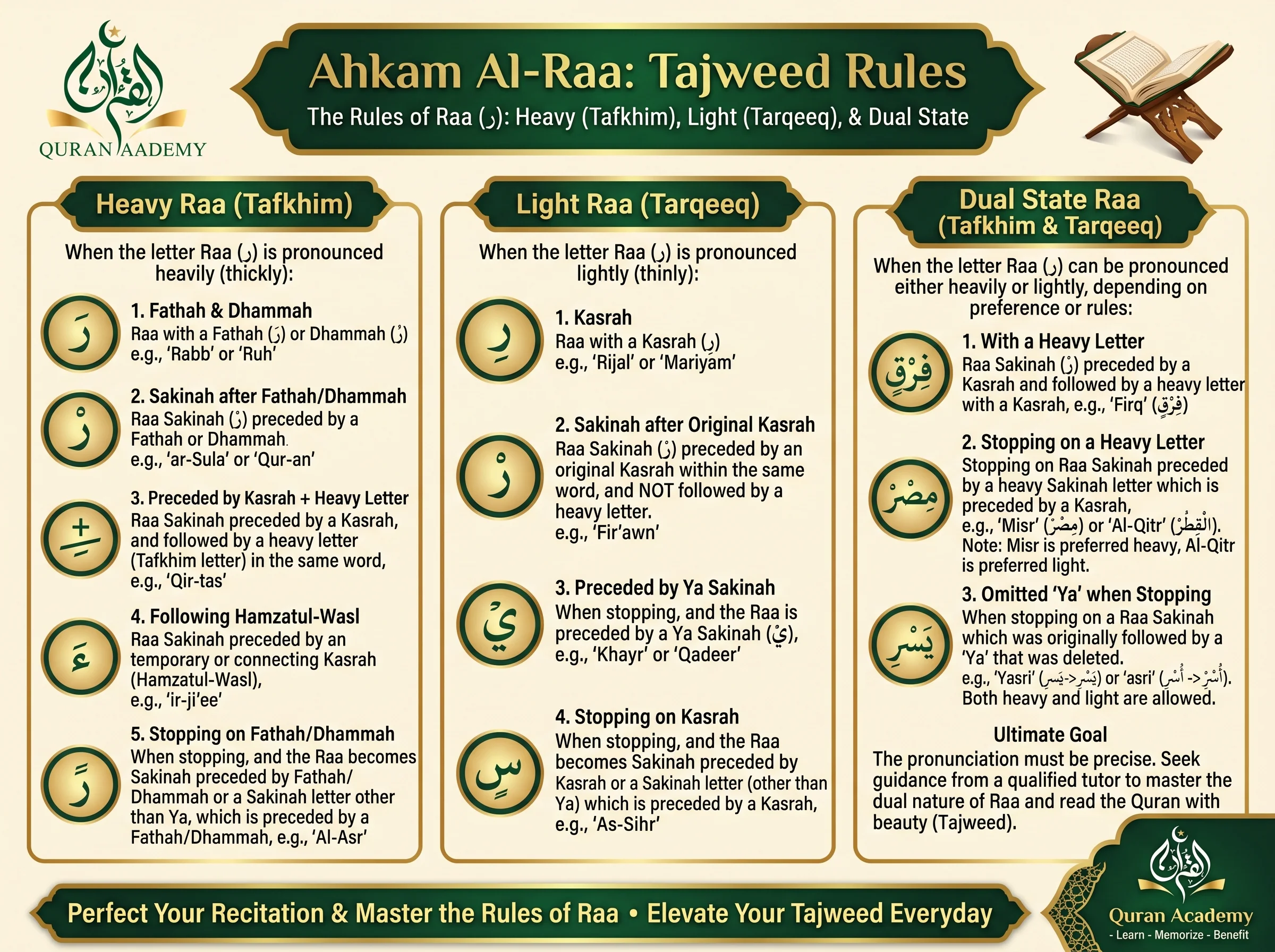
✦ Quick Answer & Key Takeaways: Ahkam Al-Raa in Tajweed
Mastering Ahkam Al Raa Tajweed rules (أَحْكَامُ الرَّاءِ فِي التَّجْوِيدِ) is one of the fastest ways to elevate your Quranic recitation from a beginner level to the polished precision of an Ijazah reciter. Unlike the 7 permanently heavy letters (خص ضغط قظ) and the 21 permanently light letters, the Arabic letter Raa (ر) is a variable letter that shifts between 3 distinct states depending on its vowel and surrounding letters: (1) Obligatory Tafkhim (Heavy — 8 cases), (2) Obligatory Tarqeeq (Light — 4 main cases + 1 Imalah case), and (3) Jawaz al-Wajhayn (Dual-State Permissibility — 7 special Quranic words). In our 1-on-1 Online Tajweed Course, certified Al-Azhar scholars train your tongue to articulate every Raa with zero excessive rolling (Takreer) and zero English "R" curling!
- The Golden Vowel Rule (When Raa Has a Vowel): رَ (Fatha) and رُ (Damma) are 100% HEAVY (Tafkhim); رِ (Kasrah) is 100% LIGHT (Tarqeeq)!
- When Raa Is Silent (رْ — Sakinah): Look at the vowel before it—Fatha or Damma before رْ makes it Heavy (unless preceded by a Yaa Leen on stop); an original Kasrah before رْ makes it Light (unless followed in the same word by a heavy Isti'laa letter with Fatha!).
- The 5 Heavy Exceptions After Kasrah: قِرْطَاسٍ • إِرْصَادًا • مِرْصَادًا • لَبِالْمِرْصَادِ • فِرْقَةٍ are all HEAVY because of the elevated letter right after the Raa!
- The 7 Dual-State Words (Jawaz al-Wajhayn): Words like فِرْقٍ (26:63), مِصْرَ, الْقِطْرِ, يَسْرِ, أَسْرِ, and نُذُرِ allow both heavy and light pronunciation!
If you listen closely to native English speakers learning to recite the Holy Quran, you will notice that no single Arabic letter gives away an English accent faster than the letter Raa (ر). Why? Because in American and British English, the letter "R" (as in "Red" or "Car") is pronounced by curling the tip of the tongue backward in mid-air without touching the roof of the mouth at all! On the other extreme, speakers of Spanish, Urdu, or beginner Arabic often over-vibrate the tip of the tongue against the gums, producing a machine-gun trilling sound (Ar-rrr-Rahmaan ❌) known in Tajweed as excessive Takreer (التَّكْرِير).
Even after a student learns the proper articulation point of Raa from our Makharij al-Huruf (Articulation Points) Guide and our Heavy & Light Letters Overview, a second puzzle appears on almost every line of the Mushaf: why is the silent Raa in فِرْعَوْنَ (Firْ'awn) pronounced light, while the silent Raa in مِرْصَادًا (Mirْsaadaa) and ارْجِعِي (Irْji'ee)—which also come right after a Kasrah!—is pronounced heavy? Below, we break down all 8 Cases of Heavy Raa, 4 Cases of Light Raa, and the 7 Dual-State Words in Hafs 'an 'Asim so you never guess on a Raa again.
- How to Pronounce the Arabic Raa Correctly (Fixing the English "R" & Excessive Takreer!)
- Part 1: The 8 Cases of Obligatory Heavy Raa (Tafkhim Ar-Raa) With Quranic Examples
- Part 2: The 4 Cases of Obligatory Light Raa (Tarqeeq Ar-Raa) + The Imalah of Hud (11:41)
- Part 3: The 7 Dual-State Words (Jawaz al-Wajhayn) — Firq, Misr, Al-Qitr & Beyond!
- The 3-Second "Raa Decision Tree" (How to Know Any Raa's Rule Instantly While Reciting)
- Frequently Asked Questions (FAQs)
1. How to Pronounce the Arabic Raa Correctly (Fixing the English "R" & Excessive Takreer!)
As we detailed in our Sifaat al-Huruf (Characteristics of Arabic Letters) Guide and our Interactive Tajweed Encyclopedia, the letter Raa (ر) exits from the very tip of the tongue together with the top of the tip (ظهر طرف اللسان) touching the gums of the two upper front incisors. What makes Raa unique is that it combines two delicate traits—Al-Inhiraf (الِانْحِرَاف — Slight Deviation) and At-Takreer (التَّكْرِير — Trilling Potential):
Curling the tongue backward without touching the upper gum ridge produces a hollow English "R" ("Ar-Wabb" instead of "Ar-Rabb"). In Arabic, the tip of the tongue must physically tap the gum ridge!
Imam Ibn Al-Jazari warned in Al-Muqaddimah Al-Jazariyyah: وَأَخْفِ تَكْرِيرًا إِذَا تُشَدَّدُ ("And conceal/suppress excessive trilling when Raa carries a Shaddah!"). We learn the trait of Takreer in order to control it, not multiply it!
Press the left and right edges of your tongue tip firmly against the upper gums while leaving a tiny groove in the very center of the tip so the sound flows smoothly (Tawassut) with only a single clean tap!
2. Part 1: The 8 Cases of Obligatory Heavy Raa (Tafkhim Ar-Raa) With Quranic Examples
When pronouncing a Heavy Raa (الرَّاءُ الْمُفَخَّمَةُ), you simultaneously elevate the back of your tongue (Aqsal-Lisaan) and slightly concave the middle of your tongue so the chamber of your mouth fills with a rich, resonant echo. You can verify every Quranic example below in our Online Uthmani Quran Explorer. Here are all 8 Cases where Raa MUST be pronounced Heavy:
| Heavy Case # | Exact Condition of the Raa (ر) | Quranic Examples | Why It Is Heavy (Tajweed Logic) |
|---|---|---|---|
| 1. Raa With Fatha (رَ) | Voweled with a Fatha (or Fathatayn) at the start, middle, or end of a word. | رَبَّنَا • الرَّحْمَٰنِ • أَرَأَيْتَ • صَبْرًا | Fatha naturally opens the mouth upward and triggers full heaviness. |
| 2. Raa With Damma (رُ) | Voweled with a Damma (or Dammatayn) anywhere in a word. | رُزِقُوا • نَصْرُ اللَّهِ • كَفَرُوا • غَفُورٌ | Damma rounds the lips and elevates the back of the tongue. |
| 3. Raa Sakinah After Fatha or Damma (ـَرْ / ـُرْ) | Silent Raa (either mid-word or when stopping) preceded directly by a Fatha or Damma. | مَرْيَمَ • الْأَرْضِ • الْقُرْآنَ • وَانْحَرْ | A silent Raa borrows its strength from the Fatha or Damma directly before it! |
| 4. Raa Sakinah After Silent Letter Preceded by Fatha/Damma | When stopping on a final Raa preceded by a silent letter (other than Yaa!), and the letter before that has Fatha or Damma. | وَالْعَصْرِ → وَالْعَصْرْ • الْفَجْرْ • الشَّهْرْ • الْعُسْرْ • خُسْرْ | Because the middle letter is silent, the Raa looks back one step further to the Fatha or Damma! |
| 5. Raa Sakinah After Long Alif or Long Waw (ـَارْ / ـُورْ) | When stopping on a final Raa preceded by a Madd Alif or Madd Waw. | النَّارْ • الْأَبْرَارْ • غَفُورْ • شَكُورْ | Alif is an extension of Fatha, and Waw is an extension of Damma! |
| 6. Raa Sakinah After a Temporary Kasrah (Kasrah 'Aaridah) ⭐ | Silent Raa preceded by a Hamzatul-Wasl or a word whose final sukoon was given a temporary Kasrah to prevent two sukoons meeting! | ارْجِعِي (Irْji'ee) • ارْتَابُوا • أَمِ ارْتَابُوا • لِمَنِ ارْتَضَىٰ • إِنِ ارْتَبْتُمْ | Because the Kasrah is only temporary ('Aaridah, not part of the root word), it cannot make the Raa light! |
| 7. Raa Sakinah After a Kasrah in a Separate Word ⭐ | When the original Kasrah is at the end of Word 1, and the Raa Sakinah is at the start of Word 2 (via dropped Hamzatul-Wasl). | رَبِّ ارْحَمْهُمَا (Rabbirْ-hamhumaa) • الَّذِي ارْتَضَىٰ • بِرَبِّكُمُ ارْجِعُونِ | The Kasrah belongs to the previous word, so the Raa in the second word stays Heavy! |
| 8. The 5 Words: Raa Sakinah After Kasrah + Isti'laa Letter With Fatha 🏆 | Raa Sakinah preceded by an original Kasrah, but followed in the exact same word by a heavy Isti'laa letter (ط، ص، ق) carrying a Fatha! | 1. قِرْطَاسٍ (6:7) 2. وَإِرْصَادًا (9:107) 3. مِرْصَادًا (78:21) 4. لَبِالْمِرْصَادِ (89:14) 5. فِرْقَةٍ (9:122) |
These are the only 5 words in the entire Quran for this rule! The powerful heavy letter with Fatha right after the Raa pulls the Raa up into Tafkhim! |
3. Part 2: The 4 Cases of Obligatory Light Raa (Tarqeeq Ar-Raa) + The Imalah of Hud (11:41)
When pronouncing a Light Raa (الرَّاءُ الْمُرَقَّقَةُ), the back of your tongue stays flat and relaxed in the floor of your mouth (Istifal) with a gentle, smiling jaw alignment. Here are the 4 Main Cases where Raa MUST be pronounced Light (plus the single Imalah word in Hafs 'an 'Asim):
| Light Case # | Exact Condition of the Raa (ر) | Quranic Examples | Crucial Note for Reciters |
|---|---|---|---|
| 1. Raa With Kasrah (رِ) | Whenever Raa carries a Kasrah (or Kasratayn) at the beginning, middle, or end of a word (when continuing). | رِجَالٌ • رِزْقًا • كَرِيمٌ • الْفَجْرِ (in Wasl) | Every single Raa with a Kasrah in the Quran is 100% Light—without a single exception! |
| 2. Raa Sakinah After Original Kasrah (ـِرْ) | Silent Raa preceded by an original Kasrah in the same word, and NOT followed in the same word by a heavy Isti'laa letter! | فِرْعَوْنَ • مِرْيَةٍ • شِرْعَةً • وَاصْبِرْ • فَكَبِّرْ • وَاسْتَغْفِرْ | Watch out for: فِرْدَوْس (Al-Firْdaws) & أَنذِرْ قَوْمَكَ (Andhirْ Qawmaka)—both are LIGHT because the heavy Qaaf in Qawmaka is in the next word! |
| 3. Raa Sakinah After Silent Light Letter Preceded by Kasrah | When stopping on a final Raa preceded by a silent light (Istifal) letter, and the letter before that carries a Kasrah. | السِّحْرْ • الذِّكْرْ • الشِّعْرْ • بِكْرْ • حِجْرْ | Because the middle letter is silent and light, the Kasrah passes right through it and makes the final Raa Light! |
| 4. Raa Sakinah After Any Yaa Sakinah (Madd or Leen! — ـِيرْ / ـَيْرْ) ⭐ | When stopping on a final Raa preceded by EITHER a long Madd Yaa (ـِيرْ) OR a soft Leen Yaa preceded by a Fatha (ـَيْرْ)! | • Madd Yaa: قَدِيرْ • خَبِيرْ • بَصِيرْ • Leen Yaa: خَيْرْ • طَيْرْ • غَيْرْ • السَّيْرْ |
Even though خَيْرْ (Khayrْ) and طَيْرْ (Tayrْ) start with a heavy letter and Fatha, the Yaa Sakinah (يْ) is the mother of Kasrah—making the Raa 100% LIGHT on stop! |
| 5. Raa With Imalah (Surah Hud 11:41) 🏆 |
The single word in Hafs 'an 'Asim recited with Imalah Kubra (tilting the Fatha and Alif toward Kasrah and Yaa): مَجْر۪هَا (Majreehaa)! | بِسْمِ اللَّهِ مَجْر۪هَا وَمُرْسَاهَا (11:41) | Notice the diamond sign below the Raa in the Mushaf: the Raa in Majreehaa is Light, while the Raa in Wa Murْsaahaa right after it is Heavy! |
4. Part 3: The 7 Dual-State Words (Jawaz al-Wajhayn) — Firq, Misr, Al-Qitr & Beyond!
Just as we covered the famous exam questions in our guide on What Happens During an Online Quran Ijazah Exam, every Ijazah examiner tests candidates on the 7 Quranic Words where BOTH Heavy (Tafkhim) and Light (Tarqeeq) Raa are permissible (جَوَازُ الْوَجْهَيْنِ)—and asks which of the two is preferred (Al-Muqaddam Ada'an):
Struggling to perfect your Recitation?
Join hundreds of students mastering the Quran with our Verified Al-Azhar Graduates. We offer flexible 1-on-1 sessions tailored to your schedule.
Book a Free Evaluation Class →- 1. The Word "Firqin" in Surah Ash-Shu'ara (كُلُّ فِرْقٍ كَالطَّوْدِ الْعَظِيمِ — 26:63):
• When Continuing (Wasl): Both Light and Heavy are permitted, and LIGHT (Tarqeeq) is preferred—because the heavy letter Qaaf (قٍ) carries a Kasrah, which weakens its elevation!
• When Stopping on "Firqْ" (Waqf): Both are permitted, and HEAVY (Tafkhim) is preferred—because stopping removes the Kasrah from the Qaaf and restores its full heavy power! - 2. Stopping on "Misr" (مِصْرَ — in 10:87, 12:21, 12:99, 43:51):
When continuing, Misra is 100% Heavy because the Raa has a Fatha. When stopping on مِصْرْ (Misrْ), the silent Raa is preceded by a silent heavy صْ (Saad) preceded by a Kasrah! Both Heavy and Light are permitted on stop, and HEAVY (Tafkhim) is preferred (matching its state when continuing!). - 3. Stopping on "Al-Qitr" in Surah Saba' (عَيْنَ الْقِطْرِ — 34:12):
When continuing, Al-Qitri is 100% Light because the Raa has a Kasrah. When stopping on الْقِطْرْ (Al-Qitrْ), the silent Raa is preceded by a silent heavy طْ (Taa') preceded by a Kasrah! Both Light and Heavy are permitted on stop, and LIGHT (Tarqeeq) is preferred (matching its state when continuing!). - 4 – 7. Stopping on the 4 Words With a Deleted Final Yaa: "Yasr" (يَسْرِ — 89:4), "Asr" (أَسْرِ / فَأَسْرِ — 11:81, etc.) & "Nudhur" (نُذُرِ — 6x in Surah Al-Qamar):
When continuing, all four are Light because of the Kasrah on the Raa. When stopping on يَسْرْ, أَسْرْ, فَأَسْرْ, and نُذُرْ, both Light and Heavy are permitted, and LIGHT (Tarqeeq) is preferred to point to the original deleted Yaa at the end of those words (Yasree, Asree, Nudhuree)!
Stopping on "Al-Fajْr", "Al-Qadْr" & "As-Sabْr": Qalqalah + Raa Together!
Have you ever noticed how many famous Quranic words end with a silent Qalqalah letter (ق ط ب ج د) followed immediately by a final Raa (ر)—such as الْفَجْرِ (Al-Fajْrْ), الْقَدْرِ (Al-Qadْrْ), الصَّبْرِ (As-Sabْrْ), الْعِطْرِ / الْقِطْرِ (Al-Qitْrْ), and الْحِجْرِ (Al-Hijْrْ)? Watch Senior Instructor Ustadhah Yasmeen Gamal demonstrate how to bounce the Qalqalah letter cleanly before landing on the final Raa on our Quran Academy YouTube Channel:
- Two Distinct Consonants: Bounce the جْ / دْ / بْ first, then tap the رْ cleanly without dropping it!
- 1-on-1 Live Coaching: Audit your Raa pronunciation with our Al-Azhar scholars!
5. The 3-Second "Raa Decision Tree" (How to Know Any Raa's Rule Instantly While Reciting)
When you are reciting any page of the Mushaf—whether in our Rules of Madd, Noon Sakinah Rules, Meem Sakinah Rules, or Rules of Waqf lessons—use this 3-Step Mental Checklist to determine any Raa in a split second:
- Step 1 — Does the Raa Have a Vowel (Are You Continuing Over It)?
Look solely at its own vowel: Fatha (رَ) or Damma (رُ) = Heavy! Kasrah (رِ) = Light! (No need to look before or after a voweled Raa!). - Step 2 — Is the Raa Silent (Mid-Word or Because You Stopped on It)?
First check if there is a Yaa Sakinah (ـِيرْ or ـَيْرْ) right before it—if yes, it is 100% Light (Qadeerْ, Khayrْ)! - Step 3 — If There Is No Yaa Sakinah Before the Silent Raa, Look at the Nearest Preceding Vowel:
• Preceded by Fatha or Damma = Heavy! (Maryam, Wal-'Asrْ, An-Naarْ).
• Preceded by Original Kasrah in the Same Word = Light! (Fir'awn, Wasbirْ, As-Sihrْ)—unless it is one of the 5 Isti'laa words (Qirtas, Irsad, Mirsaad, Labil-Mirsaad, Firqah) or follows a temporary/separate-word Kasrah (Irji'ee)!
Practice spotting Heavy and Light Raa today across our most popular Surah guides: Surah Ar-Rahman (notice how the refrain Fa-bi-ayyi aalaaa'i Rabbikumaa tukadhdhibaan has a Heavy Raa in Rabbikumaa!), Surah Ya-Sin, Surah Al-Waqi'ah, Surah Maryam (compare Heavy Marْyam with Light Zakarِiyyaa and Light Dhikْru!), Surah Yusuf (where Misr appears twice!), Surah Luqman (compare Heavy Ushkurْ in 31:12 with Light Tusa''irْ in 31:18!), Surah Al-Hujurat, Surah As-Sajdah & Al-Insan (where stopping on the 2nd Qawareerْ in 76:16 gives a Light Raa!), Ayatul Kursi (Heavy Al-Kurْsiyyu!), Last 2 Verses of Surah Al-Baqarah (compare Light Waghfirْ with Heavy Warْhamnaa and Heavy Isrْan!), The 3 Quls, and Surah Ad-Duha & Ash-Sharh! You can also apply these rules when reciting our 40 Rabbana Duas, Morning & Evening Adhkar, Salat Al-Istikharah Dua, Salat Al-Janazah Dua, Sujood As-Sahw, Wudu Duas, 5 Pillars of Islam, and 25 Prophets in the Quran in our Online Hifz Program (using our Smart Hifz Planner) with our Al-Azhar Certified Tutors—or enroll your child in our 1-on-1 Kids Quran Classes with our Printable Kids Star Chart! See how students across the US, UK, Canada, and Australia rate our teachers on our Verified Student & Parent Reviews Page.
6. Frequently Asked Questions (FAQs) About Ahkam Al-Raa in Tajweed
1. What are the 3 main states of the letter Raa (ر) in Tajweed?
In Hafs 'an 'Asim Tajweed, the letter Raa (ر) has 3 states: (1) Obligatory Tafkhim (Heavy pronunciation — 8 cases), (2) Obligatory Tarqeeq (Light pronunciation — 4 main cases plus Imalah in Surah Hud 11:41), and (3) Jawaz al-Wajhayn (Permissibility of both heavy and light pronunciation in 7 specific Quranic words like Firq, Misr, and Al-Qitr).
2. When is Raa Sakinah (رْ) pronounced heavy vs. light when it comes after a Kasrah?
Normally, Raa Sakinah preceded by an original Kasrah is pronounced LIGHT (e.g., Fir'awn, Miryah). However, it becomes HEAVY in 3 exceptions: (1) If the Kasrah is temporary/imported (Kasrah 'Aaridah, like Irji'ee or Amirtaboo), (2) If the Kasrah is in a separate preceding word (like Rabbi irhamhumaa), or (3) If the Raa Sakinah is followed in the same word by one of the 7 heavy Isti'laa letters carrying a Fatha (in the 5 Quranic words: Qirtas, Irsad, Mirsaad, Labil-Mirsaad, and Firqah).
3. Why does the word "Firq" in Surah Ash-Shu'ara (26:63) allow both heavy and light Raa when continuing?
In the word فِرْقٍ (Firqin), the Raa Sakinah is preceded by an original Kasrah, and followed in the same word by the heavy letter Qaaf (قٍ)—but that Qaaf carries a Kasrah, which weakens its heaviness! Therefore, scholars permitted both Tarqeeq (looking at the Kasras before and after, which is preferred in continuation) and Tafkhim (looking at the presence of the Isti'laa letter Qaaf, which is preferred when stopping on Firqْ).
4. What is the rule for stopping on "Misr" (مِصْرَ) and "Al-Qitr" (الْقِطْرِ) in the Quran?
When stopping on Misr or Al-Qitr, the Raa becomes silent after a silent heavy Isti'laa letter (Saad or Taa') preceded by a Kasrah. Both heavy and light pronunciation are permitted upon stopping, with Imam Ibn Al-Jazari selecting Heavy (Tafkhim) as preferred when stopping on "Misr" (because it has a Fatha when continuing) and Light (Tarqeeq) as preferred when stopping on "Al-Qitr" (because it has a Kasrah when continuing)!
5. How do you avoid excessive rolling (Takreer) when pronouncing the Arabic Raa?
As taught by Imam Ibn Al-Jazari ("Wa akhfi takreeran idhaa tushaddadu"), touch the tip and upper dorsum of your tongue firmly once to the alveolar ridge while leaving a tiny central gap (Inhiraf) for the sound to flow smoothly—preventing your tongue tip from vibrating multiple times like a Spanish "RR" or curling backward in mid-air like an American English "R".
Perfect Your Heavy & Light Raa With a Certified Al-Azhar Scholar!
Want live 1-on-1 feedback on your pronunciation of Raa, Makharij, and Sifaat from an Ijazah-certified male or female Al-Azhar teacher? Book your free diagnostic trial session today!
Book Your Free 1-on-1 Tajweed Trial Class →