
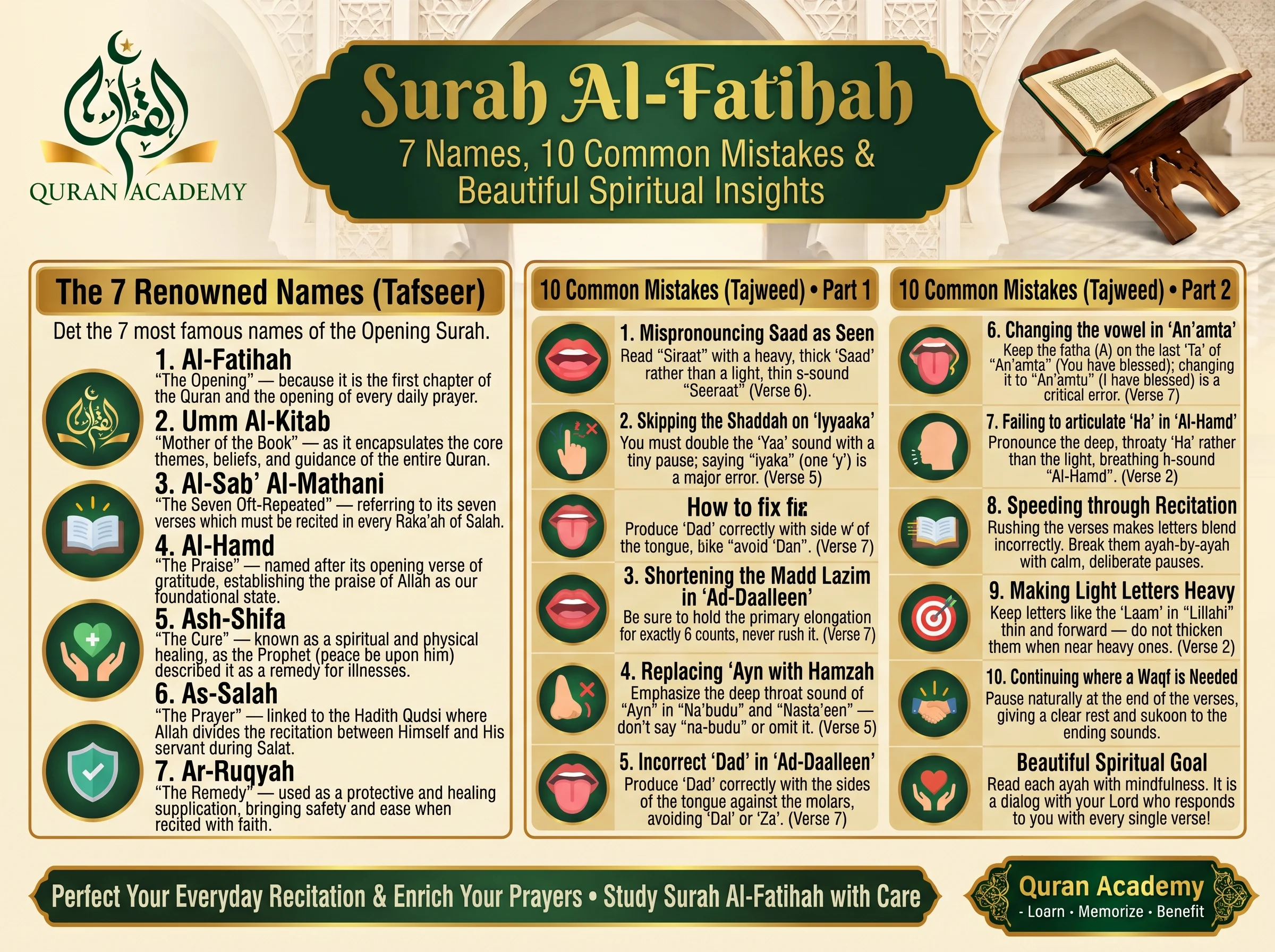
✦ Quick Answer & Key Takeaways: Surah Al-Fatihah Tafseer & Tajweed Guide
Mastering Surah Al Fatihah Tafseer and Tajweed is the single most important obligation upon every Muslim's tongue and heart—because Prophet Muhammad (ﷺ) declared in Sahih al-Bukhari (756) and Sahih Muslim (394): « لَا صَلَاةَ لِمَنْ لَمْ يَقْرَأْ بِفَاتِحَةِ الْكِتَابِ » ("There is no valid prayer for the one who does not recite the Opening of the Book!"). Recited at least 17 times every single day in the obligatory prayers (and over 30 times with Sunnah prayers), Surah Al-Fatihah (Chapter 1 • 7 Makkan verses on Page 1 of the Mushaf) is the greatest Surah in the entire Quran (Sahih al-Bukhari 4474). In our 1-on-1 Online Tajweed Course, certified Al-Azhar scholars audit your recitation of Surah Al-Fatihah letter by letter to eliminate the 10 hidden pronunciation mistakes (Lahn Jali) that can compromise your daily Salah!
- A Live 2-Way Conversation With Allah (Sahih Muslim 395): When you pause at the end of each verse in Surah Al-Fatihah during Salah, Allah Almighty personally responds to you after every single Ayah!
- The 14 Obligatory Shaddahs Rule: Surah Al-Fatihah contains 14 doubled letters (Shaddahs) (including the Basmalah); dropping the Shaddah on إِيَّاكَ (Iyyaaka) alters the meaning completely!
- The 6-Beat Madd Lazim in Verse 7 (وَلَا الضَّالِّينَ): Contains the most famous 6-count Madd Lazim Kalimi Muthaqqal in the Quran before saying "Aameen!"
- The 3 Groups in Verses 6 & 7: Contrasts those blessed with both knowledge and action (An'amta 'alayhim) against those who knew the truth and rejected it (Al-Maghdoobi 'alayhim) and those who acted without knowledge (Ad-Daalleen).
Think about this remarkable reality: if you pray your five daily obligatory prayers and your regular Sunnah prayers, you recite Surah Al-Fatihah more than 10,000 times every single year! Yet because we memorized Surah Al-Fatihah when we were very young children, two dangerous things often happen to adults without realizing it.
First, familiarity can breed speed: many worshippers rush through all seven verses in a single breath on autopilot, never pausing to feel that the King of Kings is personally answering them after every verse! Second, childhood pronunciation habits often hide major articulation errors (Lahn Jali — اللَّحْنُ الْجَلِيُّ)—such as turning the heavy ص (Saad) of As-Siraat into a light Seen (As-Siraat), dropping the Shaddah on إِيَّاكَ (Iyyaaka), or pronouncing the heavy ض (Daad) of Ad-Daalleen like a letter Dal or Dhal! Just as we placed Surah Al-Fatihah at the very top of our Most Important Surahs to Start Learning Tafseer With and identified it as a pillar that cannot be dropped in our Sujood As-Sahw & Pillars of Salah Guide, this complete guide unpacks its 7 Secret Names, the Hadith Qudsi Dialogue, the Verse-by-Verse Tafseer, and the 10 Common Tajweed Mistakes to fix today.
- The 7 Classical Names of Surah Al-Fatihah & Why It Is "Umm Al-Quran"
- The Hadith Qudsi Dialogue (Sahih Muslim 395): How Allah Answers You After Every Verse!
- Verse-by-Verse Tafseer of Surah Al-Fatihah (1:1–7): From Praise to the Straight Path
- Master Audit Chart: 10 Common Tajweed Mistakes in Surah Al-Fatihah & How to Fix Them
- The 14 Shaddahs & The 6-Beat Madd Lazim in "Wa Lad-Daalleen" (1:7)
- Frequently Asked Questions (FAQs)
1. The 7 Classical Names of Surah Al-Fatihah & Why It Is "Umm Al-Quran"
In Arabic culture, when something is extraordinarily noble, it is given many titles that highlight its different virtues. As we explain in our Complete Quran Tafseer Guide and our Interactive Tajweed & Islamic Encyclopedia, classical scholars like Imam Al-Qurtubi and Imam Ibn Kathir recorded seven primary scriptural names for Chapter 1:
| # & Classical Name | Arabic Title | Quran / Hadith Source | Secret Behind This Name |
|---|---|---|---|
| 1. Fatihatul-Kitab | فَاتِحَةُ الْكِتَابِ | Sahih al-Bukhari 756 | "The Opening of the Book"—because both the written Mushaf and every Rak'ah of Salah open with it! |
| 2. Ummul-Quran / Ummul-Kitab | أُمُّ الْقُرْآنِ / أُمُّ الْكِتَابِ | Sahih al-Bukhari 4704 | "The Mother/Essence of the Quran"—because all 6,236 verses of the Quran branch out from its 3 themes (Tawheed, Worship/Shari'ah, and the Hereafter/Paths of People)! |
| 3. As-Sab'ul-Mathani | السَّبْعُ الْمَثَانِي | Surah Al-Hijr 15:87 & Bukhari 4474 | "The Seven Oft-Repeated Verses"—because its 7 verses are repeated in every single Rak'ah of obligatory and voluntary prayer. |
| 4. Al-Quran Al-'Adheem | الْقُرْآنُ الْعَظِيمُ | Surah Al-Hijr 15:87 & Bukhari 4474 | "The Tremendous Quran"—honored by the Prophet (ﷺ) as the greatest chapter revealed in the Torah, Injeel, Zabur, or Furqan! |
| 5 & 6. Ar-Ruqyah & Ash-Shafiyah | الرُّقْيَةُ / الشَّافِيَةُ | Sahih al-Bukhari 2276 & Ad-Darimi | "The Spiritual Cure & Healer"—when a Companion recited it over a tribal chief bitten by a scorpion, he was healed immediately and the Prophet (ﷺ) asked: "And how did you know that it is a Ruqyah?" |
| 7. As-Salah 🏆 | الصَّلَاةُ | Sahih Muslim 395 | "The Prayer"—because Allah Almighty Himself called Surah Al-Fatihah "As-Salah" in the famous Hadith Qudsi below! |
2. The Hadith Qudsi Dialogue (Sahih Muslim 395): How Allah Answers You After Every Verse!
Why did the Prophet Muhammad (ﷺ) always pause at the end of every single verse of Surah Al-Fatihah (as we explained in our Rules of Waqf in the Quran Guide) instead of connecting two verses in one breath? Because when you stand in Salah, Surah Al-Fatihah is not a monologue—it is a live, two-way conversation between you and Allah Almighty! Read this life-changing Hadith Qudsi in Sahih Muslim (395) (verifiable in our Online Hadith Explorer):
Abu Hurayrah (may Allah be pleased with him) reported that the Messenger of Allah (peace be upon him) said that Allah Almighty declared:
"I have divided the prayer (Al-Fatihah) between Myself and My servant into two halves, and My servant shall have what he has asked for:
• When the servant says: ٱلْحَمْدُ لِلَّهِ رَبِّ ٱلْعَٰلَمِينَ — Allah Almighty says: « حَمِدَنِي عَبْدِي » (My servant has praised Me!)
• When he says: ٱلرَّحْمَٰنِ ٱلرَّحِيمِ — Allah Almighty says: « أَثْنَىٰ عَلَيَّ عَبْدِي » (My servant has extolled Me!)
• When he says: مَٰلِكِ يَوْمِ ٱلدِّينِ — Allah Almighty says: « مَجَّدَنِي عَبْدِي » (My servant has glorified Me!)
• When he says: إِيَّاكَ نَعْبُدُ وَإِيَّاكَ نَسْتَعِينُ — Allah Almighty says: « هَٰذَا بَيْنِي وَبَيْنَ عَبْدِي، وَلِعَبْدِي مَا سَأَلَ » (This is between Me and My servant, and My servant shall have what he has asked for!)
• And when he says: ٱهْدِنَا ٱلصِّرَٰطَ ٱلْمُسْتَقِيمَ ﴿٦﴾ صِرَٰطَ ٱلَّذِينَ أَنْعَمْتَ عَلَيْهِمْ غَيْرِ ٱلْمَغْضُوبِ عَلَيْهِمْ وَلَا ٱلضَّالِّينَ ﴿٧﴾ — Allah Almighty says: « هَٰذَا لِعَبْدِي، وَلِعَبْدِي مَا سَأَلَ » (This is for My servant, and My servant shall have what he has asked for!)"
3. Verse-by-Verse Tafseer of Surah Al-Fatihah (1:1–7): From Praise to the Straight Path
As we teach in our Comprehensive Islamic Studies & Tafseer Course (and notice how every word of Surah Al-Fatihah appears in our Top 50 High-Frequency Quranic Arabic Words!), reflect on the deep spiritual architecture of its seven verses:
- Verses 1 – 4 (The First Half — Love, Hope & Reverent Fear):
Imam Ibn al-Qayyim (in Madarij as-Salikeen) pointed out a breathtaking secret: why does Surah Al-Fatihah pair رَبِّ ٱلْعَٰلَمِينَ (Lord of the Worlds), ٱلرَّحْمَٰنِ ٱلرَّحِيمِ (The Most Gracious, the Most Merciful), and مَٰلِكِ يَوْمِ ٱلدِّينِ (Master of the Day of Judgment)? Because the human heart flies toward Allah on two wings with a guiding head:
• Thinking of Allah's nurturing care in ٱلْحَمْدُ لِلَّهِ رَبِّ ٱلْعَٰلَمِينَ fills the heart with Love (Al-Mahabbah)!
• Thinking of His vast, overflowing mercy in ٱلرَّحْمَٰنِ ٱلرَّحِيمِ fills the heart with Hope (Ar-Rajaa')!
• And remembering His supreme justice on the Day of Accounting in مَٰلِكِ يَوْمِ ٱلدِّينِ fills the heart with Reverent Awe (Al-Khawf)! - Verse 5 (The Pivot of the Entire Quran — إِيَّاكَ نَعْبُدُ وَإِيَّاكَ نَسْتَعِينُ):
In Arabic grammar (see our Quranic Arabic Guide), placing the object إِيَّاكَ ("You Alone") before the verbs Na'budu (we worship) and Nasta'een (we ask for help) creates absolute exclusivity (Al-Hasr wal-Ikhtisas):
• إِيَّاكَ نَعْبُدُ (You Alone we worship): Cures the heart from ostentation and showing off (Ar-Riya' & Shirk)!
• وَإِيَّاكَ نَسْتَعِينُ (And You Alone we ask for help): Cures the heart from arrogance and self-reliance (Al-Kibr)—teaching you that you cannot even worship Allah without His help! - Verses 6 & 7 (The Greatest Dua in Existence — ٱهْدِنَا ٱلصِّرَٰطَ ٱلْمُسْتَقِيمَ...):
Why do we ask Allah for guidance (Ihdinaa) 17+ times a day even though we are already Muslims? Because we need guidance to know the truth in every new situation, guidance to love and act upon the truth, and guidance to stay firm upon it until our final breath! Verse 7 then divides humanity into three groups:
• 1. ٱلَّذِينَ أَنْعَمْتَ عَلَيْهِمْ (Those Upon Whom You Have Bestowed Favor): Those who combined beneficial knowledge + righteous action—namely the Prophets, the Truthful (Siddiqeen), the Martyrs (Shuhada'), and the Righteous (Saliheen — Surah An-Nisa 4:69)!
• 2. غَيْرِ ٱلْمَغْضُوبِ عَلَيْهِمْ (Not Those Who Earned Wrath): Anyone who knew the truth clearly, yet arrogantly refused to act upon it!
• 3. وَلَا ٱلضَّالِّينَ (Nor Those Who Went Astray): Anyone who worshipped and acted upon ignorance without authentic prophetic knowledge!
4. Master Audit Chart: 10 Common Tajweed Mistakes in Surah Al-Fatihah & How to Fix Them
Combine all our Tajweed foundations—Makharij al-Huruf, Sifaat al-Huruf, Heavy & Light Letters, Ahkam Al-Raa, Laam Shamsiyyah & Qamariyyah, and Hamzatul Wasl vs. Qat'—and audit your recitation against these 10 common mistakes in Surah Al-Fatihah:
| # & Verse | Quranic Word | ❌ Common Pronunciation Mistake | ✅ Correct Al-Azhar Tajweed Fix |
|---|---|---|---|
| 1. Verse 1 | بِسْمِ ٱللَّهِ | Dropping the Kasrah on Bismi ("Basmillah" ❌) or making the Laam of Allaah heavy after a Kasrah. | Start with a crisp Kasrah (Bi-smi) and keep the Laam of ٱللَّهِ 100% Light because of the Kasrah before it! |
| 2. Verse 2 | ٱلْحَمْدُ لِلَّهِ | Bouncing the Moon Laam or Meem ("Al-a-Ham-a-du" ❌) or replacing middle-throat ح with chest هـ ("Al-Hamdu" with English H ❌). | Hold both the Moon Laam (ٱلْ) and Meem Sakinah (مْ) smoothly with Tawassut without bouncing, and articulate a sharp throat حَ! |
| 3. Verse 2 & 3 | رَبِّ ... ٱلرَّحْمَٰنِ ٱلرَّحِيمِ | Over-rolling the Raa ("Ar-rrr-Rahmaan" ❌) or curling it like an English "R" ("Aw-Wahmaan" ❌). | Tap the upper gum ridge firmly once with a Heavy Raa (Tafkhim), suppressing excess Takreer on the Shaddah! |
| 4. Verse 4 | مَٰلِكِ يَوْمِ ٱلدِّينِ | Forgetting the 2-beat dagger Alif in مَٰلِكِ (Maaliki) or turning the Dal of ٱلدِّينِ into a Taa ("At-Teen" ❌). | Stretch مَٰلِكِ for 2 full beats in Hafs 'an 'Asim, and voice the Sun Letter Dal in ٱلدِّينِ (Ad-Deen) clearly! |
| 5. Verse 5 ⚠️ | إِيَّاكَ نَعْبُدُ وَإِيَّاكَ نَسْتَعِينُ | Lahn Jali (Major Error!): Dropping the Shaddah on the Yaa ("Iyaaka" = "Your sunlight" ❌) or bouncing the 'Ayn in Na'budu ("Na'a-budu" ❌). | Press the Shaddah on the Yaa (إِيَّاكَ = Iy-yaaka) firmly in both places, and keep the 'Ayn Sakinah in نَعْبُدُ smooth without Qalqalah! |
| 6. Verse 6 | ٱهْدِنَا ٱلصِّرَٰطَ | Starting ٱهْدِنَا with a Fatha ("Ahdinaa" ❌) or turning heavy ص (Saad) and ط (Taa') into light Seen and Taa ("As-Siraat" ❌). | Start Hamzatul Wasl with a Kasrah (إِهْدِنَا = Ihdinaa) because the 3rd letter (دِ) has a Kasrah, and keep صّ، رَ، طَ 100% Heavy! |
| 7. Verse 6 | ٱلْمُسْتَقِيمَ | Making the light تَ (Taa) heavy ("Al-Mustaqeem" with ط ❌) or turning the heavy قِ (Qaaf) into an English "K" ("Al-Mustakeem" ❌). | Keep سْ and تَ smiling and light (Al-Mus-ta-), then elevate the back of the tongue for قِيمَ (-qeem)! |
| 8. Verse 7a ⚠️ | أَنْعَمْتَ عَلَيْهِمْ | Lahn Jali (Invalidates Meaning!): Reading a Damma on the Taa ("An'amtu" = I bestowed favor ❌) or a Kasrah ("An'amti" ❌), or holding a Ghunnah on An'amta. | Pronounce a clear Fatha on the Taa (أَنْعَمْتَ = An'am-TA — "You [O Allah] bestowed favor"), with crisp Izhar Halqi on نْعَ and Izhar Shafawi on مْتَ! |
| 9. Verse 7b | غَيْرِ ٱلْمَغْضُوبِ عَلَيْهِمْ | Making the Raa in Ghayri heavy, or bouncing the Ghayn Sakinah in ٱلْمَغْضُوبِ like a Qalqalah letter ("Al-Magh-a-doobi" ❌). | Keep the Raa in غَيْرِ (Ghay-ri) Light because of its Kasrah, and let friction flow smoothly through غْ (Rakhawah) into heavy ضُ! |
| 10. Verse 7c 🏆 | وَلَا ٱلضَّالِّينَ | Pronouncing ض (Daad) from the teeth like د (Dal) or ظ (Dhaa'), or stretching the Alif for only 2 counts instead of 6 full beats! | Press the side of your tongue against the upper molars for ٱلضَّ, stretch the Alif for 6 full counts (Madd Lazim), and press the Shaddah on the Laam (لِّ)! |
Zero Qalqalah Letters in Surah Al-Fatihah! (Don't Bounce "Al-Hamdu" or "An'amta"!)
Here is a mind-blowing Tajweed fact: across all 7 verses of Surah Al-Fatihah, there is NOT A SINGLE silent Qalqalah letter (قْ طْ بْ جْ دْ) anywhere in the Surah! That means if your tongue bounces on ٱلْحَمْدُ (Al-Hamdu), نَعْبُدُ (Na'budu), ٱهْدِنَا (Ihdinaa), أَنْعَمْتَ (An'amta), or ٱلْمَغْضُوبِ (Al-Maghdoobi), you are adding a false Qalqalah where none exists! Watch Senior Instructor Ustadhah Yasmeen Gamal explain true Qalqalah on our Quran Academy YouTube Channel:
Struggling to perfect your Recitation?
Join hundreds of students mastering the Quran with our Verified Al-Azhar Graduates. We offer flexible 1-on-1 sessions tailored to your schedule.
Book a Free Evaluation Class →- Keep Every Sukoon in Al-Fatihah Steady: Hold لْ، مْ، عْ with calm Tawassut and هْ، سْ، غْ with smooth Rakhawah!
- 1-on-1 Live Audit: Have an Al-Azhar scholar check your Surah Al-Fatihah today!
5. The 14 Shaddahs & The 6-Beat Madd Lazim in "Wa Lad-Daalleen" (1:7)
In classical Fiqh manuals across the four Sunni schools, jurists state that because a letter carrying a Shaddah (ـّ) is actually two letters (the first silent and the second voweled), dropping any of the 14 Shaddahs in Surah Al-Fatihah is equivalent to dropping a letter from the Quran! Count all 14 Shaddahs as you recite:
- In Verse 1 (3 Shaddahs): 1. ٱللَّهِ • 2. ٱلرَّحْمَٰنِ • 3. ٱلرَّحِيمِ.
- In Verse 2 (2 Shaddahs): 4. لِلَّهِ • 5. رَبِّ.
- In Verse 3 (2 Shaddahs): 6. ٱلرَّحْمَٰنِ • 7. ٱلرَّحِيمِ.
- In Verse 4 (1 Shaddah): 8. ٱلدِّينِ.
- In Verse 5 (2 Shaddahs): 9. إِيَّاكَ (1st) • 10. وَإِيَّاكَ (2nd).
- In Verse 6 (1 Shaddah): 11. ٱلصِّرَٰطَ.
- In Verse 7 (3 Shaddahs): 12. ٱلَّذِينَ • 13. ٱلضَّالِّينَ (on the Daad: ٱلضَّ) • 14. ٱلضَّالِّينَ (on the Laam: لِّ—right after the 6-beat Madd Lazim!).
Once your recitation of Surah Al-Fatihah is 100% free of errors (test your knowledge on our Free 3-Minute Tajweed Quiz and review our Rules of Madd, Noon Sakinah Rules, Meem Sakinah Rules, 4 Special Words of Hafs, and 7 Alifs in the Quran!), pair it in your daily prayers with our 3 Quls Guide, Surah Ad-Duha & Ash-Sharh Guide, Ayatul Kursi Guide, Last 2 Verses of Surah Al-Baqarah, 15-Day Surah Ya-Sin Plan, 10-Day Surah Ar-Rahman Plan, 12-Day Surah Al-Waqi'ah Schedule, 14-Day Surah Maryam Plan, 30-Day Surah Yusuf Schedule, Surah Luqman Parenting Guide, Surah Al-Hujurat Manners Guide, Friday Fajr Surahs Guide, Morning & Evening Adhkar, 40 Rabbana Duas, Wudu & Tayammum Guide, Salat Al-Istikharah, Salat Al-Janazah, and 5 Pillars of Islam! Whether you are studying with our Al-Azhar Certified Tutors in our Online Hifz Program (using our Smart Hifz Planner) or enrolling your child in our 1-on-1 Kids Quran Classes with our Printable Kids Star Chart, see how families across the US, UK, Canada, and Australia rate our teachers on our Verified Student & Parent Reviews Page.
6. Frequently Asked Questions (FAQs) About Surah Al-Fatihah Tafseer & Tajweed
1. What are the 7 main names of Surah Al-Fatihah and what do they mean?
The 7 most famous names of Surah Al-Fatihah are: (1) Fatihatul-Kitab (The Opening of the Book), (2) Ummul-Kitab / Ummul-Quran (The Mother/Essence of the Quran), (3) As-Sab'ul-Mathani (The Seven Oft-Repeated Verses — Surah Al-Hijr 15:87), (4) Al-Quran Al-'Adheem (The Tremendous Quran), (5) Ash-Shafiyah / Ash-Shifa' (The Healer), (6) Ar-Ruqyah (The Spiritual Cure — Sahih al-Bukhari 2276), and (7) As-Salah (The Prayer — Sahih Muslim 395).
2. How does Allah answer every verse of Surah Al-Fatihah in Salah?
In the famous Hadith Qudsi in Sahih Muslim (395), Allah says: "I have divided the prayer (Al-Fatihah) between Myself and My servant into two halves." When you say Al-hamdu lillaahi Rabbil-'aalameen, Allah says: "My servant has praised Me." When you say Ar-Rahmaanir-Raheem, Allah says: "My servant has extolled Me." When you say Maaliki yawmid-deen, Allah says: "My servant has glorified Me." When you say Iyyaaka na'budu wa iyyaaka nasta'een, Allah says: "This is between Me and My servant, and My servant shall have what he has asked for!" And when you finish Ihdinas-siraatal-mustaqeem..., Allah says: "This is for My servant, and My servant shall have what he has asked for!"
3. What are the major pronunciation mistakes (Lahn Jali) in Surah Al-Fatihah that can invalidate Salah?
In Islamic jurisprudence (Fiqh), a major error (Lahn Jali) in Surah Al-Fatihah that replaces one Arabic letter with another, drops one of its 14 obligatory Shaddahs (especially on Iyyaaka in Verse 5), or changes a grammatical vowel so that the meaning is corrupted (such as reading An'amtu or An'amti instead of An'amta in Verse 7) can invalidate the recitation in prayer if not corrected.
4. Why is dropping the Shaddah on the Yaa in "Iyyaaka" (إِيَّاكَ) so dangerous in meaning?
In classical Arabic, إِيَّاكَ (Iyyaaka — with a firm Shaddah on the Yaa) means "You Alone [O Allah]!" If a reciter drops the Shaddah and reads it lightly as Iyaaka (إِيَاكَ), the Arabic noun Iyaa means "sunlight"—corrupting the meaning from "You Alone we worship" to "Your sunlight we worship"!
5. How many times does a Muslim recite Surah Al-Fatihah every single day?
A Muslim recites Surah Al-Fatihah at least 17 times every day in the 5 obligatory (Fard) prayers alone—and over 30 times daily when including the 12 Sunnah Rawatib and Witr prayers!
Perfect Your Surah Al-Fatihah Recitation Today With an Al-Azhar Scholar!
Recite Surah Al-Fatihah live in a private 1-on-1 session with a certified male or female Al-Azhar teacher and get instant, gentle feedback on all 7 verses and 14 Shaddahs. Book your free trial session now!
Book Your Free 1-on-1 Tajweed Trial Class →