
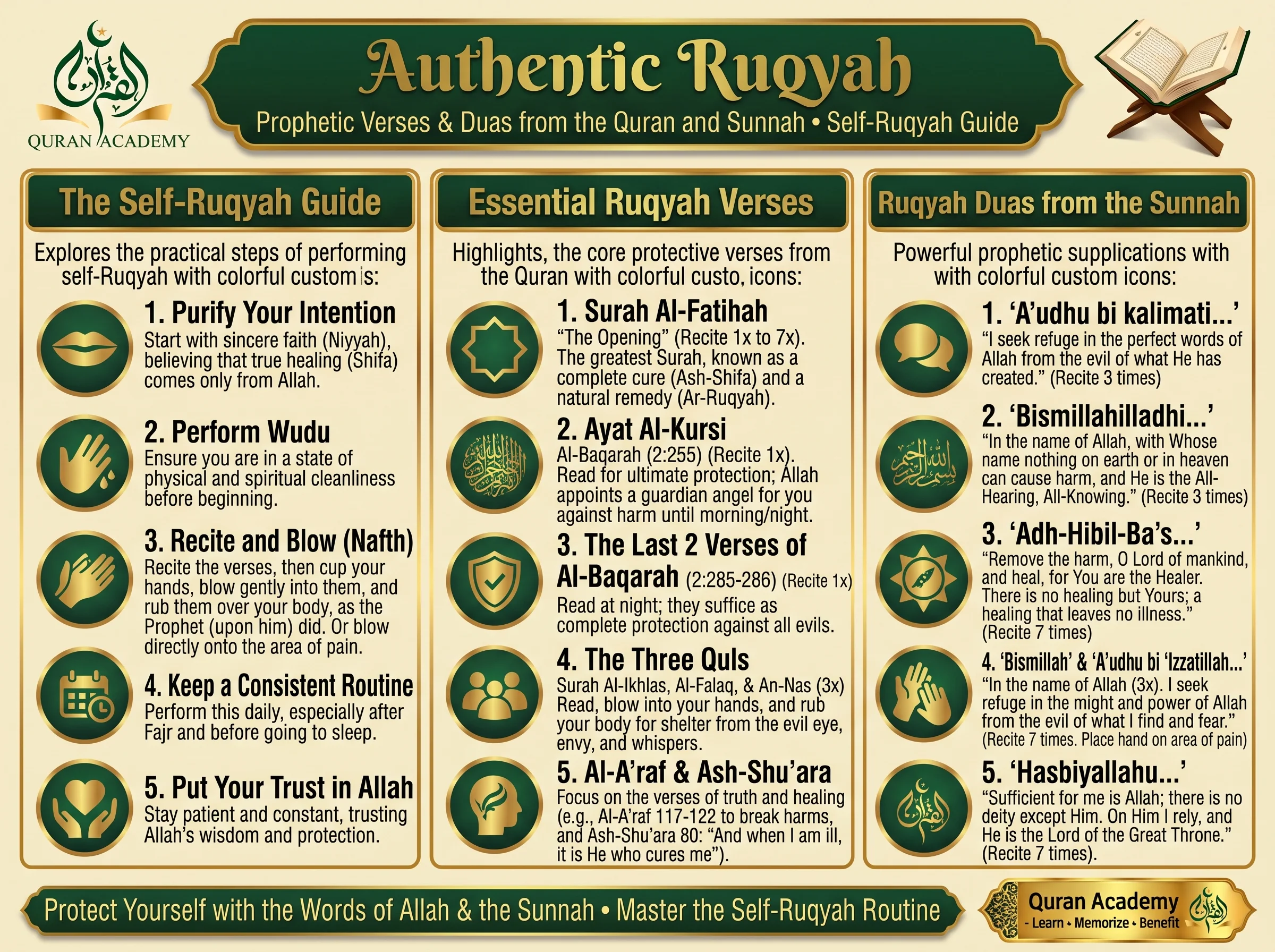
✦ Quick Answer & Key Takeaways: Authentic Ruqyah Verses and Duas
Practicing authentic Ruqyah verses and Duas (الرُّقْيَةُ الشَّرْعِيَّةُ مِنَ الْقُرْآنِ وَالسُّنَّةِ) is the Prophetic method of seeking spiritual and physical healing directly from Allah Almighty through His revealed Speech and the verified supplications of Prophet Muhammad (ﷺ). Rooted in Allah's declaration in Surah Al-Isra (17:82) and Surah Fussilat (41:44) that the Quran is a healing and a mercy for the believers, the core Self-Ruqyah routine requires no intermediary: you simply place your right hand upon the area of pain or cup your palms together, recite (1) Surah Al-Fatihah, (2) Ayatul Kursi (2:255), (3) The Last 2 Verses of Surah Al-Baqarah (2:285–286), and (4) The 3 Quls (Surahs 112, 113 & 114 — 3x each), followed by the 5 Prophetic Healing Duas from Sahih al-Bukhari and Sahih Muslim. In our 1-on-1 Online Islamic Studies & Daily Sunnah Course, students master these exact passages with pure Aqeedah and accurate Tajweed!
- The 3 Scholarly Conditions of Permissible Ruqyah (Sahih Muslim 2200): (1) Using the Quran, Allah's Names, or authentic Sunnah Duas, (2) In clear, understandable Arabic, and (3) With firm conviction that healing comes from Allah alone!
- Why Self-Ruqyah Is Best: Reciting over yourself and your children directly with presence of heart is the Prophetic Sunnah (Sahih al-Bukhari 5016) and strengthens pure Tawakkul.
- The "3x Bismillah + 7x Refuge" Pain Formula (Sahih Muslim 2202): Place your hand on the pain, say Bismillah (3x), and recite A'oodhu billaahi wa qudratihi min sharri maa ajidu wa uhaadhir (7x).
- The Kids Protection Shield (Sahih al-Bukhari 3371): Recite Ibrahim's (AS) protection prayer over your children every morning and evening!
Whenever a believer or their child falls ill with a fever, experiences sudden exhaustion, struggles with heavy anxiety, or fears the effect of envy and the evil eye (Al-'Ayn wal-Hasad), the heart immediately longs for comfort and healing. Allah Almighty combined two complementary gifts for His servants: seeking beneficial medical treatment (for the Prophet ﷺ said in Sunan Abu Dawud 3855: "Seek medical treatment, O servants of Allah, for Allah has not created a disease without creating a cure for it") and seeking spiritual & physical cure through Ar-Ruqyah Ash-Shar'iyyah (الرُّقْيَةُ الشَّرْعِيَّةُ).
Unfortunately, many families today feel intimidated by the word Ruqyah—mistakenly thinking that you must hire an outside practitioner or recite complex, unverified lists of hundreds of verses for hours on end! In reality, the Prophetic Sunnah of Ruqyah is remarkably simple, gentle, and intimate: Prophet Muhammad (ﷺ) taught every believer how to perform Ruqyah upon themselves and their family members in less than 10 minutes using the chapters they already know! Building upon our guides to Surah Al-Fatihah (named Ar-Ruqyah & Ash-Shafiyah!), Ayatul Kursi, The 3 Quls, and our Morning & Evening Adhkar Authentic List, this complete guide gives you the 3 conditions of permissible Ruqyah, the 7 Core Quranic Healing Passages, the 5 Authentic Prophetic Healing Duas, and a step-by-step 10-Minute Self-Ruqyah Routine.
- What Is Ruqyah Shariah? (The 3 Conditions of Permissible Ruqyah & What Is Prohibited)
- Master Chart Part 1: The 7 Core Quranic Passages for Authentic Ruqyah
- Master Chart Part 2: The 5 Authentic Prophetic Ruqyah Duas (Bukhari & Muslim)
- How to Perform a 10-Minute Self-Ruqyah Routine Step by Step (For Yourself & Your Kids)
- 4 Essential Tajweed Rules When Reciting Ruqyah Verses & Duas
- Frequently Asked Questions (FAQs)
1. What Is Ruqyah Shariah? (The 3 Conditions of Permissible Ruqyah & What Is Prohibited)
In Islamic terminology—as we define in our Interactive Tajweed & Islamic Encyclopedia and our 5 Pillars of Islam & 6 Articles of Faith Guide—Ar-Ruqyah (الرُّقْيَةُ) refers to Quranic verses and authentic prophetic supplications recited over a sick or afflicted person to seek healing and protection from Allah Almighty. In Sahih Muslim (2200), when the Companions asked the Prophet (ﷺ) about Ruqyah, he commanded: « اعْرِضُوا عَلَيَّ رُقَاكُمْ، لَا بَأْسَ بِالرُّقَى مَا لَمْ يَكُنْ فِيهِ شِرْكٌ » ("Present your Ruqyahs to me; there is no harm in Ruqyah so long as there is no Shirk [polytheism] in it!").
Commenting on this Hadith in Fath al-Bari, Imam Ibn Hajar al-'Asqalani stated that scholars agreed by consensus (Ijma') that Ruqyah Shariah is permissible and rewarding when 3 conditions are met:
It must be performed using the Words of Allah (the Holy Quran), His Beautiful Names and Attributes, or the authentic supplications of His Messenger (ﷺ).
It must be spoken in clear Arabic (or clearly understood speech)—strictly avoiding all forbidden amulets (Tama'im), talismans, mysterious grids, or unknown incantations!
Both the reciter and the listener must firmly believe that Ruqyah is a blessed means (Sabab), while true healing occurs solely by the Will and Decree of Allah!
2. Master Chart Part 1: The 7 Core Quranic Passages for Authentic Ruqyah
While the entire Quran is a source of healing (as we explore in our Complete Quran Tafseer Guide and our Online Uthmani Quran Explorer), the Prophetic Sunnah specifically established 7 primary Quranic passages as the foundation of every authentic Ruqyah:
| # & Quranic Passage | Recommended Count | Authentic Hadith Proof & Specific Ruqyah Benefit |
|---|---|---|
| 1. Surah Al-Fatihah (Chapter 1:1–7) |
1x, 3x, or 7x | Sahih al-Bukhari 2276 & 5736: Abu Sa'id Al-Khudri (RA) recited Surah Al-Fatihah alone over a tribal chief stung by a venomous scorpion, and he was cured on the spot—earning the Prophet's (ﷺ) praise: "How did you know that it is a Ruqyah?" |
| 2. Ayatul Kursi (Al-Baqarah 2:255) |
1x or 3x | Sahih al-Bukhari 2311 & Muslim 810: The greatest verse in the Book of Allah; appoints a guardian from Allah over the reciter and prevents any devil from approaching until morning! |
| 3. Last 2 Verses of Al-Baqarah (Al-Baqarah 2:285–286) |
1x | Sahih al-Bukhari 5009 & Muslim 807: Whoever recites these two verses at night, they will suffice him (Kafataahu) against every illness, pest, and spiritual harm—and Satan flees from the home in which Surah Al-Baqarah is recited (Muslim 780)! |
| 4, 5 & 6. The Three Quls (Al-Ikhlas, Al-Falaq & An-Nas) |
3x Each | Sahih al-Bukhari 5016 & Sunan Abu Dawud 1463: Whenever the Prophet (ﷺ) felt unwell or went to sleep, he cupped his palms, blew gently into them, recited Al-Ikhlas, Al-Falaq, and An-Nas, and wiped over his head, face, and body three times! |
| 7. Bonus Quranic Healing Gems 🏆 (59:22–24 & Ayat Ash-Shifa') |
1x Each | You may also enrich your recitation with the Last 3 Verses of Surah Al-Hashr (59:22–24), the opening of Surah Al-Baqarah (2:1–5), and the 6 Verses of Healing (آيَاتُ الشِّفَاءِ: 9:14, 10:57, 16:69, 17:82, 26:80, and 41:44)! |
3. Master Chart Part 2: The 5 Authentic Prophetic Ruqyah Duas (Bukhari & Muslim)
Alongside the Quranic verses above, Prophet Muhammad (ﷺ) taught five short, comprehensive healing and protection supplications—every single one graded 100% Sahih—that you can memorize in minutes using our 3x3 Memorization Method:
Struggling to perfect your Recitation?
Join hundreds of students mastering the Quran with our Verified Al-Azhar Graduates. We offer flexible 1-on-1 sessions tailored to your schedule.
Book a Free Evaluation Class →| # & Occasion | Authentic Arabic Text & Transliteration | Core Meaning & Hadith Source |
|---|---|---|
| 1. For Physical Pain in Your Own Body (3x + 7x) |
بِسْمِ ٱللَّهِ (3x) أَعُوذُ بِٱللَّهِ وَقُدْرَتِهِ مِنْ شَرِّ مَا أَجِدُ وَأُحَاذِرُ (7x) Bismillaah (3x). A'oodhu billaahi wa qudratihi min sharri maa ajidu wa uhaadhir (7x). |
Sahih Muslim 2202: Place your hand on the spot of pain and seek refuge in Allah and His Power from the pain you currently feel (Ajidu) and what you fear in the future (Uhaadhir)! |
| 2. The Comprehensive Healing Dua (1x or 3x) |
ٱللَّهُمَّ رَبَّ ٱلنَّاسِ، أَذْهِبِ ٱلْبَأسَ، ٱشْفِ أَنْتَ ٱلشَّافِي، لَا شِفَاءَ إِلَّا شِفَاؤُكَ، شِفَاءً لَا يُغَادِرُ سَقَمًا Allaahumma Rabban-naas, adh-hibil-ba's, ishfi Antash-Shaafee, laa shifaa'a illaa shifaa'uka, shifaa'an laa yughaadiru saqamaa. |
Sahih al-Bukhari 5743 & Muslim 2191: The Prophet's (ﷺ) primary Ruqyah over his family—calling upon the Lord of mankind and the Sole Healer (Ash-Shaafee) for a complete cure that leaves zero trace of illness behind! |
| 3. Angel Jibreel's (AS) Ruqyah Over the Prophet (ﷺ) (1x or 3x) |
بِسْمِ ٱللَّهِ أَرْقِيكَ، مِنْ كُلِّ شَيْءٍ يُؤْذِيكَ، مِنْ شَرِّ كُلِّ نَفْسٍ أَوْ عَيْنِ حَاسِدٍ، ٱللَّهُ يَشْفِيكَ، بِسْمِ ٱللَّهِ أَرْقِيكَ Bismillaahi arqeeka, min kulli shay'in yu'dheeka, min sharri kulli nafsin aw 'ayni haasidin, Allaahu yashfeeka... |
Sahih Muslim 2186: Recited by Angel Jibreel (AS) over the Prophet (ﷺ)—seeking Allah's healing from everything that harms, and from the evil of every soul or envious eye! |
| 4. Protecting Children From Evil Eye & Pests (Morning & Evening) |
أُعِيذُكُمَا (أُعِيذُكَ / أُعِيذُكِ) بِكَلِمَاتِ ٱللَّهِ ٱلتَّامَّةِ، مِنْ كُلِّ شَيْطَانٍ وَهَامَّةٍ، وَمِنْ كُلِّ عَيْنٍ لَامَّةٍ U'eedhuka / U'eedhuki / U'eedhukumaa bi-kalimaatillaahit-taammati min kulli shaytaanin wa haammatin, wa min kulli 'aynin laammah. |
Sahih al-Bukhari 3371: How Ibrahim (AS) protected Isma'il and Ishaq, and how Muhammad (ﷺ) protected Al-Hasan and Al-Husayn from every devil, venomous pest, and blaming/evil eye! |
| 5. Visiting a Sick Person (7 Times • Abu Dawud 3106) 🏆 |
أَسْأَلُ ٱللَّهَ ٱلْعَظِيمَ، رَبَّ ٱلْعَرْشِ ٱلْعَظِيمِ، أَنْ يَشْفِيَكَ (7x) As'alullaahal-'Adheema, Rabbal-'Arshil-'Adheemi, an yashfiyaka (7x). |
Sunan Abu Dawud 3106 & At-Tirmidhi 2083 (Sahih): Whoever visits a sick person whose appointed time has not yet come and says this 7 times in their presence, Allah will heal them from that illness! |
4. How to Perform a 10-Minute Self-Ruqyah Routine Step by Step (For Yourself & Your Kids)
Just as we designed a practical habit-stacking plan in our 15-Minute Daily Quran Routine for Busy Moms, here is how you can perform a complete, Prophetic 10-Minute Self-Ruqyah (or Ruqyah over your child) right at home:
- Step 1 — Preparation & Heart Conviction (1 Minute):
Ideally perform Wudu (though as we explained in our guide on Reading Quran & Making Dhikr During Your Period, a sister on her monthly cycle can perform Ruqyah without Wudu!), face the Qiblah if convenient, and place your right hand on the area of pain (or gently on your child's forehead/chest). - Step 2 — Recite the Core Quranic Shield With Gentle "Nafth" (6 Minutes):
Cup your palms together (or keep your hand on the area of pain) and recite with calm, audible presence of heart:
• Surah Al-Fatihah (1x, 3x, or 7x)
• Ayatul Kursi (2:255) (1x) + Last 2 Verses of Surah Al-Baqarah (2:285–286) (1x)
• Surah Al-Ikhlas, Surah Al-Falaq & Surah An-Nas (3x each)—blowing gently with a tiny trace of moisture (An-Nafth) into your palms and wiping over your head, face, and body! - Step 3 — Seal With the Prophetic Healing Duas (3 Minutes):
Recite the 3x Bismillah + 7x A'oodhu billaahi wa qudratihi... directly over the painful area, followed by Allaahumma Rabban-naas, adh-hibil-ba's... (3x) and the protection Dua over your children! *(Note: Classical scholars like Imam Ahmad and Ibn al-Qayyim also permitted reciting these verses over clean water—especially Zamzam water—and drinking/washing from it as a beneficial means).*
Mastering the Crisp Qalqalah in "Qudْratihi", "Al-Falaqْ" & "Ahadْ" During Ruqyah!
When reciting the Prophetic pain-relief Ruqyah—أَعُوذُ بِٱللَّهِ وَقُدْرَتِهِ (Wa Qudْratihi)—and the verse-endings of Surah Al-Ikhlas and Surah Al-Falaq, every single phrase features the 5 echoing Qalqalah letters (ق ط ب ج د)! Watch Senior Instructor Ustadhah Yasmeen Gamal demonstrate how to articulate crisp Qalqalah without adding extra vowels on our Quran Academy YouTube Channel:
- Mid-Word Bounce on "Qudْratihi": Bounce the silent Dal gently before tapping the Heavy Raa!
- 1-on-1 Live Coaching: Perfect your Ruqyah verses and Tajweed with our Al-Azhar scholars!
5. Four Essential Tajweed Rules When Reciting Ruqyah Verses & Duas
To recite your daily Ruqyah with calm, unhurried beauty (Tarteel), apply these four Tajweed rules from our 1-on-1 Online Tajweed Course:
- 1. Starting "Ishfi" With a Kasrah (ٱشْفِ أَنْتَ ٱلشَّافِي — Hamzatul Wasl Rule):
As we learned in our Hamzatul Wasl & Hamzatul Qat' Guide, when you pause on Adh-hibil-ba's and start the command verb ٱشْفِ (Ishfi — "Cure/Heal!"), look at the 3rd letter (فِ), which carries a Kasrah—so start Hamzatul Wasl with a Kasrah (إِشْفِ = Ishfi), letting the breathy Tafasshi of the Sheen (شْ) flow smoothly! - 2. Heavy vs. Light Raa in "Uhaadhir" & "Yughaadiru" (Ahkam Al-Raa):
Applying our Ahkam Al-Raa Guide, when stopping at the end of وَأُحَاذِرُ (Wa uhaadhirْ), the silent Raa is preceded by a Kasrah on the Dhal (ذِ)—making the final Raa 100% Light (Tarqeeq)! In contrast, the Raa in أَرْقِيكَ (Arْqeeka) and شَرِّ (Sharri — in continuation with Kasrah it is Light; if stopped on, Heavy!) follows its exact vowel rules. - 3. Sun & Moon Letters in "Rabban-Naas" vs. "Al-Ba's" & "Ash-Shaafee":
Using our Laam Shamsiyyah & Laam Qamariyyah Guide, merge the Sun Laam with a 2-beat Ghunnah in رَبَّ ٱلنَّاسِ (Rabban-nnaas) and without Ghunnah in ٱلشَّافِي (Ash-Shaafee), while pronouncing the Moon Laam clearly in ٱلْبَأْسَ (Al-Ba'sa)! - 4. 4-to-5 Beat Madd Wajib Muttasil in "Shifaa'uka" & "Shifaa'an":
According to our Rules of Madd, Makharij al-Huruf, Sifaat al-Huruf, Heavy & Light Letters, Noon Sakinah Rules (merging Shifaa'al-laa without Ghunnah!), Meem Sakinah Rules, Rules of Waqf, 4 Special Words of Hafs, and 7 Alifs in the Quran, stretch the Alif before the Hamzah in شِفَاءَ / شِفَاؤُكَ / شِفَاءً for 4 to 5 counts! Test your Tajweed skills right now on our Free 3-Minute Tajweed Quiz!
Weave your daily protection and healing routine together with our 40 Rabbana Duas From the Quran, Surah Ad-Duha & Ash-Sharh Guide for Anxiety, 10 Shortest Surahs for Salah, Surah Al-Alaq First Revelation Guide, Surah Qaf 6-Day Plan, Surah Ya-Sin, Surah Ar-Rahman, Surah Al-Waqi'ah, Surah Al-Mulk, Surah Maryam, Surah Yusuf, Surah Luqman, Surah Al-Hujurat, Surah As-Sajdah & Al-Insan, Sujood As-Sahw, Salat Al-Istikharah, Salat Al-Janazah, and 25 Prophets in the Quran! Whether you are learning with our Al-Azhar Certified Tutors in our Online Hifz Program (using our Smart Hifz Planner) or enrolling your child in our 1-on-1 Kids Quran Classes with our Printable Kids Star Chart, read how families across the US, UK, Canada, and Australia rate our teachers on our Verified Student & Parent Reviews Page.
6. Frequently Asked Questions (FAQs) About Authentic Ruqyah Shariah
1. What are the 3 conditions for Ruqyah to be permissible (Ruqyah Shariah) in Islam?
As summarized by classical scholars (such as Imam Ibn Hajar al-'Asqalani in Fath al-Bari), scholars agreed by consensus that Ruqyah is permissible when 3 conditions are met: (1) It consists of the Speech of Allah (the Quran) or His Names and Attributes, or authentic Prophetic supplications, (2) It is spoken in clear Arabic or words whose upright meaning is clearly understood, and (3) One firmly believes that the Ruqyah has no independent power in itself, and that healing comes solely from Allah Almighty.
2. What are the 7 core Quranic passages recited in authentic Ruqyah?
The 7 foundational Quranic passages for Ruqyah are: (1) Surah Al-Fatihah (1:1–7), (2) Ayatul Kursi (Surah Al-Baqarah 2:255), (3) The Last 2 Verses of Surah Al-Baqarah (2:285–286), (4) Surah Al-Ikhlas (Chapter 112), (5) Surah Al-Falaq (Chapter 113), (6) Surah An-Nas (Chapter 114), and (7) General verses of healing (Ayat ash-Shifa', such as Surah Al-Isra 17:82) and the concluding verses of Surah Al-Hashr (59:22–24).
3. How do you perform self-Ruqyah step by step for physical pain?
According to the authentic Hadith of 'Uthman ibn Abi Al-'As (may Allah be pleased with him) in Sahih Muslim (2202), place your right hand directly upon the area of your body that feels pain, say "Bismillah" (3 times), and then say (7 times): "A'oodhu billaahi wa qudratihi min sharri maa ajidu wa uhaadhir" (I seek refuge in Allah and in His Power from the evil of what I feel and what I fear).
4. What is the authentic Ruqyah Dua to recite over children for protection from the evil eye?
In Sahih al-Bukhari (3371), Ibn 'Abbas (may Allah be pleased with him) reported that Prophet Muhammad (ﷺ) used to seek refuge for Al-Hasan and Al-Husayn with the words of Prophet Ibrahim (AS) for Isma'il and Ishaq: "U'eedhukumaa bi-kalimaatillaahit-taammati min kulli shaytaanin wa haammatin, wa min kulli 'aynin laammah" (I seek refuge for you both in the Perfect Words of Allah from every devil and venomous creature, and from every harmful/evil eye).
5. Is it better to perform Ruqyah on yourself or ask someone else to perform it on you?
Performing Ruqyah on yourself (and on your own children and family) is far superior and more complete in reliance upon Allah (Tawakkul), because no one feels a person's need and humility before Allah like the person themselves, and Prophet Muhammad (ﷺ) regularly performed self-Ruqyah by cupping his hands and reciting the 3 Quls during his illness (Sahih al-Bukhari 5016).
Fill Your Home With the Healing & Light of the Quran!
Learn to recite and memorize the healing Surahs and Prophetic Duas with crystal-clear Tajweed alongside certified male and female Al-Azhar scholars. Book your free 1-on-1 trial session today!
Book Your Free 1-on-1 Trial Class →