
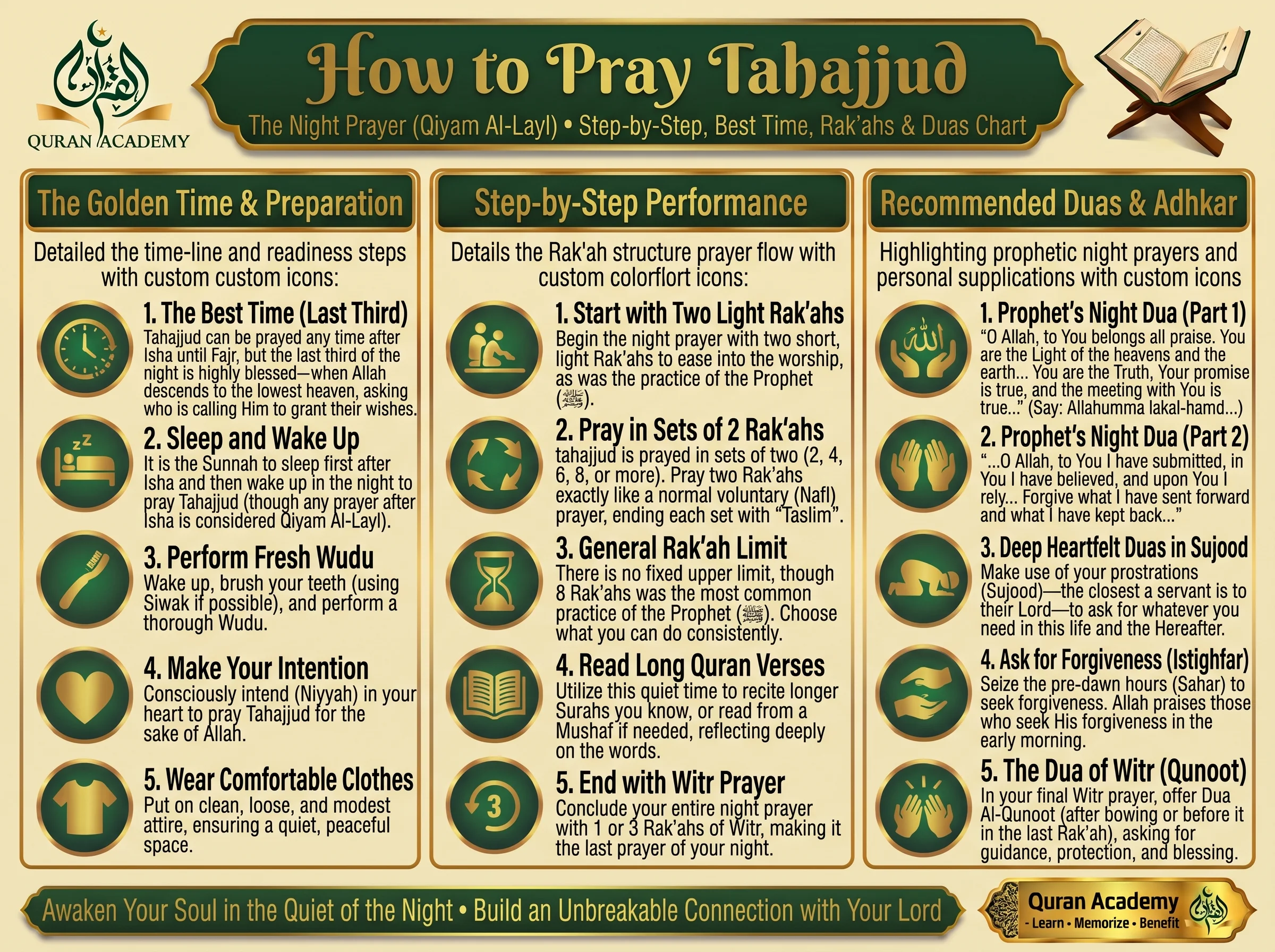
✦ Quick Answer & Key Takeaways: How to Pray Tahajjud Step by Step
Learning how to pray Tahajjud step by step (صَلَاةُ التَّهَجُّدِ وَقِيَامُ اللَّيْلِ) opens the door to the single greatest voluntary prayer in Islam after the five obligatory prayers (Sahih Muslim 1163). Commanded in Surah Al-Isra (17:79) and Surah Al-Muzzammil (73:1–6), the window for night prayer (Qiyam Al-Layl) begins immediately after Isha prayer and lasts until true dawn (Fajr), while Tahajjud specifically refers to rising to pray in the night after sleeping—most virtuously during the Last Third of the Night when Allah Almighty descends to the lowest heaven asking: "Who is calling upon Me that I may answer him?" (Sahih al-Bukhari 1145). You pray Tahajjud in units of 2 Rak'ahs at a time (Mathna Mathna)—starting from as little as 2 Rak'ahs up to 8 Rak'ahs (the Prophetic habit) or more—and seal your night with odd-numbered Witr. In our 1-on-1 Online Quran Memorization (Hifz) & Islamic Studies Program, students build a lifelong habit of reciting their memorized Surahs in Tahajjud!
- Qiyam Al-Layl vs. Tahajjud: Qiyam Al-Layl is any night prayer after Isha (before or after sleep); Tahajjud is specifically praying after waking up from sleep!
- The 30-Second "Last Third" Formula: Divide the total hours from Maghrib to Fajr by 3, and subtract that number from Fajr time!
- The Prophetic 11-Rak'ah Pattern (Sahih al-Bukhari 1147): Pray two light opening Rak'ahs, then pray in 2-Rak'ah units (up to 8 Rak'ahs total), and seal with 3 Rak'ahs of Witr.
- The Ultimate Hifz Secret (Sahih Muslim 789): Reciting your newly memorized Quran pages during night prayer cements them permanently in your chest!
Imagine having a private, uninterrupted one-on-one audience with the King of Kings while the rest of the city is fast asleep—a moment when no phone notifications ring, no worldly noise distracts your heart, and the doors of heaven are wide open for every need, worry, and dream you carry in your chest.
In the early days of Islam in Makkah, before the five daily prayers were even legislated, Allah Almighty trained Prophet Muhammad (ﷺ) and the first generation of believers through Qiyam Al-Layl in Surah Al-Muzzammil (73:1–6)—explaining that rising in the stillness of the night makes the heart and tongue harmonize more deeply than any daytime hour (Inna naashi'atal-layli hiya ashaddu wat'an wa aqwamu qeelaa). Yet many Muslims today miss out on Tahajjud because of two misconceptions: either they think you must wake up at 2:00 AM and stand for two full hours reciting long Juz's you haven't memorized, or they think that if they cannot wake up before Fajr, they get zero share of night prayer! Building upon our guides to Bedtime & Waking Up Duas, Dua Al-Qunoot in Witr Prayer, and Salat Al-Istikharah, this complete guide breaks down Qiyam vs. Tahajjud vs. Tarawih, the Last Third of the Night Calculation, the Step-by-Step Method, and the Authentic Night Duas.
- 1. Comparison Chart: Qiyam Al-Layl vs. Tahajjud vs. Tarawih (What Is the Difference?)
- 2. When Is the Best Time for Tahajjud? (How to Calculate the Last Third of the Night in 30 Seconds!)
- 3. How to Pray Tahajjud Step by Step (Rak'ah Count, 2-by-2 Method & Reading From the Mushaf)
- 4. The Authentic Prophetic Tahajjud Duas (Sahih al-Bukhari 1120 & Sujood Supplications)
- 5. The 3 Night-Reward Tiers (10 Verses, 100 Verses & 1,000 Verses) & Tajweed Rules
- 6. Frequently Asked Questions (FAQs)
1. Comparison Chart: Qiyam Al-Layl vs. Tahajjud vs. Tarawih (What Is the Difference?)
As we explain in our Interactive Tajweed & Islamic Encyclopedia and our Complete Quran Tafseer Guide, beginners often ask whether Qiyam Al-Layl, Tahajjud, and Tarawih are three separate prayers or different names for the same voluntary night worship. Compare them side by side:
| Feature | Qiyam Al-Layl (قِيَامُ اللَّيْلِ) | Tahajjud (التَّهَجُّدُ) | Tarawih (التَّرَاوِيحُ) |
|---|---|---|---|
| 1. Linguistic & Fiqh Definition | The broadest umbrella term: spending any part of the night in voluntary prayer, Quran recitation, and Dhikr. | From Hajada (to leave sleep): specifically refers to voluntary night prayer performed AFTER waking up from sleep! | From Tarweehah (resting after every 4 Rak'ahs): Qiyam Al-Layl prayed in congregation at the beginning of the night in Ramadan. |
| 2. Does It Require Sleeping First? | No! Can be prayed immediately after Isha (before going to bed) OR late at night. | Yes (in strict terminology)! You sleep first after Isha, then wake up in the night to pray. | No! Prayed directly after Isha prayer and its Sunnah during Ramadan. |
| 3. Exact Time Window | From completing Isha prayer until the break of Fajr dawn. | After waking from sleep—best in the Last Third of the Night (or the finalsixth, Sahih al-Bukhari 1131). | From after Isha prayer in Ramadan until Fajr. |
| 4. Where Is Best to Pray It? 🏆 | At home in private sincerity (except Ramadan). | At home (Sahih al-Bukhari 731: "The best prayer of a person is in his home, except the obligatory prayer!"). | In congregation behind the Imam until he finishes (Sunan at-Tirmidhi 806: recorded as standing the whole night!). |
2. When Is the Best Time for Tahajjud? (How to Calculate the Last Third of the Night in 30 Seconds!)
In one of the most famous Hadiths in Islam—recorded in Sahih al-Bukhari (1145) and Sahih Muslim (758) (verifiable in our Online Hadith Explorer)—Prophet Muhammad (ﷺ) informed us of the nightly Divine descent (Hadith an-Nuzool):
Abu Hurayrah (may Allah be pleased with him) reported that the Messenger of Allah (peace be upon him) said:
"Our Lord, the Blessed and Exalted, descends every night to the lowest heaven when the last third of the night remains (حِينَ يَبْقَى ثُلُثُ اللَّيْلِ الْآخِرُ), saying: 'Who is calling upon Me, that I may answer him? Who is asking of Me, that I may give him? Who is seeking My forgiveness, that I may forgive him?'"
How to Calculate the Exact Start of the Last Third of the Night in 3 Easy Steps:
- Step 1 — Measure the Night From Maghrib to Fajr (NOT From Isha or Bedtime!): In Islamic Fiqh, the legal night begins at Maghrib (sunset) and ends at Fajr (true dawn). *(Example: Suppose Maghrib is at 7:00 PM and Fajr is at 4:00 AM—that is a **9-hour night**).*
- Step 2 — Divide the Total Night Duration by 3: Divide 9 hours by 3 = 3 hours per third.
- Step 3 — Subtract One-Third From Fajr Time: Subtract 3 hours from 4:00 AM = 1:00 AM! That means the Last Third of the Night runs from 1:00 AM until 4:00 AM—and even waking up 20 to 30 minutes before Fajr Adhan places you squarely inside this blessed window (and allows you to seal your prayer with pre-dawn Istighfar bil-As-haar praised in Surah Adh-Dhariyat 51:18!)
3. How to Pray Tahajjud Step by Step (Rak'ah Count, 2-by-2 Method & Reading From the Mushaf)
In Sahih al-Bukhari (990), when a man asked the Prophet (ﷺ) how to pray the night prayer, he answered in four crystal-clear words: « صَلَاةُ اللَّيْلِ مَثْنَىٰ مَثْنَىٰ، فَإِذَا خَشِيَ أَحَدُكُمُ الصُّبْحَ صَلَّى رَكْعَةً وَاحِدَةً تُوتِرُ لَهُ مَا قَدْ صَلَّى » ("The night prayer is offered two Rak'ahs by two Rak'ahs; and if one of you fears the break of dawn [Fajr], let him pray one Rak'ah to make odd [Witr] what he has already prayed!"). Follow this 6-Step Prophetic Blueprint:
- Step 1 — Make the Intention Before Sleeping:
Set your alarm and go to sleep intending in your heart to wake up for Tahajjud! In Sunan an-Nasa'i (1787 — Sahih), the Prophet (ﷺ) promised that whoever goes to bed intending to rise and pray at night, but sleep overcomes them until morning, the reward of what they intended is written for them, and their sleep is a charity from their Lord! - Step 2 — Wake Up, Wipe Sleep From Your Face, Look at the Sky/Recite Surah Al 'Imran (3:190–200) & Perform Wudu:
As narrated by Ibn 'Abbas (RA) in Sahih al-Bukhari (183), when the Prophet (ﷺ) woke up at night, he wiped the sleep from his face, recited the final 10 verses of Surah Al 'Imran (which include the 5 Rabbana Duas of 3:191–194!), used the Siwak/toothbrush, and performed a complete Wudu. - Step 3 — Start With 2 Short, Light Opening Rak'ahs (Sahih Muslim 767):
The Prophet (ﷺ) instructed: "When one of you rises at night to pray, let him open his prayer with two light Rak'ahs!" Why? To gently shake off physical drowsiness and untie Satan's knots before entering longer recitation! - Step 4 — Pray in Units of 2 Rak'ahs at a Time (Giving Salam After Every 2 Rak'ahs):
Pray 2 Rak'ahs just like Fajr prayer (reciting Surah Al-Fatihah + any Surah or verses in both Rak'ahs, either softly aloud or silently depending on what helps your focus without disturbing sleeping family members), sit for Tashahhud, and give Salam. Repeat in 2-Rak'ah sets (2, 4, 6, or 8 Rak'ahs). - Step 5 — Can You Hold the Physical Mushaf or Read From Our Online Quran Explorer During Tahajjud?
Yes! As we explained in our Fiqh guide on Reading the Quran From a Mushaf or Phone, the majority of scholars (following the practice of Mother of the Believers 'Aishah RA recorded in Sahih al-Bukhari) permit holding a Mushaf or placing it on a stand during voluntary night prayer so you can enjoy longer Surahs even before memorizing them! - Step 6 — Seal Your Night With Salat Al-Witr & Pre-Dawn Istighfar:
Conclude your night prayer before Fajr Adhan with odd-numbered Witr (1 or 3 Rak'ahs, including Dua Al-Qunoot), and spend the final 5 minutes before Fajr making Istighfar!
4. The Authentic Prophetic Tahajjud Duas (Sahih al-Bukhari 1120 & Sujood Supplications)
What specific words did Prophet Muhammad (ﷺ) recite when he opened his Tahajjud prayer at night and when he bowed into prostration (Sujood)? Here are the two most famous authentic Tahajjud supplications:
ٱللَّهُمَّ لَكَ ٱلْحَمْدُ أَنْتَ قَيِّمُ ٱلسَّمَاوَاتِ وَٱلْأَرْضِ وَمَنْ فِيهِنَّ، وَلَكَ ٱلْحَمْدُ أَنْتَ نُورُ ٱلسَّمَاوَاتِ وَٱلْأَرْضِ وَمَنْ فِيهِنَّ، وَلَكَ ٱلْحَمْدُ أَنْتَ مَلِكُ ٱلسَّمَاوَاتِ وَٱلْأَرْضِ وَمَنْ فِيهِنَّ، وَلَكَ ٱلْحَمْدُ أَنْتَ ٱلْحَقُّ، وَوَعْدُكَ ٱلْحَقُّ، وَلِقَاؤُكَ حَقٌّ، وَقَوْلُكَ حَقٌّ، وَٱلْجَنَّةُ حَقٌّ، وَٱلنَّارُ حَقٌّ، وَٱلنَّبِيُّونَ حَقٌّ، وَمُحَمَّدٌ ﷺ حَقٌّ، وَٱلسَّاعَةُ حَقٌّ. ٱللَّهُمَّ لَكَ أَسْلَمْتُ، وَبِكَ آمَنْتُ، وَعَلَيْكَ تَوَكَّلْتُ، وَإِلَيْكَ أَنَبْتُ، وَبِكَ خَاصَمْتُ، وَإِلَيْكَ حَاكَمْتُ، فَٱغْفِرْ لِي مَا قَدَّمْتُ وَمَا أَخَّرْتُ، وَمَا أَسْرَرْتُ وَمَا أَعْلَنْتُ، أَنْتَ ٱلْمُقَدِّمُ وَأَنْتَ ٱلْمُؤَخِّرُ، لَا إِلَٰهَ إِلَّا أَنْتَ.
Transliteration & Summary: Allaahumma lakal-hamdu Anta Qayyimus-samaawaati wal-ardi wa man feehinna, wa lakal-hamdu Anta Noorus-samaawaati wal-ardi... Antal-Haqqu, wa wa'dukal-haqqu... Allaahumma laka aslamtu, wa bika aamantu, wa 'alayka tawakkaltu, wa ilayka anabtu... faghfir lee maa qaddamtu wa maa akh-khartu, wa maa asrartu wa maa a'lantu, Antal-Muqaddimu wa Antal-Mu'akh-khiru, laa ilaaha illaa Ant. (Praises Allah as the Sustainer, Light, and King of the heavens and earth, affirms the truth of His promise, Paradise, Hellfire, and the Prophets, and asks forgiveness for past, future, secret, and public sins!).
Struggling to perfect your Recitation?
Join hundreds of students mastering the Quran with our Verified Al-Azhar Graduates. We offer flexible 1-on-1 sessions tailored to your schedule.
Book a Free Evaluation Class →ٱللَّهُمَّ أَعُوذُ بِرِضَاكَ مِنْ سَخَطِكَ، وَبِمُعَافَاتِكَ مِنْ عُقُوبَتِكَ، وَأَعُوذُ بِكَ مِنْكَ، لَا أُحْصِي ثَنَاءً عَلَيْكَ، أَنْتَ كَمَا أَثْنَيْتَ عَلَىٰ نَفْسِكَ.
(Sahih Muslim 486 — Recited by the Prophet ﷺ in Sujood of night prayer: "O Allah, I seek refuge in Your pleasure from Your wrath, and in Your pardon from Your punishment, and I seek refuge in You from You; I cannot enumerate Your praise—You are as You have praised Yourself!").
Mastering the Shaddah Qalqalah on "Al-Haqqّْ" & "Anabْtu" in the Tahajjud Dua!
In the famous opening Tahajjud Dua of Sahih al-Bukhari (1120), the word ٱلْحَقُّ / حَقٌّ (Al-Haqqّْ) is repeated 8 times in a row—and right after it comes وَإِلَيْكَ أَنَبْتُ (Wa ilayka Anabْtu)! Both the doubled Qaaf (قّْ) when pausing and the mid-word Baa Sakinah (بْ) in Anabْtu are Qalqalah (Echoing) letters (ق ط ب ج د)! Watch Senior Instructor Ustadhah Yasmeen Gamal demonstrate how to hold the Shaddah before releasing the Qalqalah bounce on our Quran Academy YouTube Channel:
- Crisp Baa in "Anabْtu": Keep the Baa voiced so it never turns into an English "P" before the Taa!
- 1-on-1 Live Coaching: Beautify your night recitation with our Al-Azhar scholars!
5. The 3 Night-Reward Tiers (10, 100 & 1,000 Verses — Abu Dawud 1398) & Tajweed Rules
In one of the most motivating Hadiths for Quran students—recorded in Sunan Abu Dawud (1398 — graded Sahih) from 'Abdullah ibn 'Amr ibn Al-'As (may Allah be pleased with them)—the Prophet (ﷺ) revealed a 3-tier reward system based on how many verses you recite in your night prayer:
- 🥉 Tier 1 — Standing With 10 Verses: "Not Written Among the Heedless (Al-Ghafileen)!"
Even on your most exhausted night, if you pray just 2 Rak'ahs after Isha or before Fajr and recite 10 verses (for example, any two of our 10 Shortest Surahs for Salah or Surah Ad-Duha & Ash-Sharh!), your name is erased from the register of the heedless for that entire night! - 🥈 Tier 2 — Standing With 100 Verses: "Written Among the Devoutly Obedient (Al-Qaniteen)!"
How easy is it to reach 100 verses in 10 minutes? Reciting Surah Al-Waqi'ah (96 verses) + 1 short Surah, OR Surah Ar-Rahman (78 verses) + Surah Al-Mulk (30 verses), OR Surah Qaf (45 verses) + Surah Ya-Sin (83 verses), OR Surah Maryam (98 verses) easily passes 100 verses—inscribing your name among Al-Qaniteen! - 🥇 Tier 3 — Standing With 1,000 Verses: "Written Among Those With Mountain-Loads of Reward (Al-Muqantareen)!"
Did you know that the entire Juz Amma (Juz 30) plus Juz Tabarak (Juz 29) equals 995 verses—meaning reciting Juz 29 & 30 across your night prayers writes you among Al-Muqantareen!
Because Allah Almighty commanded in the Surah of Night Prayer (Surah Al-Muzzammil 73:4): وَرَتِّلِ ٱلْقُرْآنَ تَرْتِيلًا ("And recite the Quran with measured, distinct Tarteel!"), use your Tahajjud prayers to practice all our Tajweed rules: Makharij al-Huruf, Sifaat al-Huruf, Heavy & Light Letters, Rules of Madd, Noon Sakinah Rules, Meem Sakinah Rules, Rules of Waqf, Ahkam Al-Raa, Laam Shamsiyyah & Qamariyyah, Hamzatul Wasl vs. Qat', 4 Special Words of Hafs, and 7 Alifs in the Quran in our 1-on-1 Online Tajweed Course (and test your ear on our Free 3-Minute Tajweed Quiz!). Pair your night prayers with our Prophetic Duas for Anxiety & Debt Relief, Authentic Ruqyah Shariah, Authentic Duas After Fard Salah, Morning & Evening Adhkar, Last 3 Verses of Surah Al-Hashr, Surah Al-Alaq, Ayatul Kursi, Last 2 Verses of Surah Al-Baqarah, The 3 Quls, Surah Yusuf, Surah Luqman, Surah Al-Hujurat, Surah As-Sajdah & Al-Insan, Sujood As-Sahw, Salat Al-Janazah, 5 Pillars of Islam, and 25 Prophets in the Quran with our Al-Azhar Certified Tutors—or enroll your child in our 1-on-1 Kids Quran Classes with our Printable Kids Star Chart! See how students across the US, UK, Canada, and Australia rate our teachers on our Verified Student & Parent Reviews Page.
6. Frequently Asked Questions (FAQs) About How to Pray Tahajjud & Qiyam Al-Layl
1. What is the main difference between Qiyam Al-Layl, Tahajjud, and Tarawih?
Qiyam Al-Layl (Standing in the Night) is the general umbrella term for any voluntary worship or prayer performed after Isha prayer until Fajr dawn—whether before or after sleeping. Tahajjud (derived from Hajada, meaning to leave sleep) specifically refers to night prayer performed AFTER waking up from sleep in the night. Tarawih is the congregationally performed Qiyam Al-Layl during the nights of Ramadan.
2. How do you calculate the Last Third of the Night for Tahajjud?
In Islamic jurisprudence, the night begins at Maghrib (sunset) and ends at Fajr (true dawn). Count the total hours and minutes between Maghrib and Fajr, divide that total by 3, and subtract that third from the Fajr time. For example, if Maghrib is at 6:00 PM and Fajr is at 6:00 AM (a 12-hour night), one-third is 4 hours—so the Last Third of the Night begins at 2:00 AM and lasts until 6:00 AM.
3. How many Rak'ahs is Tahajjud prayer and how is it performed?
According to Sahih al-Bukhari (990 & 1147), the night prayer is prayed in units of two by two (Mathna Mathna—giving Salam after every 2 Rak'ahs). The minimum for Tahajjud is 2 Rak'ahs (plus Witr), there is no maximum limit when praying alone, and the consistent Sunnah of Prophet Muhammad (ﷺ) was 8 Rak'ahs of Tahajjud plus 3 Rak'ahs of Witr (totaling 11 Rak'ahs).
4. Can I pray Qiyam Al-Layl before going to sleep if I am afraid I won't wake up for Tahajjud?
Yes! Any voluntary prayer performed after completing the obligatory Isha prayer and its Sunnah counts as Qiyam Al-Layl. If you fear you will not be able to wake up before Fajr, the Prophet (ﷺ) advised praying 2 or more Rak'ahs of Qiyam and sealing them with Witr before going to sleep (Sahih Muslim 755).
5. What if I already prayed Witr before sleeping and then woke up in the Last Third of the Night for Tahajjud?
If you already prayed Witr before going to sleep and then Allah blessed you to wake up in the Last Third of the Night, pray as many 2-Rak'ah units of Tahajjud as you wish, and do NOT repeat Witr again—because Prophet Muhammad (ﷺ) declared: "There are no two Witrs in a single night" (Sunan Abu Dawud 1439 — Sahih).
Illuminate Your Nights With Sweet Quranic Recitation!
Imagine standing in Tahajjud reciting your favorite Surahs from memory with effortless Tajweed and deep heart connection. Start your personalized 1-on-1 journey with our certified male and female Al-Azhar scholars today!
Book Your Free 1-on-1 Trial Class →