
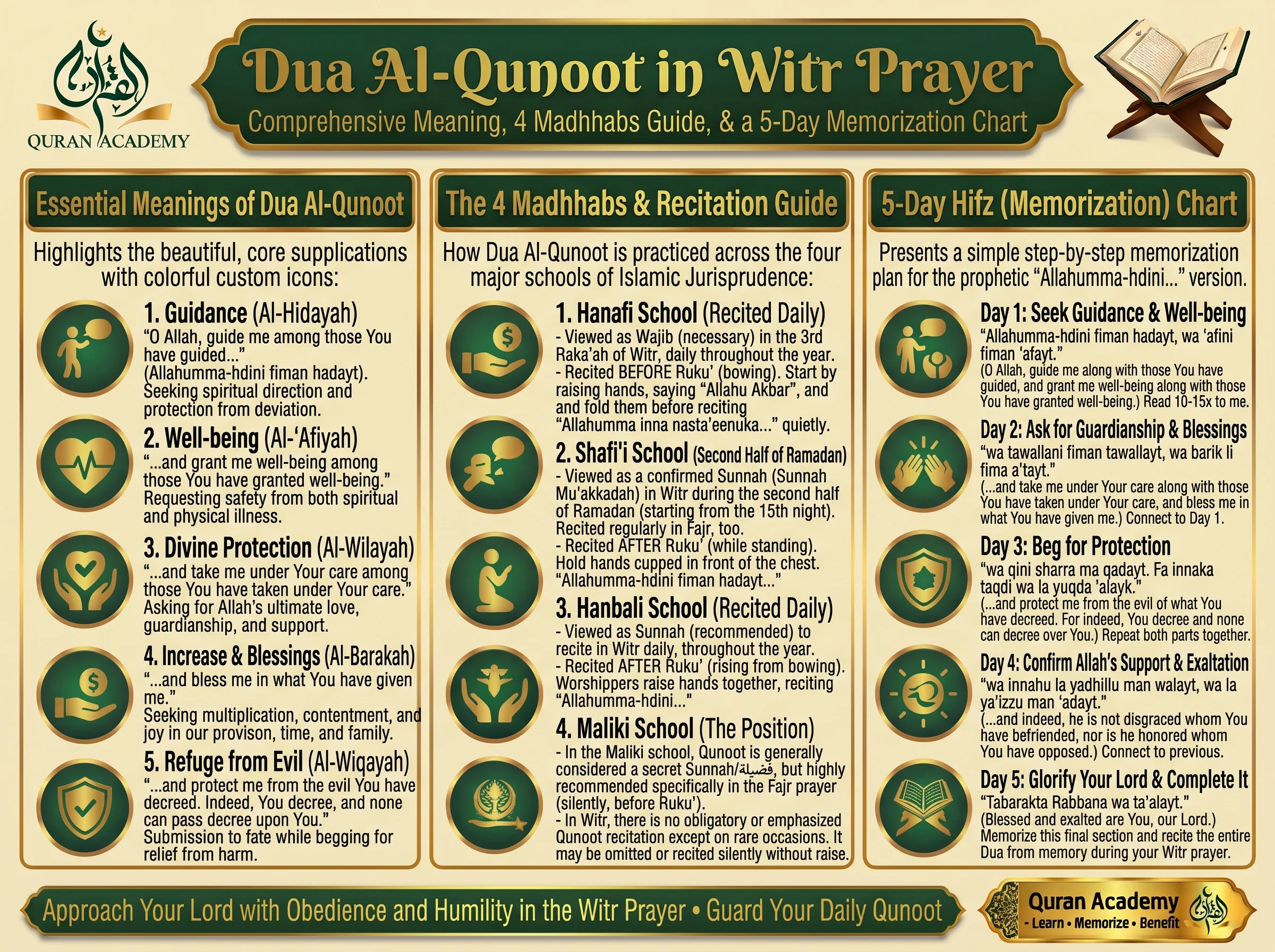
✦ Quick Answer & Key Takeaways: Dua Al-Qunoot Arabic & Meaning
Mastering Dua Al Qunoot Arabic and meaning (دُعَاءُ الْقُنُوتِ فِي صَلَاةِ الْوِتْرِ) crowns your nightly prayer routine with one of the most moving supplications ever taught by Prophet Muhammad (ﷺ). Recited standing in the final Rak'ah of Salat Al-Witr—whether in quiet devotion at home every night or behind the Imam during the blessed nights of Ramadan—Dua Al-Qunoot has two authentic, complementary forms in the Sunnah: (1) The Prophetic Qunoot taught to Al-Hasan ibn 'Ali (RA) (Allaahummah-dinee feeman hadayt... — Sunan Abu Dawud 1425) and (2) The Qunoot of Caliph 'Umar ibn Al-Khattab (RA) (Allaahumma innaa nasta'eenuka wa nastaghfiruka... — standard in the Hanafi school). In our 1-on-1 Online Islamic Studies & Fiqh Course, adults and children memorize both authentic texts in 5 minutes using rhythmic rhyming chunks!
- The 5 Core Requests of Al-Hasan's Qunoot: Asks Allah for (1) Guidance (Ihdinee), (2) Complete Wellbeing ('Aafinee), (3) Loving Guardianship (Tawallanee), (4) Barakah in Provision (Baarik lee), and (5) Protection from harmful decrees (Qinee sharra maa qadayt)!
- Before Ruku' vs. After Ruku': Recited before Ruku' in the Hanafi school (with an extra Takbeer) and after rising from Ruku' in the Shafi'i and Hanbali schools—both positions are authentically transmitted from the Companions!
- Singular ("Ihdinee") vs. Plural ("Ihdinaa"): Say Ihdinee (singular) when praying alone at home, and Ihdinaa (plural) when an Imam leads a congregation!
- What If You Haven't Memorized It Yet? Recite Rabbanaa aatinaa fid-dunyaa hasanah... (Surah Al-Baqarah 2:201) until you master the full Dua in 5 minutes below!
Every Muslim who has stood in the mosque during the final nights of Ramadan knows the feeling: the Imam finishes reciting the Surah in the last Rak'ah of Witr, raises his hands in humble devotion, and begins reciting Dua Al-Qunoot as hundreds of voices echo "Aameen!" behind him. Yet when Ramadan ends and we pray Witr alone on our prayer mats at home before going to sleep, many people realize they only know the first line or two—or they get confused between the two famous versions of Dua Al-Qunoot!
Even more common are the practical Fiqh questions that arise in multicultural communities: "Why does my Hanafi friend raise his hands for Qunoot BEFORE bowing into Ruku' and recite 'Allaahumma innaa nasta'eenuka...', while my Shafi'i or Hanbali friend rises FROM Ruku' first and recites 'Allaahummah-dinee feeman hadayt...'? And what is the difference between the nightly Qunoot of Witr and the emergency Qunoot of calamity (Qunoot an-Nawazil)?" Building upon our guides to Bedtime & Waking Up Duas, Authentic Duas After Fard Salah, and Sujood As-Sahw, this complete guide gives you both authentic Arabic texts, their chunk-by-chunk memorization breakdown, the 4 Madhhab comparison chart, and key Tajweed rules.
- 1. What Does "Al-Qunoot" Mean in the Quran & Sunnah? (Qunoot Al-Witr vs. Qunoot An-Nawazil)
- 2. Authentic Text #1: The Prophetic Qunoot of Al-Hasan ibn 'Ali (Allaahummah-dinee Feeman Hadayt)
- 3. Authentic Text #2: The Qunoot of 'Umar ibn Al-Khattab (Allaahumma Innaa Nasta'eenuka — Hanafi)
- 4. Master Fiqh Chart: Dua Al-Qunoot Across the 4 Sunni Schools (Hanafi, Maliki, Shafi'i & Hanbali)
- 5. Five Essential Tajweed Rules When Reciting Dua Al-Qunoot
- 6. Frequently Asked Questions (FAQs)
1. What Does "Al-Qunoot" Mean in the Quran & Sunnah? (Witr vs. Nawazil)
In classical Quranic Arabic—as we explore in our Complete Quran Tafseer Guide and our Interactive Tajweed & Islamic Encyclopedia—the root word الْقُنُوتُ (Al-Qunoot) means humble, prolonged obedience, devotion, and standing in prayer before Allah (as in Surah Al-Baqarah 2:238: Wa qoomoo lillaahi qaaniteen and Maryam's title in Surah At-Tahrim 66:12: Wa kaanat minal-qaaniteen!). When Prophet Muhammad (ﷺ) was asked in Sahih Muslim (756) which prayer is best, he answered: « طُولُ الْقُنُوتِ » ("Prolonged standing in devotion!").
In Islamic jurisprudence (Fiqh), standing to recite a special supplication inside prayer is divided into two distinct categories:
- 🌙 1. Qunoot Al-Witr (قُنُوتُ الْوِتْرِ — The Nightly Witr Supplication): Performed in the final Rak'ah of the odd-numbered Witr prayer at night (whether you pray 1, 3, 5, 7, 9, or 11 Rak'ahs)—focusing on personal guidance, wellbeing, forgiveness, and praise of Allah.
- 🌍 2. Qunoot An-Nawazil (قُنُوتُ النَّوَازِلِ — The Supplication During Times of Major Calamity): Performed by the Imam after rising from Ruku' in the final Rak'ah of the obligatory prayers (especially Fajr, as recorded in Sahih al-Bukhari 1001 & Muslim 677) when the Muslim Ummah faces a severe crisis, war, or catastrophe!
2. Authentic Text #1: The Prophetic Qunoot of Al-Hasan ibn 'Ali (Allaahummah-dinee Feeman Hadayt)
Recorded in Sunan Abu Dawud (1425), Sunan at-Tirmidhi (464), An-Nasa'i (1745), and Musnad Ahmad (1718 — graded Sahih)—verifiable in our Online Hadith Explorer—Al-Hasan ibn 'Ali (may Allah be pleased with them both) said: "The Messenger of Allah (ﷺ) taught me words to say in the Qunoot of Witr..." Using our 3x3 Memorization Method, notice how easily you can memorize this entire supplication in 5 minutes because every phrase rhymes on the exact same "-ayt" sound:
| Chunk & Petition | Voweled Arabic Text & Transliteration | Deep Spiritual Meaning |
|---|---|---|
| Chunk 1: Guidance & Wellbeing |
ٱللَّهُمَّ ٱهْدِنِي فِيمَنْ هَدَيْتَ، وَعَافِنِي فِيمَنْ عَافَيْتَ Allaahummah-dinee feeman hadayt, wa 'aafinee feeman 'aafayt, |
"O Allah, guide me among those whom You have guided (the Prophets & righteous), and grant me complete wellbeing (in faith and body) among those whom You have pardoned and healed," |
| Chunk 2: Guardianship & Barakah |
وَتَوَلَّنِي فِيمَنْ تَوَلَّيْتَ، وَبَارِكْ لِي فِيمَا أَعْطَيْتَ Wa tawallanee feeman tawallayt, wa baarik lee feemaa a'tayt, |
"And take me into Your loving care and guardianship among those whom You have befriended, and bless me in all that You have given me," |
| Chunk 3: Protection & Decree |
وَقِنِي شَرَّ مَا قَضَيْتَ، إِنَّكَ تَقْضِي وَلَا يُقْضَىٰ عَلَيْكَ Wa qinee sharra maa qadayt, innaka taqdee wa laa yuqdaa 'alayk, |
"And protect me from the evil of what You have decreed; for indeed You decree and none can pass decree over You!" |
| Chunk 4: True Honor & Might |
وَإِنَّهُ لَا يَذِلُّ مَنْ وَالَيْتَ، وَلَا يَعِزُّ مَنْ عَادَيْتَ Wa innahu laa yadhillu man waalayt, wa laa ya'izzu man 'aadayt, |
"And indeed, he whom You befriend can never be humiliated, and he whom You take as an enemy can never be honored!" |
| Chunk 5 🏆: Praise & Salawat Seal |
تَبَارَكْتَ رَبَّنَا وَتَعَالَيْتَ (وَصَلَّى ٱللَّهُ عَلَىٰ ٱلنَّبِيِّ مُحَمَّدٍ) Tabaarakta Rabbanaa wa ta'aalayt (Wa sallallaahu 'alan-Nabiyyi Muhammad). |
"Blessed are You, our Lord, and Exalted!" *(And as practiced by the Companions like Ubayy ibn Ka'b RA, sealing Qunoot with Salawat upon the Prophet ﷺ!).* |
3. Authentic Text #2: The Qunoot of 'Umar ibn Al-Khattab (Allaahumma Innaa Nasta'eenuka — Hanafi)
In the Hanafi school (and recommended by scholars across the Maliki, Shafi'i, and Hanbali schools to combine right alongside Al-Hasan's Dua above!), worshippers recite the majestic Qunoot authentically transmitted from Caliph 'Umar ibn Al-Khattab, 'Ali ibn Abi Talib, and 'Abdullah ibn Mas'ud (may Allah be pleased with them all, recorded in Musannaf Ibn Abi Shaybah 6965 and As-Sunan Al-Kubra of Al-Bayhaqi 2/210 — graded Sahih):
ٱللَّهُمَّ إِنَّا نَسْتَعِينُكَ وَنَسْتَغْفِرُكَ، وَنُؤْمِنُ بِكَ وَنَتَوَكَّلُ عَلَيْكَ، وَنُثْنِي عَلَيْكَ ٱلْخَيْرَ كُلَّهُ، وَنَشْكُرُكَ وَلَا نَكْفُرُكَ، وَنَخْلَعُ وَنَتْرُكُ مَنْ يَفْجُرُكَ. ٱللَّهُمَّ إِيَّاكَ نَعْبُدُ، وَلَكَ نُصَلِّي وَنَسْجُدُ، وَإِلَيْكَ نَسْعَىٰ وَنَحْفِدُ، نَرْجُو رَحْمَتَكَ وَنَخْشَىٰ عَذَابَكَ، إِنَّ عَذَابَكَ بِٱلْكُفَّارِ مُلْحِقٌ.
Transliteration: Allaahumma innaa nasta'eenuka wa nastaghfiruk, wa nu'minu bika wa natawakkalu 'alayk, wa nuthnee 'alaykal-khayra kullah, wa nashkuruka wa laa nakfuruk, wa nakhla'u wa natruku man yafjuruk. Allaahumma iyyaaka na'bud, wa laka nusallee wa nasjud, wa ilayka nas'aa wa nahfid, narjoo rahmataka wa nakhshaa 'adhaabak, inna 'adhaabaka bil-kuffaari mulhiq.
Core Meaning Summary: Declares our reliance upon Allah's help and forgiveness, praises Him for all good, pledges gratitude over ingratitude, disavows those who rebel against Him, echoes Surah Al-Fatihah's "Iyyaaka na'budu" by dedicating all prayer, prostration, and eager striving (Nahfid) to Allah alone—balancing hope in His Mercy (Narjoo rahmatak) with reverent fear of His punishment!
Struggling to perfect your Recitation?
Join hundreds of students mastering the Quran with our Verified Al-Azhar Graduates. We offer flexible 1-on-1 sessions tailored to your schedule.
Book a Free Evaluation Class →4. Master Fiqh Chart: Dua Al-Qunoot Across the 4 Sunni Schools
Just as we compared the four schools in our Wudu & Tayammum Guide and our Salat Al-Janazah Guide, here is how the Hanafi, Maliki, Shafi'i, and Hanbali Madhhabs practice Dua Al-Qunoot in Witr (so you can follow any Imam with complete harmony and knowledge):
| Fiqh Question | Hanafi School | Shafi'i School | Hanbali & Maliki Schools |
|---|---|---|---|
| 1. When in the Year Is Witr Qunoot Recited? | Every night of the entire year! (Considered Wajib in the 3rd Rak'ah of Witr; if forgotten, perform Sujood As-Sahw). | Recommended (Sunnah) in the 2nd half of Ramadan (from Night 15/16 to the end of Ramadan; also recited in Fajr prayer year-round in the Shafi'i school). | • Hanbali: Recommended (Sunnah) in Witr all year round. • Maliki: Performed in Fajr silently before Ruku' (and by many in the 2nd half of Ramadan). |
| 2. Before Ruku' or After Ruku'? | BEFORE Ruku': Finish the Surah in the 3rd Rak'ah, raise hands with an extra "Allahu Akbar," fold/raise hands, recite Qunoot, then bow into Ruku'! | AFTER Ruku': Bow into Ruku', rise saying "Sami'allaahu liman hamidah, Rabbanaa wa lakal-hamd," then raise hands for Qunoot before Sujood! | • Hanbali: AFTER Ruku' is preferred (and Before Ruku' is also valid). • Maliki: BEFORE Ruku' without an extra Takbeer. |
| 3. Primary Chosen Text | Text #2 (Allaahumma innaa nasta'eenuka...), or combining both Text #2 and Text #1! | Text #1 (Allaahummah-dinee feeman hadayt...), and combining Text #2 after it in congregation is praised by Imam An-Nawawi! | Text #1 (Allaahummah-dinee feeman hadayt...) or combining both texts. |
| 4. Raising Hands & Wiping the Face | Raise hands for Takbeer then fold them (or hold at chest level); do not wipe face inside prayer. | Raise palms to chest level during Qunoot; do NOT wipe the face with hands after Qunoot inside Salah (Al-Majmu' of Imam An-Nawawi). | Raise palms to chest level; preferred not to wipe the face inside prayer according to Imam Ahmad and investigative scholars. |
Mastering the Crisp Qalqalah in "Taqْdee", "Yuqْdaa" & "Yafْjuruk" in Dua Al-Qunoot!
Look at the central declaration of decree in Dua Al-Qunoot: فَإِنَّكَ تَقْضِي وَلَا يُقْضَىٰ عَلَيْكَ (Fa-innaka Taqْdee wa laa Yuqْdaa 'alayk) and in 'Umar's Qunoot: مَنْ يَفْجُرُكَ (Yafْjuruk) and وَنَسْجُدُ (Wa Nasjudْ)! Both the silent Qaaf (قْ) in Taqْdee / Yuqْdaa and the silent Dal (دْ) on stop are Qalqalah (Echoing) letters (ق ط ب ج د)! Watch Senior Instructor Ustadhah Yasmeen Gamal demonstrate how to bounce the Qaaf without turning the Taa into a heavy Taa' on our Quran Academy YouTube Channel:
- Light "Ta-" + Heavy "Qْ-" + Heavy "-dee": Keep the Taa smiling in Ta-qْ-dee before elevating the Qaaf and Daad!
- 1-on-1 Live Coaching: Perfect your Witr Qunoot and Quran recitation with Al-Azhar scholars!
5. Five Essential Tajweed Rules When Reciting Dua Al-Qunoot
Before you stand for Witr prayer tonight, apply these five core Tajweed rules from our 1-on-1 Online Tajweed Course:
- 1. Dropping Hamzatul Wasl & Whispering the Haa' in "Allaahummah-dinee" (ٱللَّهُمَّ ٱهْدِنِي):
As we mastered in our Hamzatul Wasl & Hamzatul Qat' Guide, when connecting Allaahumma to ٱهْدِنِي, drop the Hamzatul Wasl completely and let the soft breath of the silent Haa' (هْ) flow from the deepest throat: Allaahummahْ-dinee (NEVER "Allaahumma-ihdinee" ❌)! - 2. Stopping With Soft Madd Leen & Hams on the Taa's (هَدَيْتْ، عَافَيْتْ، تَوَلَّيْتْ، أَعْطَيْتْ، قَضَيْتْ):
Using our Rules of Madd Guide, Rules of Waqf Guide, and Sifaat al-Huruf Guide, every rhyming clause in Al-Hasan's Qunoot ends with a Yaa Sakinah preceded by a Fatha (ـَيْتَ). When pausing at the end of each clause, stretch the soft Madd Leen consistently and finish with a gentle, whispered breath (Hams) on the silent Taa (ـَيْتْ = -aytْ)! - 3. Crisp Izhar vs. Idgham With Ghunnah Across "Feeman":
Applying our Noon Sakinah & Tanween Guide and Meem Sakinah Guide, notice how the Noon Sakinah at the end of فِيمَنْ (Feeman) and مَنْ (Man) changes its rule based on the next letter:
• Izhar Halqi (Clear Noon): Before هـ، ع، أ in Feemanْ hadayt, Feemanْ 'aafayt, and Manْ 'aadayt!
• Ikhfaa' Haqiqi (2-Beat Concealed Nasal Ghunnah): Before ت in Feeman-tawallayt!
• Idgham Bighunnah (2-Beat Merged Nasal Ghunnah): Before و and ي in Maw-waalayt (مَنْ وَالَيْتَ) and May-yafjuruk (مَنْ يَفْجُرُكَ)! - 4. Light Raa in "Wa Baarik Lee" vs. Heavy Raa in "Sharra" & "Tabaarakta" (Ahkam Al-Raa):
According to our Ahkam Al-Raa Guide, keep the Raa in وَبَارِكْ لِي (Wa Baa-ri-kْ lee) 100% Light (Tarqeeq) because of its Kasrah, and keep the Raa in شَرَّ (Sharra), تَبَارَكْتَ (Tabaarakta), and رَبَّنَا (Rabbanaa) 100% Heavy (Tafkhim)! - 5. Keeping "Taqdee" & "A'tayt" Balanced Between Light and Heavy Letters:
Following our Makharij al-Huruf, Heavy & Light Letters, Laam Shamsiyyah & Qamariyyah, 4 Special Words of Hafs, and 7 Alifs in the Quran guides, in أَعْطَيْتَ (A'-tayt), keep the Hamzah and 'Ayn light before elevating the heavy طَ, and finish on a light تْ! Test your Tajweed accuracy right now on our Free 3-Minute Tajweed Quiz!
With this guide, we have completed all 5 Prophetic Duas, Adhkar & Ruqyah Guides of Day 3 (Articles 86 to 90)—connecting Dua Al-Qunoot seamlessly with our Authentic Ruqyah Shariah Guide, Prophetic Duas for Anxiety & Debt Relief, Morning & Evening Adhkar, 40 Rabbana Duas From the Quran, Surah Al-Fatihah Guide, Last 3 Verses of Surah Al-Hashr, Surah Qaf 6-Day Plan, 10 Shortest Surahs for Salah (including Al-Ikhlas & Al-Kafirun recited in Witr!), Surah Al-Alaq Guide, Ayatul Kursi, Last 2 Verses of Surah Al-Baqarah, The 3 Quls, Surah Ad-Duha & Ash-Sharh, Surah Ya-Sin, Surah Ar-Rahman, Surah Al-Waqi'ah, Surah Maryam, Surah Yusuf, Surah Luqman, Surah Al-Hujurat, Salat Al-Istikharah, Salat Al-Janazah, 5 Pillars of Islam, and 25 Prophets in the Quran in our Online Hifz Program! Whether you are learning with our Al-Azhar Certified Tutors or enrolling your child in our 1-on-1 Kids Quran Classes with our Printable Kids Star Chart, see how families across the US, UK, Canada, and Australia rate our teachers on our Verified Student & Parent Reviews Page.
6. Frequently Asked Questions (FAQs) About Dua Al-Qunoot in Witr Prayer
1. What is the most authentic Dua Al-Qunoot for Witr prayer?
The most famous authentic text is the Dua taught by Prophet Muhammad (ﷺ) to his grandson Al-Hasan ibn 'Ali (may Allah be pleased with them) in Sunan Abu Dawud (1425) and At-Tirmidhi (464): "Allaahummah-dinee feeman hadayt, wa 'aafinee feeman 'aafayt, wa tawallanee feeman tawallayt, wa baarik lee feemaa a'tayt, wa qinee sharra maa qadayt, fa-innaka taqdee wa laa yuqdaa 'alayk, wa innahu laa yadhillu man waalayt, wa laa ya'izzu man 'aadayt, tabaarakta Rabbanaa wa ta'aalayt."
2. Why do Hanafi Muslims recite "Allaahumma innaa nasta'eenuka" in Witr Qunoot?
In the Hanafi school (and recommended to combine with Al-Hasan's Dua in other schools), worshippers recite the authentic Qunoot narrated from Caliph 'Umar ibn Al-Khattab and 'Abdullah ibn Mas'ud (may Allah be pleased with them): "Allaahumma innaa nasta'eenuka wa nastaghfiruka wa nu'minu bika wa natawakkalu 'alayk..." Both texts are authentic and beloved in the Sunnah, and combining them or reciting either one is completely valid.
3. Is Dua Al-Qunoot recited before Ruku' or after Ruku' in the final Rak'ah of Witr?
Both positions are authentically established from the Companions! In the Hanafi school (and an option in the Maliki and Hanbali schools), Qunoot in Witr is recited BEFORE Ruku' after finishing the Surah recitation. In the Shafi'i and Hanbali schools, Qunoot is recited AFTER rising from Ruku' in the final Rak'ah of Witr.
4. What can I recite in Witr if I have not memorized Dua Al-Qunoot yet?
Until you memorize the full text of Dua Al-Qunoot, jurists across the Sunni schools agree that you may recite comprehensive Quranic supplications such as Surah Al-Baqarah (2:201): "Rabbanaa aatinaa fid-dunyaa hasanatan wa fil-aakhirati hasanatan wa qinaa 'adhaaban-Naar," or say "Allaahummagh-fir lee, Yaa Ghafoor, Yaa Raheem" three times.
5. Should you wipe your face with your hands after finishing Dua Al-Qunoot inside prayer?
The majority of Hadith and Fiqh scholars (such as Imam Al-Bayhaqi, Imam An-Nawawi, and Imam Ahmad) state that while raising the hands to chest level during Qunoot is Sunnah, one should NOT wipe the face with the hands after finishing Qunoot inside Salah, because no authentic narration establishes wiping the face inside prayer.
Memorize Dua Al-Qunoot & Perfect Your Night Prayers!
Master Dua Al-Qunoot, Witr Salah Fiqh, and Quranic Tajweed in personalized 1-on-1 classes with certified male and female Al-Azhar scholars. Book your free diagnostic trial session today!
Book Your Free 1-on-1 Trial Class →