✦ Quick Answer & Key Takeaways: Surah Al-Alaq First Revelation Lessons
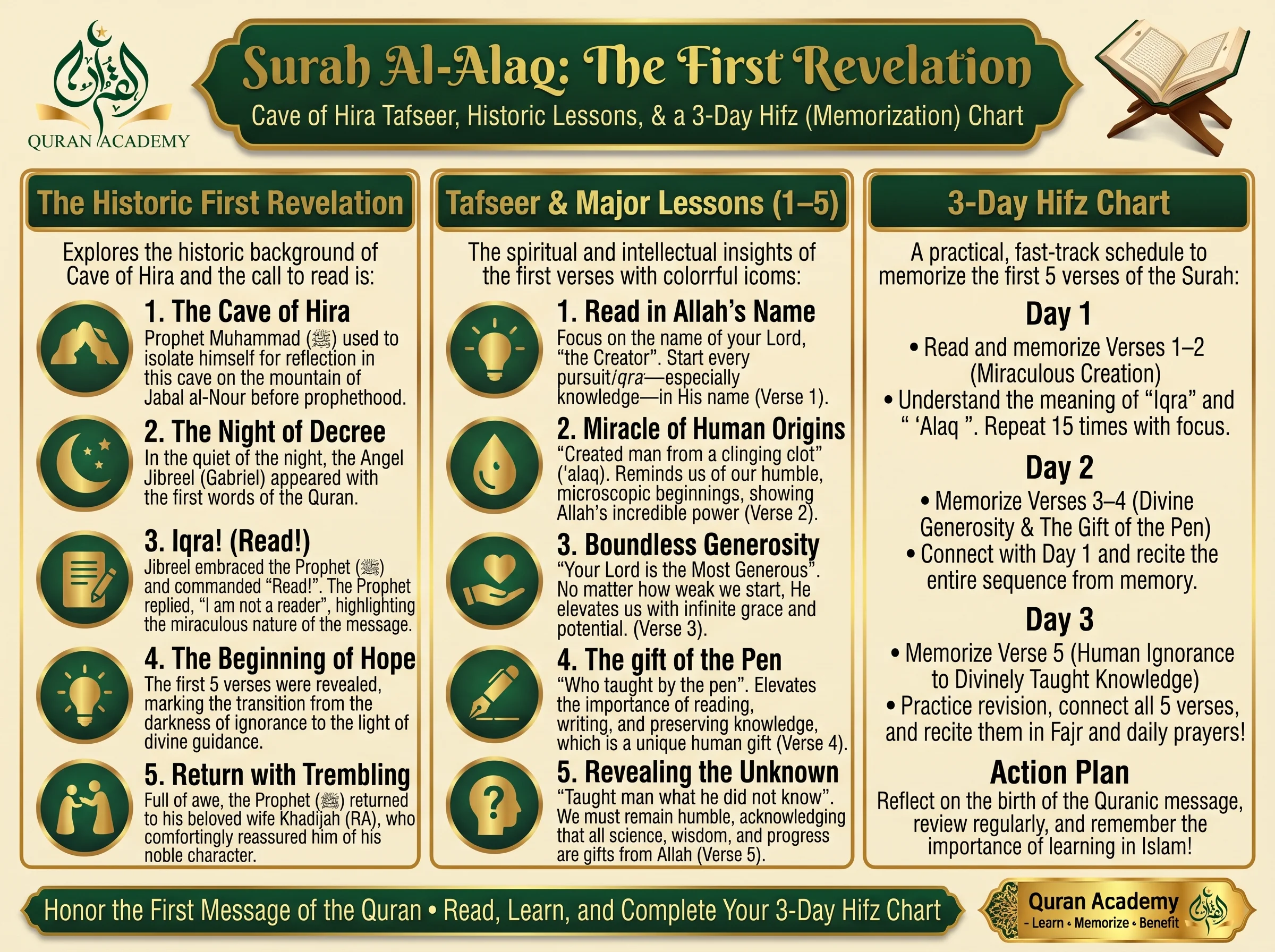
Studying Surah Al Alaq first revelation lessons (سُورَةُ الْعَلَقِ — Chapter 96 of the Holy Quran, located in Juz Amma on Page 597 of the Mushaf) takes every Muslim back to the exact night in Ramadan when heaven reconnected with earth inside the Cave of Hira. Recorded in Sahih al-Bukhari (3) and Sahih Muslim (160), the first 5 verses of Surah Al-Alaq (96:1–5) are the very first words of the Quran ever revealed—opening not with a legal ruling, war, or ritual, but with the transformative command ٱقْرَأْ (Iqra' — "Read / Recite!") paired with the biological miracle of human creation ('Alaq) and the honor of the Pen (Al-Qalam). Later in the Makkan period, Verses 6 to 19 were revealed to diagnose why human beings become arrogant when they feel self-sufficient, concluding with the beloved command to prostrate and draw near to Allah (وَٱسْجُدْ وَٱقْتَرِب ۩ — 96:19). In our 1-on-1 Online Quran Memorization (Hifz) Program, adults and kids master all 19 verses in just 3 days!
- Why "Iqra'" Was Repeated Twice (96:1 & 96:3): The first Iqra' commands reading and learning in the Name of the Creator; the second Iqra' links reading to Allah's supreme generosity (Al-Akram) in teaching through the Pen!
- Two Revelations United in One Surah: Verses 1–5 show how humble knowledge elevates a human being from a tiny clot to noble honor, while Verses 6–19 show how arrogant rebellion (Tughyan) drags a person down unless they bow in prostration!
- The Final Sajdah Tilawah in the Mushaf (96:19): Verse 19 marks the 15th and final Prostration of Recitation in the Quran—connected directly to the Hadith: "The closest a servant comes to his Lord is when he is prostrating" (Sahih Muslim 482)!
- 3-Day Hifz Breakdown: Just 72 Arabic words total across 19 short, rhythmic verses—easily memorized in 3 blocks of 5 to 7 verses!
Picture the scene atop Jabal an-Noor overlooking Makkah over 1,400 years ago: a society steeped in tribal warfare, idol worship, and widespread illiteracy—where Prophet Muhammad (ﷺ) himself had never read a book or held a pen (An-Nabiyy Al-Ummiyy). In the stillness of the night inside the narrow Cave of Hira, Angel Jibreel (AS) appears, embraces the Prophet (ﷺ) three times until his strength is exhausted, and delivers the opening word of the final message to mankind: ٱقْرَأْ (Iqra' — Read / Recite!).
Yet many Muslims today know the story of the first five verses of Surah Al-Alaq, without realizing how deeply the second part of the Surah (Verses 6 to 19) completes the message! Why did Allah place the story of Abu Jahl trying to stop the Prophet (ﷺ) from praying at the Ka'bah right after the verses of reading and the Pen? Because knowledge without humility before Allah breeds the illusion of self-sufficiency (An ra'aahus-taghnaa — 96:7), and the only cure for human ego is placing your forehead (An-Nasiyah) on the ground in prostration! Just as we explored the 10 Shortest Surahs for Salah and our Juz Amma Memorization Schedule, this complete guide unpacks the Cave of Hira narrative, the 3 thematic sections of Surah Al-Alaq, its Tajweed rules, and a 3-Day Memorization Plan.
- The Historical Account of the First Revelation in the Cave of Hira (Sahih al-Bukhari 3)
- 5 Profound Lessons From Verses 1–5: Why "Iqra'", "Al-Alaq" & "Al-Qalam"?
- Thematic Tafseer of All 19 Verses: From the Pen to Abu Jahl & The Final Prostration
- The 3-Day Surah Al-Alaq Memorization Schedule (For Kids & Adults)
- 5 Essential Tajweed Rules in Surah Al-Alaq & How to Perform Sajdah Tilawah at Verse 19
- Frequently Asked Questions (FAQs)
1. The Historical Account of the First Revelation in the Cave of Hira (Sahih al-Bukhari 3)
In the opening chapter of Sahih al-Bukhari (Hadith #3) and Sahih Muslim (160)—which you can verify in our Online Hadith Explorer—Mother of the Believers 'Aishah (may Allah be pleased with her) narrated how revelation first began for the Messenger of Allah (ﷺ) when he turned forty years old:
- 1. True Visions & Seclusion in Cave Hira: Revelation began with righteous dreams in sleep that came true as bright as the break of dawn. Then solitude was made beloved to him, so he used to retreat to the Cave of Hira for nights of devotion (Tahannuth) before returning to his wife Khadijah (may Allah be pleased with her) for provisions.
- 2. The Three Embraces of Angel Jibreel (AS): Until the Truth came to him while he was in the Cave of Hira! The Angel came to him and said: "Read! (ٱقْرَأْ)." The Prophet (ﷺ) replied: "I do not know how to read (مَا أَنَا بِقَارِئٍ)." Angel Jibreel held him and pressed him tightly until he reached his limit, then released him and repeated: "Read!" Twice more the Prophet (ﷺ) replied "I do not know how to read," and after the third embrace—which emptied his heart of worldly distractions and focused every fiber of his being—Jibreel recited the first five verses of Surah Al-Alaq (96:1–5)!
- 3. The Comforting Wisdom of Lady Khadijah (RA): Returning home with his heart trembling, the Prophet (ﷺ) asked Khadijah (RA) to cover him (Zammiloonee!) and expressed fear for himself. Khadijah (RA) spoke her immortal words of reassurance—testifying that Allah would never disgrace him because he upheld family ties, bore the burdens of the weak, clothed the destitute, honored guests, and aided people in distress!
2. Five Profound Lessons From Verses 1–5: Why "Iqra'", "Al-Alaq" & "Al-Qalam"?
As we teach in our Complete Quran Tafseer Guide and our Online Islamic Studies Course, reflect on the five foundational principles embedded inside those first 18 Arabic words:
- 1. Sacred Knowledge & Literacy First (ٱقْرَأْ بِٱسْمِ رَبِّكَ): Islam is a religion where the very first divine imperative is to read, recite, and seek knowledge—yet it immediately qualifies that reading with بِٱسْمِ رَبِّكَ ("In the Name of your Lord") so that knowledge always serves truth, ethics, and gratitude to the Creator!
- 2. From "Al-'Alaq" to Supreme Honor (خَلَقَ ٱلْإِنسَانَ مِنْ عَلَقٍ): Why did Allah remind humanity in Verse 2 that He created the human being from عَلَقٍ ('Alaq — a tiny clinging embryonic clot) right before mentioning the Pen in Verse 4? To humble human pride and show Allah's power: the Lord Who transformed a microscopic clinging clot without sight, hearing, or speech into an intelligent scholar who reads and writes is worthy of complete worship!
- 3. "Al-Akram" — The Most Generous Educator (ٱقْرَأْ وَرَبُّكَ ٱلْأَكْرَمُ): In Verse 3, Allah describes Himself in the superlative form ٱلْأَكْرَمُ (Al-Akram — The Most Generous of all)—teaching us that the greatest manifestation of Allah's generosity is gifting humanity revelation, intellect, and understanding!
- 4. The Two Tools of Knowledge: Speech ("Iqra'") & Writing ("Al-Qalam" — ٱلَّذِي عَلَّمَ بِٱلْقَلَمِ): Verses 1–4 unite the two pillars of human civilization: oral transmission (Iqra' — how the Quran is recited by heart) and written preservation (Al-Qalam — how knowledge is recorded across generations)!
- 5. Every Discovery Comes From Allah (عَلَّمَ ٱلْإِنسَانَ مَا لَمْ يَعْلَمْ): Every human being is born knowing nothing (Surah An-Nahl 16:78); every language, science, and verse we learn is taught to us by our Lord!
3. Thematic Tafseer of All 19 Verses: From the Pen to Abu Jahl & The Final Prostration
Open Page 597 of our Online Uthmani Quran Explorer and see how all 19 verses of Surah Al-Alaq divide into three cohesive sections:
| Section & Verses | Key Arabic Anchor Cues | Historical Context & Core Tafseer Message |
|---|---|---|
| Block 1: The First Revelation & The Pen (Verses 1 – 5) |
ٱقْرَأْ بِٱسْمِ رَبِّكَ ٱلَّذِي خَلَقَ ... عَلَّمَ ٱلْإِنسَانَ مَا لَمْ يَعْلَمْ | Revealed in Cave Hira: establishes reading in Allah's Name, human humility in creation from 'Alaq, and Allah's generosity in teaching by the Pen. |
| Block 2: The Psychology of Arrogance & Abu Jahl (Verses 6 – 14) |
كَلَّا إِنَّ ٱلْإِنسَانَ لَيَطْغَىٰ ﴿٦﴾ أَن رَّآهُ ٱسْتَغْنَىٰ ... أَرَأَيْتَ ٱلَّذِي يَنْهَىٰ ﴿٩﴾ عَبْدًا إِذَا صَلَّىٰ ... أَلَمْ يَعْلَم بِأَنَّ ٱللَّهَ يَرَىٰ | Diagnoses why man transgresses bounds (Yatghaa): when he sees himself rich and self-sufficient, forgetting that to his Lord is the final return (Ar-Ruj'aa)! Revealed regarding Abu Jahl ('Amr ibn Hisham) when he threatened to stop the Prophet (ﷺ) from praying at the Ka'bah (Sahih Muslim 2797)—reminding him: "Does he not know that Allah sees (Bi-annallaaha Yaraa)?" (96:14) |
| Block 3: The Forelock Warning & Prostration Seal 🏆 (Verses 15 – 19) |
كَلَّا لَئِن لَّمْ يَنتَهِ لَنَسْفَعًا بِٱلنَّاصِيَةِ ... كَلَّا لَا تُطِعْهُ وَٱسْجُدْ وَٱقْتَرِب ۩ | Warns that if the tyrant does not desist, he will be seized by the lying, sinful forelock (An-Nasiyah—the prefrontal region of decision-making!), and if he calls his council (Naadiyah), Allah will call the angels of punishment (Az-Zabaniyah)! Closes with the command to the believer: "No! Do not obey him; rather, prostrate and draw near [to Allah]!" (96:19) |
4. The 3-Day Surah Al-Alaq Memorization Schedule (For Kids & Adults)
Using our 3x3 Quran Memorization Method and our Smart Hifz Planner, look at how easily you and your children can memorize all 19 verses (only 12 lines in the Mushaf!) in 3 days—especially because of the rhythmic rhyme endings:
- Day 1 (Verses 1 – 5 • 18 Words): Memorize the Cave of Hira revelation—notice the alternating rhyme between Qaaf Sakinah (خَلَقْ، عَلَقْ) and Meem Sakinah (ٱلْأَكْرَمْ، بِٱلْقَلَمْ، يَعْلَمْ)!
- Day 2 (Verses 6 – 14 • 32 Words): Memorize the open Alif/Maqsurah rhyme (لَيَطْغَىٰ، ٱسْتَغْنَىٰ، ٱلرُّجْعَىٰ، يَنْهَىٰ، صَلَّىٰ، ٱلْهُدَىٰ، بِٱلتَّقْوَىٰ، وَتَوَلَّىٰ، يَرَىٰ)—every single verse from 6 to 14 ends on the exact same 2-count open "-aa" sound!
- Day 3 (Verses 15 – 19 • 22 Words): Memorize the 4 feminine Haa' endings (بِٱلنَّاصِيَهْ، خَاطِئَهْ، نَادِيَهْ، ٱلزَّبَانِيَهْ) and seal with the Qalqalah Kubra of Verse 19 (وَٱسْجُدْ وَٱقْتَرِبْ ۩)!
Mastering the 8 Qalqalah Echoes in Surah Al-Alaq: From "Iqْra'" to "Waqْtaribْ"!
Did you notice that the very first word ever revealed in the Quran—ٱقْرَأْ (Iqْra')—and the very last word of Surah Al-Alaq—وَٱقْتَرِبْ (Waqْtaribْ)—both rely on the 5 echoing Qalqalah letters (ق ط ب ج د), alongside خَلَقْ (Khalaqْ), عَلَقْ ('Alaqْ), يَطْغَىٰ (Yatْghaa), ٱلرُّجْعَىٰ (Ar-Rujْ'aa), عَبْدًا ('Abْdan), and وَٱسْجُدْ (Wasjudْ)? Watch Senior Instructor Ustadhah Yasmeen Gamal demonstrate Qalqalah on our Quran Academy YouTube Channel:
Struggling to perfect your Recitation?
Join hundreds of students mastering the Quran with our Verified Al-Azhar Graduates. We offer flexible 1-on-1 sessions tailored to your schedule.
Book a Free Evaluation Class →- Crisp Qaaf Bounce in "Iqْra'": Bounce the silent Qaaf first, then cut the sound cleanly on the final Hamzah Sakinah!
- 1-on-1 Live Coaching: Recite Surah Al-Alaq live to our Al-Azhar scholars!
5. Five Essential Tajweed Rules in Surah Al-Alaq & How to Perform Sajdah Tilawah at Verse 19
Before you recite Surah Al-Alaq today, apply these five core rules from our 1-on-1 Online Tajweed Course:
- 1. Starting "Iqra'" With a Kasrah & Stopping on the Silent Hamzah (96:1 & 96:3):
As we learned in our Hamzatul Wasl & Hamzatul Qat' Guide, ٱقْرَأْ starts with a Kasrah (إِقْرَأْ = Iqra') because the 3rd letter (رَ) carries a Fatha! After bouncing the silent Qaaf (Iqْ-) and pronouncing the Heavy Raa (-ra), close the vocal cords cleanly for the silent Hamzatul Qat' (أْ) without bouncing the Hamzah! - 2. Iqlab (Turning Tanween Into Meem With 2-Beat Ghunnah) in Verse 15:
Look closely at the Mushaf in Verse 15: لَنَسْفَعًا بِٱلنَّاصِيَةِ (Lanasfa'am-bin-naasiyah)! Even though Lanasfa'an is an emphatic verb ending in the light Noon of Emphasis (نُونُ التَّوْكِيدِ الْخَفِيفَةُ), it is written in the Mushaf as a Tanween followed by the letter ب (Baa)—indicated by the small standing Meem (ـۢ)! Using our Noon Sakinah & Tanween Guide, apply Iqlab with a 2-beat nasal Ghunnah before the Baa! - 3. Ikhfaa' Shafawi in Verse 14 (أَلَمْ يَعْلَم بِأَنَّ ٱللَّهَ يَرَىٰ):
Applying our Meem Sakinah Rules Guide, when the silent Meem of يَعْلَمْ is followed by the Baa of بِأَنَّ, conceal the Meem lightly between the lips with a 2-beat Ghunnah (Ikhfaa' Shafawi), followed immediately by a 2-beat Ghunnah on أَنَّ! - 4. Heavy vs. Light Raa at the End of Surah Al-Alaq (وَٱقْتَرِبْ — 96:19):
According to our Ahkam Al-Raa Guide, while the Raa in ٱقْرَأْ, رَبِّكَ, ٱلْأَكْرَمُ, رَّآهُ, ٱلرُّجْعَىٰ, أَرَأَيْتَ, and يَرَىٰ is 100% Heavy (Tafkhim), the Raa in the final word وَٱقْتَرِب ۩ (Waq-ta-ri-bْ) carries a Kasrah—making it 100% Light (Tarqeeq) right before the final Qalqalah Kubra on the Baa! - 5. Performing Sajdah at-Tilawah at the End of Verse 19 (وَٱسْجُدْ وَٱقْتَرِب ۩):
Just as we explained the prostration of recitation in our Surah As-Sajdah & Al-Insan Friday Fajr Guide, when you finish reciting وَٱسْجُدْ وَٱقْتَرِب ۩ (whether inside Salah or outside Salah, as recorded in Sahih Muslim 578 from Abu Hurayrah RA), say "Allahu Akbar," perform one single prostration on the ground, recite "Subhaana Rabbiyal-A'laa (3x)" and "Sajada wajhiya lilladhee khalaqahu wa shaqqahu sam'ahu wa basarahu bi-hawlihi wa quwwatih," and rise (saying "Allahu Akbar" if inside Salah)! Test your Tajweed knowledge right now on our Free 3-Minute Tajweed Quiz!
With this guide, we have completed all 5 Surah & Hifz Guides of Day 2 (Articles 81 to 85)—connecting Surah Al-Alaq seamlessly with our Surah Al-Fatihah Guide, Last 3 Verses of Surah Al-Hashr, Surah Qaf 6-Day Plan, Makharij al-Huruf, Sifaat al-Huruf, Heavy & Light Letters, Rules of Madd, Rules of Waqf, Laam Shamsiyyah & Qamariyyah, 4 Special Words of Hafs, and 7 Alifs in the Quran! Continue your family's journey across our Surah Ad-Duha & Ash-Sharh Guide, The 3 Quls, Ayatul Kursi, Last 2 Verses of Surah Al-Baqarah, Surah Ya-Sin, Surah Ar-Rahman, Surah Al-Waqi'ah, Surah Maryam, Surah Yusuf, Surah Luqman, Surah Al-Hujurat, Morning & Evening Adhkar, 40 Rabbana Duas, Wudu & Tayammum, 5 Pillars of Islam, and 25 Prophets in the Quran with our Al-Azhar Certified Tutors—or enroll your child in our 1-on-1 Kids Quran Classes with our Printable Kids Star Chart! See how families across the West rate our teachers on our Verified Student & Parent Reviews Page.
6. Frequently Asked Questions (FAQs) About Surah Al-Alaq
1. Which verses of Surah Al-Alaq were the very first revelation of the Holy Quran?
According to the authentic narration of Mother of the Believers 'Aishah (may Allah be pleased with her) in Sahih al-Bukhari (3) and Sahih Muslim (160), the first five verses of Surah Al-Alaq (96:1–5) were the very first revelation of the Quran brought down by Angel Jibreel (AS) to Prophet Muhammad (ﷺ) in the Cave of Hira during the month of Ramadan.
2. Why did the Quran begin with the command "Iqra'" (Read/Recite) in the Name of Your Lord?
Classical scholars explain that beginning the final revelation with ٱقْرَأْ بِٱسْمِ رَبِّكَ ("Read in the Name of your Lord") establishes that true faith in Islam is built upon divine knowledge, literacy, and reflection—and that all learning and science must be anchored in the Name of the Creator Who formed humanity from a clinging clot ('Alaq) and taught by the pen (Al-Qalam).
3. Were all 19 verses of Surah Al-Alaq revealed at the same time?
No. Verses 1 to 5 were revealed at the very beginning of Prophethood in the Cave of Hira. Verses 6 to 19 were revealed years later in Makkah after public preaching began, addressing the arrogance of Abu Jahl when he attempted to prevent the Prophet (ﷺ) from praying at the Ka'bah.
4. What should you do when you reach the end of Verse 19 in Surah Al-Alaq?
Verse 19 of Surah Al-Alaq concludes with a confirmed Prostration of Recitation (Sajdah at-Tilawah) at the command وَٱسْجُدْ وَٱقْتَرِب ۩ ("Prostrate and draw near [to Allah]"). Both the reciter and the listener are encouraged to perform one single prostration to Allah, reciting the authentic Sajdah supplications.
5. How can children and beginners memorize all 19 verses of Surah Al-Alaq easily?
By dividing the 19 short Makkan verses into 3 logical story blocks across 3 days: Day 1 (Verses 1–5: The First Revelation & The Pen), Day 2 (Verses 6–14: The Warning Against Self-Sufficiency & Arrogance), and Day 3 (Verses 15–19: The Final Warning & The Command to Prostrate and Draw Near).
Answer the First Command—"Iqra'"—With an Al-Azhar Scholar!
Whether you are beginning your Quran reading journey or memorizing Juz Amma with your children, our certified male and female Al-Azhar scholars guide you every step of the way. Book your free 1-on-1 trial session today!
Book Your Free 1-on-1 Trial Class →