
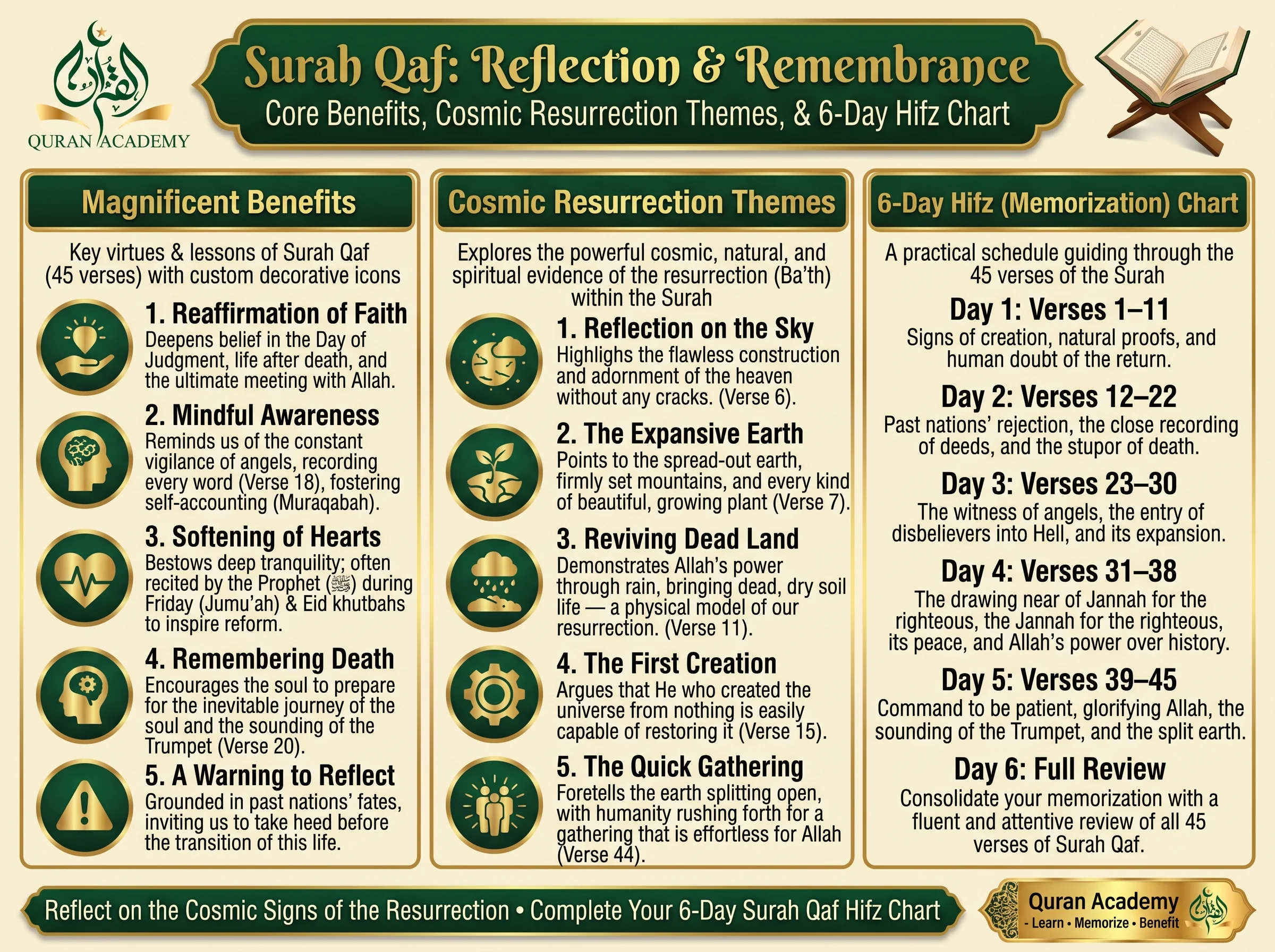
✦ Quick Answer & Key Takeaways: Surah Qaf Benefits & Memorization Plan
Exploring Surah Qaf benefits and memorization plan (سُورَةُ قٓ — Chapter 50 of the Holy Quran, located in Juz 26 on Pages 518 to 520 of the Mushaf) connects every believer to the chapter that Prophet Muhammad (ﷺ) chose to recite aloud before the largest public gatherings of the week and the year: on the pulpit during the Friday Khutbah (Sahih Muslim 873) and in the Eid al-Fitr and Eid al-Adha prayers (Sahih Muslim 891)! Consisting of 45 short, rhythmic Makkan verses, Surah Qaf awakens heedless hearts by linking the revival of dead earth after rain to bodily Resurrection, reminding us of the two recording angels on our right and left (Raqeeb and 'Ateed — 50:17–18), and comforting the believer with the morning and evening Adhkar command (50:39–40). In our 1-on-1 Online Quran Memorization (Hifz) Program, students master all 45 verses in just 6 days by memorizing 7 to 8 short verses (half a page) per day!
- Memorized Directly From the Prophet's (ﷺ) Mouth (Sahih Muslim 873): The female Companion Umm Hisham bint Harithah (RA) testified that she memorized "Qaf. Wal-Quranil-Majeed" purely from hearing the Prophet (ﷺ) recite it on the pulpit every Friday!
- The Gateway to "Al-Mufassal" (الحزب المفصل): Surah Qaf marks the beginning of the final, most frequently recited seventh of the Quran (Chapters 50 to 114).
- A Masterclass in Qalqalah Tajweed: Named after the heavy letter ق (Qaaf), nearly every verse in Surah Qaf ends with a resonant Qalqalah Kubra bounce (Majeedْ, Ba'eedْ, Hafeedhْ, Muneebْ, Hadeedْ, Wa'eedْ)!
- The Cure for Heart Tightness (50:39–40): Commands patience over what people say and prescribes glorifying Allah before sunrise, before sunset, and after prostration!
Have you ever wondered why, out of all 114 chapters in the Mushaf, the Messenger of Allah (ﷺ) repeatedly selected Surah Qaf to address the entire community on Friday afternoons from the Minbar, and again on the mornings of Eid al-Fitr and Eid al-Adha when men, women, and children gathered in the open prayer ground?
Imam An-Nawawi and Qadi 'Iyad explained the secret in their commentaries on Sahih Muslim: when human beings get caught up in the busyness of weekly work or the festivities of Eid, their hearts easily forget the reality of death, accountability, and the Hereafter. Yet in just two and a half pages of short, thunderous verses, Surah Qaf takes the listener on an unforgettable journey—from gazing up at the star-adorned sky and watching rain bring dead gardens to life, to the moment the soul meets its final breath, to standing before Allah on the Day of Resurrection when the veil is lifted and every person's sight is piercing sharp (Fabasaruka al-yawma hadeed — 50:22)! Just as we explored the Friday traditions of Surah Al-Kahf and Surah As-Sajdah & Al-Insan, and the social ethics of its neighbor Surah Al-Hujurat (Chapter 49), this complete guide breaks down the Prophetic virtues of Surah Qaf, its 4 thematic movements, its Qalqalah Tajweed rules, and a step-by-step 6-Day Memorization Plan.
- The Authentic Virtues of Surah Qaf: The Friday Khutbah, Eid Prayers & Fajr Sunnah
- Thematic Tafseer of Surah Qaf (50:1–45): The 4 Cosmic & Spiritual Journeys
- Deep Dive Into Verses 16–18: "Closer Than the Jugular Vein" & The Two Recording Angels
- The 6-Day Surah Qaf Memorization Plan (7 to 8 Short Verses Per Day!)
- 5 Essential Tajweed Rules in Surah Qaf (Madd Lazim on "Qaf" & Qalqalah Kubra)
- Frequently Asked Questions (FAQs)
1. The Authentic Virtues of Surah Qaf: The Friday Khutbah, Eid Prayers & Fajr Sunnah
When we check the authentic collections of Sahih Muslim in our Online Hadith Explorer, we find that Surah Qaf occupied three special places in the weekly and annual worship of Prophet Muhammad (ﷺ):
• 1. Every Friday From the Pulpit (Sahih Muslim 873): Umm Hisham bint Harithah ibn An-Nu'man (may Allah be pleased with her) said: "I did not memorize 'Qaf. Wal-Quranil-Majeed' except directly from the tongue of the Messenger of Allah (ﷺ), who used to recite it every Friday upon the Minbar when he addressed the people!"
• 2. In the Two Eid Prayers (Sahih Muslim 891): When Caliph 'Umar ibn Al-Khattab (RA) asked Abu Waqid Al-Laythi (RA) what the Messenger of Allah (ﷺ) used to recite in the Eid al-Adha and Eid al-Fitr prayers, he replied: "He used to recite in them Qaf (Chapter 50) and Iqtarabatis-Saa'ah (Surah Al-Qamar, Chapter 54)!"
• 3. In the First Rak'ah of Fajr Prayer (Sahih Muslim 458): Jabir ibn Samurah (RA) reported that the Prophet (ﷺ) used to recite Surah Qaf and similar chapters in the morning (Fajr) prayer!
2. Thematic Tafseer of Surah Qaf (50:1–45): The 4 Cosmic & Spiritual Journeys
You can read the full Uthmani script and listen to the recitation of Pages 518 to 520 in our Online Uthmani Quran Explorer. Following the methodology of our Complete Quran Tafseer Guide, notice how Surah Qaf flows across four interconnected movements—beginning and ending with the majesty of the Quran itself:
| Section & Verses | Key Arabic Anchor Cues | Core Tafseer Message & Spiritual Lesson |
|---|---|---|
| 1. Cosmic Proof of Resurrection (Verses 1 – 15) |
قٓ ۚ وَٱلْقُرْآنِ ٱلْمَجِيدِ ... أَفَلَمْ يَنظُرُوا إِلَى ٱلسَّمَاءِ فَوْقَهُمْ كَيْفَ بَنَيْنَاهَا ... وَأَحْيَيْنَا بِهِ بَلْدَةً مَّيْتًا | Answers the sceptics who claimed returning to life after becoming dust is "far-fetched" (Raj'un Ba'eed) by pointing to the flawless sky above, the mountains anchoring the earth, blessed rain reviving dead land (Kadhlikal-Khurooj!), and the destroyed nations before them—reminding us that the first creation is no harder than the new creation (50:15)! |
| 2. Inner Whispers, Death & The Two Angels (Verses 16 – 22) |
وَلَقَدْ خَلَقْنَا ٱلْإِنسَانَ ... مَّا يَلْفِظُ مِن قَوْلٍ إِلَّا لَدَيْهِ رَقِيبٌ عَتِيدٌ ... وَجَاءَتْ سَكْرَةُ ٱلْمَوْتِ بِٱلْحَقِّ | Shifts from the outer universe to the inner human soul: Allah knows every whisper of the self, two angels sit on the right and left recording every word, the stupor of death arrives with truth, the Trumpet is blown, and every soul arrives with a driver angel (Saa'iq) and a witness angel (Shaheed)! |
| 3. The Courtroom of Judgment: Hellfire vs. Jannah (Verses 23 – 35) |
أَلْقِيَا فِي جَهَنَّمَ كُلَّ كَفَّارٍ عَنِيدٍ ... يَوْمَ نَقُولُ لِجَهَنَّمَ هَلِ ٱمْتَلَأْتِ ... وَأُزْلِفَتِ ٱلْجَنَّةُ لِلْمُتَّقِينَ | Contrasts the stubborn denier of good and his devil companion (Qareen) disputing before Hellfire with the breathtaking welcome of the righteous—for whom Paradise is brought near (Uzlifatil-Jannah) because they feared the Most Merciful in the unseen and came with a repentant heart (Qalbin Muneeb — 50:33), receiving everything they wish for and even more (Wala-daynaa Mazeed — looking at Allah's Countenance!). |
| 4. Consolation, Daily Adhkar & The Quranic Seal (Verses 36 – 45) |
إِنَّ فِي ذَٰلِكَ لَذِكْرَىٰ لِمَن كَانَ لَهُ قَلْبٌ ... فَسَبِّحْ بِحَمْدِ رَبِّكَ قَبْلَ طُلُوعِ ٱلشَّمْسِ وَقَبْلَ ٱلْغُرُوبِ ... فَذَكِّرْ بِٱلْقُرْآنِ | Declares that these signs benefit whoever has a living heart or listens with full presence (50:37), commands patience paired with morning, evening, and night Tasbeeh (50:39–40), and closes with the majestic command: "So remind by means of the Quran whoever fears My warning!" (50:45). |
3. Deep Dive Into Verses 16–18: "Closer Than the Jugular Vein" & The Two Recording Angels
Three verses in the center of Surah Qaf—Verses 16, 17, and 18—stand out as foundational pillars of Islamic ethics and speech (complementing our Surah Al-Hujurat Manners Guide and our 6 Articles of Faith Guide):
- 1. What Does "Closer to Him Than His Jugular Vein" (وَنَحْنُ أَقْرَبُ إِلَيْهِ مِنْ حَبْلِ ٱلْوَرِيدِ — 50:16) Mean?
The Wareed is the vital life-vein running through the human neck. Classical scholars of Sunni Aqeedah (including Imam Ibn Kathir, Imam Al-Qurtubi, and Shaykh al-Islam Ibn Taymiyyah) explain that Allah Almighty is risen above His Throne as befits His Majesty, while His Knowledge, Sight, Power, and His commissioned Angels are closer to the human being than their own jugular vein—knowing even the fleeting thoughts that cross the chest (Maa tuwaswisu bihi nafsuh)! - 2. "Raqeeb" and "'Ateed" (مَّا يَلْفِظُ مِن قَوْلٍ إِلَّا لَدَيْهِ رَقِيبٌ عَتِيدٌ — 50:18):
Not a single word—whether spoken aloud or typed on a screen—leaves a person except that a watchful observer (Raqeeb) who is ever-present and ready ('Ateed) records it! Remembering Verse 18 before speaking or posting online is the ultimate shield of the tongue. - 3. The Secret of How to Benefit From the Quran in Verse 37 (لِمَن كَانَ لَهُ قَلْبٌ أَوْ أَلْقَى ٱلسَّمْعَ وَهُوَ شَهِيدٌ):
Imam Ibn al-Qayyim dedicated the opening of his masterpiece Al-Fawa'id to Verse 37 of Surah Qaf: to be transformed by the Quran, you only need (1) A living, receptive heart (Qalb), (2) Attentive listening (Alqas-Sam'a), and (3) Full presence of mind without distraction (Wa huwa Shaheed)!
4. The 6-Day Surah Qaf Memorization Plan (7 to 8 Short Verses Per Day!)
Because Surah Qaf spans just 2.5 pages (Pages 518, 519, and the top half of 520) with short, punchy verses that rhyme with Qalqalah consonants, you can master the entire Surah in 6 days using our 3x3 Quran Memorization Method and Sabaq, Sabqi & Manzil Revision System:
| Day | Verses & Mushaf Page | Opening & Closing Anchor Cues | Thematic Memory Hook |
|---|---|---|---|
| Day 1 | Verses 1 – 8 (Top of Page 518) |
قٓ ۚ وَٱلْقُرْآنِ ٱلْمَجِيدِ ... لِكُلِّ عَبْدٍ مُّنِيبٍ | The oath by the Glorious Quran, the sceptics' amazement, and looking up at the sky and down at the earth. |
| Day 2 | Verses 9 – 15 (Bottom of Page 518) |
وَنَزَّلْنَا مِنَ ٱلسَّمَاءِ مَاءً مُّبَارَكًا ... بَلْ هُمْ فِي لَبْسٍ مِّنْ خَلْقٍ جَدِيدٍ | Blessed rain reviving dead land + the list of previous nations who denied the Messengers (Nuh, Ar-Rass, Thamud, 'Aad, Fir'awn, Lut, Al-Aykah, Tubba'). |
| Day 3 | Verses 16 – 22 (Top of Page 519) |
وَلَقَدْ خَلَقْنَا ٱلْإِنسَانَ ... فَبَصَرُكَ ٱلْيَوْمَ حَدِيدٌ | The jugular vein, the two recording angels, the stupor of death, the Trumpet, and the lifting of the veil! |
| Day 4 | Verses 23 – 30 (Middle of Page 519) |
وَقَالَ قَرِينُهُ هَٰذَا مَا لَدَيَّ عَتِيدٌ ... وَتَقُولُ هَلْ مِن مَّزِيدٍ | The dialogue with the companion angel and the Qareen, the command "Throw into Hellfire (Alqiyaa fee Jahannam)," and Hell asking "Are there any more?" |
| Day 5 | Verses 31 – 38 (Bottom 519 – Top 520) |
وَأُزْلِفَتِ ٱلْجَنَّةُ لِلْمُتَّقِينَ ... وَمَا مَسَّنَا مِن لُّغُوبٍ | Paradise brought near to the God-fearing (Wala-daynaa Mazeed!), the lesson for a living heart (50:37), and creation in 6 days without fatigue. |
| Day 6 🏆 | Verses 39 – 45 (Top Half of Page 520) |
فَٱصْبِرْ عَلَىٰ مَا يَقُولُونَ ... فَذَكِّرْ بِٱلْقُرْآنِ مَن يَخَافُ وَعِيدِ | Morning, evening, and night Tasbeeh + the Day the caller calls from a near place + Full 45-Verse Recitation in Friday/Fajr Prayer! |
Why Surah Qaf Is the Ultimate Training Ground for Qalqalah Kubra & Sughra!
Did you know that out of the 45 verses of Surah Qaf, 43 verses end with a silent Dal (دْ) or Baa (بْ) upon stopping—such as ٱلْمَجِيدْ (Al-Majeedْ), بَعِيدْ (Ba'eedْ), مُّنِيبْ (Muneebْ), عَتِيدْ ('Ateedْ), حَدِيدْ (Hadeedْ), and وَعِيدْ (Wa'eedْ)—while mid-verse words like قَبْلَ (Qabْla), عَبْدٍ ('Abْdin), حَبْلِ (Habْli), and أَقْرَبُ (Aqْrabu) feature mid-word Qalqalah Sughra? Watch Senior Instructor Ustadhah Yasmeen Gamal demonstrate Qalqalah (ق ط ب ج د) on our Quran Academy YouTube Channel:
Struggling to perfect your Recitation?
Join hundreds of students mastering the Quran with our Verified Al-Azhar Graduates. We offer flexible 1-on-1 sessions tailored to your schedule.
Book a Free Evaluation Class →- Crisp Verse-Ending Echo: Hear how every verse in Surah Qaf lands on a resonant Qalqalah Kubra bounce!
- 1-on-1 Live Coaching: Recite Surah Qaf live to our certified Al-Azhar scholars!
5. Five Essential Tajweed Rules in Surah Qaf
Before reciting Surah Qaf in your prayers this week, master these five Tajweed highlights from our 1-on-1 Online Tajweed Course and our Interactive Tajweed Encyclopedia:
- 1. The 6-Beat Madd Lazim Harfi Mukhaffaf on "Qaf" (قٓ — 50:1):
As we explained in our Rules of Madd Guide and Surah Ya-Sin Guide, the disjointed letter قٓ at the start of Verse 1 is spelled as three letters (قَافْ = Qaaf): elevate the back of your tongue for the heavy Qaaf, stretch the central Alif for 6 full beats, and finish with a soft, breathy Hams on the silent Faa (Qaaaaaafْ)! - 2. Heavy Ikhfaa' Ghunnah in "Min Qawl", "Min Qaryah" & "Man Qalb":
Using our Noon Sakinah & Tanween Guide and Heavy & Light Letters Guide, whenever a Noon Sakinah or Tanween comes before the heavy letter ق (Qaaf)—such as مِّن قَوْلٍ (50:18), مِّن قَرْيَةٍ (50:36), or مَّاءً فَأَنبَتْنَا (Light Ikhfaa') vs. رِزْقًا لِّلْعِبَادِ (Idgham without Ghunnah)—make the 2-beat Ikhfaa' nasal sound Heavy (Tafkhim al-Ghunnah) before Qaaf! - 3. Two Only Non-Qalqalah Verse-Endings in Verse 4 ("Hafeedh") & Verse 38 ("Lughoob"):
Applying our Makharij al-Huruf and Sifaat al-Huruf guides, notice that while 43 verses end in Dal or Baa (Qalqalah Kubra), Verse 4 ends in كِتَابٌ حَفِيظٌ (Hafeedhْ) and Verse 28 ends in تَخْتَصِمُونِ (Takhtasimoonْ)—so never bounce the heavy ظْ or the نْ when stopping on those two verses! - 4. Stopping on "Wa'eed" (وَعِيدِ — Verses 14 & 45) With Deleted Final Yaa:
Following our Rules of Waqf Guide, both Verse 14 (Fa-haqqa wa'eedِ) and the final word of the Surah in Verse 45 (Man yakhaafu wa'eedِ) originally had a possessive Yaa (Wa'eedee = "My warning") that was dropped for rhythmic conciseness—so when stopping on them, you drop the Kasrah and stop with a 4-beat Madd 'Aarid + crisp Qalqalah Kubra on the Dal (Wa'eeeedْ)! - 5. Heavy vs. Light Raa Across Surah Qaf (Ahkam Al-Raa):
Applying our Ahkam Al-Raa Guide, Laam Shamsiyyah & Qamariyyah, Hamzatul Wasl vs. Qat', Meem Sakinah, 4 Special Words of Hafs, and 7 Alifs in the Quran, compare the Light Raa in ٱلْوَرِيدِ (Al-Wa-reed), قَرِينُهُ (Qa-reenuhu), and فَٱصْبِرْ (Fas-birْ) against the Heavy Raa in ٱلْقُرْآنِ (Al-Qurْ'aan), رَقِيبٌ (Ra-qeeb), and وَإِدْبَارَ (Wa Id-baara)! Test your Tajweed ear right now on our Free 3-Minute Tajweed Quiz!
Once you have completed your 6-day memorization of Surah Qaf (recognizing dozens of words from our Top 50 High-Frequency Quranic Words!), pair it in your memorization journey with our Surah Al-Fatihah Guide, Last 3 Verses of Surah Al-Hashr, 10-Day Surah Ar-Rahman Plan, 12-Day Surah Al-Waqi'ah Schedule, 14-Day Surah Maryam Plan, 30-Day Surah Yusuf Schedule, Surah Luqman Parenting Guide, Ayatul Kursi Guide, Last 2 Verses of Surah Al-Baqarah, 3 Quls Guide, Surah Ad-Duha & Ash-Sharh, Morning & Evening Adhkar (commanded in 50:39!), 40 Rabbana Duas, Sujood As-Sahw, Salat Al-Istikharah, Salat Al-Janazah, Wudu & Tayammum, and 25 Prophets in the Quran! Whether you are learning with our Al-Azhar Certified Tutors or enrolling your child in our 1-on-1 Kids Quran Classes with our Printable Kids Star Chart, see how families across the US, UK, Canada, and Australia rate our teachers on our Verified Student & Parent Reviews Page.
6. Frequently Asked Questions (FAQs) About Surah Qaf
1. Why did Prophet Muhammad (ﷺ) recite Surah Qaf during the Friday Khutbah and Eid prayers?
As recorded in Sahih Muslim (873 & 891), the Prophet (ﷺ) frequently recited Surah Qaf on the pulpit every Friday and during the two Eid prayers (alongside Surah Al-Qamar) because its 45 verses contain a powerful, comprehensive reminder of Creation, the Beginning and Return, the resurrection of the dead, the two recording angels, the reckoning, Paradise, and Hellfire.
2. What is the meaning of "We are closer to him than his jugular vein" in Surah Qaf (50:16)?
Classical scholars of Tafseer (such as Imam Ibn Kathir and Imam Al-Qurtubi) explain that Allah's closeness in Verse 16 refers to His all-encompassing Knowledge, Sight, and the presence of His commissioned recording angels who know even what a person's own soul whispers within their chest—inspiring deep mindfulness and sincerity (Ihsan).
3. Why is Surah Qaf considered the first chapter of the "Al-Mufassal" section of the Quran?
According to the majority of Companions and classical scholars (based on Sunan Abu Dawud 1393), the fourth and final section of the Quran—known as Al-Mufassal (the frequently divided chapters with shorter verses)—begins at Surah Qaf (Chapter 50) or Surah Al-Hujurat (Chapter 49) and extends all the way to Surah An-Nas (Chapter 114).
4. What is the Tajweed rule for the opening letter "Qaf" (قٓ) in Verse 1?
The disjointed letter قٓ (Qaf) at the beginning of Surah Qaf (50:1) is governed by Madd Lazim Harfi Mukhaffaf: you spell the letter out as three letters (قَافْ = Qaaf), stretch the central Alif for 6 full counts, and conclude with a soft breathy Hams on the silent Faa (Qaaaaaafْ)—while Qalqalah Kubra occurs when stopping on words ending in Dal or Baa throughout the Surah!
5. How long does it take to memorize Surah Qaf?
Surah Qaf consists of 45 short, rhythmic verses spanning less than 3 pages in the standard 15-line Madinah Mushaf (Pages 518 to 520). By memorizing just 7 to 8 verses (roughly half a page) per day using our 6-Day Memorization Schedule, both adults and children can memorize the entire Surah in less than a week.
Memorize Surah Qaf in 6 Days With an Al-Azhar Scholar!
Master the Prophetic Friday and Eid Surah with crystal-clear Qalqalah, deep Tafseer, and structured revision alongside certified male and female Al-Azhar scholars. Book your free 1-on-1 evaluation session today!
Book Your Free 1-on-1 Trial Class →