
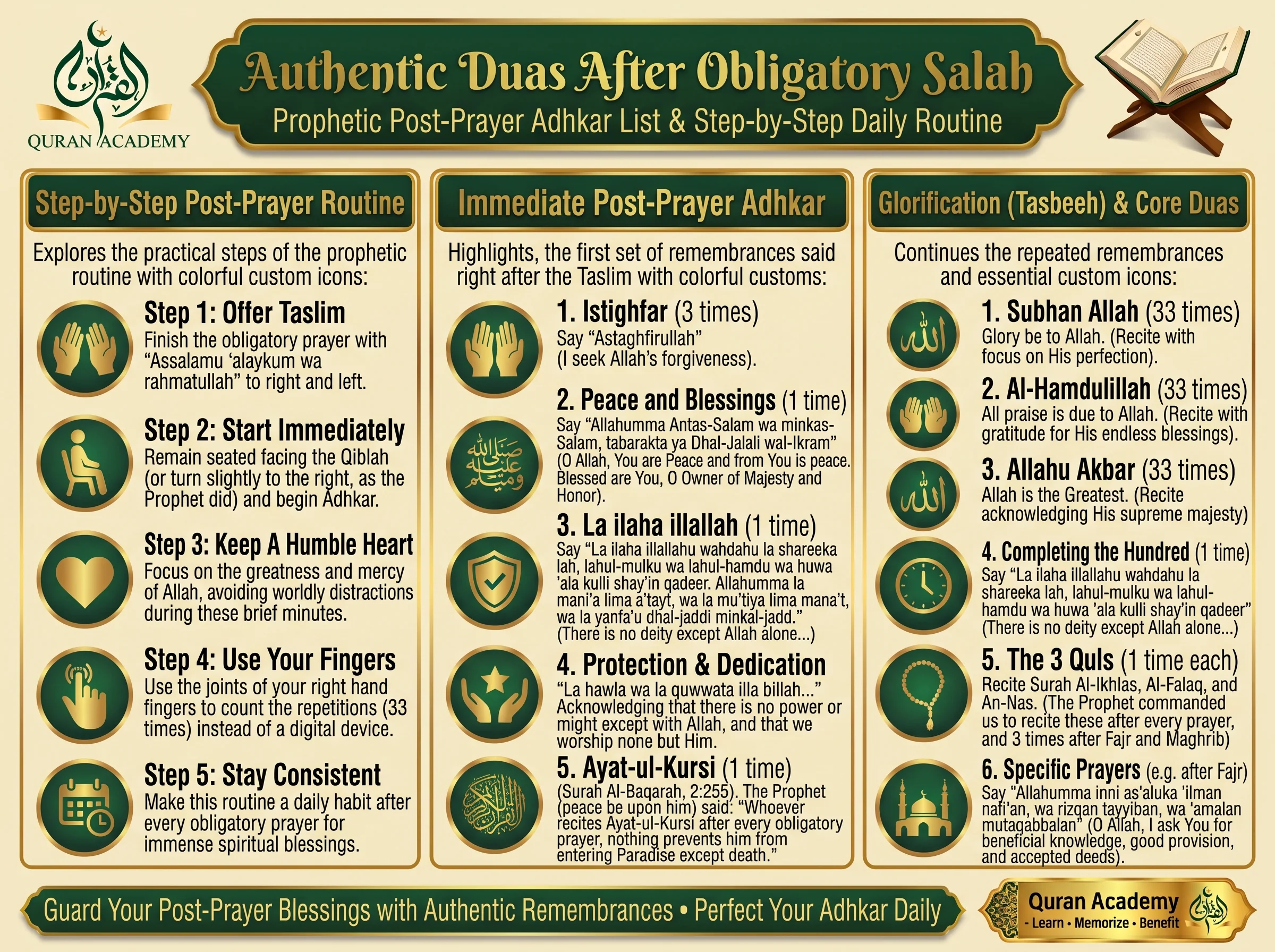
✦ Quick Answer & Key Takeaways: Authentic Duas After Obligatory Salah
Mastering authentic Adhkar and Duas after Fard Salah (الْأَذْكَارُ وَالدُّعَاءُ بَعْدَ الصَّلَاةِ الْمَكْتُوبَةِ) transforms the moments immediately following the completion of your five daily prayers into a treasure trove of forgiveness, spiritual elevation, and Divine protection. According to verified narrations in Sahih Muslim and Sunan Abi Dawud, Prophet Muhammad (ﷺ) established a precise, unhurried post-prayer Sunnah sequence: starting with seeking forgiveness 3 times (Istighfar), praising Allah as the Source of Peace, reciting Ayatul Kursi (securing guaranteed entry into Paradise), performing the 33-33-33 Tasbeeh sealed with the 100th Tahlil phrase (erasing minor sins as vast as sea foam), and reciting protective Duas for gratitude and steadfastness. In our 1-on-1 Online Islamic Studies & Daily Sunnah Course, students master the exact Arabic pronunciation, meanings, and rewards of every post-prayer remembrance!
- The Direct Ticket to Jannah (An-Nasa'i & Ibn Hibban): Whoever recites Ayatul Kursi immediately after every obligatory prayer has nothing standing between them and Paradise except death!
- The Sea-Foam Sins Eraser (Sahih Muslim 597): Saying Subhanallah (33x), Alhamdulillah (33x), Allahu Akbar (33x) plus the 100th Tahlil wipes away minor sins even if as abundant as the foam of the sea.
- The 3 Quls Extra Shield (Sunan at-Tirmidhi 3471): Specifically recommended 3 times each after Fajr and Maghrib prayers for comprehensive protection.
- The Daily Gratitude Prayer (Sunan Abu Dawud 1522): Never missing Mu'adh ibn Jabal's (RA) favorite prophetic instruction: "O Allah, help me to remember You, to thank You, and to worship You in the best manner!"
Think about how many times we rush to stand up, check our phones, or dive back into our workday the absolute second we turn our heads to give the final Salam (Tasleem) at the end of prayer. We just stood before the King of Kings, yet we exit His presence in such haste that we miss the golden post-prayer moments when the angels are still supplicating for us!
In the Prophetic Sunnah, the transition from formal prayer into daily life is bridged by a structured, peaceful sequence of remembrances and Duas (Al-Adhkar Al-Masnoonah). Just as we established our daily shield in our Morning and Evening Adhkar Guide, mastered our prostrations in our Sujood As-Sahw Guide, and learned Salat Al-Istikharah, knowing the verified post-prayer checklist ensures your Salah leaves a lasting imprint on your heart. Below, we give you the exact 6-Step Prophetic Post-Prayer Sequence, the rewards of Ayatul Kursi and Tasbeeh, and the special additions for Fajr and Maghrib.
- The 6-Step Prophetic Post-Prayer Sequence (From Istighfar to Tasleem Adhkar)
- Detailed Directory: Arabic Text, Transliteration & Rewards of Every Post-Prayer Adhkar
- Special Additions After Fajr & Maghrib Prayers (The 10x Tahlil & 3 Quls)
- The Etiquette of Finger-Counting & Why Rushing Through Adhkar Flaws Salah
- 5 Essential Tajweed Rules When Reciting Post-Prayer Adhkar
- Frequently Asked Questions (FAQs)
1. The 6-Step Prophetic Post-Prayer Sequence (From Istighfar to Tasleem Adhkar)
As recorded in Sahih Muslim (591) from Thawban (may Allah be pleased with him), whenever the Messenger of Allah (ﷺ) finished his prayer, he would seek Allah's forgiveness three times and say the greeting formula. Here is the verified 6-Step Prophetic Sequence agreed upon by all four Sunni schools:
- Step 1 — The Triple Istighfar & Peace Formula (Sahih Muslim 591): Immediately after saying Salam to the right and left, say "Astaghfirullaah" 3 times, followed by "Allaahumma Antas-Salaam..."
- Step 2 — Ayatul Kursi (Surah Al-Baqarah 2:255 — An-Nasa'i 9928): Recite Ayatul Kursi immediately—securing your direct ticket to Jannah.
- Step 3 — The 33-33-33 Tasbeeh + 100th Tahlil (Sahih Muslim 597): Recite Subhanallah (33x), Alhamdulillah (33x), Allahu Akbar (33x), and seal with Laa ilaaha illaa-llaah...
- Step 4 — The 3 Quls (Surahs 112, 113, 114 — Sunan at-Tirmidhi 3471): Recite the 3 Quls (3 times each after Fajr and Maghrib; 1 time each after Dhuhr, Asr, and Isha).
- Step 5 — The Gratitude & Help Dua (Sunan Abu Dawud 1522): Recite "Allaahumma a'nnee 'alaa dhikrika wa shukrika wa husni 'ibaadatik".
- Step 6 — Seeking Refuge & Forgiveness Duas: Conclude with Sayyidul-Istighfar or personal supplications!
2. Detailed Directory: Arabic Text, Transliteration & Rewards of Post-Prayer Adhkar
You can verify every Hadith source below in our Online Hadith Explorer. Here is the complete voweled Arabic text, transliteration, and spiritual reward of each step:
| Step & Name | Arabic Text & Transliteration | Meaning & Authentic Hadith Reward |
|---|---|---|
| 1. Triple Istighfar & Peace Formula (Sahih Muslim 591) |
أَسْتَغْفِرُ اللَّهَ (3x) اللَّهُمَّ أَنْتَ السَّلَامُ وَمِنْكَ السَّلَامُ، تَبَارَكْتَ يَا ذَا الْجَلَالِ وَالِكْرَامِ Astaghfirullaah (3x). Allaahumma Antas-Salaam wa minkas-salaam, tabaarakta yaa Dhal-Jalali wal-Ikraam. |
Seeking forgiveness compensates for any minor distractions or shortcomings during prayer, and praises Allah as the sole source of peace and majesty. |
| 2. Ayatul Kursi (An-Nasa'i 9928) |
اللَّهُ لَا إِلَٰهَ إِلَّا هُوَ الْحَيُّ الْقَيُّومُ... Allaahu laa ilaaha illaa Huwal-Hayyul-Qayyoom... (Surah Al-Baqarah 2:255) |
An-Nasa'i & Ibn Hibban (Sahih): Whoever recites it after every obligatory prayer has nothing standing between them and Paradise except death! |
| 3. The 33-33-33 Tasbeeh & 100th Tahlil (Sahih Muslim 597) |
سُبْحَانَ اللَّهِ (33) • الْحَمْدُ لِلَّهِ (33) • اللَّهُ أَكْبَرُ (33) لَا إِلَٰهَ إِلَّا اللَّهُ وَحْدَهُ لَا شَرِيكَ لَهُ... Subhaanallah (33), Alhamdulillah (33), Allahu Akbar (33), Laa ilaaha illallaahu wahdahu laa... |
Sahih Muslim 597: Wipes away minor sins even if they are as abundant as the foam of the sea! |
| 4. The 3 Quls (Sunan at-Tirmidhi 3471) |
قُلْ هُوَ اللَّهُ أَحَدٌ • قُلْ أَعُوذُ بِرَبِّ الْفَلَقِ • قُلْ أَعُوذُ بِرَبِّ النَّاسِ | Surahs Al-Ikhlas, Al-Falaq, and An-Nas recited for spiritual protection (recited 3x each after Fajr and Maghrib, and 1x each after Dhuhr, Asr, and Isha). |
| 5. The Gratitude & Help Prayer (Sunan Abu Dawud 1522) |
اللَّهُمَّ أَعِنِّى عَلَى ذِكْرِكَ وَشُكْرِكَ وَحُسْنِ عِبَادَتِكَ Allaahumma a'nnee 'alaa dhikrika wa shukrika wa husni 'ibaadatik. |
Abu Dawud & An-Nasa'i (Sahih): The Prophet (ﷺ) told Mu'adh ibn Jabal (RA): *"O Mu'adh, by Allah I love you! Never leave this Dua at the end of every prayer."* |
| 6. Seeking Refuge & Protection 🏆 (Sunan Abu Dawud 1523) |
اللَّهُمَّ إِنِّي أَعُوذُ بِكَ مِنَ الْبُخْلِ، وَأَعُوذُ بِكَ مِنَ الْجُبْنِ... Allaahumma innee a'oodhu bika minal-bukhli, wa a'oodhu bika minal-jubni... |
Sahih al-Bukhari 2822: Seeks refuge from miserliness, cowardice, senility, and the trials of this world and the grave. |
3. Special Additions After Fajr & Maghrib Prayers (The 10x Tahlil & 3 Quls)
As we teach in our Morning & Evening Adhkar Authentic List, two post-prayer moments carry special Prophetic additions because of the transition between night and day (Fajr and Maghrib):
- 1. Reciting the 10x Tahlil Before Moving Your Feet After Fajr and Maghrib (Sunan at-Tirmidhi 3471):
Before changing your posture or speaking to anyone after finishing the Fajr and Maghrib prayers, recite ten times: لَا إِلَٰهَ إِلَّا اللَّهُ وَحْدَهُ لَا شَرِيكَ لَهُ، لَهُ الْمُلْكُ وَلَهُ الْحَمْدُ، يُحْيِي وَيُمِيتُ، وَهُوَ عَلَىٰ كُلِّ شَيْءٍ قَدِيرٌ (Laa ilaaha illaa-llaahu wahdahu laa shareeka lahu, lahul-mulku wa lahul-hamdu, yuhyee wa yumeetu, wa Huwa 'alaa kulli shay'in qadeer).
• The Reward: Recorded as equivalent to freeing slaves, written for you as 10 good deeds, erasing 10 bad deeds, raising you 10 degrees, and shielding you from every disliked thing and Satan all day! - 2. The 3 Quls Recited 3 Times Each After Fajr and Maghrib:
While Surahs Al-Ikhlas, Al-Falaq, and An-Nas are recited once after Dhuhr, Asr, and Isha, the Prophet (ﷺ) specifically instructed reciting them 3 times each immediately after Fajr and Maghrib as part of your morning and evening fortress of protection!
Mastering the Crisp Qalqalah in "Tabaarakta", "Al-Mulk" & "Qadeerْ" After Prayer!
When reciting post-prayer Adhkar—such as تَبَارَكْتَ يَا ذَا الْجَلَالِ (Tabaarakta), لَهُ الْمُلْكُ وَلَهُ الْحَمْدُ (Lahul-mulku), and عَلَىٰ كُلِّ شَيْءٍ قَدِيرٌ (Qadeerْ)—notice how many words feature the 5 Qalqalah letters (ق ط ب ج د)! Watch Senior Instructor Ustadhah Yasmeen Gamal demonstrate how to bounce these consonants cleanly without adding extra vowels on our Quran Academy YouTube Channel:
- Crisp Qalqalah on Stop: Hear how stopping on Qadeerْ and Majeedْ lands on a resonant Qalqalah Kubra bounce!
- 1-on-1 Live Coaching: Perfect your post-prayer Adhkar and Tajweed with our Al-Azhar scholars!
4. The Etiquette of Finger-Counting & Why Rushing Through Adhkar Flaws Salah
As we teach in our parenting and student guides on Building Focus and Presence of Heart in Worship, how you perform your post-prayer Adhkar matters just as much as the words you say:
Struggling to perfect your Recitation?
Join hundreds of students mastering the Quran with our Verified Al-Azhar Graduates. We offer flexible 1-on-1 sessions tailored to your schedule.
Book a Free Evaluation Class →- 1. Always Count on Your Right Hand Fingers (Sunan Abu Dawud 1502):
The Prophet (ﷺ) explicitly commanded the female Companions: "Hold fast to Tasbeeh, Tahlil, and Taqdees, and count them upon your fingers—for indeed the fingers will be questioned and made to speak on the Day of Judgment!" While electronic counters or beads are permissible, using your right-hand fingers is the direct Prophetic Sunnah. - 2. Unhurried Tranquility (At-Tuma'ninah) vs. Speed-Racing:
Never rush through Subhanallah 33x like a mechanical race; say each remembrance calmly with presence of heart, reflecting on Allah's perfection, your gratitude, and His supreme greatness. - 3. The Post-Prayer Adhkar Belong to the Prayer:
Treat these 3 to 5 minutes after the Salam as an organic continuation of your Salah, knowing that the angels are still surrounding you and recording your quiet glorifications.
5. Five Essential Tajweed Rules When Reciting Post-Prayer Adhkar
Before reciting your post-prayer Adhkar today, apply these five core rules from our 1-on-1 Online Tajweed Course:
- 1. Starting "Antas-Salaam" With a Kasrah (اللَّهُمَّ أَنْتَ السَّلَامُ — Hamzatul Wasl Rule):
As we mastered in our Hamzatul Wasl vs. Qat' Guide, when starting the greeting formula ٱلسَّلَامُ (As-Salaam) after pausing on Astaghfirullah, because it is the definite article الـ (Al-), you always start it with a Fatha (أَلْسَّلَامُ = As-Salaam)! - 2. Heavy vs. Light Raa in "Rabbil-'Aalameen" & "Qadeer" (Ahkam Al-Raa):
Applying our Ahkam Al-Raa Guide, notice that the Raa in رَبَّ (Rabba) is Heavy, the Raa in غَفُورٌ رَّحِيمٌ (Ghafoorur-Raheem) is Heavy, while the Raa in قَدِيرٌ (Qadeerْ — on stop) is preceded by a Yaa Sakinah—making it 100% Light (Tarqeeq)! - 3. Sun & Moon Letters in "As-Salaam", "Al-Mulku" & "An-Naas":
Using our Laam Shamsiyyah & Qamariyyah Guide, merge the Sun Laam with a Shaddah in ٱلسَّلَامُ and ٱلنَّاسِ, while pronouncing the Moon Laam clearly in ٱلْمُلْكُ and ٱلْحَمْدُ! - 4. Merging Nun Sakinah Without Ghunnah in "Shay'in Qadeer" (Idgham Bila Ghunnah):
According to our Noon Sakinah & Tanween Guide and Meem Sakinah Guide, when the Tanween in شَيْءٍ قَدِيرٍ (Shay'in Qadeer) or غَفُورٍ رَّحِيمٍ meets Laam or Raa, merge it without nasal Ghunnah (Idgham Bila Ghunnah)! - 5. 4-to-5 Beat Madd Wajib Muttasil in "Jaa'a" & "Shash-Shaafee":
Following our Rules of Madd, Makharij al-Huruf, Sifaat al-Huruf, Heavy & Light Letters, Rules of Waqf, 4 Special Words of Hafs, and 7 Alifs in the Quran, stretch the Alif before any Hamzah for 4 to 5 counts! Test your Tajweed accuracy right now on our Free 3-Minute Tajweed Quiz!
Pair your post-prayer Adhkar with our comprehensive library of daily remembrances and Surah guides: Authentic Ruqyah Shariah Guide, Morning & Evening Adhkar Authentic List, 40 Rabbana Duas From the Quran, Surah Al-Fatihah Guide, Last 3 Verses of Surah Al-Hashr, Surah Qaf 6-Day Plan, 10 Shortest Surahs for Salah, Surah Al-Alaq Guide, Ayatul Kursi Guide, Last 2 Verses of Surah Al-Baqarah, 3 Quls Guide, Surah Ad-Duha & Ash-Sharh, Surah Ya-Sin, Surah Ar-Rahman, Surah Al-Waqi'ah, Surah Maryam, Surah Yusuf, Surah Luqman, Surah Al-Hujurat, Surah As-Sajdah & Al-Insan, Sujood As-Sahw, Salat Al-Istikharah, Salat Al-Janazah, and 25 Prophets in the Quran in our Online Hifz Program (using our Smart Hifz Planner)! Whether you are studying with our Al-Azhar Certified Tutors or enrolling your child in our 1-on-1 Kids Quran Classes with our Printable Kids Star Chart, read how families across the US, UK, Canada, and Australia rate our teachers on our Verified Student & Parent Reviews Page.
6. Frequently Asked Questions (FAQs) About Authentic Post-Prayer Adhkar
1. What is the exact step-by-step sequence of Adhkar after obligatory (Fard) Salah in the Sunnah?
According to authentic Hadiths in Sahih Muslim and Sunan Abi Dawud, the Prophetic sequence immediately after finishing the Tasleem (Salam) of an obligatory prayer is: (1) Say "Astaghfirullah" 3 times, (2) Recite: "Allaahumma Antas-Salaam wa minkas-salaam, tabaarakta yaa Dhal-Jalali wal-Ikraam", (3) Recite Ayatul Kursi (Surah Al-Baqarah 2:255), (4) Recite Subhanallah (33x), Alhamdulillah (33x), and Allahu Akbar (33x) completed with the 100th phrase of Tahlil, (5) Recite the 3 Quls (especially after Fajr and Maghrib), and (6) Recite specific Duas like "Allaahumma a'nnee 'alaa dhikrika wa shukrika wa husni 'ibaadatik".
2. What is the reward for reciting Ayatul Kursi immediately after every obligatory prayer?
According to an authentic narration in An-Nasa'i (As-Sunan Al-Kubra 9928) and Ibn Hibban (Sahih), Prophet Muhammad (ﷺ) stated: "Whoever recites Ayatul Kursi after every obligatory prayer, nothing stands between him and entering Paradise except that he dies."
3. How do you count the 33-33-33 Tasbeeh after prayer according to the Sunnah?
In Sunan Abu Dawud (1502) and At-Tirmidhi (3410), the Prophet (ﷺ) instructed counting the remembrances using the fingers of the right hand (or both hands), because the fingers will be questioned and made to speak on the Day of Judgment. You say Subhanallah 33 times, Alhamdulillah 33 times, and Allahu Akbar 33 times (totaling 99), and complete the 100 with: "Laa ilaaha illallaahu wahdahu laa shareeka lahu, lahul-mulku wa lahul-hamdu, wa Huwa 'alaa kulli shay'in qadeer"—which forgives minor sins even if as abundant as the foam of the sea (Sahih Muslim 597).
4. Is it permissible to make personal Dua (supplication) immediately after the Fard prayer before doing the Adhkar?
Scholars clarify that the established Sunnah sequence is to start immediately with the prescribed Adhkar (Istighfar, Tasleem formulas, Ayatul Kursi, and Tasbeeh). However, making personal Duas is highly recommended right before finishing the prayer in the final Tashahhud (before Salam) and also immediately following the completion of the Sunnah post-prayer Adhkar.
5. Which post-prayer Adhkar have specific extra counts after Fajr and Maghrib prayers?
In authentic Hadiths (such as Sunan at-Tirmidhi 3471), the Prophet (ﷺ) instructed reciting the 3 Quls (Surahs Al-Ikhlas, Al-Falaq, and An-Nas) 3 times each specifically after Fajr and Maghrib prayers, alongside reciting "Laa ilaaha illallaahu wahdahu laa shareeka lahu..." 10 times specifically after Fajr and Maghrib.
Teach Your Family Authentic Salah & Adhkar With an Al-Azhar Scholar!
Master daily prayers, post-prayer Adhkar, and Quranic Tajweed with structured 1-on-1 classes from certified male and female Al-Azhar scholars. Book your free trial session today!
Book Your Free 1-on-1 Trial Class →