
✦ Quick Answer & Key Takeaways: How to Pray Salat Ad-Duha Benefits
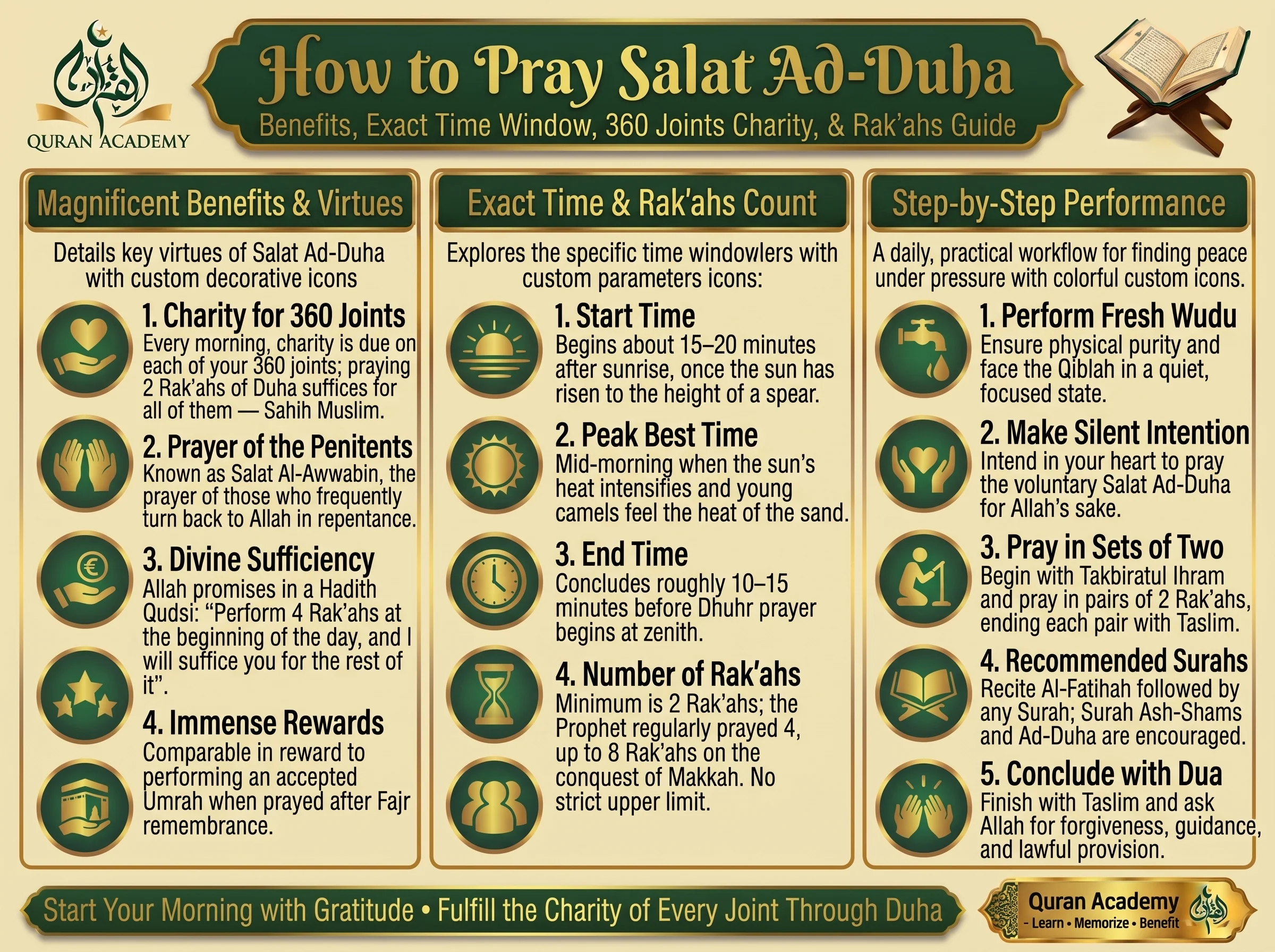
Discovering how to pray Salat Ad Duha benefits (صَلَاةُ الضُّحَىٰ / صَلَاةُ الْأَوَّابِينَ — also known in South Asia as Salat Al-Chasht) unlocks a 4-minute morning Sunnah that pays the daily gratitude tax for every single joint in your body! Performed anytime between 15–20 minutes after sunrise and 10–15 minutes before Dhuhr Adhan, Salat Ad-Duha is prayed in 2-Rak'ah units (from a minimum of 2 Rak'ahs up to 4, 6, or 8 Rak'ahs) silently like Dhuhr prayer. In Sahih Muslim (720 & 1007), Prophet Muhammad (ﷺ) revealed that every human being was created with 360 joints, each owing a daily charity (Sadaqah) of gratitude every morning—and just 2 Rak'ahs of Salat Ad-Duha suffice for all 360 charities at once! In our 1-on-1 Online Islamic Studies & Daily Sunnah Course, students pair Salat Ad-Duha with their daily Quran recitation and morning Adhkar!
- The 3-Part Lifelong Advice to Abu Hurayrah (Sahih al-Bukhari 1178): The Prophet (ﷺ) advised his close friend never to leave 3 things until death: fasting 3 days each month, 2 Rak'ahs of Duha, and praying Witr before sleeping!
- The 4-Rak'ah Hadith Qudsi Promise (Sunan at-Tirmidhi 475): Allah Almighty says: "O son of Adam, bow for Me four Rak'ahs at the beginning of the day, and I will suffice you for the rest of your day!"
- Ishraq vs. Duha vs. Awwabeen: Salat Al-Ishraq is Duha prayed 15–20 min after sunrise (earning a complete Hajj & 'Umrah reward after Fajr Dhikr!); Salat Al-Awwabeen is Duha prayed in late mid-morning!
- The 100x Post-Duha Istighfar (Al-Adab Al-Mufrad 619): Allaahummagh-fir lee, wa tub 'alayya, innaka Antat-Tawwaabur-Raheem (100x).
Think about the longest gap between any two obligatory prayers during your waking day: from the moment you finish Fajr prayer at dawn until Dhuhr prayer enters after midday—often a stretch of 6 to 8 full hours filled with school, work, commuting, and worldly busyness!
Right in the middle of that long morning stretch, while the world is rushing after its daily provision, the Prophetic Sunnah placed a radiant spiritual oasis called Salat Ad-Duha (صَلَاةُ الضُّحَىٰ — The Forenoon Prayer, named after the bright morning sunlight sworn by in Surah Ad-Duha 93:1). In Sahih Muslim (748), Prophet Muhammad (ﷺ) gave this prayer one of the most honorable titles in Islam: « صَلَاةُ الْأَوَّابِينَ » (Salat Al-Awwabeen — "The Prayer of Those Who Constantly Turn Back to Allah!"). Yet many Muslims miss out on this daily treasure simply because they aren't sure when the prohibited sunrise time ends, when the prohibited zenith time before Dhuhr begins, or how Salat Al-Ishraq relates to Salat Ad-Duha! Building upon our guides to Tahajjud & Qiyam Al-Layl, Salat Al-Witr, and Morning & Evening Adhkar, this complete guide breaks down the 4 Authentic Virtues of Duha, the Exact Timing Window, the Step-by-Step Method, and the 100x Post-Duha Supplication.
- 1. Four Authentic Virtues of Salat Ad-Duha (360 Joints Charity, Hajj Reward & Sufficiency!)
- 2. Exact Timing Chart: Start Time, End Time & The Difference Between Ishraq, Duha & Awwabeen
- 3. How to Pray Salat Ad-Duha Step by Step (2, 4, 6, or 8 Rak'ahs & Recommended Surahs)
- 4. The Authentic Prophetic Dua After Salat Ad-Duha (100x Istighfar & Repentance!)
- 5. Four Essential Tajweed Rules When Reciting Surah Ad-Duha & The Post-Duha Dua
- 6. Frequently Asked Questions (FAQs)
1. Four Authentic Virtues of Salat Ad-Duha (360 Joints Charity, Hajj Reward & Sufficiency!)
Why did the Prophet (ﷺ) personally bequeath Salat Ad-Duha to Companions like Abu Hurayrah, Abu Ad-Darda', and Abu Dharr (may Allah be pleased with them all)? Look at the four tremendous rewards verified in the authentic Sunnah:
• 1. Paying the Daily Charity of 360 Joints (Sahih Muslim 720 & 1007): Abu Dharr and 'Aishah (RA) reported that the Messenger of Allah (ﷺ) said: "Every single human being from the children of Adam was created upon three hundred and sixty (360) joints (مِفْصَل / سُلَامَى)! Every morning, charity (Sadaqah) is due upon every single joint of your bones: every Subhanallah is a charity, every Alhamdulillah is a charity, every La ilaha illallah is a charity, every Allahu Akbar is a charity, enjoining good is a charity, and forbidding evil is a charity—and two Rak'ahs that one prays in the forenoon (Ad-Duha) suffice for all of that (وَيُجْزِئُ مِنْ ذَٰلِكَ رَكْعَتَانِ يَرْكَعُهُمَا مِنَ الضُّحَىٰ)!"
• 2. Sufficiency for the Rest of Your Day for 4 Rak'ahs (Sunan at-Tirmidhi 475 & Abu Dawud 1289 — Sahih): In a Hadith Qudsi, Allah Almighty says: "يَا ابْنَ آدَمَ، ارْكَعْ لِي أَرْبَعَ رَكَعَاتٍ مِنْ أَوَّلِ النَّهَارِ أَكْفِكَ آخِرَهُ" ("O son of Adam, bow for Me four Rak'ahs at the beginning of the day, and I will suffice you [protect and provide for you] for the rest of your day!")
• 3. The Complete Reward of Hajj & 'Umrah (Sunan at-Tirmidhi 586 — Hasan): Whoever prays Fajr in congregation, then sits remembering Allah until the sun rises, and then prays two Rak'ahs (Salat Al-Ishraq / early Duha), shall have the reward of a complete, complete, complete Hajj and 'Umrah!
• 4. Inscribed as "Salat Al-Awwabeen" (Sahih Muslim 748): The Prophet (ﷺ) declared: "The prayer of the Oft-Returning (Salat Al-Awwabeen) is when the young weaned camels feel the heat of the morning sun!"
2. Exact Timing Chart: Start Time, End Time & Ishraq vs. Duha vs. Awwabeen
In Islamic Fiqh (as defined in our Interactive Tajweed & Islamic Encyclopedia), there are two brief prohibited times around the morning sun when voluntary prayer is not offered: (1) During sunrise itself until the sun rises a spear's length above the horizon, and (2) Right at solar noon (Istiwa') just before the sun tilts westward for Dhuhr. Everything between those two brief buffers is the valid window for Salat Ad-Duha!
| Time Phase | Clock Calculation Rule | Specific Name & Virtue |
|---|---|---|
| 1. Earliest Start Time (Salat Al-Ishraq) |
15 to 20 minutes AFTER Sunrise (Shurooq) *(e.g., if Sunrise is 6:00 AM, start at 6:15–6:20 AM).* |
Called Salat Al-Ishraq (صَلَاةُ الْإِشْرَاقِ): it is simply Salat Ad-Duha prayed at the very start of its time—earning the Hajj & 'Umrah reward if preceded by sitting in Fajr Dhikr! |
| 2. Most Virtuous Prime Time 🏆 (Salat Al-Awwabeen) |
Mid-to-Late Morning (Roughly halfway between Sunrise & Dhuhr) *(e.g., between 9:00 AM and 11:15 AM).* |
Called Salat Al-Awwabeen (صَلَاةُ الْأَوَّابِينَ): when the morning sun grows warm and most people are absorbed in worldly work, pausing for 5 minutes to remember Allah is supreme! |
| 3. Final End Time (Before Zenith / Zawal) |
10 to 15 minutes BEFORE Dhuhr Adhan *(e.g., if Dhuhr is 12:15 PM, finish Duha by 12:00 PM).* |
Stop praying voluntary prayers 10–15 minutes before Dhuhr while the sun is directly overhead at its zenith, until Dhuhr enters. |
*(Note on "Salat Al-Awwabeen": In authentic Hadith [Sahih Muslim 748], Salat Al-Awwabeen is the authentic name of Salat Ad-Duha in the late morning; some later scholars also applied the title loosely to voluntary prayers between Maghrib and Isha, though its primary Prophetic source is Salat Ad-Duha!).*
3. How to Pray Salat Ad-Duha Step by Step (2, 4, 6, or 8 Rak'ahs & Recommended Surahs)
Whether you are a busy mother at home (following our 15-Minute Daily Quran Routine for Busy Moms), a student on a morning study break, or a professional in your office, here is how to pray Salat Ad-Duha in 4 minutes:
- Step 1 — Wudu & Intention in the Heart:
Ensure you are in a state of Wudu, face the Qiblah, and intend in your heart to pray 2 Rak'ahs of Sunnah Salat Ad-Duha for the sake of Allah. - Step 2 — Pray 2 Rak'ahs Silently (Just Like Fajr Prayer, With Silent Recitation):
Because Salat Ad-Duha is a daytime prayer, recite Surah Al-Fatihah and a second Surah silently (Sirran) in both Rak'ahs, complete your Ruku', Sujood, and Tashahhud, and give Salam to the right and left! - Step 3 — How Many Rak'ahs Should You Pray? (2, 4, 6, or 8 Rak'ahs):
• 2 Rak'ahs: The valid minimum that fulfills the 360 joints charity Hadith!
• 4 Rak'ahs (2 Rak'ahs + Salam, then 2 Rak'ahs + Salam): Fulfills the Hadith Qudsi promise of Allah sufficing you for the rest of your day (and 'Aishah RA narrated in Sahih Muslim 719 that the Prophet ﷺ often prayed 4 Rak'ahs of Duha and added whatever Allah willed)!
• 8 Rak'ahs (2+2+2+2): Prayed by the Prophet (ﷺ) on the Day of the Conquest of Makkah (Sahih al-Bukhari 1176). - Step 4 — Which Surahs Are Best to Recite in Salat Ad-Duha?
You may recite any Surah or verses from the Quran (open our Online Quran Explorer or use Duha to revise your current Hifz page!). Many scholars also loved reciting Surah Ash-Shams (Chapter 91) in the 1st Rak'ah and Surah Ad-Duha (Chapter 93) in the 2nd Rak'ah—or Surah Al-Kafirun (109) and Surah Al-Ikhlas (112)!
4. The Authentic Prophetic Dua After Salat Ad-Duha (100x Istighfar & Repentance!)
Did Prophet Muhammad (ﷺ) have a specific remembrance that he repeated after giving Salam from Salat Ad-Duha? Yes! In Al-Adab Al-Mufrad of Imam Al-Bukhari (619) and Sunan an-Nasa'i Al-Kubra (9908 — graded Sahih by Shaykh Al-Albani and Shaykh Shu'ayb Al-Arna'ut), Mother of the Believers 'Aishah (may Allah be pleased with her) narrated that the Messenger of Allah (ﷺ) prayed Salat Ad-Duha and then said 100 times:
ٱللَّهُمَّ ٱغْفِرْ لِي، وَتُبْ عَلَيَّ، إِنَّكَ أَنْتَ ٱلتَّوَّابُ ٱلرَّحِيمُ (أَوِ ٱلتَّوَّابُ ٱلْغَفُورُ).
Transliteration: Allaahummagh-fir lee, wa tub 'alayya, innaka Antat-Tawwaabur-Raheem (or: Antat-Tawwaabul-Ghafoor) — 100 times.
Struggling to perfect your Recitation?
Join hundreds of students mastering the Quran with our Verified Al-Azhar Graduates. We offer flexible 1-on-1 sessions tailored to your schedule.
Book a Free Evaluation Class →Meaning & Why It Takes Only 2 Minutes: "O Allah, forgive me and accept my repentance; indeed, You are the Ever-Accepting of Repentance, the Most Merciful!" Counting this short 8-word supplication 100 times on your right-hand fingers after Duha takes less than 2 minutes—sealing the Prayer of the Oft-Returning (Salat Al-Awwabeen) with 100 acts of returning to Allah!
Mastering the Crisp Qalqalah on "Wa Tubْ 'Alayya" in the Post-Duha Dua!
In the Prophetic post-Duha supplication—ٱللَّهُمَّ ٱغْفِرْ لِي، وَتُبْ عَلَيَّ (Wa Tubْ 'alayya)—notice that the silent Baa (بْ) at the end of the command verb Tubْ is one of the 5 Qalqalah (Echoing) letters (ق ط ب ج د)! If you don't give that Baa Sakinah a gentle mid-line Qalqalah bounce before the throat letter 'Ayn (عَ), the Baa either disappears or turns into an English "P"! Watch Senior Instructor Ustadhah Yasmeen Gamal demonstrate Qalqalah on our Quran Academy YouTube Channel:
- Clean Baa Bounce Before 'Ayn: Keep Wa Tubْ 'alayya voiced and distinct across all 100 repetitions!
- 1-on-1 Live Coaching: Perfect your morning Surahs & Tajweed with Al-Azhar scholars!
5. Four Essential Tajweed Rules When Reciting Surah Ad-Duha & The Post-Duha Dua
Before you pray your 2 or 4 Rak'ahs of Salat Ad-Duha tomorrow morning, apply these four Tajweed rules from our 1-on-1 Online Tajweed Course:
- 1. Sun Laam on "Ad-Duha", "At-Tawwaab" & "Ar-Raheem":
Applying our Laam Shamsiyyah & Laam Qamariyyah Guide and Hamzatul Wasl Guide, notice that in وَٱلضُّحَىٰ (Wad-Duhaa) and أَنْتَ ٱلتَّوَّابُ ٱلرَّحِيمُ (Antat-Tawwaabur-Raheem), the letters ض، ت، ر are all among the 14 Sun Letters—so skip the Laam completely and merge directly into the Shaddah! (Whereas if you end with ٱلْغَفُورُ = Al-Ghafoor, pronounce the Moon Laam clearly before the Ghayn!). - 2. Light Raa in "Allaahummagh-firْ Lee" vs. Heavy Raa in "Ar-Raheem" (Ahkam Al-Raa):
Using our Ahkam Al-Raa Guide, in ٱللَّهُمَّ ٱغْفِرْ لِي (Allaahummagh-firْ lee), the silent Raa is preceded by an original Kasrah on the Faa (فِ) and is not followed by a heavy letter—so keep the Raa in Ighfirْ 100% Light (Tarqeeq)! In contrast, the Raa in ٱلرَّحِيمُ (Ar-Raheem) carries a Fatha, making it 100% Heavy (Tafkhim)! - 3. Smooth Friction (Rakhawah) on the Ghayn Sakinah in "Allaahummagh-fir":
According to our Makharij al-Huruf and Sifaat al-Huruf guides, never bounce the silent upper-throat Ghayn (غْ) in Allaahummaghْ-fir like a Qalqalah letter—let its heavy sound flow smoothly into the light Faa! - 4. Light Ikhfaa' on "Anta" + 2-Beat Ghunnah on "Innaka":
Following our Noon Sakinah Rules, Meem Sakinah Rules, Heavy & Light Letters, Rules of Madd, Rules of Waqf, 4 Special Words of Hafs, and 7 Alifs in the Quran, hold a 2-beat nasal Ghunnah on the Noon Mushaddadah of إِنَّكَ (Innaka) and a 2-beat light Ikhfaa' on أَنْتَ (Anta)! Test your Tajweed ear right now on our Free 3-Minute Tajweed Quiz!
Pair your daily Salat Ad-Duha with our complete library of Salah, Adhkar, and Surah guides: Authentic Duas After Fard Salah, Bedtime & Waking Up Duas, Prophetic Duas for Anxiety & Debt Relief, Authentic Ruqyah Shariah, Dua Al-Qunoot in Witr, 40 Rabbana Duas, Last 3 Verses of Surah Al-Hashr, Surah Qaf 6-Day Plan, Surah Al-Alaq Guide, Ayatul Kursi, Last 2 Verses of Surah Al-Baqarah, The 3 Quls, Surah Ya-Sin, Surah Ar-Rahman, Surah Al-Waqi'ah, Surah Maryam, Surah Yusuf, Surah Luqman, Surah Al-Hujurat, Surah As-Sajdah & Al-Insan, Sujood As-Sahw, Salat Al-Istikharah, Salat Al-Janazah, 5 Pillars of Islam, and 25 Prophets in the Quran in our Online Hifz Program (using our Smart Hifz Planner)! Whether you are studying with our Al-Azhar Certified Tutors or enrolling your child in our 1-on-1 Kids Quran Classes with our Printable Kids Star Chart, see how families across the US, UK, Canada, and Australia rate our teachers on our Verified Student & Parent Reviews Page.
6. Frequently Asked Questions (FAQs) About How to Pray Salat Ad-Duha
1. What is the exact start and end time for Salat Ad-Duha?
The time for Salat Ad-Duha begins roughly 15 to 20 minutes after sunrise (once the sun has risen a spear's length above the horizon and the prohibited sunrise window has passed) and lasts until roughly 10 to 15 minutes before Dhuhr Adhan (just before the sun reaches its zenith at midday). The most virtuous time to pray it is late mid-morning when the sun's heat becomes warm (Salat al-Awwabeen — Sahih Muslim 748).
2. How do 2 Rak'ahs of Salat Ad-Duha pay the daily charity of all 360 joints in the human body?
In Sahih Muslim (720), Prophet Muhammad (ﷺ) explained that every morning charity (Sadaqah) is due upon every single joint (Sulama — 360 joints, Sahih Muslim 1007) of the human body: every Subhanallah, Alhamdulillah, La ilaha illallah, Allahu Akbar, commanding good, and forbidding evil is a charity—and "two Rak'ahs that one prays in the forenoon (Ad-Duha) suffice for all of that!"
3. What is the difference between Salat Al-Ishraq, Salat Ad-Duha, and Salat Al-Awwabeen?
All three are names for the exact same forenoon prayer (Salat Ad-Duha) depending on when it is prayed: (1) Salat Al-Ishraq is Duha prayed at the very beginning of its time (15–20 minutes after sunrise, especially after sitting in the masjid remembering Allah after Fajr — Sunan at-Tirmidhi 586), and (2) Salat Al-Awwabeen (Prayer of the Oft-Returning) is Duha prayed in the late mid-morning when the sun becomes warm (Sahih Muslim 748).
4. How many Rak'ahs is Salat Ad-Duha?
The minimum for Salat Ad-Duha is 2 Rak'ahs (as in the Hadith of Abu Hurayrah RA in Sahih al-Bukhari 1178). You may also pray 4 Rak'ahs (2+2, fulfilling the Hadith Qudsi promise of sufficiency for the rest of the day), 6 Rak'ahs, or 8 Rak'ahs (2+2+2+2, which the Prophet ﷺ prayed on the Day of the Conquest of Makkah in Sahih al-Bukhari 1176)—and many scholars state there is no maximum limit.
5. What is the authentic Dua after Salat Ad-Duha?
Recorded in Al-Adab Al-Mufrad of Imam Al-Bukhari (619 — graded Sahih), 'Aishah (may Allah be pleased with her) reported that the Prophet (ﷺ) prayed Salat Ad-Duha and then said 100 times: "Allaahummagh-fir lee, wa tub 'alayya, innaka Antat-Tawwaabur-Raheem" (O Allah, forgive me and accept my repentance; indeed You are the Ever-Accepting of Repentance, the Most Merciful).
Bless Your Mornings With the Quran & Salat Ad-Duha!
Schedule your flexible morning or evening 1-on-1 Quran, Tajweed, and Islamic Studies classes with certified male and female Al-Azhar scholars. Book your free diagnostic trial session today!
Book Your Free 1-on-1 Trial Class →