
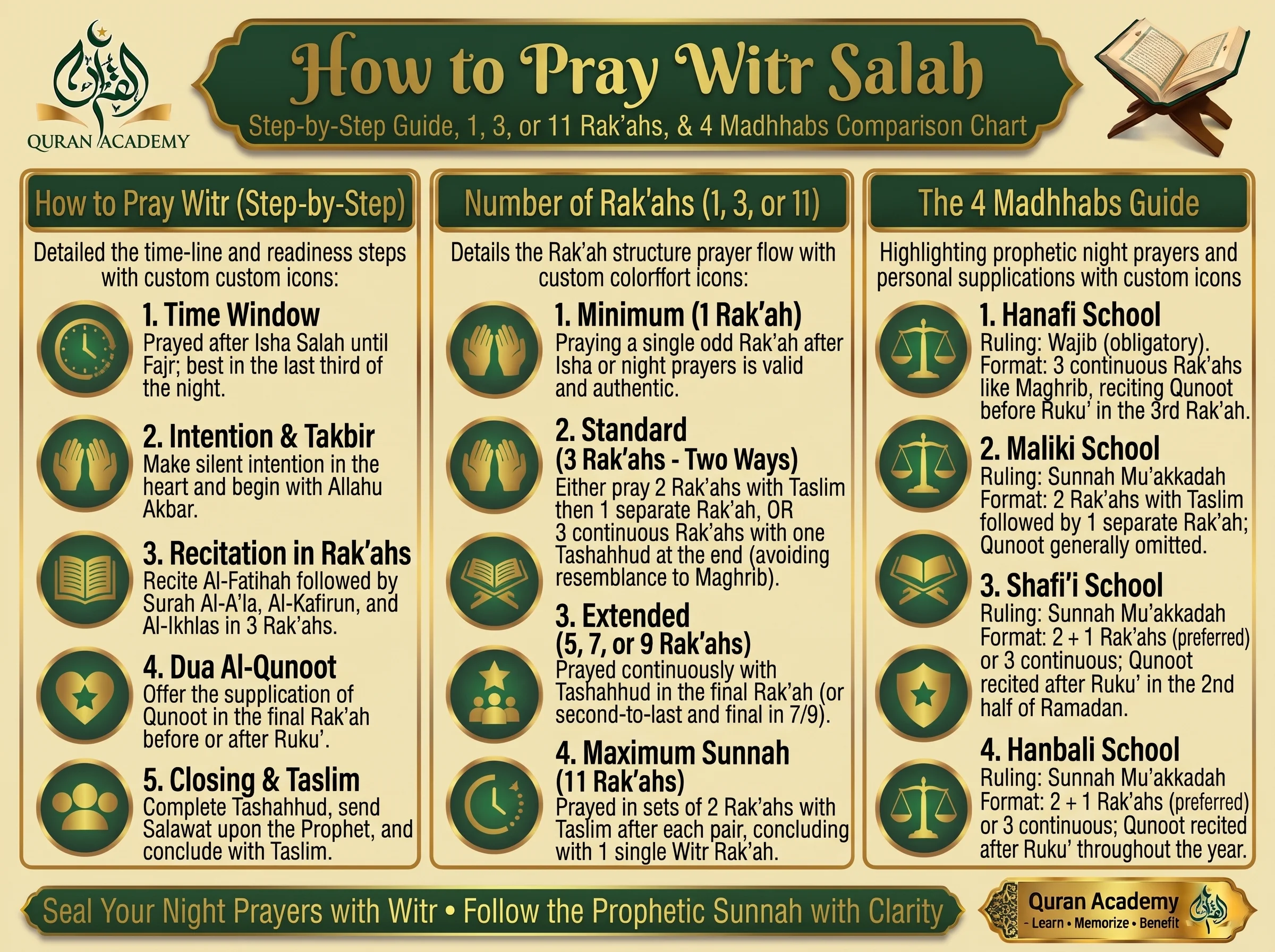
✦ Quick Answer & Key Takeaways: How to Pray Witr Salah Step by Step
Mastering how to pray Witr salah step by step (صَلَاةُ الْوِتْرِ) gives your daily worship its Prophetic final seal—for Prophet Muhammad (ﷺ) declared in Sahih al-Bukhari (998) and Sahih Muslim (751): « اجْعَلُوا آخِرَ صَلَاتِكُمْ بِاللَّيْلِ وِتْرًا » ("Make the very last of your prayers at night odd-numbered [Witr]!") and never omitted Witr whether at home or while traveling! Prayed anytime between completing the obligatory Isha prayer and the break of Fajr dawn, Salat Al-Witr can be performed as 1, 3, 5, 7, 9, or 11 Rak'ahs—with 3 Rak'ahs being the most widespread daily habit. In our 1-on-1 Online Islamic Studies & Fiqh Course, adults and children master the 3 authentic ways to pray 3 Rak'ahs of Witr across the four Sunni schools alongside its 3 Sunnah Surahs!
- Why "Al-Witr" (الْوِتْر — The Odd Number)? In Sunan Abu Dawud (1416), the Prophet (ﷺ) said: "Indeed, Allah is Witr (One/Odd), and He loves Al-Witr—so pray Witr, O people of the Quran!"
- The 3 Ways to Pray 3 Rak'ahs: (1) 2 Rak'ahs + Salam, then 1 Rak'ah + Salam (preferred in Maliki, Shafi'i & Hanbali), (2) 3 continuous Rak'ahs with only 1 Tashahhud at the end, or (3) 3 Rak'ahs with 2 Tashahhuds & Surah + Qunoot in the 3rd (Hanafi school).
- The 3 Sunnah Surahs of Witr (An-Nasa'i 1733): Recite Surah Al-A'la (87) in Rak'ah 1, Surah Al-Kafirun (109) in Rak'ah 2, and Surah Al-Ikhlas (112) in Rak'ah 3!
- The Post-Witr Tasbeeh (3x): Immediately after Salam, say سُبْحَانَ الْمَلِكِ الْقُدُّوسِ (Subhaanal-Malikil-Quddoos) 3 times, raising your voice on the third!
Every night after Isha prayer—or at the end of Tahajjud and Qiyam Al-Layl before Fajr—millions of Muslims stand on their prayer mats to seal their day with Salat Al-Witr. In FACT, out of all the non-Fard prayers in Islam, there are only two prayers that Prophet Muhammad (ﷺ) never left even once while traveling on a journey: the two Sunnah Rak'ahs of Fajr and Salat Al-Witr (Ibn al-Qayyim in Zad al-Ma'ad)!
Yet when Muslims pray together in mosques across the US, UK, Canada, and Australia—or when beginners try to learn Witr at home—three questions immediately come up: "Can I really pray just 1 single Rak'ah of Witr on a busy night? If I pray 3 Rak'ahs of Witr, why did the Prophet (ﷺ) say 'Do not make Witr resemble the 3 Rak'ahs of Maghrib prayer'? And what should I do if my alarm fails and I accidentally sleep through Witr until after Fajr?" Complementing our detailed guide to Dua Al-Qunoot in Witr Prayer and our Sujood As-Sahw Guide, this complete guide breaks down the ruling and timing of Witr, all odd-numbered Rak'ah options (1, 3, 5, 7, 9, and 11), the 3 Authentic Ways to Pray 3 Rak'ahs, the 3 Sunnah Surahs, the post-Witr Adhkar, and how to make up missed Witr.
- 1. Ruling, Virtues & Best Time for Salat Al-Witr (Right After Isha vs. End of the Night!)
- 2. How Many Rak'ahs Is Witr? (1, 3, 5, 7, 9, or 11 Rak'ahs Explained)
- 3. Master Comparison Chart: The 3 Authentic Ways to Pray 3 Rak'ahs of Witr (4 Madhhabs)
- 4. The 3 Sunnah Surahs of Witr (87, 109 & 112), Post-Witr Tasbeeh & Making Up Missed Witr
- 5. Four Essential Tajweed Rules in Witr Surahs & "Subhaanal-Malikil-Quddoos"
- 6. Frequently Asked Questions (FAQs)
1. Ruling, Virtues & Best Time for Salat Al-Witr (Right After Isha vs. End of the Night!)
When we check the authentic Sunnah collections in our Online Hadith Explorer and our Interactive Tajweed & Islamic Encyclopedia, look at the extraordinary status of Salat Al-Witr:
- 1. Ruling Across the 4 Sunni Schools: In the majority Maliki, Shafi'i, and Hanbali schools, Salat Al-Witr is the strongest confirmed Sunnah (Sunnah Mu'akkadah)—so emphasized that Imam Ahmad ibn Hanbal remarked: "Whoever deliberately abandons Witr is a person of poor character whose testimony should not be accepted!" In the Hanafi school (Imam Abu Hanifah), Witr is classified as Wajib (practically obligatory) based on the Prophet's (ﷺ) command: "O people of the Quran, perform Witr!"
- 2. Better Than Priceless Red Camels (Sunan Abu Dawud 1418): The Prophet (ﷺ) told his Companions: « إِنَّ اللَّهَ زَادَكُمْ صَلَاةً هِيَ خَيْرٌ لَكُمْ مِنْ حُمْرِ النَّعَمِ، أَلَا وَهِيَ الْوِتْرُ » ("Indeed, Allah has added for you a prayer that is better for you than the finest red camels [the most prized wealth of the Arabs]—and it is Al-Witr, which He placed for you between Isha prayer and the break of Fajr dawn!").
- 3. Should You Pray Witr Right After Isha or Delay It Until Before Fajr? (Sahih Muslim 755):
Jabir ibn 'Abdillah (may Allah be pleased with him) reported that the Messenger of Allah (ﷺ) gave us this golden rule:
• If you fear that you will NOT wake up at the end of the night: Pray Witr in the first part of the night (right after Isha and its 2 Sunnah Rak'ahs, before going to bed)!
• If you are confident that you WILL wake up at the end of the night for Tahajjud: Delay Witr until the end of the night—"for indeed prayer at the end of the night is witnessed by the angels (Mash-hoodah), and that is superior!"
2. How Many Rak'ahs Is Witr? (1, 3, 5, 7, 9, or 11 Rak'ahs Explained)
In the Sunnah (Sunan Abu Dawud 1422 & Sahih Muslim 736), the Prophet (ﷺ) taught that Witr can be prayed with any odd number of Rak'ahs from 1 to 11:
- 1 Rak'ah (The Valid Minimum in Shafi'i & Hanbali Schools): In Sahih Muslim (752) and Abu Dawud (1422), the Prophet (ﷺ) said: "Whoever wishes to pray Witr with one Rak'ah, let him do so." *(Note: In the Hanafi and Maliki schools, Witr is not less than 3 Rak'ahs, so praying 3 Rak'ahs fulfills the agreement of all four schools!).*
- 3 Rak'ahs (The Minimum of Perfection & Daily Standard): Prayed by millions of Muslims every night after Isha (using one of the 3 methods in the table below!).
- 5, 7, 9, or 11 Rak'ahs (Combining Tahajjud + Witr): You can either pray 2 Rak'ahs at a time (2+2+2+2 = 8 Rak'ahs) and seal with 3 or 1 Rak'ah of Witr (totaling 11 or 9 Rak'ahs), OR pray 5 or 7 continuous Rak'ahs sitting only in the very last Rak'ah for Tashahhud and Salam (Sahih Muslim 737)!
3. Master Comparison Chart: The 3 Authentic Ways to Pray 3 Rak'ahs of Witr
In an authentic Hadith in Sahih Ibn Hibban (2429) and Al-Hakim (1/304 — graded Sahih upon the conditions of Bukhari and Muslim), the Prophet (ﷺ) instructed: « لَا تُوتِرُوا بِثَلَاثٍ تُشَبِّهُوا بِصَلَاةِ الْمَغْرِبِ » ("Do not pray 3 Rak'ahs of Witr in a way that makes it identical to Maghrib prayer!"). How did the four Sunni schools distinguish 3 Rak'ahs of Witr from Maghrib prayer? Through three authentic methods—all of which are valid:
| Method Name & Schools | Step-by-Step Execution of the 3 Rak'ahs | How It Differs From Maghrib Prayer |
|---|---|---|
| Method 1: Separated (2 + 1) (Al-Fasl • Preferred in Maliki, Shafi'i & Hanbali) ⭐ |
1. Pray 2 Rak'ahs (reciting Al-Fatihah + Surah Al-A'la in Rak'ah 1, and Al-Fatihah + Surah Al-Kafirun in Rak'ah 2), sit for Tashahhud, and give Salam. 2. Stand up immediately and pray 1 separate Rak'ah (reciting Al-Fatihah + Surah Al-Ikhlas), perform Dua Al-Qunoot after Ruku', sit for Tashahhud, and give Salam! |
Differs from Maghrib because you break the 3 Rak'ahs into two separate prayers (2 Rak'ahs + 1 Rak'ah) with two Salams (as practiced by Ibn 'Umar RA in Sahih al-Bukhari 991)! |
| Method 2: Continuous With 1 Tashahhud (3 in a Row) (Al-Wasl • Shafi'i & Hanbali) |
1. Pray all 3 Rak'ahs continuously without sitting in the 2nd Rak'ah at all! 2. After finishing the 2nd Sujood of Rak'ah 2, stand straight up for Rak'ah 3. 3. Sit for Tashahhud only once at the very end of the 3rd Rak'ah and give Salam! |
Differs from Maghrib because Maghrib has 2 Tashahhuds (sitting in Rak'ah 2 and Rak'ah 3), whereas this method has only 1 Tashahhud at the end (An-Nasa'i 1700 — Sahih)! |
| Method 3: The Hanafi Method (3 Continuous With 2 Tashahhuds + Extra Takbeer & Qunoot) 🏆 |
1. Pray Rak'ah 1 and Rak'ah 2, sit after Rak'ah 2 for the first Tashahhud (At-Tahiyyat only, no Salam), and stand for Rak'ah 3. 2. In Rak'ah 3, recite Al-Fatihah + a Surah (unlike Maghrib!), raise both hands to the ears saying an extra "Allahu Akbar," fold hands and recite Dua Al-Qunoot before Ruku', then complete Ruku', Sujood, final Tashahhud, and Salam! |
Differs from Maghrib in 3 ways: (1) You recite a Surah after Al-Fatihah in the 3rd Rak'ah, (2) You raise your hands for an extra Takbeer in the 3rd Rak'ah, and (3) You recite Dua Al-Qunoot before Ruku'! |
4. The 3 Sunnah Surahs of Witr, Post-Witr Tasbeeh & Making Up Missed Witr
Open our Online Uthmani Quran Explorer and look at the three chapters from our Juz Amma Schedule and 10 Shortest Surahs Guide that the Prophet (ﷺ) consistently recited in the 3 Rak'ahs of Witr (Sunan an-Nasa'i 1733 & Abu Dawud 1423):
- 1. The 3 Sunnah Surahs of Witr (Why These 3 Together?):
• 1st Rak'ah — Surah Al-A'la (سَبِّحِ ٱسْمَ رَبِّكَ ٱلْأَعْلَىٰ — Chapter 87): Glorifies the Most High Creator, reminds us of the Quran ("We will make you recite so you will not forget"), and contrasts the fleeting life of this world with the everlasting Hereafter!
• 2nd Rak'ah — Surah Al-Kafirun (قُلْ يَا أَيُّهَا ٱلْكَافِرُونَ — Chapter 109): Disavows all forms of polytheism and devotes worship exclusively to Allah!
• 3rd Rak'ah — Surah Al-Ikhlas (قُلْ هُوَ ٱللَّهُ أَحَدٌ — Chapter 112): Seals your night with pure monotheism (Tawheed al-'Ilmi)—and in some narrations, combining Al-Ikhlas, Al-Falaq, and An-Nas in the 3rd Rak'ah! - 2. The Post-Witr Tasbeeh Immediately After Salam (An-Nasa'i 1733):
As soon as you give the final Salam from Witr, say 3 times:
« سُبْحَانَ ٱلْمَلِكِ ٱلْقُدُّوسِ » (Subhaanal-Malikil-Quddoos — 3x)
—raising and stretching your voice on the third time (and you may add once: رَبِّ ٱلْمَلَائِكَةِ وَٱلرُّوحِ — Rabbil-malaa'ikati war-Rooh), echoing the first two Royal Names from our Last 3 Verses of Surah Al-Hashr (59:23: Al-Malikul-Quddoos)! Followed by: ٱللَّهُمَّ إِنِّي أَعُوذُ بِرِضَاكَ مِنْ سَخَطِكَ، وَبِمُعَافَاتِكَ مِنْ عُقُوبَتِكَ... (Sunan Abu Dawud 1427 — Sahih). - 3. How to Make Up Missed Witr If You Overslept Until Morning (Sahih Muslim 746):
What if you intended to wake up for Tahajjud and Witr, but slept through your alarm until Fajr entered?
• In the Majority Schools (Following 'Aishah's RA Narration in Sahih Muslim 746): Pray it during the forenoon (Duha time, after the sun has risen a spear's length above the horizon) as an EVEN number of Rak'ahs—adding 1 Rak'ah to your usual nightly habit! So if you normally pray 1 Rak'ah of Witr, pray 2 Rak'ahs in the morning; if you normally pray 3 Rak'ahs of Witr, pray 4 Rak'ahs (2 Rak'ahs + Salam, then 2 Rak'ahs + Salam)!
• In the Hanafi School: Because Witr is considered Wajib, you make up (Qada) the exact 3 Rak'ahs of Witr with Qunoot whenever you remember it (outside the 3 prohibited sunrise/zenith/sunset moments)!
Mastering the Crisp Qalqalah in "Subْhaanal-Malikil-Quddoos" & Surah Al-Ikhlas!
When you finish the 3rd Rak'ah of Witr with Surah Al-Ikhlas (where every verse ends on a Dal Sakinah: أَحَدْ، ٱلصَّمَدْ، يَلِدْ، يُولَدْ) and then say سُبْحَانَ ٱلْمَلِكِ ٱلْقُدُّوسِ (Subْhaanal-Malikil-Quddoos) 3 times, notice the mid-word Qalqalah Sughra on the Baa Sakinah (بْ) in "Subْhaana"! Watch Senior Instructor Ustadhah Yasmeen Gamal demonstrate Qalqalah on our Quran Academy YouTube Channel:
Struggling to perfect your Recitation?
Join hundreds of students mastering the Quran with our Verified Al-Azhar Graduates. We offer flexible 1-on-1 sessions tailored to your schedule.
Book a Free Evaluation Class →- No "P" Sound in "Subْhaana": Keep the Baa voiced and gently echoed before the throat Haa'!
- 1-on-1 Live Coaching: Perfect your Witr Surahs and Tajweed with Al-Azhar scholars!
5. Four Essential Tajweed Rules in Witr Surahs & "Subhaanal-Malikil-Quddoos"
Before you stand to pray your 3 Rak'ahs of Witr tonight, check your recitation against these four Tajweed rules from our 1-on-1 Online Tajweed Course:
- 1. Dropping Hamzatul Wasl in "Sabbihi-sma Rabbikal-A'laa" (Surah Al-A'la 87:1 — Rak'ah 1):
As we mastered in our Hamzatul Wasl & Hamzatul Qat' Guide (where ٱسْمَ is one of the 7 standard nouns!), when connecting the command verb سَبِّحِ (Sabbihi) to ٱسْمَ, the Hamzatul Wasl drops completely—so you jump straight from the Kasrah on the Haa' to the silent Seen: Sabbihi-sma Rabbikal-A'laa (NEVER "Sabbih-isma" with a Hamzah ❌)! - 2. Dropping the Alif of "Ana" (أَنَا۠) in Surah Al-Kafirun (109:4 — Rak'ah 2):
Applying our 7 Alifs in the Quran (Oval Zero Rule) Guide, remember that in وَلَا أَنَا۠ عَابِدٌ, the Alif of Ana carries the tall oval zero (۠)—so drop the Alif completely when continuing (Wa laa ana 'aabidun)! - 3. Two Moon Laams + Shaddah on the Dal in "Subhaanal-Malikil-Quddoos":
Using our Laam Shamsiyyah & Laam Qamariyyah Guide and Rules of Madd Guide, both ٱلْمَلِكِ (Al-Maliki) and ٱلْقُدُّوسِ (Al-Quddoos) begin with a clearly pronounced Moon Laam (لْ); press the Shaddah firmly on the voiced Dal (دُّ), stretch the Madd Waw for 2, 4, or 6 beats on stop, and finish with a soft whistle (Safeer) on the silent Seen (Al-Quddoooosْ)! - 4. Whispered Hams on the Taa Sakinah in "Al-Witr" & Light Raa in "Yassir" (87:8):
According to our Ahkam Al-Raa Guide, Makharij al-Huruf, Sifaat al-Huruf, Heavy & Light Letters, Noon Sakinah Rules, Meem Sakinah Rules, Rules of Waqf, and 4 Special Words of Hafs, in Surah Al-A'la, keep the Raa in وَنُيَسِّرُكَ لِلْيُسْرَىٰ (Wa nuyassiruka lil-yusraa) and فَذَكِّرْ (Fadhakkirْ) accurate to its vowel—with Fadhakkirْ having a 100% Light Raa because of the Kasrah on the Kaaf! Test your Tajweed accuracy right now on our Free 3-Minute Tajweed Quiz!
Pair your nightly Salat Al-Witr with our complete family library of Salah, Adhkar, and Surah guides: Bedtime & Waking Up Duas, Authentic Duas After Fard Salah, Prophetic Duas for Anxiety & Debt Relief, Authentic Ruqyah Shariah, Morning & Evening Adhkar, 40 Rabbana Duas, Surah Al-Fatihah Guide, Surah Qaf 6-Day Plan, Surah Al-Alaq Guide, Ayatul Kursi, Last 2 Verses of Surah Al-Baqarah, Surah Ad-Duha & Ash-Sharh, Surah Ya-Sin, Surah Ar-Rahman, Surah Al-Waqi'ah, Surah Al-Mulk, Surah Maryam, Surah Yusuf, Surah Luqman, Surah Al-Hujurat, Salat Al-Istikharah, Salat Al-Janazah, Wudu & Tayammum, 5 Pillars of Islam, and 25 Prophets in the Quran in our Online Hifz Program (using our Smart Hifz Planner)! Whether you are learning with our Al-Azhar Certified Tutors or enrolling your child in our 1-on-1 Kids Quran Classes, see how families across the US, UK, Canada, and Australia rate our teachers on our Verified Student & Parent Reviews Page.
6. Frequently Asked Questions (FAQs) About How to Pray Salat Al-Witr
1. What are the 3 valid ways to pray 3 Rak'ahs of Salat Al-Witr?
Across the four Sunni schools, there are 3 valid ways to pray 3 Rak'ahs of Witr: (1) The Separated Method (Al-Fasl — preferred in the Maliki, Shafi'i, and Hanbali schools): pray 2 Rak'ahs and give Salam, then stand and pray 1 separate Rak'ah with Salam; (2) The 3 Continuous Rak'ahs with 1 Final Tashahhud (Al-Wasl — permissible in the Shafi'i and Hanbali schools so it does not resemble Maghrib); and (3) The Hanafi Method: pray 3 continuous Rak'ahs with a middle sitting (Tashahhud) in the 2nd Rak'ah without Salam, then stand for the 3rd Rak'ah, recite Fatiha + a Surah, raise hands for Takbeer and Qunoot before Ruku', and finish.
2. Which 3 Surahs did Prophet Muhammad (ﷺ) recite in the 3 Rak'ahs of Witr?
According to authentic narrations in Sunan an-Nasa'i (1733) and Sunan Abu Dawud (1423), when praying 3 Rak'ahs of Witr, Prophet Muhammad (ﷺ) consistently recited after Surah Al-Fatihah: (1) Surah Al-A'la (Chapter 87) in the 1st Rak'ah, (2) Surah Al-Kafirun (Chapter 109) in the 2nd Rak'ah, and (3) Surah Al-Ikhlas (Chapter 112 — sometimes adding Al-Falaq and An-Nas) in the 3rd Rak'ah.
3. Is Salat Al-Witr obligatory (Wajib) or a confirmed Sunnah (Sunnah Mu'akkadah)?
In the Maliki, Shafi'i, and Hanbali schools (the majority Jumhur), Salat Al-Witr is the single strongest confirmed Sunnah (Sunnah Mu'akkadah) in Islam—never abandoned by the Prophet (ﷺ) whether resident or traveling. In the Hanafi school (Imam Abu Hanifah), Witr is classified as Wajib (practically necessary, just below Fard).
4. What is the authentic Dhikr to say immediately after finishing Salat Al-Witr?
Recorded in Sunan an-Nasa'i (1733) and Sunan Abu Dawud (1430 — Sahih), immediately after giving Salam from Witr, the Prophet (ﷺ) used to say 3 times: "Subhaanal-Malikil-Quddoos" (Glory be to the Sovereign, the Most Pure/Holy), raising and extending his voice on the third time (and adding in Daraqutni: "Rabbil-malaa'ikati war-Rooh").
5. How do you make up Salat Al-Witr if you accidentally slept through it until morning?
According to Sahih Muslim (746) from Mother of the Believers 'Aishah (RA), if a person sleeps through Witr or forgets it until Fajr has entered, they may pray it during the forenoon (Duha time, after sunrise) as an EVEN number of Rak'ahs (adding 1 Rak'ah to their usual odd habit: e.g., praying 4 Rak'ahs if they normally pray 3, or 12 Rak'ahs if they normally pray 11)—or in the Hanafi school, making up the 3 Rak'ahs of Witr as Qada.
Seal Every Night With Authentic Witr & Quran Recitation!
Master Surah Al-A'la, Dua Al-Qunoot, and everyday Salah Fiqh in private 1-on-1 classes with certified male and female Al-Azhar scholars. Book your free diagnostic trial session today!
Book Your Free 1-on-1 Trial Class →