
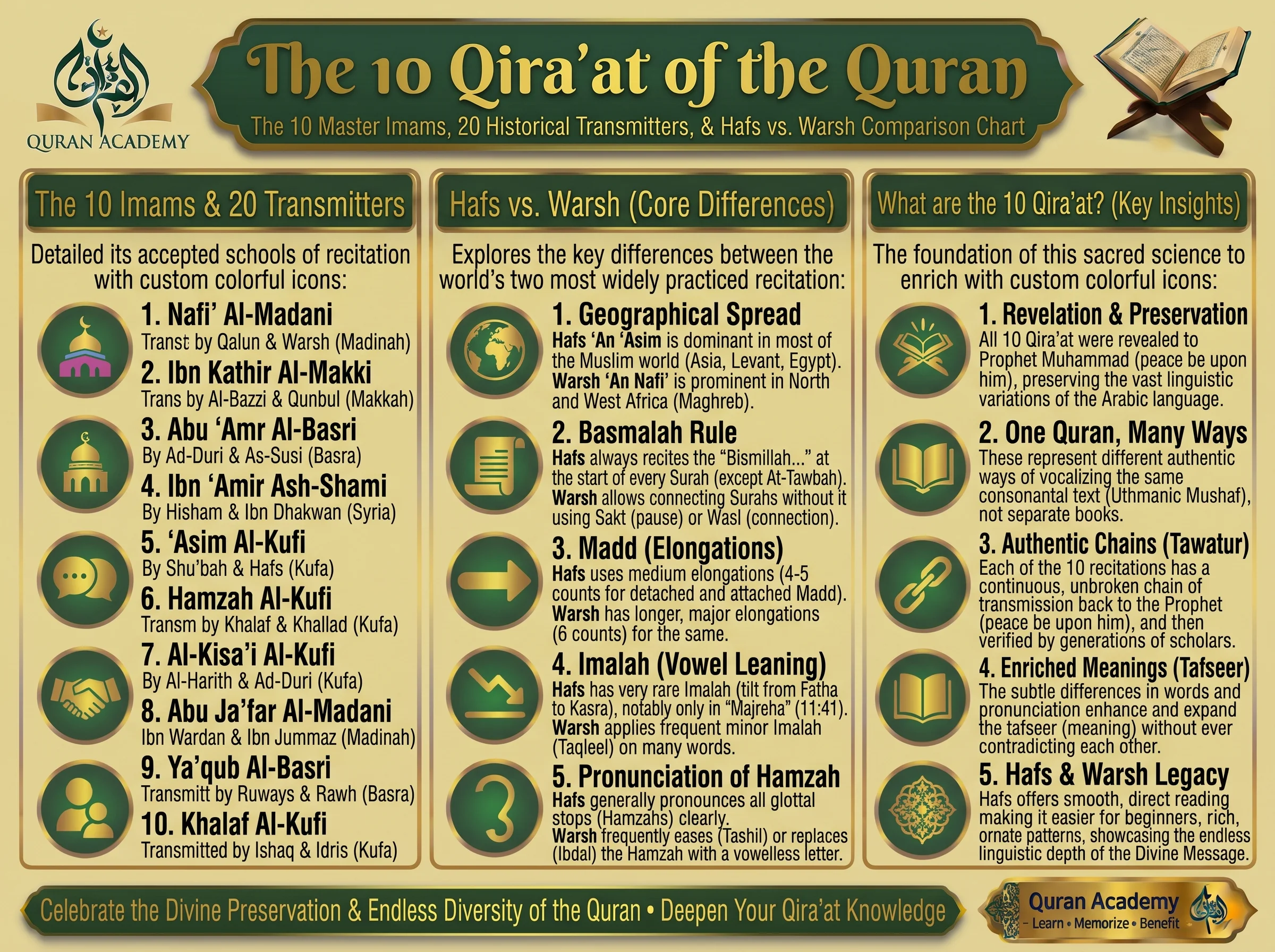
✦ Quick Answer & Key Takeaways: The 10 Qira'at of the Quran Explained
Understanding the 10 Qiraat of the Quran (الْقِرَاءَاتُ الْعَشْرُ الْمُتَوَاتِرَةُ) unveils the miraculous oral preservation of Allah's Book across 1,400 years! There is only one single Quran—revealed to Prophet Muhammad (ﷺ) in Seven Ahruf (Seven Modes — Sahih al-Bukhari 4992) to facilitate recitation for the diverse Arab tribes, and standardized in its skeletal script during the Caliphate of 'Uthman ibn 'Affan (may Allah be pleased with him). The 10 Mutawatir Qira'at are the ten mass-transmitted, 100% authentic methods of pronouncing that exact Uthmani text—named after 10 renowned Imams of recitation (7 compiled in Ash-Shatibiyyah + 3 compiled in Ad-Durrah), each represented by 2 primary transmitters (Rawis = 20 Riwayat total). In our 1-on-1 Online Tajweed & Ten Qira'at Ijazah Program, Al-Azhar scholars guide students from mastering Hafs 'an 'Asim to earning Sanad certification across the Qira'at!
- Did the 10 Imams Invent Their Qira'at? NEVER! Every single recitation was taught directly by Prophet Muhammad (ﷺ) to his Companions; the 10 Imams are simply the famous scholars who dedicated their lives to teaching and transmitting that specific Prophetic chain!
- Qira'ah vs. Riwayah vs. Tareeq: Qira'ah = the Imam (e.g., 'Asim); Riwayah = his student transmitter (e.g., Hafs or Shu'bah); Tareeq = the route of transmission (e.g., Ash-Shatibiyyah vs. At-Tayyibah).
- Why Hafs Is Recited by 95% of Muslims: Because of its direct Kufan chain to 'Ali ibn Abi Talib (RA), its natural phonetic ease, and the global printing of the Cairo and Madinah Mushafs.
- Complementary Meaning (Maaliki vs. Maliki in 1:4): Combining Maaliki (Owner) and Maliki (King) in Surah Al-Fatihah enriches Tafseer without a single contradiction!
Imagine visiting a mosque in Morocco, Algeria, or West Africa and listening to the Imam lead Maghrib prayer: in Surah Al-Fatihah (Verse 4), instead of reciting مَالِكِ يَوْمِ ٱلدِّينِ (Maaliki yawmid-deen) with a 2-count Alif, he recites مَلِكِ يَوْمِ ٱلدِّينِ (Maliki yawmid-deen)—and when he reaches a word like مُؤْمِنُونَ, he softens the Hamzah into a pure Waw (مُومِنُونَ = Moominoon)! If you have only ever heard the narration of Hafs 'an 'Asim, you might wonder: "Why is he reciting differently? And what are Warsh, Qalun, Shu'bah, and Ad-Duri?"
That exact question happened during the lifetime of Prophet Muhammad (ﷺ) himself! In a famous Hadith in Sahih al-Bukhari (2419 & 4992), 'Umar ibn Al-Khattab (may Allah be pleased with him) heard Hisham ibn Hakim (RA) reciting Surah Al-Furqan in prayer with recitational modes that 'Umar had not yet heard. When they brought the matter before the Messenger of Allah (ﷺ), the Prophet (ﷺ) listened to Hisham and declared: « كَذَٰلِكَ أُنْزِلَتْ » ("Thus was it revealed!"), then listened to 'Umar and declared: « كَذَٰلِكَ أُنْزِلَتْ، إِنَّ هَٰذَا الْقُرْآنَ أُنْزِلَ عَلَىٰ سَبْعَةِ أَحْرُفٍ، فَاقْرَءُوا مَا تَيَسَّرَ مِنْهُ » ("Thus was it revealed! Indeed, this Quran was revealed upon Seven Ahruf [modes], so recite whichever of it is easy for you!"). Building upon our guides to What Happens During an Online Quran Ijazah Exam and The 4 Special Words of Hafs 'an 'Asim, this complete guide explains the 7 Ahruf vs. 10 Qira'at, the 3 Conditions of an Authentic Qira'ah, the Master Directory of the 10 Imams & 20 Rawis, and why Hafs 'an 'Asim became the global standard.
- 1. What Is the Difference Between the 7 Ahruf (Seven Modes) & The 10 Qira'at?
- 2. The 3 Golden Pillars of an Authentic Qira'ah (Imam Ibn al-Jazari's Rule)
- 3. Master Directory: The 10 Imams of Qira'at, Their Cities & Their 20 Transmitters (Rawis)
- 4. Why 95% of Muslims Recite Hafs 'an 'Asim + 5 Real Examples of Hafs vs. Warsh & Shu'bah
- 5. Four Fascinating Tajweed Rules That Differ Between Hafs and Other Qira'at
- 6. Frequently Asked Questions (FAQs)
1. What Is the Difference Between the 7 Ahruf (Seven Modes) & The 10 Qira'at?
One of the most common misconceptions among beginners is thinking that the "7 Ahruf" mentioned in the Hadith are the same thing as the "7 Qira'at" or "10 Qira'at"! As we explain in our Interactive Tajweed & Islamic Encyclopedia and our Online Hadith Explorer, here is the historical progression from the 7 Ahruf to the 10 Qira'at in three clear stages:
- Stage 1 — Revelation of the 7 Ahruf (الأحرف السبعة — Sahih Muslim 820):
When Islam spread across the Arabian Peninsula, different Arab tribes had distinct phonetic habits (some pronounced every Hamzah sharply like Quraysh and Tamim; others softened Hamzahs, tilted vowels with Imalah, or elongated plural Meems). Out of mercy for elderly men, women, and children who had never read a book, Angel Jibreel (AS) brought down the Quran in up to 7 divinely revealed linguistic and phonetic modes (7 Ahruf)! - Stage 2 — The Final Review (Al-'Ardah Al-Akheerah) & The Uthmani Mushafs (Sahih al-Bukhari 4987):
In the final Ramadan of the Prophet's (ﷺ) life, Angel Jibreel (AS) reviewed the entire Quran with him twice. Later, during the Caliphate of 'Uthman ibn 'Affan (RA), a committee led by Zayd ibn Thabit (RA) wrote the official master copies of the Uthmani Mushaf without dots or vowel marks so that the skeletal Arabic script (Ar-Rasm Al-'Uthmani) could accommodate every authentic prophetic recitation confirmed in that Final Review (for example, writing ملـك without an Alif so it accommodates both مَٰلِكِ = Maaliki and مَلِكِ = Maliki, and writing فتبينوا without dots so it accommodates both فَتَبَيَّنُوا = verify and فَتَثَبَّتُوا = confirm in Surah Al-Hujurat 49:6!)—and 'Uthman (RA) sent each master Mushaf to a major Islamic capital (Madinah, Makkah, Kufah, Basrah, and Damascus) alongside a Companion/scholar to teach its exact oral recitation! - Stage 3 — Codification of the 7 + 3 = 10 Mutawatir Qira'at:
In the 2nd and 3rd centuries AH, across those five cities (Madinah, Makkah, Kufah, Basrah, and Damascus), 10 towering Imams became famous for their precision and lifelong devotion to teaching the exact Prophetic chains they inherited from the Companions. Later, Imam Abu Bakr Ibn Mujahid (d. 324 AH) selected 7 of them in his book As-Sab'ah (versified by Imam Ash-Shatibi in Ash-Shatibiyyah), and Imam Ibn al-Jazari (d. 833 AH) confirmed the remaining 3 Mutawatir Imams in Ad-Durrah Al-Mudiyyah and Tayyibat An-Nashr—completing the 10 Mutawatir Qira'at!
2. The 3 Golden Pillars of an Authentic Qira'ah (Imam Ibn al-Jazari's Rule)
How did classical scholars distinguish the 10 Mutawatir Qira'at from irregular/non-canonical narrations (Al-Qira'at Ash-Shadhdhah, which may be cited for Tafseer or Arabic grammar but cannot be recited as Quran in Salah)? In two famous lines of poetry in Tayyibat an-Nashr, Imam Ibn al-Jazari stated the 3 mandatory conditions:
It must be transmitted through an unbroken, mass-transmitted oral chain (Tawatur) from generation to generation directly from Prophet Muhammad (ﷺ)!
It must match the consonantal skeletal script of at least one of the official Mushafs sent out by Caliph 'Uthman ibn 'Affan (RA), either explicitly or implicitly!
It must conform to an established rule or face of eloquent classical Quranic Arabic grammar!
3. Master Directory: The 10 Imams of Qira'at, Their Cities & Their 20 Transmitters
Here is the complete reference chart of all 10 Canonical Readers (الْقُرَّاءُ الْعَشَرَةُ), the Islamic capital where each taught, and their 20 primary student transmitters (الرُّوَاةُ الْعِشْرُونَ):
| # & Imam (The Qari') | City & Companion Source | Rawi #1 (1st Transmitter) | Rawi #2 (2nd Transmitter) |
|---|---|---|---|
| PART A: THE 7 READERS OF ASH-SHATIBIYYAH (حِرْزُ الْأَمَانِي لِلْإِمَامِ الشَّاطِبِيِّ) | |||
| 1. Imam Nafi' Al-Madani (نَافِعٌ الْمَدَنِيُّ • d. 169 AH) |
Madinah (Ubayy ibn Ka'b, Ibn 'Abbas & Abu Hurayrah RA) |
Qalun (قَالُونُ) (Recited in Libya & Tunisia) |
Warsh (وَرْشٌ) (Morocco, Algeria & West Africa) |
| 2. Imam Ibn Kathir Al-Makki (ابْنُ كَثِيرٍ الْمَكِّيُّ • d. 120 AH) |
Makkah (Ibn 'Abbas & Ubayy ibn Ka'b RA) |
Al-Bazzi (الْبَزِّيُّ) | Qunbul (قُنْبُلٌ) |
| 3. Imam Abu 'Amr Al-Basri (أَبُو عَمْرٍو الْبَصْرِيُّ • d. 154 AH) |
Basrah (Iraq) (Anas, Ibn 'Abbas & Ubayy RA) |
Ad-Duri (الدُّورِيُّ) (Sudan & parts of East Africa) |
As-Susi (السُّوسِيُّ) |
| 4. Imam Ibn 'Amir Ash-Shami (ابْنُ عَامِرٍ الشَّامِيُّ • d. 118 AH) |
Damascus (Syria) (Abu Ad-Darda' & 'Uthman RA) |
Hisham (هِشَامٌ) | Ibn Dhakwan (ابْنُ ذَكْوَانَ) |
| 5. Imam 'Asim Al-Kufi 🏆 (عَاصِمٌ الْكُوفِيُّ • d. 127 AH) |
Kufah (Iraq) ('Ali ibn Abi Talib & Ibn Mas'ud RA) |
Shu'bah (شُعْبَةُ) (99% identical to Hafs!) |
Hafs (حَفْصٌ) ⭐ (Recited by 95% of Muslims worldwide!) |
| 6. Imam Hamzah Al-Kufi (حَمْزَةُ الزَّيَّاتُ • d. 156 AH) |
Kufah (Iraq) (Ibn Mas'ud & 'Ali RA) |
Khalaf (خَلَفٌ) | Khallad (خَلَّادٌ) |
| 7. Imam Al-Kisa'i Al-Kufi (الْكِسَائِيُّ الْكُوفِيُّ • d. 189 AH) |
Kufah (Iraq) (Studied under Hamzah) |
Abu Al-Harith (أَبُو الْحَارِثِ) | Ad-Duri 'an Al-Kisa'i (الدُّورِيُّ) |
| PART B: THE 3 COMPLEMENTARY READERS OF AD-DURRAH (الدُّرَّةُ الْمُضِيَّةُ لِابْنِ الْجَزَرِيِّ) | |||
| 8. Imam Abu Ja'far Al-Madani (أَبُو جَعْفَرٍ الْمَدَنِيُّ • d. 130 AH) |
Madinah (Teacher of Imam Nafi'!) |
Ibn Wardan (ابْنُ وَرْدَانَ) | Ibn Jammaz (ابْنُ جَمَّازٍ) |
| 9. Imam Ya'qub Al-Hadrami (يَعْقُوبُ الْحَضْرَمِيُّ • d. 205 AH) |
Basrah (Iraq) (Imam of the Basrah Mosque) |
Ruways (رُوَيْسٌ) | Rawh (رَوْحٌ) |
| 10. Imam Khalaf Al-'Ashir (خَلَفٌ الْعَاشِرُ • d. 229 AH) |
Kufah / Baghdad (Also Rawi #1 of Hamzah!) |
Ishaq (إِسْحَاقٌ) | Idris (إِدْرِيسُ) |
4. Why 95% of Muslims Recite Hafs 'an 'Asim + 5 Real Examples of Hafs vs. Warsh & Shu'bah
Why did the narration of Imam Hafs ibn Sulayman (90–180 AH) from his stepfather and teacher Imam 'Asim ibn Abi an-Najud Al-Kufi become the primary recitation of 95% of the Muslim world today? Look at the 4 reasons:
Struggling to perfect your Recitation?
Join hundreds of students mastering the Quran with our Verified Al-Azhar Graduates. We offer flexible 1-on-1 sessions tailored to your schedule.
Book a Free Evaluation Class →- 1. Direct Sanad to 'Ali ibn Abi Talib (RA): Imam 'Asim learned directly from Abu 'Abdir-Rahman As-Sulami, who learned directly from Caliph 'Ali ibn Abi Talib, 'Uthman ibn 'Affan, and Zayd ibn Thabit (may Allah be pleased with them)—so 'Asim told his stepson Hafs: "The recitation I taught you is the exact recitation I learned from Abu 'Abdir-Rahman As-Sulami from 'Ali ibn Abi Talib (RA)!"
- 2. Phonetic Clarity & Simplicity: Unlike recitations that apply frequent Imalah, Naql, or 6-beat Madd Badal, Hafs 'an 'Asim pronounces every Hamzah clearly and has only 4 special rules in the entire Mushaf—making it the easiest starting point for non-native speakers and children!
- 3. The 1924 Cairo Royal Mushaf & Madinah Printing Complex: When Al-Azhar scholars under Shaykh Muhammad 'Ali Khalaf Al-Husayni produced the landmark 1924 Cairo Mushaf (and later the King Fahd Complex in Madinah printed hundreds of millions of copies worldwide), they selected Hafs 'an 'Asim as the primary edition (while also printing dedicated Mushafs for Warsh, Qalun, and Ad-Duri!).
- 4. How Complementary Qira'at Enrich Quranic Tafseer (5 Famous Examples):
Open our Online Uthmani Quran Explorer and see how twoMutawatir Qira'at act like two verses in one:
• Surah Al-Fatihah (1:4): مَالِكِ (Maaliki — Owner) in Hafs & Al-Kisa'i + مَلِكِ (Maliki — King) in Warsh, Qalun & the rest = Allah is both the Supreme King and Absolute Owner!
• Surah Al-Baqarah (2:10): يَكْذِبُونَ (Yakdhiboon — "because they used to lie") in Hafs + يُكَذِّبُونَ (Yukadhdhiboon — "because they used to deny the truth") in Warsh & Nafi'!
• Surah Al-Ma'idah (5:6 — Wudu Verse): وَأَرْجُلَكُمْ (Wa arjulakum — with Fatha, commanding washing the feet) in Hafs, Nafi', Ibn 'Amir & Al-Kisa'i + وَأَرْجُلِكُمْ (Wa arjulikum — with Kasrah, permitting wiping over leather socks/Khuffayn!) in Ibn Kathir, Abu 'Amr & Shu'bah—as we explained in our Wudu & Wiping Over Socks Guide!
• Surah Al-Hujurat (49:6): فَتَبَيَّنُوا (Fatabayyanoo — verify carefully) in Hafs + فَتَثَبَّتُوا (Fatathabbatoo — confirm patiently) in Hamzah & Al-Kisa'i!
• Surah Al-Masad (111:4): حَمَّالَةَ ٱلْحَطَبِ (Hammaalatal-hatab — with Fatha) in Hafs + حَمَّالَةُ ٱلْحَطَبِ (Hammaalatul-hatab — with Damma) in Warsh & the rest!
What Unites All 10 Qira'at? The 5 Qalqalah Letters (ق ط ب ج د)!
Did you know that while the 10 Qira'at differ in certain Madd lengths, Hamzah rules, and Raa rules (Al-Usool), the core articulation points (Makharij al-Huruf) and intrinsic characteristics like the 5 echoing Qalqalah letters (ق ط ب ج د) are 100% identical across all 10 Qira'at and all 20 Riwayat? Watch Senior Instructor Ustadhah Yasmeen Gamal demonstrate Qalqalah on our Quran Academy YouTube Channel:
- Universal Tajweed Foundation: Master Hafs first, then add Shu'bah, Qalun, and Warsh effortlessly!
- 1-on-1 Live Ijazah Mentorship: Study with Al-Azhar Qira'at specialists!
5. Four Fascinating Tajweed Rules That Differ Between Hafs & Other Qira'at
When a student finishes memorizing in Hafs 'an 'Asim and begins studying Shu'bah 'an 'Asim or Warsh 'an Nafi' with our Al-Azhar Certified Tutors, they discover four fascinating phonetic rules (Al-Usool) that connect directly to our previous Tajweed guides:
- 1. Madd Badal & Madd Muttasil Lengths (Rules of Madd):
As we learned in our Rules of Madd Guide, in Hafs, Madd Badal (آمَنُوا، إِيمَانًا، أُوتُوا) is always 2 beats, and Madd Wajib Muttasil / Ja'iz Munfasil is 4 or 5 beats (via Ash-Shatibiyyah). In Warsh 'an Nafi', Madd Muttasil and Munfasil are stretched for 6 full beats (Ishba'), and Madd Badal can be read with 2, 4, or 6 beats! - 2. Thinning a Fatha/Damma Raa After Kasrah or Yaa in Warsh (Ahkam Al-Raa):
Applying our Ahkam Al-Raa Guide, while Hafs makes any Raa with a Fatha or Damma heavy (such as خَبِيرًا = Khabeeraa or سِرَاجًا = Siraajaa), Warsh 'an Nafi' pronounces a Fatha/Damma Raa Light (Tarqeeq) whenever it is preceded immediately by a Kasrah or Yaa Sakinah in the same word! - 3. Transferring the Vowel of a Hamzah (An-Naql — النَّقْلُ) in Warsh:
Building upon our Hamzatul Wasl & Hamzatul Qat' Guide, in Hafs you pronounce the Hamzah clearly in قَدْ أَفْلَحَ (Qadْ aflaha) and مِنْ آمَنَ (Manْ aamana). In Warsh, the vowel of the Hamzah is transferred onto the silent letter before it and the Hamzah is dropped: قَدَ فْلَحَ (Qada-flaha) and مَنَ امَنَ (Manaa-mana)! - 4. Why You Must Never Mix Two Qira'at Inside a Single Verse (Talfeeq):
Using our 15 Etiquettes of Reading the Quran and Idgham Mutamathilayn, Mutajanisayn & Mutaqaribayn Guide, scholars point out that if you start your prayer or sitting in Hafs 'an 'Asim, you must stick consistently to the rules of Hafs without mixing rules from another Qira'ah inside the same passage! Test your Tajweed accuracy right now on our Free 3-Minute Tajweed Quiz!
Continue your advanced Tajweed and Quranic studies across our interconnected 100+ article library: Sifaat al-Huruf, Heavy & Light Letters, Noon Sakinah Rules, Meem Sakinah Rules, Rules of Waqf, Laam Shamsiyyah & Qamariyyah, 7 Alifs in the Quran, 99 Names of Allah, 30-Day Quran Khatmah Schedule, Traveler's Prayer, Salat Al-Jumu'ah, 12 Sunnah Rawatib, Salat Al-Eid, Salat Ad-Duha, Salat Al-Witr, Tahajjud, Dua Al-Qunoot, Duas for Anxiety & Debt, Bedtime Duas, Post-Prayer Adhkar, Authentic Ruqyah Shariah, Surah Al-Alaq, 10 Shortest Surahs, Surah Qaf, and Last 3 Verses of Surah Al-Hashr in our Online Hifz Program (using our Smart Hifz Planner)! Whether you are preparing for Ijazah or enrolling your child in our 1-on-1 Kids Quran Classes with our Printable Kids Star Chart, see how students worldwide rate our teachers on our Verified Student & Parent Reviews Page.
6. Frequently Asked Questions (FAQs) About the 10 Qira'at of the Quran
1. What is the difference between the 7 Ahruf (Seven Modes) and the 10 Qira'at?
The 7 Ahruf (الأحرف السبعة — Sahih al-Bukhari 4992) were the seven divinely revealed dialectical and phonetic modes granted by Allah to Prophet Muhammad (ﷺ) to make recitation easy for diverse Arab tribes. The 10 Qira'at (القراءات العشر المتواترة) are the 10 mass-transmitted schools of recitation named after the 10 Imams who preserved the authentic recitations that matched the consonantal script of the Uthmani Mushaf!
2. Who are the 10 Imams of the 10 Mutawatir Qira'at and their 20 Rawis (transmitters)?
The 7 Readers of Ash-Shatibiyyah are: (1) Nafi' of Madinah [Qalun & Warsh], (2) Ibn Kathir of Makkah [Al-Bazzi & Qunbul], (3) Abu 'Amr of Basrah [Ad-Duri & As-Susi], (4) Ibn 'Amir of Damascus [Hisham & Ibn Dhakwan], (5) 'Asim of Kufah [Shu'bah & Hafs], (6) Hamzah of Kufah [Khalaf & Khallad], and (7) Al-Kisa'i of Kufah [Abu Al-Harith & Ad-Duri]. The 3 complementary Readers of Ad-Durrah are: (8) Abu Ja'far of Madinah [Ibn Wardan & Ibn Jammaz], (9) Ya'qub of Basrah [Ruways & Rawh], and (10) Khalaf Al-'Ashir of Kufah [Ishaq & Idris].
3. What are the 3 conditions for an authentic Quranic Qira'ah according to Imam Ibn al-Jazari?
In Tayyibat an-Nashr, Imam Ibn al-Jazari stated that every authentic Qira'ah must fulfill 3 pillars: (1) Authentic, unbroken chain of mass transmission (Tawatur / Sahih Sanad) back to the Prophet (ﷺ), (2) Conformity with the consonantal skeletal script of the Uthmani Mushaf (even if implicitly/probabilistically), and (3) Conformity with a valid face of classical Arabic grammar.
4. Why do 95% of Muslims today recite in the narration of Hafs 'an 'Asim?
Hafs 'an 'Asim became the global standard due to 4 historical and phonetic reasons: (1) Its high chain of transmission directly from 'Asim to Abu 'Abdir-Rahman As-Sulami to 'Ali ibn Abi Talib and Ibn Mas'ud (RA), (2) Its natural phonetic ease (having only 1 Imalah, 1 Tashil, and 4 Saktat), (3) Its official adoption by the Abbasid and Ottoman courts, and (4) The 1924 Cairo Royal Mushaf and King Fahd Complex printing millions of copies in Hafs!
5. Do differences between the 10 Qira'at contradict each other in meaning?
Never! Every variation between the 10 Mutawatir Qira'at is a variation of complementary enrichment (Ikhtilaf Tanawwu'), never contradiction—such as reading "Maaliki yawmid-deen" (Owner of the Day of Judgment — Hafs) and "Maliki yawmid-deen" (King of the Day of Judgment — Warsh), which unite to show that Allah is both the Supreme King and the Absolute Owner!
Join the Unbroken Chain of Quranic Transmission!
Whether you want to perfect your daily recitation in Hafs 'an 'Asim or earn an Ijazah with Sanad in Warsh, Qalun, Shu'bah, or the 10 Qira'at, our certified Al-Azhar scholars are ready to guide you. Book your free 1-on-1 evaluation session today!
Book Your Free 1-on-1 Ijazah Trial Class →