
✦ Quick Answer & Key Takeaways: An-Nabr in Tajweed Rules
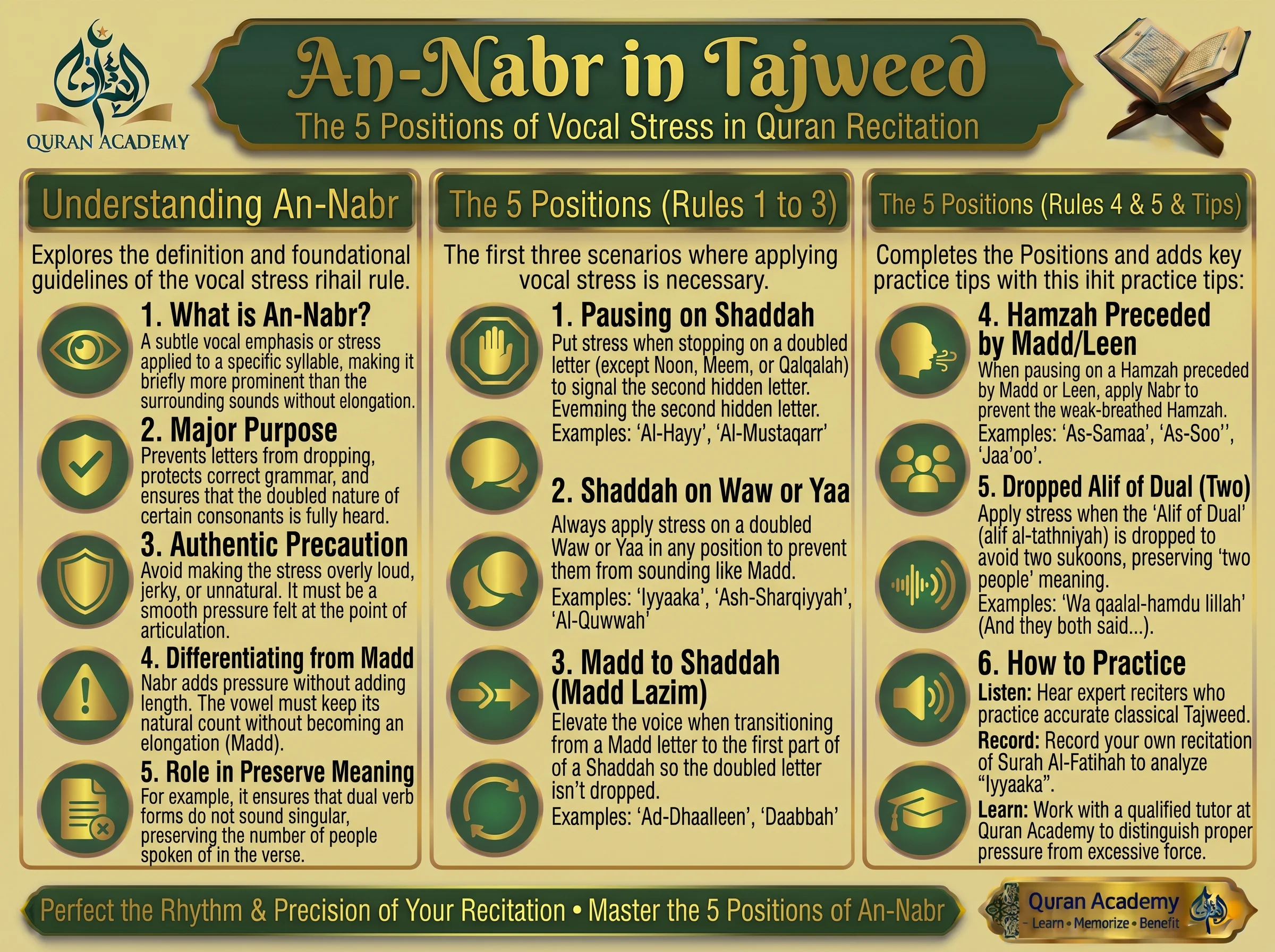
Mastering An Nabr in Tajweed rules (أَحْكَامُ النَّبْرِ فِي التَّجْوِيدِ وَمَوَاضِعُهُ الْخَمْسَةُ) is one of the secrets that separates an ordinary reciter from a master Al-Azhar Qari'! In Tajweed terminology, An-Nabr (Vocal Stress / Accentuation) is a deliberate, subtle pressure applied to a specific letter or syllable so that its sound rises slightly above its neighbors—protecting doubled letters (Shaddahs), final Hamzahs, and dual verbs from being swallowed or misunderstood. Contemporary Al-Azhar scholars systematized this oral Prophetic tradition into 5 exact positions: (1) Stopping on a final Shaddah (like ٱلْحَيّْ or مُسْتَقَرّْ), (2) Pronouncing a doubled Waw or Yaa (like إِيَّاكَ or قُوَّةٍ), (3) Transitioning from the 6-beat Madd into the Shaddah in Madd Lazim (like وَلَا ٱلضَّالِّينَ), (4) Stopping on a final Hamzah after a Madd/Leen letter (like ٱلسَّمَاءْ), and (5) Preserving the dropped dual Alif in 3 Quranic contexts (like ذَاقَا ٱلشَّجَرَةَ). In our 1-on-1 Online Tajweed & Ijazah Course, students practice all 5 positions live until they become second nature!
- Why Do We Need An-Nabr? To prevent both Lahn Jali (dropping a Shaddah or Hamzah) and Lahn Khafi when two letters meet or at the end of a breath!
- The 2 Exceptions When Stopping on a Final Shaddah: (1) نّ / مّ (where the 2-beat Ghunnah already shows the Shaddah) and (2) قّ، طّ، بّ، جّ، دّ (where the Qalqalah bounce already shows the Shaddah)!
- Twice in Surah Al-Fatihah: You apply Nabr in EVERY Rak'ah of Salah on إِيَّاكَ (1:5 — Position #2) and ٱلضَّالِّينَ (1:7 — Position #3)!
- Dual vs. Singular Clarity: Nabr on the Qaaf of ذَاقَا ٱلشَّجَرَةَ (7:22) tells the listener that both Adam and Hawwa tasted from the tree!
Try a quick experiment out loud right now: pause on the word ٱلسَّمَاءِ (As-Samaa'i — the sky) after stretching the 4-or-5-beat Alif. Did your voice run out of air at the end of the long Alif so that the final Hamzah (ءْ) disappeared completely—making it sound like "As-Samaaaa" ❌ (without a Hamzah)? Now try a second word: in Surah Al-Qamar (54:3), pause on the final word of the verse: وَكُلُّ أَمْرٍ مُّسْتَقَرٌّ (Mustaqarrّْ). Because you made the Raa silent for stopping, how does the listener sitting next to you know that the word ends with a doubled Raa (Shaddah = رّ) and not a single Raa (Mustaqarْ)?
The answer to both challenges is one single phonetic tool preserved through oral transmission (At-Talaqqi wal-Mushafahah) across the 10 Qira'at of the Quran: An-Nabr (النَّبْرُ — Vocal Stress / Accentuation)! Building upon our foundational guides to Rules of Waqf (Stopping) in the Quran, Rules of Madd, and Lahn Jali vs. Lahn Khafi, this complete guide breaks down the linguistic and Tajweed definition of Nabr, the Master Chart of all 5 Positions, the 2 Exceptions on final Shaddahs, and the 3 Dual Verbs where Nabr protects the meaning of the verse.
- 1. What Is An-Nabr in Tajweed? (Linguistic & Phonetic Definition)
- 2. Master Chart: The 5 Positions of An-Nabr in Quranic Recitation (With Examples)
- 3. Deep Dive Into Positions #1 & #2: Stopping on a Final Shaddah (And Its 2 Exceptions!) & "Iyyaaka"
- 4. Deep Dive Into Positions #3, #4 & #5: Madd Lazim, Final Hamzah & The 3 Dual Alif Verbs
- 5. How to Practice Nabr Without Over-Exaggerating or Bouncing the Letter
- 6. Frequently Asked Questions (FAQs)
1. What Is An-Nabr in Tajweed? (Linguistic & Phonetic Definition)
In classical Arabic dictionaries—and as defined in our Interactive Tajweed Encyclopedia—the root word النَّبْرُ (An-Nabr) means elevation, prominence, and raising the voice (which is why the mosque pulpit is called a مِنْبَر = Minbar, because it elevates the speaker!).
In Tajweed Terminology: An-Nabr is applying a firm, noticeable vocal pressure (ضَغْطٌ صَوْتِيٌّ) onto a specific letter or syllable during recitation so that its sound is slightly elevated and clearer than the letters beside it. Why didn't early introductory poems like Tuhfat al-Atfal dedicate a separate chapter to Nabr? Because native Arab reciters applied this vocal stress instinctively in oral transmission (Mushafahah); however, as Islam spread globally and non-native speakers began dropping final Shaddahs and Hamzahs, senior Al-Azhar scholars documented the 5 exact positions where every reciter must apply Nabr!
2. Master Chart: The 5 Positions of An-Nabr in Quranic Recitation
You can listen to and practice every Quranic example below in our Online Uthmani Quran Explorer. Here are all 5 positions of An-Nabr side by side:
| # & Position of Nabr | Quranic Examples | Why Nabr Is Needed Here |
|---|---|---|
| Position 1: Stopping on a Word Ending in a Shaddah |
ٱلْحَيُّ → ٱلْحَيّْ (2:255) مُسْتَقَرٌّ → مُسْتَقَرّْ (54:3) وَبَثَّ → وَبَثّْ (4:1) عَدُوٌّ → عَدُوّْ (2:36) |
When you stop on a final Shaddah, the vowel drops—leaving two silent letters at the end! Without pressing firmly on the syllable (Nabr), the listener only hears 1 letter instead of 2! *(Excludes نّ / مّ and Qalqalah letters).* |
| Position 2: Pronouncing a Doubled Waw (وّ) or Yaa (يّ) |
إِيَّاكَ نَعْبُدُ (1:5) بِقُوَّةٍ (2:63) سَيَّارَةٌ (12:19) قَوَّامِينَ (4:135) |
Because Waw and Yaa are also soft Madd letters from Al-Jawf, if you don't press firmly (Nabr) on the Shaddah of وّ and يّ, your tongue relaxes and turns the Shaddah into a weak Madd vowel ("Eeyaaka" or "Qoo-wah" ❌)! |
| Position 3: Transitioning From Madd to Shaddah in Madd Lazim |
وَلَا ٱلضَّالِّينَ (1:7) ٱلْحَاقَّةُ (69:1) ٱلطَّامَّةُ (79:34) دَابَّةٍ (11:6) |
At the end of a long 6-beat Madd Lazim Kalimi Muthaqqal, your breath is running low right as you need to enter a heavy Shaddah! Applying Nabr at the transition point ensures the Shaddah on لِّ، قَّ، مَّ، بَّ is heard clearly! |
| Position 4: Stopping on a Final Hamzah After Madd or Leen |
ٱلسَّمَاءِ → ٱلسَّمَاءْ (2:22) ٱلسُّوءُ → ٱلسُّوءْ (12:25) جِيءَ → جِيءْ (89:23) شَيْءٍ → شَيْءْ (2:20) |
Because Hamzah (ءْ) comes from the deepest throat with 100% vocal cord closure (Shiddah + Jahr), stopping on it after a 4-to-6 beat Madd causes many reciters to swallow the Hamzah completely unless they apply gentle Nabr! |
| Position 5 🏆: Preserving the Dropped Dual Alif in Continuation |
فَلَمَّا ذَاقَا ٱلشَّجَرَةَ (7:22) وَٱسْتَبَقَا ٱلْبَابَ (12:25) دَّعَوَا ٱللَّهَ (7:189) وَقَالَا ٱلْحَمْدُ لِلَّهِ (27:15) |
When continuing across the two words, the dual Alif (ـَا) drops because of two meeting silent letters (Iltiqa' as-Sakinayn)—making the dual verb sound identical to a singular verb unless you apply Nabr on the letter before the Alif! |
3. Deep Dive Into Positions #1 & #2: Stopping on a Final Shaddah (And Its 2 Exceptions!) & "Iyyaaka"
Let us look closely at the first two positions—especially the two famous exceptions to Position #1 that frequently appear in Online Quran Ijazah Exams:
- Why Position #1 (Stopping on a Final Shaddah) Has 2 Exceptions:
When you pause on a word ending in a Shaddah—like ٱلْحَيُّ (Al-Hayyّْ) in Ayatul Kursi (2:255), or مُسْتَقَرٌّ (Mustaqarrّْ), or عَفُوٌّ ('Afuwwّْ) in our 99 Names of Allah Guide—you must press firmly with Nabr on the syllable so both silent letters are heard. However, in two groups of letters, you do NOT need extra Nabr because an existing Tajweed rule already reveals the Shaddah automatically:
• Exception A — Noon Mushaddadah (نّ) & Meem Mushaddadah (مّ): When you stop on هُنَّ → هُنّْ (Hunnّْ), ٱلْجَانُّ → ٱلْجَانّْ (Al-Jaannّْ — Surah Ar-Rahman 55:15), or ٱلْغَمِّ → ٱلْغَمّْ (Al-Ghammّْ), holding the obligatory 2-beat nasal Ghunnah already proves to the listener that the Noon or Meem is doubled!
• Exception B — The 5 Qalqalah Letters With a Shaddah (قّ، طّ، بّ، جّ، دّ): When you stop on ٱلْحَقُّ → ٱلْحَقّْ (Al-Haqqّْ), وَٱلْحَجِّ → وَٱلْحَجّْ (Wal-Hajjّْ), وَتَبَّ → وَتَبّْ (Wa tabbّْ — 111:1), or أَشَدُّ → أَشَدّْ (Ashaddّْ), holding the silent first letter inside its articulation point before releasing the Qalqalah Akbar bounce on the second letter already shows both letters without needing extra vocal stress! - Why Position #2 (Doubled Waw وّ & Yaa يّ) Is Critical in Surah Al-Fatihah (1:5):
As we emphasized in our Surah Al-Fatihah Tafseer & Tajweed Guide, in إِيَّاكَ نَعْبُدُ وَإِيَّاكَ نَسْتَعِينُ (Iy-yaaka na'budu wa iy-yaaka nasta'een), press the middle of your tongue firmly against the hard palate on the Yaa Mushaddadah (يَّ) so it sounds crisp and solid—never let it float into the empty throat/mouth cavity (Al-Jawf) or it will turn into a soft Madd letter!
Why Qalqalah Letters (ق ط ب ج د) Don't Need Nabr on a Final Shaddah—And Why Hamzah Is NEVER Qalqalah!
Compare two words when stopping at the end of a verse: when you stop on وَٱلْحَجّْ (2:189) or وَتَبّْ (111:1), the Qalqalah Akbar bounce on جّْ and بّْ naturally reveals the Shaddah! Conversely, when you stop on a final Hamzah in ٱلسَّمَاءْ or شَيْءْ (Position #4 of Nabr), you must apply firm Nabr to close the vocal cords cleanly—without bouncing the Hamzah like a Qalqalah letter! Watch Senior Instructor Ustadhah Yasmeen Gamal explain true Qalqalah on our Quran Academy YouTube Channel:
- Crisp Hamzah vs. Echoing Qalqalah: Never bounce a final Hamzah into "As-Samaa-'a" ❌!
- 1-on-1 Live Coaching: Polish your Nabr and Qalqalah with Al-Azhar scholars!
4. Deep Dive Into Positions #3, #4 & #5: Madd Lazim, Final Hamzah & The 3 Dual Alif Verbs
Now let us examine how Positions #3, #4, and #5 work in practice—especially Position #5 (The Dual Alif Rule), which is one of the most beautiful examples of how Tajweed protects Quranic Tafseer:
Struggling to perfect your Recitation?
Join hundreds of students mastering the Quran with our Verified Al-Azhar Graduates. We offer flexible 1-on-1 sessions tailored to your schedule.
Book a Free Evaluation Class →- Position #3 — Transitioning From 6-Beat Madd Lazim Into the Shaddah:
As we learned in our Rules of Madd in Tajweed Guide, in words like ٱلضَّالِّينَ (Ad-Daaaaaall-leen — 1:7), ٱلْحَاقَّةُ (Al-Haaaaaq-qah — 69:1), and أَتُحَاجُّونِّي (Atuhaaaaaj-joonee — 6:80), right as you reach beat #6 of the Alif, give a slight upward vocal push (Nabr) as you lock into the doubled consonant (لِّ، قَّ، جُّ) so the listener hears a crisp Shaddah instead of a flat transition! - Position #4 — Stopping on a Final Hamzah After Madd or Leen:
Whenever you pause on a word ending in a Hamzah preceded by a long vowel (ٱلسَّمَاءِ، مَاءٍ، شُهَدَاءَ، قُرُوءٍ، سِيءَ) or a Leen letter (شَيْءٍ، السَّوْءِ), apply a gentle, firm vocal stress right at the end of the Madd so the vocal cords close audibly on the silent Hamzah (ءْ)—without letting the Hamzah vanish into thin air and without bouncing it! - Position #5 — Preserving the Dropped Dual Alif When Continuing Across Two Words:
Why do we apply Nabr on the قَ of فَلَمَّا ذَاقَا ٱلشَّجَرَةَ (Surah Al-A'raf 7:22), the قَ of وَٱسْتَبَقَا ٱلْبَابَ (Surah Yusuf 12:25), and the لَ of وَقَالَا ٱلْحَمْدُ لِلَّهِ (Surah An-Naml 27:15)?
• Look at the grammar: ذَاقَا (Dhaaqaa = "The two of them [Adam & Hawwa] tasted"), ٱسْتَبَقَا (Istabaqaa = "The two of them raced"), and قَالَا (Qaalaa = "The two of them [Dawud & Sulayman AS] said") all end with a 2-beat Dual Alif (ألف الاثنين)!
• However, when you connect the verb directly to the next word (which starts with Hamzatul Wasl + a silent Sun/Moon letter: ٱلشَّـ / ٱلْبَـ / ٱلْحَـ), Arabic drops the silent Dual Alif to prevent two silent letters from colliding (Iltiqa' as-Sakinayn)!
• Once that Dual Alif drops in pronunciation, ذَاقَا ٱلشَّجَرَةَ (Dual: "They both tasted the tree") sounds 100% identical to singular ذَاقَ ٱلشَّجَرَةَ ("He alone tasted the tree")! Therefore, reciters apply a gentle vocal stress (An-Nabr) onto the Fatha of ذَاقَـ / ٱسْتَبَقَـ / قَالَـ to signal to the listener's ear that a Dual Alif was originally there! *(Whereas in **قَالَا رَبَّنَا** [7:23], because the next word starts with a voweled Raa, the 2-beat Dual Alif is pronounced in full without needing Nabr!).*
5. How to Practice Nabr Without Over-Exaggerating or Bouncing the Letter
When students first learn An-Nabr in our 1-on-1 Online Tajweed Course, our Al-Azhar instructors give them three golden rules of balance so their Nabr stays natural and eloquent:
- 1. Nabr Is a Smooth Vocal Stress—Never a Jerky Jolt or Shout:
Think of how you naturally stress the first syllable of the English word "FA-ther" or the second syllable of "to-DAY" without shouting! In the same way, Nabr on إِيَّاكَ or ذَاقَا ٱلشَّجَرَةَ is a gentle, dignified firmness of the voice—never a harsh jolt that breaks the melody of Tarteel! - 2. Never Add a Extra Vowel or Saktah Pause During Nabr:
When applying Nabr on the Dual Alif in وَقَالَا ٱلْحَمْدُ لِلَّهِ (Wa qaalal-hamdu lillaah — 27:15), press gently on the Laam of Qaala-l while flowing straight into the Moon Laam of Al-Hamdu—never pause your breath (which would create an unpermitted Saktah!) and never stretch the Alif before the silent Laam! - 3. Combine Nabr With Exact Makharij & Sifaat:
Applying our Makharij al-Huruf, Sifaat al-Huruf, Heavy & Light Letters, Ahkam Al-Raa, Noon Sakinah Rules, Meem Sakinah Rules, Laam Shamsiyyah & Qamariyyah, Idgham Mutamathilayn, Mutajanisayn & Mutaqaribayn, 4 Special Words of Hafs, and 7 Alifs in the Quran guides, when stopping with Nabr on مُسْتَقَرّْ (54:3), keep the Raa 100% Heavy (Tafkhim) while suppressing excess trilling (Takreer), and when stopping with Nabr on مُسْتَمِرّْ (54:2), keep the Raa 100% Light (Tarqeeq) because of the Kasrah on the Meem!
Practice all 5 positions of Nabr across our interconnected library of Surah, Salah, and Adhkar guides: 30-Day Quran Khatmah Schedule, Traveler's Prayer, Salat Al-Jumu'ah, 12 Sunnah Rawatib, Salat Al-Eid, Salat Ad-Duha, Salat Al-Witr, Tahajjud (featuring Al-Haqqّْ 8 times in the Tahajjud Dua!), Dua Al-Qunoot, Duas for Anxiety & Debt, Bedtime Duas, Post-Prayer Adhkar, Authentic Ruqyah Shariah, Surah Al-Alaq, 10 Shortest Surahs, Surah Qaf, and Last 3 Verses of Surah Al-Hashr (featuring Al-Jabbaar & Al-Mutakabbir!) in our Online Hifz Program (using our Smart Hifz Planner)! Whether you are studying with our Al-Azhar Certified Tutors or enrolling your child in our 1-on-1 Kids Quran Classes with our Printable Kids Star Chart, read how families across the US, UK, Canada, and Australia rate our teachers on our Verified Student & Parent Reviews Page.
6. Frequently Asked Questions (FAQs) About An-Nabr in Tajweed
1. What is the definition of An-Nabr in Tajweed?
Linguistically, An-Nabr (النبر) means elevation and raising the voice. In Tajweed terminology, An-Nabr is a firm, measured vocal pressure (stress/accentuation) applied to a specific letter or syllable so that its voice becomes slightly louder than the neighboring letters—preventing a doubled letter (Shaddah), a final Hamzah, or a dual Alif from being swallowed or confused in meaning!
2. What are the 5 positions of An-Nabr in Quranic recitation?
The 5 positions of An-Nabr in Tajweed are: (1) Stopping on a word ending in a Shaddah (like Al-Hayyّْ or Al-Mustaqarrّْ, excluding Noon/Meem Mushaddadah and Qalqalah letters), (2) Pronouncing a doubled Waw or Yaa (Waw or Yaa Mushaddadah, like Iyyaaka or Quwwah) so it does not turn into a long Madd vowel, (3) Transitioning from the 6-beat Madd to the Shaddah in Madd Lazim Kalimi Muthaqqal (like Walaad-Daalleen), (4) Stopping on a word ending in a Hamzah after a Madd or Leen letter (like As-Samaa'ْ or Shay'ْ), and (5) Preserving the dropped dual Alif in 3 specific verbs when continuing (such as Falammā dhāqash-shajarah in 7:22).
3. What are the 2 exceptions when stopping on a final Shaddah where Nabr is NOT needed?
When stopping on a word that ends with a Shaddah (doubled letter), An-Nabr is NOT required in two cases because another intrinsic characteristic already makes the Shaddah crystal clear: (1) Noon Mushaddadah and Meem Mushaddadah (such as Al-Jaannّْ or Al-Yammّْ), where the 2-beat nasal Ghunnah already shows the doubling, and (2) The 5 Qalqalah letters with a Shaddah (such as Al-Haqqّْ, Al-Hajjّْ, or Wa tabbّْ), where holding the Shaddah before releasing the Qalqalah bounce already shows both letters!
4. Why must you apply Nabr on the Yaa of "Iyyaaka" in Surah Al-Fatihah (1:5)?
In Surah Al-Fatihah (1:5: Iyyaaka na'budu), the Yaa is doubled with a Shaddah and preceded by a Kasrah. Without firm vocal pressure (Nabr) on the Yaa, the tongue relaxes and stretches the Yaa into a soft Madd letter ("Eeyaaka" ❌), which drops the Shaddah and alters the meaning from "You alone" to "your sunlight"!
5. Which 3 dual verbs in the Quran require Nabr in continuation to distinguish dual from singular?
When two silent letters meet across two words (Iltiqa' as-Sakinayn), the dual Alif at the end of a verb drops in pronunciation, making it sound like a singular verb unless the reciter applies Nabr on the letter before the Alif! The 3 Quranic examples are: (1) "Falammā dhāqash-shajarah" (Surah Al-A'raf 7:22 — referring to Adam and Hawwa), (2) "Wa-stabaqal-baab" (Surah Yusuf 12:25), and (3) "Da'awallaaha" (Surah Al-A'raf 7:189) / "Wa qaalal-hamdu lillaah" (Surah An-Naml 27:15 — Dawud and Sulayman AS).
Recite Every Syllable With Al-Azhar Mastery!
Master the 5 positions of Nabr, precise Makharij, and melodious Tarteel in live 1-on-1 sessions with certified male and female Al-Azhar scholars. Book your free diagnostic trial session today!
Book Your Free 1-on-1 Tajweed Trial Class →