
✦ Quick Answer & Key Takeaways: Idgham Mutamathilayn, Mutajanisayn & Mutaqaribayn
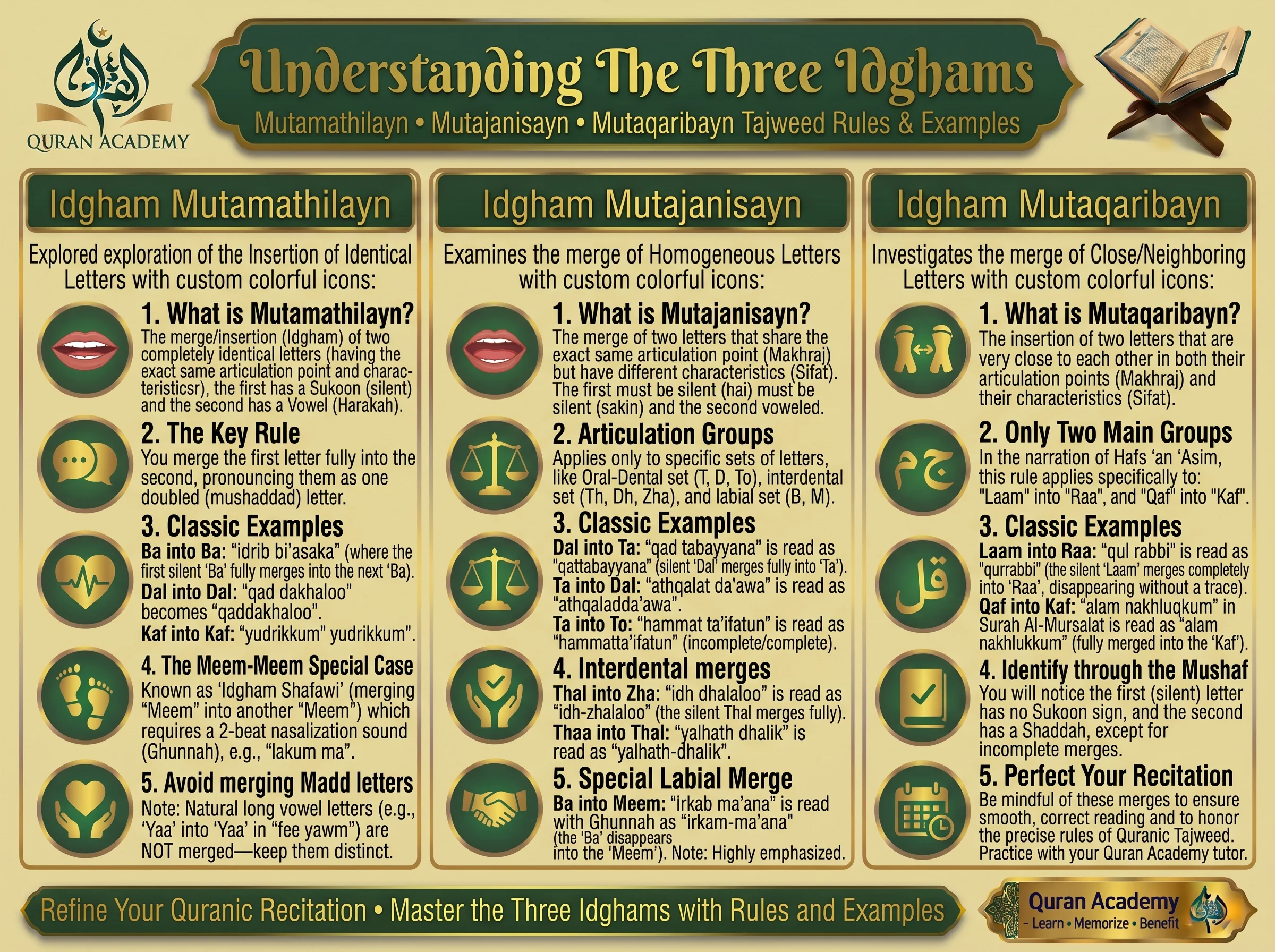
Mastering Idgham Mutamathilayn, Mutajanisayn and Mutaqaribayn (إِدْغَامُ الْمُتَمَاثِلَيْنِ وَالْمُتَجَانِسَيْنِ وَالْمُتَقَارِبَيْنِ) unlocks the advanced chapter of 'Alaqat Al-Huruf (Letter Relationships) in Tajweed—explaining why certain silent consonants merge seamlessly into the next letter even when neither letter is a Noon Sakinah or Meem Sakinah! Whenever a silent consonant (Sakin) meets a voweled consonant (Mutaharrik) in the narration of Hafs 'an 'Asim—a state called As-Sagheer (الصَّغِيرُ — The Small Meeting)—merging occurs across three relationships: (1) Mutamathilayn (Two Identical Letters in both Makhraj and Sifaat, like بْ + ب = ٱضْرِب بِّعَصَاكَ), (2) Mutajanisayn (Two Homogeneous Letters sharing the exact same Makhraj but differing in Sifaat, like دْ + ت = قَد تَّبَيَّنَ), and (3) Mutaqaribayn (Two Approximated Letters close in Makhraj and Sifaat, like لْ + ر = قُل رَّبِّ). In our 1-on-1 Online Tajweed & Ijazah Course, students learn to spot all three instantly from the Uthmani Mushaf symbols!
- The Uthmani Mushaf Visual Clue: Whenever the first letter has NO Sukoon hat and the second letter carries a Shaddah (ـّ), it is a 100% Complete Merge (Idgham Kamil)—the first letter disappears completely!
- The Incomplete Merge Clue (Idgham Naqis): When the first letter has NO Sukoon hat and the second letter has NO Shaddah (as in أَحَطتُ، بَسَطتَ، فَرَّطتُمْ), keep the heavy closure of the طْ and open on the light ت without Qalqalah!
- The Madd Exception in Mutamathilayn: Never merge a long vowel Madd letter into an identical consonant (e.g., read آمَنُوا وَعَمِلُوا with a full 2-beat Madd, NOT "Aamanow-wa" ❌!).
- Why Called "Sagheer" (Small)? Because the 1st letter is already silent and the 2nd is voweled—so merging requires only one small step!
Suppose you are reciting Surah Al-Baqarah (Verse 256) right after Ayatul Kursi—قَد تَّبَيَّنَ ٱلرُّشْدُ مِنَ ٱلْغَيِّ—or reciting Prophet Nuh's (AS) call to his son in Surah Hud (11:42)—يَا بُنَيَّ ٱرْكَب مَّعَنَا—or reciting Surah Al-Mursalat (77:20)—أَلَمْ نَخْلُقكُّم مِّن مَّاءٍ مَّهِينٍ. In all three verses, you notice something surprising in the Uthmani Mushaf: the Dal of Qad, the Baa of Irkab, and the Qaaf of Nakhluq have zero Sukoon symbol written above them, and the letter right after them carries a Shaddah (ـّ)!
Why do we read قَد تَّبَيَّنَ as "Qat-tabayyana" (without bouncing the Dal!), ٱرْكَب مَّعَنَا as "Irkam-ma'anaa" (with a 2-beat nasal Ghunnah on the Meem!), and أَحَطتُ in Surah An-Naml (27:22) by closing the tongue heavy on the Taa' and opening light on the Taa? Because whenever two neighboring letters in Arabic speech are identical or very close in their Articulation Points (Makharij al-Huruf) and Letter Characteristics (Sifaat al-Huruf), lifting the tongue twice in a row creates phonetic heaviness—so Arabic merges the first silent letter into the second! Below, we break down all 3 Types of Consonant Idgham, the difference between Sagheer, Kabeer, and Mutlaq, the 7 Pairs of Mutajanisayn, and the 2 Groups of Mutaqaribayn.
- 1. The Foundation: The 4 Letter Relationships & Why Only "Sagheer" Merges in Hafs 'an 'Asim
- 2. Type 1: Idgham Mutamathilayn (Two Identical Letters) & Its 2 Crucial Exceptions (Madd & Saktah)
- 3. Type 2: Master Chart of the 7 Pairs of Idgham Mutajanisayn (Same Makhraj, Different Sifaat)
- 4. Type 3: Idgham Mutaqaribayn (Close in Makhraj & Sifaat): Laam/Raa & "Alam Nakhluqkkum"
- 5. Complete Merge (Kamil) vs. Incomplete Merge (Naqis): How to Read "Ahath-tu" & "Basath-ta"
- 6. Frequently Asked Questions (FAQs)
1. The Foundation: The 4 Letter Relationships & Why Only "Sagheer" Merges in Hafs
As Imam Ibn al-Jazari and Imam Al-Jamzuri explained in Tuhfat al-Atfal (and as defined in our Interactive Tajweed Encyclopedia), whenever any two Arabic letters meet side by side—whether in the same word or across two words—their relationship falls into one of four categories:
- 1. Al-Mutamathilan (الْمُتَمَاثِلَانِ — Identical): Same Makhraj + Same Sifaat (e.g., ب + ب, ت + ت, ك + ك).
- 2. Al-Mutajanisan (الْمُتَجَانِسَانِ — Homogeneous): Same Makhraj + Different Sifaat (e.g., د + ت, ط + ت, ذ + ظ, ب + م).
- 3. Al-Mutaqariban (الْمُتَقَارِبَانِ — Approximated): Close in Makhraj and/or Sifaat (e.g., ل + ر, ق + ك).
- 4. Al-Mutaba'idan (الْمُتَبَاعِدَانِ — Distant): Far apart in Makhraj and different in Sifaat (e.g., a throat letter meeting a lip letter)—whose ruling is always clear pronunciation (Izhar)!
What Do "Sagheer", "Kabeer", and "Mutlaq" Mean? Within the first three relationships above, scholars look at the vowels on the two letters:
- As-Sagheer (الصَّغِيرُ — Small): 1st letter is Silent (Sakin) + 2nd letter is Voweled (Mutaharrik) → THIS IS WHERE IDGHAM OCCURS IN HAFS 'AN 'ASIM!
- Al-Kabeer (الْكَبِيرُ — Large): Both letters are Voweled (e.g., مَنَاسِكَكُمْ or فِيهِ هُدًى) → Ruling in Hafs is Izhar (Clear pronunciation) except in a few built-in words like تَأْمَنَّا (Yusuf 12:11) and مَكَّنِّي (Al-Kahf 18:95)!
- Al-Mutlaq (الْمُطْلَقُ — Opposite): 1st letter is Voweled + 2nd letter is Silent (e.g., نَنْسَخْ) → Ruling in all 10 Qira'at is 100% Izhar!
2. Type 1: Idgham Mutamathilayn Sagheer (Two Identical Letters) & Its 2 Exceptions
Whenever any silent letter in the Arabic alphabet is followed immediately by the exact same letter with a vowel, it is obligatory (Wajib) to merge them into a single doubled letter with a Shaddah! Open our Online Uthmani Quran Explorer and compare these examples:
- Examples With Zero Ghunnah (All Consonants Except Meem & Noon):
• بْ + ب: ٱضْرِب بِّعَصَاكَ (Idrib-bi'asaaka — 2:60) — Do NOT bounce the first Baa with Qalqalah! Hold the lips closed for the Shaddah and open on bi'asaaka.
• دْ + د: وَقَد دَّخَلُوا (Wa qad-dakhaloo — 5:61) — Do NOT bounce the first Dal!
• تْ + ت: فَمَا رَبِحَت تِّجَارَتُهُمْ (Famaa rabihat-tijaaratuhum — 2:16).
• كْ + ك: يُدْرِككُّمُ ٱلْمَوْتُ (Yudrikkumul-mawtu — 4:78).
• لْ + ل: قُل لَّا أَمْلِكُ (Qul-laa amliku — 7:188).
• وْ (Leen) + و: ٱتَّقَواْ وَّآمَنُوا (Ittaqaw-wa aamanoo — 5:93) — Because the first Waw is a consonant Waw Leen (preceded by a Fatha!), it merges completely into the second Waw! - Examples With a 2-Beat Nasal Ghunnah (Meem + Meem & Noon + Noon):
As we covered in our Meem Sakinah Rules and Noon Sakinah Rules, لَكُم مَّا كَسَبْتُمْ (مْ + م) and مِن نِّعْمَةٍ (نْ + ن) are also Idgham Mutamathilayn Sagheer—accompanied by a 2-beat nasal Ghunnah! - ⚠️ The 2 Exceptions Where Idgham Mutamathilayn Does NOT Happen:
Exception 1 (When the 1st Letter Is a Long Vowel Madd Letter): In آمَنُوا وَعَمِلُوا (Aamanoo wa 'amiloo) or ٱلَّذِي يُوَسْوِسُ (Alladhee yuwaswisu — 114:5), the first Waw/Yaa is a long vowel Madd Tabee'i (from Al-Jawf!), whereas the second Waw/Yaa is a consonant! Therefore, you MUST pronounce the full 2-beat Madd without merging!
Exception 2 (The Saktah in Surah Al-Haqqah 69:28–29): In مَالِيَهْ ۜ ﴿٢٨﴾ هَلَكَ عَنِّي, if you connect the two verses with the preferred silent pause (Saktah), the pause prevents merging the two Haa's (though merging them without Saktah is also a valid secondary option in Hafs!).
3. Type 2: Master Chart of the 7 Pairs of Idgham Mutajanisayn (Same Makhraj, Different Sifaat)
In Idgham Mutajanisayn Sagheer (إِدْغَامُ الْمُتَجَانِسَيْنِ الصَّغِيرُ), the two meeting letters come from the exact same specific articulation point (Makhraj), but differ in some of their characteristics (such as Heavy vs. Light, or Voiced vs. Whispered). In Hafs 'an 'Asim, this occurs ONLY across 3 articulation zones totaling 7 specific letter pairs:
| Makhraj Zone | # & Letter Pair | Merge Type | Quranic Examples & How to Read |
|---|---|---|---|
| Zone 1: The Nit'iyyah Tongue Tip (ط • د • ت) |
1. دْ → ت (Dal into Taa) |
Complete (Kamil) | قَد تَّبَيَّنَ (Qat-tabayyana — 2:256), وَمَهَّدتُّ (Wa mahhat-tu — 74:14), عَبَدتُّمْ ('Abat-tum — 109:4). |
| 2. تْ → د (Taa into Dal) |
Complete (Kamil) | أَثْقَلَت دَّعَوَا ٱللَّهَ (Athqalad-da'awallaaha — 7:189), أُجِيبَت دَّعْوَتُكُمَا (Ujeebad-da'watukumaa — 10:89). | |
| 3. تْ → ط (Taa into Taa') |
Complete (Kamil) | وَدَّت طَّائِفَةٌ (Waddat-taa'ifatun — 3:69), فَآمَنَت طَّائِفَةٌ (Fa-aamanat-taa'ifatun — 61:14). | |
| 4. طْ → ت 🏆 (Heavy Taa' into Light Taa) |
Incomplete (Naqis)! (No Shaddah on ت!) |
Occurs in only 4 words: أَحَطتُ (27:22), بَسَطتَ (5:28), فَرَّطتُمْ (12:80), and فَرَّطتُ (39:56)! Keep the heavy closure of طْ and open on light ت! | |
| Zone 2: The Interdental Tip (ظ • ذ • ث) |
5. ذْ → ظ (Dhal into Dhaa') |
Complete (Kamil) | Occurs in only 2 places: إِذ ظَّلَمُوا (Idh-dhalamoo — 4:64) and إِذ ظَّلَمْتُمْ (Idh-dhalamtum — 43:39)! |
| 6. ثْ → ذ (Thaa' into Dhal) |
Complete (Kamil) | Occurs in only 1 place: يَلْهَث ذَّٰلِكَ (Yalhadh-dhaalika — Surah Al-A'raf 7:176)! | |
| Zone 3: The Two Lips (ب • م) |
7. بْ → م (Baa into Meem) |
Complete + 2-Beat Ghunnah! | Occurs in only 1 place: يَا بُنَيَّ ٱرْكَب مَّعَنَا (Irkam-ma'anaa — Surah Hud 11:42)! The Baa turns completely into a Meem with a 2-beat nasal Ghunnah! |
4. Type 3: Idgham Mutaqaribayn (Close in Makhraj & Sifaat): Laam/Raa & "Alam Nakhluqkkum"
In Idgham Mutaqaribayn Sagheer (إِدْغَامُ الْمُتَقَارِبَيْنِ الصَّغِيرُ), the two meeting consonants come from two neighboring articulation points that are so close to one another that the tongue merges them. Aside from Laam Shamsiyyah and Noon Sakinah Idgham into ي ر م و, specific consonant Idgham Mutaqaribayn in Hafs 'an 'Asim occurs in two famous pairs:
- 1. Silent Laam (لْ) Followed by Raa (ر) — Complete Merge:
Whenever the verb قُلْ (Qul) or the particle بَلْ (Bal) is followed by a word starting with ر (Raa), the Laam merges 100% into the Raa:
• وَقُل رَّبِّ زِدْنِي عِلْمًا (Wa qur-Rabbi zidnee 'ilmaa — 20:114)
• بَل رَّفَعَهُ ٱللَّهُ إِلَيْهِ (Bar-rafa'ahullaahu ilayhi — 4:158)
⚠️ The Single Exception: As we learned in our guide to The 4 Special Words of Hafs 'an 'Asim (Saktah), in Surah Al-Mutaffifin (83:14): كَلَّا ۖ بَلْ ۜ رَانَ عَلَىٰ قُلُوبِهِم, the obligatory silent pause (Saktah) prevents the Laam of Bal from merging into Raana! - 2. Silent Qaaf (قْ) Followed by Kaaf (ك) in "Alam Nakhluqkkum" (Surah Al-Mursalat 77:20):
In أَلَمْ نَخْلُقكُّم مِّن مَّاءٍ مَّهِينٍ (77:20), the deepest-tongue consonant قْ (Qaaf) is followed immediately by its neighbor كُ (Kaaf)! In Hafs 'an 'Asim, two valid ways are transmitted, though Way #1 is the primary standard indicated in the Uthmani Mushaf (by placing a Shaddah on the Kaaf):
• Way #1 (Complete Merge / Idgham Kamil — Preferred & Standard): The Qaaf transforms 100% into a doubled light Kaaf: أَلَمْ نَخْلُكُّمْ (Alam nakhluk-kum)!
• Way #2 (Incomplete Merge / Idgham Naqis): Keeping the heavy elevation (Isti'la') of the Qaaf upon closing the back of the tongue (without Qalqalah) and opening on the light Kaaf!
Why Qalqalah Disappears When ق، ط، ب، د Merge in Idgham!
Here is one of the most important secrets in Tajweed: normally, the silent letters قْ، طْ، بْ، دْ are Qalqalah (Echoing) letters. Yet whenever they merge via Idgham Mutamathilayn, Mutajanisayn, or Mutaqaribayn—such as ٱضْرِب بِّعَصَاكَ (Baa + Baa), قَد تَّبَيَّنَ (Dal + Taa), أَحَطتُ (Taa' + Taa), or نَخْلُقكُّم (Qaaf + Kaaf)—100% of the Qalqalah bounce is canceled because bouncing the first letter would break the merge! Watch Senior Instructor Ustadhah Yasmeen Gamal explain Qalqalah on our Quran Academy YouTube Channel:
Struggling to perfect your Recitation?
Join hundreds of students mastering the Quran with our Verified Al-Azhar Graduates. We offer flexible 1-on-1 sessions tailored to your schedule.
Book a Free Evaluation Class →- Bounce on Izhar, Hold on Idgham: Bounce the Ra/Dal in Qadْ sami'a, but merge seamlessly in Qat-tabayyana!
- 1-on-1 Live Coaching: Master advanced Ijazah Tajweed with our Al-Azhar scholars!
5. Complete Merge (Kamil) vs. Incomplete Merge (Naqis): How to Read "Ahath-tu" & "Basath-ta"
As we highlighted in our guide on What Happens During an Online Quran Ijazah Exam and our Heavy & Light Letters Guide, why do the 4 Quranic words where a silent heavy Taa' (طْ) comes before a light Taa (ت)—namely أَحَطتُ (27:22), بَسَطتَ (5:28), فَرَّطتُمْ (12:80), and فَرَّطتُ (39:56)—have Incomplete Merging (إِدْغَامٌ نَاقِصٌ)?
- 1. Why a Strong Letter Cannot Disappear Completely Into a Weak Letter:
The letter ط (Taa') is the single strongest letter in the Arabic language (possessing Jahr, Shiddah, Isti'la', Itbaq, and Qalqalah!), whereas ت (Taa) is a light, whispered letter. If you merged طْ completely into ت and read بَسَطتَ as "Basat-ta" ❌, all the heavy Isti'la' and Itbaq of the Taa' would vanish! - 2. Step-by-Step Physical Execution of "Ahath-tu" & "Basath-ta":
• Step A (Close on Heavy طْ): Raise the back of your tongue and press the front of your tongue into the upper gum ridge in the full, heavy posture of طْ (Itbaq + Isti'la')—and hold it briefly without bouncing it with Qalqalah!
• Step B (Open on Light ت): In that exact same tongue position, drop the back of your tongue and release your tongue tip on a light, smiling تُ / تَ (-tu / -ta) with a gentle whisper of Hams! - 3. Compare the Two Uthmani Mushaf Symbols Side by Side:
• In وَدَّت طَّائِفَةٌ (تْ → ط — Weak into Strong = Complete Merge): The first letter has no Sukoon, and the second letter has a Shaddah (طَّ)!
• In بَسَطتَ (طْ → ت — Strong into Weak = Incomplete Merge): The first letter has no Sukoon, and the second letter has NO Shaddah (تَ)!
Practice spotting Idgham Mutamathilayn, Mutajanisayn, and Mutaqaribayn across our complete library of Tajweed, Surah, and Fiqh guides: Ahkam Al-Raa, Hamzatul Wasl vs. Qat', 7 Alifs in the Quran, Rules of Waqf, Surah Al-Fatihah Guide, Last 3 Verses of Surah Al-Hashr, Surah Qaf, 10 Shortest Surahs for Salah (featuring 'Abat-tum in Al-Kafirun 109:4!), Surah Al-Alaq, Surah Yusuf (featuring Mā farrath-tum in 12:80!), Surah Maryam, Surah Ya-Sin, Surah Ar-Rahman, Surah Al-Waqi'ah, Surah Luqman, Surah Al-Hujurat, 99 Names of Allah, 30-Day Quran Khatmah Plan, 15 Etiquettes of Reading the Quran, Traveler's Prayer, Salat Al-Jumu'ah, 12 Sunnah Rawatib, Salat Al-Eid, Salat Ad-Duha, Salat Al-Witr, Tahajjud, and Dua Al-Qunoot (featuring Feemanْ hadayt vs. Maw-waalayt!) in our Online Hifz Program (using our Smart Hifz Planner)! Whether you are learning with our Al-Azhar Certified Tutors or enrolling your child in our 1-on-1 Kids Quran Classes with our Printable Kids Star Chart, see how families across the US, UK, Canada, and Australia rate our teachers on our Verified Student & Parent Reviews Page.
6. Frequently Asked Questions (FAQs) About Idgham Mutamathilayn, Mutajanisayn & Mutaqaribayn
1. What is the difference between Idgham Mutamathilayn, Mutajanisayn, and Mutaqaribayn in Tajweed?
When a silent consonant (Sakin) is followed immediately by a voweled consonant (Mutaharrik): (1) Idgham Mutamathilayn occurs when the two letters are 100% identical in both articulation point (Makhraj) and characteristics (Sifaat), such as Baa into Baa (Idrib-bi'asaaka). (2) Idgham Mutajanisayn occurs when the two letters share the exact same Makhraj but differ in some Sifaat, such as Taa into Dal (Athqalad-da'awallaaha). (3) Idgham Mutaqaribayn occurs when the two letters are close to each other in Makhraj and Sifaat, such as Laam into Raa (Qur-Rabbi) or Qaaf into Kaaf (Alam nakhluqkkum).
2. When is Idgham Mutamathilayn Sagheer NOT applied between two identical letters?
Idgham Mutamathilayn Sagheer is NOT applied in two specific cases: (1) When the first letter is a long vowel Madd letter (Waw Maddiyyah or Yaa Maddiyyah), such as "Aamanoo wa 'amiloo" or "Fee yawmin"—where you must keep the 2-count natural Madd to preserve the vowel length, and (2) When making a silent pause (Saktah) in Surah Al-Haqqah (69:28–29: "Maaliyah [saktah] halaka 'annee").
3. What are the 7 letter pairs of Idgham Mutajanisayn in Hafs 'an 'Asim?
In the narration of Hafs 'an 'Asim, Idgham Mutajanisayn Sagheer occurs across 3 articulation zones in 7 specific pairs: (1) Dal into Taa (Qad tabayyana), (2) Taa into Dal (Athqalat da'awaa), (3) Taa into Taa' (Waddat taa'ifah), (4) Taa' into Taa with incomplete merging (Ahath-tu, Basath-ta, Farrath-tum), (5) Dhal into Dhaa' (Idh dhalamoo), (6) Thaa' into Dhal (Yalhath dhaalika in 7:176), and (7) Baa into Meem (Irkam-ma'anaa in Hud 11:42).
4. How do you pronounce the incomplete Idgham (Idgham Naqis) in "Ahattu" and "Basatta"?
In the 4 Quranic words where a silent heavy Taa' (طْ) is followed by a light voweled Taa (ت)—namely Ahath-tu (27:22), Basath-ta (5:28), Farrath-tum (12:80), and Farrath-tu (39:56)—because Taa' is the strongest letter in Arabic, you perform Incomplete Merging (Idgham Naqis): close your tongue with the heavy elevation (Isti'la' and Itbaq) of the Taa' without bouncing it with Qalqalah, and open your tongue directly on the light voweled Taa!
5. How do you spot Idgham Mutamathilayn, Mutajanisayn, and Mutaqaribayn in the Uthmani Mushaf?
In the Uthmani Mushaf, Complete Idgham (Idgham Kamil) is marked by leaving the first letter completely bare (with NO Sukoon hat on it) and placing a Shaddah (ـّ) on the second letter! Incomplete Idgham (Idgham Naqis, as in بَسَطتَ) is marked by leaving BOTH the first letter without a Sukoon hat AND the second letter without a Shaddah!
Master Every Letter Relationship With an Al-Azhar Scholar!
From incomplete Taa' merging in "Ahath-tu" to full Ijazah certification, our certified male and female Al-Azhar scholars guide your tongue verse by verse. Book your free 1-on-1 evaluation session today!
Book Your Free 1-on-1 Tajweed Trial Class →