
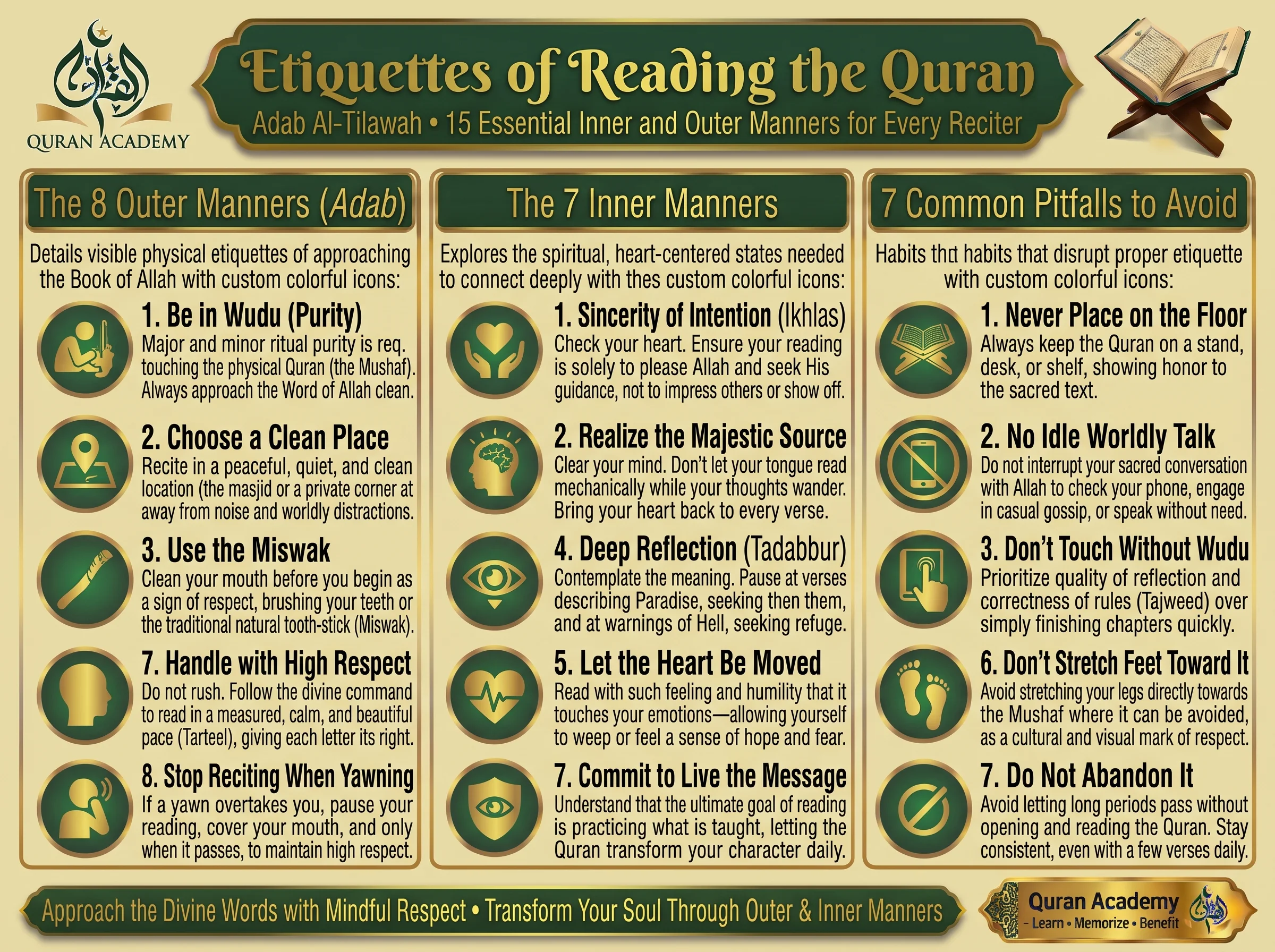
✦ Quick Answer & Key Takeaways: 15 Etiquettes of Reading the Quran
Practicing the etiquettes of reading the Quran (آدَابُ تِلَاوَةِ الْقُرْآنِ الْكَرِيمِ — Adab Al-Tilawah) transforms your daily recitation from a mechanical reading exercise into an intimate, life-changing audience with the Lord of the Worlds! Summarized in classical masterpieces such as Imam An-Nawawi's At-Tibyan fi Adab Hamalat al-Quran, the Sunnah manners of recitation unite 8 Outer Physical Etiquettes (performing Wudu to touch the physical Mushaf, cleaning the mouth with Siwak, sitting respectfully facing the Qiblah, opening with Isti'adhah and Basmalah, reciting with measured Tarteel, beautifying the voice, and honoring the Mushaf) with 7 Inner Heart Etiquettes (pure sincerity, feeling personally addressed by Allah, deep Tadabbur, interacting with verses of mercy and warning, and sealing the sitting with the Prophetic closing Dua). In our 1-on-1 Online Tajweed & Recitation Course, certified Al-Azhar scholars instill both outer Tajweed precision and inner reverence in every student!
- Why Clean the Mouth With Siwak Before Reciting? (Sunan Ibn Majah 291): Because the angel draws near to the reciter's mouth to listen directly to the Speech of Allah!
- Isti'adhah vs. Basmalah Rule (Surah An-Nahl 16:98): Always open with A'oodhu billaahi minash-shaytaanir-rajeem; add Bismillaahir-Rahmaanir-Raheem at the start of every Surah except Surah At-Tawbah (Chapter 9)!
- Interactive Tadabbur (Sahih Muslim 772): Pause to ask Allah for Jannah at verses of mercy, and seek refuge at verses of punishment (when reciting outside Fard congregation).
- The Authentic Closing Dua (An-Nasa'i Al-Kubra 10067): Seal your Quran sitting with Subhaanaka Allaahumma wa bi-hamdika, ash-hadu an laa ilaaha illaa Anta, astaghfiruka wa atoobu ilayk!
Imagine receiving a personal, sealed letter from the greatest king on earth: before opening it, you would wash your hands, sit up straight in a quiet room, silence every distraction, and read every single line with complete awe, asking yourself: "What is the King asking of me in this sentence?" How much greater, then, when you open the Mushaf to read the uncreated Speech of the King of Kings—Allah Almighty!
The noble Companion 'Abdullah ibn Mas'ud (may Allah be pleased with him) used to advise his students: « لَا تَنْثُرُوهُ نَثْرَ الدَّقَلِ، وَلَا تَهُذُّوهُ هَذَّ الشِّعْرِ، قِفُوا عِنْدَ عَجَائِبِهِ، وَحَرِّكُوا بِهِ الْقُلُوبَ، وَلَا يَكُنْ هَمُّ أَحَدِكُمْ آخِرَ السُّورَةِ » ("Do not scatter it hastily like dry dates falling from a tree, and do not race through it like rapid poetry! Pause at its wonders, move your hearts with it, and never let the sole concern of any one of you be merely reaching the end of the Surah!" — Sahih Muslim 822 & Al-Bayhaqi). Building upon our foundational guides to Reading Quran Without Wudu or During Your Period, How to Reflect on the Quran (Tadabbur & Tafseer), and our 15-Minute Daily Quran Routine, this complete guide breaks down all 15 Outer & Inner Etiquettes of Reading the Quran, the 4 Ways to Connect Isti'adhah and Basmalah, the 3 Speeds of Recitation, and how to close your recitation according to the Sunnah.
- 1. Part 1: The 8 Outer Physical Etiquettes Before & During Recitation (Wudu, Siwak, Qiblah & Mushaf Care)
- 2. Part 2: The 7 Inner Heart Etiquettes of Tadabbur & Interacting With the Verses
- 3. Master Tajweed Chart: Rules of Isti'adhah & Basmalah + The 3 Valid Speeds of Recitation
- 4. How to Close Your Quran Recitation: The Authentic Sunnah Dua vs. Saying "Sadaqallahul-Adheem"
- 5. Four Essential Tajweed Rules in the Isti'adhah & Basmalah
- 6. Frequently Asked Questions (FAQs)
1. Part 1: The 8 Outer Physical Etiquettes Before & During Recitation
In his renowned manual At-Tibyan fi Adab Hamalat al-Quran (and verifiable across the Hadith collections in our Online Hadith Explorer), Imam An-Nawawi outlined eight physical manners that prepare your body, tongue, and environment to honor the Book of Allah:
- 1. Perform Wudu Before Touching the Physical Mushaf (Surah Al-Waqi'ah 56:79):
To hold and touch the paper pages of the Arabic Mushaf directly, perform complete Wudu. *(As we detailed in our Fiqh guide on Reading Quran Without Wudu, reciting from memory or reading from a phone/tablet screen without Wudu is permissible, though having Wudu is always more rewarding!).* - 2. Purify Your Mouth With the Siwak or Toothbrush (Sunan Ibn Majah 291 — Sahih):
'Ali ibn Abi Talib (RA) said: "Indeed your mouths are the pathways of the Quran, so purify them with the Siwak!" - 3. Choose a Clean, Quiet Place & Face the Qiblah With Dignity:
Imam An-Nawawi stated: "The noblest of gatherings are those facing the Qiblah." Sit with calmness and humility (though reciting while standing, walking, or lying in bed is also permissible, as Allah praised in Surah Al 'Imran 3:191!). - 4. Begin With the Isti'adhah & Basmalah (Surah An-Nahl 16:98):
Allah commanded: فَإِذَا قَرَأْتَ ٱلْقُرْآنَ فَٱسْتَعِذْ بِٱللَّهِ مِنَ ٱلشَّيْطَانِ ٱلرَّجِيمِ ("So when you recite the Quran, first seek refuge in Allah from Satan, the expelled!"). - 5. Recite With Measured "Tarteel" & Accurate Tajweed (Surah Al-Muzzammil 73:4):
Give every Arabic letter its rightful articulation point (Makhraj) and characteristic (Sifah) without rushing or swallowing vowels. - 6. Beautify Your Voice With Natural Humility (Sahih al-Bukhari 7544 & Abu Dawud 1468):
The Prophet (ﷺ) said: « زَيِّنُوا الْقُرْآنَ بِأَصْوَاتِكُمْ » ("Adorn the Quran with your voices!") and declared that the person with the most beautiful voice for the Quran is the one whom, when you hear them recite, you feel that they fear Allah! - 7. Pause if You Yawn Until the Yawn Finishes (Musannaf Ibn Abi Shaybah):
Mujahid (may Allah have mercy on him) taught that out of reverence for Allah's Speech, if a reciter begins to yawn, they should pause their recitation until the yawn subsides, then resume! - 8. Honor the Physical Placement of the Mushaf at Home:
Always place the Mushaf on a high shelf, desk, or wooden stand (Rahl)—never leave it on the floor, never stack worldly books or objects on top of the Mushaf, and never wet your finger with saliva to turn its sacred pages!
2. Part 2: The 7 Inner Heart Etiquettes of Tadabbur & Interacting With the Verses
While the 8 outer manners honor the vessel of the Quran, the 7 inner manners of the heart unlock its light and healing (as we explore in our Complete Quran Tafseer Guide and Surah Qaf 50:37):
- 9. Pure Sincerity (Al-Ikhlas) for Allah's Pleasure Alone (Sahih Muslim 1905):
Purify your intention before opening the Mushaf: recite to draw closer to Allah, ascend in Jannah (Sunan Abu Dawud 1464: "Read and ascend!"), and earn 10 good deeds for every single letter (Sunan at-Tirmidhi 2910)—never to show off your voice or Hifz! - 10. Feel That Allah Almighty Is Addressing *You* Personally:
Ibn Mas'ud (RA) said: "Whenever you hear Allah say يَا أَيُّهَا ٱلَّذِينَ آمَنُوا (O you who believe!) in the Quran, lend it your full ear and heart—for it is either a good that He is commanding you to do, or an evil that He is warning you away from!" - 11. Deep Reflection (At-Tadabbur — Surah Sad 38:29 & Muhammad 47:24):
One single Surah recited slowly with understanding and reflection (using our Top 50 High-Frequency Quranic Words!) is more transformative to the heart than racing through three Juz's with an absent mind. - 12. Interact Live With Verses of Mercy, Warning & Glorification (Sahih Muslim 772):
Hudhayfah (RA) narrated how the Prophet (ﷺ) recited in night prayer: whenever he passed a verse glorifying Allah, he said Subhanallah; whenever he passed a verse of Jannah or mercy, he paused and asked Allah for it; and whenever he passed a verse of Hellfire, he sought refuge in Allah! - 13. Softening the Heart & Weeping Out of Awe (Surah Al-Isra 17:109):
Allow the verses of the Hereafter (like Surah Al-Hashr 59:21) to humble and soften your heart. - 14. Perform Sajdah at-Tilawah at All 15 Prostration Verses (Sahih Muslim 578):
Whenever you reach one of the 15 prostration symbols (۩, such as at the end of Surah Al-Alaq 96:19 or Surah As-Sajdah 32:15), prostrate immediately to Allah! - 15. Act Upon What You Read (Khuluquhul-Quran — Sahih Muslim 746):
The ultimate etiquette of reading the Quran is translating its manners into how you treat your parents, spouse, children, and neighbors!
3. Master Tajweed Chart: Rules of Isti'adhah & Basmalah + The 3 Speeds of Recitation
In Tajweed scholarship—as defined in our Interactive Tajweed Encyclopedia and tested in our Online Quran Ijazah Exams—how do you connect the Isti'adhah (أَعُوذُ بِٱللَّهِ مِنَ ٱلشَّيْطَانِ ٱلرَّجِيمِ), the Basmalah (بِسْمِ ٱللَّهِ ٱلرَّحْمَٰنِ ٱلرَّحِيمِ), and the First Verse of the Surah? And what are the 3 permissible speeds of recitation (مَرَاتِبُ التِّلَاوَةِ)? Compare both below:
| Tajweed Category | The Valid Options / Tiers | How to Execute & What Is Forbidden |
|---|---|---|
| A. The 4 Valid Ways of Isti'adhah + Basmalah + Start of Surah | 1. Separating All Three (قَطْعُ الْجَمِيعِ — Best!): Pause after Isti'adhah, pause after Basmalah, then start the Surah. 2. Separating 1st & Connecting 2nd to 3rd: Pause after Isti'adhah, then connect Basmalah to the Surah. 3. Connecting 1st to 2nd & Pausing Before 3rd. 4. Connecting All Three in One Breath (وَصْلُ الْجَمِيعِ). |
Note When Connecting Two Surahs: The first 3 options are valid, while connecting the end of Surah 1 directly to the Basmalah and then pausing before Surah 2 is FORBIDDEN (so listeners don't think the Basmalah is the last verse of Surah 1!). |
| B. The 3 Valid Speeds of Recitation (Under Tarteel) 🏆 | 1. At-Tahqeeq (التَّحْقِيقُ — Slow & Deliberate) 2. At-Tadweer (التَّدْوِيرُ — Moderate & Balanced) 3. Al-Hadr (الْحَدْرُ — Brisk & Fluent) |
• Tahqeeq: Best for learning Tajweed and teaching. • Tadweer: Best for daily Salah and contemplation. • Hadr: Best for Manzil Hifz revision and Tarawih—while still preserving every 2-beat Ghunnah and 4-beat Madd! |
4. How to Close Your Quran Recitation: The Authentic Sunnah Dua vs. "Sadaqallahul-Adheem"
One of the most frequently asked questions by Quran students is: "What did Prophet Muhammad (ﷺ) say when he finished a sitting of Quran recitation, and what is the ruling on saying 'Sadaqallahul-Adheem'?"
سُبْحَانَكَ ٱللَّهُمَّ وَبِحَمْدِكَ، لَا إِلَٰهَ إِلَّا أَنْتَ، أَسْتَغْفِرُكَ وَأَتُوبُ إِلَيْكَ.
Transliteration: Subhaanaka Allaahumma wa bi-hamdika, laa ilaaha illaa Anta, astaghfiruka wa atoobu ilayk.
Hadith Proof & Scholarly Balance: Mother of the Believers 'Aishah (may Allah be pleased with her) narrated in As-Sunan Al-Kubra of Imam An-Nasa'i (10067 — graded Sahih by Imam Ibn Hajar and Shaykh Al-Albani) that the Messenger of Allah (ﷺ) never sat in a gathering, nor recited the Quran, nor prayed a prayer without concluding it with these words! When she asked him why, he replied: "If one spoke good [such as reciting the Quran], it acts as a seal upon that good until the Day of Resurrection; and if one spoke anything else, it acts as an expiation for it!"
• What About Saying "صَدَقَ ٱللَّهُ ٱلْعَظِيمُ (Sadaqallaahul-'Adheem)"? The phrase "Allah has spoken the truth" comes directly from Surah Al 'Imran (3:95: قُلْ صَدَقَ ٱللَّهُ), and classical scholars like Imam Al-Qurtubi mentioned it as a beautiful expression of reverence. At the same time, scholars clarify that it was not a fixed Sunnah formula recited by the Prophet (ﷺ) at the end of every Surah—so one should not treat it as an obligatory ritual, and reviving the authentic Subhaanaka Allaahumma wa bi-hamdika... above is the direct Prophetic Sunnah!
Struggling to perfect your Recitation?
Join hundreds of students mastering the Quran with our Verified Al-Azhar Graduates. We offer flexible 1-on-1 sessions tailored to your schedule.
Book a Free Evaluation Class →Mastering the Crisp Qalqalah in "Subْhaanaka" & Never Bouncing the Basmalah!
When you open every Quran sitting with بِسْمِ ٱللَّهِ ٱلرَّحْمَٰنِ ٱلرَّحِيمِ, notice that neither the Seen (سْ) in Bi-smi nor the Haa' (حْ) in Ar-Rahْmaan is a Qalqalah letter—so never bounce them! Then when you close your sitting with سُبْحَانَكَ ٱللَّهُمَّ (Subْhaanaka), give the silent Baa (بْ) a crisp Qalqalah Sughra bounce! Watch Senior Instructor Ustadhah Yasmeen Gamal demonstrate true Qalqalah on our Quran Academy YouTube Channel:
- Smooth Basmalah + Crisp Closing Bounce: Recite every opening and closing formula with Al-Azhar precision!
- 1-on-1 Live Coaching: Beautify your Quran recitation with our Al-Azhar scholars!
5. Four Essential Tajweed Rules in the Isti'adhah & Basmalah
Because you recite the Isti'adhah and Basmalah every single time you open the Mushaf, check your pronunciation against these four Tajweed rules from our 1-on-1 Online Tajweed Course:
- 1. Interdental Soft "Dhal" (ذُ) in "A'oodhu" (أَعُوذُ بِٱللَّهِ):
Applying our Makharij al-Huruf Guide, place the very tip of your tongue lightly against the edges of your upper front teeth for ذُ (Dhu) in A'oo-dhu—never pull your tongue back to turn it into a buzzing Zay ("A'oozu" ❌)! - 2. Light "Shay-" Before Heavy "-taani" in "Minash-Shaytaanir-Rajeem":
Using our Heavy & Light Letters Guide and Laam Shamsiyyah & Qamariyyah Guide, merge the Sun Laam into the Sheen and Yaa Sakinah while keeping ٱلشَّيْـ (Ash-Shay-) 100% Light and smiling before elevating the back of your tongue for the heavy ـطَانِ (-taani)! - 3. Three Sun Laams + Heavy Raa in "Ash-Shaytaanir-Rajeem" & "Ar-Rahmaanir-Raheem":
According to our Ahkam Al-Raa Guide and Hamzatul Wasl Guide, notice that ٱلشَّيْطَانِ، ٱلرَّجِيمِ، ٱلرَّحْمَٰنِ، and ٱلرَّحِيمِ all begin with a merged Sun Laam, and all three Raas carry a Fatha—making them 100% Heavy (Tafkhim) while suppressing excess trilling (Takreer)! - 4. Stopping on "Ar-Rajeem" & "Ar-Raheem" With Madd 'Aarid (2, 4, or 6 Counts):
Following our Rules of Madd, Rules of Waqf, Sifaat al-Huruf, Noon Sakinah Rules, Meem Sakinah Rules, 4 Special Words of Hafs, and 7 Alifs in the Quran guides, keep your Madd 'Aarid lis-Sukoon count equal (e.g., 4 beats on Ar-Rajeeeemْ and 4 beats on Ar-Raheeeemْ) and close the lips gently on the Meem with Tawassut! Test your Tajweed accuracy right now on our Free 3-Minute Tajweed Quiz!
Apply these 15 etiquettes of reading the Quran across our complete library of Surah, Hifz, and Salah guides: Surah Al-Fatihah Guide, Last 3 Verses of Surah Al-Hashr, 10 Shortest Surahs for Salah, Ayatul Kursi, Last 2 Verses of Surah Al-Baqarah, The 3 Quls, Surah Ad-Duha & Ash-Sharh, Surah Ya-Sin, Surah Ar-Rahman, Surah Al-Waqi'ah, Surah Al-Mulk, Surah Al-Kahf, Surah Maryam, Surah Yusuf, Surah Luqman, Surah Al-Hujurat, How to Pray Tahajjud, Salat Al-Witr, Salat Ad-Duha, Salat Al-Eid, 12 Sunnah Rawatib, Salat Al-Jumu'ah, Traveler's Prayer (Qasr & Jam'), Authentic Ruqyah Shariah, Post-Prayer Adhkar, Bedtime Duas, Duas for Anxiety & Debt, Dua Al-Qunoot, and 40 Rabbana Duas in our Online Hifz Program (using our Smart Hifz Planner)! Whether you are learning with our Al-Azhar Certified Tutors or enrolling your child in our 1-on-1 Kids Quran Classes with our Printable Kids Star Chart, see how families across the US, UK, Canada, and Australia rate our teachers on our Verified Student & Parent Reviews Page.
6. Frequently Asked Questions (FAQs) About the Etiquettes of Reading the Quran
1. What are the main outer and inner etiquettes of reading the Quran (Adab Al-Tilawah)?
As compiled by Imam An-Nawawi in At-Tibyan fi Adab Hamalat al-Quran, the etiquettes of reading the Quran divide into: (1) Outer Physical Etiquettes (performing Wudu when touching the physical Mushaf, cleaning the mouth with Siwak, sitting respectfully facing the Qiblah, starting with Isti'adhah and Basmalah, reciting with Tajweed/Tarteel, and beautifying the voice), and (2) Inner Heart Etiquettes (pure sincerity/Ikhlas, realizing you are being addressed by Allah, deep reflection/Tadabbur, weeping or humbling the heart, and interacting with verses of mercy and punishment).
2. When must you say the Isti'adhah and when do you omit the Basmalah?
According to Surah An-Nahl (16:98), you always begin any Quran recitation—whether from the start of a Surah or the middle of a Surah—by saying the Isti'adhah ("A'oodhu billaahi minash-shaytaanir-rajeem"). You recite the Basmalah ("Bismillaahir-Rahmaanir-Raheem") at the beginning of every Surah in the Quran EXCEPT Surah At-Tawbah (Chapter 9), which begins without the Basmalah; if starting in the middle of a Surah, reciting the Basmalah after Isti'adhah is optional.
3. How did Prophet Muhammad (ﷺ) interact with the verses when reciting the Quran?
Recorded in Sahih Muslim (772) from Hudhayfah ibn Al-Yaman (RA), whenever the Prophet (ﷺ) passed by a verse glorifying Allah, he glorified Him (Subhanallah); whenever he passed by a verse of asking/mercy, he asked Allah for His bounty; and whenever he passed by a verse of seeking refuge from punishment, he sought refuge in Allah!
4. What is the scholarly ruling on saying "Sadaqallahul-Adheem" after finishing Quran recitation?
Scholars explain that while "Sadaqallaahul-'Adheem" (Allah the Almighty has spoken the truth — based on Surah Al 'Imran 3:95) is a true statement of praise permitted by many scholars as a general expression of reverence, it was not a fixed Prophetic Sunnah formula said at the end of every recitation. Instead, the established Sunnah when finishing a sitting of Quran recitation is to recite the Kaffaratul-Majlis Dua ("Subhaanaka Allaahumma wa bi-hamdika, laa ilaaha illaa Anta, astaghfiruka wa atoobu ilayk" — Sunan an-Nasa'i Al-Kubra 10067, Sahih)!
5. What are the 3 speeds of Quranic recitation (Tahqeeq, Tadweer, and Hadr) in Tajweed?
All three speeds fall under the Quranic command of Tarteel (Surah Al-Muzzammil 73:4) provided every Tajweed rule is preserved: (1) Tahqeeq (التحقيق — slow, deliberate pace ideal for learning and teaching), (2) Tadweer (التدوير — moderate, balanced pace between slow and fast), and (3) Hadr (الحدر — brisk, fluent pace ideal for daily Hifz revision and Tarawih while maintaining full Madd and Ghunnah counts).
Recite the Quran With Beauty, Tajweed & Reverence!
Experience live 1-on-1 Quran recitation, Tajweed correction, and Tafseer reflection with certified male and female Al-Azhar scholars. Book your free diagnostic trial session today!
Book Your Free 1-on-1 Trial Class →