
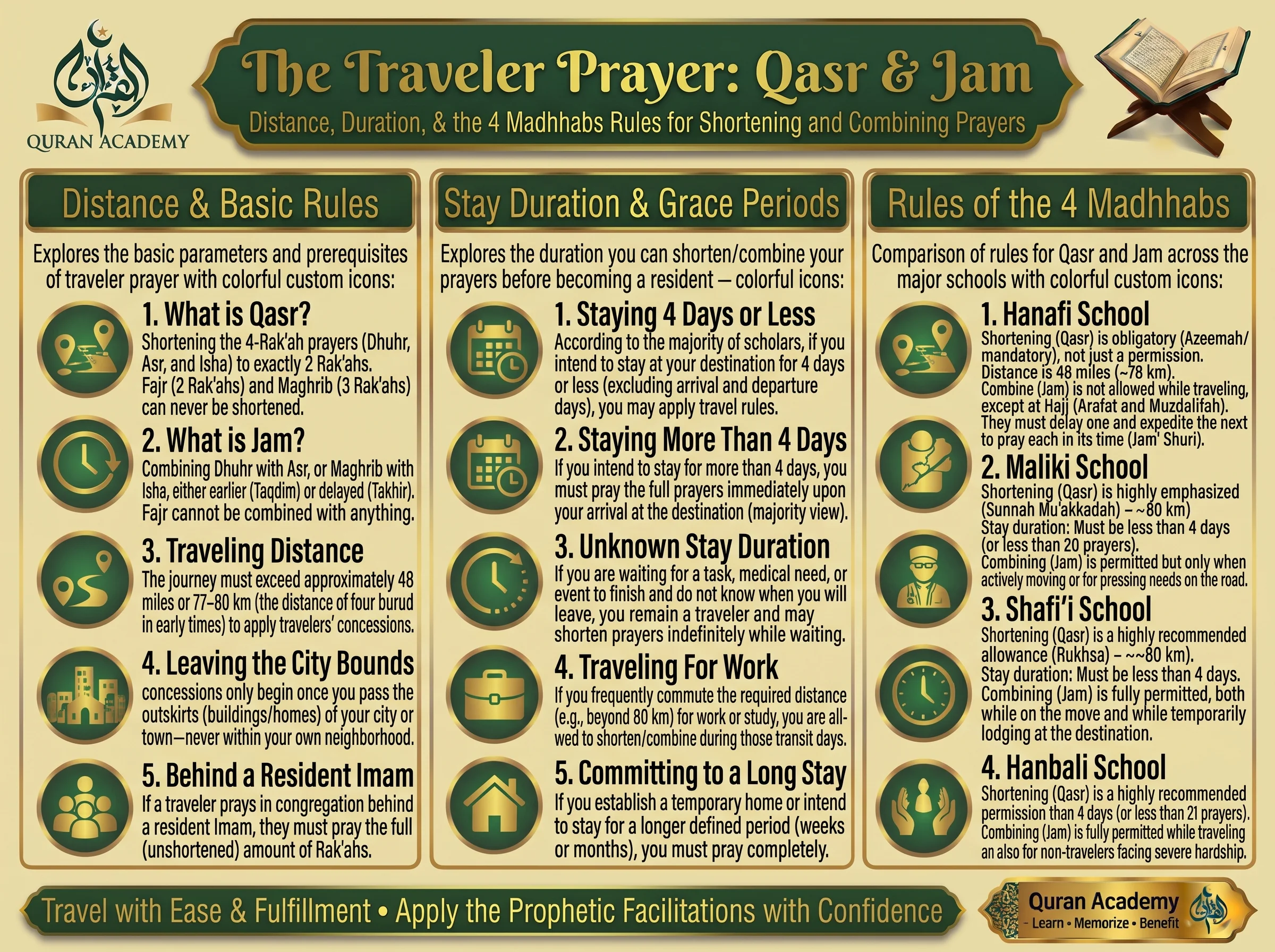
✦ Quick Answer & Key Takeaways: Traveler's Prayer Qasr & Jam' Rules
Mastering traveler prayer Qasr and Jam rules (صَلَاةُ الْمُسَافِرِ: أَحْكَامُ الْقَصْرِ وَالْجَمْعِ) allows every Muslim traveling by car, train, or airplane to accept Allah's gift of ease—for Prophet Muhammad (ﷺ) declared in Sahih Muslim (686) regarding shortening prayer during travel: « صَدَقَةٌ تَصَدَّقَ اللَّهُ بِهَا عَلَيْكُمْ، فَاقْبَلُوا صَدَقَتَهُ » ("It is a charity that Allah has bestowed upon you, so accept His charity!"). Whenever you embark on a permissible journey of approximately 80 to 83 km (48 to 51 miles) or more one way and physically pass the outer boundaries of your city, two Prophetic concessions apply: (1) Al-Qasr (Shortening): shortening the three 4-Rak'ah prayers (Dhuhr, Asr, and Isha) to 2 Rak'ahs each (while Fajr stays 2 and Maghrib stays 3!), and (2) Al-Jam' (Combining): joining Dhuhr + Asr together and Maghrib + Isha together either in the earlier time (Jam' Taqdeem) or the later time (Jam' Ta'kheer). In our 1-on-1 Online Islamic Studies & Fiqh Course, families learn every detail of travel Fiqh, airplane Salah, and the Prophetic Travel Dua!
- When Does Qasr Begin? (Sahih al-Bukhari 1089): Only AFTER you exit the built-up limits of your city—never inside your house before leaving!
- Which Sunnah Rawatib Are Kept During Travel? (Bukhari 1101): The Prophet (ﷺ) dropped the Sunnah Rawatib of Dhuhr, Maghrib, and Isha while traveling, and kept only the 2 Sunnah before Fajr and Salat Al-Witr!
- Praying Behind a Local Resident Imam: If a traveler joins a local resident Imam, the traveler must pray all 4 Rak'ahs!
- Maximum Stay Duration at Destination: 4 days or less (Maliki, Shafi'i & Hanbali) vs. less than 15 days (Hanafi).
Whether you are taking a family road trip across state lines, flying internationally for work or vacation, or traveling to Makkah and Madinah for 'Umrah, prayer times inevitably enter while you are at an airport gate, driving on the highway, or staying in a hotel for a few days.
In Surah An-Nisa (4:101), Allah Almighty revealed the foundational verse of Salat Al-Musafir: وَإِذَا ضَرَبْتُمْ فِي ٱلْأَرْضِ فَلَيْسَ عَلَيْكُمْ جُنَاحٌ أَن تَقْصُرُوا مِنَ ٱلصَّلَاةِ... ("And when you travel throughout the land, there is no blame upon you for shortening the prayer..."). When 'Umar ibn Al-Khattab (RA) asked the Prophet (ﷺ) in Sahih Muslim (686) why we still shorten our prayers even when traveling in complete safety, the Messenger of Allah (ﷺ) smiled and answered that it is a gift of charity from Allah that we should gladly accept! Yet travelers frequently ask five practical questions: "How many kilometers or miles count as travel? How many days can I stay at my hotel and still shorten prayers? What is the exact difference between Qasr (shortening) and Jam' (combining)? What if I pray behind a local Imam at a rest-stop masjid? And how do I pray on a long-haul airplane flight?" Building upon our guides to Wudu, Wiping Over Socks & Tayammum and Salat Al-Jumu'ah, this complete guide answers all five across the four Sunni schools.
- 1. Qasr (Shortening) vs. Jam' (Combining): Which Prayers Change, and How?
- 2. Master Fiqh Chart: Travel Distance, Maximum Stay Duration & Combining Across the 4 Madhhabs
- 3. Five Crucial Travel Scenarios: Praying Behind a Local Imam, Airplane Salah & Wiping Socks
- 4. The Authentic Prophetic Dua for Travel (Surah Az-Zukhruf 43:13–14 & Sahih Muslim 1342)
- 5. Four Essential Tajweed Rules When Reciting the Prophetic Travel Dua
- 6. Frequently Asked Questions (FAQs)
1. Qasr (Shortening) vs. Jam' (Combining): Which Prayers Change, and How?
As we define in our Interactive Tajweed & Islamic Encyclopedia, beginners often confuse Al-Qasr (الْقَصْرُ — Shortening the number of Rak'ahs) with Al-Jam' (الْجَمْعُ — Combining two prayers in one time window). Here is the exact distinction:
4-Rak'ah Prayers Become 2 Rak'ahs!
- Fajr (2 Rak'ahs): Remains 2 Rak'ahs (never shortened).
- Dhuhr (4 Rak'ahs): Shortened to 2 Rak'ahs!
- Asr (4 Rak'ahs): Shortened to 2 Rak'ahs!
- Maghrib (3 Rak'ahs): Remains 3 Rak'ahs (never shortened).
- Isha (4 Rak'ahs): Shortened to 2 Rak'ahs!
Joining Dhuhr + Asr OR Maghrib + Isha!
- Fajr Prayer: Prayed in its own time (NEVER combined with Isha or Dhuhr!).
- Pair 1 (Dhuhr + Asr): Pray 2 Rak'ahs of Dhuhr + Salam, then immediately call a 2nd Iqamah and pray 2 Rak'ahs of Asr! (Either in Dhuhr's window = Jam' Taqdeem, or in Asr's window = Jam' Ta'kheer).
- Pair 2 (Maghrib + Isha): Pray 3 Rak'ahs of Maghrib + Salam, then immediately call a 2nd Iqamah and pray 2 Rak'ahs of Isha! (Either in Maghrib's window = Jam' Taqdeem, or in Isha's window = Jam' Ta'kheer).
How Did the Prophet (ﷺ) Choose Between Jam' Taqdeem (Early Combining) & Jam' Ta'kheer (Late Combining)? In Sahih al-Bukhari (1112) and Sahih Muslim (704), Mu'adh ibn Jabal and Anas ibn Malik (RA) narrated a super practical travel rule: if the Prophet (ﷺ) set out on the road before Dhuhr or Maghrib entered, he delayed Dhuhr/Maghrib to combine it with Asr/Isha when he stopped (Jam' Ta'kheer); and if Dhuhr or Maghrib entered before he set out from his resting spot, he combined Asr/Isha early with Dhuhr/Maghrib before hitting the road (Jam' Taqdeem)!
2. Master Fiqh Chart: Travel Distance, Stay Duration & Combining Across the 4 Madhhabs
Just as we compared the four schools in our guides to Salat Al-Witr and Salat Al-Eid, here is how the Hanafi, Maliki, Shafi'i, and Hanbali schools define the rules of travel prayer:
| Travel Fiqh Rule | Maliki, Shafi'i & Hanbali (Majority) | Hanafi School |
|---|---|---|
| 1. Minimum One-Way Travel Distance (Masafat Al-Qasr) | 4 Burud (16 Farsakhs) ≈ 80 to 83 km (48 to 51 miles) one way—regardless of whether traveled in 1 hour by plane/car or 2 days on foot! *(And travel must be permissible, not for sin).* | 3-Day Journey on Foot/Camel ≈ 77.25 to 88 km (48 to 55 miles) one way—which remarkably converges at virtually the exact same ~80 km (50-mile) benchmark in modern fatwas! |
| 2. Ruling of Shortening (Qasr): Obligatory or Sunnah? | Emphasized Sunnah (Sunnah Mu'akkadah) in Maliki & Hanbali, and a superior concession (Rukhsah) in Shafi'i. | Wajib ('Azimah / Obligatory)! Based on 'Aishah's (RA) Hadith in Sahih al-Bukhari (350) that prayer was first enjoined as 2 Rak'ahs and remained 2 Rak'ahs in travel! |
| 3. Maximum Known Stay Duration at Destination | 4 Days or Less (or 20 Fard prayers in Hanbali): If you intend to stay at your destination for 4 complete days or less (not counting the day of arrival and day of departure in Shafi'i/Maliki), you perform Qasr. If you plan from the start to stay more than 4 days, you pray full 4-Rak'ah prayers as soon as you arrive at the destination (though you still perform Qasr on the road/flight getting there and back!). | Less Than 15 Days: If you intend to stay in a single city/town for 14 days or less, you continue to shorten your 4-Rak'ah prayers to 2 Rak'ahs for the entire stay! If you intend to stay in one single city for 15 full days or more, you become a resident (Muqeem) upon arrival and pray full prayers. |
| 4. Ruling of Combining Two Prayers (Al-Jam') 🏆 | Permissible during travel (especially while actively on the road/flight, and permissible when needed during a short stay, though praying each shortened 2-Rak'ah prayer in its own time when settled at a hotel is preferred!). | In the Hanafi school, literal combining in one time is restricted to 'Arafah and Muzdalifah during Hajj; during regular travel, Hanafis practice Apparent Combining (الْجَمْعُ الصُّورِيُّ): delaying Dhuhr/Maghrib to the very end of its time window, and praying Asr/Isha at the very start of its time window! |
3. Five Crucial Travel Scenarios: Local Imam, Airplane Salah & Wiping Socks
Here are the clear, consensus-backed answers to the five real-world situations every Muslim traveler encounters:
- 1. What If a Traveler Prays Behind a Local Resident Imam? (Complete 4 Rak'ahs!):
When Ibn 'Abbas (RA) was asked in Musnad Ahmad (1862 — Sahih): "Why does the traveler pray 2 Rak'ahs when praying alone [or with fellow travelers], and 4 Rak'ahs when praying behind a resident Imam?" He replied: « تِلْكَ السُّنَّةُ » ("That is the Sunnah!"). Even if you join a local resident Imam in the 2nd half of his prayer, you must complete all 4 Rak'ahs! - 2. What If a Traveler Leads Local Residents as the Imam?
Following the Prophetic practice during the Conquest of Makkah (Sunan Abu Dawud 1229), the traveler Imam leads for 2 Rak'ahs and gives Salam, and the local residents behind him stand up without giving Salam to complete their remaining 2 Rak'ahs! - 3. How to Pray on an Airplane, Train, or Ship:
• Before Boarding or After Landing (Via Jam' Taqdeem or Ta'kheer): Whenever possible, if your flight spans Dhuhr/Asr or Maghrib/Isha, combine the two prayers at the airport prayer room before boarding or after landing so you can pray standing on solid ground facing the Qiblah!
• If the Entire Prayer Window (e.g., Fajr or Both Combined Windows) Will Expire in the Air: Never let a prayer time expire! Perform Wudu (using a small water bottle in the lavatory), ask the flight crew if there is a small open space by the galley to stand facing the Qiblah (check the in-flight map!), and pray. If turbulence or seatbelt signs make standing impossible, pray in your seat facing as close to the Qiblah as you can, bowing your torso slightly for Ruku' and slightly lower for Sujood (Surah At-Taghabun 64:16: Fattaqullaaha mastata'tum)! - 4. Wiping Over Socks (Al-Mash 'alal-Khuffayn) for 3 Full Days & Nights:
As we detailed in our Wudu, Wiping Socks & Tayammum Guide, while a resident wipes over thick socks put on in a state of complete Wudu for 24 hours, a traveler wipes over them for 72 hours (3 days and 3 nights — Sahih Muslim 276)! - 5. What About Salat Al-Jumu'ah While Traveling?
As we learned in our Salat Al-Jumu'ah Guide, a traveler on the road is exempted from the obligation of Jumu'ah and prays 2 Rak'ahs of shortened Dhuhr—though if the traveler is staying in a city and attends Jumu'ah at the local mosque, it is valid and rewarding!
4. The Authentic Prophetic Dua for Travel (Surah Az-Zukhruf 43:13–14 & Sahih Muslim 1342)
In Sunan Abu Dawud (2539) and At-Tirmidhi (3448 — Hasan), the Prophet (ﷺ) gave every traveler a heartwarming glad tiding: « ثَلَاثُ دَعَوَاتٍ مُسْتَجَابَاتٌ لَا شَكَّ فِيهِنَّ: دَعْوَةُ الْمَظْلُومِ، وَدَعْوَةُ الْمُسَافِرِ، وَدَعْوَةُ الْوَالِدِ عَلَى وَلَدِهِ » ("Three supplications are answered without a shadow of doubt: the Dua of the oppressed, the Dua of the traveler, and the Dua of a parent for their child!"). And in Sahih Muslim (1342), 'Abdullah ibn 'Umar (RA) narrated the exact words the Prophet (ﷺ) recited every time he mounted his ride to set out on a journey (and when returning home):
ٱللَّهُ أَكْبَرُ، ٱللَّهُ أَكْبَرُ، ٱللَّهُ أَكْبَرُ.
﴿ سُبْحَانَ ٱلَّذِي سَخَّرَ لَنَا هَٰذَا وَمَا كُنَّا لَهُ مُقْرِنِينَ ﴿١٣﴾ وَإِنَّا إِلَىٰ رَبِّنَا لَمُنْقَلِبُونَ ﴿١٤﴾ ﴾
ٱللَّهُمَّ إِنَّا نَسْأَلُكَ فِي سَفَرِنَا هَٰذَا ٱلْبِرَّ وَٱلتَّقْوَىٰ، وَمِنَ ٱلْعَمَلِ مَا تَرْضَىٰ، ٱللَّهُمَّ هَوِّنْ عَلَيْنَا سَفَرَنَا هَٰذَا وَٱطْوِ عَنَّا بُعْدَهُ، ٱللَّهُمَّ أَنْتَ ٱلصَّاحِبُ فِي ٱلسَّفَرِ، وَٱلْخَلِيفَةُ فِي ٱلْأَهْلِ، ٱللَّهُمَّ إِنِّي أَعُوذُ بِكَ مِنْ وَعْثَاءِ ٱلسَّفَرِ، وَكَآبَةِ ٱلْمَنْظَرِ، وَسُوءِ ٱلْمُنْقَلَبِ فِي ٱلْمَالِ وَٱلْأَهْلِ.
Transliteration: Allaahu Akbar (3x). Subhaanal-ladhee sakh-khara lanaa haadhaa wa maa kunnaa lahu muqrineen, wa innaa ilaa Rabbinaa la-munqaliboon. Allaahumma innaa nas'aluka fee safarinaa haadhal-birra wat-taqwaa, wa minal-'amali maa tardaa. Allaahumma hawwin 'alaynaa safaranaa haadhaa watwi 'annaa bu'dah. Allaahumma Antas-Saahibu fis-safar, wal-Khaleefatu fil-ahl. Allaahumma innee a'oodhu bika min wa'thaa'is-safar, wa ka'aabatil-mandhar, wa soo'il-munqalabi fil-maali wal-ahl.
Struggling to perfect your Recitation?
Join hundreds of students mastering the Quran with our Verified Al-Azhar Graduates. We offer flexible 1-on-1 sessions tailored to your schedule.
Book a Free Evaluation Class →And What to Add When Returning Home: Repeat the exact same Travel Dua above, and add at the very end: « آيِبُونَ، تَائِبُونَ، عَابِدُونَ، لِرَبِّنَا حَامِدُونَ » (Aayiboona, taa'iboona, 'aabidoona, li-Rabbinaa haamidoon — "Returning safely, repenting, worshipping, and praising our Lord!").
Mastering the Crisp Qalqalah in "Subْhaana", "Muqْrineen" (43:13) & "Watْwi"!
In the Quranic verse of the Travel Dua—سُبْحَانَ ٱلَّذِي سَخَّرَ لَنَا هَٰذَا وَمَا كُنَّا لَهُ مُقْرِنِينَ (Subْhaanal-ladhee... Muqْrineen — Surah Az-Zukhruf 43:13)—and in وَٱطْوِ عَنَّا بُعْدَهُ (Watْwi) and ٱلتَّقْوَىٰ (At-Taqْwaa), notice how the silent Baa (بْ), Qaaf (قْ), and Taa' (طْ) are all among the 5 Qalqalah (Echoing) letters (ق ط ب ج د)! Watch Senior Instructor Ustadhah Yasmeen Gamal demonstrate Qalqalah on our Quran Academy YouTube Channel:
- Heavy Qaaf Bounce + Light Raa in "Muqْrineen": Bounce the heavy Qaaf first, then keep the Raa with Kasrah light!
- 1-on-1 Live Coaching: Study Quran & Tajweed from anywhere in the world!
5. Four Essential Tajweed Rules When Reciting the Prophetic Travel Dua
Open our Online Uthmani Quran Explorer to Surah Az-Zukhruf (43:13–14) and apply these four Tajweed rules from our 1-on-1 Online Tajweed Course:
- 1. Heavy Ikhfaa' Ghunnah in "La-Munqaliboon" (لَمُنْقَلِبُونَ — 43:14) & "Al-Mandhar":
As we mastered in our Noon Sakinah & Tanween Guide and Heavy & Light Letters Guide, in both لَمُنْقَلِبُونَ / ٱلْمُنْقَلَبِ (Noon Sakinah before heavy ق) and ٱلْمَنْظَرِ (Noon Sakinah before heavy ظ), make the 2-beat Ikhfaa' nasal sound 100% Heavy (Tafkhim al-Ghunnah)! - 2. Light Raa vs. Heavy Raa Across the Travel Dua (Ahkam Al-Raa):
Applying our Ahkam Al-Raa Guide, compare the Light Raa (Tarqeeq) in مُقْرِنِينَ (Muqْ-ri-neen) and فِي سَفَرِنَا (Fee Safa-ri-naa) (because of their Kasrah) against the Heavy Raa (Tafkhim) in سَخَّرَ (Sakh-khara), رَبِّنَا (Rabbinaa), تَرْضَىٰ (Tarْdaa), and when stopping on ٱلْبِرَّ (Al-Birrْ — in continuation with Fatha it is Heavy; if stopped on after Kasrah, Light!) and ٱلسَّفَرِ (As-Safarْ — Heavy on stop!)! - 3. Four-to-Five Beat Madd Ja'iz Munfasil vs. Madd Wajib Muttasil:
Using our Rules of Madd Guide, in وَإِنَّا إِلَىٰ رَبِّنَا (Wa innaaaa ilaa), stretch the Alif across the two words for 4 to 5 counts (Madd Ja'iz Munfasil), and in وَعْثَاءِ (Wa'thaaaa'i) and سُوءِ (Soooo'i), stretch the Madd letter inside the same word for 4 to 5 counts (Madd Wajib Muttasil)! - 4. Sun & Moon Letters in "As-Saahibu fis-Safar" vs. "Al-Khaleefatu fil-Ahl":
According to our Laam Shamsiyyah & Qamariyyah, Hamzatul Wasl vs. Qat', Makharij al-Huruf, Sifaat al-Huruf, Meem Sakinah Rules, Rules of Waqf, 4 Special Words of Hafs, and 7 Alifs in the Quran guides, merge the Sun Laams in ٱلصَّاحِبُ فِي ٱلسَّفَرِ (As-Saahibu fis-Safar) and pronounce the Moon Laams clearly in وَٱلْخَلِيفَةُ فِي ٱلْأَهْلِ (Wal-Khaleefatu fil-Ahl)! Test your Tajweed accuracy right now on our Free 3-Minute Tajweed Quiz!
Because our classes at Quran Academy are 100% online and flexible across all time zones, you and your children never have to pause your Quran progress even while traveling for summer vacation! Pair this travel guide with our complete library: How to Pray Tahajjud & Qiyam Al-Layl, How to Pray Salat Ad-Duha, Salat Al-Istikharah (before booking your trip!), Sujood As-Sahw, Salat Al-Janazah, Authentic Duas After Fard Salah, Bedtime & Waking Up Duas, Prophetic Duas for Anxiety & Debt Relief, Authentic Ruqyah Shariah, Dua Al-Qunoot, Morning & Evening Adhkar, 40 Rabbana Duas, Surah Al-Fatihah Guide, Last 3 Verses of Surah Al-Hashr, Surah Qaf 6-Day Plan, 10 Shortest Surahs for Salah (ideal for travel!), Surah Al-Alaq Guide, Ayatul Kursi, Last 2 Verses of Surah Al-Baqarah, The 3 Quls, Surah Ad-Duha & Ash-Sharh, Surah Ya-Sin, Surah Ar-Rahman, Surah Al-Waqi'ah, Surah Maryam, Surah Yusuf, Surah Luqman, Surah Al-Hujurat, Surah As-Sajdah & Al-Insan, 5 Pillars of Islam, and 25 Prophets in the Quran in our Online Hifz Program (using our Smart Hifz Planner)! Whether you are learning with our Al-Azhar Certified Tutors or enrolling your child in our 1-on-1 Kids Quran Classes with our Printable Kids Star Chart, read how families across the US, UK, Canada, and Australia rate our teachers on our Verified Student & Parent Reviews Page.
6. Frequently Asked Questions (FAQs) About Traveler's Prayer (Qasr & Jam')
1. What is the minimum travel distance required to shorten prayers (Qasr) in Islam?
According to the majority of scholars (Maliki, Shafi'i, and Hanbali schools, based on the practice of Ibn 'Umar and Ibn 'Abbas RA in Sahih al-Bukhari), the minimum travel distance (Masafat al-Qasr) is 4 Burud (16 Farsakhs), which equals approximately 80 to 83 kilometers (48 to 51 miles) one way. In the Hanafi school, the minimum distance is a 3-day journey on foot or camel, which equals approximately 77.25 to 88 kilometers (48 to 55 miles).
2. Which prayers are shortened in Qasr, and which prayers are combined in Jam'?
In Qasr (Shortening), ONLY the three 4-Rak'ah obligatory prayers—Dhuhr, Asr, and Isha—are shortened from 4 Rak'ahs to 2 Rak'ahs; Fajr (2 Rak'ahs) and Maghrib (3 Rak'ahs) are never shortened! In Jam' (Combining), Dhuhr and Asr can be combined together (either in Dhuhr's time as Jam' Taqdeem, or in Asr's time as Jam' Ta'kheer), and Maghrib and Isha can be combined together; Fajr is never combined with any prayer.
3. How many days can a traveler stay in a destination city and still shorten their prayers?
If a traveler knows their exact stay duration in advance: (1) In the Maliki, Shafi'i, and Hanbali schools, if you intend to stay for 4 days or less (excluding the day of arrival and day of departure, or 20 prayers in Hanbali), you shorten your prayers; if you intend to stay more than 4 days, you pray full prayers from the moment you arrive. (2) In the Hanafi school, if you intend to stay for less than 15 days in one city, you continue to shorten your prayers; if 15 days or more, you pray full prayers. If a traveler does NOT know when their business will finish, all four schools agree they may continue shortening even for months!
4. What happens if a traveler prays behind a resident (local) Imam in the mosque?
By scholarly consensus across all four Sunni schools (based on the narration of Ibn 'Abbas RA in Musnad Ahmad 1862 — Sahih), if a traveler prays Dhuhr, Asr, or Isha behind a local resident Imam—even if the traveler joins in the final Tashahhud—the traveler MUST complete all 4 Rak'ahs following the resident Imam! However, if a traveler leads local residents as the Imam, the traveler prays 2 Rak'ahs, gives Salam, and tells the local residents: "Complete your 4 Rak'ahs, for we are travelers!"
5. When does a traveler begin shortening prayers—at home before leaving or after passing city limits?
As recorded in Sahih al-Bukhari (1089) and Sahih Muslim (690) from Anas ibn Malik (RA), a traveler does NOT begin shortening or combining prayers inside their own home or city before departure; Qasr and Jam' begin only AFTER you have physically exited the built-up boundaries ('Umran) of your city or town!
Keep Your Family Connected to the Quran at Home & On the Road!
Whether at home or traveling abroad, enjoy flexible 1-on-1 Quran, Tajweed, Hifz, and Islamic Studies classes with certified male and female Al-Azhar scholars. Book your free trial session today!
Book Your Free 1-on-1 Trial Class →