
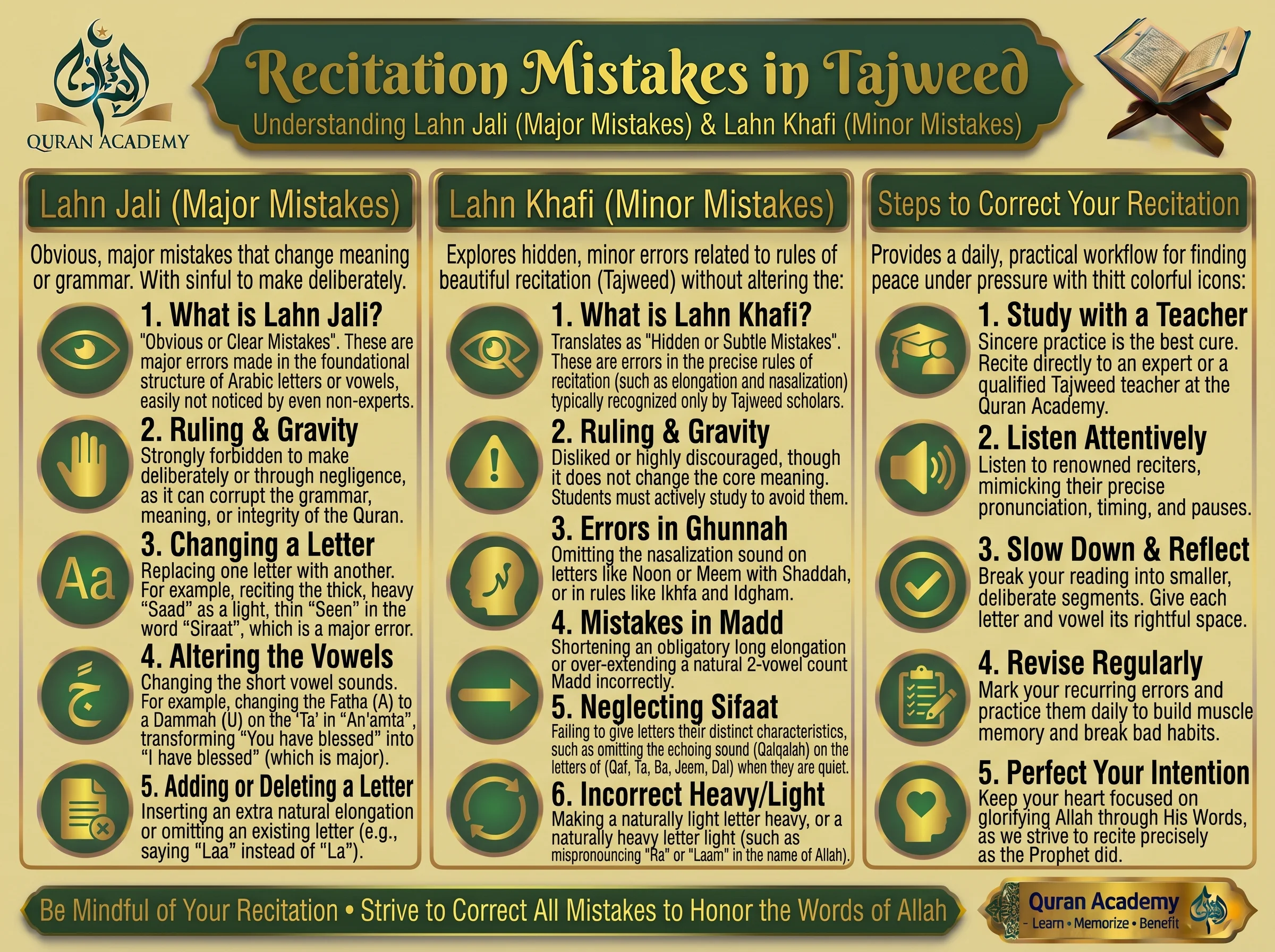
✦ Quick Answer & Key Takeaways: Lahn Jali vs. Lahn Khafi in Tajweed
Understanding Lahn Jali and Lahn Khafi in Tajweed (اللَّحْنُ الْجَلِيُّ وَاللَّحْنُ الْخَفِيُّ فِي التَّجْوِيدِ) is the foundation of every Quran student's journey—because protecting your tongue from pronunciation errors (Al-Lahn) is the very reason the science of Tajweed was codified! Classical scholars divide all recitation mistakes into two distinct grades: (1) Al-Lahn Al-Jali (Clear / Major Mistake)—an error in the consonant or vowel structure of a word (such as turning heavy ط into light ت, changing the Fatha of أَنْعَمْتَ to a Damma, or dropping a 2-count natural Alif) that is obvious to both scholars and general Arabic speakers and can alter the meaning or invalidate Salah; and (2) Al-Lahn Al-Khafi (Hidden / Minor Mistake)—an error in phonetic perfection (such as skipping a 2-beat Ghunnah, shortening a 4-beat Madd, or over-rolling the Raa) that does not change the meaning and is noticed only by trained Tajweed specialists. In our 1-on-1 Online Tajweed Course, certified Al-Azhar scholars help you eliminate 100% of Lahn Jali first, then polish away every trace of Lahn Khafi!
- Why Called "Jali" (Clear) vs. "Khafi" (Hidden)? Jali is visible to everyone who knows Arabic grammar; Khafi is "hidden" from regular listeners and heard only by the trained ear of a Tajweed teacher!
- Impact on Daily Salah: Uncorrected Lahn Jali that corrupts the meaning in Surah Al-Fatihah can invalidate prayer; Lahn Khafi never invalidates Salah, though avoiding it completes the beauty of recitation!
- The Beginner's Glad Tiding (Sahih al-Bukhari 4937): Whoever struggles with their tongue while sincerely learning to fix their mistakes receives double the reward!
- The Ijazah Benchmark: Passing an Online Quran Ijazah Exam requires zero Lahn Jali and mastery over Lahn Khafi!
In the Arabic language, a single millimeter of tongue placement or a single changed vowel can transform a word into its exact opposite! For example, in Surah Al-Hashr (59:24), Allah describes Himself as ٱلْخَالِقُ (Al-Khaaliq — with a deep uvular Qaaf ق), which means "The Creator." If an untrained reciter replaces the heavy ق (Qaaf) with a light ك (Kaaf) and says "Al-Khaalik" ❌, the meaning changes to "the one who shaves/destroys"! Similarly, in Surah At-Tawbah (9:3): أَنَّ ٱللَّهَ بَرِيءٌ مِّنَ ٱلْمُشْرِكِينَ وَرَسُولُهُ (Wa Rasoolu-HU — with a Damma) means "Allah is free from the polytheists, and so is His Messenger!" If someone reads a Kasrah on the Laam (Wa Rasooli-hi ❌), it would make His Messenger attached to the polytheists—inverting the entire creed of Islam!
At the same time, many sincere beginners and non-native speakers suffer from unnecessary anxiety: they worry that if their 2-beat Ghunnah in Inna is half a second too short, or if their 4-beat Madd in As-Samaa' is slightly uneven, they are sinning or their Salah is invalid! That is why every Muslim needs to know the exact boundary between Al-Lahn Al-Jali (Major Errors) and Al-Lahn Al-Khafi (Hidden Errors). Building upon our guides to Makharij al-Huruf, Sifaat al-Huruf, Idgham Mutamathilayn, Mutajanisayn & Mutaqaribayn, and The 10 Qira'at of the Quran, this complete guide breaks down both types of Lahn with side-by-side charts, Quranic examples, and Fiqh rulings.
- 1. Master Comparison Chart: Lahn Jali (Major Error) vs. Lahn Khafi (Minor Error)
- 2. Deep Dive Into Lahn Jali: The 3 Categories (Letters, Vowels & Dropped Madd/Shaddah) With Examples
- 3. Deep Dive Into Lahn Khafi: The 5 Most Common Hidden Mistakes & How to Fix Them
- 4. Fiqh Rulings Across the 4 Madhhabs: When Does Lahn Invalidate Salah, and Who Is Excused?
- 5. Your 4-Step Self-Audit Checklist to Eliminate Both Lahn Jali & Lahn Khafi
- 6. Frequently Asked Questions (FAQs)
1. Master Comparison Chart: Lahn Jali (Major Error) vs. Lahn Khafi (Minor Error)
Linguistically—as defined in our Interactive Tajweed Encyclopedia—Al-Lahn (اللَّحْنُ) means deviation and inclination away from correctness in speech. Compare its two branches side by side:
| Comparison Point | Al-Lahn Al-Jali (اللَّحْنُ الْجَلِيُّ — Major) | Al-Lahn Al-Khafi (اللَّحْنُ الْخَفِيُّ — Minor) |
|---|---|---|
| 1. Literal Meaning & Why Named Thus | "Clear / Obvious Error": Because both Tajweed scholars AND general Arabic speakers immediately hear that the word or grammar has been broken! | "Hidden / Subtle Error": Because it is hidden from ordinary listeners and noticed only by trained Tajweed teachers! |
| 2. What Does It Affect? | Affects the core letters (Mabna), vowels (I'rab), Shaddahs, and natural 2-beat Madds—often corrupting the meaning of the verse! | Affects ornamental Tajweed rules (Ahkam at-Tilawah) like 2-beat Ghunnahs, 4-to-6 beat Madds, Raa heaviness, and Qalqalah—without changing the meaning! |
| 3. Islamic Ruling (Hukm Shar'i) | Strictly Forbidden (Haram) by Consensus! Avoiding it is an individual obligation (Fard 'Ayn) upon every reciter. | Disliked (Makruh) for general Muslims and a defect for advanced students; avoiding it completes the perfection of Tarteel. |
| 4. Effect on Validity of Salah 🏆 | Can Invalidate Salah if committed in Surah Al-Fatihah in a way that corrupts the meaning and is not corrected! | NEVER Invalidates Salah! Your prayer is 100% valid across all four Sunni schools even if Lahn Khafi occurs. |
2. Deep Dive Into Lahn Jali: The 3 Categories (Letters, Vowels & Dropped Madd/Shaddah)
Open our Online Uthmani Quran Explorer and inspect the three specific ways Lahn Jali occurs—even when the reciter doesn't realize they changed the meaning:
- Category 1 — Replacing One Arabic Letter With Another (إِبْدَالُ حَرْفٍ بِحَرْفٍ):
As we warned in our Heavy & Light Letters Guide and Makharij al-Huruf Guide, look at the 6 most dangerous letter substitutions for non-native speakers:
• Replacing Heavy ط (Taa') with Light ت (Taa): Reading ٱلطَّامَّةُ (At-Taammah — The Overwhelming Calamity, 79:34) as "At-Taammah" with ت (which means "the complete one")!
• Replacing Heavy ص (Saad) with Light س (Seen) or Vice Versa: Reading عَسَىٰ (Perhaps/It may be) as عَصَىٰ (He disobeyed!), or reading وَأَسَرُّوا ٱلنَّدَامَةَ (They concealed regret — 10:54) with ص (which means "they insisted on regret")!
• Replacing Interdental ذ / ث / ظ with Buzzing ز / س: Reading ٱلَّذِينَ (Alladheena) as "Allazeena" ❌, ٱلْكَوْثَرَ (Al-Kawthar — Abundance, 108:1) as "Al-Kawsar" ❌, or مَحْظُورًا (Mahdhooraa — Restricted, 17:20) as مَحْذُورًا (Mahdhooraa — Feared/Beware of, 17:57)!
• Replacing Middle-Throat ح & ع with Chest هـ & أ: Reading ٱلْحَمْدُ (Al-Hamdu) as "Al-Hamdu" with English H (which means death/extinction!), or أَلِيمٌ (Aleem — Painful) as عَلِيمٌ ('Aleem — All-Knowing)!
• Replacing Heavy ق (Qaaf) with Light ك (Kaaf): Reading قَلْب (Qalb — Heart) as كَلْب (Kalb — Dog), or خَلَقْنَاكُمْ (Khalaqnaakum — We created you) with ك! - Category 2 — Changing a Vowel (Fatha, Damma, Kasrah, or Sukoon):
Even if a vowel change does NOT corrupt the meaning (such as reading a Damma instead of a Fatha on the Dal of Al-Hamdu), it is still classified as Lahn Jali because it breaks the transmitted Quranic word! And when it DOES change the grammatical doer vs. object, it inverts the theology of the verse:
• In Surah Al-Fatihah (1:7): Reading أَنْعَمْتَ ('An'am-TA — "You [O Allah] bestowed favor") as "An'am-TU" ("I bestowed favor" ❌) or "An'am-TI" ❌!
• In Surah Fatir (35:28): إِنَّمَا يَخْشَى ٱللَّهَ مِنْ عِبَادِهِ ٱلْعُلَمَاءُ: Here, ٱللَّهَ (Allaaha) has a Fatha (He is the One feared) and ٱلْعُلَمَاءُ (Al-'Ulamaa'u) has a Damma (the scholars are the ones who fear Him!). Reversing those two vowels would reverse the entire meaning! - Category 3 — Dropping or Adding a Natural Madd (Madd Tabee'i) or a Shaddah:
Why is dropping or adding a 2-beat Madd Tabee'i classified as a Major Error (Lahn Jali) rather than a minor Madd error? Because in Arabic, a 2-beat Alif, Waw, or Yaa changes the grammar from singular to dual/plural, or from affirmation to negation!
• Dropping a Madd Tabee'i: Reading لَا أَعْبُدُ (Laa a'budu — "I do NOT worship" in 109:2) quickly without the Alif as "La-a'budu" ("Indeed I DO worship!" ❌), or reading قَالَا رَبَّنَا (Qaalaa — "They both [Adam & Hawwa] said" in 7:23) as singular "Qaala" ("He said")!
• Adding a False Madd Tabee'i (Tamteet): Stretching the short Fatha of أَنَا۠ in continuation (7 Alifs Rule), or stretching كُنْتُمْ (Kuntum) into "Kuntoom" ❌!
• Dropping a Shaddah: Because a Shaddah is two letters, dropping the Shaddah on إِيَّاكَ (Iyyaaka — 1:5) or رَبِّ (Rabbi — 1:2) drops an entire letter from the Book of Allah!
3. Deep Dive Into Lahn Khafi: The 5 Most Common Hidden Mistakes & How to Fix Them
Once your recitation is free of the major errors above, how do you polish away Al-Lahn Al-Khafi (اللَّحْنُ الْخَفِيُّ) so your voice sounds like a master Qari'? Check your recitation against these 5 subtle traps:
| # & Hidden Error Type | What It Sounds Like (❌ Mistake) | How to Fix It (✅ Al-Azhar Standard) |
|---|---|---|
| 1. Rushing or Skipping the 2-Beat Ghunnah | Tapped quickly as 1 beat in إِنَّ، عَمَّ، مَن يَقُولُ، أَنبِئْهُم، مِن قَبْلُ, or pressing the tongue tip to the gums during Ikhfaa'! | Hold every Noon Sakinah & Meem Sakinah Ghunnah for a calm, resonant 2 full beats, and hover the tongue near the next letter during Ikhfaa'! |
| 2. Uneven Secondary Madd Counts | Stretching جَاءَ / ٱلسَّمَاءِ for only 2 beats, or reading one Madd 'Aarid at 2 beats and the next verse at 6 beats! | Follow our Rules of Madd Guide: give Madd Muttasil/Munfasil 4–5 beats, Madd Lazim 6 beats, and keep all verse-ending Madd 'Aarid equal! |
| 3. Over-Trilling or Miscoloring the Raa | Rolling ٱلرَّحْمَٰنِ like a Spanish "rrr" (Takreer), or making the Raa in فِرْعَوْنَ or مِرْيَةٍ heavy! | Follow our Ahkam Al-Raa Guide: tap the gum ridge once firmly with a tiny gap for sound to pass without multiple trills! |
| 4. Heavy Contagion on Neighboring Light Letters | Making the Meem and Waw heavy in مَخْمَصَةٍ or وَٱللَّهُ ("Wallaahu" like English "Wall" ❌)! | Keep وَ (Wa-) and مَ (Ma-) 100% smiling and light right before elevating the tongue for ٱللَّهُ or خْ! |
| 5. False Qalqalah vs. Swallowed Qalqalah 🏆 | Bouncing non-Qalqalah letters like ٱلْحَمْدُ، أَنْعَمْتَ، يَعْلَمُونَ, OR swallowing true Qalqalah in ٱلْفَلَقْ، أَحَدْ! | Hold لْ نْ عْ مْ رْ smoothly with Tawassut (zero bounce!), and bounce ONLY the 5 Qalqalah letters (ق ط ب ج د)! |
Eliminating the #1 Lahn Khafi: False Qalqalah vs. True Qalqalah (ق ط ب ج د)!
In our diagnostic Tajweed evaluations at Quran Academy, the single most common Lahn Khafi we hear is bouncing silent letters that are NOT Qalqalah letters (like نْ، مْ، لْ، غْ، كْ، تْ), or turning a Qalqalah bounce into a full Fatha or Kasrah vowel (which turns Lahn Khafi into Lahn Jali!) Watch Senior Instructor Ustadhah Yasmeen Gamal demonstrate clean Qalqalah on our Quran Academy YouTube Channel:
- Neutral Echo Without a Vowel: Separate the organ cleanly without adding an "-a" or "-i" vowel!
- 1-on-1 Live Diagnostic Audit: Have an Al-Azhar scholar check your recitation free!
4. Fiqh Rulings Across the 4 Madhhabs: When Does Lahn Invalidate Salah, and Who Is Excused?
In his famous poem Al-Muqaddimah Al-Jazariyyah, Imam Ibn al-Jazari wrote: وَٱلْأَخْذُ بِٱلتَّجْوِيدِ حَتْمٌ لَازِمُ • مَنْ لَمْ يُجَوِّدِ ٱلْقُرَانَ آثِمُ ("Adhering to Tajweed is an obligatory duty; whoever does not recite the Quran with Tajweed is sinful!"). How did the jurists of the four Sunni schools explain this line in relation to Lahn Jali vs. Lahn Khafi and the validity of Salah?
Struggling to perfect your Recitation?
Join hundreds of students mastering the Quran with our Verified Al-Azhar Graduates. We offer flexible 1-on-1 sessions tailored to your schedule.
Book a Free Evaluation Class →- 1. What Is Obligatory Upon Every Muslim Individual (Fard 'Ayn)?
Preserving the consonants, vowels, and Shaddahs of the Quran—especially in Surah Al-Fatihah and the short Surahs recited in Salah—so that your recitation is 100% free of Lahn Jali (Major Errors)! That is what Imam Ibn al-Jazari meant by "whoever does not recite with Tajweed [by deliberately committing Lahn Jali] is sinful." - 2. What Is a Communal Obligation Upon Scholars & Ijazah Students (Fard Kifayah)?
Studying the theoretical terminology of Tajweed and mastering the fine nuances that prevent Lahn Khafi so the Ummah preserves the exact oral recitation of the Prophet (ﷺ). - 3. The Mercy of Islam for Beginners & Non-Native Speakers (Sahih al-Bukhari 4937 & Muslim 798):
What if a new Muslim, a child, or an adult with a non-Arab tongue struggles to pronounce ح، ع، ص، ض، ط، ظ، ق despite trying their best and taking lessons? All four Sunni schools agree that their prayer is 100% valid, they carry zero sin, and they receive DOUBLE the reward—as promised by the Prophet (ﷺ) in our Online Hadith Explorer: « وَالَّذِي يَقْرَأُ الْقُرْآنَ وَيَتَتَعْتَعُ فِيهِ وَهُوَ عَلَيْهِ شَاقٌّ لَهُ أَجْرَانِ » ("And the one who recites the Quran while stammering/struggling with it, finding it difficult, shall have TWO rewards!").
5. Your 4-Step Self-Audit Checklist to Eliminate Both Lahn Jali & Lahn Khafi
Follow this 4-Step Action Plan used by our Al-Azhar Certified Tutors to make your recitation crystal clear:
- Step 1 — Audit Your Surah Al-Fatihah & 10 Short Surahs First:
Begin by checking the 14 Shaddahs and 7 verses of Surah Al-Fatihah and the 10 Shortest Surahs for Salah so your 5 daily prayers are 100% free of Lahn Jali! - Step 2 — Slow Your Speed Down to "At-Tahqeeq" or "At-Tadweer":
As we explained in our 15 Etiquettes of Reading the Quran, 80% of accidental vowel slips (Lahn Jali) and skipped Ghunnahs (Lahn Khafi) happen simply because the reciter is rushing! Slow down by 20% and watch your accuracy soar. - Step 3 — Keep Your Eyes on the Last Letter of Every Word (I'rab Focus):
Never guess the ending vowel of a Quranic word from memory if you haven't mastered it—look directly at the final Fatha, Damma, or Kasrah on the Mushaf page, and apply our Rules of Waqf, Hamzatul Wasl vs. Qat', Laam Shamsiyyah & Qamariyyah, 4 Special Words of Hafs, and 7 Alifs in the Quran! - Step 4 — Recite Live to a Qualified Teacher ("At-Talaqqi wal-Mushafahah"):
Because Lahn Khafi is "hidden" from your own ear while you are reciting, the only way to catch subtle errors is having a trained Al-Azhar teacher listen to you live in our Online Hifz & Tajweed Program (using our Smart Hifz Planner)!
Apply these principles across our complete library of Surah, Salah, and Adhkar guides: 30-Day Quran Khatmah Schedule, 99 Names of Allah, Traveler's Prayer, Salat Al-Jumu'ah, 12 Sunnah Rawatib, Salat Al-Eid, Salat Ad-Duha, Salat Al-Witr, Tahajjud, Dua Al-Qunoot, Duas for Anxiety & Debt, Bedtime Duas, Post-Prayer Adhkar, Authentic Ruqyah Shariah, Surah Al-Alaq, Surah Qaf, and Last 3 Verses of Surah Al-Hashr! Whether you are an adult learner or enrolling your child in our 1-on-1 Kids Quran Classes with our Printable Kids Star Chart, see how families across the US, UK, Canada, and Australia rate our teachers on our Verified Student & Parent Reviews Page.
6. Frequently Asked Questions (FAQs) About Lahn Jali & Lahn Khafi
1. What is the main difference between Lahn Jali and Lahn Khafi in Tajweed?
Al-Lahn Al-Jali (اللحن الجلي — Clear/Major Error) is a mistake in the structure of the Arabic word—such as replacing one letter with another, changing a vowel (Harakah), or dropping a Shaddah—which is obvious to both Tajweed scholars and general Arabic speakers. Al-Lahn Al-Khafi (اللحن الخفي — Hidden/Minor Error) is a mistake in ornamental Tajweed rules—such as shortening a 4-beat Madd, omitting a 2-beat Ghunnah, or over-rolling the Raa—which does not alter the word's meaning and is detected only by trained Tajweed specialists.
2. What is the Islamic ruling on committing Lahn Jali (Major Error) during Quran recitation?
By scholarly consensus (Ijma'), intentionally committing Lahn Jali (changing a letter or vowel in the Quran) is strictly forbidden (Haram) and a major sin. If done unintentionally out of forgetfulness or by a beginner who is actively trying to learn, the person is excused and rewarded twice (Sahih al-Bukhari 4937), though it is obligatory upon every Muslim to learn enough Tajweed to recite Surah Al-Fatihah free of Lahn Jali.
3. When does a pronunciation mistake (Lahn Jali) invalidate Salah?
Jurists across the four Sunni schools state that if a reciter commits Lahn Jali in Surah Al-Fatihah (which is a pillar of Salah) in a way that corrupts the meaning—such as reading "An'amtu" (I bestowed favor) instead of "An'amta" (You bestowed favor) in 1:7, or dropping the Shaddah on "Iyyaaka" (1:5)—and does not correct it despite being able to, the prayer is invalidated. However, Lahn Khafi (such as missing an Ikhfaa' or Ghunnah) never invalidates Salah.
4. What are the 3 main categories of Lahn Jali with Quranic examples?
The 3 categories of Lahn Jali are: (1) Errors in Letters (Ibdal Harf bi-Harf — such as replacing heavy Taa' with light Taa in At-Taammah, or Saad with Seen in As-Siraat), (2) Errors in Vowels (Taghyeer Harakah — such as changing a Fatha to Damma in An'amta, or making a voweled letter silent), and (3) Adding or Dropping a Letter/Madd/Shaddah (such as dropping the 2-count natural Alif in Laa so negation becomes affirmation!).
5. What are the 5 most common examples of Lahn Khafi (Hidden Errors) in Tajweed?
The 5 most common examples of Lahn Khafi are: (1) Omitting or shortening the 2-beat nasal Ghunnah in Idgham, Ikhfaa', Iqlab, or Noon/Meem Mushaddadah, (2) Uneven or shortened Madd counts (reading Madd Wajib Muttasil as 2 beats instead of 4–5 beats), (3) Over-trilling the Raa (Takreer), (4) Making a light letter heavy next to a heavy letter (such as the Taa in Al-Mustaqeem), and (5) Adding a false Qalqalah bounce on non-Qalqalah silent letters like Laam, Meem, or Noon.
Eliminate Every Hidden Error With an Al-Azhar Scholar!
Recite live in a welcoming, encouraging 1-on-1 session with a certified male or female Al-Azhar teacher and get a personalized roadmap to master both Lahn Jali and Lahn Khafi. Book your free trial class today!
Book Your Free 1-on-1 Tajweed Trial Class →