
✦ Quick Answer & Key Takeaways: All 15 Sajdah Tilawah Verses in the Quran
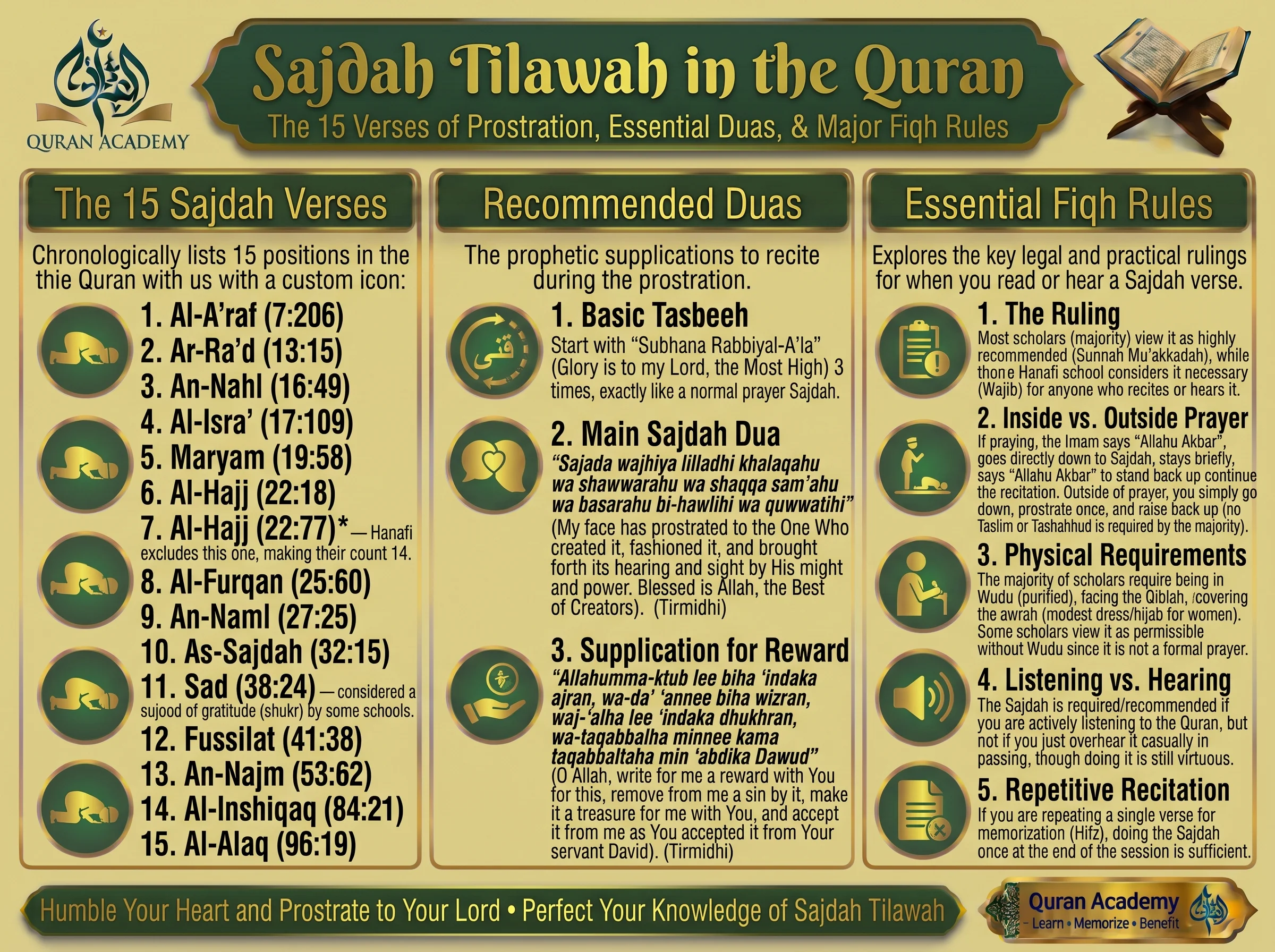
Knowing the 15 Sajdah Tilawah verses in the Quran (آيَاتُ سَجَدَاتِ التِّلَاوَةِ الْخَمْسَ عَشْرَةَ) allows you to respond immediately in physical obedience whenever Allah Almighty mentions prostration—earning Paradise while Satan weeps in defeat! Marked in the Uthmani Mushaf by a horizontal line under the trigger word and the dome-shaped prostration arch symbol (۩) at the end of the verse, Sujood At-Tilawah occurs in 15 total locations across 14 Surahs (because Surah Al-Hajj [Chapter 22] uniquely contains two Sajdahs in Verses 18 and 77!). Whenever you recite or attentively listen to one of these 15 verses—whether inside Salah or during your daily recitation—you perform one single prostration saying Subhaana Rabbiyal-A'laa (3x) and the authentic Prophetic Dua: سَجَدَ وَجْهِيَ لِلَّذِي خَلَقَهُ، وَشَقَّ سَمْعَهُ وَبَصَرَهُ، بِحَوْلِهِ وَقُوَّتِهِ. In our 1-on-1 Online Tajweed & Islamic Fiqh Course, students master the exact trigger words, Duas, and 4 Madhhab rulings of all 15 Sajdahs!
- Why Satan Weeps at Sajdah Tilawah (Sahih Muslim 81): When the son of Adam recites a verse of Sajdah and prostrates, Satan withdraws weeping, saying: "Woe to me! The son of Adam was commanded to prostrate and he prostrated, so Paradise is his; and I was commanded to prostrate and I refused, so the Fire is mine!"
- How to Spot the 2 Mushaf Symbols: A line under the trigger word (showing why we prostrate) + the arch symbol (۩) at the end of the verse (showing *where* we prostrate)!
- Only 3 Sajdahs in Juz' Amma & The Final Third: Surah An-Najm (53:62), Surah Al-Inshiqaq (84:21), and Surah Al-'Alaq (96:19)!
- Ruling Across the 4 Madhhabs: Sunnah Mu'akkadah in Maliki, Shafi'i & Hanbali (Sahih al-Bukhari 1077); Wajib in the Hanafi school.
Every Muslim who has prayed Friday Fajr behind the Imam reciting Surah As-Sajdah (32:15)—or who is reading through their 30-Day Quran Khatmah Schedule—has experienced that sudden moment of pause when the dome-shaped arch symbol (۩) appears on the page. Inside congregational prayer, if a worshipper doesn't realize the Imam is reciting a Sajdah verse, they might accidentally bow into Ruku' when the Imam says "Allahu Akbar" to go straight down to the floor for prostration!
Outside of prayer, while reading from your Mushaf or smartphone on the couch, five practical Fiqh questions immediately arise: "Where are all 15 Sajdah verses located across the 30 Juz'? Do I prostrate on the underlined word itself or at the arch symbol at the end of the verse? What is the authentic Prophetic Dua to say in Sajdah Tilawah? Do I need Wudu, facing the Qiblah, or giving Salam when performing Sajdah Tilawah outside of prayer? And why do the 4 Madhhabs count 14 vs. 15 Sajdahs in Surah Al-Hajj and Surah Sad?" Building upon our guides to 15 Etiquettes of Reading the Quran, Sujood As-Sahw (Prostration of Forgetfulness), Surah Maryam (19:58), and Surah Al-'Alaq (96:19), this complete guide gives you the Master 15 Sajdah Verses Chart, the 2 Authentic Prophetic Duas, the step-by-step method inside and outside Salah, and the 4 Madhhab comparison.
- 1. Master Chart: All 15 Sajdah Tilawah Verses in the Quran (Surah, Verse, Juz', Page & Trigger Word)
- 2. The 2 Authentic Prophetic Duas for Sajdah Tilawah (Arabic Text, Transliteration & Meaning)
- 3. How to Perform Sajdah Tilawah Step by Step (Outside of Salah vs. Inside Salah!)
- 4. Fiqh Comparison Across the 4 Madhhabs: Ruling, Wudu, Surah Al-Hajj & Surah Sad
- 5. Four Essential Tajweed Rules When Reciting the Sajdah Tilawah Duas
- 6. Frequently Asked Questions (FAQs)
1. Master Chart: All 15 Sajdah Tilawah Verses in the Quran (Surah, Verse, Juz' & Page)
In the standard 15-line Madinah / Uthmani Mushaf, how do you read the two Sajdah symbols? A horizontal line is drawn over/under the trigger phrase (Mawdi' as-Sabab — showing the word of prostration or humility that triggered the Sajdah), while the dome-shaped arch symbol (۩) is placed at the end of the verse (Mawdi' as-Sujood — showing the exact spot where you stop reciting and prostrate!). Here are all 15 Sajdah Tilawah locations in order:
| # & Surah Name | Surah : Verse | Juz' & Mushaf Page | Arabic Trigger Ending & Theme |
|---|---|---|---|
| 1. Surah Al-A'raf (الأعراف — The Very 1st Sajdah!) |
7 : 206 | Juz' 9 • Page 176 | وَيُسَبِّحُونَهُ وَلَهُ يَسْجُدُونَ ۩ Joining the angels who never grow too proud to worship Allah! |
| 2. Surah Ar-Ra'd (الرعد — The Thunder) |
13 : 15 | Juz' 13 • Page 251 | وَظِلَالُهُم بِٱلْغُدُوِّ وَٱلْآصَالِ ۩ All in the heavens and earth and their shadows prostrate! |
| 3. Surah An-Nahl (النحل — The Bee) |
16 : 50 | Juz' 14 • Page 272 | وَيَفْعَلُونَ مَا يُؤْمَرُونَ ۩ (Note: Trigger starts in 16:49, Sajdah is at the end of 16:50!). |
| 4. Surah Al-Isra (الإسراء — The Night Journey) |
17 : 109 | Juz' 15 • Page 293 | وَيَخِرُّونَ لِلْأَذْقَانِ يَبْكُونَ وَيَزِيدُهُمْ خُشُوعًا ۩ (Trigger starts in 17:107, Sajdah at the end of 17:109!). |
| 5. Surah Maryam (مريم — Mary) |
19 : 58 | Juz' 16 • Page 309 | إِذَا تُتْلَىٰ عَلَيْهِمْ آيَاتُ ٱلرَّحْمَٰنِ خَرُّوا سُجَّدًا وَبُكِيًّا ۩ Following the Prophets who fell prostrate and weeping! |
| 6. Surah Al-Hajj (1st Sajdah) (الحج — The Pilgrimage) |
22 : 18 | Juz' 17 • Page 334 | إِنَّ ٱللَّهَ يَفْعَلُ مَا يَشَاءُ ۩ Stars, sun, moon, mountains, and trees prostrate to Allah! |
| 7. Surah Al-Hajj (2nd Sajdah) 🏆 (Only Surah With 2 Sajdahs!) |
22 : 77 | Juz' 17 • Page 341 | وَٱفْعَلُوا ٱلْخَيْرَ لَعَلَّكُمْ تُفْلِحُونَ ۩ (Agreed in Shafi'i & Hanbali; see Madhhab chart below!). |
| 8. Surah Al-Furqan (الفرقان — The Criterion) |
25 : 60 | Juz' 19 • Page 365 | وَزَادَهُمْ نُفُورًا ۩ Prostrating eagerly to Ar-Rahman when the arrogant refuse! |
| 9. Surah An-Naml (النمل — The Ant) |
27 : 26 | Juz' 19 • Page 379 | ٱللَّهُ لَا إِلَٰهَ إِلَّا هُوَ رَبُّ ٱلْعَرْشِ ٱلْعَظِيمِ ۩ (Trigger starts in 27:25, Sajdah at the end of 27:26!). |
| 10. Surah As-Sajdah (السجدة — Friday Fajr Sunnah!) |
32 : 15 | Juz' 21 • Page 416 | وَهُمْ لَا يَسْتَكْبِرُونَ ۩ True believers fall prostrate and glorify their Lord! |
| 11. Surah Sad 🏆 (ص — Repentance of Dawud AS) |
38 : 24 | Juz' 23 • Page 454 | وَخَرَّ رَاكِعًا وَأَنَابَ ۩ Following Prophet Dawud's (AS) prostration of repentance/gratitude! |
| 12. Surah Fussilat (فصلت — Explained in Detail) |
41 : 38 | Juz' 24 • Page 480 | يُسَبِّحُونَ لَهُ بِٱللَّيْلِ وَٱلنَّهَارِ وَهُمْ لَا يَسْأَمُونَ ۩ (Trigger starts in 41:37, Sajdah at the end of 41:38!). |
| 13. Surah An-Najm (النجم — The 1st Sajdah Revealed!) |
53 : 62 | Juz' 27 • Page 528 | فَٱسْجُدُوا لِلَّهِ وَٱعْبُدُوا ۩ The very first Surah with a Sajdah revealed in Makkah (Bukhari 1067)! |
| 14. Surah Al-Inshiqaq (الانشقاق — 1st in Juz' Amma) |
84 : 21 | Juz' 30 • Page 589 | وَإِذَا قُرِئَ عَلَيْهِمُ ٱلْقُرْآنُ لَا يَسْجُدُونَ ۩ Prostrating immediately when the disbelievers refuse! |
| 15. Surah Al-'Alaq (العلق — Final Sajdah in Mushaf!) |
96 : 19 | Juz' 30 • Page 597 | كَلَّا لَا تُطِعْهُ وَٱسْجُدْ وَٱقْتَرِب ۩ "No! Do not obey him; prostrate and draw near [to Allah]!" |
2. The 2 Authentic Prophetic Duas for Sajdah Tilawah (Arabic, Transliteration & Meaning)
What do you say when your forehead touches the ground in Sajdah Tilawah? First, say the standard glorification of prostration « سُبْحَانَ رَبِّيَ الْأَعْلَىٰ » (Subhaana Rabbiyal-A'laa — 3 times) so your Sajdah is never empty of Tasbeeh—even if you haven't memorized the special Dua yet! Then add either (or both) of these two verified Prophetic Sajdah Tilawah supplications from our Online Hadith Explorer:
سَجَدَ وَجْهِيَ لِلَّذِي خَلَقَهُ وَصَوَّرَهُ، وَشَقَّ سَمْعَهُ وَبَصَرَهُ، بِحَوْلِهِ وَقُوَّتِهِ ﴿ فَتَبَارَكَ ٱللَّهُ أَحْسَنُ ٱلْخَالِقِينَ ﴾.
Transliteration: Sajada wajhiya lilladhee khalaqahu wa sawwarahu, wa shaqqaa sam'ahu wa basarahu, bi-hawlihi wa quwwatihi (fatabaarakallaahu Ahsanul-Khaaliqeen).
Meaning: "My face has prostrated to the One Who created it and fashioned it, and brought forth its hearing and its sight by His might and His power (so blessed is Allah, the Best of Creators)!"
2. AUTHENTIC DUA #2 FOR SAJDAH TILAWAH (SUNAN AT-TIRMIDHI 579 & IBN HIBBAN 2768 • HASAN)ٱللَّهُمَّ ٱكْتُبْ لِي بِهَا عِنْدَكَ أَجْرًا، وَضَعْ عَنِّي بِهَا وِزْرًا، وَٱجْعَلْهَا لِي عِنْدَكَ ذُخْرًا، وَتَقَبَّلْهَا مِنِّي كَمَا تَقَبَّلْتَهَا مِنْ عَبْدِكَ دَاوُودَ.
Transliteration: Allaahummak-tub lee bihaa 'indaka ajraa, wa da' 'annee bihaa wizraa, waj'alhaa lee 'indaka dhukhraa, wa taqabbalhaa minnee kamaa taqabbaltahaa min 'abdika Daawood.
Meaning: "O Allah, record for me through this prostration a reward with You, remove from me through it a burden of sin, make it a stored treasure for me with You, and accept it from me just as You accepted it from Your servant Dawud (AS)!"
Struggling to perfect your Recitation?
Join hundreds of students mastering the Quran with our Verified Al-Azhar Graduates. We offer flexible 1-on-1 sessions tailored to your schedule.
Book a Free Evaluation Class →3. How to Perform Sajdah Tilawah Step by Step (Outside of Salah vs. Inside Salah!)
How do you perform Sajdah Tilawah when reading the Quran at home vs. when reciting inside prayer? Compare both step by step:
1 Single Prostration (Zero Ruku' & Zero Tashahhud!)
- When you finish reciting the Sajdah verse (at the ۩ symbol), place the Mushaf respectfully on an elevated stand/cushion (never on the floor!).
- Face the Qiblah, say "Allahu Akbar" (without needing to raise your hands according to many scholars, or raising them in Shafi'i/Hanbali), and go straight down into prostration on your 7 bones.
- Recite Subhaana Rabbiyal-A'laa (3x) + the Sajdah Tilawah Dua above.
- Rise from prostration saying "Allahu Akbar" (in the Hanafi, Maliki, and investigative Hanbali view, no Tashahhud and no Salam are required; in the Shafi'i and standard Hanbali view, give one Salam to the right upon sitting up) and resume your reading!
Prostrate, Stand Back Up & Continue the Rak'ah!
- When you (or the Imam) reach the end of the Sajdah verse while standing in prayer, say "Allahu Akbar" (without raising your hands) and go straight down to the floor into a single prostration (do NOT bow into Ruku'!).
- Recite Subhaana Rabbiyal-A'laa (3x) + the Sajdah Tilawah Dua.
- Say "Allahu Akbar" and stand all the way back up to the standing position (Qiyam)!
- Continue reciting the next verses of the Surah (or if the Sajdah was the very last verse of the Surah, like Surah Al-'Alaq 96:19 or An-Najm 53:62, pause briefly standing or recite a few verses, then say "Allahu Akbar" to bow into your regular Ruku'!).
4. Fiqh Comparison Across the 4 Madhhabs: Ruling, Wudu, Surah Al-Hajj & Surah Sad
Why do some books mention 14 Sajdahs while the Uthmani Mushaf marks 15? And what if you are reading the Quran without Wudu when you reach a Sajdah verse? Compare the four Sunni schools below:
| Fiqh Question | Maliki, Shafi'i & Hanbali (Majority) | Hanafi School |
|---|---|---|
| 1. Overall Ruling of Sajdah Tilawah | Confirmed Sunnah (Sunnah Mu'akkadah) — Not Obligatory! Proof: In Sahih al-Bukhari (1077), 'Umar ibn Al-Khattab (RA) recited Surah An-Nahl (16:50) on Friday and prostrated; the next Friday he recited it and did NOT prostrate, saying: "O people, we pass by the verses of prostration: whoever prostrates has done right, and whoever does not prostrate has no sin upon him!" |
Wajib (Practically Obligatory) upon both the reciter and anyone who hears the Sajdah verse (though if heard outside of prayer, it does not have to be performed on the exact spot if you are busy driving/walking—you can perform it shortly after!). |
| 2. Which Verses Are Counted Among the 15? | • Shafi'i & Hanbali (14 Sajdahs): Count both Sajdahs in Surah Al-Hajj (22:18 & 22:77), and consider Surah Sad (38:24) a prostration of gratitude (Sajdat Shukr) recommended outside Fard prayer. • Maliki (11 Sajdahs): Count Surah Sad (38:24) and the first Sajdah of Al-Hajj (22:18). |
Hanafi (14 Sajdahs): Count Surah Sad (38:24) and the first Sajdah of Al-Hajj (22:18), while considering the 2nd Sajdah of Al-Hajj (22:77) to refer to the Ruku' & Sujood of regular Salah. *(The Uthmani Mushaf marks all **15** so all schools are accommodated!).* |
| 3. What If You Are Reciting Without Wudu (Or on Your Period)? 🏆 | The four schools state that Wudu, covering the 'Awrah, and facing the Qiblah are standard conditions for Sajdah Tilawah (while a group of scholars including Ibn 'Umar RA in Bukhari, Ash-Sha'bi, and Ibn Taymiyyah permitted prostrating for Tilawah even without Wudu when unable to do Wudu immediately). And if you prefer not to prostrate while without Wudu or during your monthly cycle, classical Shafi'i jurists recommended saying 4 times: « سُبْحَانَ ٱللَّهِ، وَٱلْحَمْدُ لِلَّهِ، وَلَا إِلَٰهَ إِلَّا ٱللَّهُ، وَٱللَّهُ أَكْبَرُ »! | |
Mastering the 3 Qalqalah Letters in the Final Sajdah of the Quran: "Wasjudْ Waqْtaribْ" (96:19)!
Look at the 15th and final Sajdah Tilawah in the Quran—at the end of Surah Al-'Alaq (96:19): وَٱسْجُدْ وَٱقْتَرِب ۩ (Wasjudْ Waqْtaribْ)—and in the Sajdah Tilawah Dua: سَجَدَ وَجْهِيَ (Wajْhiya) and أَجْرًا (Ajْraa)! In just two words—Wasjudْ Waqْtaribْ—you articulate three consecutive Qalqalah (Echoing) letters (دْ، قْ، بْ)! Watch Senior Instructor Ustadhah Yasmeen Gamal demonstrate Qalqalah on our Quran Academy YouTube Channel:
- Sughra + Sughra + Kubra: Bounce the Dal (دْ) and Qaaf (قْ) lightly in flow, and land on a crisp Qalqalah Kubra on the final Baa (بْ) before prostrating!
- 1-on-1 Live Coaching: Recite all 15 Sajdah verses with our Al-Azhar scholars!
5. Four Essential Tajweed Rules When Reciting the Sajdah Tilawah Duas
Before you prostrate at your next Sajdah Tilawah verse, apply these four Tajweed rules from our 1-on-1 Online Tajweed Course:
- 1. Applying Position #2 of Nabr on "Wa Shaqqaa" & "Wa Quwwatihi" (وَشَقَّ ... وَقُوَّتِهِ):
As we just mastered in our An-Nabr (Vocal Stress) in Tajweed Guide, in وَقُوَّتِهِ (Wa Quw-watihi), press firmly with Nabr on the doubled Waw (وَّ) so it never relaxes into a long Madd vowel ("Wa Qoo-watihi" ❌)! - 2. Mid-Word Qalqalah Sughra on "Wajْhiya", "Ukْtubْ", "Wajْ'alhaa" & "Ajْraa":
Using our Qalqalah Letters Guide and Sifaat al-Huruf Guide, bounce the silent Jeem (جْ) in وَجْهِيَ, أَجْرًا, and وَٱجْعَلْهَا, and bounce the silent Baa (بْ) in ٱللَّهُمَّ ٱكْتُبْ لِي (Allaahummakْ-tubْ lee) while keeping the Kaaf Sakinah before it whispered with Hams! - 3. Keeping Light Letters Smiling Before Heavy Letters in "Wa Sawwarahu" & "Wa Basarahu":
Applying our Heavy & Light Letters Guide and Ahkam Al-Raa Guide, in وَبَصَرَهُ (Wa Ba-sa-ra-hu), keep the Baa (بَ) 100% Light before elevating the heavy Saad (صَ) and Heavy Raa (رَ)—never let the Saad turn the Baa into "Wa Baa-sarahu" ❌! - 4. Two-Beat Madd Silah Sughra on Every "Haa' al-Kinayah" (خَلَقَهُۥ وَصَوَّرَهُۥ ... بِحَوْلِهِۦ وَقُوَّتِهِۦ):
Following our Rules of Madd Guide, Makharij al-Huruf, Noon Sakinah Rules, Meem Sakinah Rules, Rules of Waqf, Laam Shamsiyyah & Qamariyyah, Hamzatul Wasl vs. Qat', 4 Special Words of Hafs, and 7 Alifs in the Quran guides, whenever the singular masculine pronoun Haa' (ـهُ / ـهِ) sits between two voweled letters in continuation, stretch its Damma or Kasrah for 2 natural counts (Khalaqahoo wa sawwarahoo... bi-hawlihee wa quwwatih)! Test your Tajweed accuracy right now on our Free 3-Minute Tajweed Quiz!
With this guide, we have completed all 5 Advanced Tajweed & Qira'at Guides of Day 1 of Matrix 4 (Articles 101 to 105)—connecting the 15 Sajdah Tilawah verses seamlessly with Idgham Mutamathilayn, Mutajanisayn & Mutaqaribayn, The 10 Qira'at of the Quran, Lahn Jali vs. Lahn Khafi, 99 Names of Allah, Traveler's Prayer, Salat Al-Jumu'ah, 12 Sunnah Rawatib, Salat Al-Eid, Salat Ad-Duha, Salat Al-Witr, Tahajjud, Dua Al-Qunoot, Duas for Anxiety & Debt, Bedtime Duas, Post-Prayer Adhkar, and Authentic Ruqyah Shariah in our Online Hifz Program (using our Smart Hifz Planner)! Whether you are studying with our Al-Azhar Certified Tutors or enrolling your child in our 1-on-1 Kids Quran Classes with our Printable Kids Star Chart, see how families across the US, UK, Canada, and Australia rate our teachers on our Verified Student & Parent Reviews Page.
6. Frequently Asked Questions (FAQs) About the 15 Sajdah Tilawah Verses
1. What are the 15 Sajdah Tilawah verses in the Quran?
The 15 prostration of recitation (Sajdah Tilawah) locations in the Uthmani Mushaf are: (1) Al-A'raf 7:206, (2) Ar-Ra'd 13:15, (3) An-Nahl 16:50, (4) Al-Isra 17:109, (5) Maryam 19:58, (6) Al-Hajj 22:18, (7) Al-Hajj 22:77, (8) Al-Furqan 25:60, (9) An-Naml 27:26, (10) As-Sajdah 32:15, (11) Sad 38:24, (12) Fussilat 41:38, (13) An-Najm 53:62, (14) Al-Inshiqaq 84:21, and (15) Al-'Alaq 96:19.
2. What is the authentic Dua to recite during Sajdah Tilawah?
During Sajdah Tilawah, you first say "Subhaana Rabbiyal-A'laa" (3 times) just like regular prayer prostration, and then add the authentic Prophetic Sajdah Tilawah Duas: (1) "Sajada wajhiya lilladhee khalaqahu, wa shaqqaa sam'ahu wa basarahu, bi-hawlihi wa quwwatihi" (Sahih Muslim 771 & Sunan Abu Dawud 1414), and (2) "Allaahummak-tub lee bihaa 'indaka ajraa, wa da' 'annee bihaa wizraa, waj'alhaa lee 'indaka dhukhraa, wa taqabbalhaa minnee kamaa taqabbaltahaa min 'abdika Daawood" (Sunan at-Tirmidhi 579 — Hasan).
3. Is Sajdah Tilawah obligatory (Wajib) or a confirmed Sunnah (Sunnah Mu'akkadah)?
In the Maliki, Shafi'i, and Hanbali schools (the majority Jumhur, based on 'Umar ibn Al-Khattab's RA action on the pulpit in Sahih al-Bukhari 1077), Sajdah Tilawah is an emphasized confirmed Sunnah (Sunnah Mu'akkadah), not obligatory. In the Hanafi school, Sajdah Tilawah is classified as Wajib (practically obligatory) upon both the reciter and the one who hears the verse.
4. How do you perform Sajdah Tilawah outside of prayer (Does it have Tashahhud or Salam)?
Outside of prayer, Sajdah Tilawah is a single prostration: face the Qiblah, say "Allahu Akbar" as you go down into prostration on your 7 bones, recite the Sajdah Duas, and rise saying "Allahu Akbar" (with no Tashahhud in any school, and no Salam required in the Hanafi, Maliki, and investigative Hanbali view; whereas the Shafi'i and standard Hanbali schools include opening Takbeer and one Salam upon rising). There is NEVER a Ruku' or Tashahhud in Sajdah Tilawah!
5. Which Surah in the Quran has TWO Sajdah Tilawah verses?
Surah Al-Hajj (Chapter 22) is the only Surah in the Quran that contains TWO Sajdah Tilawah locations in the Uthmani Mushaf: the first in Verse 18 (22:18) and the second in Verse 77 (22:77), as transmitted from 'Umar ibn Al-Khattab and 'Uqbah ibn 'Amir (may Allah be pleased with them, Sunan Abu Dawud 1402).
Prostrate and Draw Closer to Allah Through His Book!
Master Quranic recitation, Tajweed rules, and the meanings of all 15 Sajdah verses in live 1-on-1 sessions with certified male and female Al-Azhar scholars. Book your free diagnostic trial session today!
Book Your Free 1-on-1 Trial Class →