
✦ Quick Answer & Key Takeaways: Surah Al-Qalam Tafseer & Benefits
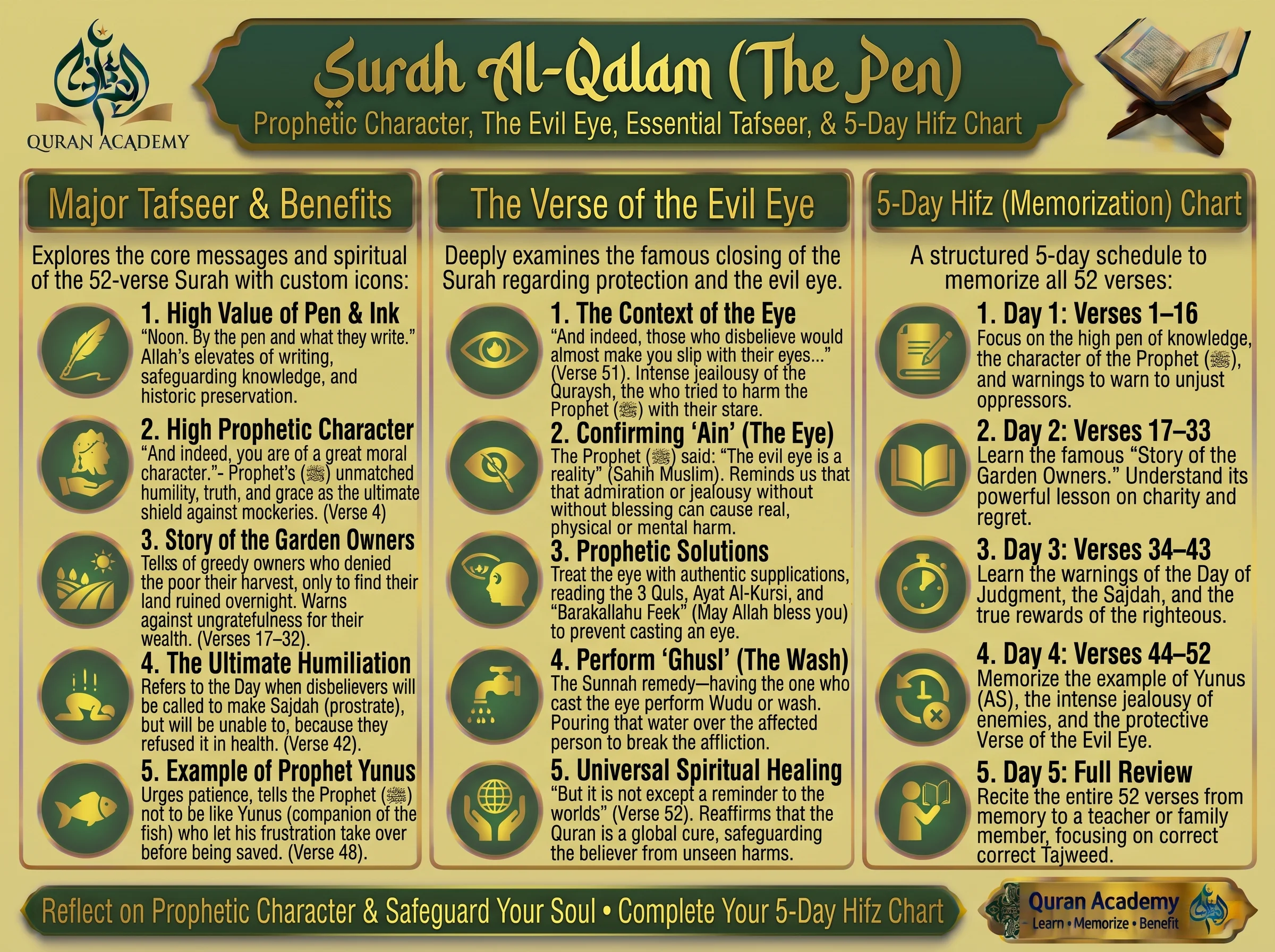
Exploring Surah Al Qalam Tafseer and benefits (سُورَةُ الْقَلَمِ / سُورَةُ نٓ — Chapter 68 of the Holy Quran, containing 52 Makkan verses across Pages 564–566 of Juz Tabarak [Juz 29]) connects your heart to one of the earliest chapters revealed in Makkah right after Surah Al-'Alaq! Opening with Allah's majestic oath by the Pen and what the angels and scribes write (نٓ ۚ وَٱلْقَلَمِ وَمَا يَسْطُرُونَ), Surah Al-Qalam delivers the greatest Divine certificate of character ever bestowed upon a human being in Verse 4: وَإِنَّكَ لَعَلَىٰ خُلُقٍ عَظِيمٍ ("And indeed, you [O Muhammad ﷺ] are of a great moral character!"). Across its 52 rhythmic verses, the Surah exposes the 9 toxic traits of arrogant deniers, narrates the unforgettable parable of the Owners of the Garden (As-habul-Jannah), comforts the Prophet (ﷺ) through the story of Prophet Yunus (AS), and concludes with the famous protection verses against the envious gaze (68:51–52). In our 1-on-1 Online Quran Memorization (Hifz) & Tafseer Program, students memorize Surah Al-Qalam effortlessly in 5 days!
- Twin Revelation With Surah Al-'Alaq: Surah Al-'Alaq (96:4) introduced Allah teaching by the Pen (ٱلَّذِي عَلَّمَ بِٱلْقَلَمِ), and Surah Al-Qalam (68:1) swore by that exact Pen to defend the Messenger (ﷺ)!
- The Living Quran (Sahih Muslim 746): Explaining Verse 4, 'Aishah (RA) declared: "The character of the Prophet of Allah (ﷺ) was the Quran!"
- The Garden Owners' Lesson (68:17–33): Never plan a future task without saying In sha' Allah (68:18), and know that giving the poor their share protects your wealth!
- The "Noon wal-Qalam" Tajweed Secret: Stretch نٓ for 6 beats and pronounce its final Noon with clear Izhar (do NOT merge into the Waw!) when continuing in Hafs!
Imagine standing alone in Makkah in the earliest days of Islam, calling your people to pure monotheism, truth, and mercy—only to have the wealthiest leaders of Quraysh launch a ruthless smear campaign calling you "deluded" or "possessed" (Majnoon) so tribes visiting Makkah wouldn't listen to the Quran. How did the Creator of the universe comfort the heart of His beloved Messenger (ﷺ)?
Allah Almighty did not merely tell him to ignore their insults; He revealed Surah Al-Qalam (Chapter 68)—swearing by the Pen of Divine Decree and human knowledge that Muhammad (ﷺ) is the most sane, blessed, and noble of all creation, possessing an unbreakable, unceasing reward (Ajran Ghayra Mamnoon) and the highest pinnacle of moral character (وَإِنَّكَ لَعَلَىٰ خُلُقٍ عَظِيمٍ — 68:4)! Then, in a stunning reversal, Allah revealed that it is those arrogant, stingy deniers who are truly deluded—proving it through the vivid story of the Owners of the Garden and the awe-inspiring scene of the Day of Resurrection when the Shin is uncovered (Yawma yukshafu 'an saaq) and the arrogant are unable to prostrate! Building upon our guides to How to Memorize Juz Tabarak in 30 Days, Surah Al-Mulk (Chapter 67), and Authentic Ruqyah Shariah, this complete guide unpacks the 5 Thematic Sections of Surah Al-Qalam, the 5-Day Memorization Plan, and its 5 Unique Tajweed Rules.
- 1. Overview & The 5 Thematic Sections of Surah Al-Qalam (Verses 1 to 52)
- 2. Deep Dive #1: "Wa Innaka La'alaa Khuluqin 'Adheem" (68:4) vs. The 9 Toxic Traits (68:10–16)
- 3. Deep Dive #2: The Story of the Owners of the Garden (68:17–33) & 4 Family Lessons
- 4. Deep Dive #3: The Lesson of Prophet Yunus (AS) & The Evil Eye Verses (68:48–52)
- 5. The 5-Day Surah Al-Qalam Memorization Plan & 5 Essential Tajweed Rules (Noon, Yasturoon & Balawnaahum!)
- 6. Frequently Asked Questions (FAQs)
1. Overview & The 5 Thematic Sections of Surah Al-Qalam (Verses 1 to 52)
As we teach in our Complete Quran Tafseer Guide, dividing a 52-verse Surah into 5 logical thematic blocks makes both understanding and memorizing it 3x faster:
| Section & Verses | Core Theme & Opening Verse | Key Tafseer Takeaway |
|---|---|---|
| Section 1: Verses 1 – 7 |
The Oath by the Pen & The Prophet's Exalted Character (نٓ ۚ وَٱلْقَلَمِ وَمَا يَسْطُرُونَ...) |
Allah swears by the Pen (both the First Pen that wrote the Preserved Tablet 50,000 years before creation in Sahih Muslim 2653 and every pen of knowledge) that Muhammad (ﷺ) is blessed with an unceasing reward and supreme character! |
| Section 2: Verses 8 – 16 |
Refusing Compromise & Exposing the 9 Vices of Arrogance (فَلَا تُطِعِ ٱلْمُكَذِّبِينَ...) |
Commands never compromising Islamic truth to appease falsehood (Waddoo law tud-hinu fa-yud-hinoon) and warns against 9 vile traits (excessive swearing, backbiting, slander, hindering good, transgression, and pride in wealth/sons). |
| Section 3: Verses 17 – 33 |
The Parable of the Owners of the Garden (أَصْحَابُ الْجَنَّةِ) (إِنَّا بَلَوْنَاهُمْ كَمَا بَلَوْنَا أَصْحَابَ ٱلْجَنَّةِ...) |
How the wealthy brothers lost their orchard overnight when they plotted to deprive the poor, and how sincere repentance opened the door to hope for a better garden from their Lord! |
| Section 4: Verses 34 – 47 |
Divine Justice & The Day the Shin Is Uncovered (يَوْمَ يُكْشَفُ عَن سَاقٍ) (إِنَّ لِلْمُتَّقِينَ عِندَ رَبِّهِمْ جَنَّاتِ ٱلنَّعِيمِ...) |
Refutes the notion that the righteous and the wicked could ever be treated equally (68:35: Afanj'alul-muslimeena kal-mujrimeen?) and warns that those who refused to prostrate willingly in this world will have their backs stiffened on the Day of Judgment (68:42–43)! |
| Section 5 🏆: Verses 48 – 52 |
Patience Like Yunus (AS) & Protection From the Evil Eye (فَٱصْبِرْ لِحُكْمِ رَبِّكَ وَلَا تَكُن كَصَاحِبِ ٱلْحُوتِ...) |
Commands patient perseverance for Allah's decree, praises Yunus's (AS) repentance, shields against the envious gaze (68:51), and seals the Surah by declaring the Quran a Reminder for all the worlds (68:52)! |
2. Deep Dive #1: "Wa Innaka La'alaa Khuluqin 'Adheem" (68:4) vs. The 9 Toxic Traits
Look at the linguistic power of Verse 4: وَإِنَّكَ لَعَلَىٰ خُلُقٍ عَظِيمٍ (Wa innaka la-'alaa khuluqin 'adheem)! As we explore in our Quranic Arabic Guide and our Online Hadith Explorer, Allah Almighty combined four layers of emphasis in just five words: (1) إِنَّ (Inna — Indeed), (2) اللام المزحلقة (La- — Surely), (3) the preposition عَلَىٰ ('Alaa — elevated firmly atop), and (4) describing his character with Allah's own attribute of grandeur: عَظِيم ('Adheem — Tremendous/Exalted)!
Sa'd ibn Hisham ibn 'Amir asked Mother of the Believers 'Aishah (may Allah be pleased with her): "O Mother of the Believers, tell me about the character of the Messenger of Allah (ﷺ)!"
She asked him: "Do you not read the Quran?" He said: "Yes, of course!"
She replied: « فَإِنَّ خُلُقَ نَبِيِّ اللَّهِ ﷺ كَانَ الْقُرْآنَ » ("Then indeed, the character of the Prophet of Allah ﷺ was the Quran!")
—andSa'd said: "I felt like standing up and never asking anyone about anything until I died!"
Right after praising the Prophet's (ﷺ) exalted character in Verse 4, Verses 10–14 contrast that pure Prophetic character with 9 destructive traits that every believer and child (just as we learned in Surah Al-Hujurat and Surah Luqman!) must stay far away from: (1) حَلَّافٍ (Hallaf — swearing oaths constantly and cheaply), (2) مَّهِينٍ (Maheen — base/untrustworthy), (3) هَمَّازٍ (Hammaz — slandering and mocking people), (4) مَّشَّاءٍ بِنَمِيمٍ (Mash-shaa'in bi-nameem — walking around carrying gossip/talebearing to divide hearts), (5) مَّنَّاعٍ لِّلْخَيْرِ (Mannaa'in lil-khayr — stingily blocking charity and good), (6) مُعْتَدٍ (Mu'tadin — transgressing limits), (7) أَثِيمٍ (Atheem — indulging in sin), (8) عُتُلٍّ ('Utull — harsh, cruel, and coarse-hearted), and (9) أَن كَانَ ذَا مَالٍ وَبَنِينَ (becoming arrogant simply because Allah blessed him with wealth and sons)!
3. Deep Dive #2: The Story of the Owners of the Garden (68:17–33) & 4 Family Lessons
In Verses 17 to 33, Allah Almighty tells one of the most vivid, relatable stories in Juz Tabarak—a favorite bedtime story for children in our 1-on-1 Kids Quran Classes:
- The Story in Brief: A righteous father owned a fertile orchard (near Sana'a in Yemen, according to Ibn 'Abbas RA), and every harvest season he generously gave the poor and needy their rightful share. When the father passed away, his sons inherited the orchard and whispered to each other: "Why should we give away our hard-earned fruit to the poor? Let us sneak out at dawn tomorrow morning and harvest the entire orchard before a single poor person enters upon us!"—and they swore to this plan without saying "In sha' Allah" (وَلَا يَسْتَثْنُونَ — 68:18)!
- The Overnight Reversal: While they were fast asleep in their beds that night, a visitation from Allah swept over the orchard, turning it pitch-black like a harvested night (كَٱلصَّرِيمِ — 68:20)! When the brothers crept out at dawn whispering "Do not let a single needy person enter upon you today!" (68:24) and saw their burnt orchard, they first cried out: "Surely we have lost our way!"—before realizing: بَلْ نَحْنُ مَحْرُومُونَ ("Rather, we ourselves have been deprived!").
- The Turning Point of Repentance (68:28–32): The wisest, most fair-minded brother among them (أَوْسَطُهُمْ) reminded them: "Did I not tell you: 'Why do you not glorify Allah (Lawlaa tusabbihoon)?'" Immediately, their hearts woke up and they proclaimed together:
﴿ قَالُوا سُبْحَانَ رَبِّنَا إِنَّا كُنَّا ظَالِمِينَ ﴿٢٩﴾ ... عَسَىٰ رَبُّنَا أَن يُبْدِلَنَا خَيْرًا مِّنْهَا إِنَّا إِلَىٰ رَبِّنَا رَاغِبُونَ ﴿٣٢﴾ ﴾
—teaching every family 4 timeless lessons: (1) Always say In sha' Allah (just as in Surah Al-Kahf 18:23–24!), (2) Giving Sadaqah increases and protects your wealth, (3) Speak up when friends or siblings plan something wrong (like the middle brother Awsatuhum!), and (4) Sincere repentance turns loss into hope for something even better!
4. Deep Dive #3: The Lesson of Prophet Yunus (AS) & The Evil Eye Verses (68:48–52)
In the concluding section of the Surah (Verses 48 to 52), Allah Almighty seals Surah Al-Qalam with two profound messages:
- 1. Patience Like the Messengers vs. Hastiness (68:48–50): Allah commands His Messenger (ﷺ): فَٱصْبِرْ لِحُكْمِ رَبِّكَ وَلَا تَكُن كَصَاحِبِ ٱلْحُوتِ إِذْ نَادَىٰ وَهُوَ مَكْظُومٌ—reminding us how Prophet Yunus (AS, one of the 25 Prophets in the Quran) left his people before receiving Allah's permission, called out from the belly of the whale filled with grief (Laa ilaaha illaa Anta Subhaanaka...), and how Allah's grace and mercy overtook him, chose him, and placed him among the righteous!
- 2. The Famous Evil Eye Verses (68:51–52):
﴿ وَإِن يَكَادُ ٱلَّذِينَ كَفَرُوا لَيُزْلِقُونَكَ بِأَبْصَارِهِمْ لَمَّا سَمِعُوا ٱلذِّكْرَ وَيَقُولُونَ إِنَّهُ لَمَجْنُونٌ ﴿٥١﴾ وَمَا هُوَ إِلَّا ذِكْرٌ لِّلْعَالَمِينَ ﴿٥٢﴾ ﴾ In Tafseer Ibn Kathir, scholars explain that this verse affirms that the effect of the evil eye (Al-'Ayn) is real by Allah's decree (Sahih Muslim 2188: "The evil eye is real"), and shows how Allah Almighty completely shielded His Messenger (ﷺ) when the envious disbelievers glared at him in hatred while he recited the Quran! *(To protect yourself and your children according to the Prophetic Sunnah, combine reciting the Quran with our Three Quls and Authentic Self-Ruqyah Guide!).*
Mastering the Crisp Qalqalah in "Bi-Abْsaarihim" (68:51), "Subْhaana" (68:29) & "Saaqْ" (68:42)!
Look at the key verses of Surah Al-Qalam: in لَيُزْلِقُونَكَ بِأَبْصَارِهِمْ (Bi-Abْsaarihim — 68:51), قَالُوا سُبْحَانَ رَبِّنَا (Subْhaana — 68:29), مُقْتَدِرِينَ (Muqْtadireen — 68:25), and when pausing on يَوْمَ يُكْشَفُ عَن سَاقٍ (Saaqْ — 68:42), every single word features one of the 5 Qalqalah (Echoing) letters (ق ط ب ج د)! Watch Senior Instructor Ustadhah Yasmeen Gamal demonstrate Qalqalah on our Quran Academy YouTube Channel:
Struggling to perfect your Recitation?
Join hundreds of students mastering the Quran with our Verified Al-Azhar Graduates. We offer flexible 1-on-1 sessions tailored to your schedule.
Book a Free Evaluation Class →- Light "Abْ-" Before Heavy "-saa": Bounce the Baa lightly in Bi-abْ-saarihim before elevating the heavy Saad!
- 1-on-1 Live Coaching: Memorize Surah Al-Qalam with our Al-Azhar scholars!
5. The 5-Day Surah Al-Qalam Memorization Plan & 5 Essential Tajweed Rules
Using our 3x3 Memorization Method and our Smart Hifz Planner, memorize all 52 verses of Surah Al-Qalam in 5 days (10–11 short verses per day):
• Day 1 (Verses 1–16): The Oath & the 9 Vices (rhyming on ـُونْ / ـِينْ / ـِيمْ!).
• Day 2 (Verses 17–33): The Complete Story of the Owners of the Garden (17 verses that flow like a movie scene!).
• Day 3 (Verses 34–43): The Debate With the Deniers & the Day of the Shin.
• Day 4 (Verses 44–52): The Gradual Istidraj, Prophet Yunus (AS), and the Evil Eye Shield.
• Day 5 (Full Consolidation): Recite all 52 verses from memory in your night prayer!
As you recite, apply these 5 special Tajweed rules from our 1-on-1 Online Tajweed Course:
- 1. Six-Beat Madd Lazim + Izhar Mutlaq on "Noon ۚ Wal-Qalam" (نٓ ۚ وَٱلْقَلَمِ — 68:1):
Applying our Rules of Madd Guide and Noon Sakinah & Tanween Guide, stretch the letter نٓ (Noooooonْ) for 6 full counts (Madd Lazim Harfi Mukhaffaf). And here is a famous Ijazah exam question: if you do NOT pause after Noon and connect it directly to وَٱلْقَلَمِ, normally a Noon Sakinah before Waw would merge (Idgham Bighunnah)—yet in Hafs 'an 'Asim (via Ash-Shatibiyyah), both نٓ ۚ وَٱلْقَلَمِ (68:1) and يسٓ ﴿١﴾ وَٱلْقُرْآنِ ٱلْحَكِيمِ (36:1–2) are exceptions of Izhar Riwayah (Clear Pronunciation: Noooooonْ wal-Qalam)! - 2. Reading With Pure Seen (سْ) in "Wa Maa Yasturoon" (وَمَا يَسْطُرُونَ — 68:1) & "Amohumul-Musaytiroon" (52:37):
As we learned in our 4 Special Words of Hafs Guide and Heavy & Light Letters Guide, keep the silent Seen (سْ) in يَسْطُرُونَ (Yasْ-turoon) and يُسْطَرُونَ (68:37) 100% Light and smiling right before the heavy طُ—never let the heavy Taa' turn the Seen into a heavy Saad ("Yasturoon" with ص ❌)! - 3. Two Consecutive Iqlabs (Small Meem مـ) in Verse 11 & Verse 16:
Look at هَمَّازٍ مَّشَّاءٍ بِنَمِيمٍ (Mash-shaaaa'im-bi-nameem — 68:11) and سَنَسِمُهُ عَلَى ٱلْخُرْطُومِ (68:16): in 68:11, convert the Kasratayn of Mash-shaa'in before the Baa into a hidden Meem with a 2-beat nasal Ghunnah (Iqlab)! - 4. Stopping on the Oval Zero Alif in "Laa-kinaa" vs. "Al-Kharaateem / Al-Khurtoom":
Applying our Ahkam Al-Raa Guide, in ٱلْخُرْطُومِ (Al-Khurْtoom — 68:16), the silent Raa is preceded by a Damma and followed by a heavy Taa'—making it doubly Heavy (Tafkhim)! Conversely, in صَارِمِينَ (Saa-ri-meen — 68:22), قَادِرِينَ (Qaa-di-reen — 68:25), and مُقْتَدِرِينَ (Muq-tadi-reen), the Raa is voweled with a Kasrah—making it 100% Light (Tarqeeq)! - 5. Preserving the Dual Pronouns & Madd Leen in the Garden Story (68:17–33):
Following our Makharij al-Huruf, Sifaat al-Huruf, Meem Sakinah Rules, Rules of Waqf, Laam Shamsiyyah & Qamariyyah, Hamzatul Wasl vs. Qat', 7 Alifs in the Quran, Idgham Mutamathilayn, Mutajanisayn & Mutaqaribayn, 10 Qira'at, Lahn Jali vs. Lahn Khafi, and An-Nabr (Vocal Stress) guides, keep the soft Waw Leen in بَلَوْنَاهُمْ (Balawْnaahum — 68:17), أَوْسَطُهُمْ (Awْsatuhum — 68:28), and لَوْلَا (Lawْlaa) smooth and un-bounced! Test your Tajweed accuracy right now on our Free 3-Minute Tajweed Quiz!
Continue your journey through Juz Tabarak and our interconnected library: All 15 Sajdah Tilawah Verses, 99 Names of Allah, 30-Day Quran Khatmah Schedule, 15 Etiquettes of Reading the Quran, Traveler's Prayer, Salat Al-Jumu'ah, 12 Sunnah Rawatib, Salat Al-Eid, Salat Ad-Duha, Salat Al-Witr, Tahajjud, Dua Al-Qunoot, Bedtime Duas, Post-Prayer Adhkar, Surah Al-Fatihah Guide, Last 3 Verses of Surah Al-Hashr, Surah Qaf, and 10 Shortest Surahs! Meet our Al-Azhar Certified Tutors, print our Printable Kids Star Chart, and read how families across the US, UK, Canada, and Australia rate our teachers on our Verified Student & Parent Reviews Page.
6. Frequently Asked Questions (FAQs) About Surah Al-Qalam
1. Why is Surah Al-Qalam called both "Al-Qalam" (The Pen) and "Surah Noon"?
Surah Al-Qalam (Chapter 68 — 52 verses, Makkan) is named after its opening oath in Verse 1: "Noon. By the Pen and what they inscribe (نٓ وَالْقَلَمِ وَمَا يَسْطُرُونَ)." It is one of the very earliest Surahs revealed in Makkah right after Surah Al-'Alaq (which also praised Allah for teaching man by the Pen in 96:4), and it is the 2nd Surah of Juz Tabarak (Juz 29) and the 29th and final Surah in the Mushaf to begin with Huruf Muqatta'at (Disjoined Letters).
2. How did Mother of the Believers 'Aishah (RA) explain Verse 4 of Surah Al-Qalam ("Wa innaka la'alaa khuluqin 'adheem")?
Recorded in Sahih Muslim (746), when Sa'd ibn Hisham asked 'Aishah (may Allah be pleased with her) about the character of the Messenger of Allah (ﷺ), she asked him: "Do you not read the Quran?" He said, "Yes." She replied: "Indeed, the character of the Prophet of Allah (ﷺ) was the Quran (كَانَ خُلُقُهُ الْقُرْآنَ)!"—meaning he was the living embodiment of every Quranic command and manner.
3. What is the main lesson of the Story of the Owners of the Garden (As-habul-Jannah) in Surah Al-Qalam (68:17–33)?
In Verses 17 to 33, Allah tells the story of wealthy brothers who inherited a lush orchard after their righteous father died, and secretly plotted to harvest its fruits at dawn without saying "In sha' Allah" and without giving the poor their rightful share. Allah sent a visitation upon the garden by night while they slept, turning it black like a harvested field—until they repented saying "Subhaana Rabbinaa, innaa kunnaa dhaalimeen"—teaching us that gratitude and charity preserve blessings while stinginess destroys them!
4. What is the context of the Evil Eye verses at the end of Surah Al-Qalam (68:51–52)?
In Verses 51–52 ("Wa in yakaadul-ladheena kafaroo layuzliqoonaka bi-absaarihim lammaa sami'udh-Dhikra..."), classical commentators like Imam Ibn Kathir and Al-Qurtubi explain that the disbelievers of Makkah harbored such intense envy and hatred when hearing the Prophet (ﷺ) recite the Quran that they tried to strike him with the evil eye ('Ayn), but Allah protected His Messenger—making these verses a powerful reminder of Allah's protection against envy!
5. What is the Tajweed rule when connecting "Noon" to "Wal-Qalam" in Verse 1 (68:1)?
In Hafs 'an 'Asim via the route of Ash-Shatibiyyah, the letter "Noon" (نٓ) is stretched for 6 full beats (Madd Lazim Harfi Mukhaffaf). If you connect "Noon" directly to "Wal-Qalam" without pausing, the final silent Noon of "Noon" is pronounced with CLEAR Izhar (Izhar Riwayah / Izhar Mutlaq) and does NOT merge into the Waw of "Wal-Qalam"—just like "Ya-Sin wal-Quranil-Hakeem" (36:1–2)!
Memorize Surah Al-Qalam & Build Prophetic Character!
Master Surah Al-Qalam and the 11 Surahs of Juz Tabarak with live 1-on-1 Tajweed correction and engaging story-based Tafseer from certified male and female Al-Azhar scholars. Book your free trial class today!
Book Your Free 1-on-1 Trial Class →