
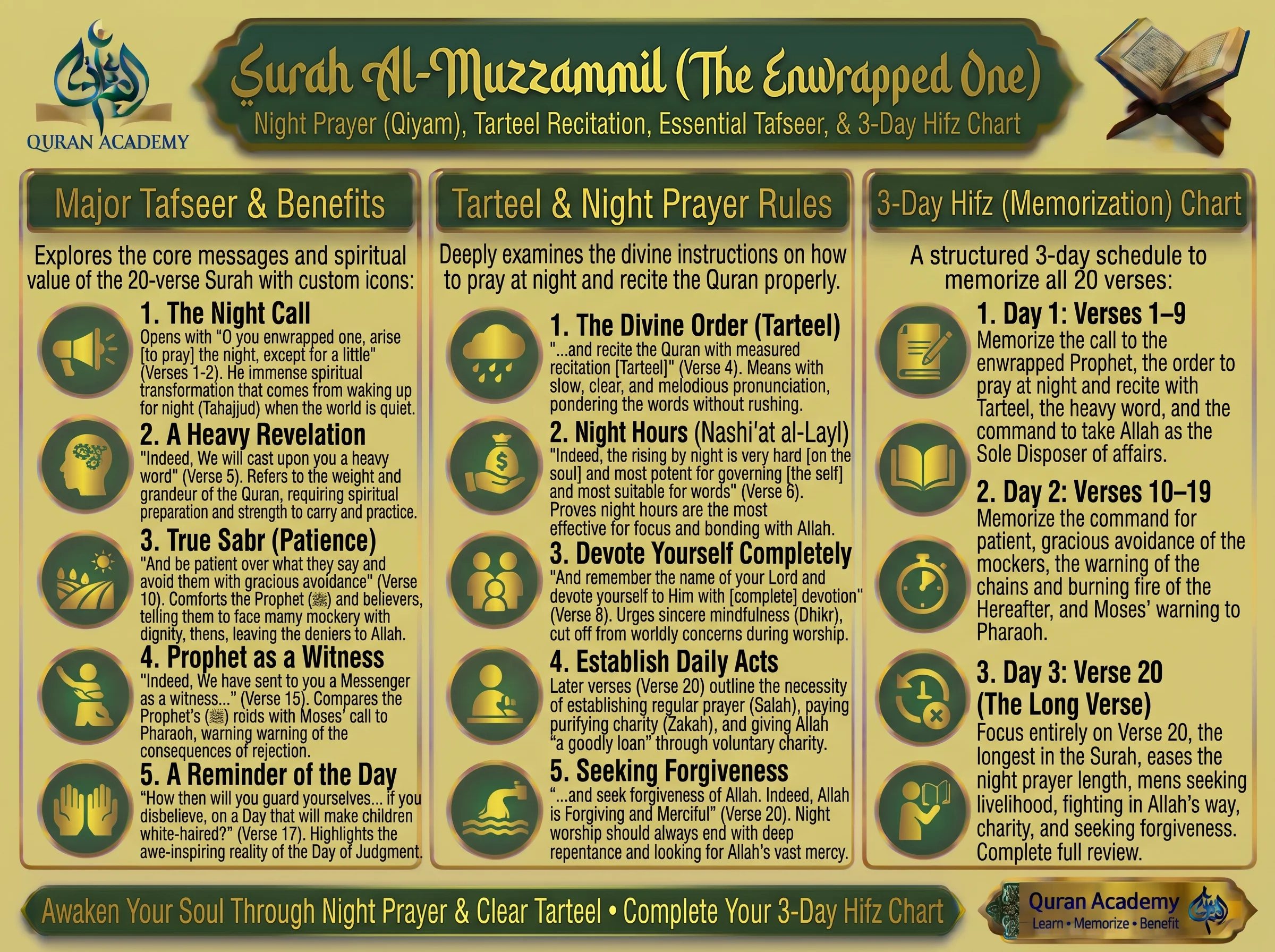
✦ Quick Answer & Key Takeaways: Surah Al-Muzzammil Benefits & Tafseer
Exploring Surah Al Muzzammil benefits and Tafseer (سُورَةُ الْمُزَّمِّلِ — Chapter 73 of the Holy Quran, containing 20 verses across Pages 574–575 of Juz Tabarak [Juz 29]) reveals the exact spiritual training program that built Prophet Muhammad (ﷺ) and the first generation of believers in Makkah! Addressing the Prophet (ﷺ) with the tender, affectionate title يَا أَيُّهَا ٱلْمُزَّمِّلُ ("O you who wraps himself in his garments!"), the Surah establishes the foundational rule of Quranic recitation in Verse 4: وَرَتِّلِ ٱلْقُرْآنَ تَرْتِيلًا ("And recite the Quran with measured, distinct Tarteel!") and explains why standing in Qiyam Al-Layl (Night Prayer) gives the soul the strength required to carry the "Heavy Word" (قَوْلًا ثَقِيلًا — 73:5)! Then, in its majestic half-page concluding verse (Verse 20), Allah grants merciful relief to the sick, travelers, and workers by commanding: فَٱقْرَءُوا مَا تَيَسَّرَ مِنَ ٱلْقُرْآنِ ("So recite whatever is easy for you of the Quran!"). In our 1-on-1 Online Tajweed & Hifz Program, students memorize Surah Al-Muzzammil in 3 days while applying its exact command of Tarteel!
- Why "Qawlan Thaqeela" (A Heavy Word — 73:5)? Because the Quran carries immense majesty during revelation, weighty responsibilities in life, and heavy rewards on the Scales of the Hereafter!
- 'Ali ibn Abi Talib's (RA) Golden Definition of Tarteel (73:4): "At-Tarteel is Tajweed of the letters and knowing the places of stopping (Waqf)!"
- The 12-Month Night Prayer Training (Sahih Muslim 746): Verses 1–4 made Qiyam Al-Layl obligatory for a full year before Verse 20 eased it into a voluntary Sunnah!
- The 5 Spiritual Provisions of Verses 1–10: (1) Qiyam Al-Layl, (2) Tarteel, (3) Dhikr & Tabattul (devotion), (4) Complete Tawakkul, and (5) Hajran Jameela (gracious patience)!
When a leader, teacher, or parent is about to face the heaviest mission of their life—surrounded by opposition, responsibilities, and daytime stress—what is the very first preparation they need? Look at how Allah Almighty prepared Prophet Muhammad (ﷺ) right after the initial revelations of Surah Al-'Alaq (Chapter 96) and Surah Al-Qalam (Chapter 68): while he was resting wrapped in his cloak, Allah revealed Surah Al-Muzzammil (Chapter 73) and its twin Surah Al-Muddaththir (Chapter 74)!
Notice the complementary secret between those two neighbor Surahs in Juz Tabarak: in Surah Al-Muzzammil (73:1–2), Allah says: يَا أَيُّهَا ٱلْمُزَّمِّلُ ﴿١﴾ قُمِ ٱللَّيْلَ إِلَّا قَلِيلًا ("Stand in prayer by night..." — building your inner spiritual battery with Allah first!), and then in Surah Al-Muddaththir (74:1–2), He says: يَا أَيُّهَا ٱلْمُدَّثِّرُ ﴿١﴾ قُمْ فَأَنذِرْ ("Arise and warn!" — going out to serve and guide humanity during the day!). You cannot pour light into the hearts of your children, students, or community during the busy daytime (إِنَّ لَكَ فِي ٱلنَّهَارِ سَبْحًا طَوِيلًا — 73:7) unless you first recharge your own heart with measured Quranic recitation (Tarteel) in the stillness of the night! Building upon our guides to How to Pray Tahajjud & Qiyam Al-Layl, 15 Etiquettes of Reading the Quran, and Surah Nuh (Chapter 71), this complete guide breaks down the 3 Thematic Sections of Surah Al-Muzzammil, the 5 Spiritual Provisions of Verses 1–10, how to memorize the long final verse (73:20) in 5 chunks, and the 3-Day Hifz Schedule.
- 1. Overview & The 3 Thematic Sections of Surah Al-Muzzammil (Verses 1 to 20)
- 2. Deep Dive #1: The 5 Spiritual Provisions in Verses 1–10 (Qiyam, Tarteel, Tabattul, Tawakkul & Hajr Jameel)
- 3. Deep Dive #2: The Story of Verse 20 (Sahih Muslim 746) & How to Memorize It in 5 Easy Chunks
- 4. The 3-Day Surah Al-Muzzammil Memorization Plan (Pages 574–575)
- 5. Five Essential Tajweed Rules in Surah Al-Muzzammil (Al-Muzzammil, Wat'an & Thuluthayil-Layl!)
- 6. Frequently Asked Questions (FAQs)
1. Overview & The 3 Thematic Sections of Surah Al-Muzzammil (Verses 1 to 20)
Occupying just 1.5 pages in the Madinah Mushaf (Pages 574 to 575), Surah Al-Muzzammil is structured into three crystal-clear sections—where Verses 1 to 19 rhyme on a resonant 2-count open Alif (ـِيلًا / ـِبًا / ـِيمًا) and Verse 20 seals the Surah with a majestic half-page conclusion:
| Section & Verses | Core Theme & Opening Verse | Key Tafseer Takeaway |
|---|---|---|
| Section 1: Verses 1 – 10 (Day 1 Hifz) |
The Night Prayer Training & 5 Spiritual Provisions (يَا أَيُّهَا ٱلْمُزَّمِّلُ ﴿١﴾ قُمِ ٱللَّيْلَ إِلَّا قَلِيلًا...) |
Prescribes standing in night prayer (for a half, a third, or two-thirds of the night), reciting the Quran with measured Tarteel, devoting the heart completely to Allah (Tabattul), taking Him as Wakeel, and practicing gracious patience! |
| Section 2: Verses 11 – 19 (Day 2 Hifz) |
Warning the Arrogant Deniers & The Lesson of Pharaoh (وَذَرْنِي وَٱلْمُكَذِّبِينَ أُولِي ٱلنَّعْمَةِ وَمَهِّلْهُمْ قَلِيلًا...) |
Comforts the Prophet (ﷺ) by telling him: "Leave Me alone to deal with the deniers of luxury!"—reminding Quraysh of how Pharaoh defied Prophet Musa (AS) and depicting the Day of Judgment Whose terror turns children gray-haired (73:17)! |
| Section 3 🏆: Verse 20 (Day 3 Hifz) |
The Merciful Easing of Night Prayer & The 5 Closing Commands (إِنَّ رَبَّكَ يَعْلَمُ أَنَّكَ تَقُومُ أَدْنَىٰ مِن ثُلُثَيِ ٱللَّيْلِ...) |
Revealed 12 months after Verses 1–4 to lift the obligation of fixed-hour night prayer—replacing it with "Recite whatever is easy for you of the Quran," establishing Salah, giving Zakah, lending Allah a goodly loan, and seeking forgiveness! |
2. Deep Dive #1: The 5 Spiritual Provisions in Verses 1–10 (Why Night Prayer + Tarteel Transform the Soul!)
In Verses 1 to 10, Allah Almighty gives every student of the Quran five lifelong spiritual habits:
- 1. Rising in the Stillness of the Night (قُمِ ٱللَّيْلَ إِلَّا قَلِيلًا — 73:2–3 & 6):
Why did Allah say in Verse 6: إِنَّ نَاشِئَةَ ٱللَّيْلِ هِيَ أَشَدُّ وَطْئًا وَأَقْوَمُ قِيلًا? As Ibn 'Abbas and Mujahid explained (and as we explored in our How to Pray Tahajjud & Qiyam Al-Layl Guide), نَاشِئَةَ ٱللَّيْلِ (Naashi'atal-Layl) refers to the hours of the night when a believer rises after sleep: it is أَشَدُّ وَطْئًا (stronger in impression and heavier upon the lower self, where the heart and ears agree!) and وَأَقْوَمُ قِيلًا (more upright, focused, and accurate in speech and recitation) because daytime noise has fallen silent! - 2. Measured, Distinct Recitation — "At-Tarteel" (وَرَتِّلِ ٱلْقُرْآنَ تَرْتِيلًا — 73:4):
Notice the absolute verbal noun (Maf'ool Mutlaq): Allah did not merely say "Recite the Quran," He commanded: وَرَتِّلِ ٱلْقُرْآنَ تَرْتِيلًا ("And recite the Quran with measured, unhurried Tarteel!"). When Caliph 'Ali ibn Abi Talib (RA) was asked to explain this verse, he gave the foundational definition taught in our Interactive Tajweed Encyclopedia: « التَّرْتِيلُ هُوَ تَجْوِيدُ الْحُرُوفِ وَمَعْرِفَةُ الْوُقُوفِ » ("Tarteel is pronouncing the letters with Tajweed and knowing the Rules of Stopping (Waqf)!"). - 3. Wholehearted Devotion — "At-Tabattul" (وَٱذْكُرِ ٱسْمَ رَبِّكَ وَتَبَتَّلْ إِلَيْهِ تَبْتِيلًا — 73:8):
What does تَبَتَّلْ إِلَيْهِ تَبْتِيلًا (Tabattal ilayhi tabteelaa) mean? Unlike monasticism (which Islam forbids), Islamic Tabattul means detaching your heart from attachment to creation and devoting your worship, hope, and supplication exclusively to Allah while actively fulfilling your family and work duties during the day! - 4. Taking the Lord of the East & West as Your Sole Trustee (رَّبُّ ٱلْمَشْرِقِ وَٱلْمَغْرِبِ لَا إِلَٰهَ إِلَّا هُوَ فَٱتَّخِذْهُ وَكِيلًا — 73:9):
Calling upon Al-Wakeel (#53 in our 99 Names of Allah Guide!) removes all anxiety over those who oppose you. - 5. Gracious Parting Without Revenge — "Hajran Jameela" (وَٱصْبِرْ عَلَىٰ مَا يَقُولُونَ وَٱهْجُرْهُمْ هَجْرًا جَمِيلًا — 73:10):
Just like Sabrun Jameel (patience without complaining to creation) in Surah Yusuf (12:18) and Surah Al-Ma'arij (70:5), هَجْرًا جَمِيلًا (Hajran Jameela) is stepping away from ignorant mockers graciously without harshness, vulgarity, or personal vengeance!
3. Deep Dive #2: The Story of Verse 20 (Sahih Muslim 746) & How to Memorize It in 5 Easy Chunks
When you open Page 575 of the Madinah Mushaf, you immediately notice something striking: while Verses 1 to 19 are short 3-to-6 word lines, Verse 20 is half a page long! Why is Verse 20 so different in length and style? Look at the authentic Hadith of Mother of the Believers 'Aishah (may Allah be pleased with her) in Sahih Muslim (746) (verifiable in our Online Hadith Explorer):
Sa'd ibn Hisham asked Mother of the Believers 'Aishah (may Allah be pleased with her): "O Mother of the Believers, tell me about the night prayer (Qiyam Al-Layl) of the Messenger of Allah (ﷺ)!"
She asked: "Do you not read Yaa ayyuhal-Muzzammil?" He said: "Yes!"
She replied: "Indeed, Allah the Exalted made Qiyam Al-Layl obligatory at the beginning of this Surah—so the Prophet of Allah (ﷺ) and his Companions stood in prayer for an entire year (حَوْلًا) until their feet swelled up! And Allah held back the concluding verse of this Surah in heaven for twelve months, and then revealed the relief (التَّخْفِيف) at the end of this Surah—so Qiyam Al-Layl became voluntary after having been obligatory!"
How to Memorize Verse 20 of Surah Al-Muzzammil in 5 Minutes Using 5 Logical Chunks:
Instead of trying to memorize all 11 lines of Verse 20 as one giant block, divide it into 5 sequential ideas:
- Chunk 1 (Allah's Witnessing of Your Night Prayer): إِنَّ رَبَّكَ يَعْلَمُ أَنَّكَ تَقُومُ أَدْنَىٰ مِن ثُلُثَيِ ٱللَّيْلِ وَنِصْفَهُ وَثُلُثَهُ وَطَائِفَةٌ مِّنَ ٱلَّذِينَ مَعَكَ ۚ وَٱللَّهُ يُقَدِّرُ ٱللَّيْلَ وَٱلنَّهَارَ (Notice the descending fractions: 2/3 → 1/2 → 1/3!).
- Chunk 2 (The 1st Command of Relief + The 3 Excused Groups): عَلِمَ أَن لَّن تُحْصُوهُ فَتَابَ عَلَيْكُمْ ۖ فَٱقْرَءُوا مَا تَيَسَّرَ مِنَ ٱلْقُرْآنِ ۚ عَلِمَ أَن سَيَكُونُ مِنكُم مَّرْضَىٰ ۙ وَآخَرُونَ يَضْرِبُونَ فِي ٱلْأَرْضِ يَبْتَغُونَ مِن فَضْلِ ٱللَّهِ ۙ وَآخَرُونَ يُقَاتِلُونَ فِي سَبِيلِ ٱللَّهِ (1. The Sick Mardaa, 2. Travelers seeking halal provision, and 3. Strivers in Allah's cause!).
- Chunk 3 (Repeating the Relief + Salah, Zakah & Goodly Loan): فَٱقْرَءُوا مَا تَيَسَّرَ مِنْهُ ۚ وَأَقِيمُوا ٱلصَّلَاةَ وَآتُوا ٱلزَّكَاةَ وَأَقْرِضُوا ٱللَّهَ قَرْضًا حَسَنًا.
- Chunk 4 (The Reward Waiting With Allah): وَمَا تُقَدِّمُوا لِأَنفُسِكُم مِّنْ خَيْرٍ تَجِدُوهُ عِندَ ٱللَّهِ هُوَ خَيْرًا وَأَعْظَمَ أَجْرًا.
- Chunk 5 (The Final Seal of Istighfar & Mercy): وَٱسْتَغْفِرُوا ٱللَّهَ ۖ إِنَّ ٱللَّهَ غَفُورٌ رَّحِيمٌ ﴿٢٠﴾!
4. The 3-Day Surah Al-Muzzammil Memorization Plan (Pages 574–575)
Using our 3x3 Memorization Method and our Smart Hifz Planner, master all 20 verses in 3 days:
• Day 1 (Verses 1–10 — Bottom half of Page 574): The 5 Spiritual Provisions (rhyming on قَلِيلًا، تَرْتِيلًا، ثَقِيلًا، قِيلًا، طَوِيلًا، تَبْتِيلًا، وَكِيلًا، جَمِيلًا!).
• Day 2 (Verses 11–19 — Top half of Page 575): The Warning & Pharaoh's Story (rhyming on قَلِيلًا، جَحِيمًا، أَلِيمًا، مَّهِيلًا، رَسُولًا، وَبِيلًا، شِيبًا، مَّفْعُولًا، سَبِيلًا!).
• Day 3 (Verse 20 — Middle of Page 575): Memorize the 5 chunks of Verse 20 above and link the entire Surah in your night prayer!
Struggling to perfect your Recitation?
Join hundreds of students mastering the Quran with our Verified Al-Azhar Graduates. We offer flexible 1-on-1 sessions tailored to your schedule.
Book a Free Evaluation Class →Mastering the Crisp Qalqalah in "Watْ'an" (73:6), "Tabْteelaa" (73:8) & "Faqْra'oo" (73:20)!
Look closely at the iconic words of Surah Al-Muzzammil: أَشَدُّ وَطْئًا (Watْ'an — 73:6), وَتَبَتَّلْ إِلَيْهِ تَبْتِيلًا (Tabْteelaa — 73:8), أَدْنَىٰ (Adْnaa — 73:20), فَٱقْرَءُوا (Faqْra'oo), يَبْتَغُونَ (Yabْtaghoon), and وَأَقْرِضُوا (Wa Aqْridoo)! Every single one of these words relies on a crisp mid-word Qalqalah Sughra on طْ، بْ، دْ، or قْ! Watch Senior Instructor Ustadhah Yasmeen Gamal demonstrate Qalqalah on our Quran Academy YouTube Channel:
- Heavy Taa' Bounce Before Hamzah in "Watْ'an": Bounce the elevated طْ cleanly before the sharp Hamzah!
- 1-on-1 Live Coaching: Fulfill the command of Tarteel (73:4) with our Al-Azhar scholars!
5. Five Essential Tajweed Rules in Surah Al-Muzzammil
Before reciting Surah Al-Muzzammil in your night prayer tonight, apply these five Tajweed rules from our 1-on-1 Online Tajweed Course:
- 1. Two Shaddahs (Zay + Meem With 2-Beat Ghunnah) in "Al-Muzzammil" (ٱلْمُزَّمِّلُ — 73:1):
Applying our Meem Sakinah & Mushaddadah Guide and Sifaat al-Huruf Guide, notice that ٱلْمُزَّمِّلُ contains two consecutive Shaddahs: first press firmly on the buzzing Zay (زَّ — Safeer), and immediately hold a full 2-beat nasal Ghunnah on the Meem Mushaddadah (مِّ): Al-Muz-zamm-milْ! (The exact same rule applies to ٱلْمُدَّثِّرُ = Al-Mud-dath-thirْ in 74:1!). - 2. Heavy Raa vs. Light Raa Across the Surah (Ahkam Al-Raa):
Using our Ahkam Al-Raa Guide, compare the Light Raa (Tarqeeq) in ٱلْمُزَّمِّلْ (no Raa!), وَٱذْكُرِ ٱسْمَ (Wadh-ku-ri-sma — 73:8, because of the helper Kasrah!), ٱلْمَشْرِقِ وَٱلْمَغْرِبِ (Al-Mash-ri-qi wal-Magh-ri-bi — 73:9), and وَٱصْبِرْ (Was-birْ — 73:10, preceded by Kasrah!) against the Heavy Raa (Tafkhim) in وَرَتِّلِ ٱلْقُرْآنَ تَرْتِيلًا (Wa Rat-tilil-Qurْ-aana Tarْ-teelaa — 73:4), وَذَرْنِي (Wa Dharْ-nee — 73:11), مَّرْضَىٰ (Marْ-daa — 73:20), and فَٱقْرَءُوا (Faqْ-ra-oo)! - 3. Pronouncing the Kasrah on the Yaa of "Thuluthayil-Layl" (مِن ثُلُثَيِ ٱللَّيْلِ — 73:20):
Here is a subtle Lahn Jali vowel check in Verse 20: the word ثُلُثَيْ ("two-thirds of") ends with a Yaa Leen that is given a helper Kasrah (ـَيِ) to prevent two silent letters from colliding before ٱللَّيْلِ—so read it clearly as: Min thu-lu-tha-yil-layli (NEVER "Min thuluthil-layl" ❌, because "one-third" comes two words later in وَثُلُثَهُ!). - 4. Idgham Without Ghunnah on "An-Lan" vs. Light Ikhfaa' on "An-Sayakoonu" (73:20):
According to our Noon Sakinah & Tanween Guide, in Verse 20, notice how the shortened particle أَن (An — shortened from أَنَّهُ) appears twice: first before Laam in عَلِمَ أَن لَّن تُحْصُوهُ ('Alima al-lan tuhsoohu — Idgham Bila Ghunnah), and second before Seen in عَلِمَ أَن سَيَكُونُ مِنكُم مَّرْضَىٰ ('Alima an-sayakoonu — 2-beat Light Ikhfaa'!). - 5. Stopping on "Al-Muzzammilْ" With Tawassut on the Final Laam:
Following our Makharij al-Huruf, Heavy & Light Letters, Rules of Madd, Rules of Waqf, Laam Shamsiyyah & Qamariyyah, Hamzatul Wasl vs. Qat', 4 Special Words of Hafs, 7 Alifs in the Quran, Idgham Mutamathilayn, Mutajanisayn & Mutaqaribayn, 10 Qira'at, An-Nabr (Vocal Stress), and 15 Sajdah Tilawah Verses guides, never bounce the final Laam of ٱلْمُزَّمِّلْ when pausing on Verse 1! Test your Tajweed accuracy right now on our Free 3-Minute Tajweed Quiz!
Continue your journey through Juz Tabarak and our interconnected library: Surah Al-Mulk (67), Surah Al-Insan (76), 30-Day Quran Khatmah Schedule, Traveler's Prayer, Salat Al-Jumu'ah, 12 Sunnah Rawatib, Salat Al-Eid, Salat Ad-Duha, Salat Al-Witr, Dua Al-Qunoot, Duas for Anxiety & Debt, Bedtime Duas, Post-Prayer Adhkar, and Authentic Ruqyah Shariah! Meet our Al-Azhar Certified Tutors, enroll your child in our 1-on-1 Kids Quran Classes with our Printable Kids Star Chart, and read how families across the US, UK, Canada, and Australia rate our teachers on our Verified Student & Parent Reviews Page.
6. Frequently Asked Questions (FAQs) About Surah Al-Muzzammil
1. What does "Al-Muzzammil" mean and why was Surah Al-Muzzammil revealed?
Linguistically, "Al-Muzzammil" (المزمل — originally Al-Mutazammil, with the Taa merged into the Zay) means "The One Enwrapped in His Garments." Revealed in Makkah right after Surah Al-'Alaq and Surah Al-Qalam (and occupying Pages 574–575 of Juz Tabarak with 20 verses), Allah addressed His Messenger (ﷺ) with this affectionate title to call him from the comfort of his blanket to stand in night prayer (Qiyam Al-Layl) in preparation for carrying the "Heavy Word" (Qawlan Thaqeela — the Holy Quran)!
2. How did 'Ali ibn Abi Talib (RA) define "Tarteel" in Surah Al-Muzzammil (73:4)?
When asked about Allah's command in Surah Al-Muzzammil (73:4): "Wa rattilil-Qur'aana tarteelaa" (And recite the Quran with measured, distinct recitation), Caliph 'Ali ibn Abi Talib (may Allah be pleased with him) famously defined it as: "At-Tarteel is Tajweed of the letters and knowing where to stop and pause (التَّرْتِيلُ هُوَ تَجْوِيدُ الْحُرُوفِ وَمَعْرِفَةُ الْوُقُوفِ)!"
3. Why did night prayer (Qiyam Al-Layl) change from Verse 1–3 to Verse 20 of Surah Al-Muzzammil?
According to Mother of the Believers 'Aishah (RA) in Sahih Muslim (746), when Verses 1–4 of Surah Al-Muzzammil were first revealed, standing in night prayer for half, a third, or two-thirds of the night was obligatory for 12 full months until the feet of the Prophet (ﷺ) and his Companions swelled—and then Allah revealed the final verse (Verse 20) as a mercy and relief ("Fa-qra'oo maa tayassara minal-Quran"), turning night prayer into a voluntary Sunnah for the Ummah!
4. Why is rising at night ("Naashi'atal-Layl" in 73:6) more impactful on the heart than daytime worship?
In Verse 6 ("Inna naashi'atal-layli hiya ashaddu wat'an wa aqwamu qeelaa"), classical commentators like Ibn 'Abbas, Mujahid, and Ibn Kathir explain that rising in the stillness of the night makes the heart and tongue agree and harmonize deeply—free from the noise, crowds, and worldly distractions of the daytime ("Inna laka fin-nahaari sabhan taweelaa" — 73:7)!
5. How can I memorize all 20 verses of Surah Al-Muzzammil in 3 days?
Because Surah Al-Muzzammil is only 1.5 pages long (Pages 574–575 in the Madinah Mushaf), you can memorize it in 3 days: Day 1 (Verses 1–10: The 5 spiritual provisions of Qiyam, Tarteel, Dhikr, Tawakkul, and Hajr Jameel), Day 2 (Verses 11–19: Warning the deniers and the reminder of Pharaoh), and Day 3 (Verse 20: The half-page concluding verse of relief broken into 5 easy clauses!).
Fulfill Allah's Command of "Tarteel" With an Al-Azhar Scholar!
Master Surah Al-Muzzammil, Juz Tabarak, and melodious Tajweed in personalized 1-on-1 classes with certified male and female Al-Azhar scholars. Book your free diagnostic trial session today!
Book Your Free 1-on-1 Trial Class →