
✦ Quick Answer & Key Takeaways: Surah Nuh Istighfar Benefits
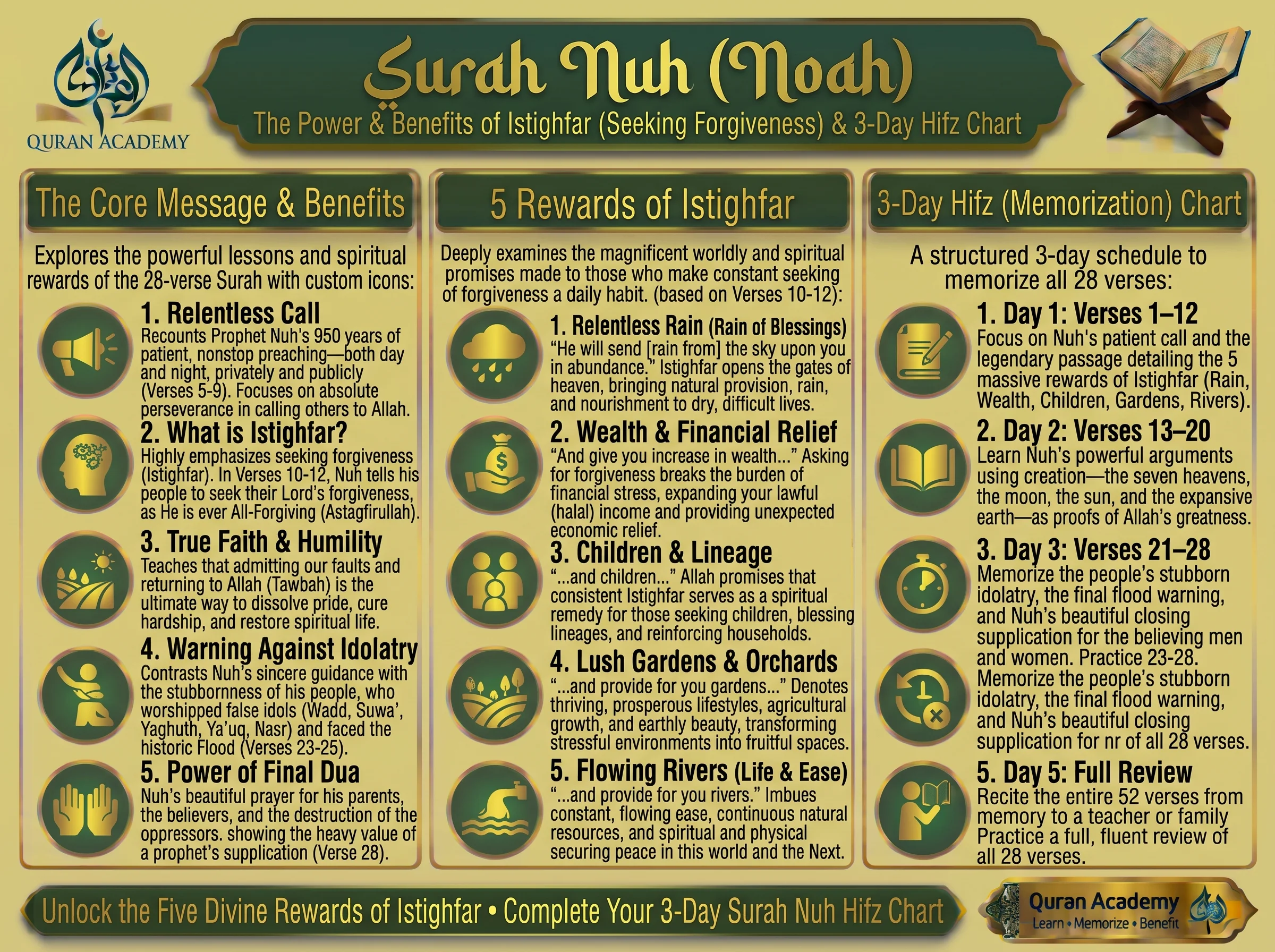
Discovering Surah Nuh Istighfar benefits (سُورَةُ نُوحٍ وَأَسْرَارُ الِاسْتِغْفَارِ — Chapter 71 of the Holy Quran, containing 28 Makkan verses across Pages 570–571 of Juz Tabarak [Juz 29]) gives every believer the Quranic key to unlocking provision, family barakah, and relief from hardship! Dedicated entirely to the 950-year call of Prophet Nuh (AS — the first of the 5 Messengers of Firm Resolve, Ulu al-'Azm), the heart of the Surah shines in Verses 10–12: فَقُلْتُ ٱسْتَغْفِرُوا رَبَّكُمْ إِنَّهُ كَانَ غَفَّارًا—where Nuh (AS) guarantees 5 direct blessings for those who make consistent Istighfar: (1) Abundant rain from the sky, (2) Increase in halal wealth, (3) Blessing in children and offspring, (4) Lush gardens, and (5) Flowing rivers of sustenance! In our 1-on-1 Online Quran Memorization (Hifz) & Tafseer Program, students memorize all 28 verses of Surah Nuh in just 3 days!
- Why "Ghaffara" (غَفَّارًا — Intensive Form)? Because Allah does not merely forgive once—He forgives repeatedly, abundantly, and covers the sins of anyone who turns back to Him!
- 4 Styles of Da'wah Used by Nuh (AS): Calling his people (1) Night & Day (71:5), (2) Loudly in public (71:8), (3) Privately one-on-one (71:9), and (4) Through cosmic signs & gentle promises (71:10–20)!
- How Idolatry Started on Earth (Sahih al-Bukhari 4920): Exposes how Satan turned the memory of 5 righteous men (Wadd, Suwa', Yaghuth, Ya'uq, and Nasr) into idols across two generations!
- The Concluding Parents & Home Dua (71:28): Rabbigh-fir lee wa li-waalidayya wa liman dakhala baytiya mu'minan...
Imagine standing in the circle of the great Successor (Tabi'i) Imam Al-Hasan Al-Basri (may Allah have mercy on him) in Basrah: a first man walks in complaining of a severe drought that has dried up the land, and Al-Hasan says to him: "Seek forgiveness from Allah (Istaghfirillaah)!" Moments later, a second man walks in complaining of crushing poverty and financial debt, and Al-Hasan tells him: "Seek forgiveness from Allah!" A third man arrives with tears in his eyes, longing for Allah to bless him and his wife with a child, and Al-Hasan tells him: "Seek forgiveness from Allah!" Finally, a fourth man complains that his farm and orchard have stopped producing fruit, and Al-Hasan tells him too: "Seek forgiveness from Allah!"
Amazed, his students asked: "O Abu Sa'id! Four men came to you with four completely different worldly problems, and you prescribed the exact same remedy—Istighfar—to all four of them?!" Imam Al-Hasan Al-Basri smiled and replied: "I did not say a single word from myself! Have you not read what Allah Almighty recounted from His Prophet Nuh (AS) in Surah Nuh (71:10–12)?" (Tafseer Al-Qurtubi 18/302). Building upon our guides to How to Memorize Juz Tabarak in 30 Days, Surah Al-Qalam (Chapter 68), The 25 Prophets in the Quran, and Prophetic Duas for Anxiety & Debt Relief, this complete guide breaks down the 4 Thematic Sections of Surah Nuh, the 5 Secrets of Istighfar, the origin of the 5 idols, the 3-Day Hifz Plan, and 5 Key Tajweed Rules.
- 1. Overview & The 4 Thematic Sections of Surah Nuh (Verses 1 to 28)
- 2. Deep Dive #1: The 5 Secrets of Istighfar in Verses 10–12 (Why Istighfar Unlocks Rizq & Offspring!)
- 3. Deep Dive #2: Creation in Stages (71:14) & The Story of the 5 Idols (Sahih al-Bukhari 4920)
- 4. Deep Dive #3: The Concluding Forgiveness Dua for Yourself, Parents & Guests (Verse 28)
- 5. The 3-Day Surah Nuh Memorization Schedule & 5 Essential Tajweed Rules
- 6. Frequently Asked Questions (FAQs)
1. Overview & The 4 Thematic Sections of Surah Nuh (Verses 1 to 28)
Why is Surah Nuh (Chapter 71) one of the easiest Surahs in Juz Tabarak for both adults and children to memorize? Because from Verse 5 all the way to Verse 28, the entire Surah is one continuous, heartfelt conversation of Prophet Nuh (AS) speaking to his Lord! Trace its 4 sections below:
| Section & Verses | Core Theme & Opening Verse | Key Tafseer Takeaway |
|---|---|---|
| Section 1: Verses 1 – 9 |
The Mission of Nuh (AS) & His 950-Year Day-and-Night Call (إِنَّا أَرْسَلْنَا نُوحًا إِلَىٰ قَوْمِهِ...) |
Shows Nuh's (AS) tireless perseverance—calling his people by night and day, publicly and privately—even when they thrust their fingers into their ears and covered their faces with their garments in arrogance! |
| Section 2 🏆: Verses 10 – 12 |
The 5 Promises of Istighfar (Rain, Wealth, Children & Gardens) (فَقُلْتُ ٱسْتَغْفِرُوا رَبَّكُمْ إِنَّهُ كَانَ غَفَّارًا...) |
Reveals the direct spiritual cause-and-effect law of Allah: seeking forgiveness with a repentant heart opens the doors of rain, halal provision, and righteous offspring! |
| Section 3: Verses 13 – 20 |
Cosmic Reminders: Created in Stages & The 7 Heavens (مَّا لَكُمْ لَا تَرْجُونَ لِلَّهِ وَقَارًا...) |
Awakens awe and reverence for Allah (Waqara) by pointing to embryonic creation in stages (71:14), the 7 layered heavens, the moon as a reflected light (Noor), the sun as a blazing lamp (Siraaj), and earth spread out with spacious pathways! |
| Section 4: Verses 21 – 28 |
The 5 Idols of Nuh's People & The Concluding Rabbana Duas (قَالَ نُوحٌ رَّبِّ إِنَّهُمْ عَصَوْنِي...) |
Names the 5 idols (Wadd, Suwa', Yaghuth, Ya'uq, and Nasr), recounts the drowning of the tyrants, and seals the Surah with the timeless Dua for oneself, parents, and believing guests (71:28)! |
2. Deep Dive #1: The 5 Secrets of Istighfar in Verses 10–12 (Why Istighfar Unlocks Rizq!)
Look at the exact Arabic wording of Surah Nuh (Verses 10 to 12):
﴿ فَقُلْتُ ٱسْتَغْفِرُوا رَبَّكُمْ إِنَّهُ كَانَ غَفَّارًا ﴿١٠﴾ يُرْسِلِ ٱلسَّمَاءَ عَلَيْكُم مِّدْرَارًا ﴿١١﴾ وَيُمْدِدْكُم بِأَمْوَالٍ وَبَنِينَ وَيَجْعَل لَّكُمْ جَنَّاتٍ وَيَجْعَل لَّكُمْ أَنْهَارًا ﴿١٢﴾ ﴾
Transliteration: Fa-qultus-taghfiroo Rabbakum innahu kaana Ghaffaaraa (10). Yursilis-samaa'a 'alaykum midraaraa (11). Wa yumdidkum bi-amwaalin wa baneena wa yaj'al lakum jannaatin wa yaj'al lakum anhaaraa (12).
- Reward #1 — Abundant, Beneficial Rain (يُرْسِلِ ٱلسَّمَاءَ عَلَيْكُم مِّدْرَارًا): That is why during the Prayer for Rain (Salat Al-Istisqa'), Caliph 'Umar ibn Al-Khattab (RA) ascended the pulpit and devoted his entire sermon to reciting Verses 10–12 of Surah Nuh and other verses of Istighfar, declaring: "I have sought rain through the stars of the sky that bring down rain [meaning Istighfar]!"
- Reward #2 & #3 — Continuous Reinforcement With Wealth & Children (وَيُمْدِدْكُم بِأَمْوَالٍ وَبَنِينَ): Notice the verb يُمْدِدْكُمْ (Yumdidkum — from Imdad), which means continuous, wave-after-wave reinforcement of halal provision and righteous children!
- Reward #4 & #5 — Lush Gardens & Flowing Rivers (وَيَجْعَل لَّكُمْ جَنَّاتٍ وَيَجْعَل لَّكُمْ أَنْهَارًا): Both in this world (barakah in your home and livelihood) and in the eternal Gardens of Paradise (Surah Al 'Imran 3:133–136)!
- Bonus Reward in Surah Hud (11:52 — Strength Added to Your Strength!): In Surah Hud, Prophet Hud (AS) added a 6th benefit of Istighfar: وَيَزِدْكُمْ قُوَّةً إِلَىٰ قُوَّتِكُمْ ("And He will add strength to your physical and spiritual strength!")—which is why Imam Ibn Taymiyyah said that whenever a complex problem or fatigue closed in on him, he would make Istighfar around 100 times until Allah opened it for him! *(Practice the best form of Istighfar today with Sayyidul-Istighfar in our Morning & Evening Adhkar Guide and the 100x Post-Duha Istighfar!).*
3. Deep Dive #2: Creation in Stages (71:14) & The Story of the 5 Idols (Bukhari 4920)
In Verses 13 to 20, Prophet Nuh (AS) appeals to his people's intellect and conscience: مَّا لَكُمْ لَا تَرْجُونَ لِلَّهِ وَقَارًا ﴿١٣﴾ وَقَدْ خَلَقَكُمْ أَطْوَارًا ﴿١٤﴾ ("What is the matter with you that you do not attribute to Allah due grandeur/reverence—while He has created you in stages [Atwara: from a drop to a clinging clot to an embryo to bones clothed with flesh]?"). Look also at the scientific precision of Verse 16: وَجَعَلَ ٱلْقَمَرَ فِيهِنَّ نُورًا وَجَعَلَ ٱلشَّمْسَ سِرَاجًا—distinguishing the sun as a self-combusting, blazing lamp (Siraaj) and the moon as a cool, reflected light (Noor)!
Then, in Verse 23, why did the leaders of Nuh's people tell the masses: لَا تَذَرُنَّ آلِهَتَكُمْ وَلَا تَذَرُنَّ وَدًّا وَلَا سُوَاعًا وَلَا يَغُوثَ وَيَعُوقَ وَنَسْرًا? Where did those five idols—Wadd, Suwa', Yaghuth, Ya'uq, and Nasr—come from? Look at the famous explanation of 'Abdullah ibn 'Abbas (may Allah be pleased with him) in Sahih al-Bukhari (4920) (verifiable in our Online Hadith Explorer):
Ibn 'Abbas (may Allah be pleased with him) said regarding the idols of the people of Nuh:
"These were the names of five righteous men from the people of Nuh (AS)! When they passed away, Satan whispered to their people: 'Erect memorial statues in the gathering places where they used to sit, and name those statues after them [merely to remind you of their righteousness]!' So they did so, and those statues were NOT worshipped at first—until that first generation died and true religious knowledge was forgotten (وَإِذَا نُسِيَ الْعِلْمُ عُبِدَتْ), and the next generation worshipped them besides Allah!"
4. Deep Dive #3: The Concluding Forgiveness Dua for Yourself, Parents & Guests (71:28)
Just as we studied the 40 Rabbana Duas From the Quran, look at how Prophet Nuh (AS) concludes Surah Nuh in Verse 28 with a comprehensive prayer that starts with himself, honors his parents, blesses every believer who enters his home, and encompasses every believing man and woman until the Day of Judgment:
﴿ رَّبِّ ٱغْفِرْ لِي وَلِوَالِدَيَّ وَلِمَن دَخَلَ بَيْتِيَ مُؤْمِنًا وَلِلْمُؤْمِنِينَ وَٱلْمُؤْمِنَاتِ وَلَا تَزِدِ ٱلظَّالِمِينَ إِلَّا تَبَارًا ﴿٢٨﴾ ﴾ ("My Lord, forgive me and my parents and whoever enters my house as a believer, and the believing men and believing women; and do not increase the wrongdoers except in destruction!"). Recite this verse regularly in your Sujood and after your prayers!
Struggling to perfect your Recitation?
Join hundreds of students mastering the Quran with our Verified Al-Azhar Graduates. We offer flexible 1-on-1 sessions tailored to your schedule.
Book a Free Evaluation Class →Mastering the Crisp Qalqalah in "Midْraaraa" (71:11), "Yumdidْkum" (71:12) & "Atْwaaraa" (71:14)!
Look closely at the famous Istighfar verses of Surah Nuh (71:11–15): مِّدْرَارًا (Midْraaraa), وَيُمْدِدْكُم (Wa Yumdidْkum), أَطْوَارًا (Atْwaaraa), and سَبْعَ سَمَاوَاتٍ طِبَاقًا (Sabْ'a)! Every single one of these words features a mid-word Qalqalah Sughra on Dal (دْ), Taa' (طْ), or Baa (بْ)! Watch Senior Instructor Ustadhah Yasmeen Gamal demonstrate Qalqalah on our Quran Academy YouTube Channel:
- Light Dal Bounce in "Midْraaraa": Keep the Dal light before elevating the Heavy Raa!
- 1-on-1 Live Coaching: Memorize Surah Nuh in 3 days with our Al-Azhar scholars!
5. The 3-Day Surah Nuh Memorization Schedule & 5 Essential Tajweed Rules
Using our 3x3 Memorization Method and our Smart Hifz Planner, memorize all 28 verses of Surah Nuh (Pages 570–571) in 3 days:
• Day 1 (Verses 1–10 — 10 Verses): Nuh's mission, his day-and-night call, and the command of Istighfar (ending on إِنَّهُ كَانَ غَفَّارًا!).
• Day 2 (Verses 11–20 — 10 Verses): The 5 rewards of Istighfar + the 6 cosmic signs of creation (notice how Verses 10 to 20 all rhyme on a resonant 2-count Madd 'Iwad open Alif: غَفَّارًا، مِّدْرَارًا، أَنْهَارًا، وَقَارًا، أَطْوَارًا، طِبَاقًا، سِرَاجًا، نَبَاتًا، إِخْرَاجًا، بِسَاطًا، فِجَاجًا!).
• Day 3 (Verses 21–28 — 8 Verses + Full Link): The 5 idols, the drowning of the wrongdoers, and the concluding Rabbana Duas!
As you recite, apply these 5 Tajweed rules from our 1-on-1 Online Tajweed Course:
- 1. Two-Beat Madd 'Iwad on Every Verse-Ending From Verse 6 to Verse 28:
As we mastered in our Rules of Madd Guide and Rules of Waqf Guide, almost every verse in Surah Nuh ends with a Fathatayn (double Fatha: فِرَارًا، إِصْرَارًا، إِسْرَارًا، غَفَّارًا... ضَلَالًا، تَبَارًا). Whenever you stop at the end of a verse, drop the Tanween "n" sound and replace it with a clean 2-beat natural Alif (Madd 'Iwad)! - 2. Idgham Mutajanisayn (Laam Into Laam = Mutamathilayn!) in "Wa Yaj'al-lakum" (71:12):
Applying our Idgham Mutamathilayn, Mutajanisayn & Mutaqaribayn Guide, in وَيَجْعَل لَّكُمْ جَنَّاتٍ وَيَجْعَل لَّكُمْ أَنْهَارًا (71:12), the silent Laam (لْ) at the end of Yaj'al merges 100% into the voweled Laam of Lakum (Idgham Mutamathilayn Sagheer)! - 3. Two Lip Rules Side by Side in Verse 11 & Verse 12 (Idgham Shafawi vs. Ikhfaa' Shafawi):
Using our Meem Sakinah Rules Guide, compare عَلَيْكُم مِّدْرَارًا (Meem Sakinah + Meem = Idgham Shafawi with 2-beat Ghunnah in 71:11) right next to وَيُمْدِدْكُم بِأَمْوَالٍ (Meem Sakinah + Baa = Ikhfaa' Shafawi with 2-beat Ghunnah in 71:12)! - 4. Heavy vs. Light Raa in "Rabbigh-firْ Lee" (71:28) & "Israaraa" (71:7 & 9):
According to our Ahkam Al-Raa Guide and Heavy & Light Letters Guide, in رَّبِّ ٱغْفِرْ لِي (Rabbigh-firْ lee — 71:28), keep the initial Raa of Rabbi Heavy and the silent Raa of Ighfirْ 100% Light (Tarqeeq) because of the Kasrah on the Faa! And notice the contrast between إِصْرَارًا (Israaraa — with heavy ص in 71:7, meaning stubborn persistence) and إِسْرَارًا (Israaraa — with light س in 71:9, meaning secretly in private)—where swapping ص and س would be a major Lahn Jali that changes the entire meaning! - 5. Stopping on "Waddan, Suwaa'an, Yaghootha, Ya'ooqa, Wa Nasraa" (71:23):
Following our Makharij al-Huruf, Sifaat al-Huruf, Noon Sakinah Rules, Laam Shamsiyyah & Qamariyyah, Hamzatul Wasl vs. Qat', 4 Special Words of Hafs, 7 Alifs in the Quran, 10 Qira'at, An-Nabr (Vocal Stress), and 15 Sajdah Tilawah Verses guides, notice that in Hafs 'an 'Asim, وَدًّا (Waddan) has a Fatha on the Waw (and merges into the next Waw with a 2-beat Ghunnah: Waddaw-wa laa Suwaa'aw-wa laa Yaghootha wa Ya'ooqa wa Nasraa)! Test your Tajweed accuracy right now on our Free 3-Minute Tajweed Quiz!
Continue your journey through Juz Tabarak and our interconnected library: Surah Al-Mulk (67), Surah Al-Insan (76), 99 Names of Allah, 30-Day Quran Khatmah Schedule, 15 Etiquettes of Reading the Quran, Traveler's Prayer, Salat Al-Jumu'ah, 12 Sunnah Rawatib, Salat Al-Eid, Salat Al-Witr, Tahajjud, Dua Al-Qunoot, Bedtime Duas, Post-Prayer Adhkar, and Authentic Ruqyah Shariah! Meet our Al-Azhar Certified Tutors, enroll your child in our 1-on-1 Kids Quran Classes with our Printable Kids Star Chart, and read how families across the US, UK, Canada, and Australia rate our teachers on our Verified Student & Parent Reviews Page.
6. Frequently Asked Questions (FAQs) About Surah Nuh & Istighfar
1. What are the 5 benefits of Istighfar promised in Surah Nuh (Verses 10–12)?
In Surah Nuh (71:10–12), Prophet Nuh (ﷺ) promised his people 5 direct rewards if they sought forgiveness from their Lord (Istighfar): (1) Abundant, beneficial rain from the sky (Yursilis-samaa'a 'alaykum midraaraa), (2) Increase in halal wealth and provision (Wa yumdidkum bi-amwaalin), (3) Blessing in children and righteous offspring (Wa baneen), (4) Lush, fertile gardens (Wa yaj'al lakum jannaatin), and (5) Flowing rivers and continuous sustenance (Wa yaj'al lakum anhaaraa)!
2. Why did Imam Al-Hasan Al-Basri prescribe Istighfar to 4 different men with 4 different problems?
Recorded by Imam Al-Qurtubi in his Tafseer of Surah Nuh (71:10–12), four men came to Imam Al-Hasan Al-Basri complaining of: (1) drought, (2) poverty, (3) infertility/lack of children, and (4) dry orchards. He advised every single one of them: "Seek forgiveness from Allah (Istaghfirullah)!" When his students asked why he gave the exact same answer to four different problems, he recited Surah Nuh (71:10–12)!
3. Who were Wadd, Suwa', Yaghuth, Ya'uq, and Nasr mentioned in Surah Nuh (71:23)?
According to the authentic narration of Ibn 'Abbas (may Allah be pleased with him) in Sahih al-Bukhari (4920), Wadd, Suwa', Yaghuth, Ya'uq, and Nasr were originally 5 righteous, pious men from the people of Prophet Nuh (AS). When they died, Satan whispered to their people to erect statues in their gathering places merely to remember their devotion; after that generation passed away and knowledge was forgotten, the next generation worshipped those statues as idols besides Allah!
4. What is the parents' forgiveness Dua at the very end of Surah Nuh (71:28)?
Surah Nuh concludes in Verse 28 with one of the most comprehensive Quranic Duas for oneself, one's parents, and all believers: "Rabbigh-fir lee wa li-waalidayya wa liman dakhala baytiya mu'minan wa lil-mu'mineena wal-mu'minaati, wa laa tazididh-dhaalimeena illaa tabaaraa" (My Lord, forgive me and my parents and whoever enters my house as a believer, and the believing men and believing women...).
5. How can I memorize all 28 verses of Surah Nuh in 3 days?
Because Surah Nuh is only 1.7 pages long (Pages 570–571 in the Madinah Mushaf) and tells a single continuous story from start to finish, you can memorize it in 3 days: Day 1 (Verses 1–10: Nuh's mission and day-and-night call), Day 2 (Verses 11–20: The 5 rewards of Istighfar and cosmic signs in creation), and Day 3 (Verses 21–28: The 5 idols and the concluding Rabbana Duas).
Memorize Surah Nuh & Fill Your Home With Barakah!
Master Surah Nuh and the 11 Surahs of Juz Tabarak with live 1-on-1 Tajweed correction and inspiring Tafseer from certified male and female Al-Azhar scholars. Book your free diagnostic trial session today!
Book Your Free 1-on-1 Trial Class →